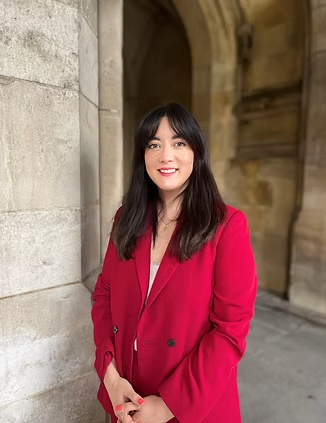
The Scottish Government has launched a new five‑week public awareness campaign encouraging boys and young men to think before sharing or engaging with misogynistic content online.
The campaign highlights the real‑life harm such content causes to women and girls, including those known to them. The campaign was developed with the support of a steering group of VAWG experts and cocreated with young people.
The campaign includes tailored messages for young people across Instagram, Snapchat, Twitch and YouTube, and resources for parents to understand the scale and impact of online misogyny and support conversations at home.
COSLA welcomes this campaign as a concrete expression of our shared commitment with the Scottish Government to challenge the attitudes and systems that enable misogyny and wider gender‑based violence.
The campaign aligns with Equally Safe’s focus on engaging men and boys as allies in preventing violence against women and girls and helping shift harmful online and offline attitudes.
COSLA’s Community Wellbeing Spokesperson, Cllr Maureen Chalmers, welcomed the new national campaign tackling online misogyny, commenting: “Young people deserve to be safe online and offline.
“By amplifying these messages locally Local Government plays a vital role in preventing harm, challenging harmful attitudes and supporting Equally Safe communities.”
All assets, including links to information supporting healthy conversations with young people and links to videos and other supporting materials can be accessed here: Tackling Misogyny Campaign Toolkit
The Scottish Council for Voluntary Organisations (SCVO) is calling for voluntary organisations and the people who work and volunteer in Scotland’s voluntary sector to apply for its annual Scottish Charity Awards.
Now in its 20th year, the Scottish Charity Awards are designed to celebrate the best of the voluntary sector, and to highlight the incredible organisations, inspiring people and innovative projects that have made an immeasurable difference to the communities they support over the past year.
Applications are now being accepted for 2026, with SCVO placing particular importance on hearing from voluntary organisations and people that reflect the diversity of Scotland’s essential voluntary sector.
All registered charities, social enterprises, campaigning groups, community interest companies and people who work and volunteer in these spaces are eligible to enter.
Last year saw the success of attempts to make the awards simpler and more accessible to as many people and organisations as possible.
There are nine award categories at the Scottish Charity Awards. Six recognise the achievements of organisations, and three recognise individuals.
The award categories are Small Charity of the Year (turnover under £100k), Medium Charity of the Year (turnover £100-500k), Large Charity of the Year (turnover over £500k), Trustee of the Year, Volunteer of the Year, Employee of the Year, Partnership of the Year, Campaign of the Year, and Climate Impact; with the winners to be decided by a panel of judges. For 2026 organisations can only make one application across all categories.
SCVO received an overwhelming response last year with hundreds of applications, and hopes that even more organisations will be inspired to apply this year.
This year, SCVO will be bringing its celebratory awards ceremony, hosted by Sally Magnusson, to Glasgow’s Radisson Blu on 11 June.
Anna Fowlie, Chief Executive of the Scottish Council for Voluntary Organisations (SCVO), said: “Each year, the Scottish Charity Awards stand out as a real highlight for me.
“Across Scotland – and far beyond – voluntary organisations are transforming lives in countless ways, and it’s impossible not to be moved by both the scale of their impact and the diversity of their work.
“Past finalists and winners often share how meaningful it is to receive recognition on a national stage. We also take care each year to refine and refresh the awards, ensuring they remain timely and relevant.
“Whether you’re a small grassroots group powered entirely by volunteers, a large national charity, or anything in between, there’s a place for you. Don’t hold back — put forward a nomination or submit an entry for this year’s awards.”
Applications are open until 12 noon on Tuesday, 17 March 2025 and can be completed on the SCVO website: scvo.scot/scottish-charity-awards/apply.
‘High harm’ procedures such as the liquid Brazilian butt lift (BBL) should be banned immediately without further consultation, a new report published today by the Women and Equalities Committee (WEC) has recommended.
The Westminster Government is ‘not moving quickly enough’ in introducing a licensing system for non-surgical cosmetic procedures and ‘should accelerate regulatory action’ MPs said, cautioning ‘this lack of timely action is fostering complacency in self-regulation’ within the industry.
The report warned of a ‘wild west’ in which procedures have reportedly taken place in Airbnbs, hotel rooms, garden sheds and public toilets. Individuals without any formal training can carry out potentially harmful interventions, placing the public at risk, MPs concluded.
Non-surgical cosmetic procedures
Liquid BBLs and liquid breast augmentations – procedures deemed high risk and which have already been shown to pose a serious threat to patient safety – should be restricted to appropriately qualified medical professionals immediately, the report recommended. Given the lack of appetite among medical professionals to carry out these procedures, this will act as a de facto ban in all but the most essential cases, it said.
A licensing system for ‘green’ and ‘amber’ lower risk non-surgical cosmetic procedures, in which only those suitably qualified can perform them, should be introduced within this Parliament, WEC recommended.
Currently, there is no regulation as to who can perform procedures that do not require incisions and are commonly used to refer to injectables, such as Botox or dermal fillers, laser therapy or chemical peels. What rules that that do exist, such as on the prescription of Botox, are being circumvented, are under enforced and under policed.
The absence of a legislative framework for training and qualifications in the non-surgical cosmetic sector has resulted in significant variability in standards, with justified concerns about short courses, online training, and the ease of entry into practice, the report warned.
The Government, it said, should bring forward consistent, enforceable standards for the non-surgical cosmetic sector that prioritise patient safety and competency, while ensuring training routes remain accessible and affordable for a predominantly female-led workforce.
The Government should work with the devolved administrations to ensure regulatory alignment across all UK nations on legislation governing non-surgical cosmetic procedures.
Cosmetic tourism
The increasing number of cases requiring medical treatment after cosmetic surgery abroad raises serious concerns for patient safety and places additional financial strain on the NHS, the report said.
It called on the Government to review the need for the NHS to systematically record data on complications arising from cosmetic procedures performed abroad. Publishing such data annually, it said, would enable a comprehensive assessment of the financial impact on the NHS and provide robust evidence to better inform and educate the public about the risks associated with cosmetic tourism. The data could include details of the clinic or practitioner that performed the original procedure to help further protect UK nationals.
Ministers should assess whether outlets in the UK that are recruiting patients for medical treatment overseas should be brought into a regulatory regime and be subject to investigation and, where necessary, sanction, the report added.
Body image
WEC’s report warned of a ‘gap in safeguarding mental health’ in the cosmetic procedures sector. It recommended training curricula required to obtain a licence to perform non-surgical cosmetic procedures should include mandatory modules on informed consent and psychological screening, with a specific focus on identifying Body Dysmorphic Disorder and other vulnerabilities.
Social media platforms and face-editing technologies are contributing to worsening body image and increasing demand for cosmetic procedures, particularly among young women and girls, the report concluded. The normalisation of high-risk procedures by online influencers and the shaping of beauty standards by algorithms which bombard users with posts on body image are particular concerns.
It is clear that social media platforms must take more responsibility for the content they promote, the report said, adding in response to the alarming increase in desire for cosmetic surgery among teenagers, the Department of Health and Social Care should work with the Department for Education to integrate evidence-based body image and social media literacy programmes into school curricula, including content on risks of cosmetic procedures.
Breast implants
The PIP implant scandal exposed failures that continue to affect women more than a decade later, the report said, recommending the NHS should remove PIP implants from women who wish to have them explanted.
Shortcomings on data collection and recording mean that the NHS does not know who received PIP implants and many women may not be aware they have them. The need for further research and improved data collection on implantation must be addressed, it added.
WEC called on the Government to introduce mandatory recording of breast implant and explant procedures and instances of adverse outcomes in the Breast and Cosmetic Implant Registry by the end of 2026. Data on adverse outcomes by implant type should be published annually to support informed consent and improve patient safety, the report recommended.
A mandatory cooling-off period of at least two weeks should be introduced between the initial consultation and surgery for breast implants, ensuring patients have sufficient time to consider risks and alternatives before making a commitment. The new post-surveillance regime for breast implants must include regular testing of approved implants to ensure continued compliance with safety standards, it added.
The Committee’s report called on the Government to commission research to better understand the health impacts of breast implants, including their potential impacts on women with pre-existing auto-immune conditions.
The research needs to be a mix of clinical research, including on the health impacts of siloxanes, and longitudinal, following a cohort of women over a period of time. Such studies are necessary to improve patient safety, diagnosis and treatment and for the purposes of informed consent, it said.
The Government should also require all practitioners performing invasive surgical cosmetic procedures to have specialist training and hold appropriate board certification in the procedures they undertake.
Chair of the Women and Equalities Committee and Labour MP Sarah Owen said: “Procedures that are deemed high risk such as liquid BBLs and liquid breast augmentations, which have already been shown to pose a serious threat to patient safety, should be banned immediately.
“There is no need for further consultation and delay. A licensing system for non-surgical cosmetic procedures should be introduced within this Parliament.
“The Government is not moving quickly enough in introducing a licensing scheme for non-surgical cosmetic procedures and should accelerate regulatory action. Currently, individuals without any formal training can carry out potentially very harmful interventions and often do so in unsafe environments. This ‘wild west’ of procedures is placing the public at risk.
“Regulation has not kept pace with the sector’s expansion. In 2013, the head of the NHS warned that a person having a non-surgical cosmetic intervention has no more protection than someone buying a toothbrush. Over a decade later the only thing that has changed is the number of people suffering life changing and life-threatening injuries.
“During our inquiry, the Committee heard a powerful and shocking testimony from a woman who developed sepsis after having a liquid BBL. Her experience and those of many others should act as an urgent wake-up call to Government for change.
“With the concerning rise in cosmetic tourism, there is a strong case for the NHS to systematically record data on complications arising from such procedures performed abroad. Publishing this data annually would enable a comprehensive assessment of the financial strain on the NHS and help raise awareness about the risks.
“Ministers should learn the lessons of the PIP breast implant scandal, and introduce mandatory recording of breast implant and explant procedures and instances of adverse outcomes and commission research to better understand the health impacts of breast implants so that women seeking this surgery can truly give informed consent.”
SCRAN Academy are excited to announce that we have been selected asBarratt Homes East Scotland’s charity partner for 2026 & 27!
This partnership is a huge moment for us and the young people we support, helping us grow our impact and reach even more young people across Edinburgh and the Lothians.
Will Bain, CEO, Scran Academy, said: “We’re so excited to be partnering up with Barratt Homes East Scotland! Working with our biggest home builder will transform just how many young people we can help feel at home in education and employment. We can’t wait to help build positive futures together!
“It’s been amazing to welcome such an enthusiastic team from Barratt Homes on board. They’ve already shared brilliant ideas that will genuinely benefit both organisations, and it’s been an absolute pleasure getting to know the whole team. We’re really excited to keep building this partnership and creating new opportunities together.
“What matters most to us is the difference this partnership will make for young people. It will open doors to new experiences, and opportunities to build skills, gain confidence, and create trusted relationships.
“Hearing directly from Barratt Homes’ directors, sharing their own stories and showing real belief in Scran and what we do, has been incredibly reassuring.
“It’s clear they truly value our work, and we can’t wait to see what we can achieve together.”
Andrew Morrison, Managing Director for Barratt and David Wilson Homes East Scotland, said:“We’re very proud to be partnering with Scran Academy and to support an organisation that is creating so many meaningful opportunities for young people. Their work is making a real difference, helping individuals build confidence, gain valuable experience and move towards brighter futures.
“Barratt and David Wilson Homes care deeply about the communities we help shape, and this partnership reflects our commitment to supporting initiatives that have a lasting, positive impact. We’re excited to see what we can achieve together over the next two years.”
This partnership will include a range of collaborative initiatives, including fundraising, volunteering, work experience opportunities, and direct engagement with the young people we support. It’s going to make a real lasting impact!
Scran Academy are proud to be Barratt Homes East Scotland’s charity partner and can’t wait to see all the amazing things we’ll achieve together over the next 2 years!
Bringing people together through music as dementia anti stigma campaign encourages Scots to Rethink Dementia
“Music gave me my life back” says Carol Topper, a South Lanarkshire mum, who says singing and dancing transformed her life with dementia following an early diagnosis, showing how shared activities like music can keep people socially connected and living well for longer
Carol Topper and broadcaster Sally Magnusson MBE, join the Minister for Social Care and Mental Wellbeing at Glasgow’s Old Fruitmarket to share advice on how Scots can do simple things to make a difference in helping relatives and friends living with dementia.
Following evidence that social contact can help alleviate some symptoms commonly associated with dementia and help someone stay well for longer, the campaign encourages friends and relatives to support their loved ones by staying in contact and doing the things they’ve always done together.
Whether it’s enjoying music together, popping in for a cup of tea, visiting the shops or going for a walk, every Scot can play their part in helping someone with dementia stay well for longer.
The campaign launch celebrates the power of music in helping people living with dementia feel positive, and stay socially connected, active and part of their community.
Carol Topper, a 59-year-old former hairdresser and office administrator, and Playlist for Life Lived Experience Ambassador from South Lanarkshire says music and dancing transformed her life since diagnosis.
Carol joined Tom Arthur, Minister for Social Care and Mental Wellbeing, Playlist for Life founder, Sally Magnusson, and former Miss Scotland contestant, fourth-year medical student and Playlist for Life ambassador, Abigail Thomson, at Glasgow’s iconic and dementia-friendly venue, the Old Fruitmarket, to mark the campaign.
Carol, who was diagnosed with onset vascular dementia in 2016, explained: “When I was diagnosed at 50, I went into a depression. I didn’t want to see anyone or leave the couch. Then I found Playlist for Life through my local Help Point in Carluke, and it changed everything.
“Now, when I put on my playlist, I’m not thinking about dementia, I’m singing, I’m dancing, I’m me again. And it’s a great activity to enjoy with my friends and family. Music is dear to my heart, and it’s helped me live the best life I can with dementia.
“My favourite song has to be ‘Amazed’ by Lonestar as it was mine and my husband Malcolm’s wedding song.”
“A dementia diagnosis can feel overwhelming for families and friends. But simple acts of kindness really do matter. Staying connected and continuing to enjoy everyday activities together can help people live well for longer.
“This year’s Rethink Dementia campaign celebrates the power of music to spark memories, lift moods and bring people together, something every Scot can help make happen. I am delighted that we have been able to relaunch this campaign, alongside our continued efforts to improve the dementia experience through our 10-year Dementia Strategy.”
Councillor Kelly from COSLA, said: “The Rethink dementia campaign is a key deliverable for COSLA and the Scottish Government’s strategy ‘Dementia in Scotland – Everyone’s Story’.
“This campaign highlights the importance of encouraging people living with dementia to stay socially connected. It reminds us all of the difference we can make to support friends or loved ones living with a dementia diagnosis by maintaining contact and doing the things we’ve always done with them”
Sally Magnusson MBE, founder of Playlist for Life, said moments like Carol’s are at the heart of why the charity exists: “I founded Playlist for Life after caring for my mother, and seeing first-hand how music could transform her days.
“Since then, I have witnessed countless moments where a familiar song lights up a face, sparks a conversation or rekindles joy”.
“It’s great to see the Scottish Government championing this message. Personally meaningful music and the connections it encourages are marvellous ways of restoring a sense of self and well-being. They really do help people to live well with dementia for longer.”
NEW PANEL MEMBERS FOR SCOTLAND’S FUEL POVERTY WATCHDOG
The Cabinet Secretary for Housing, Màiri McAllan MSP, yesterday announced the appointment of two new members to the Scottish Fuel Advisory Panel – Bryan Leask and Dr Olivia Swann.
The independent statutory panel scrutinises the Scottish Government’s progress towards meeting Scotland’s fuel poverty targets, including the goal that no more than five per cent of households should be living in fuel poverty by 2040.
It also examines how effectively policies and programmes are addressing the four key drivers of fuel poverty: poor energy efficiency, low household income, high fuel costs and how energy is used in the home.
The new appointees bring front-line experience of two of the most acute aspects of fuel poverty; the disproportionate impact on rural communities, and its consequences on health, particularly for children.
Bryan Leask, Chief Executive of Hjaltland Housing Association in Shetland, has extensive experience of rural and island fuel poverty and currently chairs the Scottish Rural and Islands Fuel Poverty Action Group.
Dr Olivia Swann brings extensive professional expertise into the harmful health consequences of fuel poverty – as a consultant paediatrician she sees first-hand how cold, damp homes contribute to children becoming unwell and requiring hospital care.
Matthew Cole, Chair of the Scottish Fuel Poverty Advisory Panel, said: “It’s great to welcome our new panel members who offer unique insights into two key areas of fuel poverty concern: rural fuel poverty and the impact of fuel poverty on health.
“Bryan and Olivia have both witnessed the impact of fuel poverty particularly in recent years when fuel bills have become unmanageable for many households.
“Bryan has seen, time after time, the realities faced by families living in cold homes – the sheer misery of coming home to a freezing property and not being able to run a hot bath or cook a warm meal and Olivia brings a practical, child‑centred perspective, with a strong focus on prevention and ensuring children’s health is fully considered in actions to tackle fuel poverty.
“We are very lucky to have them both joining our other members on the panel.”
Bryan Leask is a member of the Scottish Government’s Zero Energy Social Housing Taskforce, its New Build Heat Standard Working Group, and its Energy Standard Review Working Group.
Relationship breakdown estimated to cost Scotland £3.5 billion each year
Relationships Scotland, Scotland’s leading relationship support charity, has launched its manifesto ahead of the Scottish Parliament Elections, calling on the next Scottish Government and the new Parliament to prioritise support for positive relationships.
Stuart Valentine, Chief Executive of Relationships Scotlandsaid: “Strong couple, family and social relationships are fundamental to thriving communities and to Scotland’s economic and social prosperity. Making good mental health a national priority is essential to sustaining these relationships.
“We are calling on the next Scottish Government and all policymakers to invest in a preventative, cross-sector approach, including early intervention and policies that support children and families from the outset.
“Relationship breakdown is estimated to cost Scotland £3.5 billion each year, so investing at an early stage not only delivers a social good, but clear value for the people of Scotland.”
Relationships Scotland’s key asks ahead of the election include:
Investing in prevention, early intervention and recovery for mental health that focuses on cross-sectoral working and collaboration, making good mental health and wellbeing a shared national priority.
Expanding future policies that impact on children and families to highlight the vital role relationships play in ensuring the best opportunities and outcomes in life.
Guaranteeing the availability of counselling, mediation, child contact centres and other family support services across the country through increased funding to ensure this support is available for all people in their local communities across Scotland.
Applying the provisions in the Children (Scotland) Act 2020 to increase uptake of family mediation and other forms of alternative dispute resolution (ADR) as an alternative to court action in family cases.
Evidence shows that relationship breakdown and family instability can lead to poverty, while also disproportionately impacting those already experiencing deprivation. Addressing relationship breakdown as a driver of poverty, and its role in deepening deprivation, must be a national priority and will support national efforts to reduce child poverty and improve long-term outcomes for children and young people. Providing early support for couples and families is critical to achieving these outcomes.
Stuart Valentineadded: “It is vital that the services delivered by our 21 member organisations across Scotland are accessible to everyone, particularly those experiencing socio-economic disadvantage, and are provided without stigma or financial barriers.
“A cost benefit analysis last year indicated an average saving of £13.77 for every £1 spent on delivering our services.
“Addressing relationship breakdown as a driver of poverty, and recognising its role in deepening deprivation, is essential to supporting national efforts to reduce child poverty and improve long-term outcomes for children and young people.”
Relationships Scotland’s services are delivered via its network of 21 member services providing a range of counselling, mediation, child contact services and other forms of family support across Scotland from the Highlands and Islands including Lerwick, Stornoway, Kirkwall, Inverness, and Oban, across the central belt as well as Dumfries and Galloway and the Scottish Borders.
Royal Mail has issued a set of 12 stamps to celebrate the world of Hornby Model Railways, a brand that has shaped British hobby culture for over a century.
Frank Hornby, the inventor of Meccano, produced his first clockwork Hornby Series trains in 1920. In 1929 the first models representing real British locomotives arrived.
Each stamp features an exclusive photograph of an iconic Hornby model, specially commissioned by Royal Mail.
Stamps in the set are:
1 locomotive, GNR (1920)
Princess Elizabeth, LMS (1937)
4MT tank locomotive, BR (1954)
AL1 electric locomotive, BR (1963)
InterCity 125 High Speed Train, BR (1977)
Merchant Navy class locomotive, BR (2000)
Bournemouth Belle Pullman cars, BR (2009)
Experimental ‘Hush-Hush’ locomotive, LNER (2021)
An additional four stamps presented in a vibrant miniature sheet celebrate the rich heritage of Hornby through four nostalgic designs, each featuring classic packaging, catalogue covers and promotional artwork from different eras.
The stamps are set against an illustration of a London, Midland and Scottish Railway (LMS) locomotive in full steam.
Royal Mail worked with renowned model railway historian and author, Pat Hammond, on the stamp issue.
David Gold, Director of External Affairs & Policy, Royal Mail,said: “Hornby trains entertained millions, preserved the romance of rail travel, and become a cultural icon of British design and imagination.
“Each of these stamps celebrates a piece of history, of Hornby’s craftsmanship and its role in British culture for generations.”
Martyn Weaver, Brand MD, Hornby, said: “To see Hornby Model Railways celebrated on Royal Mail stamps is a real honour.
“Hornby has been part of British life for more than a century, inspiring creativity, craftsmanship and a lifelong interest in railways and modelling. These stamps recognise the enduring appeal of model railways and the role the hobby continues to play in bringing people together across generations.”
Pat Hammond, Archivist to the Train Collectors Society, said: “The Hornby brand is over 100 years old and that is a major achievement. It is part of Britain’s heritage, and long may it be so.”
HORNBY RAILWAYS:
Hornby’s story began in 1920, when Frank Hornby, the inventor of Meccano, introduced his first clockwork Hornby Series trains.
These 0 gauge models, crafted from pressed steel, brass and tinplate, were twice the size of today’s 00 gauge scale. By the late 1920s, Hornby had launched electrically driven train sets and in 1929 introduced models based on real British locomotives. The iconic LMS Princess Elizabeth locomotive appeared in 1937, followed by the debut of the smaller 00 gauge system, Hornby Dublo, in 1938.
The introduction of plastic mouldings and a two-rail system marked a new era, and by the late 1970s Hornby was producing highly detailed models that appealed to both children and adult enthusiasts. Highlights included the British Railways High Speed Train (HST), released in 1977, which became one of the brand’s best-selling models.
Hornby continued to innovate into the 21st century, combining heritage with cutting-edge technology. From live steam locomotives and digital control systems to collaborations with beloved brands such as Thomas and Friends and Harry Potter, Hornby has remained a leader in model railways.
Today, the company boasts an extensive tooling stock and continues to create authentic, finely detailed models that celebrate Britain’s rich railway history.
The stamps, and a range of collectible products, are available to pre-order from today (12 February) at www.royalmail.com/hornby and by telephone on 03457 641 641. A Presentation Pack including all 12 stamps is priced at £21.30.
The stamps go on general sale on 19 February from Royal Mail and from 27 February in selected Post Office branches.
Lothian’s multi-million pound new Eye Hospital has moved an exciting step closer to becoming a reality after NHS Lothian appointed a main contractor.
Kier will act as Principal Supply Chain Partner to build the state-of-the-art facility, which will serve adults and children across the region, as well as south-east Scotland.
The pioneering project will replace the Princess Alexandra Eye Pavilion (PAEP), Edinburgh, with a bespoke new eye hospital on the Little France BioQuarter campus.
Jim Crombie, Deputy Chief Executive, NHS Lothian, said: “We are pleased to appoint Kier as our Principal Supply Chain Partner and take the next step in the process towards opening a new eye hospital in Lothian.
“We are delighted that the hospital is becoming a reality and that makes this milestone even more exciting. I would like to thank our teams for their commitment and endurance throughout the planning of this project – I know this step will mean a great deal to them.
“Our teams in the Princess Alexandra Eye Pavilion have a world-class reputation for their innovation, treatment, patient safety and care, but the building no longer supports them or the thousands of surgical, inpatients and outpatients who attend each year.
“This new state-of-the-art facility will allow our magnificent teams to continue providing the exceptional patient care and treatment they are renowned for.”
The new hospital will stand as a hub of excellence and also provide specialist services, such as surgical retinal services, paediatric surgery and neuro-ophthalmology for patients from NHS Borders, Tayside and Fife, as well as Lothian.
Health Secretary Neil Gray said: “The appointment of a Principal Supply Chain Partner for the new Eye Hospital marks an important milestone for eye care in Lothian and the south-east of Scotland.
“The dedicated teams currently working in the Princess Alexandra Eye Pavilion have a world-class reputation for innovation, treatment and patient care. They deserve a modern, purpose-built facility that matches their expertise and supports the thousands of patients who rely on their services each year. This new hospital will do exactly that, providing a state-of-the-art environment where staff can continue to deliver the excellent care they are known for.
“This investment demonstrates our commitment to improving healthcare infrastructure and ensuring everyone has access to the treatment they need.”
Kier, which has already worked on the NHS Golden Jubilee Eye Hospital, in Glasgow and Sunderland Eye Infirmary brings a wealth of innovation and experience to Lothian’s new Eye Hospital.
Sean Fenner, Managing Director, Kier Construction North & Scotland, said: “We are proud to be the Principal Supply Chain Partner for NHS Lothian to deliver early construction works at the new Princess Alexandra Eye Pavilion – a new Centre of Excellence that will transform eye care for patients across the region.
“Our team brings unrivalled expertise, shaped by landmark projects such as the NHS Golden Jubilee Eye Hospital and Sunderland Eye Infirmary, and informed by best practice from leading ophthalmic centres in the UK and internationally.
“Working in partnership with NHS Lothian, we will create an environment that enhances patient experience, empowers staff and establishes a new standard of excellence in ophthalmic care across Scotland.”