The Council’s Transport and Environment Committee may have voted to prioritise the Sothern section this week, but the debate about the Northern tram route – should it ever happen – continues:
LIB-DEM Inverleith Councillor Hol Osler said on social media: ‘On Thursday at the Transport and Environment Committee there was a report to consider the next steps on the Granton to Bio Quarter leg of the tram.
‘The Liberal Democrat’s put an amendment in to remove the Roseburn Path from being used for the Northern Leg and consideration given to other proposals.
‘Unfortunately Labour/SNP/Greens voted to keep the Roseburn Path in.
‘Presently there is no funding and priority is being given to progress the southern part of the route.
‘I am very disappointed that Labour/SNP/Greens, having been given another chance to remove the Roseburn Path and consider other options, have again voted to keep it in. This is despite the SNP having committed that they would not support Roseburn as an option.’
Tracy Gilbert MP has written to councillors ahead of the City of Edinburgh Council Transport and Environment Committee considering the city’s future tram network, warning Councillors that any moves to scrap tram proposals to Granton would entrench inequality and poverty in North Edinburgh.
Tomorrow (Thursday 10 September), Councillors on the Transport and Environment Committee will consider the Strategic Business Case for the Trams to Granton, the BioQuarter and beyond. The officer recommendations are to prioritise the southern section of the proposed tram extension.
Tracy Gilbert is concerned that communities in North Edinburgh, including some of the poorest areas of the city, could once again be left waiting for investment in public transport.
In her letter to councillors on the Transport and Environment Committee, she sets out the case for North Edinburgh to remain firmly within the city’s transport priorities and that a failure to progress trams to Granton could entrench inequality and poverty.
Tracy Gilbert MP said: “In part of my constituency the economic and social benefits of the trams are realised every day. That lived experience and the Strategic Business Case being considered by the Council’s Transport and Environment Committee this week makes the strong case for investment in both the South and North to spread these benefits further.
“Trams to Granton would directly serve three of the 5% most deprived communities in Scotland and six of the 10% most deprived. We are talking about communities that already face significant inequalities, where access to reliable, affordable public transport can open opportunities for training education and employment.
“That is why I have written to councillors ahead of this week’s committee meeting. I am very clear that a failure to realise the ambition of the trams that has been shared by a number of political parties over the last three decades will entrench inequality and poverty in Granton, Pilton and Muirhouse.
“I hope that Councillors will make the ambitious decision this week. Either way I will continue making the case for the strategic investment needed in Granton, Muirhouse and Pilton because our communities deserve better.”
Ms Gilbert’s letter reads:
Since July 2024, I have had the privilege of representing Edinburgh North and Leith. In one part of the constituency the benefits of the trams to local people and businesses are being realised every day, in another part of the constituency the potential benefits of the tram are well known but need political support to become a reality.
Success of Trams to Newhaven
In and around Leith, Leith Walk and Newhaven local people and businesses have enjoyed the benefits of the tram since the extension to Newhaven was opened in June 2023. The recent closure of the line between the City Centre and Newhaven has perversely demonstrated the importance of the trams for connectivity and trade.
Over the tram closure I received a number of e-mails from residents on the increased difficulty they had in travelling to work and into the city centre generally. Most residents experienced severe delays on buses running through Newhaven, Ferry Road, the Shore, Easter Road and Leith Walk. In addition to delays, many buses were full before going up to the City Centre or leaving the City Centre before going along Leith Walk.
Similarly, although the deployment of an additional 200 Voi Bikes was welcome in the wake of the fire there was a tram to bike shift from constituents travelling to and from work which meant many Voi Bike stops were empty across Leith during the day.
In terms of the economic impact there was a visible decrease in the number of people visiting cafes, pubs and restaurants around the Shore and Leith Walk. I am aware that at least one pub and one restaurant have decided to close following the impact of poor summer sales for a second year in a row following Leith Connections project delays and now the impact of the trams.
Argonaut Books have shared data on their Instagram page which shows that in every August since 2022 their sales from July to August have increased. In August 2025, they had a 30% increase in sales compared to July 2025. However, the impact of the tram closure meant in August 2026 they saw a 5% decrease in sales compared to July 2026.
Over the last two months I have repeatedly heard from businesses and residents on the positive impact the trams have had on them. Many of those businesses and residents were sceptical in the past. This lived experience of the trams over the last few years for communities in Leith, Leith Walk, Newhaven and the Shore demonstrate the opportunity of following through on the vision that was developed through the early 2000s for trams in Edinburgh for the other side of my constituency in Edinburgh North and Leith
The Case for Trams to Granton
The Strategic Business Case for consideration by the Transport and Environment Committee makes the case for progressing the whole of the route. Due to my constituency interest, I will focus on the route to Granton.
The proposed routes through Roseburn and Orchard Brae meet the Transport Planning Objectives (TPOs) set in accordance with Strategic Transport Appraisal Guidance (STAG).
TPO1 – To support inclusive and sustainable economic growth
The route between the City Centre and Granton would increase connectivity of major centres of employment such as Craigleith Retail Park, Leonardos and the Western General to the City Centre and beyond. In reverse the increased connectivity would open up employment opportunities for residents in Granton, Muirhouse and Pilton.
A number of major employers in Edinburgh have informed me of the difficulty they have in recruiting people in this area due to the lack of direct public transport connections especially to accommodate shift work.
TPO2 – To respond to climate change, delivering net zero
The route between the City Centre and Granton would increase public transport connectivity between Granton, Muirhouse and Pilton and the West of the city. At present only one bus route serves these communities and the West to the Airport.
The tram extension would help provide the option for residents to use public transport rather than private cars for intra-city and airport journeys. The option would be extended to new residents in the community through the Granton Waterfront Development.
TPO3 – To promote equality and inclusion and help tackle the city’s housing emergency The route between the City Centre and Granton would drastically increase connectivity between the rest of the city and Edinburgh College (Granton Campus). The Campus delivers over 70 qualifications in hospitality, construction, travel operations and the arts with many of the qualifications essential for key growth areas for the city and not delivered at alternative campuses.
The route to Granton would directly service three communities in the 5% most deprived areas of Scotland according to the Scottish Index of Multiple Deprivation (SIMD) (Muirhouse – SO1008929 and SO1008930 and Granton South and Wardieburn – SO1008919) and directly service 6 communities in the 10% most deprived areas (adding Muirhouse SO1008933, Granton and Royston Mains – SO1008921 and Granton South and Wardieburn – SO1008918).
Furthermore, the route would directly serve 12 communities which are in the 20% most deprived communities in Scotland.
TPO4 – To improve health, wellbeing and safety and TPO5 – To protect and enhance our environment The route between the City Centre and Granton would improve connectivity for the whole city to the Western General which provides a range of medical specialisms including geriatric, infectious diseases, diabetes, stroke medicine and breast surgery for the whole of Edinburgh and is the regional cancer centre for the whole of the South East of Scotland.
The route could also see a major upgrade to the Roseburn Path which at present is poorly lit and unsafe during the dark.
In addition, there is considerable development planned across the area. The Granton Waterfront Development which will deliver 3,500 new homes and the Art Works which will help open up Scotland’s National Collection. Ensuring that the trams are extended to Granton will help the public transport network to cope with the increase in demand from these developments alone. A number of these public and private investments have been made on the understanding over the last two decades that the tram network would extend to Granton in one form or another.
Current Position
Despite widespread political support for the trams at various points over the last three decades, it is clear that political will for the route to Granton is falling. I also suspect that there will be calls at the Transport and Environment Committee to only proceed with the South route for trams to the Bioquarter.
Taking such a decision would entrench the inequality and poverty experienced by too many in Granton, Muirhouse and Pilton. Such a decision would be based on political will, not the facts. The Strategic Business Case sets out the performance of both the North route to Granton and the South route to the Bioquarter against the TPOs and the STAG criteria. The appraisals were favourable for both routes and is demonstrated by the analysis below.
Table 1: Analysis of Multi-Criteria Assessment Framework Scoring Framework for each route (Section 4.5.6 of Strategic Business Case)
Benefit/ Impact
Roseburn
Orchard Brae
South East Corridor
Major Benefit (+++)
2
0
2
Moderate Benefit (++)
9
6
10
Minor Benefit (+)
2
4
2
No benefit or impact (0)
1
6
1
Minor cost or negative impact (-)
1
2
3
Moderate cost or negative impact (–)
3
0
0
Major cost or negative impact (—)
0
0
0
Table 2: Analysis performance against STAG Criteria (Section 4.5.7 of Strategic Business Case)
Benefit/ Impact
Roseburn
Orchard Brae
South East Corridor
Major Benefit (+++)
3
2
3
Moderate Benefit (++)
8
7
7
Minor Benefit (+)
4
4
5
No benefit or impact (0)
5
3
3
Minor cost or negative impact (-)
1
6
5
Moderate cost or negative impact (–)
2
1
0
Major cost or negative impact (—)
0
0
0
Next Steps
At the Transport and Environment Committee on Thursday 10th September, I encourage Elected Members to proceed with the officer recommendations on Agenda Item 6.
For the past three decades there has been wide spread support for the vision and ambition for trams to run between the City Centre and Granton in one form or another. Councillors of many groups have championed the route over the past three decades because of the transformative benefits it can have for Granton, Pilton and Muirhouse. The legacy of those Councillors is a legacy of ambition, proceeding
with the officer recommendations allows that ambition to take a further step in being realised. Tearing up that ambition would entrench inequality and poverty, particularly in Granton, Muirhouse and Pilton and would be a dereliction of responsibility by Councillors.
I hope you will take the ambitious decision for Granton, Pilton and Muirhouse and the whole of Edinburgh on Thursday.
Yours sincerely,
Tracy Gilbert MP
Member of Parliament for Edinburgh North and Leith
The Capital Rail Action Group (CRAG) requested to send a deputation to Thursday’s Transport and Environment committee meeting – but were informed that, due to there being already six deputations, this would not be possible.
We were advised to instead submit a written statement – which I now attach (see below):
CEC Transport and Environment Committee, 10 September 2026 – Item 7.6: Trams from Granton to Edinburgh BioQuarter and Beyond
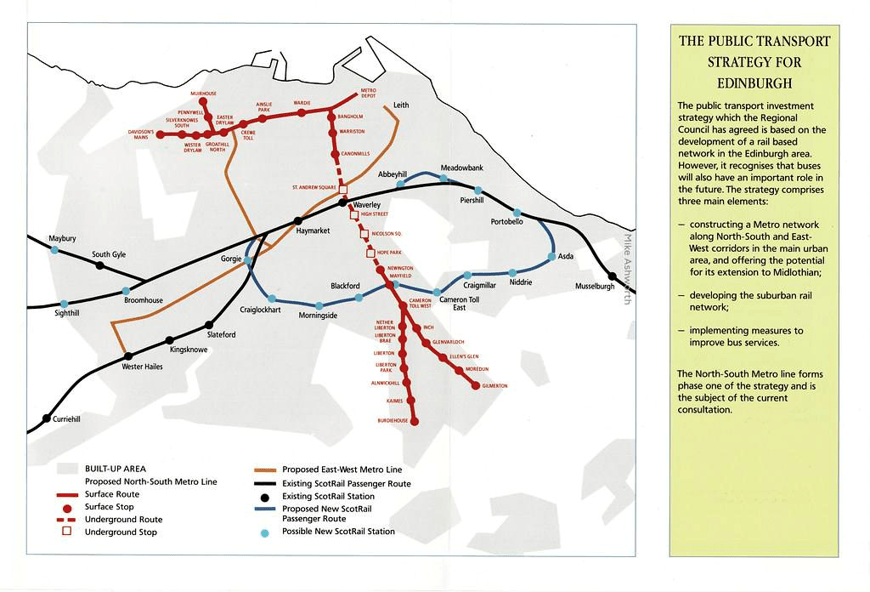
CRAG was set up to campaign for better public transport, especially rail-based, in and around Edinburgh back in the heady days of 1989 when Lothian Regional Council was consulting on their North-South Metro proposal:
You can see that the general thrust of proposals hasn’t changed much since then – except, of course, that Granton now features prominently in your discussions, making full use of the old Caledonian Railway alignment from Roseburn shown above. And the BioQuarter wasn’t even a thing back then.
Progress on developing public transport is extraordinarily slow and costly in this country and our competitor nations have since advanced on a scale unimaginable for us back in 1989, hugely boosting their economic output and raising millions of their population out of poverty – a truly virtuous cycle.
The decisions before you today are shaped by our limited progress on those fronts. The old railway alignments of north Edinburgh were re-purposed in the meantime as active travel corridors – a welcome ‘green travel’ initiative. But they have always been earmarked for travel not just by individuals fit enough to cycle, walk and jog but by all.
Indeed, Parliamentary consent was obtained for use of the Roseburn to Granton alignment for trams as far back as 2006.
CRAG recognises how attractive the Roseburn corridor has become over the years since the old railway trackbed was tarmacked. And we also recognise the utility it offers to cyclists in particular as part of a growing network of paths throughout the city. The 2006 consent also recognised this.
But this utility must now be extended to those who wish to travel by modern mass transit in our increasingly congested city.
The Council have proposed that, to better address the concerns of active travellers, the tram line from Roseburn to Craigleith be only single track with the stop at Ravelston dropped – and with no overhead wires. That carries with it operational risk for the tram – but it is a compromise offered in good faith. Unfortunately, for many cyclists, it is a compromise they are unwilling to accept. This is a view both myopic and discriminatory.
Whereas today approximately 600,000 trips are made along the Roseburn corridor, the tram is projected to carry 4.25 million passengers annually by 2042.
Moreover, it would not only support and drive the ongoing development of brownfield sites around Granton but would transform access to employment, education and health services for disadvantaged and deprived communities in Granton, Pilton and Drylaw.
To cap it all, building a tram line along the Roseburn corridor can be accomplished without the need to dig up streets, move utilities, etc. which bedevilled construction of Edinburgh’s only current tram line from the airport to Newhaven.
It, moreover, separates tram operation from general traffic – enabling a speedier and more reliable journey. And it links with the important transport hub which is Haymarket. It remains the only feasible route by which to connect Granton most efficiently to the city centre. That will not change.
So, whilst recognising the political reality in the City Chambers of minority support for the Roseburn to Granton corridor and that it is likely that the headline positive decision today will be to first proceed with the southern leg of the north-south tram route from the city centre to the BioQuarter, we would urge you, as per recommendation 1.1.4 to “Agree the need to retain ambition to deliver a mass transit connection between Granton and the city centre”.
We, of course, also support delivery of the leg from the city centre to the BioQuarter – not without its challenges but serving a corridor also long recognised as worthy of being provided with mass transit.
And, of course, this opens up the possibility of integration with the emerging tram-train proposal on the South Suburban railway line, especially at Cameron Toll – where a transport hub could be in the making.
Finally, two points:
we note that Parliamentary powers were also given in 2006 to construct a tram line from Newhaven to Granton. It’s not an ideal way to connect Granton to the west of the city centre – but it would be fine for journeys to and from the BioQuarter. Building this short section deserves serious consideration if the regeneration of the Granton area is to proceed most efficiently
to further enable this, consideration should also be given to running such trams directly up Leith Street – with a stop at the Omni Centre – instead of via St. Andrew Square. We note that the Leith Street alignment is shown in Figure 4.4 of the papers before you today.
… and finally, finally:
Cllr. Stephen Jenkinson revealed this aspirational Metro ‘concept’ map at a rail conference in Edinburgh in January of this year. It’s not official policy – but it’s always good to plant seeds for trees under whose shade, at my age, I may not live to sit. Hopefully some of you will live to see this!
Transforming public transport provision in and around Edinburgh is a challenge for our time. Let’s not drop the ball this time.
From Monday June 9, the city council will begin implementing a series of speed reduction measures, from 40mph to 30mph, in locations across the city.
The new speed limit signs will be installed through June and July, beginning with Biggar Road. Once the new 30mph speed limit signs are in place, the new speed limits will be enforceable.
Motorists are being urged to look out for the new signage and respect the speed limit.
Transport and Environment Convener, Councillor Stephen Jenkinson said:“Road safety is a key priority for us and I’m glad that we’re moving ahead with this important process. Whilst this has taken longer than we initially anticipated, I’m confident that these measures will make many of our roads across the city safer.
“The evidence is clear – lower speed limits make roads safer for everyone. A pedestrian or cyclist has twice the chance of surviving a collision at 30mph compared to 40mph. Any action that we can take to make sure all road users are safer is a positive step.”
You can view a map of the roads with new 30mph speed limits on our website.
The full list of streets and road where the city council is installing new signage and reducing the speed limit from 40mph to 30mph is below:
Biggar Road
Calder Road
Frogston Brae
Glasgow Road (East section)
Glasgow Road (West section and Old Liston Road)
Gogar Station Road
Hawes Brae and Bankhead Road
Hillhouse Road
Lang Loan (section at the junction with Lasswade Road)
This reports also outlines the future decision-making process, with an annual update report covering any proposed changes.
Prioritisation was scored against 15 separate criteria points across three key areas: Objectives, Deliverability and Financial. Some examples include impact on road safety, public transport, inequality, and capital raising challenges.
Over 70 projects are set to be taken forward, including:
Walking, wheeling and cycling connection from the Meadows to the Union Canal, including better public space around the King’s Theatre.
Public transport and active travel route between West Shore Road and Waterfront Broadway, complementing the Granton redevelopment.
Major city centre projects, including a trial to reduce vehicle traffic on the Lawnmarket, Cowgate improvements, Meadows to George Street walking and cycling upgrade, and the transformation of George Street.
Over 50 projects are recommended to be paused, the vast majority of which are already on hold or not started. There are also around five projects which are set to be paused for this financial year only. Again, these are all either on hold or not started.
The report was approved with amendments from the Administration and the SNP group, along with an addendum from the Green group.
Transport and Environment Convener, Cllr Stephen Jenkinson said: “I’m really pleased that we’ve agreed this bold programme for our city. Prioritisation allows us to work smarter with the resources we have available – making sure we have a clear and achievable path to achieving our objectives.
“This programme follows the successes of major infrastructure projects such as Trams to Newhaven and active travel projects including the City Centre West to East Link (CCWEL), Roseburn to Union Canal and Leith Connections.
“This is an extensive piece of work which allows the City Mobility Plan to be agile, and able to adapt in the future as necessary.
“However, one key element in this conversation is the fact that we remain dependent on external funding for many projects, particularly from the Scottish Government and by extension Transport Scotland.
“Complex projects which take years to plan and complete but which are subject to annual external funding decisions makes this situation inherently difficult, we need commitment and stability from the Scottish Government if we’re to deliver the changes which our city needs and deserves.
“We’ll now take forward these projects which will keep Edinburgh moving and make our city a safer, more sustainable and accessible place for all.”
Living Streets Edinburgh calls (again) for more investment in everyday walking
LIVING Streets Edinburgh wrote to city councillors prior to the meeting. The campaigners said: “We’re surprised, and very disappointed, to see no mention of some key initiatives which we were able to get included in the CMP delivery plan.
“Especially disappointing after the committee decided to freeze footway maintenance while increasing spending on roads, only last month.
“We’ve therefore sent councillors this message:
Dear Councillor
I’m writing in connection with the report on City Mobility Plan priorities, Item 7.5 on the TEC agenda for 22 May bit.ly/43ktlep The recommendations do not adequately reflect the CMP’s ambition to effect “a transformational change in walking and wheeling in Edinburgh”.
Over two years ago, two new initiatives were introduced into the Active Travel component of the City Mobility Plan: ‘Action for Better Crossings” (ABC) and the “Edinburgh Accessible Streets Initiative” EASI). These programmes (both proposed by us) finally offered the prospect of a strategic, rather than piecemeal, approach to addressing some of the most fundamental problems with getting around the city as a pedestrian – for example:
the time that you have to wait for the green man at traffic lights,
the thousands of missing dropped kerbs on pavements,
narrow footways,
pavement clutter, etc.
As we understand it, effectively nothing has been done yet to implement either initiative as a coherent programme. We had hoped that they would form a key part of this report. However, there is no mention whatsoever in the report of either ABC or EASI, despite Council having confirmed them as at the heart of CMP policy only last year (see attached).
Instead, some elements of ABC and EASI are simply noted as part of the ‘rolling programme’ in Appendix 4b. Paragraph 4.14 of the report states an expectation that these will be funded at “an overall level roughly equal to recent overall investment”. This isn’t good enough: there is no indication of how much money is budgeted for these schemes; certainly there has been no systematic investment at all in recent years in widening footways. Many of the other aspects like the pedestrian crossing programme and the crucial school streets reviews have huge backlogs owing to lack of resourcing.
These vital programmes need to be considered alongside, and on the same level playing field, as the active travel and public transport listed in Appendix 1.
Councillors should be able to consider whether investment in school streets, road safety, ABC or EASI is more or less worthy than these projects, whether they be George Street, Hawthornvale-Salamander Street, the Lindsey Bridge or Dalry 20 Minute Neighbourhood.
Otherwise the opportunity to consider where best to invest both staff time and capital funding is lost and a ‘silo’ approach is entrenched.
We also have serious concerns with the overly-complex methodology for assessing projects in Appendix 1. It gives no weighting to walking and wheeling (“top of the travel hierarchy”) and doesn’t sufficiently value schemes relatively modest but important to pedestrians such as Calton Road and the Causey.
These projects fail to score highly enough only because work on them has already been “paused’ for years.
However, the fundamental weakness of the report is to take too narrow an approach to evaluating a limited set of projects. We would therefore like to see the report deferred perhaps for two cycles, and a new report brought forward with a more strategic approach to future investment, including the programmes mentioned above.
Proposals for five new supported bus services in the west of Edinburgh are set to be discussed at the Transport and Environment Committee tomorrow (Thursday 23 May).
Under the plans the routes would be The Gyle to Hermiston Park & Ride via Ratho; Queensferry to The Gyle; Cramond to Balerno; Wester Hailes to Chesser and The Gyle to Clermiston.
There are currently three existing bus services operating in the west of the city that are fully financially supported by the City of Edinburgh Council – services 20, 63 and 68 – operated by McGill’s Bus Services but these are to be withdrawn on 14 July this year.
Four of the new routes would be run by Lothian with the The Gyle to Clermiston route being operated by Handicabs Lothian.
Before the revised contracts went out for tender the Council consulted with local communities and operators to help develop route specifications and help balance community requirements within the available budget.
The new services will improve bus provision in the west of the city with some of the routes amended and a new connection to Cramond being provided by utilising a developer contribution from new housing in the area.
Cllr Scott Arthur, Transport Convener for the City of Edinburgh Council, said: “This is fantastic news for residents in the west of the city as it’s really important to make sure the areas they live in are connected with the rest of Edinburgh. There are some parts of the city that are just not well-connected which is why these supported bus services are so important.
“I’m pleased that the community and bus operators also fed into the proposed routes allowing us to amend some services, which should improve reliability and connections to the wider public transport network.
“I’m delighted to be proposing that these services will be operated by Lothian Buses and Handicabs. Once these contracts are awarded better connecting Lady Nairne and Dumbiedykes will become our top priority.”
If the proposals are approved next week then the Council will immediately move to award contracts so the new services can be registered with the Traffic Commissioner and be ready to operate as soon as McGill’s services stop. The proposed contract lengths are for two years, with two one year optional extensions.
The Council will also work with the successful operators to update all available passenger information on each route and keep community groups updated on the changes to services in their area.
Tendering for the new service provision for the Lady Nairne and Dumbiedykes areas will now start to be progressed.
Changes proposed to ease congestion around Picardy Place
Plans to re-introduce the left turn from Leith Walk onto London Road in Edinburgh will be considered by the Transport and Environment Committee on Thursday (23 May).
After the completion and opening of the new Trams to Newhaven line the project team has continued to monitor a number of issues raised along the route including the lack of left turns and accessibility from Leith Walk heading east which has resulted in increased congestion in and around the Picardy Place area causing delays to public transport.
Following the period of monitoring and public feedback the report to the Committee next week proposes re-introducing the left turn which will include these measures:
A minimum of 10 seconds for traffic to use it
When the left turn goes off the ahead signal will remain on allowing pedestrian and cyclists to come over from London Road and
The overall time for the two stages would be the same as currently operating for the ahead only and pedestrian stage
The proposed changes are not anticipated to have any impact on Elm Row bus stops and will benefit the overall traffic flow around Picardy Place, Leith Street and Broughton Street.
Cllr Scott Arthur, Transport Convener for the City of Edinburgh Council, said: “It was important for us to give the successful new tram line to Newhaven time to bed in, and, as with any major transport infrastructure project we continued to review the traffic management arrangements in the area.
“After this monitoring process, and in response to public feedback (i.e. complaints? – Ed.) and discussions with Lothian Buses, we’re proposing to re-introduce the left hand turn from Leith Walk onto London Road. Importantly thanks to the plans we’re also maintaining single phase crossing for both pedestrians and cyclists crossing over from London Road.
“The overall positive impact of these changes will support Lothian Buses and their operations while also easing congestion in and around Picardy Place and associated streets.
“The previous Transport and Environment Committee made the decision to close the turn in good faith some time ago, but it is now clear the prohibition has been detrimental to the flow of public transport through the area.”
If the plans are approved next week then the statutory process will begin under the Trams to Newhaven Temporary Traffic Regulation Order.
An Accessibility Commission is to be formally established to make sure Edinburgh’s public spaces are as inclusive as possible for disabled people.
On Thursday (11 January) Transport and Environment Committee will be asked to note the next steps for establishing the commission, including its Terms of Reference. These will cover the roles and responsibilities of Commissioners, who will represent a range of accessibility, disability, walking and public transport organisations (see below*).
In December, internationally recognised disability activist Zara Todd was appointed as chair of the Accessibility Commission. Ms Todd, who has previously been chair of Inclusion London and deputy chair of public body Equality 2025, has advised the British Council, the Fundamental Rights Agency and Transport for London on disability and accessibility issues, and has over 20 years’ experience in chairing and facilitating inclusive meetings.
She will lead the Accessibility Commission in providing independent advice to the Council on the challenges, opportunities and actions required to make sure the city’s public streets and spaces are accessible for disabled people.
Councillor Scott Arthur, Transport and Environment Convener, said: “I am proud that Edinburgh is a welcoming and diverse city, but it’s clear that there is much work to be done to make it truly accessible and inclusive for everyone.
“In the coming decade transport in our capital will evolve substantially to accommodate growth, tackle congestion and respond to the climate emergency.
“This transition is also a huge opportunity to a create a more equal city, and the Accessibility Commission is there to help ensure that happens.
“The Accessibility Commission will focus on addressing that challenge, and listening to the needs of disabled people to make our streets and public spaces as accessible as possible.
“Zara Todd brings with her a wealth of personal and professional experience which will be invaluable to the Commission’s aims. As a resident of Edinburgh she knows what works here, and also where we have made mistakes in recent years.
“I look forward to working with her, and other Commission members, to make Edinburgh a better place for everyone to live, work and visit.”
Zara Todd said: “As a disabled Edinburgh resident it is great to see the council taking accessibility seriously, I look forward to working with everybody involved.“
The establishment of an Accessibility Commission follows several motions from councillors in support of Transport for All’s Equal Pavements Pledge, which commits to ensuring streets are accessible for everyone.
Progress has been made to set up the group, including discussions around challenges faced by people with disabilities in accessing Edinburgh’s public streets and spaces, along with the role, remit and membership of a new Accessibility Commission.
It is intended to hold the Commission’s first meeting next month.
Official road signs are being installed on the boundary of Edinburgh’s Low Emission Zone (LEZ), with six months until enforcement begins.
The signs, which are being used in the four Scottish cities with city centre LEZs, inform drivers they are driving within the zone. In Edinburgh, additional warning signs will tell drivers that Penalty Charge Notices (PCNs) will not be issued until 1 June 2024 and only to the most polluting vehicles.
On Wednesday, Transport and Environment Convener Councillor Scott Arthur met contractors installing some of the first signs and urged drivers to prepare for the changes coming into force from 1 June 2024.
Councillor Scott Arthur, Transport and Environment Convener, said: “While enforcement against non-compliant vehicles won’t begin until 1 June 2024, these signs are a reminder that the changes will soon come into force.
“By allowing a two-year grace period we wanted to give people plenty of time to prepare for the LEZ. However, with six months to go there’s still time, and I’d urge anyone who’s eligible to apply for the support funds on offer.
“Essentially, reducing the most polluting vehicles from the city will benefit everyone. Air pollution harms both our physical and mental health, so the LEZ we will help create a healthier place for everyone, reducing inequalities and making the city centre a more welcoming place.”
Dona Milne, Director of Public Health, NHS Lothian, added: “Reducing air pollution has clear long and short-term health benefits for everyone.
“Our hope is that improved air quality will also encourage people to take advantage of more sustainable and active ways of travel, such as walking, cycling and public transport, which is beneficial for individuals and communities alike.
Some households and small businesses may be eligible for the Low Emission Zone Support Fund, funded by Transport Scotland and administered by Energy Saving Trust. This offers successful applicants grants to dispose of non-compliant vehicles and to help households invest in more sustainable forms of transport, including public transport or bike hire schemes.
Heather Quin, Senior Programme Manager at Energy Saving Trust, said: “We’re pleased to support the introduction of Scotland’s low emission zones (LEZ) through our delivery of the LEZ support funds on behalf of the Scottish Government.
“With the need to improve air quality in our cities, it’s important that lower-income households and small businesses get the support they need to adapt and make the switch to low carbon transport.
“This funding has already helped hundreds of individuals, families and businesses in and around Edinburgh adopt more sustainable travel options. With the introduction of Edinburgh’s LEZ just six months away, we hope to enable even more people to enjoy the many benefits that improved air quality and access to active and sustainable transport can bring.”
Automatic Number Plate Recognition (ANPR) cameras, which support enforcement, will be installed in late 2023/early 2024 and a mobile enforcement vehicle will be active from June 2024 onwards.
In early 2024 there will also be changes made to some street layouts and signals around the LEZ boundary to cut congestion and improve safety for everyone. Full details of the changes can be found on the Council website.
Independent market research carried out in June indicates that a majority of drivers in Edinburgh continue to support the LEZ and think protecting public health is important. Data analysed by the Scottish Environment Protection Agency (SEPA) earlier this year also revealed that overall compliance with Edinburgh’s LEZ emissions standards had increased from 48% to 78% over the last six years.
A city centre LEZ was introduced in Edinburgh on 31 May 2022, along with LEZs in Glasgow, Aberdeen and Dundee, restricting the most polluting vehicles only and benefiting everyone’s health. In Edinburgh, a two-year grace period is in place, meaning no PCN charges will be issued during this time.
LEZ restrictions will apply to motor vehicles, except motorcycles and mopeds. Vehicles must meet the minimum emissions standards to drive within the zone, though national exemptions apply including for blue badge holders and emergency vehicles.
Edinburgh’s LEZ will issue PCNs, or fines, in line with Scottish regulations, from 1 June 2024. Full details on LEZ penalties are available online.
Preparations are underway to begin enforcement against pavement parking in Edinburgh, following the introduction of new powers by the Scottish Government.
A report to Transport and Environment Committee sets out a proposed approach and timescales for enforcing against pavement parking as part of new parking prohibitions being introduced. National regulations are expected to come into force on 11 December and it is proposed that Edinburgh’s enforcement begins in January 2024.
Parking on pavements, at dropped kerbs and double parking can inconvenience all road users, significantly impacting people with mobility issues, parents with pushchairs and older people.
The Council has always supported a ban on pavement parking and has collaborated closely with Living Streets and Guide Dogs Scotland to lobby for the introduction of controls in Scotland. This will help ensure Edinburgh’s roads and footways are accessible for all, which is central to our vision of an equal, accessible and sustainable city as part of the City Mobility Plan.
Councillor Scott Arthur, Transport and Environment Convener, said: “Implementing these new parking restrictions is part of our commitment to ensure Edinburgh’s roads and pavements are accessible for all.
“Making sure our footways are kept clear will deliver real benefits for pedestrians and road users, particularly those who are disproportionately affected such as parents with pushchairs, older people and wheelchair users.
“We would expect everyone to adhere to the new prohibitions when the final regulations come into force to guarantee our streets are safer and more user-friendly.”
Stuart Hay, Director, Living Streets Scotland, said:“Edinburgh is taking the right approach to the enforcement of pavement parking, recognising that footways are for people, not parking spaces for cars.
“Exemptions should only be applied in exceptional cases based on evidence, which can only be collected via careful monitoring and consultation. This is the best way to ensure those most affected by blocked pavements, including disabled people, have safe access to our streets.”
Niall Foley, Lead External Affairs Manager at Guide Dogs Scotland, said:“Parking on pavements is a nuisance for everyone, but potentially dangerous if you are a wheelchair user forced onto the road, pushing a buggy, or have sight loss and can’t see traffic coming towards you.
“When cars block the way, it undermines the confidence of people with a vision impairment to get out and about independently.
“We welcome the parking measures being introduced and look forward to working with Edinburgh Council to ensure the pavement parking prohibitions are a success.”
Preparations include the assessment of 5,217 roads by officers as part of the footway parking assessment project. This has helped to identify a small number of streets where significant pavement parking may require mitigation measures to minimise potential negative impacts on the wider road network.
Despite the prohibitions featuring in the Transport (Scotland) Act 2019, the necessary regulations required to support the enforcement and appeals procedures have only recently been finalised by Transport Scotland and are expected to come into effect on 11 December.
Work to complete the necessary changes in Edinburgh will commence as soon as it is confirmed that the new regulations have come into force.
An awareness campaign, currently being designed by Transport Scotland, is hoped to drive a change in behaviour over the festive period in advance of enforcement beginning. A further Council-run campaign aligned with the national approach is intended once the new prohibitions take effect.