Camera Obscura & World of Illusions is offering free entry for Edinburgh children throughout September, helping local families enjoy a day out in the capital for less.
The offer is available as part of Forever Edinburgh’s Resident Rewards programme, which gives EH postcode holders access to exclusive offers across the city.
From Sunday to Friday, EH postcode holders can receive one free child ticket with each full-paying adult ticket booked online using the code EHREWARD26.
Edinburgh residents visiting without children can also benefit from its ongoing 20% off off-peak tickets from Sunday to Friday. The discount is available online using the code RESIDENTRATE20.
The offers follow Camera Obscura’s participation in the Government’s Great British Summer Savings Initiative, which saw the attraction pass on the full VAT reduction across advance and walk-up tickets during the peak summer season.
Located at the top of the Royal Mile, Camera Obscura features more than 100 interactive exhibits across five floors, from optical illusions and mind-bending installations to panoramic views of Edinburgh from its rooftop.
The attraction also welcomes families of all needs. Visitors with sensory needs can borrow Sensory Backpacks containing ear defenders, sunglasses, a torch, an activity sheet and sensory toys. A sensory map of the building is also available to help families plan their visit.
Andrew Johnson, General Manager of Camera Obscura & World of Illusions, said:“September is a brilliant time for Edinburgh residents to rediscover what is on their doorstep, once the busiest weeks of the summer have passed.
“We know the cost of a family day out can quickly add up, so we hope our child-goes-free offer will make it easier for local families to visit. We also wanted to ensure residents visiting without children could benefit, with 20% off off-peak tickets available throughout the month.”
Council Leader Jane Meagher said:“Our Resident Rewards programme, delivered by Forever Edinburgh, is all about giving the people who live in Edinburgh more opportunities to discover, enjoy and experience their own city for less.
“Camera Obscura is one of the capital’s most loved attractions, and I hope that residents will be able to make the most of this offer.”
Both offers are available to EH postcode holders from Sunday to Friday throughout September and must be booked online. Only one discount can be used per booking.
Russia is reported to be proactively engaging in sabotage and military provocations across Europe, while Europe retaliates with its ‘Readiness 2030 plan’ and increased spending on re-arming.
Will these measures lead to a more united Europe?
And how will the USA fit into this?
Join panellists from @univofstandrews, @StirUni, the University of Edinburgh, and @ohiou at Festival of Politics event ‘Are we at war?’ to be part of the discussion.
In partnership with the Scottish Council on Global Affairs
Russia is reported to be waging a proactive campaign of sabotage, airspace incursions, cyber intrusions and military provocations right across Europe. In retaliation, Europe is re-arming with an estimated budget rise of 100 billion euros and war preparedness set out in the ‘Readiness 2030 Plan’.
Will these existing threats and challenges forge a more united Europe as it sits in the grey zone of WWIII, or will Europe splinter under pressure? And what about its NATO ally America, and President Trump’s claim on Greenland? Can, and will, Europe fight on two fronts and how ready is it for war?
Professor Kristen Harkness is the Director of the Institute for the Study of War and Strategy and teaches in the School of International Relations at the University of St. Andrews. In 2023-24, she served as the Thematic Research Lead for International Affairs and National Security with the UK Parliament.
Professor Holger Nehring is Professor of Contemporary European History at the University of Stirling. He specialises in the history of post-1945 Western Europe, in particular the history of the Cold War, the history of social movements and sub-national diplomacy. He has held visiting positions at Stanford, EHESS in Paris and the Mershon Center at Ohio State University. He co-authored the book Cold War Scotland.
Emile Chabal is Professor of Contemporary History at the University of Edinburgh, with a particular interest in the political and intellectual life of post-war Europe. His latest book is The Age of Hobsbawm: The Life of a Revolutionary Historian.
Scott Milburn is an Executive-in-Residence at Ohio University in the Voinovich School of Leadership and Public Affairs where he focuses on leadership development for state and local public sectors.
Previously he held senior positions at the White House, a presidential campaign, the U.S. House and Senate, and for two Ohio governors.
From Doha to Washington D.C., performers from across the world have answered the call and arrived in Edinburgh ready for the start of The Royal Edinburgh Military Tattoo 2026.
From Friday 7 August, more than 800 performers from the Germany, New Zealand, Qatar, United Kingdom, USA and beyond will take to the iconic Edinburgh Castle Esplanade for a month-long celebration of music, military tradition, and the power of connection.
Performers from the German Army Band (Heeresmusikkorps) Koblenz, King’s Colour Squadron Royal Air Force, New Zealand Army Band, Qatar Police Academy Band and Drill Team, United States Army Field Band, and The Royal Edinburgh Military Tattoo performers join forces on Edinburgh’s iconic Royal Mile ahead of the 2026 show, A Call To Gather, map in hand, and ready for the adventure ahead.
For more information and tickets please visit the website here.
Families have just a few weeks left to enjoy discounted tickets at Which? UK’s third best tourist attraction, with five floors of interactive illusions, family-friendly experiences and panoramic rooftop views waiting to be discovered.
With the school summer holidays in full swing and the Edinburgh Fringe Festival bringing the city to life in August, Camera Obscura & World of Illusions is inviting visitors to make the most of their Edinburgh adventure with all tickets reduced as part of the Government’s Great British Summer Savings Initiative.
Families, friends and curious explorers can save on admission while stepping into a world where nothing is quite as it seems from shrinking rooms and gravity-defying illusions to mesmerising light displays and spectacular views across the capital.
After exploring more than one hundred interactive exhibits, visitors can unwind away from the festival crowds with panoramic views of Edinburgh from the attraction’s latest rooftop bar, with refreshments available to purchase including cold soft drinks, snacks and ice cream.
With extended summer opening hours and a location on Edinburgh’s historic Royal Mile, Camera Obscura offers the perfect addition to a summer day in the city.
Camera Obscura & World of Illusions welcomes families of all needs. To support visitors with sensory needs, they can borrow Sensory Backpacks containing items such as ear defenders, sunglasses, a torch, an activities sheet and sensory toys, alongside a sensory map of the building to help families plan and enjoy their visit.
Discounted tickets are now available via the Camera Obscura’s website and available for walk-up admissions and will continue to be until September 1. A family of four visiting during the summer holidays could save more than £10 compared to standard admission prices.
Reduced ticket prices include:
Adult tickets reduced from £24.95 to £21.85
Senior/Student tickets reduced from £21.95 to £19.20
Child tickets reduced from £17.95 to £15.70
Children under 5 go FREE
Andrew Johnson, General Manager of Camera Obscura said; “The response to the Summer Savings initiative has been fantastic so far, and we are delighted to be supporting an initiative that helps people discover and enjoy what UK attractions have to offer.
“The summer holidays can be a financially stressful time for many families, which is why we are pleased to be offering discounted rates and helping visitors make the most of the summer season, especially as the city comes alive with activity.
“Our latest addition to the rooftop offers the perfect place to take a break from the festival crowds, enjoy a soft drink or an ice cream and soak up some of the best views overlooking Edinburgh.”
POLICE are appealing for information following two assaults in Edinburgh.
Around 2.10am this morning (Saturday, 1 August, 2026), a man was assaulted on South Bridge near the junction with High Street. Enquiries to trace the victim, a man, are ongoing.
A short time later, the suspect continued further along South Bridge and assaulted another man, before walking towards Chambers Street. The man was taken to hospital for treatment.
The suspect is described as male, white, and between 30 and 40-years-old. He was wearing a green top, a dark-coloured gilet, white trainers, and a light-coloured baseball cap.
Detective Sergeant Steven Dick said: “Enquiries are ongoing and we are appealing to anyone who witnessed either assault to contact us.
“We’d also ask the victim in the first assault to get in touch with us.
“Anyone with information, private CCTV or dash-cam footage which could assist our enquiries, is asked to come forward.
“Information can be given be calling Police Scotland on 101 quoting incident 0421 of 1 August, 2026. Alternatively, Crimestoppers can be contacted anonymously on 0800 555 111.”
On Europe Day, Saturday 9 May 2026, a free drop-in event for 16–35-year-olds will take place in Edinburgh, offering practical opportunities to study, work, travel, and volunteer across Europe.
The Connecting Europe Fair will be hosted at the French Institute on the Royal Mile from 10:00 to 16:30. Part of the wider Festival of Europe Scotland (7–17 May), this Fair is all about sharing exciting European connections that are accessible to as many people as possible.
Visitors will have the chance to meet with key organisations offering access to European opportunities, including the British Council, Erasmus Student Network, International Voluntary Service, the University of Edinburgh’s Languages for All programme, and the EU–UK Parliamentary Liaison Office.
The Fair will also feature exciting activities, such as:
Prize Draw: Win Interrail passes
Photo Booth Competition: Get creative for a chance to win Amazon vouchers
Europe Day Quiz – to test your knowledge about Europe and learn something new!
Following the UK’s rejoining of Erasmus Plus, the Connecting Europe Fair offers a timely opportunity to explore education, volunteering, and travel across Europe once again. Whether you have five minutes or five hours to spare, pop by the Fair and in-person connect with experts who can help you unlock European experiences.
Organiser Niamh Donnellan explained: “The Fair aims to open doors and highlight accessible ways for young people in Scotland to engage with Europe, whether through study, volunteering, or cultural exchange.”
EVENT DETAILS
Date: Saturday 9 May 2026
Time: 10:00 – 16:30
Location: French Institute, Royal Mile, Edinburgh EH1 1RN (Step-free access via George IV Bridge)
A glamorous, never-before-exhibited portrait of Queen Mary and a miniature sleigh made of rock crystal will be among highlights on show in Scotland for the first time in a major exhibition opening tomorrow.
The Edwardians: Age of Elegance will explore the glitzy world of two of Britain’s most fashionable royal couples – King Edward VII and Queen Alexandra, and King George V and Queen Mary – through their family connections, royal events, global travels and art collecting.
The exhibition will open in Edinburgh following a successful run in London and is the first Royal Collection Trust exhibition to explore the Edwardian era. It will bring together more than 150 items including fashion, paintings and books, as well as personal items such as jewellery, photographs and chinaware, more than half of which are on show in Scotland for the first time.
Visitors will see works from the Royal Collection by many of the period’s most celebrated names, including Fabergé, Tiffany & Co, and Edward Burne-Jones, and depictions of famous faces including composer Sir Edward Elgar.
Curator Kathryn Jones said: ‘The Edwardian era was a golden age of glamour and parties, but it was so much more than that; it was a fast-paced period making great advances in technology.
“Our royal couples wanted to make the most of it all, living lavishly and embracing new trends, before the sobering arrival of war. Throughout, they were collecting art as a way to hold onto tradition and capture the rapidly changing world around them. We hope that visitors to the exhibition will enjoy stepping back in time to this exciting period.’
In 1863, Queen Victoria’s eldest son Albert Edward married Princess Alexandra of Denmark. The marriage of the fashionable young couple – the future King Edward VII and Queen Alexandra – initiated a glamorous new era for the royal family, with Queen Victoria still in mourning and away from public life.
Edward and Alexandra established a new, vibrant court filled with opulent balls, society events and contemporary art – a lifestyle continued by their son, the future King George V, and his wife Queen Mary.
Full-length portraits of the two Queens will open the exhibition, showcasing the spectacular fashions of the era. The portraits of Queen Alexandra by François Flameng, and Queen Mary by William Samuel Henry Llewellyn (which has never before been on public display) will be shown alongside marble busts of their husbands, Kings Edward and George.
Both couples were fond of Scotland, with Edward having studied at the University of Edinburgh and George and Mary making regular visits and devotedly modernising the Palace of Holyroodhouse to make it once again suitable for royal entertaining.
Displays will evoke the interiors of the royal couples’ private residences, Marlborough House and Sandringham House, where the Edwardian fashion of filling every cabinet and covering every surface small decorative objects or family photographs reigned.
A star object on display for the first time in Scotland is a paperweight shaped like a tiny 10cm-tall sledge with a figure lying on it by Robert Colquhon. Thought to have been Scottish, Colquhon was a goldsmith based in Russia who made small-scale decorative objects from rock crystal and silver of snowy subjects like sleighs and bears on ice floes.
Edward and Alexandra collected several of his works – with one of his sleighs appearing in a photograph of Alexandra’s desk in Marlborough House in the 1890s.
Visitors will also learn of the relationships linking the family to the rest of Europe. Fabergé was introduced to the British royal family through Alexandra’s sister Dagmar, who had married Alexander III, Tsar of Russia.
The royal patronage caused the popularity of Fabergé to soar in the UK, and on show will be 21 items from the firm, including an ornate picture frame holding a photograph of Princess Louise, Duchess of Fife; a cigarette case famously given to Edward by his official mistress Mrs Keppel; and six miniature figures of the royal couple’s favourite animals on the Sandringham estate.
As enthusiastic patrons of the arts, the Edwardians embraced new artistic movements including Art Nouveau and Arts and Crafts, and the burgeoning medium of photography. Alexandra was particularly taken with the drawings of the Pre-Raphaelite artist, Edward Burne-Jones, whose study for a larger painting inspired by Sleeping Beauty will be on display. A soft-focus photograph of Alexandra by photographer Alice Hughes was typical of her pioneering yet delicate style, and both are on display in Scotland for the first time.
Garden parties formed an essential part of the Edwardian social calendar, with the first taking place at the Palace of Holyroodhouse during the much-anticipated visit of George and Mary in 1911. Danish painter Laurits Tuxen had been introduced to Queen Victoria through her daughter-in-law Alexandra, and his painting of a garden party at Buckingham Palace captures the spirit of the joyous occasion.
Contributions to society were also celebrated through the founding of the Order of Merit in 1902 to recognise prominent figures in cultural, scientific or military life. George commissioned a portrait of each recipient – a tradition that continues to this day – and drawings of Sir Edward Elgar and the physicist Sir J.J. Thomson by Scottish artist William Strang will be on display for the first time in Scotland.
The turn of the century saw great improvements to methods of travel, and the Edwardian royals travelled further than any previous members of the royal family – collecting and receiving gifts as they went. In February 1901, George and Mary set sail for 10 months on HMS Ophir to open the new federal parliament in Melbourne, Australia. To mark the occasion, the ‘Ladies of Adelaide’ gave Mary a richly embroidered silk hanging featuring a eucalyptus tree and local varieties of irises and orchids.
George and Mary visited the Palace of Holyroodhouse in July 1914, only a few weeks before the outbreak of the First World War. The glamour of the Edwardian era was being eclipsed by a serious atmosphere of duty – a sentiment led by the King, as Herbert Arnould Olivier’s study of King George V and Frank O. Salisbury’s painting The Passing of the Unknown Warrior, King George V as Chief Mourner, Whitehall attest.
Collecting had now become a way to honour the many sacrifices made in the Great War; a more restrained and dutiful monarchy had emerged.
The King’s Gallery will continue to offer £1 tickets for visitors receiving Universal Credit and other named benefits. Other concessionary rates are available, including discounted tickets for Young People, half-price entry for children (with under-fives free), and the option to convert standard tickets bought directly from Royal Collection Trust into a 1-Year Pass for unlimited re-entry for 12 months.
The Edwardians: Age of Elegance is at The King’s Gallery, Palace of Holyroodhouse, 24 April – 6 December 2026.
Visitor information and tickets for The King’s Gallery, Palace of Holyroodhouse: www.rct.uk, T. +44 (0)303 123 7306.
The King’s Gallery will be open seven days a week from opening until 7 September 2026, when it will be open for five days (closed Tuesdays and Wednesdays) until 6 December 2026.
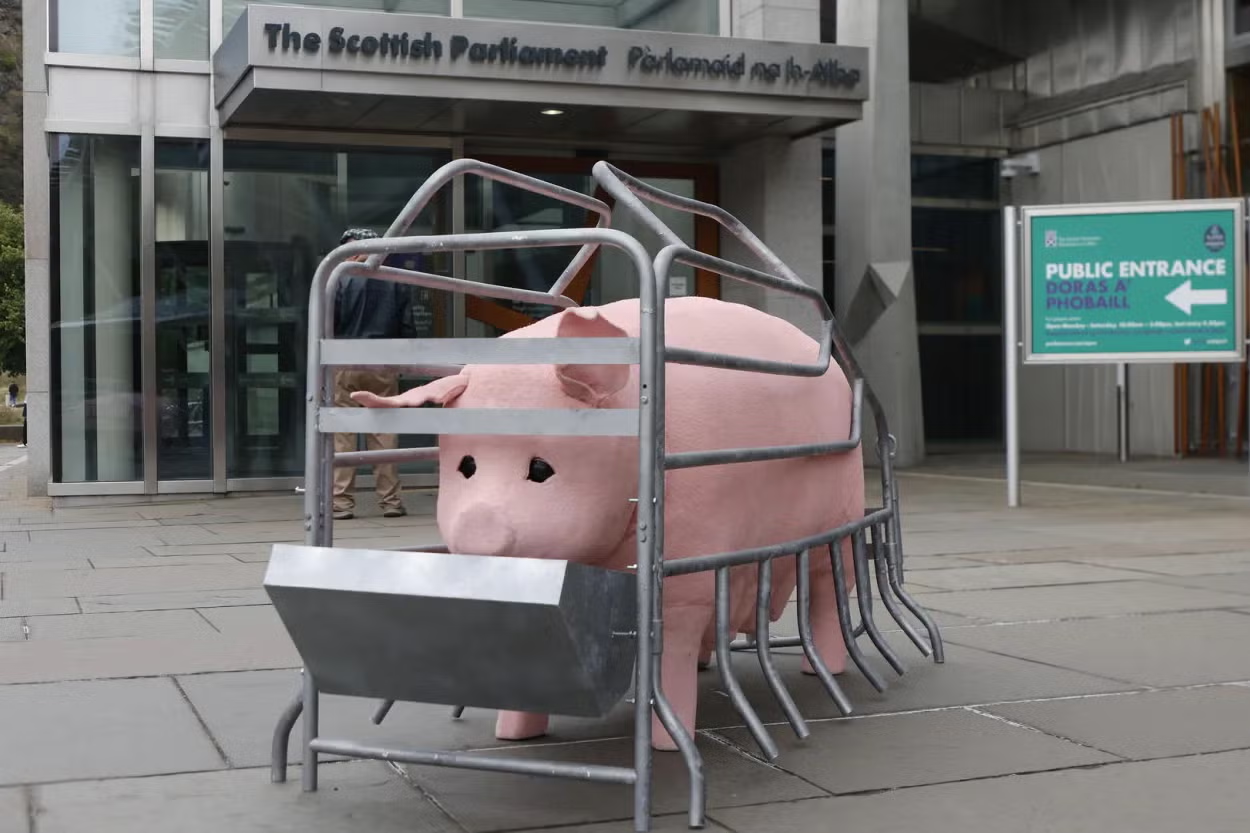
Humane World for Animals UK (formerly known as Humane Society International UK) will take its campaign to ban farrowing crates to Edinburgh today (14 April) by installing a life-sized animatronic pig named Penny to highlight the harsh reality faced by tens of thousands of mother pigs on industrial farms.
Penny will appear inside a metal crate like those used to confine sows while they give birth and nurse their piglets. The striking installation is designed to show the severe restriction endured by mother pigs kept in these systems.
You can meet Penny at the Mercat Cross today from 10am – 2pm.
As of 2025, Scotland is home to 25,600 sows, about half of whom are kept in indoor pig farms that keep mother pigs in these cages. Under current laws, they can be kept for up to five weeks confined in narrow metal cages every time they give birth, typically two or three times a year.
The cages are so restrictive that the animals are unable to turn around and have little opportunity to engage in natural behaviours such as nest-building or moving freely with their piglets, damaging their physical and mental health.
Polling commissioned by Humane World for Animals UK revealed that 84% of the Scottish public reject the use of farrowing crates for mother pigs.
Over half of respondents (54%) stated they would be willing to pay more for meat from crate-free pigs, indicating opportunities for farmers to benefit from the highest welfare standards financially.
Claire Bass, senior director of campaigns at Humane World for Animals UK, said: “Many people are shocked that such extreme, prolonged confinement is still legal in Scotland.
“Farmers must end cruel caging, not replace old cages with new ones that would condemn millions more pregnant and nursing pigs to future decades of misery. A cage is a cage, and public opinion is clear: mother pigs don’t belong behind bars.
“With the Scottish election fast approaching, our tour is turning public compassion into political pressure. Voters in Edinburgh and across Scotland are demanding change and joining our call for the next Scottish Government to support farmers to put an end to pregnancy cage cruelty.”
The Real Mary King’s Close is celebrating International Women’s Day with a specially curated Herstory Tour. The underground experience invites visitors to journey underneath The Royal Mile and learn all about the incredible lives of the women who once lived and worked on the now hidden streets of Edinburgh.
The one-hour tour will include fascinating revelations about some of the most famous women in Scottish history. The tour is guided by a former resident of The Close, including Janet Chesney, a member of the last family to leave the historic street behind.
Guests will even get to meet Mary King herself and find out how she obtained voting rights nearly 300 years ahead of her time. They will also hear how revolutionary thinkers like Sophia-Jex Blake and the other medical students who formed the Edinburgh Seven pioneered gender equality.
The Herstory Tour shares stories of the women who faced suppression and persecution over the centuries but also of how Auld Reekie’s most influential women shaped the city’s history and impacted our lives today.
Mary King’s Close is known for having been “a haven for independent women” with 45% of properties having a female head of the household.
The Close is the perfect place to celebrate International Women’s Day, learning about the achievements of the women of the Close.
Paul Nixon, General Manager at The Real Mary King’s Close, said: “Telling stories of the past, shining a light on Edinburgh’s history and those who came before us are things we are extremely passionate about.
“We are delighted to be sharing the less popular stories of some of the remarkable women who once occupied the Close.
“We can’t wait to welcome everyone on the Herstory Tour and explore a hidden world together.”
Tours will run on Sunday March 8th at 1400 and 1600.
Prices are £30 per adult / £24 per child (5 to 15yo – no under 5 allowed).
One of Scotland’s oldest visitor attractions has turned Edinburgh’s Royal Mile into the ultimate aisle. From sightseeing to ‘I do’, last year the iconic location saw more than 10,000 people put a ring on it at its unique marriage machine.
This Valentine’s Day, Camera Obscura & World of Illusions is once again setting the scene for love, laughter, and unforgettable memories with its famous AutoWed Machine.
The fully automated ceremony is one of only two of its kind in the world, with the other located in the USA. Created by the innovative Cornwall-based company ConceptShed, AutoWed first captured the public’s imagination after appearing on the BBC TV show Dragons’ Den. The novelty wedding vending machine delivers a fun, tongue-in-cheek ceremony at the push of a button, with couples receiving rings and a personalised keepsake wedding certificate.
The entire AutoWed ceremony lasts around 60 seconds / minutes, making it one of the quickest ways to celebrate love in the capital city.Last year, Olympic diver Tom Daley was amongst the many visitors to take the plunge and get ‘AutoWed’ with his husband, Oscar-winning Hollywood screenwriter Dustin Lance Black.
Andrew Johson, General Manager at Camera Obscura said; “The AutoWed Machine has become one of our most-loved experiences, and it’s incredible to see just how many people choose to tie the knot here.
“This Valentine’s Day, we’re inviting even more couples to come and celebrate their love in a fun and memorable way, and we can’t wait to welcome more visitors this February.”
In addition to the AutoWed, couples can explore over 100 interactive, hands-on exhibits that challenge the senses and dazzle the mind. From bewildering optical illusions to breathtaking views of Edinburgh from the Rooftop Terrace.