Blended, a walking art exhibition at Granton:Hub / Madelvic House
October 23rd – 25th 2026
Opening Event:
Community Walk 5pm (Madelvic House and the Riddle of the Sphinx, United Wire, ‘To The Beach’ (sculpture by Vincent Butler made by Powderhall Bronze), Caroline House, Granton Gasworks, Granton Station and back)
Exhibition Opening with refreshments – 6pm at Granton:Hub
Saturday and Sunday opening: 10am – 5pm
The winner of the international Marŝarto Award for Walking Art in 2024,
Tamsin Grainger, will be exhibiting current solo and collaborative mixed-media art work on Friday. All made during or after walking together and with others.
The works include:
textiles – ‘Walking the Granton Burn’ which has been selected for the SAU exhibition at the RSA in 2027, and more
‘Repair’ – a fence made from wire donated by United Wire, the factory opposite the venue, with deckchairs which have new knitted covers
‘A Street Blanket for Homeless Children’ – a collage of knotted and stitched doormat, manhole covers, and Granton graffiti
Plus, short films and works on paper
Pop-up shop with zines and new Granton postcards set
Venue address: 37 Granton Park Avenue, Edinburgh, EH5 1HS
The Space Between Us is an exhibition of poems and images by sisters Rachel Barr and Bridget Grant.
Together, they explore the impact of a glioblastoma brain tumour diagnosis.
It is a tender, honest and deeply moving body of work, and North Edinburgh Arts is proud to support it.
The exhibition offers visitors the opportunity to spend time with the sisters’ work and gain a personal perspective on the experience of a glioblastoma diagnosis.
Indepen-dance exhibition event at The National Portrait Gallery of Scotland in Edinburgh with fine art photographer Flannery O’Kafka.
Photographer and dancer Dylan Lombard with fine art photographer Flannery O’Kafka’s who has mentored him.
Over 20 inspiring photographs by artist Flannery O’kafka representing Scotland’s disabled community have been acquired for the nation. Made in collaboration with Glasgow-based Indepen-dance over several months these photographs capture the vibrant energy of Indepen-dance and the personalities of the individual dancers.
A selection of 10 photographs by O’kafka are now on show in the Modern Portrait rooms at the National Galleries Scotland: Portrait in a free-to-visit display. Indepen-dance visited their proudly displayed photographs for the first time at a special event this week at the Portrait gallery in Edinburgh.
National Galleries of Scotland commissioned the work after recognising a lack of representation of the disabled community in the nation’s photography collection. Inspired by statistics from Scotland’s census, the photographs aim to explore the notion of identity.
What do we have in common, and what makes us unique?
With support from Art Fund, O’kafka spent months with Indepen-dance to create the Same Dance, Different Song series. She got to know the dancers, hearing their stories and dancing with them, ensuring she could authentically capture and celebrate who they are in their portraits.
The result is 21 vibrant and playful photographs, capturing each dancer’s individuality and fearlessness in dancing. The remaining 11 from the series will be swapped at a later date, allowing visitors the opportunity to experience the full collection of photographs.
Indepen-dance exhibition event at The National Portrait Gallery of Scotland in Edinburgh with fine art photographer Flannery O’Kafka.
The final selection of photographs acquired by the National Galleries of Scotland was made in collaboration with Indepen-dance staff and dancers. Seeing their portrait for the first time one dancer said “Photographs have really helped me to see myself as a beautiful person”. Another said “I think they look amazing, I like them all, I can’t pick one.”
Indepen-dance is an award-winning inclusive dance company for disabled and non-disabled people to enjoy, express, and fulfil their potential through dance. Marking Indepen-dance’s 30th anniversary, this project is a visual representation of the positive impact they have had on providing opportunities for disabled and non-disabled dancers.
Flannery O’kafka is an artist living and working in Glasgow. Their work is mostly photographic and often autobiographical, with a focus on examining how disability is pictured. Central to O’kafka’s practice is offering agency to bodies which have historically been marginalised by photography.
During their time with Indepen-dance O’kafka mentored a young photographer Dylan Lombard who was also part of the Indepen-dance group. With a passion for photography and dance, Dylan had the opportunity to collaborate with O’kafka and develop his own skills as a photographer through the project.
Indepen-dance exhibition event at The National Portrait Gallery of Scotland in Edinburgh with fine art photographer Flannery O’Kafka.
Speaking on the positive impact photography has had on him, he said: “Photography gives me so much joy. Photography has changed me and helped me to become more positive about myself and about life.”
Dylan’s own photographs are also available to view for free at the Portrait gallery, with a dedicated display in the Connections gallery on the ground floor.
Indepen-dance exhibition event at The National Portrait Gallery of Scotland in Edinburgh with fine art photographer Flannery O’Kafka.
Karen Anderson MBE, founder of Indepen-dance said: “Seeing our dancers represented in the National Galleries of Scotland is a really special moment for Indepen-dance, particularly as we celebrate 30 years of the organisation.
“These photographs are about so much more than dance or disability they are about people, personality, identity and the freedom to be seen for who you are.
“For me, this project is also about changing the way disabled people are seen and represented. Our dancers should be part of Scotland’s cultural story, not on the edges of it. To have these photographs acquired for the national collection and displayed for everyone to see is an important recognition of that.
“I’m incredibly proud of our dancers and Dylan, and grateful to Flannery and the National Galleries of Scotland for creating something that celebrates them so authentically. It is wonderful to see their images taking their place in our national collection.”
Indepen-dance exhibition event at The National Portrait Gallery of Scotland in Edinburgh with fine art photographer Flannery O’Kafka.
Photographer and dancer Dylan Lombard with fine art photographer Flannery O’Kafka’s who has mentored him.
Louise Pearson, Curator (Photography) and Ailbhe Turley, Outreach Coordinator said: “It has been brilliant to collaborate with the dancers and staff of Indepen-dance and artists Flannery O’kafka and Dylan Lombard on this project.
“Their generosity in sharing their knowledge and experiences has transformed how we think about access and inclusivity when collecting and commissioning artworks at the National Galleries of Scotland.
“We would also like to thank Art Fund for their generous support which has allowed us the time and resources to create this important body of work.”
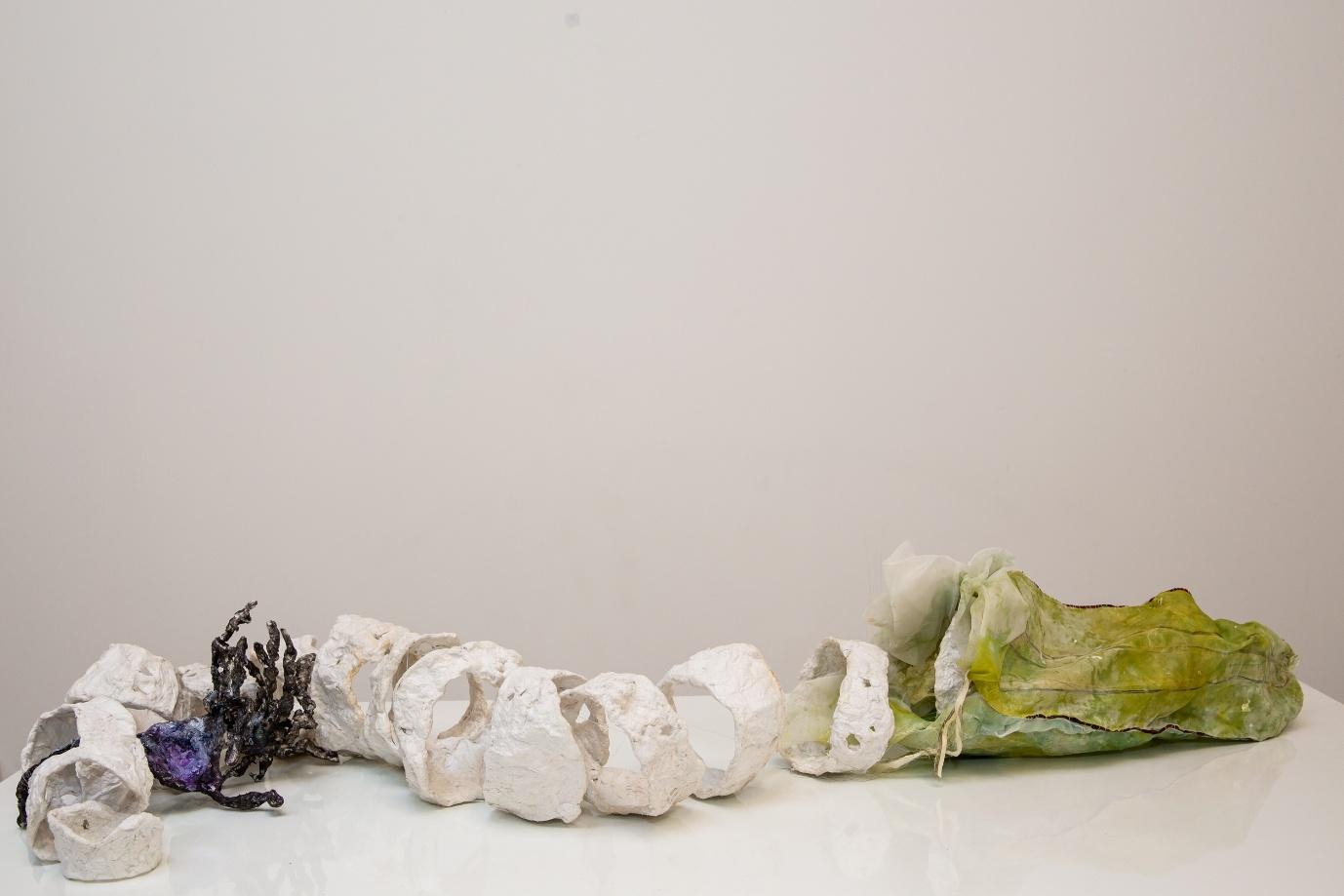
Polly Thelwall is a British painter and sculptor whose practice centres on small-scale casting, modelling, stitching, papier-mâché, found natural objects and paint.
She grew up on the Atlantic North Coast of Northern Ireland, an environment where raw landscape and weather formed an early sensibility for the meeting point between the human body and the natural world. Alongside her sculptural work, she maintains an active practice of drawing, sketching and painting.
Over the last 55 years she has been growing and developing her artistic career from childhood drawing and plasticine modelling through studying sculpture at Edinburgh college of Art in the 90s, and on, now, to her current broad and mature practice.
During that time, she sketched, drew, painted and sculpted, honing her practice in the landscapes of Scotland, especially the waters of the landscape: sea, streams, lochs and rivers.
The artist was invited by the owners of 197 Portobello High Street basement to consider putting in a proposal to Artwalk Weekends. This exhibition is on the theme ‘shift and flow’.
This installation represents a first site specific sculptural work of a large piece involving many smaller elements. It is also the first time the artist has used sound she recorded as part of the work.
The basement happens to be well supplied with excellent audio equipment strengthening the collaboration between the venue owners and the artist
Thelwall works intuitively and experimentally, navigating the threshold where human experience and the more-than-human world intersect. Her process invites the soft, scarred animal of the body to speak alongside the mind, often inclined to assume its own perfection. Through an internal and external alchemical process, she allows these dualities to interact, transform and reconfigure. Opening herself to the unknown, she creates conditions for unexpected forms, ideas and emotional registers to emerge.
Thelwall’s practice is ultimately an exploration of transformation: material, emotional and perceptual. Through making, she seeks to articulate the subtle, shifting relationship between body, landscape and imagination, allowing new forms of understanding to surface.
Polly Thelwall said: “This has been an opportunity to sit with the ephemeral. Each time in rising and lower tides, the creatures will be different, the beach will be different, the specific drops of water will be different, the conditions will be different etc.”’
This Art Walk Weekend, centred around the shift and flow of the intertidal zone, comes at a moment when we have been grappling with forest fires and warming seas.
It is a time that needs space to evolve new ways like the one created by this artist who works in transformation, opening a gap for us to find our own answers.
Polly Thelwall’s relationship with the sea began as a baby living by the sea on the Atlantic coast of Northern Ireland. A childhood in and out of the water grew into a long-term love of waters and wild swimming.
The artist also volunteers in Marine conservancy, helping by cleaning oysters for repopulating the Forth and as a litter picker. As a means of exploring this passion Polly Thelwall participated in a SailBritain Sailing residency in Scotland in 2019. This led to a first cast in the landscape of a water pattern on a beach, which was later used to create part of a sculpture.
The first international exhibition from the world-renowned Legacy Museum arrives in Scotland for a limited run at Edinburgh International Festival from 8 to 30 August
This August, UK audiences will have a rare opportunity to experience one of the most powerful cultural exhibitions ever created about slavery, racial injustice and their continuing legacy.
Opening on 8 August, The Legacy of Slavery brings the work of the internationally acclaimed Legacy Museum in Montgomery, Alabama to Scotland – and marks the first occasion the Museum has created a major exhibition outside the United States.
Presented by Edinburgh International Festival in the spectacular surroundings of the Playfair Library Hall in one of Scotland’s great civic institutions, the exhibition coordinated by the Equal Justice Initiative (EJI) invites visitors to confront the history of slavery across the Atlantic world and consider how its consequences continue to shape modern society.
The Legacy of Slavery is an immersive, hour-long experience. Visitors travel through centuries of history, from the transatlantic slave trade and the economics of enslavement to segregation, racial terror, mass incarceration and contemporary inequalities within systems of justice.
Founded by the Equal Justice Initiative (EJI), the Legacy Museum has become internationally recognised for transforming public understanding of slavery and racial injustice through rigorous historical research and powerful storytelling.
The exhibition is guided by the work of Bryan Stevenson, founder of the EJI and one of the world’s most influential advocates for justice and human rights.
Through decades of legal advocacy, Stevenson has challenged wrongful convictions, overturned death sentences and sparked international conversations about how societies reckon with difficult histories.
Bryan Stevenson said: “We are thrilled to bring a part of the Legacy Sites to Edinburgh for this exciting festival.
“The relationship between art, music, and justice is deep, profound, and ancient. So much of the world’s most extraordinary creative works have been shaped by eras of inequality, bigotry, and injustice.
“The Legacy Museum documents and explores a painful part of America’s history, which should deepen visitors’ appreciation of the extraordinary music and creative expression this history has inspired.”
Festival Director, Nicola Benedetti said: “The Edinburgh International Festival was founded in 1947 as an act of reconciliation, built on the belief that art and dialogue together could help humanity reckon with its darkest chapters and find a way forward.
“That is what this work with The Legacy Museum offers: a chance to bring the International Festival’s tradition of ideas and conversation into direct contact with one of the most searching acts of historical reckoning being made anywhere today. Hosting the first ever international exhibition of The Legacy Museum is a profound expression of our founding purpose.
“With this year’s International Festival we are placing a particular spotlight on the United States, and this exhibition sits at its heart. Running from the 8th to the 30th of August, it will sit alongside performances and works that explore the same history from different artistic angles, from theatre works Angels in America and HANG TIME to Jazz at the Lincoln Center Orchestra performing Duke Ellington’s monumental symphony Black, Brown and Beige.
“Bryan Stevenson and the Equal Justice Initiative have created something that demands our attention, our honesty and our willingness to sit with discomfort in the service of truth. This exhibition is free and open to everyone, and we hope as many people as possible will come and see it.”
The exhibition, which is focused on the Legacy of Slavery in the US, also includes some context on Scotland’s connections to transatlantic slavery. The exhibit explores the evolution of slavery in America using multiple forms of immersive content and material documenting the past all the way to the present.
Presented within the Edinburgh International Festival’s 2026 programme, which marks the 250th anniversary of American independence, The Legacy of Slavery sits at the heart of the Festival’s wider examination of freedom, hypocrisy and the contradictions that have shaped the modern world.
Exhibition will run from 18 November 2026 – 11 April 2027
Free Admission
Over 180 artists from Orkney to Dumfries and Galloway and beyond, including some who have never publicly shown their work before, have been shortlisted for the Scottish Portrait Awards 2026.
The selected works will go on display alongside the nation’s magnificent collection of art at National Galleries Scotland: Portrait from 18 November 2026.
A total of 187 works were chosen from nearly 2,500 entries across three categories including Fine Art, Photography and the free to enter, Scotland Now! Phone Portrait Awards. These include nine nominations for the Young Fine Artist Award and nine nominations for the Young Photographer Award.
Judges were wowed by the vibrance and creativity of this year’s submissions, championing the incredible talent of Scottish artists. Now in its ninth year, the Scottish Portrait Awards, Scotland’s largest awards in portraiture will be bigger than ever, as the National Galleries of Scotland partner with the Scottish Arts Trust for the first time.
Robyn Jenkins, an animation student at Edinburgh College of Art, who at 18 is one of the youngest artists to be selected, said, ‘To walk into the Great Hall and know my work is hanging in the National Galleries Scotland: Portrait is an absolute dream.
“After visiting the galleries so many times, it feels surreal to have my work share the space of the incredible art I’ve admired for so long.”
Shortlisted artists captured the imagination and in collaboration with their sitters, have shone a spotlight on diverse stories and experiences in today’s society.
The exhibition at National Galleries Scotland: Portrait will feature dynamic works from vibrant paintings of family members, to moving photographs of athletes, uplifting moments of celebration, unique fashion portraits and LGBTQ+ communities.
Capturing a snapshot of what it means to live in Scotland today, the exhibition will celebrate the artists who capture these moments in time.
Each shortlisted artist will have the opportunity to win the John Clark Motor Group Scottish Portrait Awards in Fine Art or the MPB Scottish Portrait Awards in Photography plus £5,000 and a commission from the National Galleries of Scotland to make a portrait for Scotland’s national collection.
Open to anyone over 16 years, born, living or studying in Scotland, regardless of experience, the Scottish Portrait Awards brings together well-established artists as well as newcomers working in many different styles – not only in painting and sculpture but also, for the first time, animated portraits will feature in the exhibition.
The prize-winners will be announced on the opening week of the exhibition in November during the awards events at the National Galleries Scotland: Portrait before opening to the public from 18 November 2026 – 11 April 2027.
From over 600 works submitted, 64 portraits have been shortlisted by the judging panel for the John Clark Motor Group Scottish Portrait Awards in Fine Art.
The range of fine art media – painting, drawing, printmaking, collage, sculpture, animation and film – and materials used reflect the many approaches to making a portrait. Self-portraits, together with depictions of family, friends and admired figures, capture moments in time.
Visitors to the exhibition will discover works exploring the passing of time, identity, relationships, vulnerability, play, the natural world and human nature.
Judges selected 63 pictures from more than 800 entries submitted for the MPB Scottish Portrait Awards in Photography.
More than just pictures of people, these images exemplify a broad range of approaches to photography and portraiture today. They challenge us, spark joy, create conversation, tell stories and share different points of view.
The portraits demonstrate different photographic methods and techniques, from the documentary to the surreal, and from older analogue processes to digital photography. Indicative of the scope covered by this year’s awards, the subjects represented in the exhibition range in age from a newborn baby to a centenarian.
The awards also encouraged everyone across Scotland, aged over 16 years, to send photos taken on a phone to its free to enter competition. 60 works shortlisted for the Scotland Now! Phone Portrait Awards, will go on display on a screen in the gallery, championing the art of photography at all levels.
Throughout the exhibition, visitors will explore themes of care, kinship and interconnectedness through the eyes of others.
Gordon Mitchell RSW RSA RGI, Director, Scottish Portrait Awards and Fine Art Chair, said: ‘We’re bringing the country’s biggest and most prestigious portrait awards to a world-class national stage.
“Nothing compares to standing in a major gallery and experiencing the breadth and intimacy of the artworks firsthand.”
Simon Murphy, Chair of Photography, said: ‘Showcasing established and emerging artists together in a single exhibition isn’t just about sharing gallery space, it creates a powerful dialogue and democratic opportunity.
“Add a major national collection as a backdrop and you create an electric energy that is rarely experienced.”
Anne Lyden, Director General of the National Galleries of Scotland, said: ‘Portraiture shows us what it is to be human – to connect and foster empathetic relationships. This year’s entries embody this and more, capturing life in Scotland in the most beautiful way.
“It has been inspiring and moving to experience the work of artists who have previously entered and to see how participating has furthered their practice.
“The judges were enthralled by the range of submissions and captivated by the artists skill, storytelling and personal statements. We are delighted to have the opportunity to share this with our visitors in November and hope everyone can join us in celebrating the incredible artistic talent Scotland has to offer.’
Since its inception, the awards have discovered and recognised almost 500 artists whose work features in the Scottish Portrait Awards online archive.
Many of the artists have continued to advance their careers with exhibitions and commissions. Previous award winners include Helen Wilson, Robin Gillanders and Graeme Wilcox.
Granton Primary School children using the 30th anniversary of the Old and News Towns World Heritage Site in Edinburgh as inspiration to create an exhibition to help mark this important milestone.
The children’s artwork will be displayed in a special exhibition for residents and visitors to view in the Museum of Edinburgh later this year to celebrate three decades since the Site was inscribed by UNESCO in 1995.
The class of primary four pupils are working with local artist Stephanie Walker on their ‘Imagine if…’ project to help the children put together artwork using the Old Town to help spark excitement and curiosity for the world around us. The aim of the project is to create a connection and a sense of wonder for the valuable heritage Edinburgh is so famous for.
Local artist Stepanie Walker said:“The project has been designed to guide the children through a series of art sessions to help them imagine and create their final piece to display on canvas.
“Before our visit to the World Heritage Site we explored what we know about Edinburgh. The children brainstormed and shared ideas about famous buildings and drew them to create a class exhibition.
“We visited the Museum of Edinburgh on the Royal Mile and learnt about why the city has a World Heritage Site, explored artefacts in the museum and shared what we had discovered.
“We visited the Site twice walking around the cobbled streets and narrow closes in and around the Royal Mile. The children looked carefully at the old buildings, monuments and skylines as well as all the nature we found in the historic area. We visited the Canongate Kirk, and I encouraged the children to imagine what the people who lived there long ago were like.
“The pupils then made sketches and used water colours to create paintings of their favourite scenes, buildings and objects to use as reference material for the final piece they will put together back in the classroom.”
Cllr Joan Griffiths Planning Convener said: “This project is both creative and educational as it allows pupils from a different area of the city to use art to help bring to life different aspects of the World Heritage Site such as the buildings and skylines that they find inspirational.
“It’s wonderful to see the work they have produced and I’m very much looking forward to the final exhibition in the Museum of Edinburgh later this year. It’s important that we teach children the value of preserving our World Heritage Site for future generations to come.
“I’m hoping this class of primary four pupils will remember the project in years to come holding onto what they’ve learned about what’s special about the history of their city and will pass this on.”
Entries will be grouped into twelve categories, each celebrating a particular value of Scotland’s capital city. The winning photograph in each category will become part of a year-long calendar, which will be sold on Historic Scotland sites and at Edinburgh World Heritage events to raise money for the Trust.
The over-all winner will take pride of place on the front cover of the calendar and will receive a one-year membership for Historic Scotland, who run top-rated visitor attractions all over the country.
The Second World War Comes to Queensferry has been developed in partnership with the Queensferry History Group and reveals how the community experienced the upheaval of war.
Queensferry occupied a strategically important position during the Second World War because of its proximity to the Firth of Forth, the naval base at Port Edgar and the iconic Forth Bridge. Local residents lived with the constant awareness that Scotland’s east coast played a crucial role in Britain’s wartime defence and witnessed the first Luftwaffe attack over Britain.
Through a local perspective, the exhibition examines the conflict through the eyes of ordinary people living in and around Queensferry.
Many of the photographs, stories and research featured in the exhibition come directly from community collections and local investigations carried out by the Queensferry History Group, helping to preserve memories that might otherwise have been lost.
Culture and Communities Convener Margaret Graham said:“The Queensferry History Group has created an invaluable record of the town’s past, and I’m delighted that we’ve been able to work with them to bring this exhibition to life.
“By working closely with local people to shape how we present and interpret history, exhibitions like this help to uncover personal stories, family memories, and community perspectives, making the past more meaningful, engaging and accessible for visitors of all ages.
“I hope visitors will take the opportunity to visit the exhibition and discover a deeper understanding on the events that have shaped our shared heritage.”
A spokesperson from the Queensferry History Group said:“Queensferry History Group, a volunteer research group, has been meeting for almost 40 years, through the years, seeing varying faces and places but ultimately bringing the History of Queensferry to the local and wider community.
“This recent project is to commemorate the men who fought and died for Queensferry during World War Two, to bring their stories to life and to introduce some who fought and returned home.
“We researched the war history of the men and the battles they fought in. We searched through earlier transcripts of interviews with community members recorded some years ago.
They contained stories of people’s personal experiences, witnessing the first air attack of the War, in Britain, which was on ships in the Forth. How the children felt being sent away from their families as evacuees, how people coped with rationing and many more effects on the community back then.
“We are proud to bring this exhibition to our community now.”
This summer, the City Art Centre will present Start from the Level, the largest exhibition ever staged of the work of Sandra George (1957–2013).
Start from the Level is produced in partnership with Craigmillar Now, an arts and heritage centre based in Craigmillar, who hold Sandra’s collection in their community archive, and is part of the Edinburgh Art Festival.
Opening on 27 June and running until 27 September 2026, the exhibition brings together photographs spanning more than two decades, many of which will be shown publicly for the first time. Drawn from Sandra’s extensive archive, the exhibition offers a powerful portrait of Edinburgh’s communities and explores themes of identity, activism, motherhood, belonging, and social justice.
Born in Nottingham and raised between Jamaica and the UK before settling in Edinburgh, she became widely known for her work as a community organiser and advocate. Alongside this, she developed a prolific photographic practice, documenting everyday life across Edinburgh and beyond from the late 1970s through to the early 2000s.
Through her lens, she captured both intimate personal moments and wider social movements, creating a remarkable visual record of the city and the people who shaped it. Her photographs are united by a deep sense of humanity and a commitment to representing people with dignity, openness, and care.
The exhibition takes its title from Sandra’s own words: her desire to “start from the level people are based”. This guiding principle informed her work throughout her life, resulting in an extraordinary body of photography that remains as relevant and resonant today as ever.
Culture and Communities Convener Margaret Graham said: “Sandra George’s photographs offer an invaluable record of Edinburgh and its communities, seen through the eyes of someone deeply committed to social justice, equality, and human connection.
“This landmark exhibition celebrates not only her extraordinary talent as a photographer, but also her lasting contribution to the cultural and community life of our city.
“We are proud to bring this important body of work to audiences and ensure that Sandra’s legacy continues to inspire future generations.”
In addition to the exhibition at City Art Centre, a special outdoor presentation of Sandra’s work will be displayed on street-side billboard and poster sites across Edinburgh from 22 June for three weeks in partnership with BuildHollywood.
Featuring photographs taken throughout the city, the displays will appear in Fountain Park, Teviot and Meadowbank, bringing George’s images directly into the public spaces she documented.
Discover powerful photographic portraits by groundbreaking American artist Catherine Opie in the National Galleries of Scotland’s showstopping summer exhibition.
Curated in collaboration with the artist, Catherine Opie: To Be Seen is Opie’s first ever solo exhibition in Scotland.
Specially adapted for presentation at the Royal Scottish Academy in Edinburgh, To Be Seen presents a unique experience of the people, communities and stories in the art of Catherine Opie.
The exhibition comes to Edinburgh from the National Portrait Gallery in London, having already received rave reviews from the likes of The Guardian and the Independent, with Time Out calling it ‘something worth celebrating’.
Tickets are on sale now and for the first time, under 18s can visit the National Galleries of Scotland summer exhibition for free.
Explore nearly 80 vibrant portraits by Opie alongside her selection of works from Scotland’s national art collection. Displayed across seven rooms in the Royal Scottish Academy building, come face to face with Opie’s mentors and collaborators, Queer communities, children, surfers, high school footballers and political crowds as well as self-portraits of the artist.
See Opie’s work alongside a selection of 13 paintings from the national collection in arrangements prompting new narratives around ideas of identity. Join Opie as she questions ‘what is identity right now, and how do we look at it?
Where and how do we belong’. Documenting people brought together by common experiences or a shared sense of identity, Opie celebrates these communities by making them visible and offers us a platform to recognise ourselves in her exquisite and colourful images.
Thought-provoking and visually powerful, her striking work challenges who is represented in art and who remains unseen. Depicting a world made meaningful through connection, the artist says: ‘If you can walk away having a little better understanding about being human, that’s what I care about the most.’
One of the most influential artists of our time, Opie’s work is driven by the urgency to examine the ebb and flow of human culture and communities. Journey through 35 years of the artist’s work as she questions representations of home, intimacy and family, and explores politics, identity and power structures.
At the basis of her practice is her ongoing questioning of evolving ideas of community, identity and belonging. For Opie, portraiture is a radical act of representation – a desire to make the invisible visible and a gesture of belonging and resistance. Opie’s art attests to a great sense of humanity and care.
Whether as a university professor, a mother, a member of the Queer community, an American, or a world citizen, her portraits of fellow artists, friends, children and protestors draw attention to the power of visibility.
From photographs covering Barack Obama’s presidential inauguration, Tea Party rallies, and LGBTQ+ rights protests, to tender family moments and vulnerable self-portraits, Opie’s photographs collapse divisions between the personal and the political.
Experience Opie’s portraits alongside works such as Benedetto Gennari’s Elizabeth Murray, Duchess of Lauderdale and Pablo Picasso’s Mère et enfant and consider how history is recorded through portraiture.
Opie says, ‘What first drew me to photography was the idea that history was being made and language was being made through images.’
The artist has long been influenced by historic portraits, taking early inspiration from Hans Holbein the Younger. Inspired by Holbein’s precise renderings of nobility, Opie sought to give stature to her friends and challenge notions of ‘normality’.
Opie’s first major work, Being and Having (1991) is her own representation of identity challenging gender norms. Comprised of 13 closely cropped portraits of Opie and her friends enacting their masculine personas, Opie considers these her ‘own royal portraits,’ and affirms that ‘without representation, there is no visibility’.
To Be Seen will span the artist’s most famous works, with Opie’s own identity also threaded through the exhibition. Works range from ennobling portraits of the artist’s LGBTQ+ friends, Baroque inspired portraits of artists, images chronicling the likes of 1990s West-Coast leather dyke scene alongside her own experiences of family life and community.
Opie says, ‘I like to think that portraiture literally creates a history of one’s community’. The exhibition’s wide-ranging portraits span intimate studio shots capturing moments of vulnerability, pride and resilience to socially engaged documentary narratives.
Born 1961 in Sandusky, Ohio— the American Midwest—Opie got her first Kodak camera at the age of 9 and remembers, ‘I photographed everything around me’.
Her fascination with photography continued throughout her childhood after she moved to California at the age of 13. She fashioned her teenage years, through friendships forged by taking photographs of school plays. Opie was later encouraged to study photography at the San Francisco Art Institute.
Moving to the city she worked and lodged at the Kenmore Residence Club, coming out as a lesbian and having her first significant relationship.
Later, Opie studied for a master’s at the California Institute of the Arts, where she developed her critical approach and secured her technical knowledge.
Rising to prominence in the early 1990s, Opie has since been at the cutting edge of documentary and portrait photography. She taught at UCLA for 25 years and was the Endowed Chair, Department of Art at UCLA (2021–23), retiring in 2023. Opie currently lives and works in Los Angeles.
Domestic 40×50
Catherine Opie said: ‘After my first visit to Edinburgh it is a deep privilege and honour in bringing To Be Seen to a place that immediately felt like home.
“I’m looking forward to getting to know Scotland in the exchange of ideas and humanity when I return in August.“
Anne Lyden, Director General of National Galleries of Scotland, said: ‘One of the most significant artists of our time, Catherine Opie is really not to be missed this summer!
“We are so excited to be working with the National Portrait Gallery, London, to host the artist’s first ever solo exhibition in Scotland. We cannot wait to share these incredibly powerful and human portraits with the people of Edinburgh and beyond.
“Opie’s life’s work resonates with our values to offer our audiences a feeling of community, connection and fun! We hope that our visitors find these moments while they explore this wonderful exhibition by a truly groundbreaking artist.’
Catherine Opie: To Be Seen is a National Galleries Scotland exhibition taking place in the Royal Scottish Academy building, opening on 8 August 2026.
The exhibition also forms part of the Edinburgh Art Festival, the UK’s largest annual festival of visual art, from 14 – 30 August, presenting alternative perspectives across the breadth of the city.
Catherine Opie: To Be Seen is kindly supported by the players of Postcode Lottery and Friends of the National Galleries of Scotland.


 North Edinburgh Arts
 Exhibition Opening Dates: 16th to 29th October
 Free entry