Campaigners have long argued for swifter progress, citing safety concerns on a road that regularly changes from single to dual carriageway. There has been political criticism of the Scottish Govenment’s failure to deliver on their original promise.
Tragically, there has all too often been the grief and pain that accompanies the loss of a loved one on what has become a notorious stretch of road.
Ronnie Weir’s house in the village of Dowally in Perthshire is a mere 25 meters from an undualled section of the A9. In April 2017, Ronnie suffered serious leg injuries on the same stretch when a car travelling in the opposite direction hit his vehicle head on. The female driver of the other car died at the wheel.
Speaking to Eòrpa, he told how the trauma follows him to this day: “You’re always concerned whether it is near the home or anywhere because the trauma which an accident causes is horrendous.
“Sometimes it’s difficult to speak about it because of that and it brings back memories about how insensitive some people were about the whole accident. They just wanted to keep on the road and don’t care.”
Lorry driver Elaine MacKenzie, whose job means frequent journeys up and down the section of the A9 that’s now due to be dualled by 2035, told Eòrpa: “People don’t understand that the signs say 50mph for lorries but not for cars.
“Everything slows down. Those behind me can’t get past, they get impatient, and they don’t understand that there’s people in front of me, and then they try to get past me in dangerous places. This is every day. I pray every time I go on the A9.”
Dualling is set to gather pace ahead of the 2035 deadline. Farmer Pamela Laird’s family has run East Dowally farm in Perthshire for generations. Speaking on camera for the first time about her situation, she told Eòrpa she’s set to lose a quarter of her land to the A9 under Scottish Government compulsory purchase powers.
So far she doesn’t know how much she’ll get: “We’re losing a hundred acres. In some areas they’re stripping the topsoil off and lowering it.
So it’s very invasive, very invasive. Flooding is number one worry for us. I don’t believe that the swales and suds and any mitigation that they have put into place will cope with the Tay when it is in full flow.
“I think when the river rises it’s just going to rip through everything.”
Transport Scotland told Eòrpa mitigation measures have been taken, including culverts to allow waters to drain.
The Scottish Government’s commitment is now for completion of dualling between Perth and Inverness by 2035.
Pressed on continuing safety concerns about sections yet to be dualled, Transport Secretary Fiona Hyslop MSP said: “Any loss of a life on the A9 or indeed other roads in Scotland is a tragedy in and of itself.
“Road safety is something as Cabinet Secretary for Transport I take extremely seriously and in terms of the A9 we’ve also invested five million pounds on interim shorter term road safety issues.
“We’re not waiting just for the dualling. The dualling in and of itself will help on road safety and that’s one of the reasons that clearly we’ve embarked on it.”
Inverness-based reporter Andrew MacKinnon: “The Scottish Government’s new deadline of 2035 can be seen as bitter-sweet. Progress is being made, and Transport Secretary Fiona Hyslop has given her assurances that 2035 will be met.
“However, those who point to a need for the section to be dualled for safety reasons are faced with another 10 years before that’ll be done. And those who have suffered the tragic loss of loved ones will continue to grieve.”
Eòrpa: The A9 | An A9 premieres on BBC ALBA TONIGHT Monday 25 August at 9pm, and on iPlayer from 6am the same day.
With the summer festivals season fast approaching, the city council is making temporary changes to the way some of our city centre streets operate between Thursday 24 July and Sunday 7 September 2025.
During this busy period the population of our city effectively doubles, which brings challenges for residents, businesses and visitors.
These temporary changes, which include removing or restricting vehicle traffic, are designed to make our streets easier and safer to walk around.
There is also specific advice for blue badge holders, home deliveries, loading and services for businesses, places of worship and special arrangements.
Transport and Environment Convener, Councillor Stephen Jenkinson said: “As we prepare to welcome the world to Edinburgh for our summer festivals, we’re making sure that these higher visitor numbers are managed safely and properly.
“We’ve made temporary changes to our city centre streets successfully during this period for many years and I’m sure that this summer will be no different.
“I’d like to thank our residents and businesses for their understanding and patience as we get ready to showcase and enjoy our city’s unparalleled cultural offering once again.”
Funding will help to build a fairer, cleaner future where every family can benefit from cheaper, greener transport
major boost to charging investment to break down barriers to electric vehicle ownership and boost charging infrastructure across the UK, cutting costs for families, businesses and the public sector
£63 million package to support at-home charging for households without driveways, transition NHS fleets to save millions for the health service in England, create thousands of chargepoints at business depots across the UK
builds on £400 million invested in charging infrastructure and recent Zero Emission Vehicle Mandate updates to kickstart economic growth, create thousands of green jobs, and put more money in people’s pockets as part of the Plan for Change
Drivers across England are set to benefit as the UK government today (13 July 2025) announces a £63 million investment package to supercharge Britain’s electric vehicle infrastructure, driving down charging costs and putting money back in the pockets of working people as part of the Plan for Change.
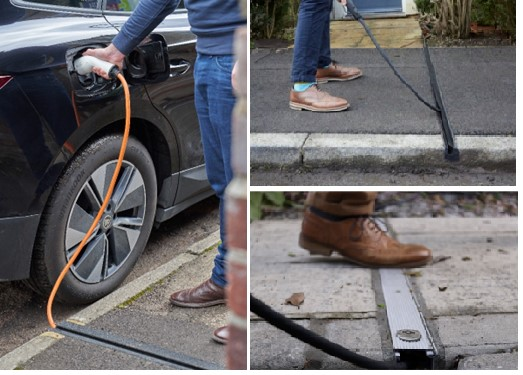
A pioneering £25 million scheme for local authorities will expand access to cheaper at-home charging. This will provide access to cheaper household rates, allowing consumers to save up to £1,500 a year compared to running a petrol or diesel car, transforming how thousands of households without driveways power up their electric cars.
The innovative cross-pavement technology will allow cables to run safely beneath pavements, connecting homes directly to parked vehicles, enabling more families to tap into cheaper domestic electricity rates for as little as 2 pence per mile even if they don’t have a driveway.
The fund is the latest move to bolster the UK’s growing charging network which has reached a record 82,000 public chargepoints, with a further 100,000 expected to be installed as a result of the government’s Local EV Infrastructure Fund and £6 billion of private investment committed to 2030.
To ensure the savings the EV transition can bring are felt in the public sector too, the NHS in England is also receiving a major sustainability upgrade with an £8 million fund to power the electrification of ambulances and medical fleets across over 200 NHS sites, saving millions in costs which can be invested into patient care.
‘Standing firmly on the side of British drivers’, this latest investment is part of the government’s plan to support motorists, including a record £1.6 billion invested to tackle potholes and bring down and frozen fuel duty at 5p until Spring 2026, saving the average motorist £50 to £60 over the year.
This investment underpins the government’s Plan for Change mission to kickstart economic growth and make life easier for working people, ensuring the transition to net zero delivers for working families whilst creating good jobs and driving economic growth across all regions of the UK.
Transport Secretary Heidi Alexander said: “We are making it easier and cheaper to own an electric vehicle. We know access to charging is a barrier for people thinking of making the switch, so we are tackling that head on so that everyone – whether or not they have a driveway – can access the benefits of going electric.
“Our investment is about more than just charging points – it’s about charging up Britain’s economy. I’m proud that through this boost, we are helping deliver cheaper bills for families, massive savings for the NHS to reinvest in patient care, and thousands of new green jobs.
“This is what our Plan for Change mission to kickstart Britain’s economy looks like in practice. We’re not just boosting charging infrastructure, we’re building a fairer, cleaner future where every family can benefit from cheaper, greener transport, whilst creating thousands of good jobs across the country.”
In a pioneering move to help EV drivers plug into the rapidly expanding charging network, the UK government is also modernising EV charging signage on major roads.
EV charging hubs have more than doubled since the beginning of 2023 and immediate changes will allow larger EV charging hubs to be signposted from major A-roads for the first time. Government is committed to boosting charging for long journeys, with £400 million announced in the Spending Review to support charging infrastructure, including on the strategic road network.
Alongside the boosts for electric car drivers, the government is also launching a major new grant scheme to help businesses install charging points at depots nationwide, supporting the nation’s heavy goods vehicles, vans and coach drivers in the transition to zero emissions.
With over 1.2 million people employed in the freight and logistics sector in the UK alone, today’s announcement is the latest move to keep industry at the forefront of international competition in the face of global economic headwinds.
Over 1,200 new charging sockets will deliver a more efficient, modern health system whilst generating millions in cost savings over the next two decades for the taxpayer on maintenance and fuel costs – valuable savings that can be prioritised for patient care and help rebuild the NHS.
Owning and buying an EV is becoming increasingly cheaper, with 2 in 5 of used electric cars sold at under £20,000 and 34 brand new electric cars are available from under £30,000.
The UK was also the largest EV market in Europe in 2024 and the third in the world with over 382,000 EVs sold – up a fifth on the previous year. There are now more than 82,000 public chargepoints in the UK – with one added every 30 minutes – ensuring that motorists are always a short drive from a socket.
Health Minister Karin Smyth said: “This is a win-win: cheaper travel for the NHS and cleaner air for our communities.
“As part of our Plan for Change, we’re investing in green energy to build an NHS fit for the future — cutting pollution and saving millions in fuel costs.”
Edmund King, AA president, said: “There are more public chargers than people realise, but they are often hidden in plain sight. Increasing signs for the public network is vital to help the EV transition as it will create confidence for drivers both now and in the future.
“It is great to see more support for those without off-street parking so that they can also benefit from the EV revolution.”
Delvin Lane, CEO, InstaVolt said: “We are pleased that the government has taken the crucial step of delivering official EV charging signage on the strategic road network – a move we believe will improve consumer confidence and bolster EV adoption. This marks a major milestone for the EV industry and drivers across the UK.
“At InstaVolt, we have been relentless in our campaigning and have built a strong, collaborative relationship with the government to push this initiative forward. Our opinion research suggests that the rollout of clear, official signage will make a significant difference—helping EV drivers easily locate public charging points while on the move, and reassuring those considering making the switch to electric vehicles.
“For years, we have emphasized that the UK’s public EV infrastructure, so critical to mass adoption, is already largely in place, and now this signage will finally showcase it to drivers in a visible, accessible way.
“As the UK’s largest ultra-rapid public charging network with over 2,000 chargers nationwide, InstaVolt is proud to be at the forefront of this transformation and excited to see how these signs will accelerate the adoption of electric vehicles.”
Ian Johnston, CEO, Osprey: “Signage impacts all the UK’s drivers because consumers need to see it to believe it. Osprey have tirelessly highlighted the benefit that clear EV road signage would bring to drivers looking to make the switch and to the charging businesses installing the critical infrastructure underpinning transport decarbonisation.
“This is a welcome first step and we look forward to continuing to work closely with ministers and officials to achieve clear signage for the hundreds of high-quality EV charging hubs being opened across the nation.”
NHS Chief Sustainability Officer Chris Gormley said: “The NHS has already implemented hundreds of projects that reduce emissions and drive significant cost savings, all while improving patient care.
“This new £8 million investment, across 62 NHS Trusts and around 224 sites, supports the renewed commitment in the government’s 10 Year Health Plan to deliver a more sustainable NHS while also helping hospitals to save millions on fuel and maintenance costs and reducing air pollution. These savings can be reinvested directly into frontline care, ensuring the NHS continues to deliver for our patients and communities.”
Vicky Read, CEO of ChargeUK said: “With 82,000 public charge points already installed across the UK, this positive action on strategic road signage will help more drivers see the extensive charging network that’s rapidly being built across the country. This has been a priority for our industry and will boost consumer confidence in making the switch to electric vehicles.
“Our members are investing £6 billion to ensure the deployment of charging infrastructure stays ahead of demand. Today’s announcement shows government recognising the vital role charging plays in the transition, and we look forward to working together to maintain the UK’s position as Europe’s leading EV market.”
From Monday June 9, the city council will begin implementing a series of speed reduction measures, from 40mph to 30mph, in locations across the city.
The new speed limit signs will be installed through June and July, beginning with Biggar Road. Once the new 30mph speed limit signs are in place, the new speed limits will be enforceable.
Motorists are being urged to look out for the new signage and respect the speed limit.
Transport and Environment Convener, Councillor Stephen Jenkinson said:“Road safety is a key priority for us and I’m glad that we’re moving ahead with this important process. Whilst this has taken longer than we initially anticipated, I’m confident that these measures will make many of our roads across the city safer.
“The evidence is clear – lower speed limits make roads safer for everyone. A pedestrian or cyclist has twice the chance of surviving a collision at 30mph compared to 40mph. Any action that we can take to make sure all road users are safer is a positive step.”
You can view a map of the roads with new 30mph speed limits on our website.
The full list of streets and road where the city council is installing new signage and reducing the speed limit from 40mph to 30mph is below:
Biggar Road
Calder Road
Frogston Brae
Glasgow Road (East section)
Glasgow Road (West section and Old Liston Road)
Gogar Station Road
Hawes Brae and Bankhead Road
Hillhouse Road
Lang Loan (section at the junction with Lasswade Road)
Carriageways and footways will receive £18.161m and focus on repairing roads and pavements. Street lighting and traffic signals have £1.220m, which will be used to maintain and improve this network.
Road structures take £1.545m and focusses on road bridges, foot bridges, underpasses, tunnels and gantries. Road operations will get £2.460m and encompasses drainage repairs, bus stop maintenance and surface enhancement. Other asset management and miscellaneous spending amounts to £2.3m.
An extra £12.5m of funding was also agreed last year, with a record 460,000m2 of carriageways and 52,000m2 of footways receiving treatment in that period. The Council’s Road Condition Indicator (RCI), which signifies the percentage of roads that should be considered for investment, also saw a significant improvement in 2024/25.
The council will look to build on these results in the coming year by undertaking a combination of carriageway strengthening, carriageway resurfacing, carriageway surface treatment, footway asphalt, footway flags and footway slurry sealing.
The report also outlines Edinburgh’s Street Lighting Programme and looks further ahead to their Setted Street Priorities in the next six financial years with Frederick Street, Victoria Street and the Shore all featuring for refurbishment.
Edinburgh’s Road Safety Delivery Plan 2025/26 allocates over £6m across the service. As part of this, the Road Safety team will address concerns around the Dalmahoy Junction and prioritise infrastructure improvements for safe school travel, including additional pedestrian crossings.
There will also be provision for Accident Investigation and Prevention (AIP), speed reduction measures and new 30mph and 20mph speed limit reductions over this and the forthcoming year. A full breakdown can be found in Appendix 2 of the report. Road safety progress will be reported to Committee in October, following elected member workshops to drive forward existing priority projects.
These allocations are driven by the council’s main priorities in the year ahead to promote road safety, study road accidents, review our vacant school crossing sites, take preventative measures and offer information, advice and practical training to road users.
Transport and Environment Convener, Councillor Stephen Jenkinson said: “I’m really pleased that these two ambitious and wide-reaching reports have been agreed.
“Our residents have made it abundantly clear that they want and expect continued investment in our roads network. Road safety also goes hand in hand with road condition and investment, with roads that are better maintained equalling safer roads for our children and young people. This is what I’m committed to delivering.
“From carriageway strengthening in Corstorphine and surface treatment in Seafield, to street lighting in Leith and road safety education in Ratho, we’re focussed on fulfilling our commitments and getting to work for the people of Edinburgh.”
A list of definitions for treatment specifications mentioned above in the Roads and Infrastructure Investment – Capital Delivery Priorities for 2025/26 report are below:
Carriageway Strengthening: A substantial treatment with a minimum depth of 100mm. This includes removal of the surfacing and base course of the carriageway. Deeper excavations may be required depending on existing condition. Deeper excavations are required a bus stops.
Carriageway Resurfacing: This treatment removes the surface course only. The depth of treatment is generally 40-50mm.
Carriageway Surface Treatment: A preventative maintenance treatment. A thin treatment that is designed to slow deterioration of the carriageway. It is used primarily on carriageways that are starting to deteriorate. CEC uses two surface treatments: Surface Dressing and Micro Asphalt.
Footway Asphalt: Break out of the existing asphalt footway. Depth will be dependent on existing condition. Kerbs are generally lifted and re-set as part of this treatment.
Footway Flags: Break out of the existing footway with flags (slabs) being installed. Generally, pre-cast concrete flags are used, however, the following material is specified in the World Heritage Site: Old Town: Caithness Stone Flags New Town: Yorkstone Flags
Footway Surface Treatment: A preventative maintenance treatment. A thin treatment that is designed to slow deterioration of the footway.
Northbound traffic will return to North Bridge from tomorrow (Friday 28 March) at 10am.
The northbound closure in mid-February has allowed for essential resurfacing works to be carried out on both the southbound approach to the bridge (both lanes outside Waverley Gate toward Princes Street) and the southbound departure of the bridge (both lanes from the entrance to the Hilton Edinburgh Carlton on North Bridge to the junction at High Street).
Work had been due to finish next week but the project team has completed the resurfacing ahead of schedule.
The wider work on the Category A Listed Structure in the heart of the city centre, has included structural steelwork repairs, installing cathodic protection and structural health monitoring systems to the reinforced concrete deck and fitting permanent platforms to improve access provisions for future inspection and minor maintenance. These are just a few of the host of other improvements.
Transport and Environment Convener, Councillor Stephen Jenkinson said: “I’m pleased that we’ve been able to complete these works slightly ahead of schedule.
“I appreciate that this temporary closure will have been frustrating for our residents and businesses, and I want to thank them once again for their patience.
“We’re now in the final phase of the project and, while I acknowledge that it’s taken longer than we first anticipated, we’re preserving this majestic and hugely complex structure for future generations, and we owe it to them to make sure the job is completed to a high standard.”
£1.6 billion investment to tackle scourge of potholes to be delivered to councils from next month as PM tells councils to put cash to use
for the first time every council in England must publish how many potholes they’ve filled or lose road cash
local authorities that comply will receive their full share of the £500 million roads pot – enough to fill the equivalent of 7 million potholes a year, as part of the government’s Plan for Change
UK government also announces £4.8 billion for 25/26 for motorways and major A-roads including economy boosting road schemes on the A47 and M3
The public will now see exactly what’s being done to tackle potholes, as the government demands councils prove their progress or face losing cash.
From mid-April, local authorities in England will start to receive their share of the government’s record £1.6bn highway maintenance funding, including an extra £500m – enough to fill 7 million potholes a year.
But to get the full amount, all councils in England must from today (24 March 2025) publish annual progress reports and prove public confidence in their work. Local authorities who fail to meet these strict conditions will see 25% of the uplift (£125m in total) withheld.
Also today, the Transport Secretary has unveiled £4.8bn funding for 2025/6 for National Highways to deliver critical road schemes and maintain motorways and major A-roads.
This cash will mean getting on with pivotal schemes in construction, such as the A428 Black Cat scheme in Cambridgeshire, and starting vital improvements to the A47 around Norwich and M3 J9 scheme in Hampshire, building thousands of new homes, creating high-paid jobs, connecting ports and airports, to grow the economy and deliver the Plan for Change.
It comes as figures from the RAC show drivers encounter an average of 6 potholes per mile in England and Wales, and pothole damage to cars costs an average £600 to fix. According to the AA, fixing potholes is a priority for 96% of drivers.
This government is delivering its Plan for Change to rebuild Britain and deliver national renewal through investment in our vital infrastructure which will drive growth and put more money in working people’s pockets by saving them costs on repairs.
Prime Minister Keir Starmer said: “The broken roads we inherited are not only risking lives but also cost working families, drivers and businesses hundreds – if not thousands of pounds – in avoidable vehicle repairs.
“Fixing the basic infrastructure this country relies on is central to delivering national renewal, improving living standards and securing Britain’s future through our Plan for Change.
“Not only are we investing an additional £4.8 billion to deliver vital road schemes and maintain major roads across the country to get Britain moving, next month we start handing councils a record £1.6 billion to repair roads and fill millions of potholes across the country.
“British people are bored of seeing their politicians aimlessly pointing at potholes with no real plan to fix them. That ends with us. We’ve done our part by handing councils the cash and certainty they need – now it’s up to them to get on with the job, put that money to use and prove they’re delivering for their communities.”
The Transport Secretary, Heidi Alexander, said: “After years of neglect we’re tackling the pothole plague, building vital roads and ensuring every penny is delivering results for the taxpayer.
“The public deserves to know how their councils are improving their local roads, which is why they will have to show progress or risk losing 25 per cent of their £500m funding boost.
“Our Plan for Change is reversing a decade of decline and mending our pothole-ridden roads which damage cars and make pedestrians and cyclists less safe.”
To ensure councils are taking action, they must now publish reports on their websites by 30 June 2025, detailing how much they are spending, how many potholes they have filled, what percentage of their roads are in what condition, and how they are minimising streetworks disruption.
They will also be required to show how they are spending more on long-term preventative maintenance programmes and that they have robust plans for the wetter winters the country is experiencing – making potholes worse.
By the end of October, councils must also show they are ensuring communities have their say on what work they should be doing, and where. The public can also help battle back against pothole ridden roads by reporting them to their local council, via a dedicated online portal.
To further protect motorists given continued cost-of-living pressures and potential fuel price volatility amid global uncertainty, the government has frozen fuel duty at current levels for another year to support hardworking families and businesses, saving the average car driver £59.
Edmund King, AA president and member of the Pothole Partnership, said: “Getting councils to show value for money before getting full funding is a big step in the right direction, as it will encourage a more concerted attack on the plague of potholes.
“At the same time, local authorities can share best practice, so others can learn what new innovations and planned maintenance techniques have worked for them.”
The £4.8bn for National Highways will protect the country’s strategic road network, which provides critical routes and connections across the country for people, businesses and freight to help drive for growth as part of Plan for Change.
The £4.8bn includes a record £1.3bn investment to keep this vital network in good repair, so the network remains fit for the future, and £1.8bn for National Highways’ daily operations that are critical to ensuring the network runs safely and smoothly for millions of people and businesses that rely on it every day. As well as £1.3bn for essential improvement schemes to unlock growth and housing.
Since entering office, the UK government has approved over £200m for the A47 Thickthorn Junction, and £290m for M3 Junction 9 plus £90m for local road schemes like the A130 Fairglen Interchange, the South-East Aylesbury Link Road, the A350 Chippenham Bypass, the A647 scheme in Leeds. This is a total of over £580m for schemes to get Britain moving.
Slow your speed to save lives, that’s the message from The Royal Society for the Prevention of Accidents (RoSPA) as we enter a period of wintry weather.
Caitlin Taylor, Road Safety Manager for RoSPA said: “The UK will is entering a time of wintry weather leading to travel disruption, which can pose unique risks to drivers and pedestrians – these risks are increased if someone is speeding.
“Higher speeds mean that drivers have less time to identify and react to what is happening around them, and it takes longer for the vehicle to stop, removes the driver’s safety margin and turns near misses into collisions.
“Driving at 30mph, vehicles are travelling at around three car lengths a second – one blink and the driver may fail to see the early warning brake lights; a short glance away and the movement of a child behind a parked car will be missed.
“With that in mind, and the poor visibility this season poses, it’s clear to see the tragic consequences speeding could have”.
RoSPA advises the following when driving in darker periods of the day:
Be prepared: As the wintry weather sets in, it is crucial for motorists to adjust their driving habits. The decreased visibility during early mornings and evenings demands heightened caution. RoSPA urges drivers to use dipped headlights, and ensure clean windshields, to be extra cautious when navigating poorly lit roads.
Control your Speed: Poor driving conditions and darkness increase the risks associated with speeding. The lack of visibility, compounded by higher speeds, can lead to devastating accidents. The Department for Transport (DfT) reports that in 2023, exceeding the speed limit was deemed a contributory factor related for 21% of all fatal collisions. In 8% of fatal collisions, driving too fast for the conditions was deemed a contributory factor. 1.
RoSPA emphasises that adhering to speed limits and driving to the conditions is paramount, especially when visibility is reduced, or weather conditions are poor.
Caitlin Taylor continues: “If you must travel during poor weather, I suggest leaving ample time for the journey, ensuring you can travel within the speed limit, and try to maintain a safe distance behind other road users.
“As we age, our ability to adapt to changing light reduces, which impacts how we see colours and contrasts in low-light conditions. It also takes longer for the eyes to recover from glare”
Data released by MIB (Motor Insurers’ Bureau) shows that there is an average of 300,000 uninsured vehicles on UK roads every day. As vehicles may be uninsured for months at a time, the total number uninsured across the year is over 1 million.
According to a YouGov study commissioned by MIB, 10% of the British public are not aware that motor insurance is compulsory for any vehicle used on a public road. Uninsured driving remains a huge problem to society, causing devastation to innocent victims and their families, and has strong links to secondary offences from speeding and drink / drug driving to money laundering or drug running.
However, with motor insurance premiums consistently rising since the start of 2022 and a cost-of-living crisis putting pressure of household finances, there are concerns that uninsured levels may rise as otherwise law-abiding drivers struggle to make insurance payments.
MIB, the not-for-profit entity that exists to protect people from the devastation of uninsured and hit-and-run drivers, are raising awareness of the need for continuous and appropriate insurance to be in place for all vehicles. As part of MIB’s mission to make roads safer, they have recently invested a further £5million to update and expand their enforcement initiatives that remove uninsured vehicles from the road. They are also increasing focus on prevention through education.
MIB are also encouraging all motorists to explore legal ways in which they can minimise any premium increases during their policy renewal. This may include:
Renewing early – Research suggests that premiums are likely to be at their lowest 20-26 days before your renewal is due. This alone could save you a considerable amount of money.
Black Box – consider a policy with a black box, as this reduces the risk to the insurer.
Shop around – use comparison sites, insurers own websites, or see if a BIBA-registered Broker can secure you a deal. You can also contact your current insurer too to see if they can reduce the cost.
Combine policies – consider one provider for multiple insurance policies, such as multi-car or car and home insurance, as some offer discounts.
Smaller vehicles – in some instances, a smaller, less powerful vehicle may be cheaper to insure.
Electoral roll – being on the electoral role can be part of the ID check to reduce fraud, lowering the risk to the insurer.
Martin Saunders, Head of Enforcement for MIB, said:“It’s really important to us to reduce the level of uninsured driving on the road. We know that times are tough for many people right now and increased cost-of-living pressures may cause more people to make the wrong decision to drive uninsured, but this is not the right way to save money.
“We are encouraging people to ensure their motor insurance is adequate and appropriate for their needs, whilst reminding them that they can look at ways to legally reduce their premiums. While we understand the challenges many are facing, our message is that driving uninsured is never worth the risk.”