Scotland’s export estimates for 2020 and 2021 published
Total sales to England, Wales and Northern Ireland reached an estimated £48.6 billion and accounted for the majority (61 per cent) of the value of Scotland’s exports in 2021.
Scotland’s sales to the rest of the UK are worth more than three times exports to the EU, the latest annual export statistics from the Scottish Government show, demonstrating the strength and critical importance of the UK Internal Market.
There was also a 6.2 per cent increase in the estimated value of Scotland’s international exports during 2021,to £31.3 billion, although these remained lower than before the pandemic. Scotland Office Ministers have banged the drum tirelessly to promote Scotland and Scottish business overseas through the extensive network of embassies and high commissions, with trade missions this year including to the USA and Vietnam.
Scotland’s exports to the EU are valued at an estimated £15 billion, accounting for 48 per cent of Scotland’s international exports, an increase of 0.5 per cent from 2020 and 11.7 per cent lower than in 2019.
Scottish Secretary, Alister Jack, said: “The Scottish Government’s export figures show again that the rest of the UK remains by far Scotland’s most important market. England, Wales and Northern Ireland combined buy more than 60 per cent of our exports.
“This is an important reminder of the importance of the UK’s internal market and the need for us to ensure that it continues to operate freely and effectively.
“We have also seen international sales increase to more than £31 billion. With our first trade deals post-Brexit coming into effect earlier this year Scottish businesses will be able to seize those new opportunities.”
A consultation looking at whether cowardly domestic killers should receive tougher sentences if they subject their victims to a campaign of coercive and controlling abuse, has been launched by the Lord Chancellor
Public conversation launched on reforming murder sentencing
Consultation to consider raising starting points for killings with a history of coercive and controlling abuse or with a weapon
Move latest step in UK Government’s plan to tackle domestic abuse and violence against women and girls
Ministers will also consider whether murderers who use a knife or another weapon already at the crime scene to kill should also face steeper starting points – a change that could result in higher minimum terms in these cases.
Every year, around 90 people – overwhelmingly women – are killed by their current or ex-partner, with most of these murders taking place in the home. And when a weapon is used – often a kitchen knife – it is normally already at the scene.
This means that although weapons are used, these offences generally do not qualify for a higher starting point – with a discrepancy of up to ten years compared with murders where a weapon is taken to the scene.
Lord Chancellor and Justice Secretary Alex Chalk said: “It is shocking that around 1 in 4 murders are committed by a current or former partner, or relative.
“This Government has already gone further than ever to protect women and girls, with tough new protection orders plus laws to ensure abusers and killers spend longer behind bars.
“To make sure sentencing policy is meeting the threat, it is right to review this complex landscape so that the scourge of violence against women is tackled as coherently and effectively as possible.”
Currently, when a knife or other weapon is taken to the murder scene with intent, the starting point is 25 years. This reflects the increased risk to the public when knives are carried on the streets. Where a knife is used, but not taken to the scene, a 15-year starting point normally applies.
Campaigners on this issue include Carole Gould and Julie Devey, whose daughters Ellie Gould and Poppy Devey Waterhouse were killed by their former partners using knives found in the home.
Justice Minister, Gareth Bacon, said: “For some evil people, murder is the brutal final act of a controlling and coercive relationship with their partner. It is only right we look at whether the sentences for these types of killings reflect this sustained and unacceptable abuse.
“This consultation builds on the action we are taking to clamp down on domestic homicide, by introducing new laws to punish abusers with longer jail terms, and better protect victims.”
The consultation reflects the Government’s determination to ensure the sentencing framework for murder properly punishes perpetrators of this horrific crime, while giving victims’ families the justice they deserve.
In response to Clare Wade’s landmark independent review of sentencing in cases of domestic homicide, the Government has introduced a raft of measures to ensure sentences reflect the seriousness of the crime.
This includes the introduction of new legislation which will make:
“Overkill” and previous controlling or coercive behaviour by the murderer a statutory aggravating factor resulting in longer sentences
A history of controlling or coercive behaviour a mitigating factor where the perpetrator was subject to this behaviour
Killing connected with the end of a relationship a statutory aggravating factor, through the Criminal Justice Bill
The Domestic Homicide Sentence Review was commissioned in 2021 to examine whether the sentencing framework should be reformed to better reflect the seriousness of domestic homicide and to identify options for improvements.
It followed a series of high-profile domestic murders and concerns from the then Victims’ Commissioner and Domestic Abuse Commissioner about how these offences are handled by the justice system.
This is the latest step in the Government’s commitment to be tough to keep the worst offenders locked up.
The UK Government has already ended the automatic release of sex and terrorist offenders, brought in a minimum 14-year jail term for anyone convicted of serious terror offences and under the new Sentencing Bill, the most horrific murderers will spend the rest of their lives locked up, including for any murder involving sexual or sadistic conduct, while criminals who commit rape and other serious sexual offences will spend every day of their sentence behind bars.
The proposals in the UK Government’s Back to Work Plan contain a confusing mixture of devolved and reserved responsibilities, which leave us slightly mystified as to exactly how this is all going to work in practice (writes Fraser of Allander Institute’s MAIRI SPOWAGE):
In his speech, the Chancellor said: “… last week I announced our Back to Work Plan. We will reform the Fit Note process so that treatment rather than time off work becomes the default.
“We will reform the Work Capability Assessment to reflect greater flexibility and availability of home working after the pandemic. And we will spend £1.3 billion over the next five years to help nearly 700,000 people with health conditions find jobs.
“Over 180,000 more people will be helped through the Universal Support Programme and nearly 500,000 more people will be offered treatment for mental health conditions and employment support.
“Over the forecast period, the OBR judge these measures will more than halve the net flow of people who are signed off work with no work search requirements. At the same time, we will provide a further £1.3 billion of funding to offer extra help to the 300,000 people who have been unemployed for over a year without having sickness or a disability.
“But we will ask for something in return. If after 18 months of intensive support jobseekers have not found a job, we will roll out a programme requiring them to take part in a mandatory work placement to increase their skills and improve their employability. And if they choose not to engage with the work search process for six months, we will close their case and stop their benefits.”
These changes have the potential to impact recipients of Universal Credit. The complication is that UC is reserved, while many elements of employment support – the “extra help” that the Chancellor talks about – is, on the whole, devolved.
Because of this, many of the support mechanisms to help people avoid sanctions in England (& Wales in most cases) generated Barnett consequentials, including:
Restart: expand eligibility and extend the scheme for two years
Mandatory Work Placements: phased rollout
Universal Support: increase to 100,000 starts per year
Talking Therapies: expand access and increase provision
Individual Placement and Support (IPS): expand access
Sanctions: closing claims for disengaged claimants & end of scheme review
Fit Note Reform trial
So, in summary, it looks like the sanctions could be applied in a reserved benefit, following support that may or may not be provided by the Scottish devolved employability system as the Scottish Government could choose to spend the money on something else.
We wait for more details from both the UK & Scottish Governments about how this is going to work in practice.
Payments of up to £600 are landing directly in the bank accounts of around 11.5 million UK pensioners for the second year running
Comes as part of extensive Government package helping people of all ages, including recent £300 Cost of Living payments to more than seven million eligible households.
After meeting our pledge to halve inflation, the UK Government this week also confirmed an 8.5 percent increase to the State Pension next year.
Pensioners across the country have started to receive up to £600 to help with energy bills this winter.
Winter Fuel Payments – boosted again this year by an additional £300 per household Pensioner Cost of Living payment – will land in bank accounts over the next two months, the vast majority automatically.
Work and Pensions Secretary Mel Stride said: “We have delivered on our promise to halve inflation and will continue to support people right across the country, including pensioners who may be facing particular challenges over the colder months.
“As well as up to £600 to help our pensioners stay warm this winter, we’re boosting pensions through the Triple Lock – increasing the full rate of the New State Pension by over £900 next year.”
The money will appear in bank statements with the payment reference starting with the customer’s National Insurance number followed by ‘DWP WFP’ for people in Great Britain, or ‘DFC WFP’ for people in Northern Ireland.
The overwhelming majority of Winter Fuel Payments are paid automatically but some people need to make a claim, such as those who qualify but do not receive benefits or the State Pension and have never previously received a Winter Fuel Payment. The payments deliver additional support to pensioners, the majority of whom are on fixed incomes and also are unable to raise their incomes through fixed employment.
The start of the Winter Fuel Payments season comes hot on the heels of the recent £300 Cost of Living payments made by the DWP to more than seven million eligible households across the UK.
This latest payment is the second of up to three Cost of Living Payments being made this financial year. These payments – which are all tax-free and will not have any impact on existing benefit awards – demonstrate the Government’s commitment to supporting low-income families with financial pressures.
Pensioners getting Pension Credit also qualify for this extra support. The average Pension Credit award is now worth £3,900 per year and there is still time for those who are eligible to apply and receive the £300 Cost of Living payment.
This is because an eligible claim for Pension Credit can be backdated by three months provided the entitlement conditions are met throughout that time.
Including measures announced in the Autumn Statement this week, our total commitment to ease cost of living pressures has risen to £104 billion. That includes paying around half the cost of the average energy bill since last October and amounts to an average of £3,700 per household.
• The real pay crisis is intensified and now expected to last 20 years. • The politically charged National Insurance cut makes the smallest dent in the worse squeeze on household incomes since the 1950s. • While the Chancellor has enjoyed higher revenues, he has chosen to play austerity politics rather than back public services on the brink – £20 billion has been taken from public services to fund the meagre tax cut. • An ‘Autumn Budget for growth’ has meant the reduced growth in almost every year of the forecast. • ‘Full expensing’ of capital expenditure is a seriously inefficient way to boost the economy. • In spite of all the claims to the contrary, the Tories are still presiding over worst deterioration in public finances for more than 100 years.
Real wage and household disposable income crisis unended
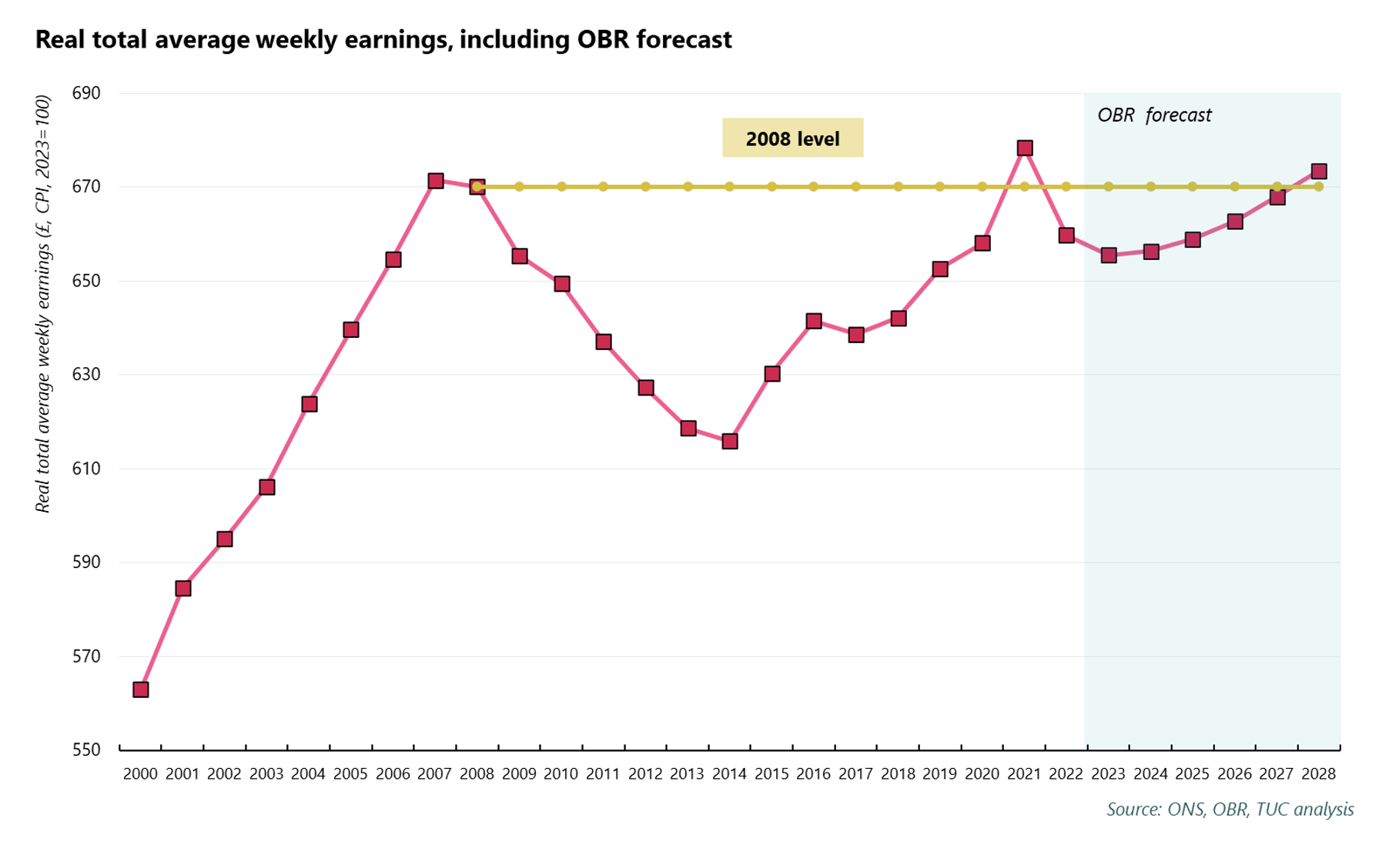
The forecasts published alongside the statement by the Office for Budget Responsibility (OBR) contained alarming news on real wages. According to the OBR forecasts, real wages are now not set to return to 2008 levels until 2028. The current pay squeeze will hit two decades.
This is a significant downgrade on the March forecast, when wages were returning to 2008 levels by 2026 – two years sooner than it now expects.
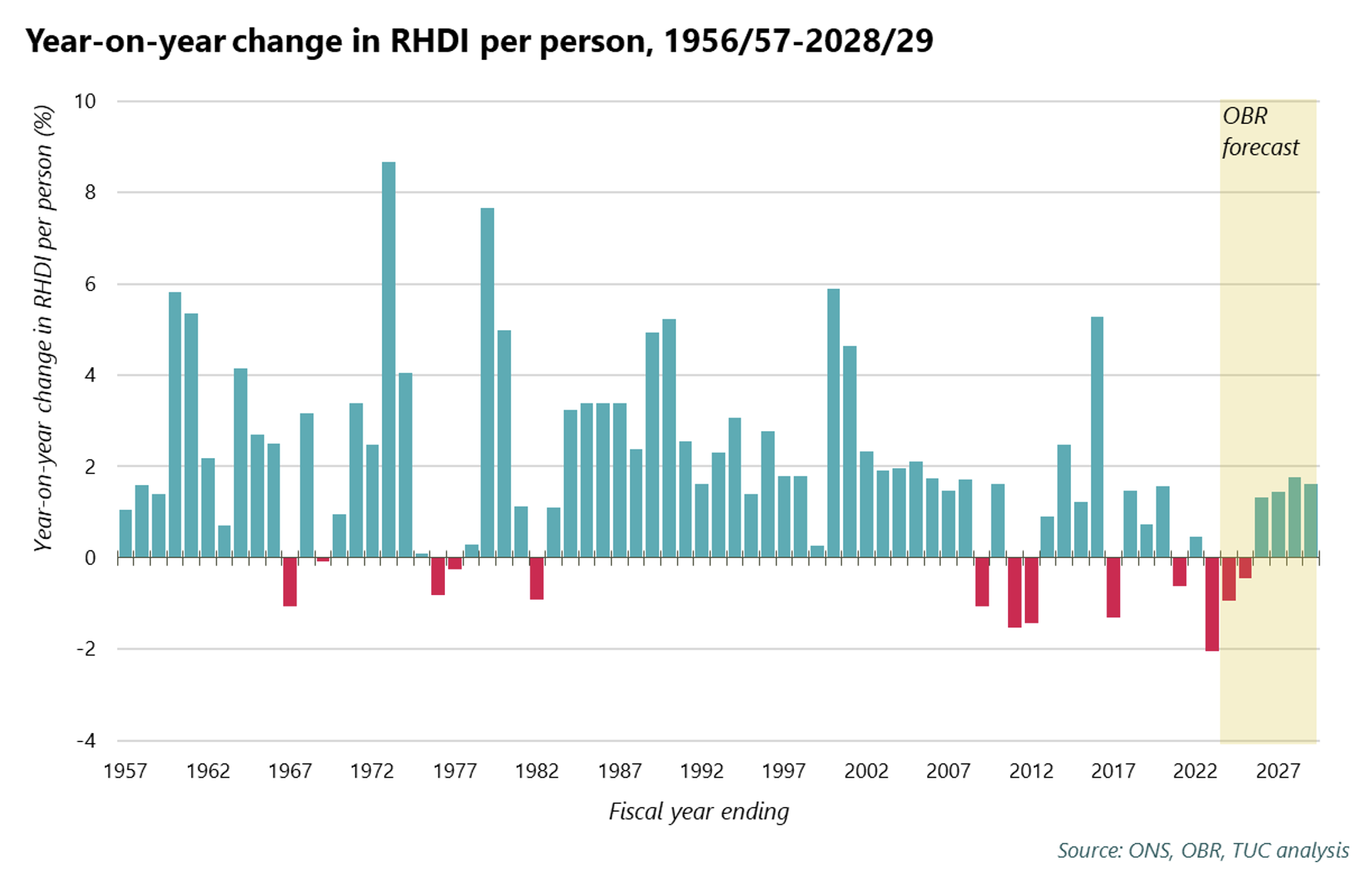
The forecast for broader living standards (as measured by real household disposable income per person) remains dire. After already declining in both the 2020/21 and 2022/23 financial years, further falls are expected over the next two.
While in fact a less bad forecast than March, the OBR stress that living standards “are forecast to be 3½ per cent lower in 2024-25 than their pre-pandemic level … this … represents the largest reduction in real living standards since ONS [Office for National Statistics] records began in the 1950s”.
The OBR also put into perspective the 2 per cent cut in National Insurance, reckoning it will boost living standards by around 0.5 per cent at the end of the forecast. This is a minor dent in an immense collapse, and of course as everybody has pointed out only reverses in a small way tax increases at past statements – even on their own terms the government are failing.
Minimum wage
Specifically for those on the minimum wage, the Chancellor has accepted the recommendations of the Low Pay Commission (LPC). This takes the wage floor to £11.44 an hour and extends coverage to everyone aged 21+. This is badly needed and follows pressure from unions and low-pay campaigners. But with prices sky high, and the OBR increasing its inflation forecasts, the minimum wage must be raised to £15 as soon as possible, and extended to all adult workers.
The Low Pay Commission’s recommendations take the minimum wage to 66% of median wages. This is an internationally recognised measure of relative low pay. However, the Chancellor’s claims that he has eliminated low pay should be taken with a pinch of salt. This is a measure of pay distribution which looks at how close low-paid workers are to the median worker. The floor has risen since 2010 but the middle has had no real pay rise over 13 years. The bottom has been catching up, in part, because wages are stagnant for everyone else. The government should set the LPC’s next minimum wage target at 75% of median wages, and this should be delivered alongside a plan for real wage growth for all workers.
Unemployment rise
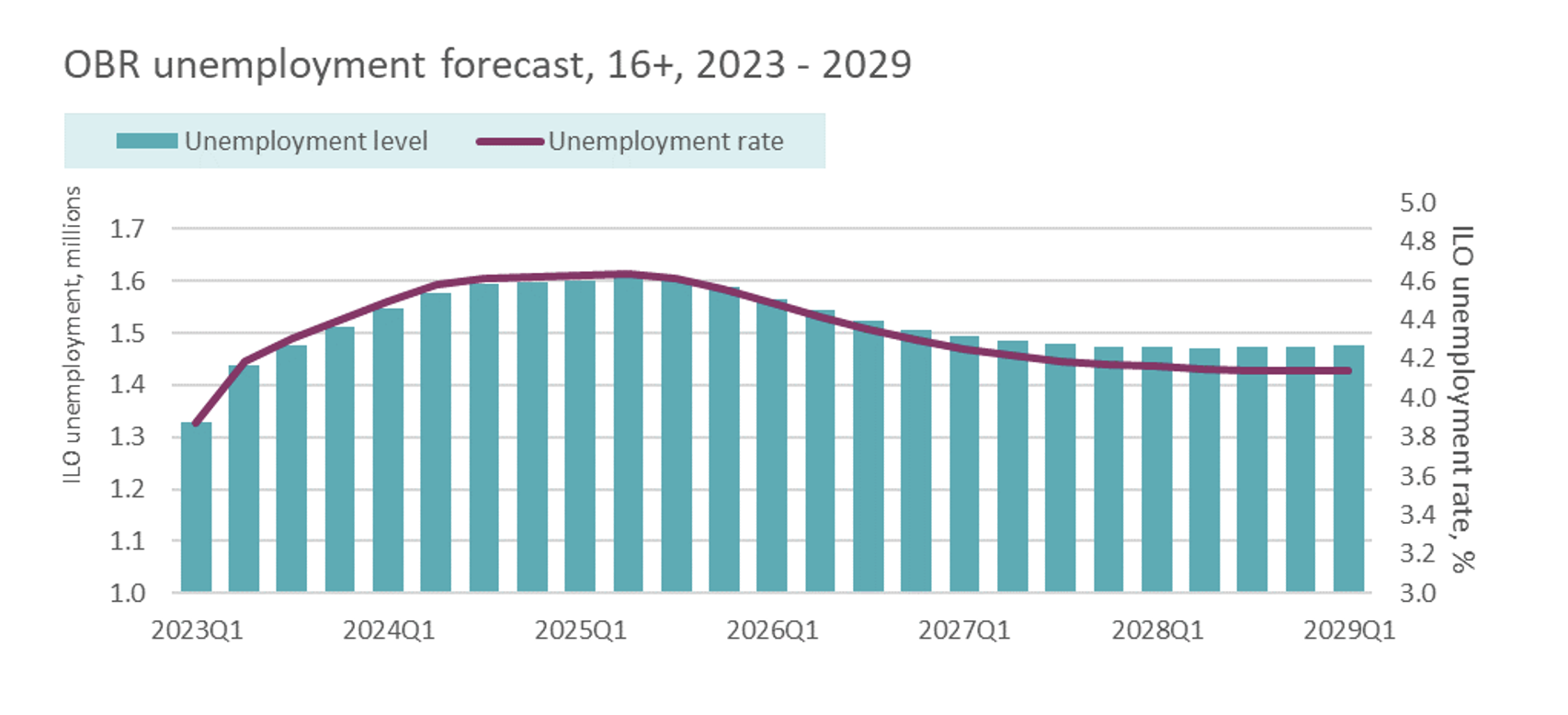
The OBR has also predicted that unemployment will steadily rise from now until midway through 2025, estimating there will be 275,000 more people in unemployment than at the start of this year. At no point in the OBR forecasts do they predict unemployment will fall below the level at the start of the year.
It is unfair to put it mildly to penalise individuals for an economic climate which is out of their control. The Chancellor decided to support compulsory work placements, but analysis show this punitive policy does not result in an improved employment outcome.
Skills
The Government plans focus largely on reforms coming in for 16-18 year olds, overlooking the skills gap faced by those already in the labour market. On apprenticeships £50m for a 2-year pilot widely misses the mark. In 2021/22, there were approximately 349,200 apprenticeship starts in England – a 31% decline from the pre-Apprenticeship Levy figures of 509,400 starts in 2015/16 (Source: CIPD). The funds are largely directed at male-dominated sectors, according to the Women’s Budget Group. Other measures are recycled and/or small – though the increase to the pitifully low apprenticeship minimum wage is be welcomed.
Little has been done to reverse cuts to adult and further education budgets since 2010, with spending still significantly below where it was when the government took office. Celebrating an uptick in Level 4 apprenticeships just repeats the ‘virtuous cycle’ where those with the highest levels of qualification receive the most investment in their training. Graduates get most of the training as working adults, and almost half of adults from the lowest socio-economic group receive no training at all after leaving school.
Social security
It is a low bar for this Government when they boast that benefits are being uprated in line with September’s rate of inflation, which is standard practice. Though they have severed the link between inflation and the uprating of benefits numerous times since 2010 – which has slashed vital financial support for families.
And while the Local Housing Allowance has been restored to the 30th percentile after it was last frozen in 2020, it will be frozen again and support reduced for ever-increasing rental prices.
There were also significant cuts to benefit entitlements for some people with long term health conditions. They are expected to lose £400 a month compared to current system, and face the threat of sanctions to enter employment.
The rate at which prices are increasing may have slowed, but families are still struggling with the essentials. Over the last two years the cost of energy has increased by 49 percent while food prices have increased by 28 percent.
Energy prices
And energy bills are a glaring omission from this Autumn Statement.
Household energy bills remain 50% higher than they were in the winter of 2021-2022 (approximately £600 higher for an average household). This means that an estimated 6.3 million households are in fuel poverty (spending more than 10% of their income on energy), and more than 1 million households are in extreme fuel poverty (spending 20% or more of their income on energy). (Estimate by Friends of the Earth and National Energy Action as government data are not yet available.)
Energy prices are expected to remain high or increase. Ofgem today raised the domestic energy price cap by 5%, based on wholesale price volatility.
Many employers will also struggle with rising and volatile energy bills. The UK consistently has some of the highest electricity prices for business in Europe, affecting the ability of UK manufacturers to compete internationally. Unions representing manufacturing workers have consistently campaigned alongside employer bodies for measures to rein in excessive and volatile wholesale energy prices – but these issues seem to be far from the list of priorities of the current Government.
Public services and public finances crises continue
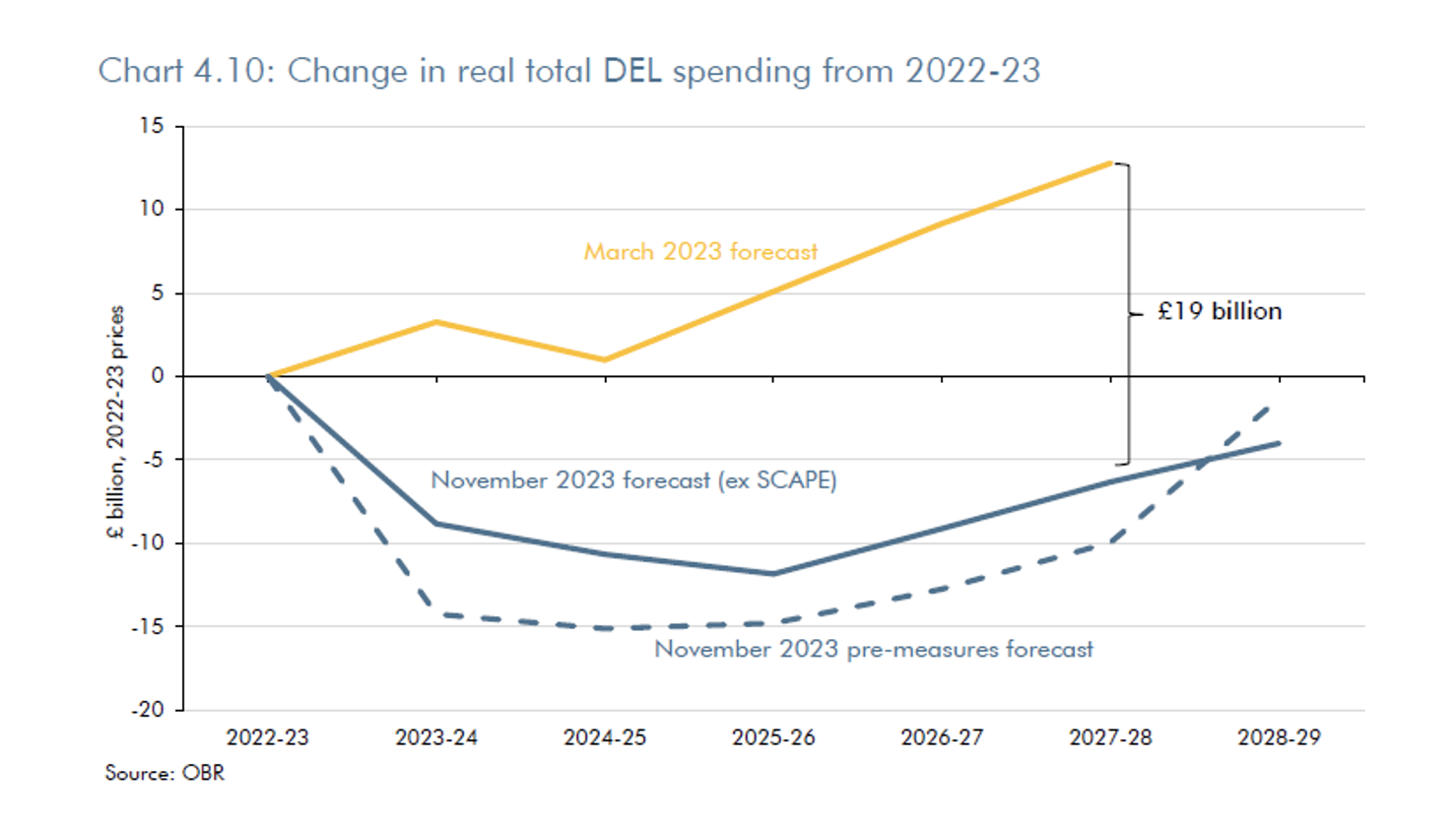
As the OBR gently warn, “it is worth dwelling for a moment on something the Chancellor didn’t announce in his Autumn Statement – which is any major change to departmental spending plans despite significantly higher inflation”.
The government has added “just” £5 billion a year in cash terms to departmental budgets, and this means that “the real spending power of these budgets is eroded by around £19 billion” relative to the previous forecast (as on their chart below).
In 2023-24 the increased budget is allocated for public sector pay increases (£3.9 billion for the NHS in 2023-24, and £0.4 and £1.4 billion for other departments in 2023-24 and 2024-25, respectively). Overall, the OBR have departmental spending growing by 0.9 per cent a year in real terms, down from 1.1 per cent at the March Budget.
Given the government’s political priorities on spending, the OBR stress that unprotected departmental spending is projected to fall by between 2.3 and 4.1 per cent a year in real terms from 2025-26. They wryly observe this (austerity) would “present challenges” and cite the Institute for Government’s recent report finding that “performance in eight out of nine major public services has declined since 2010”. Plainly there is no intention to resolve the crisis in public services and public service recruitment. And ultimately
The public finances overall
For the public finances as a whole, the government has enjoyed a momentary windfall – with less bad than expected growth outturn and higher inflation meaning tax gains (especially with tax thresholds not being uprated) outweighing higher interest and other costs. This has been spent on the NI cut and expensing.
But the Chancellor has made hollow boasts about the improved condition of the public finances. The overall management of the economy for 13 years has meant a disastrous failure for them. Immediately less bad GDP outcomes (next section) have meant marginally improved ratios for this statement. But overall the Conservatives have presided over a huge increase in debt from 65 per cent of GDP in 2009-10 to 98 per cent of GDP in the current financial year. This is an unprecedented deterioration relative to all economic cycles for more than a century.
Growth crisis unended
At the end of his speech the chancellor proclaimed an “Autumn Statement for Growth”. But nothing announced yesterday changed the bottom line. While the forecasts reflected ONS revisions to GDP data and a less bad than expected 2022, growth over the next two years is revised steeply down. And on a medium term view the OBR warn:
“we have revised DOWN our estimate of the medium-term potential GROWTH rate of the economy to 1.6 per cent, from 1.8 per cent in March” (our emphasis)
Of the onslaught in policy measures, the most prominent was making permanent the full expensing of business capital investment. The Chancellor chose to disregard OBR analysis showing both precursor measures (the super-deduction and temporary full expensing in the March 2021 and March 2023 Budgets) had a lower impact on investment levels than predicted (see OBR, Economic and Fiscal Outlook, November 2023, pp 33 – 34).
Introducing full expensing is forecast by the OBR to lead to an increase in business investment of £14 billion between now and 2028-29 and to cost £29.5 bn over the same period. This would appear then to be an extremely inefficient means of increasing business investment, reflecting huge ‘deadweight’ effects, whereby businesses gain generous tax relief on investment that would (likely) have taken place anyway.
The OBR estimates that the measure will raise the capital stock by 0.2 per cent by 2028-29 – a positive, but small, and very costly impact.
Pension saving
The chancellor also had high hopes for the role workers’ £2.5tn of pension savings could play in boosting our flagging economy. But while there were some welcome steps such as setting up a new growth fund through the British Business Bank the plans rely mostly on merging pension schemes in ways that are unlikely to be in the interests of their members, and leaning on funds to put more money into global private equity. These measures were also over shadowed by a poorly thought through proposal to upend the workplace pension system. See our fuller commentary here.
Industrial strategy?
As the Chancellor noted, the lack of long-term certainty over policy decisions (including industrial strategy, taxes, and climate commitments) is a drawback to business decisions to invest. But there was no reassurance in the Autumn Statement that the Government would provide that certainty. While reannouncements of investment commitments to support the automotive, advanced manufacturing, and energy sectors – amounting to £4.5 billion are welcome, this represents only a small proportion of the investment requirements of the Biden-style industrial strategy that the UK needs.
Ending the failure
The failure – as Labour have repeatedly identified – is still a failure of growth. The government need to invest in a stronger economy where growth and fairness go hand in hand, where decent pay means workers spend and businesses produce to meet that spending. A virtuous cycle comes when businesses invest in the face of expansion and optimism, and stronger public services re-enforce the upward dynamic. Fairer and sustainable growth will then support the public finances.
Yet the government continues to take us in the wrong direction. Yesterday’s Autumn Statement showed more strongly than ever why it is time for a change.
Autumn Statement ‘ushers in new era of welfare reform’
A ‘bold new vision for welfare’ backed by nearly £30 billion has been set out by Work and Pensions Secretary Mel Stride
Millions of people will benefit from next generation of welfare reforms and extra support for those most in need, announced at Autumn Statement
Benefits increased by 6.7% and pensions by 8.5%, maintaining commitment to seeing the country through cost of living pressures
DWP Secretary Mel Stride heralds new era offering a “brighter future for millions”
The plans offer unprecedented employment and health support to help over a million people, while protecting those in most need from cost of living pressures – including raising pensions and benefits and increasing help with housing costs.
Long term decisions to provide unprecedented help for people to move off welfare and into work were at the heart of the Government’s plan for growth set out at the Autumn Statement.
While unemployment has been almost halved since 2010, the £2.5bn Back to Work plan will help thousands of people with disabilities, long-term health conditions and the long-term unemployed, to move into jobs. This comes alongside new guarantees for those on the highest tier of health benefits around keeping benefit support to cushion those who try work.
The transformative employment programme comes as the Government continues to protect the most vulnerable, delivering a Triple Lock-protected boost for pensioners and raising benefits in line with inflation next year, worth £20bn taken together.
The changes mean the full rate of the new State Pension will go up by £17.35 per week, while families on Universal Credit will be on average £470 better off next year.
Around 1.6 million households will also benefit from an increase to the Local Housing Allowance – and will be around £800 a year better off on average. Worth more than £7bn over five years, this commitment will support low-income families in the private rented sector with rent costs and help prevent homelessness.
Secretary of State for Work and Pensions, Mel Stride MP said: “Work changes lives. With the next generation of welfare reforms, we will help thousands of people to realise their aspirations and move off benefits into work, while continuing to support the most in need.
“We are taking long term decisions that will build a brighter future for millions, offering unprecedented support to open up opportunity and grow the economy, building on our record that has seen almost four million more people in work since 2010.
“Our reforms will remove the barriers to work that we know some people still face, while we’re boosting benefits and pensions to help with cost of living pressures.”
Welfare reforms announced at the Autumn Statement include:
Uprating working age benefits in line with September’s CPI index figure of 6.7%.
Uprating state pensions in line with September’s earnings figure of 8.5%.
Increasing the Local Housing Allowance to cover the 30TH percentile – worth an average of £830 per year.
Expanded jobcentre support including intensive help for those on Universal Credit
Introducing the Chance to Work Guarantee, which will tear down barriers to work for millions of claimants to try work with no fear of reassessment or losing their health benefit top-ups.
Increasing mental health support for jobseekers by expanding NHS Talking Therapies treatment and the Individual Placement and Support programme, supporting almost 500,000 over five years.
Matching 100,000 people per year with existing vacancies and supporting them in that role through Universal Support.
Rolling out WorkWell to support people at risk of falling into long-term unemployment due to sickness or disability.
Reforming the Work Capability Assessment for new health benefit claimants to better reflect the opportunities available in the modern world of work.
Stricter sanctions for people who should be looking for work but aren’t engaging with jobcentre support.
Building on the Mansion House reforms with further steps to improve private pension returns and grow the economy.
Introducing new Government powers to request data from organisations such as banks when accounts are showing signals of fraud and error.
The Government’s ‘radical new plan’ will stem the flow people falling out of work and onto inactivity benefits due to physical or mental health problems, as it takes the long-term decisions to help people realise their dreams to find a job and build a better life.
With this unprecedented level of employment support comes tougher enforcement of sanctions for fit and able people who should be looking for work but aren’t.
Work coaches will use tools to track people’s attendance at jobs fairs and interviews, and close benefit claims of those able to work who have been sanctioned and no longer receiving money after six months.
Taken together, the package will make sure those who are vulnerable or on the lowest incomes are protected, with intensive support to get them back into work, while ensuring fairness to the taxpayer.
Foreign Secretary announces further funding to tackle growing humanitarian crisis in Gaza
On day two of a visit to Israel and the OPTs, Foreign Secretary David Cameron – Lord Cameron of Chipping Norton’ – announces further UK funding to tackle the growing humanitarian crisis in Gaza.
In meetings in Israel, Foreign Secretary pressed to open up greater access for lifesaving support including medical supplies and fuel.
As the fourth UK aircraft of humanitarian aid arrives in Egypt, the UK pledges £30 million additional aid funding for Gaza.
Following a series of meetings with senior Israeli politicians on Thursday, the Foreign Secretary’s talks today will focus on how UK efforts can help alleviate the growing humanitarian crisis in Gaza.
He will also discuss supporting the Palestinian Authority, including through training and capacity building, and look towards a long-term political solution to the crisis.
The Foreign Secretary will also meet aid agencies delivering UK-funded humanitarian support in Gaza.
The Foreign Secretary has announced that the UK will provide a further £30 million in humanitarian aid which will support trusted partners, including UN agencies on the ground, to deliver lifesaving aid to people in Gaza.
It brings to £60 million the additional aid announced by the UK for Palestinian civilians since the crisis started in October.
Foreign Secretary, David Cameron said: “We are hopeful that today will see the release of hostages, and I am urging all parties to continue to work towards the release of every hostage. A pause will also allow access for life-saving aid to the people of Gaza.
“I am proud that a fourth UK flight carrying critical supplies landed in Egypt today, and I can announce new £30m of funding which will be spent on vital aid such as shelter and medical provisions.
“It is vital to protect civilians from harm, and we are urgently looking at all avenues to get aid into Gaza, including land, maritime and air routes.”
Today’s additional funding comes as the fourth UK aircraft carrying humanitarian aid landed in Al Arish, Egypt, for onward transfer to Gaza. The RAF flight carried 23 tonnes of humanitarian aid, including 4,500 blankets and 4,500 sleeping mats for distribution by the United Nations Relief and Works Agency (UNRWA).
Defence Secretary Grant Shapps said: “The RAF continues to deliver on the UK’s commitment to helping those in need by operating flights into the region to provide urgent humanitarian support which will save civilian lives.
“The UK is driving international efforts to support the humanitarian response in Gaza, working closely alongside partners and allies to de-escalate the situation.”
During his visit, the Foreign Secretary continued to urge all parties to make progress on the agreement between Israel and Hamas, brokered by Qatar and Egypt, to allow the release of a number of hostages and a pause in the fighting and ensure the agreement is adhered to in full.
A new Welcome Hub for assisting Ukrainians in Edinburgh and an adjacent warehouse for aid and donations was officially opened yesterday by Council Leader Cammy Day.
The Council Leader was joined by Chief Executive Andrew Kerr, Secretary of State for Scotland Alister Jack, Chair of the Associations of Ukrainians in Great Britain (AUGB) Edinburgh Branch, Hannah Beaton-Hawryluk, Chief Executive of Edinburgh Voluntary Organisations’ Council (EVOC), Bridie Ashrowan, Chief Officer of Volunteer Edinburgh, Paul Wilson, and other key stakeholders.
The Hub is at the Vega Building in Flassches Yard to the west of the city, and was previously based at the NatWest Group’s Gogarburn House. The Hub is the primary entry point for direct arrivals into Scotland of which there have been over 11,000 since February 2022. Volunteers have contributed over 7,000 hours of welcoming work at Edinburgh Airport during this period.
The main Council support team for is now based at the Hub, for the approximately 3,000 Ukrainians (representing up to 900 households), currently in Edinburgh. Over 350 children and young people are in our education system.
This support now represents the shift in focus from triaging new arrivals to offering longer term help and support. From accessing advice on housing, education, employment, and other key service areas to meeting new people and developing social ties, this facility is key.
The Local Employability Partnership is made up of 12 key organisations whose collective efforts have directly supported over 1,200 individuals and helped 75% of displaced Ukrainians move into employment. The main focus is now on upskilling, development and closing the wage gap between qualifications and experience in Ukraine and Scotland.
The aid warehouse is also an integral component of the city’s response. Not only does this allow vital supplies to be delivered to Ukraine but it also provides essentials for the Ukrainian population in Edinburgh.
More information on support for Ukrainians in Edinburgh can be found on our website.
Council Leader Cammy Day said:“Since the first days of Russia’s illegal war against Ukraine, Edinburgh has stood shoulder to shoulder with Ukraine and that solidarity and support remains undiminished.
I”t was fantastic to show the Secretary of State for Scotland, Alister Jack, around our new Welcome Hub and aid warehouse. It was particularly fitting to do so alongside some of the key members of the Edinburgh partnership who have integral to the city’s monumental response to supporting Ukrainians into the Capital. The work that has been undertaken during this period has been nothing short of excellent.
“As we shift our focus from welcoming our Ukrainian guests to helping with settling into their new lives here in Edinburgh, this strength of partnership is as important as ever. I’d like to wholeheartedly thank all our partners and the people of Edinburgh for all their efforts. We’re also very grateful to NatWest Group for allowing us to use Gogarburn House as the first Hub location and for their continued support.
“To our Ukrainian friends currently residing in Edinburgh, I’d like to repeat my message that this city is your home for as long as you require it. We’re continuing to identify long-term housing opportunities for all our residents and will continue to work with the Scottish Government going forward to identify funding opportunities.
“We pride ourselves on being a diverse, welcoming, and cosmopolitan city and our Ukrainian neighbours add much to Edinburgh’s social and cultural fabric.”
Secretary of State for Scotland, Alister Jack said:“It was a huge pleasure today to meet representatives of Edinburgh’s Ukrainian community, third sector and local authority partners.
“This demonstrates the strength of partnership in Edinburgh to support Ukrainians. The Edinburgh welcome hub and aid warehouse is a fantastic initiative, offering support to Ukrainians fleeing the war, supporting Ukrainians to settle here in the longer term, as well as delivering aid to those in Ukraine.
“It is a great example of the voluntary and community sector working in partnership with Edinburgh City Council. The UK Government’s support for our friends in Ukraine is absolute, and I am very pleased that we have been able to offer refuge in Scotland to so many Ukrainians.”
Chair of the Associations of Ukrainians in Great Britain (AUGB) Edinburgh Branch, Hannah Beaton-Hawryluk, said:“Over the last 20 months, our community has grown to over 3,000 people who have sought safety in Edinburgh.
“With the support of partners, volunteers, and external agencies, we’ve been able to expand our work at the Ukrainian Community Centre to provide ongoing support and a safe social space for the community.
“Today was a great opportunity to meet with the Secretary of State to express our gratitude for the support of the UK Government and to press for further support particularly around providing certainty on routes to longer term resettlement which is one of the biggest concerns for our community. We look forward to an ongoing, and open, dialogue with the UK Government.
Bridie Ashrowan, Chief Executive of EVOC said: “Today was a great opportunity to meet with the Secretary of State to highlight the vital work of Edinburgh’s voluntary and community sector, and the ongoing partnership with the City of Edinburgh Council to support Ukrainians seeking safe refuge in the city.
“Since the start of the war in February 2022, Edinburgh’s community, and voluntary sector – with the support of EVOC and Volunteer Edinburgh, the City of Edinburgh Council, and all public partners – have worked closely to mobilise partners.
“This has delivered a range of support services including food provision, mental health services, employability support and cultural experiences. The impact has resulted people getting jobs, learning English, having early mental health support and importantly, experiences of friendship that are incredibly moving to hear about and key to life in a new country after fleeing war.
“Looking ahead, it is essential that community and voluntary sector organisations in Edinburgh are effectively resourced so that they can continue to play a key role in the long term, sustainable integration of the Ukrainian community in Edinburgh – for as long as Ukrainians require to seek safety.
Biggest ever increase to the National Living Wage, worth over £1,800 a year for a full-time worker, fulfils manifesto pledge to end low pay.
Since 2010 the National Living Wage will have doubled in cash terms from around £10,500 to nearly £21,000 a year for a full-time worker.
For the first time, 21-year-olds on the National Living Wage will always earn two-thirds of average earnings.
The Chancellor will deliver a pay rise of more than £1,800 a year for a full-time worker, as he confirms that the National Living Wage will increase by over a pound an hour from April.
The almost 10% pay boost, from £10.42 to £11.44 an hour, is the biggest cash increase in the National Living Wage in more than a decade and fulfils the government’s manifesto pledge to end low pay for those on the National Living Wage.
Eligibility for the National Living Wage will also be extended by reducing the age threshold to 21-year-olds for the first time. A 21-year-old will get a 12.4% increase, from £10.18 this year to £11.44 next year, worth almost £2,300 a year for a full-time worker.
National Minimum wage rates for younger workers will also increase. 18-20-year-olds will also get a wage boost to £8.60 per hour – a rise of £1.11.
The Department for Business and Trade estimate 2.7 million workers will directly benefit from the 2024 National Living Wage increase.
Chancellor of the Exchequer Jeremy Hunt said: “Next April all full-time workers on the National Living Wage will get a pay rise of over £1,800 a year. That will end low pay in this country, delivering on our manifesto promise.
“The National Living Wage has helped halve the number of people on low pay since 2010, making sure work always pays.”
The minimum hourly wage for an apprentice is boosted next year, with an 18-year-old apprentice in an industry like construction seeing their minimum hourly pay increase by over 20%, going from £5.28 to £6.40 an hour.
The National Living Wage was introduced in 2016 and currently sets the minimum hourly pay a person over the age of 23 earns when working. The new rate will now apply to 21- and 22-year-olds, and means that the government has met its ambitious target of lifting the National Living Wage to two-thirds of median earnings by 2024, ending low hourly pay for those on the National Living Wage.
Since 2010, the proportion of workers on low hourly pay has more than halved from 21.3% to 8.9%, supported by increases to the National Living Wage. Personal tax thresholds have been doubled, meaning a working person can now earn £1,000 a month tax-free for the first time.
Bryan Sanderson, Low Pay Commission Chair, said: “The National Living Wage has delivered an improved standard of living to thousands of people who care for our children and elderly, work in farms and shops and at many other essential jobs.
“These efforts over the lifetime of the NLW mean over £9,000 p.a. more to a full time worker without any increase in unemployment.
“This hasn’t been easy for employers, with the economy facing a range of unprecedented challenges in recent years. The high degree of political and economic uncertainty has made assessing and forecasting the performance of the economy, and therefore our task, very difficult. It is a tribute to my fellow Commissioners that we have continued to achieve consensus.
“Our new recommendation of a National Living Wage of £11.44 attempts to steer a path through this uncertainty and achieve the government target of two-thirds of the median wage, an outcome which if accepted would position the U.K. at the forefront of comparable economies.”
Getting more people into work and ensuring work pays is ‘a priority for the UK government’. The Chancellor will set out further measures in today’s Autumn Statement.
The number of 50PLUS Champions helping older workers into work has been doubled in Jobcentres up and down the country, the Minister for Employment has announced.
Network of dedicated 50PLUS Champions across Great Britain is increased ahead of National Older Workers Week
This builds on millions invested to support the over 50s into work as Minister for Employment and B&Q back older workers
The number of 50PLUS Champions helping older workers into work has been doubled in Jobcentres up and down the country, the Minister for Employment has announced.
Ahead of https://www.nationalolderworkersweek.co.uk, 77 50PLUS Champions – up from 37 – are now in place across England, Wales and Scotland, working directly with Jobcentres and employers to remove barriers that are keeping older people out of work.
50PLUS Champions work with jobseekers to change preconceptions about hiring older workers and ensure Jobcentre staff are supporting jobseekers to find roles or opportunities tailored to their skills to deliver for employers.
There are 83,000 more over 50s in work compared to this time last year. The DWP is supporting older jobseekers, with Midlife MOTs both online and in Jobcentres, helping people assess their skills and, make long-term plans for their work, wealth and wellbeing.
The news comes following a recent visit made by the new Minister for Employment, Jo Churchill, to B&Q’s New Malden branch. The company prides itself on having a multi-generational workforce with 35 percent of staff being over 50.
Minister for Employment, Jo Churchill MP said: “I know that work brings benefits to all ages, whether that’s improved wellbeing, making important friendships, or earning more.
“As a Government, we are working hard to get more people into work and tackle inactivity.
“Doubling the number of our 50PLUS Champions means even more jobseekers can access tailored support.
“On this National Older Workers Week, I urge all businesses to step up and put age diversity at the heart of what they do.”
Andy Moat, B&Q’s HR Director added: “We were delighted to recently welcome the new Minister for Employment to B&Q New Malden for her to hear at first hand from some of our older workers the benefits of working.
“B&Q is a very multigenerational workforce, and we believe in creating an environment where people can grow, thrive, and truly be themselves.
“We do this in many ways, including through our Apprenticeship programme, and we have Apprentices aged from 17 to 70 years studying to gain new knowledge and skills to help develop their careers, whilst continuing to earn the same rate of pay as others doing their role.”
While in New Malden, the Minister saw first-hand how the business is supporting the over 50s into work, meeting with older Apprentices who highlighted the impact retraining can have on this age group.
The Government is investing £6 billion to tackle economic inactivity to get more people into work, including older people. This includes £2.5 billion announced this week as part of our Back to Work Plan, an ambitious package of employment support which will keep more people in work by helping them to manage their health conditions.
To mark National Older Workers Week, the DWP is organising numerous events across Great Britain, including jobs fairs in Oldham, Edinburgh, Bath and Newport all specifically targeted at jobseekers who are over 50.
The trial will use innovative screening methods like an MRI scan and see hundreds of thousands of men across the country participating
On International Men’s Day, UK Government joins Prostate Cancer UK to unveil £42 million screening trial to find ways of detecting country’s most common male cancer earlier
Hundreds of thousands of men across the country will participate, with one in ten participants set to be black men who have a much higher prostate cancer risk
NHS England to carry out suite of improvements to men’s health pages online, and first ever Men’s Health Ambassador set to be appointed by government
Thousands of men’s lives could be saved, and their loved ones spared the tragedy of losing someone to cancer, as a major new prostate cancer screening trial is set to get under way in the UK backed by £42 million from the government and Prostate Cancer UK.
The first-of-its-kind trial – called TRANSFORM – will use innovative screening methods like an MRI scan to detect prostate cancer, and it will see hundreds of thousands of men across the country participating.
Prostate cancer is the most common cancer in men in the UK and has no screening programme. It usually has no symptoms until it has grown large and may be more difficult to treat and, sadly, 12,000 men die of it every single year.
A way of effectively screening for prostate cancer could find these men before their cancer spreads and save their lives.
The trial has the potential to see new screening methods give more accurate results than the current blood tests, which can miss some cancers and often suggest prostate cancer when no cancer exists.
Crucially, screening could also spot the disease even when no symptoms are displayed.
Announcing the programme yesterday on Men’s Health Day, Health and Social Care Secretary Victoria Atkins said: “Cancer survival rates continue to improve in the UK, with the disease being diagnosed at an earlier stage more often. But more must be done.
Our hope is that this funding will help to save the lives of thousands more men through advanced screening methods that can catch prostate cancer as early as possible.
Laura Kerby, Chief Executive at Prostate Cancer UK, said: “12,000 men die of prostate cancer each year and it’s the most common cancer that doesn’t have a national screening programme.
“It’s about time that changed. That’s why we’re launching our biggest and most ambitious trial ever. It will finally give us the answers we need to develop a routine testing system and save thousands of men each year.
“Prostate Cancer UK’s unique focus and expertise made us the only organisation that could really deliver this paradigm-shifting trial, and we’re delighted that the government has backed our vision to revolutionise diagnosis.”
1 in 4 black men will develop prostate cancer – double the risk of other men. Therefore, to ensure the trial helps reduce their risk of dying from this disease, 1 in 10 men invited to participate will be black men. Participating men in the screening trial will be aged 50-75, with black men eligible from the lower age range of 45-75.
Men at higher risk of prostate cancer due to age and ethnicity will be recruited through their GP practice and invited to a screening visit.
More than 52,000 men are diagnosed with prostate cancer every year in the UK on average – that’s 144 men every day. Around 490,000 men are currently living with and after prostate cancer.
Sports broadcaster Steve Rider, 73, shared his prostate cancer diagnosis last month: “It was from talking with friends that I explored my risk of prostate cancer, I didn’t have any symptoms and wasn’t expecting to be diagnosed.
“Luckily, my cancer was all contained within the prostate, giving me the opportunity to have significant surgery to deal with it, but for too many men they are diagnosed late.”
£16 million will be invested by the government for the trial through the National Institute of Health Research and Prostate Cancer UK, who have led the development of the trial, will provide £26m. The trial is due to start in Spring 2024 with recruitment likely to begin in Autumn 2024.
The government has already opened 127 community diagnostic centres to offer quicker, more convenient checks outside of hospitals for conditions such as cancer, with over five million additional tests delivered so far.
The Major Conditions Strategy will also consider the prevention, diagnosis, treatment and management of conditions including cancer. The UK is already working with world renowned scientists to deliver new cancer vaccine trials and is growing the size of the specialist workforce.
Daniel Burkey, 58, from Yorkshire, was diagnosed with advanced prostate cancer in June 2021. He said: “Men need prostate cancer screening so that if we’ve got it, we can find out early enough to treat it and get rid of it. I got my diagnosis in my fifties, and the doctor told me the horrible news that it can’t be cured.
“It was an awful shock, and I still find it hard to accept that I’ll always have this disease, but I’m doing everything I can to control the cancer with chemotherapy, radiotherapy and two kinds of hormone therapy; one by injection, one orally.
“Things could have been different if I’d been tested routinely and caught it early enough. If the UK gets prostate cancer screening, so many lives will be saved. Knowing that this trial is going to find a way to do that makes me optimistic for other men.”
Professor Lucy Chappell, Chief Executive of the National Institute for Health and Care Research (NIHR), said: “New research into harnessing innovative screening methods is crucial in finding ways to detect this serious disease earlier, in the race against time to save lives.
“That’s why setting up this landmark new trial in partnership between NIHR and Prostate Cancer UK is so important.
“Together we can aim to generate high quality long-term evidence to benefit men at risk of developing this condition, and to inform those who plan and deliver NHS services of how best to test for the disease.”
In other measures announced yesterday:
Men’s Health Ambassador:
The government will be recruiting for the UK’s first ever Men’s Health Ambassador, we are inviting applications from anyone with an interest and expertise in men’s health.
The successful candidate, to be announced in the coming months, will be responsible for increasing awareness of certain conditions and health needs faced by men. They will help dispel taboos and stigmas and encourage more open conversations among men about their general health.
The role will be open for applications on GOV.UK shortly.
NHS Website Updates:
NHS England will deliver a host of important improvements and updates to pages on its website most used by men.
This will make it easier for men to both find and understand the help and support on offer for certain conditions.
Pages on issues like prostatitis, testicular cancer, and low sperm count will be updated in the coming months.
Men’s Health Task and Finish Group:
The government will establish the first Men’s Health Task and Finish Group.
Membership will include behavioural scientists, men’s health campaigners, experts and academics.
Together, they will help us identify how we can get more men to engage with their health, including a focus on better understanding male access to primary care services, such as GPs, and male uptake of the NHS Health Check.