A key factor in the bid to end poverty in the Capital by 2030 is the steps being taken by the Council and partners to prevent and mitigate the impacts on women.
This is closely linked to child poverty, given there is a proportionately high share of caring responsibilities adopted by women in general – 90% of lone parents are women, 38% of those in Scotland live in poverty.
Women have also been disproportionately affected by the cost of living crisis and, alongside childcare, these patterns are strongly driven by gender inequalities in the workplace. Women account for 60% of all low paid workers in Edinburgh and 78% of all part time workers.
In response to these challenges, actions in the Council’s End Poverty in Edinburgh Delivery Plan, and other plans, which are expected to prevent or mitigate the impact of poverty on women and girls, include:
Raising awareness of the gender impacts of poverty
Helping to increase incomes for women in poverty
Reducing the costs and impact of childcare responsibilities
Council Leader Cammy Day said: “Tackling poverty is one of our key priorities as a Council and our 2030 target is ambitious but one I’m convinced can be achieved. We have to act decisively if we’re to eradicate poverty in Edinburgh.
“It’s a fact that women are more likely to experience poverty and thus it was important that we had a separate update on specific actions being taken to help to further highlight this issue.
“It’s also of course not just the material constraints of living in poverty that make things hard, it’s the emotional strain and it is important that we do all we can to tackle this.
“This update on actions currently underway was well received by councillors who fully support the work of the End Poverty in Edinburgh Delivery Plan which gives an important overview of where we are. We know that we can’t achieve our goals in insolation.
“That’s why we are working with partners such as the End Poverty Edinburgh citizen’s group who help us make sure that the real experiences of people who live in poverty are at the centre of shaping the actions we take to tackle poverty and inequality in the capital city.
“Analysis of these actions will be continued, and I look forward to the update on the wider End Poverty in Edinburgh progress later in the year where will look at all households and priority groups.”
NO Poverty concerns for one new council employee. Edinburgh’s interim Director of Adult Social Care will be paid no less than £403,390 A YEAR!
I’m sure that will go down really well with the capital’s care workers, the majority of whom are women! – Ed.
May Day is a unique occasion in our calendar. It’s when we celebrate the bonds that unite workers and trade unionists across the world. When we reflect on our shared values of equality, justice and solidarity. And when we remember the huge advances won by the collective struggles of working people (writes TUC General Secretary PAUL NOWAK).
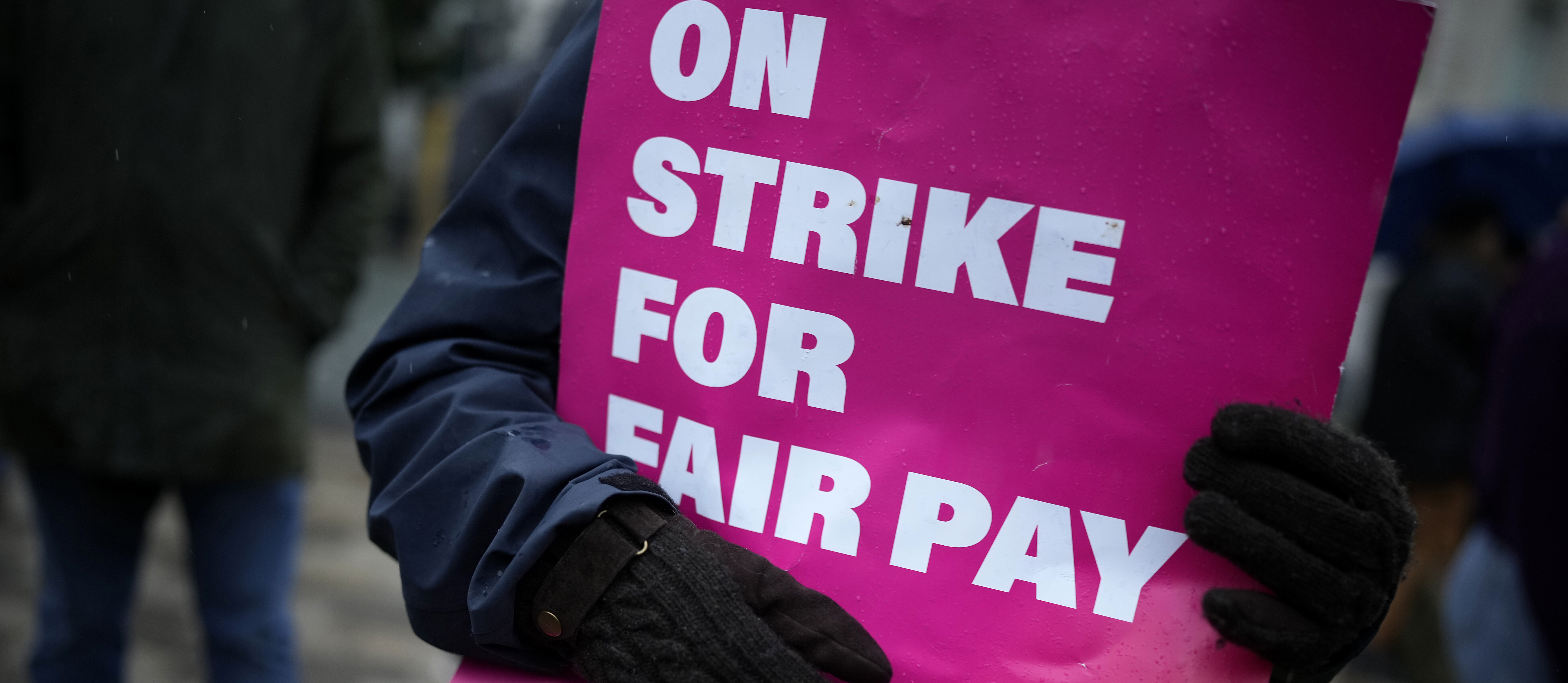
And this year, May Day has a special resonance. The cost-of-living crisis shows few signs of easing. Food prices are now rising at almost 20 per cent, hitting the poorest hardest. And across the economy, in both private and public sectors, hundreds of thousands of workers are striking for fair pay. I’ve been proud to visit scores of picket lines, meeting inspirational reps and workers, many on strike for the first time. Unions don’t accept we have to become poorer.
In the public sector, the government is refusing to deliver decent pay rises for the workers it lauded as heroes during the pandemic. Ministers had to be dragged kicking and screaming to the negotiating table following industrial action by health and education unions. But they are still failing to negotiate in the civil service – and the TUC will resist any attempts to play one group of workers against another.
Meanwhile, in the private sector, unions have been winning some impressive deals for their members. And a special mention to workers at Amazon in Coventry, who have been taking historic strike action for fair pay and union recognition.
But as workers fight for a fair deal, the Conservative government is attacking our right to strike. Their Anti Strikes Bill is undemocratic, unworkable and probably unlawful. It makes the UK an international outlier by imposing yet more draconian restrictions and penalties on unions.
Small wonder the legislation has been condemned by employment law experts and, earlier this week, by over 100 politicians worldwide. And on Wednesday, Labour, Lib Dem and crossbench peers in the House of Lords defeated the government four times on the bill.
That’s why the TUC has called an emergency “reject and repeal” protest outside Parliament to coincide with the final Commons votes on the bill. We can’t be sure about exact dates just yet, but it’s likely to be sometime in mid May.
Full details will be posted on our website as soon as possible. This is a big opportunity for us to put our concerns firmly in the political, media and public spotlight.
As working families struggle to stay afloat, those at the top are raking it in. Chief executives continue to trouser massive pay packages. Shareholder dividends have gone up three times faster than wages. And bankers in the City of London have just enjoyed the biggest bonus round since the crash. Britain is increasingly unequal: as hospitals set up food banks to feed their own staff, Porsche dealers report record sales.
Instead, we need an economy that rewards work not wealth. The TUC is demanding fair taxes, including a proper windfall tax on obscene energy profits. We want a £15 minimum wage, better pensions and a boost to Universal Credit. And we want stronger collective bargaining rights for unions, so we can win fair pay for all and ensure the gains of tech change and AI are shared fairly.
We’re also campaigning for political change and the election of a new government on a worker- and union-friendly manifesto. But whatever happens, we must rebuild our collective strength, advancing our membership and organisation right across the economy.
My overwhelming priority remains to build a stronger, more diverse, more inclusive movement. And whether it’s fighting racism, rooting out sexual harassment or resisting the government’s spiteful Illegal Migration Bill, there’s plenty we can do. This May Day, let’s resolve to fight for all working people, in all our wonderful diversity. Ultimately, that’s the best way to win the change we need.
Following the shambles of this year’s City of Edinburgh Council budget in which full council voted for a budget including privatisation and compulsory redundancies, Edinburgh’s trade unions have joined together to demand better for the workforce and the community.
GMB, Unison, and Unite represent the majority of workers employed across the council including front line services such as waste, care, parks and roads, and non-teaching staff in schools.
The joint trade unions welcome the council leader’s assurances he has no intention of implementing the budget in full, but this is not enough and are further calling on City of Edinburgh Council to give their workforce security by re-setting a budget which takes compulsory redundancies and privatisation off the cards completely.
The joint trade unions are asking the public to stand by the council workforce, by signing the public petition and writing to their local councillors: https://edcouncilpledge.carrd.co/
GMB Organiser Kirsten Muat Said: “Scotland’s council’s have been underfunded for decades, but it is unacceptable of the council to ask front line workers to bear the brunt of the lack of political leadership on this issue.
“The workforce need to be given job security, the only way this can happen is by political leaders putting their words into action and putting a complete to stop to any privatisation or compulsory redundancies.
“Privatization and redundancies will never be in the public interest, it would be wrong and short sighted for City of Edinburgh Council to pursue this.”
UNISON Branch Secretary Tom Connolly said: “We want all Edinburgh Councillors to not only adopt the trade union pledge, but we also want them to publicly endorse their commitment and outline how they will ensure our pledges are delivered.
“The public have a massive role to play here too. You can help save our services by using our campaign tools to write to your elected officials and put pressure on them to deliver.
“The Edinburgh Council unions have continually warned over many years about the devastating impact of cuts to council budgets and the threat to democratic accountability.
But under the Tory Government at Westminster and the SNP/Green Government in Scotland, local government is under pressure as never before. For years now, council workers have continuously been asked to do more with less and deliver more for less. With the current council budget, that trend will continue, and things will continue to get worse.”
Unite branch secretary Brian Robertson said: “The council needs to provide security to its workers as insecurity for the workers not only causes stress to them and their families but also puts stress on the services they deliver.
“Best Value reviews must examine in-house service delivery as a serious option. Improving Services, Creating Jobs is the Best Value our council can give to our workers, citizens, families and communities. Doing otherwise is a dis-service to our city.”
Experts say government’s Strikes Bill will make Britain an international “outlier” on union laws
Unions will be forced to “undermine” their own strikes, lawyers say
Leading employment lawyers have warned that government’s new Strikes (Minimum Service Levels) Bill will give ministers “unfettered power” to restrict the right to strike.
In a joint statement, the legal specialists say the new legislation will make Britain “an outlier” on strike laws compared to other European and Western democracies.
Those adding their names to the statement include:
Alan Bogg, Professor of Labour Law, University of Bristol
Keith Ewing, Professor of Public Law, King’s College London
Ruth Dukes, Professor of Labour Law, University of Glasgow
Highlighting the new sweeping powers the Bill will give to ministers, the lawyers say:
“The legislation gives a Secretary of State a largely unfettered power to determine what a minimum level of service should be in a particular service, and consequently the circumstances in which and the extent to which workers in these sectors can lawfully exercise their freedom to strike.”
Highlighting how Britain risks becoming an international outlier on strike laws, the lawyers say:
“The Strikes (Minimum Service Levels) Bill would place an unacceptable restriction on a worker’s right to take strike action to defend their terms and conditions of employment. It adds to an existing body of highly restrictive laws on strikes, including the Trade Union Act 2016.
“It would make Great Britain an outlier among comparable countries. If ministers are keen to learn from overseas, a more promising place to start would be the creation of a culture of social dialogue and balanced cooperation through the introduction of sector-wide collective bargaining, together with the clear legal recognition of a positive right to strike.”
Highlighting the strain the Bill will put on industrial relations, the lawyers say:
“Trade unions will be required by an employer acting with the authority of the state to take steps actively to undermine its own strike, for which its members will have voted in a ballot with high thresholds of support. Such an obligation is unprecedented in British law, and it places trade unions in an intolerable conflict with their own members.
“The legislation also removes significant protections for individual workers exposing them to the risk of dismissal and victimisation. It will do nothing to resolve the current spate of industrial action, which will be settled by negotiation and agreement, rather than by the introduction of even tighter restrictions on trade unions.”
The TUC has accused the government of ducking scrutiny over the Bill.
If passed, the Strikes Bill will mean that when workers democratically and lawfully vote to strike they can be forced to work and sacked if they don’t comply.
The Bill gives ministers power to impose new minimum service levels through regulation.
But consultations on how these regulations will work in specific services have not been completed, and parliamentarians have been given few details on how minimum service levels are intended to operate.
The TUC says the new legislation will “do nothing” to solve the current disputes across the public sector, and “only make matters worse”.
Alan Bogg, Professor of Labour Law at the University of Bristol said: “This Bill would risk leaving Britain an international outlier in its restrictive laws on trade unions.
“When combined with existing legislation, these proposals constitute a further departure from established norms and international treaty obligations.
“Rather than bringing Britain into line with other European countries, it deviates significantly from the legal traditions of our neighbours where the right to strike is often given explicit constitutional protection.”
Ruth Dukes, Professor of Labour Law at the University of Glasgow said: “These minimum service requirements will do nothing to help workers and employers reach agreement.
“But they might well prolong and inflame disputes.”
Commenting on the lawyers’ letter, TUC General Secretary Paul Nowak said: “This is a damning assessment of the government’s Strikes Bill. Make no mistake – these new laws are a naked power grab that will allow ministers to severely restrict the right to strike.
“This spiteful legislation would mean that when workers democratically vote to strike, they can be forced to work and sacked if they don’t comply.
“Compulsory work notices during strikes will place a huge strain on employer and union relations and will do nothing to help resolve disputes.
“If this nasty legislation gets on to the statute book, the TUC will fight it all the way – including through the courts.
“The Conservatives cannot legislate away worker dissatisfaction.”
The full statement reads:
We the undersigned are specialists in employment law.
Between us we have decades of experience as academics and practitioners in analysing the existing statutory regime for industrial action and the wider industrial relations landscape in Great Britain and internationally.
In our view the Strikes Bill (Minimum Service Levels) Act would place an unacceptable restriction on a worker’s right to take strike action to defend their terms and conditions of employment. It adds to an existing body of highly restrictive laws on strikes, including the Trade Union Act 2016. The cumulative effects of this legislation would place the UK well outside the mainstream of industrial relations in comparable countries.
The right to strike is guaranteed in international law by a succession of important treaties. These include the Council of Europe’s Social Charter of 1961; and the UN’s International Covenant on economic, social and cultural rights of 1966. It has also been recognised as a human right by the International Labour Organisation, and by the European Court of Human Rights. Our obligation to respect ILO conventions and the Social Charter was reinforced by the 2020 Trade and Cooperation Treaty with the European Union.
In Great Britain the right to strike is already heavily limited. The statutory regime places significant requirements on trade unions contemplating industrial action including the need to conduct a postal ballot under highly complex rules, the need to clear high thresholds of support (even higher in ‘important public services’), and to give 14 days’ notice of action.
The Strikes Bill as drafted would remove none of these requirements while placing a hugely onerous new set of requirements on unions and union members.
The legislation gives a Secretary of State a largely unfettered power to determine what a minimum level of service should be in a particular service, and consequently the circumstances in which and the extent to which workers in these sectors can lawfully exercise their freedom to strike. If a strike takes place in these services, an employer will have the power to issue a work notice effectively to requisition workers during the strike.
Trade unions will then be under a duty to take “reasonable steps” to ensure that workers comply with the work notice. Trade unions will thus be required by an employer acting with the authority of the state to take steps actively to undermine its own strike, for which its members will have voted in a ballot with high thresholds of support. Such an obligation is unprecedented in British law, and it places trade unions in an intolerable conflict with their own members.
The legislation also removes significant protections for individual workers exposing them to the risk of dismissal and victimisation. It will do nothing to resolve the current spate of industrial action, which will be settled by negotiation and agreement, rather than by the introduction of even tighter restrictions on trade unions.
The proposed minimum service legislation constitutes a further departure from established norms and treaty obligations. It would make Great Britain an outlier among comparable countries. If ministers are keen to learn from overseas, a more promising place to start would be the creation of a culture of social dialogue and balanced cooperation through the introduction of sector-wide collective bargaining, together with the clear legal recognition of a positive right to strike.
Professor Alan Bogg, Professor of Labour Law, University of Bristol
Professor Nicola Countouris, Director of the Research Department, European Trade Union Institute (ETUI) and Professor in Labour Law and European Law, University College London
Professor Ruth Dukes, Professor of Labour Law, University of Glasgow
Professor Keith Ewing, Professor of Public Law, King’s College London
Professor Lydia Hayes, Professor of Labour Rights, University of Liverpool
Dr Ioannis Katsaroumpas, Lecturer in Employment Law, University of Sussex
Professor Aristea Koukiadaki, Professor of Labour Law and Industrial Relations, Head of The University of Manchester Law School
Professor Virginia Mantouvalou, Professor of Human Rights and Labour Law, University College London
Dr Ewan McGaughey, Reader in Law, King’s College London
Professor Tonia Novitz, Professor of Labour Law, University of Bristol
At this time (1950) a petition had been launched to collect signatures against the proliferatation of nuclear weapons. We in the union branch at the New Cross tram depot decided to set up a Peace Committee to collect signatures for the Stockholm Peace Appeal.
The Cold War was intensely pursued by the Western powers. Charlie CHaplin was thron out of America and Paul Robeson too.
We had a big meeting in Camberwell to support Paul Robeson, to which he sent a recorded message, but we were up against the full wight of an anti-communist media.
I even stood as one of three candidates for the Communist Party local elections in Debtford, as their proposals seemed at the time to best address the needs of ordinary working people. But this was at the time of the Yangtse incident, where the Chinese communists were fired on by a British warship and the McCarthy era in the United States was in full swing.
The Vauxhall Tram authorities gave permission for a stall to be set up for just one day in the garage – and we were successful in collecting over 900 signatures for the Stockholm Peace Appeal, which I delivered to their offices near Regent’s Park.
I would collect the Daily Worker newspaper before my shift and do leafletting after my shifts, early morning or late. The shifts were spaced such that it was impossible to go home in between shifts. They were long days away from home.
Over the seven years I was active in the Transport and General Workers Union we were always under pressure and the canteen was a hive of activity with the early morning sales of all kinds of newspapers. We had to prove we were selling all papers inside the garage and not just the Daily Worker – this we did from outside the garage!
Then we were banned from selling the paper when we had tram uniforms on. The attempts at control were relentless.
There were of course already some big improvements such as improved provision if social services and the formation of the National Health Service in 1948; it is hard today to imagine not having an NHS and having to pay to see a doctor.
I knew that improvements to the lives of ordinary working people would have to be fought for by ordinary people like me and the hundreds of thousands of people who were now finding ways of making progress through sound argument and political pressure.
This was the challenge of winning a better future for everyone and pursuing this has been my lifelong ambition.
Progress is never guaranteed and things are sometimes disappointing, but I have seen poverty, war and destructive chaos and I know that only through ordinary working people struggling together will the devastating evils of poverty and war be avoided in the future.
The STUC, along with the TUC, are coordinating a protect the right to strike day today (Wednesday 1 February).
PM Rishi Sunak is trying to force his anti-union “sack key workers bill” through parliament in a matter of weeks. It means that when workers democratically vote to strike, they could be forced to work and sacked if they don’t.
That’s wrong, unworkable, and almost certainly illegal. We need to stop this bill.
These new laws are a direct attack on working people’s fundamental right to strike to defend their pay, terms and conditions.
EDINBURGH
Edinburgh Day of Action
The Day of Action for Edinburgh will consist of three events:
Rally in the Mound at noon particularly for the PCS DWP members who will be on strike that day;
Indoor rally in the Southside Community Centre at 1.00pm/1.30pm.
Rally in the Mound at 5.00pm particularly for EIS members.
Solidarity with worker striking on the 1st February
Join our solidarity rally. Scottish workers in the civil service, higher education, some schools, some rail operators and Co-op Funeral Care will all be taking industrial action on 1st.
Join our joint strike rally at the Donald Dewar Steps, Buchanan Street at 12 noon.
‘I want my time leading the TUC to focus on one thing: making the trade union movement bigger, stronger and more diverse. That’s how we win for more workers.‘
I started my working career stacking the warehouse shelves in Asda. Later on, I worked as a hotel porter, and in a call centre. I know the difference being in a union can make – and that’s why, as the TUC’s new General Secretary, my focus will always be on making sure the UK’s trade unions are growing (writes PAUL NOWAK).
The current wave of strike action has one cause: the Tories’ failure to get wages growing across the economy. Workers are on course for two decades of lost pay – the longest squeeze on earnings in modern history.
Working people have had enough. They are tired of their standard of living falling year after year.
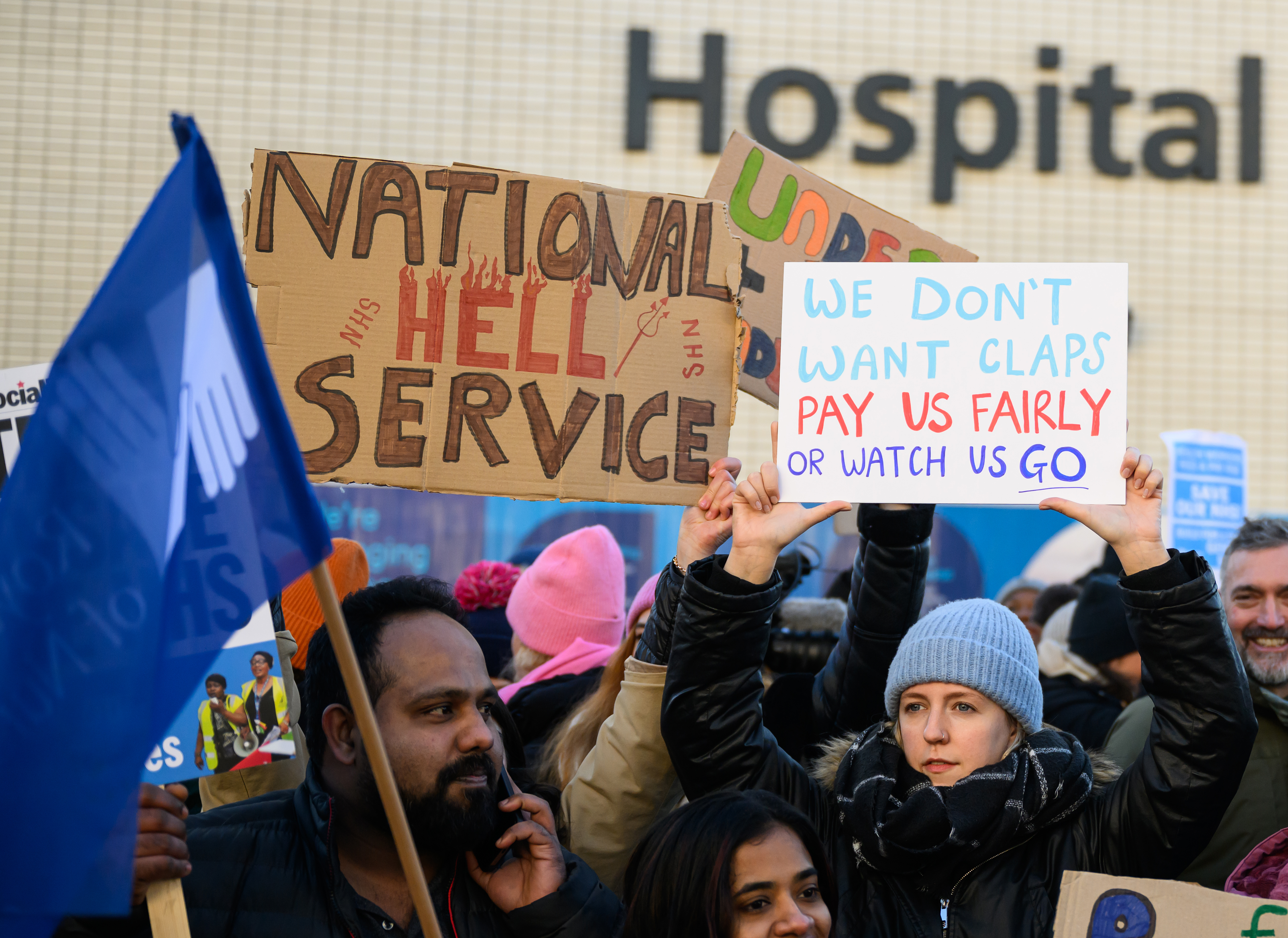
Nurses, paramedics, rail staff, posties and other key workers have been forced into taking action to defend their livelihoods and the services they provide.
Nobody takes the decision to go on strike lightly. But this is a problem of the government’s own making. Twelve years of pay cuts have left workers with no choice. And that’s why they are out on strike – with massive public support.
And rather than sitting down with unions to negotiate a resolution, ministers seem more interested in escalating disputes.
The UK already has the most restrictive trade union laws in western Europe – but ministers are set to undermine the right to strike even more. That will tilt the balance of power even further towards bad bosses and make it harder for working people to win better pay and conditions.
Have no doubt: I will lead the union movement in opposing further restrictions on the right to strike – just as we will oppose further attacks on any rights at work, including those rights that came from the EU.
But I don’t want us to spend our time just fighting bad laws – I want the trade union movement to set out a positive vision for Britain. Because we know it doesn’t have to be like this. For too long the UK has been trapped in a vicious cycle of stagnant growth, stagnant investment and stagnant wages. Now it’s time for a proper long-term economic plan that rewards work not wealth.
Unions have the answers. We should target low-pay industries, raising pay and standards and driving out rogue operators with sector-wide fair pay agreements. And ministers, unions and employers should work together on a proper industrial strategy, delivering good green jobs, training and skills across the country.
Working people deserve a seat at the tables of power – and it’s the job of unions to get them there. That’s why, when I’m asked, I always say that my first priority is building a stronger, bigger and more diverse trade union movement.
Unions must reflect the modern multiethnic working class of the UK in 2023, promoting women and Black leaders and fighting racism and discrimination.
Unions have to grow, to represent more workers and get more workplaces covered by collective bargaining. That’s how we raise wages, improve conditions and cut inequality. It’s how we stop outrages like P&O sacking hundreds of workers on the spot, with impunity.
And unions have to be stronger and more confident. That’s how we win the argument for a growing, redistributive economy, a £15 per hour minimum wage, and a ban on zero hours contracts.
The solidarity and power of a stronger, growing and more diverse trade union movement is how we will win. It is how we turn the tide on cuts, casualisation and two decades of standstill wages. And it is how we deliver what working people are asking for – a fair day’s work for a fair day’s wage.
This winter we’ve seen hundreds of thousands of workers taking industrial action – or striking – to defend their pay and conditions (writes TUC’s Alex Collinson).
These are individual disputes, and it’s important to understand the details in different workplaces. But there is a common cause: a pay disaster that means workers are being paid less in real terms now than they were 14 years ago.
First things first – what’s a strike?
Trade unions exist to defend their members’ jobs, pay and conditions. Normally they try to do that through negotiations with employers, through a process called collective bargaining. But when those negotiations break down, workers have the right to collectively withdraw their labour to help bring the employer back to the bargaining table.
In Britain, the right to strike is governed by complex and restrictive industrial action laws. In summary, to count as ‘protected industrial action’, a strike must:
relate to a work dispute with your own employer
be supported by a valid secret postal ballot with independent scrutiny, in which at least of half the balloted workers have voted (in other words, “not voting” counts as a vote against the strike)
be carried out with notice
In addition, since the Tories’ 2016 Trade Union Act strikes involving workers who provide what the government calls an “important public service” can only be lawful if at least 40% of the workers balloted over the action vote in favour of it.
How much has strike activity increased?
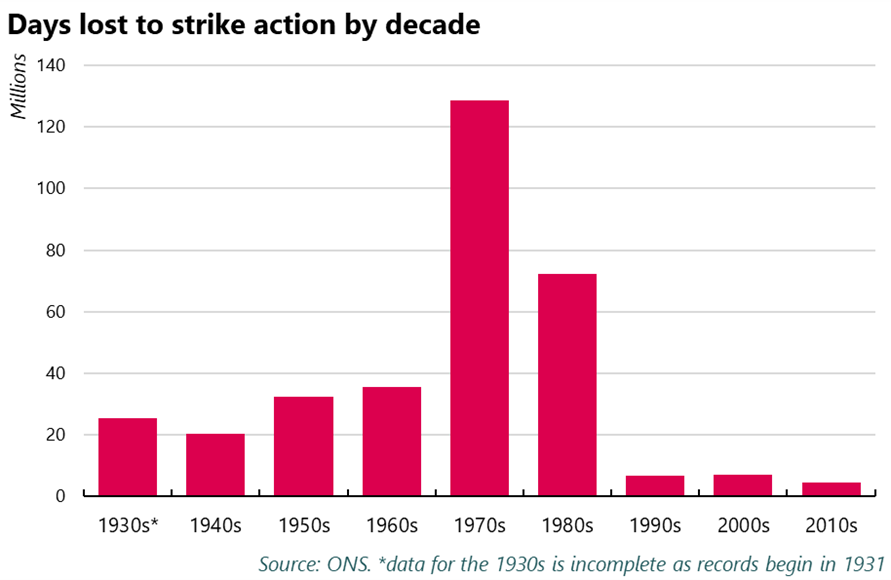
The number of strikes has been on the rise in recent months. The latest data shows that the 417,000 days were lost due to strike action in October 2022, the highest it’s been in 11 years. Some are estimating that this December will see over a million days lost to strike action for the first time since 1989.
But it’s important to put the recent rise in strike action into context. While the number of days lost due to strike action is relatively high compared to the past couple of decades, they’d be fairly standard in any decade before the 1990s.
If more than one million working days are lost due to strikes in December, it’ll be the first time it’s happened since July 1989. But between 1970 and 1989, there were 47 months when this happened. And the 417,000 days lost due to strike action in October 2022 may be the fifth highest on record since 1990, but we regularly saw far higher figures pre-1990.
So what’s behind the rise?
Each individual strike will have different reasons behind it, but there’s some common factors behind the recent rise.
Work has been getting worse for many – lower paid, worse conditions, increasingly insecure. At the same time as workers have seen pay and conditions get worse, businesses have been giving more and more money to shareholders, with dividends paid out to shareholders growing three times faster than wages over the past decade.
And the government has been refusing to properly fund pay rises for public sector workers, failing to introduce a proper minimum wage, and attacking trade union rights, and failing to introduce a proper minimum wage.
The government’s minimum wage remains below the Real Living Wage set by the Living Wage Foundation, and, even with next year’s rise, will be £4.58 below a £15 per hour minimum wage.
Pay
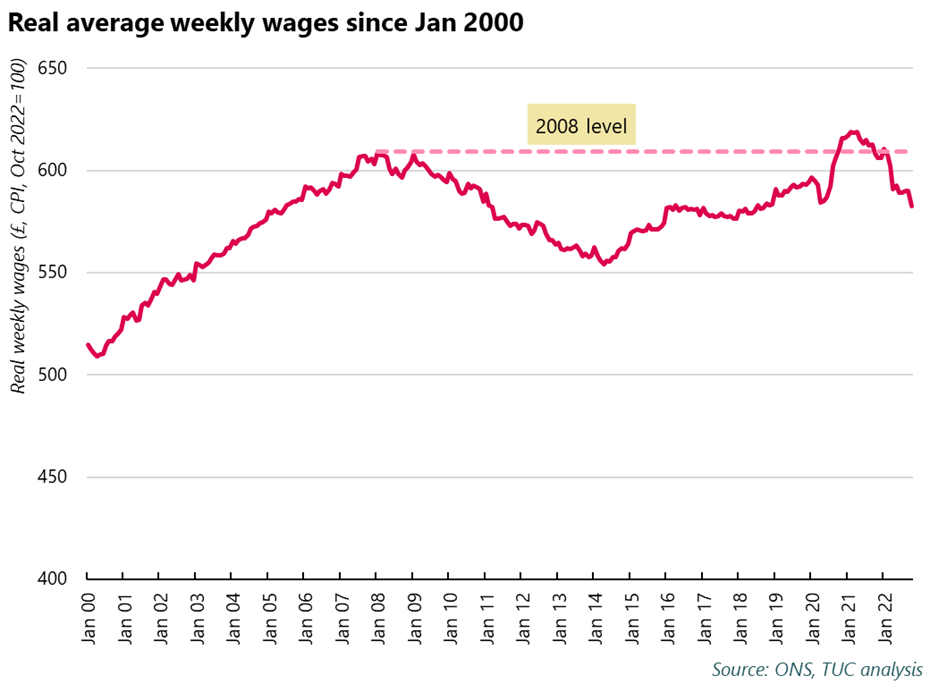
We’ll start with pay. Average real pay (that’s wages once you take inflation into account) is lower now than it was in 2008. It’s not expected to go back above 2008 levels until 2027. This 19-year pay squeeze is longer than any pay squeeze we have official records for, and likely the longest since Napoleonic times.
If wages had grown in line with pre-2008 trends over the past fourteen years, they’d now be £291 per week higher than they currently are.
Over a decade of stagnant pay has directly contributed to the current crisis, leaving many people unable to cope with a sudden rise in prices. While the cost of living crisis is often presented as a recent problem, it’s been building for years.
The situation was already dire before energy bills began to rise. As we went into the pandemic, the number of people in poverty was at a record high, with the majority of those in poverty living in a working household.
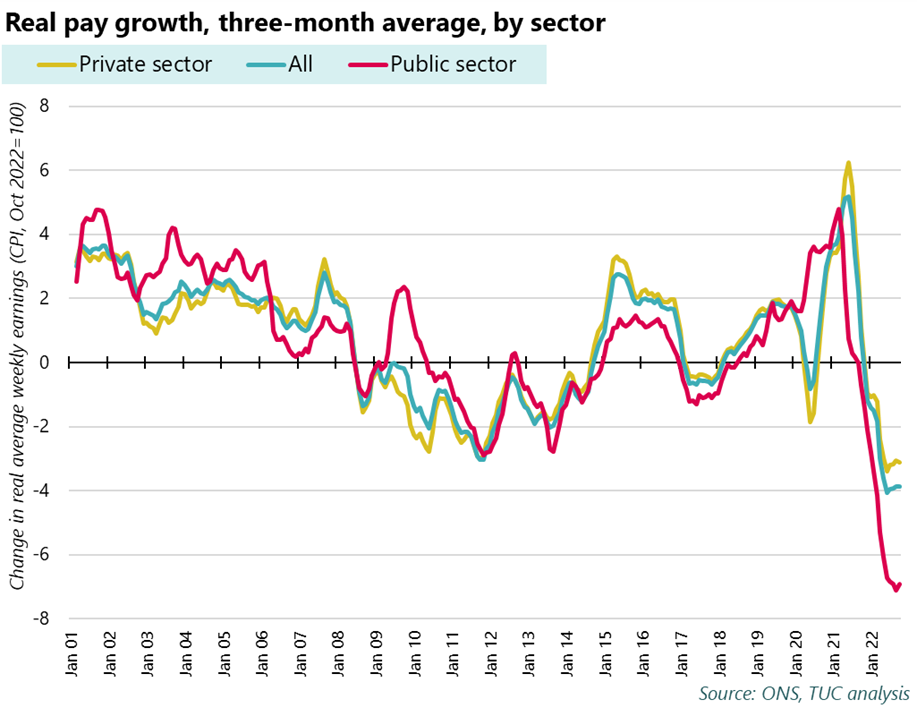
The recent rise in prices has made the situation even worse. After years of stagnant pay, workers are now facing double-digit inflation while being offered single-digit pay rises. The latest data shows that, in October, nominal pay rose by 6.4 per cent, while inflation hit 11.1 per cent. Real pay has fallen by £111 per month in the past year alone.
This is particularly bad in the public sector, where pay is rising by just 3.8 per cent, and average real pay has fallen by £185 per month in the past year.
Weak pay growth in the public sector is down to the government refusing to give proper pay rises to workers that kept the country running during the pandemic. Look at health workers, for example. TUC analysis of NHS pay scales shows that:
Nurses’ real pay fell by £1,800 over the last year
Paramedics’ real pay fell by £2,400 over the last year
Midwives’ real pay fell by £2,400 over the last year
This is after a decade of pay suppression by government that has led to nurses earning £5,000 a year less in real terms than they were in 2010. For midwives and paramedics this rises to over £6,000.
Working conditions and job losses
But it’s not just about pay. Many of the current strikes happening aren’t just about getting pay rising, but also protecting jobs, fighting against worsening working conditions, and putting an end to insecure contracts and outsourcing.
Fighting for pay itself is often a fight to improve working conditions. Better pay helps with recruitment and retention of staff.
It’s a political choice
The government spent months clapping for key workers, but now refuses to give them a fair pay rise. This is a political choice. The government could avoid, for example, rail workers, nurses, teachers, paramedics striking by getting around the negotiating table and offering a decent, fair pay rise.
Instead, it continues to offer real pay cuts to public sector workers, often hiding behind pay review bodies while it does. And when it comes to rail workers, the government is actively blocking deals being made. This is all part of wider cuts to public services that have left them understaffed and underfunded.
The government doesn’t agree pay deals in the private sector, but it can set a positive example to employers by offering decent pay rises. It also has the power to deliver increases to the minimum wage that get it to £15 an hour.
But instead, the government has repeatedly attacked trade union rights, making it harder to strike and therefore harder to negotiate for better pay.
Workers are winning
There’s another reason behind the rise in the number of people gaining confidence to take action: workers are winning. People are winning better pay deals and working conditions by joining together and standing up for themselves. Striking workers have won themselves double-digit pay rises across a range of different jobs, from bus drivers to BT engineers, as well as better conditions and an end to outsourcing.
If you aren’t in a union yet, there’s never been a better time to join – talk to your mates and talk to a union. And to learn more on how the TUC is supporting union disputes, see our solidarity hub here.
Average uplift of 7.5% the highest offer in the UK
A ‘best and final offer’ has been made to NHS Agenda for Change (AfC) workers following pay negotiations with trade unions and employers.
The record high pay offer, the best in the UK, will ensure that these front line workers will receive pay rises ranging from £2,205 to £2,751, which is a further improvement on the existing offer for staff in Bands 5-8A. For the lowest paid this represents an uplift of 11.3%, and delivers an average uplift of 7.5%.
This increased offer was made after constructive negotiations between the Scottish Government and NHS unions. In a final offer made to trade unions, the new deal is worth an additional £515 million in 2022-23 and now includes a package of progressive measures to promote staff and patient safety, support long-term workforce sustainability and to recognise the breadth of skills and experience of NHS Scotland staff.
The settlement ensures that NHS staff would remain the best paid anywhere in the UK. It gives all frontline NHS Scotland AfC staff in bands 1-7 a pay premium of between £1,149 and £2,834 over their counterparts in England, Wales and Northern Ireland.
The Agenda for Change pay offer for 2022-23 will deliver the most progressive package of terms and conditions reform in over 40 years. The deal will benefit more than 160,000 employees including nurses, paramedics, allied health professionals and healthcare support staff.
Health Secretary Humza Yousaf said: “We have engaged tirelessly with trade union representatives over recent weeks, leaving no stone unturned to reach an offer which responds to the key concerns of staff across the service.
“This best and final pay offer of over half a billion pounds underlines our commitment to supporting our fantastic NHS staff. A newly qualified nurse would see a pay rise of 8.7%, and experienced nurses and would get uplifts of between £2,450 and £2,751.
“We are making this offer at a time of extraordinary financial challenges to the Scottish Government.
“We have made the best offer possible to get money into the pockets of hard working staff and to avoid industrial action, in what is already going to be an incredibly challenging winter. If the offer is agreed this pay uplift will also be backdated to April.
“Finally, I would urge the UK Government to get back to the negotiating table with the unions. This settlement has been shaped by the unions’ constructive approach and I hope it is backed by their members.”
BACKGROUND
The new offer also includes a review into reducing the working week to 36 hours, a commitment to review the job descriptions of Band 5 roles and ensuring protected learning time for specific groups, such as staff on agreed learning and development schemes.
TABLE
Band
points
Scottish 2022/23 rates
Proposed increase
% this represents
Hourly rate
Band 1
1
£21,692
£2,205
11.32%
£11.09
Band 2
1
£21,814
£2,205
11.24%
£11.16
2
£23,820
£2,205
10.20%
£12.18
Band 3
1
£23,914
£2,205
10.16%
£12.23
2
£25,808
£2,205
9.34%
£13.20
Band 4
1
£25,914
£2,205
9.30%
£13.25
2
£28,187
£2,205
8.49%
£14.42
Band 5
1
£28,384
£2,280
8.73%
£14.52
2
£30,329
£2,280
8.13%
£15.51
3
£35,365
£2,450
7.44%
£18.09
Band 6
1
£35,522
£2,450
7.41%
£18.17
2
£37,087
£2,450
7.07%
£18.97
3
£43,286
£2,550
6.26%
£22.14
Band 7
1
£43,422
£2,550
6.24%
£22.21
2
£45,080
£2,550
6.00%
£23.06
3
£50,506
£2,660
5.56%
£25.83
Band 8A
1
£53,513
£2,548
5.00%
£27.37
2
£57,767
£2,751
5.00%
£29.54
Band 8B
1
£63,530
£2,205
3.60%
£32.49
2
£68,223
£2,205
3.34%
£34.89
Band 8C
1
£75,711
£2,205
3.00%
£38.72
2
£81,426
£2,205
2.78%
£41.65
Band 8D
1
£90,590
£2,205
2.49%
£46.33
2
£94,629
£2,205
2.39%
£48.40
Band 9
1
£107,840
£2,205
2.09%
£55.15
2
£112,673
£2,205
2.00%
£57.63
RCN Scotland Board members will, in the coming days, be considering the details of a revised NHS pay offer from Scottish government.
The pay offer was made today (24 November) following negotiations between the RCN and other health trade unions and the Scottish government.
The RCN paused a formal announcement on strike action in Scotland while negotiations took place this week.
Colin Poolman, RCN Scotland Director, said: “As always it is our members who will decide what happens next in relation to the pay offer. The first step in that process is for our board to review the detail of the offer.
“That will happen in the next few days. The revised offer still does not meet our members’ expectations, which is disappointing, but the Scottish government is saying this is their best offer.
“We will update members once that process has taken place.
“I appreciate it may be frustrating for our members in Scotland, the majority of whom voted very strongly in favour of taking strike action. It was that mandate that encouraged the Scottish government to re-open negotiations. It is right that RCN Scotland Board members consider the offer in the usual way.”
UNISON, and sister trade unions Unite and GMB, are threatening pull out local government school staff and refuse workers on strike again.
Strike action was suspended after UNISON members voted for an offer which was made to them by COSLA on 2nd September 2022.
Trade union strikes remain suspended but mandates remain live meaning UNISON can legally call their local government members back out on strike, again.
COSLA now claim that the elements of the original deal – an extra days leave and the payment of SSSC registration fees for those working in social work, social care and early years – were only for one year not in perpetuity.
UNISON have now written to COSLA to say: “It is frankly outrageous that the draft pay circular sent to us on 7th October sought to time limit elements of the offer that had no time limitation on them in the original offer letter or in the discussions we had prior to it.
“That this remains unresolved should be a source of deep embarrassment. As has previously been advised our strike mandates remain live and we are all under increasing pressure from members, who are rapidly losing faith in their employer, to lift the strike suspensions if a resolution is not achieved quickly.”
Council staff are still waiting for their increased pay uplifts to be included in their pay packets.
Johanna Baxter, UNISON Scotland head of local government said:“This is appalling behaviour – either the employer did not even understand the offer they themselves were making – or they did and are now trying to renegue on it before its even been implemented. Either way it will be our members that suffer if they are allowed to get away with it.
“We have made clear to the employer and the Scottish Government that our strike mandates remain live and all three trade unions are under increasing pressure from members, who are rapidly losing faith in their employer, to lift the strike suspensions if a resolution and call members out if a resolution is not achieved quickly.
“Our members will rightly be questioning the value of COSLA if they cannot be trusted to draft an offer that they understand or uphold one that they do understand.
“It should be a source of deep embarrassment to COSLA that more than six months since the pay implementation date and in the middle of the worst cost of living crises our country has seen, waiting on their pay rise”