Migraine Trust and Thistle Health and Wellbeing among projects benefiting from investment
Nineteen projects supporting people with neurological conditions are to benefit from Scottish Government backing.
As part of a five-year neurological care and support action plan, innovative projects which harness new techniques and technology will be helped by a third round of funding – with £1 million commissioned for work across Scotland.
The 2022 to 2023 award will continue to support earlier projects as well as invest in new schemes.
These include a collaborative bid from the Migraine Trust and NHS Grampian to work with community, primary and secondary care pharmacists to help people with migraine manage their symptoms and treatments more effectively.
NHS Greater Glasgow and Clyde Partnership Delivery Group will also receive more than £100,000 to meet key Neurological Care and Support Framework commitments – helping people to live well and improving patient experience.
Epilepsy Scotland will receive more than £40,000 to improve mental health outcomes for people with epilepsy, and other projects include NHS Lothian’s digital neurosymptoms platform.
Health Secretary Humza Yousaf said: “Around one million people in Scotland live with a neurological condition and our neurological action plan provides a clear vision for those affected to be able to access the care and support they need to live well, on their own terms.
“The allocation of this funding, as part of our £4.5 million investment over five years, will benefit a wide range of projects helping those living with epilepsy, Parkinson’s, ME/Chronic Fatigue Syndrome, Multiple Sclerosis, cerebral palsy and other neurological disorders.
“We know that migraine, which affects one in seven Scots, can have a hugely negative impact on the lives of those affected by it and this investment will enable the Migraine Trust and NHS Grampian to help those dealing with it.
“But all of these innovative projects, including cross-sector collaborations, seek to ensure seamless access to high-quality and co-ordinated health, social care and third sector support in the right place at the right time.”
EVOC is delighted to announce that more than 120 community and voluntary organisations are to benefit from grants totalling £1.32 million from the Scottish Government’s Communities Mental Health and Wellbeing Fund in Edinburgh.
This investment will support a wide range of projects and enable people across the City to access additional mental health and wellbeing support in their communities. Programmes being funded include activity-based canal boat trips; befriending services; art therapy sessions; community garden growing workshops; 1 to 1 mentoring with childcare; outdoor programmes for families; local pantries and counselling.
A full list of groups and organisations awarded grants is available here.
As a partner in Edinburgh’s Third Sector Interface we have taken the lead in developing a new community commissioning-based funding approach that invests the Scottish Government funding in projects that support the needs of different communities.
The process has taken both a geographical and thematic approach and focused on making sure people get the support they need, when they need it, where they need it.
Ian Brooke, EVOC’s Deputy Chief Executive said: “‘It is fantastic to see this investment going out to grass-roots organisations across Edinburgh and to know this is the result of shared decisions based on evidence of real need in the City’s communities.
“Our ambition to roll out a community commissioning-based approach for this fund, in less than six months, has relied on the hard work, commitment and energy of everyone involved.
“We believe this is the first process of its kind to be delivered in Scotland, if not the UK and have commissioned a research team to make sure that lessons learned and further improvements are made from this experience which can then be used to develop and refine future cross-sector funding models.”
Fresh Startis one of more than a hundred and twenty organisations and partnerships that have received a grant in this the second phase of the Fund – fourteen grants of under £2,500 were awarded earlier this month.
They have been awarded £10,673 to deliver a project that reduces the anxiety and stress that parents and care givers encounter trying to keep food on the table.
Fresh Start will run a variety of food related projects including family Fridays, provide Dish of Day cook bags, deliver community meals and provide additional support to families to tackle holiday hunger.
It is envisaged that they will support over 100 families in North Edinburgh.
Biddy Kelly, Managing Director, Fresh Start said: “We are delighted to have been successful in our application to the Scottish Government Communities Mental Health and Wellbeing Fund and are looking forward to getting the services to people at a time when they are most in need.
“I am also delighted that our collective Respond and Recovery Group in North Edinburgh could co-ordinate our applications to ensure maximum impact and reduce duplication, and that we saw a significant amount of essential work being not only funded but recognised by this process of funding in a new way.’
A partnership between Leith Community Growers and Leith Growing has been awarded £17,341.72 to explore views about local community garden development, develop community garden spaces across the North East of Edinburgh and deliver a programme of workshops on gardening, growing, connecting with nature and outdoor play.
Patrick Dunne, Leith Community Growers said: “‘Leith Community Growers aims to support and develop growing and green space initiatives in Leith.
“This funding allows us to run sessions about gardening with local organisations and our own community to the benefit of their wellbeing and mental health, and also supports us to encourage local community members to develop their local spaces in whatever way they can.
“It’s been interesting to be a part of this new model of funding process. While challenging at times it has encouraged us to reach out and collaborate with groups and spaces that are new to us and we are very happy that those new relationships will grow and be of benefit in our community in the next 12 months.
“We are looking forward to growing alongside the people of Leith this year.”
A NEW APPROACH
EVOC has worked alongside key partners in the Edinburgh Health and Social Care Partnership, Edinburgh’s Thrive Collaborative, Volunteer Edinburgh and others from the voluntary sector to develop a process that prioritises what works at a grass-roots level and what the people and communities of Edinburgh really value.
These efforts will continue and build on the City’s partnership working, developing new ways in which people and local organisations can be supported.
In addition, the work being carried out toward the development of an Edinburgh Wellbeing Pact offers opportunities for organisations to get involved throughout the next year.
Judith Proctor, Chief Officer, Edinburgh Health and Social Care Partnership, said: “The pandemic has seen rises in health inequalities, mental health challenges, and growth in social isolation.
“Whilst this is a national picture, in Edinburgh we are committed to finding ways to reach people and ensure they have access to the right kind of support at the right time. Everyone’s different.
“Via this funding, we’ve not only been able to accelerate work in this area, but through the engagement led by EVOC and our Edinburgh Wellbeing Pact, we’ve been able to reach a wide range of communities and reach those with lived experiences who are not always heard.
“Without doubt, we are very encouraged by what’s been achieved and are committed to building on this as we move forward.
“We’re incredibly thankful to all who have engaged and taken part in this process, particularly to our partners at EVOC for their hard work throughout.”
A full list of groups and organisations awarded grants from the Communities Mental Health and Wellbeing Fund for the City of Edinburgh can be found here.
The Scottish Government announced the £15 million-pound Communities Mental Health and Wellbeing Fund in October last year and announced additional investment for this fund on 25 February.
An overview of the community commissioning process devised and delivered for the Edinburgh funding by EVOC and other key partners can be found here.
An additional £6m has been provided to the Communities Mental Health and Wellbeing Fund to meet the demand for local mental health and wellbeing projects.
The fund was launched in October last year with £15 million to support grass roots community groups and organisations to deliver activities and programmes for adults which tackle the social isolation, loneliness and mental health inequalities made worse by the pandemic.
The funding provides an opportunity to re-connect and revitalise communities building on examples of good practice which emerged throughout the pandemic. Projects supporting sport, outdoor and nature initiatives as well as arts and crafts were successful in the initial funding.
Mental Wellbeing Minister Kevin Stewart said: “This additional £6 million is being provided in light of the positive demand for the original £15 million announced in October last year. We have seen lots of high quality bids for projects that will undoubtedly make a real difference to local communities and we want to support as much of this as possible.
“The importance of community interventions in supporting people’s mental wellbeing cannot be underestimated and prevention and early intervention is a priority for the Scottish Government.”
The Good Morning Service in Glasgow is one organisation which has received funding. Around 400 older people have benefitted from the service which builds meaningful relationships through regular telephone befriending sessions.
The service directly monitors mental and physical well-being, reducing social isolation, and flags potential health problems whenever a Good Morning Call remains unanswered.
Good Night Calls are also provided from November to February alleviating the heightened sense of loneliness that the dark winter nights can bring.
Nicky Thomson, Chief Executive Officer of the Good Morning Service, said; “Simply put, without the support from the Scottish Government we wouldn’t be able to run our 365 day life-enhancing and life-saving service providing practical and emotional support.
“The Community Mental Health and Wellbeing Fund has enabled us to reach more people in need. Notably, it is the light-touch, non-intrusive nature of our support which is very attractive to older people. We don’t diminish their sense of ability to live independently, we enhance it.
“Operationally, on Good Morning Calls we take whatever time is needed to help people to implement their coping strategies and build resilience. Resilient people build resilient communities, which is what we need at this challenging time.”
Registration Form for our community festival is now available!
We are looking for local community groups, organisations, businesses, creators, makers or traders to join the festival family and host events, activities or a stall.
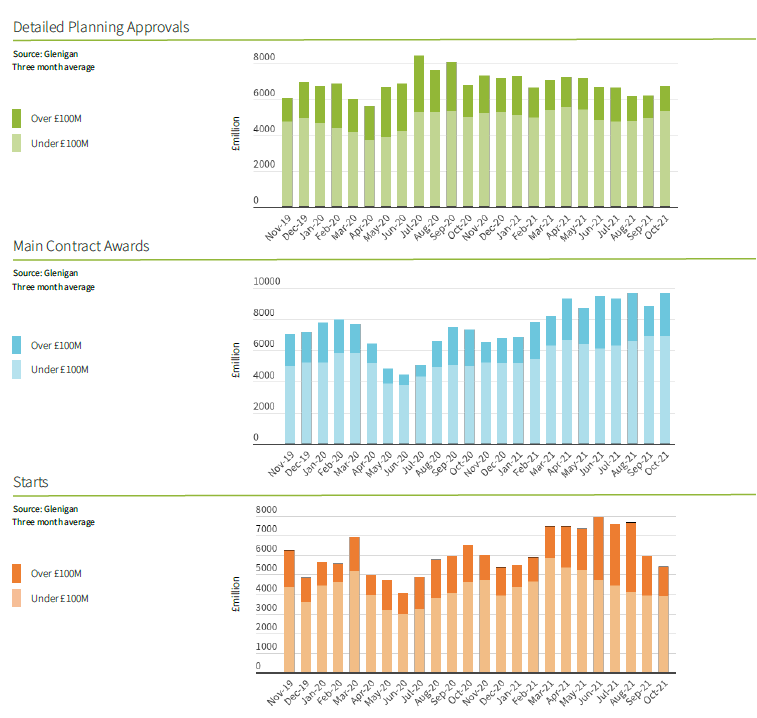
This monthly report provides a detailed, comprehensive analysis of construction data, giving built environment and property professionals a unique insight into sector results, from the three months to the end of October 2021.
A significant takeaway from November’s figures is, whilst the decline in project starts continues to affect the sector, an uptick in approvals and contract awards demonstrates a degree of resilience.
Failure to Launch
Against the context of global skills shortages and persistent supply chain issues, inevitably the overall value of project starts during the three months to October declined.
This represented a 29% drop overall against the preceding three months to October 2021 and was 17% lower than the same period last year.
A softening in underlying work (< £100 million) (16%) and a sharp decline in major projects (> £100 million) down a massive 50% on the preceding three months this year supports the wider acknowledgement of a temporary autumn slump, following a summer of intense activity.
Reasons for Optimism
Supporting Glenigan’s predictions this downturn in project starts is a short-term challenge, an increase in detailed planning approvals and main contract awards highlights a healthy pipeline of future work in 2022 and beyond.
This emphasises the predictions found in Glenigan’s most recent industry Forecast (November 2021) which predicts sector-wide growth next year, despite the current disruption battles.
Analysing the data further, the value of main contracts awarded rose by 4% against the previous three months and was 32% up on a year ago.
Major contract awards rallied, following relatively poor performance between July – September. Although still lower compared to the three months to July (-8%), awards were up 20% compared to 2020.
Planning consents edged 2% higher against the preceding three months but were unchanged on a year ago. Nevertheless, approvals were 17% above the same period in 2019.
On-site activity remains stable
According to the latest official ONS data, the value of work carried out on-site picked up in September, having weakened in the previous two months. Again, external, global events had a major role to play. Likely, the recent energy and fuel crises will have only exacerbated the situation. This slight increase was not enough to prevent a 1.5% slip against the preceding three months, but was up 9.7% on 2020.
Looking to the sector split, residential new work fell back during the period coverage in this Review, with private and social housing falling by 3.5%.
Public non-residential and commercial output also declined, dropping by 12.8% and 5% respectively against the preceding three months.
Sector Focus
A general decline in underlying starts persisted across almost all sector verticals.
Underlying civil engineering work starts saw a fall of almost a third (-32%) compared with the previous three months to October, and were 43% down on a year earlier. This was highlighted through poor underlying infrastructure performance, 42% lower than a year ago. Utilities were also 45% lower.
Residential, retail, hotel & leisure, health and education also witnessed a decline in performance in the three months to October. For underlying residential, it was also 22% down on the same period last year.
Standing out from the crowd, underlying industrial project starts proved a pillar of strength, increasing 41% against the preceding three months as well as standing 38% higher than a year earlier.
Underlying office starts were also high, climbing 8% against the preceding three-month period to October, 23% higher than a year ago.
Likely these spikes are caused by a significant increase in ‘mission critical’ projects coming online and an even greater push from employers to get staff back into the formal workplace.
Regional Performance
London was the strongest performing part of the country for underlying project-starts, with starts rising 2% during the three months to October to stand 28% up on a year ago. Similar to previous reviews, the North West was the only other region to see an increase in underlying starts against the preceding three months (+3%) with starts also up 9% on a year ago.
Underlying starts continued to fall across the rest of the nation, with Wales performing particularly poorly, with value plummeting 51% against the preceding three months to stand 74% down on a year ago.
Commenting on the findings, Glenigan’s Economic Director, Allan Wilen says, “Tough times continue as disruptive global events continue to hit hard, however a gradual increase in contract awards and planning consents indicate momentum will soon start to revive.
“Of course, ready availability of personnel and material when shovels need to go into the ground will determine how long the slump in starts persists.
“Once again, there’s massive regional inconsistency, with only two parts of the country seeing an increase in activity. This will no doubt become a priority for the new LUHC Secretary, who will need to strike a balance across the nation to deliver on the government’s much trailed levelling-up agenda.”
To find out more about Glenigan, its expert insight and leading market analysis click here.
A new fund has been established to help tackle the impact of social isolation, loneliness and the mental health inequalities made worse by the pandemic. The £15 million Communities Mental Health and Wellbeing Fund aims to support adult community-based initiatives across Scotland.
Grass roots community groups and organisations will be able to benefit from the funds to deliver activities and programmes to people to re-connect and revitalise communities building on examples of good practice which have emerged throughout the pandemic.
Mental Wellbeing Minister Kevin Stewart launched the fund at Saheliya in Edinburgh, a specialist mental health and well-being support organisation for black and minority ethnic women and girls.
Mr Stewart said: “This funding reflects the importance we place on promoting good mental health and early intervention for those in distress and will help develop a culture of mental wellbeing and prevention within local communities.
“It is vital now, more than ever as we start to re-open society that we support the mental health and wellbeing of individuals. I am very keen that this benefits communities across all of Scotland.
“I was pleased to be able to visit Saheliya this morning and meet some of the people involved with running and the project, and some of the people they help.”
A range of charity-support bodies and social enterprises, known as third sector interfaces, will manage the fund in partnership with local integrated health authorities and other partners including Community Planning Partnerships and local authority mental health leads.
The Communities Mental Health and Wellbeing Fund is part of the wider £120 million Recovery and Renewal Fund announced in February 2021 to ensure delivery of the commitments set out in the Mental Health Transition and Recovery Plan in response to the mental health need arising from the pandemic.
Projects aiming to help transform towns and neighbourhoods could apply to a new £10 million multi-year fund.
The Scotland Loves Local Fund aims to encourage people to think local first, and support businesses and enterprises in their community. The fund will provide match funding of between £5,000 and £25,000 for projects run by groups like town centre partnerships, chambers of commerce or community and charity trusts.
Administered by Scotland’s Towns Partnership it aims to bring new, suitable, creative projects and activity to towns and neighbourhoods – helping build local wealth and increase footfall and activity, while supporting local enterprise partnerships. Eligible projects could include things like community shops, marketing and digital schemes, or enabling larger construction projects delivery.
Community Wealth Minister (Eh? – Ed.) Tom Arthur said: “To support Scotland’s towns and neighbourhoods recover from the pandemic we are launching a new £10 million Scotland Loves Local Fund.
“This will provide 50% match funding for local projects between £5,000 and £25,000. Whether it be funding for small-scale improvements or adaptations, climate or active travel programmes, home delivery digital schemes, pop up shops and markets, or the direct funding or expansion of Scotland Loves Local loyalty card schemes – communities will be able to decide how best to improve their local area.
“This 100 day Scottish Government commitment reinforces our determination to support all our communities as they recover from the pandemic and will help strengthen the vital support being provided through the Scotland Loves Local marketing campaign and loyalty card scheme.”
Scotland’s Towns Partnership Chief Officer Phil Prentice said: “Over the coming years, this significant commitment from the Scottish Government will make a real difference – empowering communities to take action that will make their areas fairer, greener and more successful. We are delighted to be working with ministers to deliver this.
“This funding will unlock the great potential of our towns and neighbourhoods, allowing them not just to recover from the impact of Covid-19, but to create a stronger, more sustainable future which has localism at its heart. I would encourage interested organisations across Scotland to get their applications in.”
Director of Milngavie Business Improvement District and Business owner Wendy Ross said: “The Scotland Loves Local campaign was a massive help to Milngavie, especially at the peak of the pandemic when non-essential retail businesses were forced to close.
“Using the digital experience of our business improvement district place manager and his network of collaborators, the Loves Local funding was invested to build many e-commerce websites very quickly so we could continue to trade online, with click and collect and deliveries.
“This was a critical help for local businesses and really opened our eyes to aspects of the digital world that we knew little about. Using the Loves Local messaging and excellent #ThinkLocalFirst campaign, we used social media and milngavie.co.uk to reach local people. That really struck home and continues to do so.”
Up to £25,000 available to eligible projects – closes 28th June
The Scotch Whisky Action Fund (SWAF) provides funding to eligible projects specifically set up to reduce the negative impacts of alcohol-related harm. Only open once a year, the fund is inviting new applications before the deadline at noon on Monday 28th June.
Managed by Foundation Scotland, SWAF has so far awarded over £800,000 to over 70 projects operating across the country since its launch in 2013. The fund is focused on supporting innovative initiatives and activities specifically designed to tackle alcohol-related harms in Scotland’s communities.
Groups such as Rowan Alba, Waverley Care, Edinburgh Young Carers Project, and Govan Youth Information Project have received project support.
Jennifer McPhail, Programmes Advisor at Foundation Scotland, said: “We’re delighted to be running this important funding stream again. Now in its eighth year, the Scotch Whisky Action Fund has already made a massive impact on individuals and communities affected by alcohol related harms.
“The alcohol industry plays an important role in Scottish society, and Scotch Whisky is at the heart of the industry. However, the misuse of alcohol through excessive or inappropriate consumption can have implications for health and a range of social problems, including anti-social behaviour, violence, family breakdown, problems with money and work. This can impact individuals, families and communities.
“The fund is not set up to support recovery or treatment of alcohol issues. Rather it’s for innovative projects that educate, raise awareness, and prevent future alcohol-related harm. Examples of projects include preventative training programmes and diversionary activities for young people, peer support groups for carers and family member counselling services.
“There are many examples of previously funded projects available on our website and we are advising interested groups to carefully read through all the guidance before applying. The closing date is coming up soon so we are encouraging those that are interested to progress quickly as the fund only opens once a year.”
Projects which secure funding from SWAF, and can demonstrate an impact after their first year of funding, may be able to receive further funding of up to £25,000 per annum for a maximum of three years, to support their initiative.