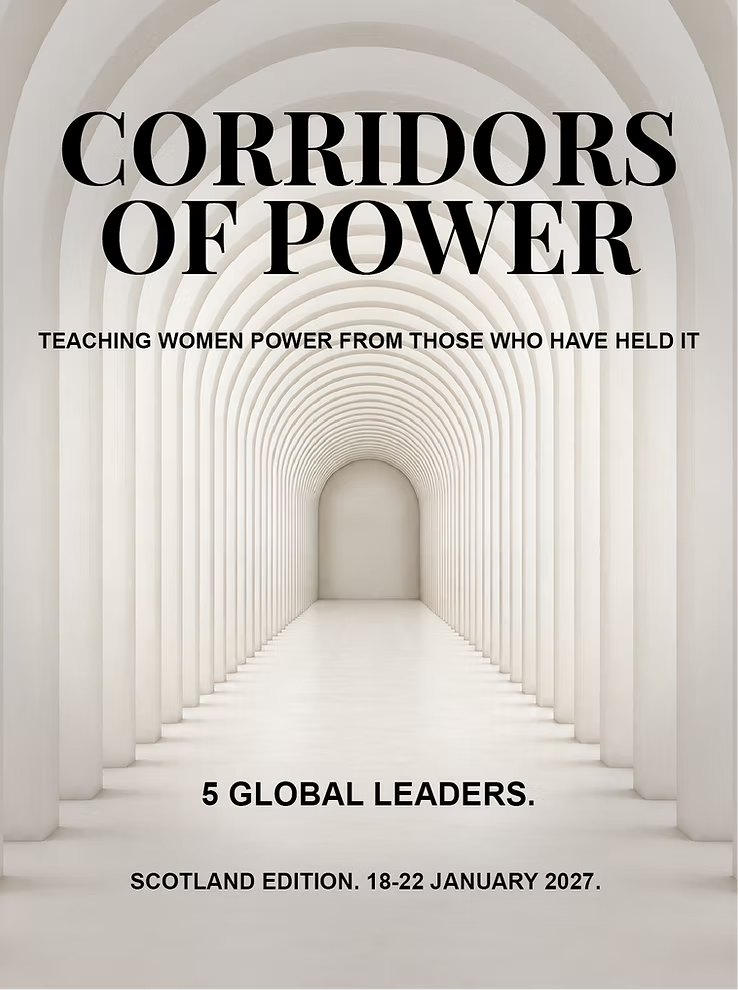
Former First Minister is first faculty leader announced for Corridors of Power, a new leadership programme for women in business and politics
Former First Minister of Scotland Nicola Sturgeon is to teach women from around the world how to lead under pressure, in a new masterclass. Launching in Edinburgh next January, the programme will feature several Prime Ministers and global leaders as faculty leaders.
Sturgeon is the first faculty leader announced for Corridors of Power, a five-day leadership programme including created by The Power Diaspora Forum (TPDF), the international platform founded by Scottish entrepreneur Veenoo Sharma to connect women to capital, influence and decision-making power.
Her full-day masterclass, Leadership Under Pressure: Lessons for Women in Power, will draw on her eight years as First Minister to show women in politics and business how to hold their ground when the stakes are highest.
Participants will learn how pressure shapes leadership at every level: in the decisions leaders make, in how they deal with others, and in the extra scrutiny women often face.
The masterclass will explore how political and institutional decisions are really made, the difference between formal authority and informal influence, and how to build coalitions and win over people who fundamentally disagree with you. It will cover negotiation and compromise, including knowing when to concede and when to stand firm, and how to maintain relationships through disagreement.
It will also examine the particular pressures on women leaders: establishing credibility in powerful environments, exercising authority where women are often judged more harshly, and carrying the responsibility of decisions with genuine consequences.
Nicola Sturgeon is Scotland’s longest-serving First Minister and the first woman to hold the role.
Nicola Sturgeon said: “We need more women in leadership across all walks of life. However, in our traditionally male-dominated world, women aspiring to or holding positions of power face unique challenges.
“I am delighted to be taking part in the Corridors of Power TPDF Masterclass to help a new generation of female leaders overcome these challenges. I am looking forward to sharing the skills and experiences I gained over many years of political leadership, and as well as an insight into the lessons I learned along the way.”
Veenoo Sharma, Founder of The Power Diaspora Forum, said: “Corridors of Power is built on a simple idea: who better to teach women about leadership and power than former First Ministers, Prime Ministers and leaders who have actually led countries?
“These are people who have made decisions at the highest level, navigated crisis, scrutiny and challenging circumstances, and carried the responsibility that comes with leading a nation.
“Bringing that lived experience directly to women is incredibly powerful. At TPDF, we believe women should be empowered through experience, not simply through discussion, and Nicola Sturgeon embodies exactly what this programme is about.”
Corridors of Power is open to women around the world working in, or aspiring to, senior roles in business and politics. Further faculty leaders including Prime Ministers and global leaders will be announced in the coming weeks.
Scotland’s most ambitious businesses are set to gain direct access to funders, investors and expert advisers when the national FUEL roadshow arrives in Edinburgh this September, building on the success of the first two events which have already generated a funding pipeline of more than £10 million for UK businesses.
On Thursday 24th September, hundreds of ambitious business owners will descend on Scottish Gas Murrayfield Stadium for a day of pre-arranged meetings with lenders, investors and business advisers, giving the nation’s SMEs the opportunity to explore funding options, receive expert guidance and build the relationships needed to accelerate growth.
The roadshow follows successful events in the North East and Yorkshire, where businesses took part in hundreds of one-to-one meetings with finance providers. Many of those conversations have already resulted in significant investment potential, with more than £10 million in funding now expected to flow into businesses across the two regions.
Rather than a traditional exhibition, FUEL has been designed as a practical event that removes many of the barrier’s businesses face when raising finance. Every attendee is triaged, and if appropriate, matched with relevant funders and advisers before the event, ensuring each meeting is tailored to their ambitions and funding requirements.
For business leaders that are unsure of which funding option is right for them or are not yet ready to seek finance, workshops are also available throughout the day which are designed to build confidence, develop investor and finance readiness and connect them to advisers who can help them on their journey.
Businesses attending FUEL Scotland will have the opportunity to meet representatives from a broad mix of funding organisations, from high street banks and specialist commercial lenders to alternative finance providers and investors.
Confirmed organisations include Barclays, Royal Bank of Scotland, Allica Bank, Scottish Enterprise, Creative UK, Maven, DSL Business Finance, The FSE Group and more, offering delegates the chance to explore funding options tailored to businesses at every stage of growth.
Delivered by business support and funding specialists, UMi, FUEL builds on almost two decades of helping businesses navigate funding, unlock investment and access expert advice. Since 2007, UMi has helped businesses secure more than £1 billion in grants, loans and private investment.
Nicki Clark OBE, CEO of UMi, said: “The response to FUEL has exceeded our expectations. Businesses have told us they value being able to speak directly with the people making funding decisions, while funders have welcomed the opportunity to meet ambitious companies that are ready to grow.
“With more than £10 million expected to be unlocked through our first two events, we’re excited to bring that momentum to Scotland, whether a business is looking to invest in innovation, expand its workforce or overcome cashflow challenges, FUEL is designed to make accessing finance, simpler, faster and far less daunting.”
Cameron Gordon, Accelerator Community Manager, Royal Bank of Scotland said: “As the UK’s biggest bank for business, we know that access to the right support is crucial for businesses to succeed.
For time-poor business owners, however, knowing what help is out there and what is best for their circumstances is not always clear. Through our Accelerator, we support a growing community of more than 30,000 entrepreneurs across the UK, and I am pleased that the Royal Bank of Scotland is supporting UMi’s FUEL roadshows, building on this work to champion small businesses and help them find the right support at the right time.”
Small Business Minister Lord Leong said: “One of the biggest challenges facing small businesses in Scotland is securing the right finance at the right time to invest, expand and create the good jobs local people deserve.
“That is why we are proud to support roadshows such as FUEL, which bring practical advice, specialist expertise and potential funding partners directly to founder-led and owner-managed businesses. By helping entrepreneurs understand their options, become investment-ready and access finance suited to their ambitions, FUEL helps turn growth plans into reality.
“Alongside this, we are working with the British Business Bank to increase the supply of finance across every region and nation of the UK. Our message to ambitious business owners is clear: wherever you are based and whatever your background, we want to help you overcome the barriers to growth, fulfil your potential and build the successful businesses and good jobs of the future.”
FUEL roadshows will be taking place throughout the UK at the following locations:
Edinburgh – Thursday 24 September – Murrayfield Stadium
London – December – Excel
Birmingham – TBC
Manchester – TBC
Cardiff – TBC
Business owners interested in attending any of the events above can book tickets, or register their interest in future events, via the website: www.fuelroadshow.co.uk.
Farmer Autocare has been acquired by Belfast-based Kerr’s Tyres Group, bringing together two family-run organisations with strong community roots and a shared long-standing commitment to looking after their customers and people.
Founded by Sir Tom Farmer in 2003, Farmer Autocare is recognised as one of Scotland’s most successful car maintenance and servicing businesses. The Company has grown rapidly over recent years and now operates 21 sites across Scotland, employing almost 200 people, many of whom have been with the Company since its beginning.
Strong staff retention, coupled with Farmer’s major focus on training and development, has created one of the most talented teams in the sector.
Farmer Autocare will continue to operate in Scotland under its existing management team, led by Managing Director, Colin McNeill, providing stability and continuity for both colleagues and customers.
Kerr’s Tyres Group was founded in 2002 by Norman Kerr in Antrim and has grown to be a trusted business with over 27 retail sites, a large commercial tyre business and a successful tyre distribution group. The retail business has a strong customer service focus providing tyres, services, maintenance and repair across Ireland.
Over the next five years Kerr’s Tyres Group plans to expand to 250 sites throughout the UK. Backed by its investors, Chiltern Capital, this expansion will be achieved by acquiring industry leading businesses, like Farmer Autocare, to create a national chain of centres.
A spokesperson for The Farmer Family said:“The Farmer Autocare business has been built and grown on the key principles that Sir Tom Farmer brought to the car maintenance and servicing sector over his sixty years in the business.
“Look after your customers by offering good value with excellent customer service and look after your people by giving them quality jobs and great opportunities.
“When Kerr’s Tyres Group approached us we quickly recognised a shared belief in how our businesses should operate and a natural fit between the two organisations.
“We also saw an opportunity to accelerate the expansion plans that were already in place for Farmer Autocare.
“There are tremendous prospects ahead for Farmer Autocare under the guidance of an experienced owner such as Norman Kerr with ambitious plans.
“This will be good for Scottish motorists and good for all colleagues at Farmer Autocare.”
Commenting on the acquisition, Norman Kerr, Founder and CEO of Kerr’s Tyres Group, said:“Farmer Autocare is an exceptional business, built on genuine care for customers and colleagues, values that very much mirror our own.
“We aim to continue delivering what makes Farmer Autocare so successful and share those best practices across Kerr’s Tyres Group, whilst providing operational scale to both businesses.
“Our growth and investment plans will create new opportunities for colleagues, while ensuring the Farmer Autocare standards and ways of working, are embedded as we expand.
“Together, we will help the business move forward without changing what makes it special.
“Having worked for Sir Tom Farmer much earlier in my career, it is an absolute privilege to build on what he created and help the team thrive for decades to come.
“Community matters to both of us and we understand the responsibility that comes with serving customers who rely on us every day.”
Looking ahead to the future, Colin McNeill, Managing Director of Farmer Autocare, said:“This is an incredibly exciting day for us all in Farmer Autocare.
“The Kerr’s Tyres Group investment creates tremendous opportunities for our people.
“Their ambitious growth plans for our already successful business, will mean we expand our centres even faster and offer our great value for money service to even more Scottish customers.”
More than half (53%) of Scottish employers say changes to statutory sick pay will have a significant impact on their business, according to a new survey.
Workplace expert, Acas, commissioned YouGov to ask which changes in the Employment Rights Act 2025 will have the biggest impact on bosses in Scotland
New rights on sick pay topped the polls, with Scottish employers ranking new rules around unfair dismissal and flexible working second.
The valuable insights gained from the results will help Acas target its support for workers and bosses where they need it the most.
Niall Mackenzie, Acas Chief Executive, said: “The Employment Rights Act is a major shake-up in employment law and will impact businesses and workers in Scotland.
“It’s crucial that both employer and employees get to grips with the new rules, and Acas remains best placed as independent experts helping everyone at work throughout this period of change.
“Acas will be working with employers, workers and their representatives on the implementation of the Employment Rights Act and we will be updating our advice and training.”
The survey results revealed that:
More than half of Scottish employers (53%) said that workers getting sick pay for the first day of illness rather than the fourth day would have the biggest impact on them.
Employers also said flexible working rules (19%) and new protections around unfair dismissal (39%) would likely have an impact.
New rules, brought in by the Employment Rights Act, regarding paternity leave and sick pay will come into force on 6th April 2026.
From 6 April, employees will be eligible for paternity leave from the first day of employment. Currently employees must have worked for their employer for 26 weeks before they are eligible.
From 1 January 2027, employees will be protected from unfair dismissal if they have worked for their employer for at least six months. Currently an employee must have two years continuous service to be able to claim unfair dismissal.
A dismissal may be considered unfair by law if there was no fair reason for the dismissal; the reason was not enough to justify dismissing them; or the employer did not follow a fair procedure.
In 2027 new measures will come into force intended to improve access to flexible working.
Flexible working can involve a change to when, where or how someone works. Employers and employees should follow the Acas Code of Practice on flexible working when handling a request.
Acas has an online roadmap of when all the new expected law changes in the Employment Rights Act are likely to come into effect, which includes webinars and training: Employment Rights Act 2025 – Acas
Over £2.5 billion of new finance can be available to businesses across Scotland in 2026, helping them grow, invest and create new jobs.
This forms part of Lloyds Banking Group’s plan to make over £35 billion of new finance available to companies operating and investing across the UK in 2026.
Businesses look to invest and grow in 2026
New research from Bank of Scotland’s Business Barometer reveals Scottish businesses identified their top target areas for growth as introducing new technology such as AI, automation or digitalisation (51%), investing in their team such as training (35%) and entering new markets (32%) in the next six months.
Martyn Kendrick, Scotland Director at Bank of Scotland Commercial Banking, said:“Bank of Scotland is proud to make £2.5 billion of new finance available to local firms in Scotland, helping them grow their businesses, invest in innovation and create new jobs.
“Whether it’s supporting a small company taking its first step into exporting, or a larger firm scaling up to meet growing demand, we’re committed to helping businesses turn their potential into growth.”
This comes as Lloyds and CBI convene business leaders, policymakers and experts from across the financial services sector in Scotland to explore how to drive sustainable growth under the UK’s Industrial Strategy.
Backing ambitious businesses across Scotland
Organisations across Scotland are already benefiting from Bank of Scotland’s support. Albyn Housing Society, one of the largest housing associations in the Highlands, has received a £10 million funding package.
The business has begun work on the first 125 homes as part of its mission to build 600 affordable homes over the next five years.
The development responds directly to Highland Council’s 2024 Housing Challenge, which calls for 24,000 new homes to be built across the region by the end of the decade.
Andrew Martin, Executive Director at Albyn Housing Society, said: “Albyn was established over 50 years ago to provide housing for workers at the Invergordon smelter.
“While the challenges have changed, our purpose hasn’t. We’re here to make sure people across the Highlands have access to good, affordable homes in the communities they live in.
“Our five-year plan is ambitious, and it reflects what local people have told us they need. Support from Bank of Scotland means we can start right away – putting plans into action and delivering the kinds of places people want to live.”
Queen Margaret University’s suite of undergraduate Business Management degrees has gained Chartered Management Institute (CMI) Level 5 Dual Accreditation, helping students develop the skills, and professional recognition to succeed in exciting graduate roles, and the confidence to secure future leadership opportunities.
This new partnership with the CMI – the UK’s only chartered body for management and leadership – will provide QMU students with an outstanding opportunity to gain a dual qualification, combining academic study with an internationally recognised professional credential.
Through this accreditation, QMU students studying one of the undergraduate Business Management courses will not only earn their degree, but will also achieve a CMI Level 5 qualification in Management and Leadership at no additional cost, giving them a competitive edge in the job market.
QMU’s new CMI Dual Accreditation offers:
A dual qualification: Students will earn both a QMU Business Management degree and a respected CMI Level 5 professional qualification, boosting employability and career readiness.
Chartered status: Graduates can progress towards Foundation Chartered Manager (fCMgr) or the prestigious Chartered Manager (CMgr) status – the highest professional accolade in management.
Exclusive CMI membership: Students receive complimentary CMI membership throughout their studies, gaining access to professional development resources, career tools, networking opportunities, and leadership events.
Thomas Peschken-Holt, Head of the Queen Margaret Business School, said: “Accreditation from CMI is a powerful addition to our Business Management offering.
“It aligns perfectly with QMU’s focus on employability and real-world learning, ensuring our graduates not only understand management theory, but also demonstrate professional competence and leadership in practice.
“We look forward to continuing to enhance the curriculum and learner experience.”
The CMI supports over 230,000 members worldwide and collaborates with more than 1,000 businesses and education providers. With over 75 years of expertise and a Royal Charter, CMI equips people at every career stage to develop the confidence and skills to lead effectively.
Research from the Chartered Management Institute (CMI) highlights the strong impact of CMI accreditation on student outcomes and employability. According to CMI, 87% of students say that CMI dual accreditation makes them more employable, and graduates with CMI Dual Accreditation see average salary increases of around 8%. In addition, nine out of ten university partners agree that CMI accreditation improves overall student satisfaction, demonstrating the value of this recognition for both learners and institutions.
This partnership with the CMI confirms the University’s commitment to preparing students for successful, impactful careers in the business industry.
QMU’s final-year Business Management students have already been briefed on the CMI accreditation during on-campus sessions and are enthusiastic about accessing CMI support materials, participating in industry events, and expanding their professional networks.
Further follow-up sessions will be held later this semester, with CMI inductions for third-year students scheduled to roll out later this year.
Upskilling staff (46%) is Scottish businesses’ top focus area for 2026
Firms will also be focused on enhancing their use of technology (44%) and improving productivity (37%)
Just over two in five (42%) say they’ll need extra support with upskilling to achieve their 2026 goals
Scottish businesses are making upskilling their focus for 2026, according to research from Bank of Scotland’s Business Barometer.
In the year ahead, nearly half (46%) of Scottish businesses will be focussing on upskilling colleagues. Another 44% will be looking to enhance their use of technology, while more than a third (37%) will be looking to improve their productivity.
Reflecting their priority areas, upskilling staff (42%) is the area where Scottish businesses say they’d most value extra support to achieve their 2026 goals, along with technology enhancements (30%). Just over a quarter (27%) would also value help improving their environmental sustainability.
The Business Barometer, which surveys 1,200 businesses monthly and which has been running since 2002, provides early signals about UK economic trends both regionally and nationwide.
Martyn Kendrick, Scotland Director at Bank of Scotland Commercial Banking, said: “Scottish businesses are putting people at the centre of their investment plans – something that will benefit the national economy, as well as their own growth aspirations.
“Whatever businesses’ ambitions for 2026, we’ll be ready to provide our support to help them achieve their goals.”
KING’S NEW YEAR HONOURS 2026CELEBRATE COMMUNITY CHAMPIONS
First Minister John Swinney has paid tribute to Scotland’s recipients of The King’s New Year’s Honours.
In recognition of exceptional contributions to public life, this year’s awards aim to celebrate community champions.
The Rt Hon Adam Ingram receives a knighthood for Parliamentary and Political Service. Also receiving a knighthood is Professor Simon Milne, Regius Keeper and Chief Executive Officer of the Royal Botanic Garden Edinburgh for services to Botany, Conservation and Horticulture.
Professor Lorna Dawson, head of the Centre for Forensic Soil Science at the James Hutton Institute has been appointed a Dame Commander of the Order of the British Empire for services to innovations in soil and forensic science
Among those receiving the CBE are Professor Susan Rigby, Principal and Vice-Chancellor of Edinburgh Napier University, for services to higher education, Mr William Watt, chair of the Scottish National Investment Bank, for services to the Economy and Professor Jill Belch, Professor of Vascular Medicine at Ninewells Hospital and Medical School, for services to Medicine and Public Health.
Those being awarded an OBE include Ann Budge, businesswoman and lately Chair and Chief Executive Officer of Heart of Midlothian Football Club, for services to sport and to the community in Midlothian, Dr Kirsty Darwent, Chair of the Scottish Fire and Rescue Service and Chair of Redress Scotland for services to the people of Scotland and Dr James Craig who receives an OBE for services to Scottish Association Football and to Charity.
Speaking about the honour, Ann said; “This is an incredibly proud moment, not just for myself but for my family too, because their support across the years allowed me to focus on doing the very best job that I could for Heart of Midlothian Football Club.
“Although sport has been such a big part of my life over the past decade, so too has community. Transforming Hearts’ relationship with the local community, and driving it forward, has been a passion of mine. To therefore be recognised for services to both sport and community is a very rewarding feeling.
“I must also thank the staff at Hearts. Without their involvement, we would not have been able to achieve what we set out to do, returning the club to the top of Scottish football. This honour is as much theirs as it is mine.”
Other recipients of the OBE include Celine Sinclair, Chief Executive of The Yard, for services to Children and Families, Kathleen Murray, for services to Children’s Hearings in Scotland, John Burns, Chief Operating Officer at NHS Scotland and Carol Copstick, Head of Inspection at HM Inspectorate, Education Scotland.
Those receiving MBEs include Mohammed Shaukat, a volunteer at Glasgow Central Mosque, for services to the community, Dr Nelson Ashmole, co-founder of Borders Forest Trust, for services to Nature and Evelyn Graham, founder member of the ‘New Seekers’ for services to the music industry.
Among those honoured with the British Empire Medal are Pipe Major Raymond Peace, for services to music and culture in Orkney and squadron leader Stewart Norris, for services to young people in Aberdeenshire.
Chief Constable Joanna Farrell and Chief Superintendent Stephen Dolan, both of Police Scotland and retired Assistant Chief Constable Andrew Freeburn receive The King’s Police Medal. The King’s Fire Service Medal is awarded to Firefighter Alexander Muir and Chief Officer Stuart Stevens, both of the Scottish Fire and Rescue Service. The King’s Ambulance Service Medal is awarded to Lead Consultant Paramedic David Lee Bywater of the Scottish Ambulance Service.
The First Minister said: “The King’s New Year’s Honours list recognises exceptional individuals – from unsung heroes to well-known names. Each recipient is worthy of their award and has made a significant difference to their community or excelled in their field.
“My congratulations to our emergency services members awarded The King’s Fire, Police or Ambulance Service Medals. Throughout Scotland people benefit from the skills and expertise of our ‘blue light’ services personnel whose skills and expertise keep our communities and people safe, in often challenging circumstances.
“These honours celebrate the best of Scotland’s courageous spirit and sense of community. Congratulations and my personal thanks to every worthy recipient.”
Those receiving honours in Scotland include Roland Christian Douglas Schau Engebretson, who established Macaulay College on the Isle of Lewis to address a critical gap in post-school opportunities for young adults with learning disabilities and additional support needs.
Louise Gough receives a BEM for services to Foster Care, after serving as a Foster Carer for 28 years and providing a stable and supportive environment for 63 children.
In total, 1157 recipients have been awarded this year for their exceptional achievements, with a particular focus being on those who have championed their communities.
This year’s recipients include dedicated foster carers, role models in women’s sports, committed health workers, champions of the arts, and supporters of young people.
Every part of the UK is represented in the List, from the Western Isles to Liskeard in Cornwall.
Recipients from Scotland make up 9% of the total number of recipients receiving honours this year.
Prime Minister Keir Starmer said: “This year’s Honours list celebrates the very best of Britain – people who put the common good ahead of themselves to strengthen communities and change lives.
“Their quiet dedication speaks to the decent, compassionate country we are proud to be. On behalf of the whole nation, thank you – and congratulations to everyone recognised today.”
Secretary of State for Scotland Douglas Alexander said: “My warmest congratulations go to all of the Scottish recipients of His Majesty’s New Year Honours. Scots the length and breadth of the country have been recognised for their contribution to politics, business, the arts, science and to their communities.
“Veteran politician Adam Ingram is Knighted for his huge contribution to our public life. Those of us of a certain vintage will welcome the perfect harmony of Eve Graham being recognised for her decades of service to the music industry.
“Also recognised is Jimmy Buchan, for his tireless dedication to championing the interests of Scottish fishermen.
“The list is packed with local heroes who strive every day to tackle disadvantage. I congratulate all those who work so hard day in day out to make our communities better places to live and work.”
Anyone can nominate someone for an honour. If you know someone who has achieved fantastic things worthy of recognition, go to https://www.gov.uk/honours to find out more about how you can put them forward.
Edinburgh’s Lord Provost has congratulated all those named in the 2026 King’s New Year Honours list, including Edinburgh Award recipient Ann Budge.
Edinburgh’s Lord Provost Robert Aldridge said: “My warmest congratulations go to all those recognised in this year’s King’s Honours, whose dedication, achievement and service have made a lasting and positive impact on our city and beyond.
“This year, 18 people from across Edinburgh have been named in the King’s New Year Honours List for 2026. From scientists and carers to NHS staff and charity leaders, each honouree reflects the very best of public service and community contribution.
“I’m particularly pleased to recognise Edinburgh Award recipient Ann Budge, who has been awarded an OBE for services to sport and the community in Midlothian. Ann’s leadership in her 11 years as Chair of Heart of Midlothian FC transformed both the club and Tynecastle Stadium into a thriving, family-friendly and community-focused institution.
“Her pioneering work to introduce the Living Wage to professional football in UK, while investing in youth skills and securing a sustainable future for the club, has set a benchmark for sporting and civic leadership.
I also extend my sincere congratulations to Carol Colburn Grigor on her appointment as Dame Commander of the Order of the British Empire for services to the arts, culture and women in the UK. Although she does not live in Edinburgh, her contribution to the city has been profound.
“Through her leadership of the Dunard Fund, Dame Carol has made an extraordinary impact on Scotland’s cultural life, supporting many of our most treasured institutions, including the Edinburgh International Festival and National Galleries of Scotland.
“Her substantial support for the Dunard Centre, Edinburgh’s first purpose-built concert hall in a century, and the revitalisation of the former Royal High School to accommodate St Mary’s Music School will leave a lasting legacy for our city.
“These honours celebrate individuals whose vision, generosity and commitment enrich our communities and inspire others. On behalf of the City of Edinburgh, I offer my heartfelt congratulations and thanks to all those recognised for their exceptional service.”
More notable recipients across Scotland include:
Marion Lindsey Foster receives an MBE for services to Scottish Craftsmanship. Marion recognised the danger of losing the heritage craft of kilt tailoring, and created an accredited training programme, going on to establish The College of Master Kilt Tailors in 2017.
Robert Harold Sharp receives an MBE for services to Mountain Rescue. Robert has dedicated over four decades to mountain rescue and safety in Scotland and the UK, transforming practices and helping to save countless lives.
Gilbert Feron receives a BEM for services to the community in Cambuslang, Lanarkshire. Gilbert has dedicated himself to improving the welfare of older people and the wider community in Cambuslang for over 30 years.
Business confidence in Scotland fell 15 points to 36% in December.
Firms’ optimism in their own trading prospects fell 24 points to 38%, while their optimism in the economy dipped seven points to 34%.
Overall UK business confidence rose five points in December to 47%
Business confidence in Scotland fell 15 points during December to 36%, according to the latest Business Barometer from Bank of Scotland.
Companies in Scotland reported lower confidence in their own business prospects month-on-month, down 24 points at 38%. When taken alongside their optimism in the economy, down seven points to 34%, this gives a headline confidence reading of 36% (vs. 51% in November).
Looking ahead to the next six months, Scottish businesses identified their top target areas for growth as investing in their team, for example through training (50%), introducing new technology, such as AI or automation (34), entering new markets (30%) and investing in sustainability (30%).
The Business Barometer, which surveys 1,200 businesses monthly and which has been running since 2002, provides early signals about UK economic trends both regionally and nationwide.
National picture
Overall, UK business confidence rose five points in December to 47%.
While firms’ confidence in their own trading prospects dropped one point to 52%, their optimism in the wider economy strengthened 11 points to 42%.
London and the West Midlands were the joint-most confident parts of the UK in December (both 63%) followed by the East Midlands (56%).
Sector Insights
Construction saw the sharpest improvement, up 22 points to 61%, its highest level seen this year. Manufacturing also was up five points to 49%, while retail firms edged higher to 47%, likely reflecting seasonal demand. Services confidence fell one percentage point to 41%.
Martyn Kendrick, regional director for Scotland at Bank of Scotland said: “Scotland’s businesses continue to showcase real resilience, and are setting out plans for growth in the new year ahead.
“We’ll be right alongside them – up and down the country, so that they can make the most of new opportunities as they arise.”
Hann-Ju Ho, Senior Economist, Lloyds Commercial Banking, said: “It is great to see business confidence ending the year on a higher note, up ten points from the start of the year.
“The uplift in business confidence is driven by an 11 point increase in optimism in the wider economy, increasing to a four month high.
“Confidence changed most in the construction sector which saw a big boost in December, to the highest level this year.”
Paul Kempster, Managing Director for Commercial Banking Coverage, Lloyds Business & Commercial said:“To end the year stronger than where we started will be a boost for businesses as they gear up for the growth opportunities that they hope lie ahead in 2026.
“As we approach the peak sales period for retailers, it’s great to see their confidence rise as well as the considerable gains seen in construction.
“For all businesses regardless of sector, maximising cashflows, investment and a keen eye on margins will stand them in good stead as we head into 2026.”
Business confidence in Scotland fell 20 points to 39% in September
Firms’ optimism in their own trading prospects fell 20 points to 45%, while optimism in the economy dipped 18 points to 34%
Overall UK business confidence dipped 12 points in September to 42%.
Business confidence in Scotland fell 20 points during September to 39%, according to the latest Business Barometer from Bank of Scotland.
Companies in Scotland reported lower confidence in their own business prospects month-on-month, down 20 points at 45%. When taken alongside their optimism in the economy, down 18 points to 34%, this gives a headline confidence reading of 39% (vs. 59% in August).
Looking ahead to the next six months, Scottish businesses identified their top target areas for growth as investing in their team, for example through training (44%), evolving their offering, for example by launching new products or services (39%) and introducing new technology (30%).
The Business Barometer, which surveys 1,200 businesses monthly and which has been running since 2002, provides early signals about UK economic trends both regionally and nationwide.
National picture
Overall, UK business confidence fell 12 points in September to 42%.
Firms’ confidence in their own trading prospects fell 12 points to 51%, and their optimism in the wider economy fell 11 points to 33%.
The North East of England was the most confident UK nation or region in September, climbing 13 points to 68%, followed by London (57%).
Sector insights
Firms across manufacturing, construction, retail and services all saw confidence fall this month. The biggest change was in manufacturing with a decline of 31 points to 31%, a two-year low. Retail sentiment fell 17 points to 40%, its lowest level in four months.
Similarly, confidence in the service sector fell six points to 47%, the lowest reading since April. Construction continued to decline for the fourth consecutive month, dropping 5 points to 35%.
Martyn Kendrick, Scotland director at Bank of Scotland Commercial Banking, said: “Despite a fall in confidence, Scottish firms remain focused on growth – planning to invest in their people, evolve their products and services, and explore new technologies.
“As we head into the busy festive trading period, we’ll continue to support businesses across Scotland as they take the next steps in their strategies.”
Hann-Ju Ho, Senior Economist, Lloyds Commercial Banking, said: “While increased market volatility earlier in the month may have impacted confidence, levels of trading prospects and economic optimism remain above their long-term averages.
“Businesses may find reassurance that the Bank of England is expected to reduce interest rates further in the next six months, while long-term global bond yields have calmed which, if sustained, may have a positive impact on businesses as we move into the last few months of the year.”
Paul Kempster, Managing Director for Commercial Banking Coverage, Lloyds Business and Commercial said: “While business confidence has returned to levels seen earlier in the year, a range of metrics remain well above the long-term average.
“Businesses still have opportunities ahead, whether that be upskilling their workforce, evolving their products or exploring new markets.”