Social Justice Secretary writes to DWP on work capability announcements
Changes to work capability assessments announced in the Autumn Statement are ‘deeply concerning’ and could mean people receive less support based on a change of criteria rather than a change in their health, Social Justice Secretary Shirley-Anne Somerville has said.
Writing to DWP Secretary Mel Stride, Ms Somerville highlighted how the Scottish Government has taken a different approach with its social security system being based on treating people with fairness, dignity and respect.
Ms Somerville said: “I remain deeply concerned about the changes to the activities and descriptors for ‘getting about’ for Limited Capability for Work, and the mobilising and substantial risk criteria for limited capability for work-related activity.
“The changes you are proposing, including the extension of the sanctions regime, will have very significant additional impact on some of the most vulnerable people in our communities who need our support most.
“In Scotland, we have taken a different approach to devolved employability support; our services remain voluntary, and we want the support we provide to be seen as an opportunity, not a threat, with fairness, dignity and respect at its heart.
“In delivering our first devolved employability service, Fair Start Scotland, Scottish Government officials had a close working relationship with Job Centre Plus to ensure we were collectively working to provide support for the people of Scotland.”
• The real pay crisis is intensified and now expected to last 20 years. • The politically charged National Insurance cut makes the smallest dent in the worse squeeze on household incomes since the 1950s. • While the Chancellor has enjoyed higher revenues, he has chosen to play austerity politics rather than back public services on the brink – £20 billion has been taken from public services to fund the meagre tax cut. • An ‘Autumn Budget for growth’ has meant the reduced growth in almost every year of the forecast. • ‘Full expensing’ of capital expenditure is a seriously inefficient way to boost the economy. • In spite of all the claims to the contrary, the Tories are still presiding over worst deterioration in public finances for more than 100 years.
Real wage and household disposable income crisis unended
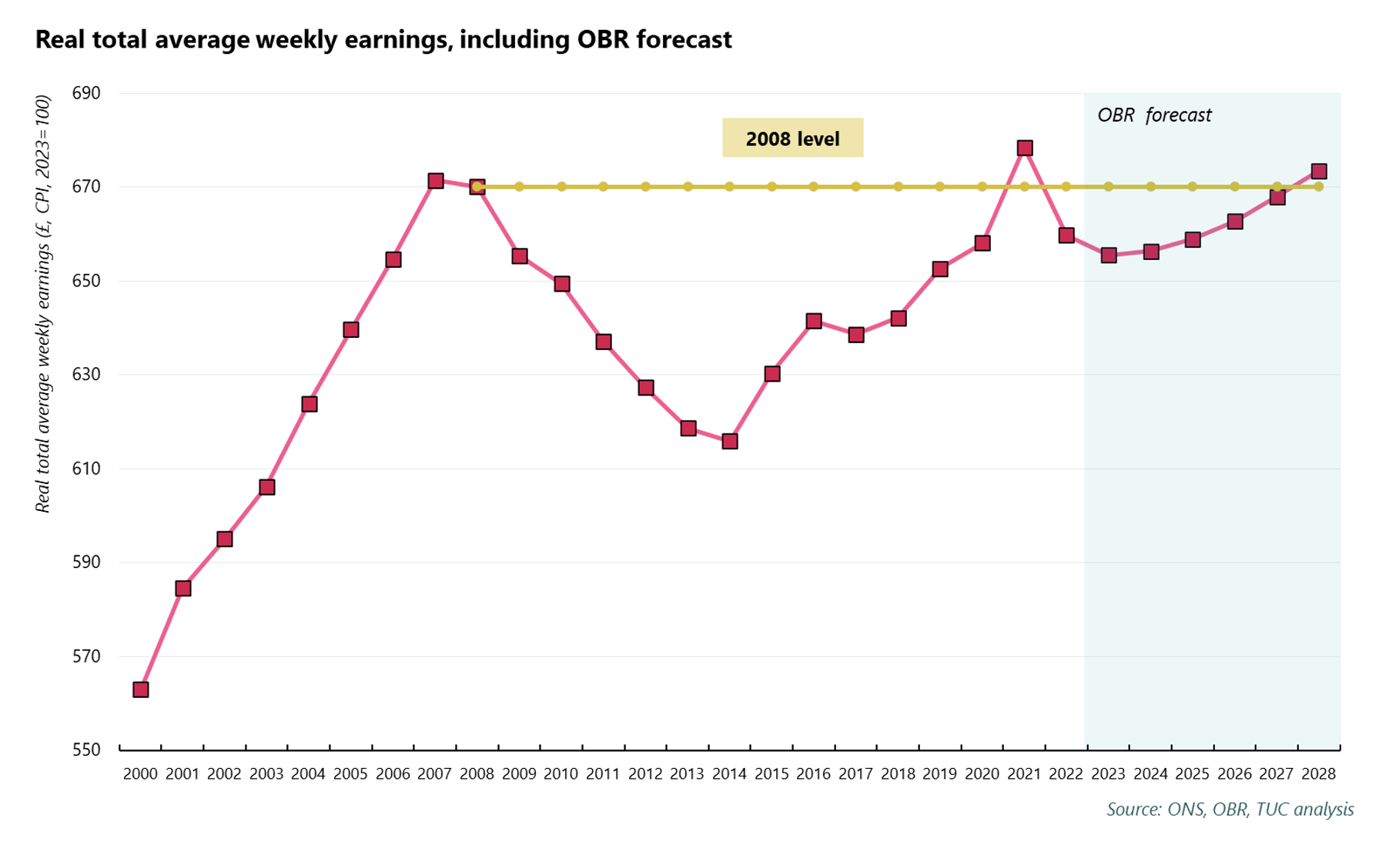
The forecasts published alongside the statement by the Office for Budget Responsibility (OBR) contained alarming news on real wages. According to the OBR forecasts, real wages are now not set to return to 2008 levels until 2028. The current pay squeeze will hit two decades.
This is a significant downgrade on the March forecast, when wages were returning to 2008 levels by 2026 – two years sooner than it now expects.
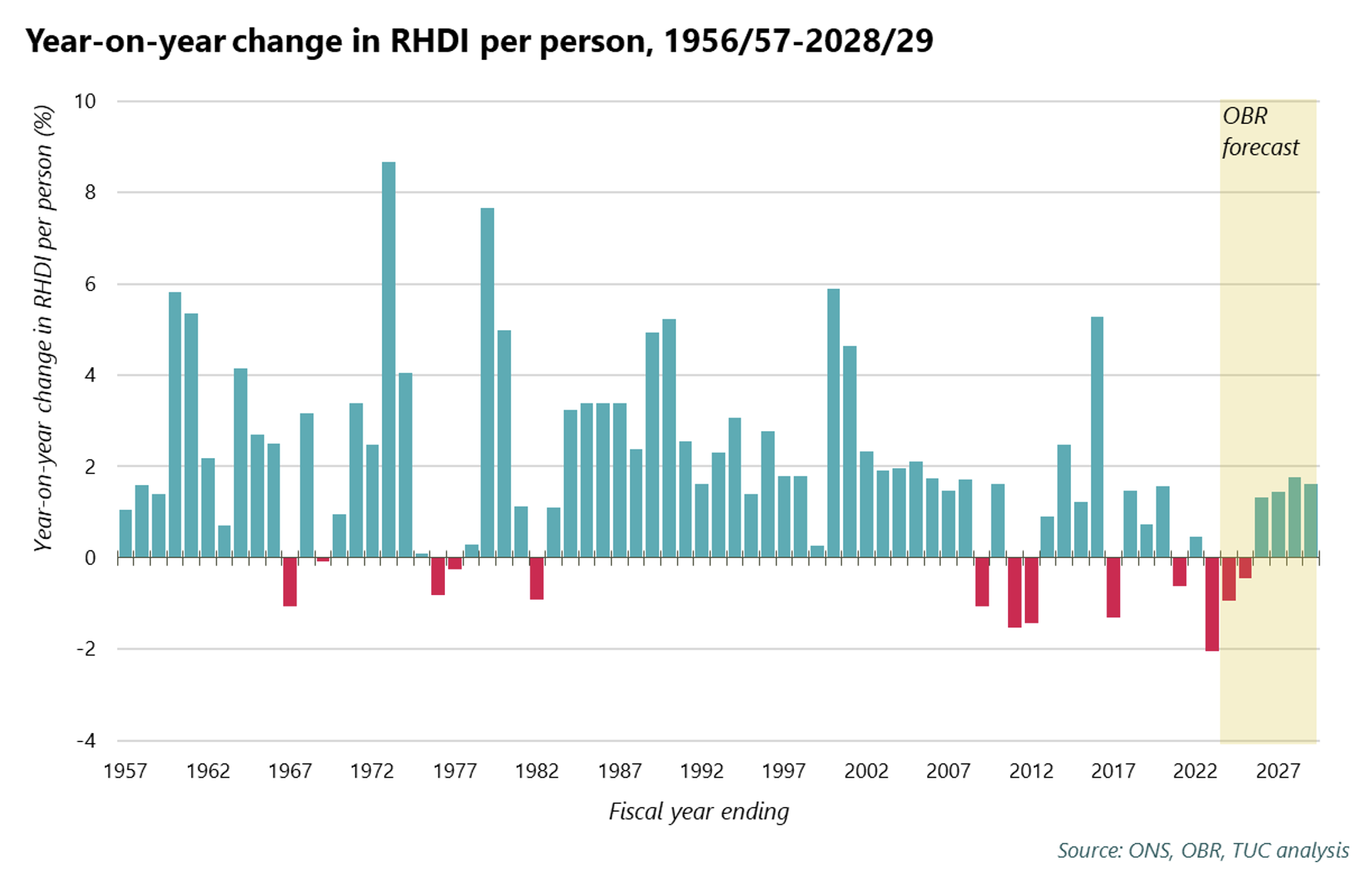
The forecast for broader living standards (as measured by real household disposable income per person) remains dire. After already declining in both the 2020/21 and 2022/23 financial years, further falls are expected over the next two.
While in fact a less bad forecast than March, the OBR stress that living standards “are forecast to be 3½ per cent lower in 2024-25 than their pre-pandemic level … this … represents the largest reduction in real living standards since ONS [Office for National Statistics] records began in the 1950s”.
The OBR also put into perspective the 2 per cent cut in National Insurance, reckoning it will boost living standards by around 0.5 per cent at the end of the forecast. This is a minor dent in an immense collapse, and of course as everybody has pointed out only reverses in a small way tax increases at past statements – even on their own terms the government are failing.
Minimum wage
Specifically for those on the minimum wage, the Chancellor has accepted the recommendations of the Low Pay Commission (LPC). This takes the wage floor to £11.44 an hour and extends coverage to everyone aged 21+. This is badly needed and follows pressure from unions and low-pay campaigners. But with prices sky high, and the OBR increasing its inflation forecasts, the minimum wage must be raised to £15 as soon as possible, and extended to all adult workers.
The Low Pay Commission’s recommendations take the minimum wage to 66% of median wages. This is an internationally recognised measure of relative low pay. However, the Chancellor’s claims that he has eliminated low pay should be taken with a pinch of salt. This is a measure of pay distribution which looks at how close low-paid workers are to the median worker. The floor has risen since 2010 but the middle has had no real pay rise over 13 years. The bottom has been catching up, in part, because wages are stagnant for everyone else. The government should set the LPC’s next minimum wage target at 75% of median wages, and this should be delivered alongside a plan for real wage growth for all workers.
Unemployment rise
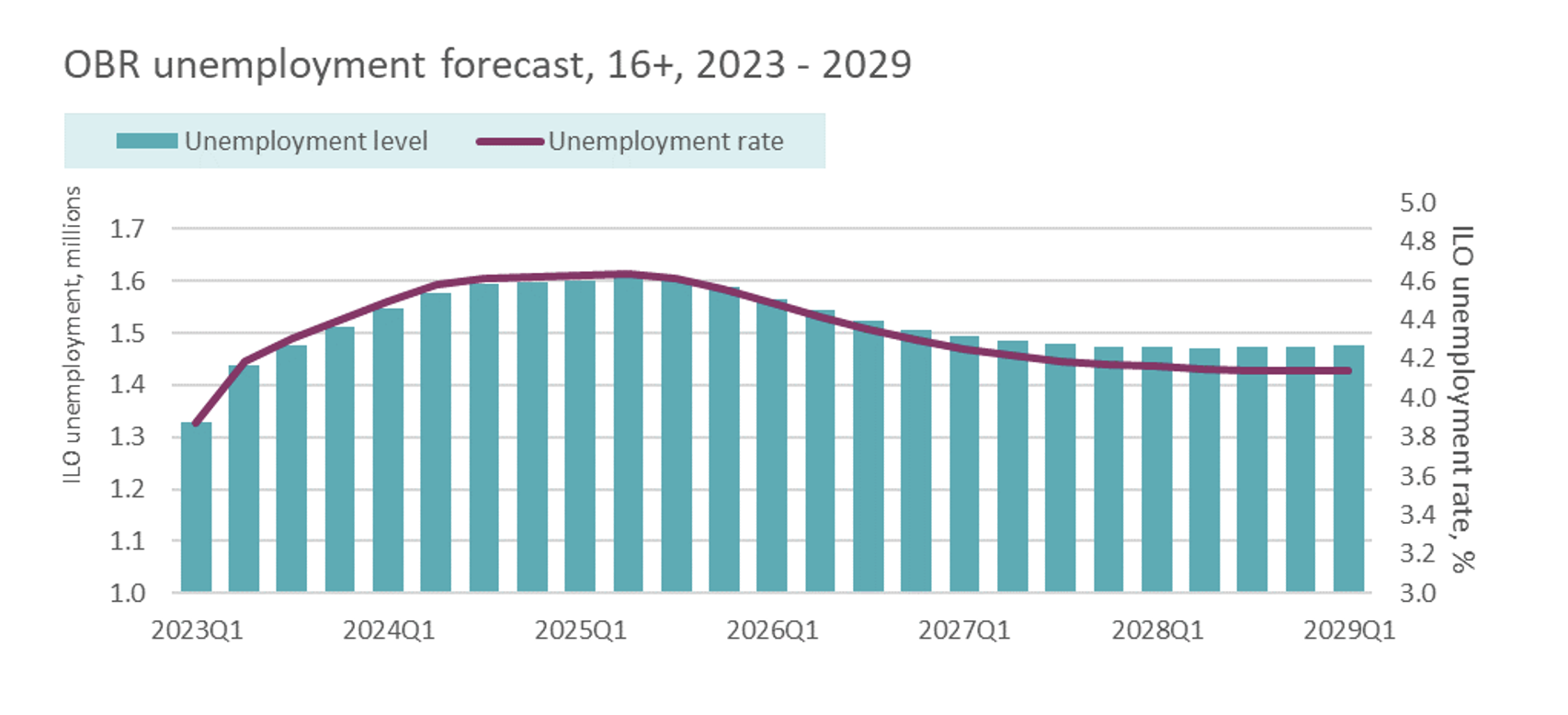
The OBR has also predicted that unemployment will steadily rise from now until midway through 2025, estimating there will be 275,000 more people in unemployment than at the start of this year. At no point in the OBR forecasts do they predict unemployment will fall below the level at the start of the year.
It is unfair to put it mildly to penalise individuals for an economic climate which is out of their control. The Chancellor decided to support compulsory work placements, but analysis show this punitive policy does not result in an improved employment outcome.
Skills
The Government plans focus largely on reforms coming in for 16-18 year olds, overlooking the skills gap faced by those already in the labour market. On apprenticeships £50m for a 2-year pilot widely misses the mark. In 2021/22, there were approximately 349,200 apprenticeship starts in England – a 31% decline from the pre-Apprenticeship Levy figures of 509,400 starts in 2015/16 (Source: CIPD). The funds are largely directed at male-dominated sectors, according to the Women’s Budget Group. Other measures are recycled and/or small – though the increase to the pitifully low apprenticeship minimum wage is be welcomed.
Little has been done to reverse cuts to adult and further education budgets since 2010, with spending still significantly below where it was when the government took office. Celebrating an uptick in Level 4 apprenticeships just repeats the ‘virtuous cycle’ where those with the highest levels of qualification receive the most investment in their training. Graduates get most of the training as working adults, and almost half of adults from the lowest socio-economic group receive no training at all after leaving school.
Social security
It is a low bar for this Government when they boast that benefits are being uprated in line with September’s rate of inflation, which is standard practice. Though they have severed the link between inflation and the uprating of benefits numerous times since 2010 – which has slashed vital financial support for families.
And while the Local Housing Allowance has been restored to the 30th percentile after it was last frozen in 2020, it will be frozen again and support reduced for ever-increasing rental prices.
There were also significant cuts to benefit entitlements for some people with long term health conditions. They are expected to lose £400 a month compared to current system, and face the threat of sanctions to enter employment.
The rate at which prices are increasing may have slowed, but families are still struggling with the essentials. Over the last two years the cost of energy has increased by 49 percent while food prices have increased by 28 percent.
Energy prices
And energy bills are a glaring omission from this Autumn Statement.
Household energy bills remain 50% higher than they were in the winter of 2021-2022 (approximately £600 higher for an average household). This means that an estimated 6.3 million households are in fuel poverty (spending more than 10% of their income on energy), and more than 1 million households are in extreme fuel poverty (spending 20% or more of their income on energy). (Estimate by Friends of the Earth and National Energy Action as government data are not yet available.)
Energy prices are expected to remain high or increase. Ofgem today raised the domestic energy price cap by 5%, based on wholesale price volatility.
Many employers will also struggle with rising and volatile energy bills. The UK consistently has some of the highest electricity prices for business in Europe, affecting the ability of UK manufacturers to compete internationally. Unions representing manufacturing workers have consistently campaigned alongside employer bodies for measures to rein in excessive and volatile wholesale energy prices – but these issues seem to be far from the list of priorities of the current Government.
Public services and public finances crises continue
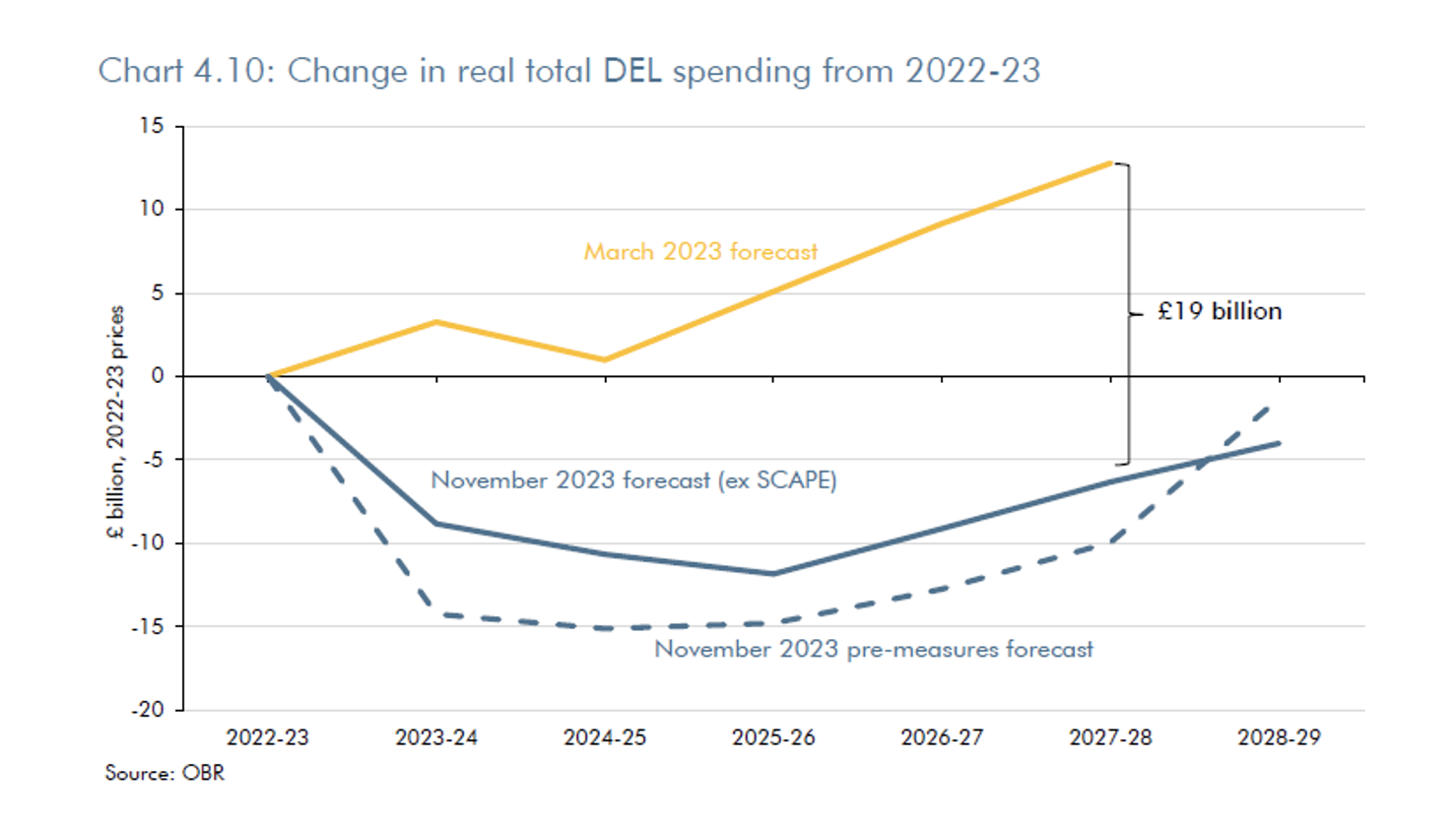
As the OBR gently warn, “it is worth dwelling for a moment on something the Chancellor didn’t announce in his Autumn Statement – which is any major change to departmental spending plans despite significantly higher inflation”.
The government has added “just” £5 billion a year in cash terms to departmental budgets, and this means that “the real spending power of these budgets is eroded by around £19 billion” relative to the previous forecast (as on their chart below).
In 2023-24 the increased budget is allocated for public sector pay increases (£3.9 billion for the NHS in 2023-24, and £0.4 and £1.4 billion for other departments in 2023-24 and 2024-25, respectively). Overall, the OBR have departmental spending growing by 0.9 per cent a year in real terms, down from 1.1 per cent at the March Budget.
Given the government’s political priorities on spending, the OBR stress that unprotected departmental spending is projected to fall by between 2.3 and 4.1 per cent a year in real terms from 2025-26. They wryly observe this (austerity) would “present challenges” and cite the Institute for Government’s recent report finding that “performance in eight out of nine major public services has declined since 2010”. Plainly there is no intention to resolve the crisis in public services and public service recruitment. And ultimately
The public finances overall
For the public finances as a whole, the government has enjoyed a momentary windfall – with less bad than expected growth outturn and higher inflation meaning tax gains (especially with tax thresholds not being uprated) outweighing higher interest and other costs. This has been spent on the NI cut and expensing.
But the Chancellor has made hollow boasts about the improved condition of the public finances. The overall management of the economy for 13 years has meant a disastrous failure for them. Immediately less bad GDP outcomes (next section) have meant marginally improved ratios for this statement. But overall the Conservatives have presided over a huge increase in debt from 65 per cent of GDP in 2009-10 to 98 per cent of GDP in the current financial year. This is an unprecedented deterioration relative to all economic cycles for more than a century.
Growth crisis unended
At the end of his speech the chancellor proclaimed an “Autumn Statement for Growth”. But nothing announced yesterday changed the bottom line. While the forecasts reflected ONS revisions to GDP data and a less bad than expected 2022, growth over the next two years is revised steeply down. And on a medium term view the OBR warn:
“we have revised DOWN our estimate of the medium-term potential GROWTH rate of the economy to 1.6 per cent, from 1.8 per cent in March” (our emphasis)
Of the onslaught in policy measures, the most prominent was making permanent the full expensing of business capital investment. The Chancellor chose to disregard OBR analysis showing both precursor measures (the super-deduction and temporary full expensing in the March 2021 and March 2023 Budgets) had a lower impact on investment levels than predicted (see OBR, Economic and Fiscal Outlook, November 2023, pp 33 – 34).
Introducing full expensing is forecast by the OBR to lead to an increase in business investment of £14 billion between now and 2028-29 and to cost £29.5 bn over the same period. This would appear then to be an extremely inefficient means of increasing business investment, reflecting huge ‘deadweight’ effects, whereby businesses gain generous tax relief on investment that would (likely) have taken place anyway.
The OBR estimates that the measure will raise the capital stock by 0.2 per cent by 2028-29 – a positive, but small, and very costly impact.
Pension saving
The chancellor also had high hopes for the role workers’ £2.5tn of pension savings could play in boosting our flagging economy. But while there were some welcome steps such as setting up a new growth fund through the British Business Bank the plans rely mostly on merging pension schemes in ways that are unlikely to be in the interests of their members, and leaning on funds to put more money into global private equity. These measures were also over shadowed by a poorly thought through proposal to upend the workplace pension system. See our fuller commentary here.
Industrial strategy?
As the Chancellor noted, the lack of long-term certainty over policy decisions (including industrial strategy, taxes, and climate commitments) is a drawback to business decisions to invest. But there was no reassurance in the Autumn Statement that the Government would provide that certainty. While reannouncements of investment commitments to support the automotive, advanced manufacturing, and energy sectors – amounting to £4.5 billion are welcome, this represents only a small proportion of the investment requirements of the Biden-style industrial strategy that the UK needs.
Ending the failure
The failure – as Labour have repeatedly identified – is still a failure of growth. The government need to invest in a stronger economy where growth and fairness go hand in hand, where decent pay means workers spend and businesses produce to meet that spending. A virtuous cycle comes when businesses invest in the face of expansion and optimism, and stronger public services re-enforce the upward dynamic. Fairer and sustainable growth will then support the public finances.
Yet the government continues to take us in the wrong direction. Yesterday’s Autumn Statement showed more strongly than ever why it is time for a change.
Autumn Statement ‘ushers in new era of welfare reform’
A ‘bold new vision for welfare’ backed by nearly £30 billion has been set out by Work and Pensions Secretary Mel Stride
Millions of people will benefit from next generation of welfare reforms and extra support for those most in need, announced at Autumn Statement
Benefits increased by 6.7% and pensions by 8.5%, maintaining commitment to seeing the country through cost of living pressures
DWP Secretary Mel Stride heralds new era offering a “brighter future for millions”
The plans offer unprecedented employment and health support to help over a million people, while protecting those in most need from cost of living pressures – including raising pensions and benefits and increasing help with housing costs.
Long term decisions to provide unprecedented help for people to move off welfare and into work were at the heart of the Government’s plan for growth set out at the Autumn Statement.
While unemployment has been almost halved since 2010, the £2.5bn Back to Work plan will help thousands of people with disabilities, long-term health conditions and the long-term unemployed, to move into jobs. This comes alongside new guarantees for those on the highest tier of health benefits around keeping benefit support to cushion those who try work.
The transformative employment programme comes as the Government continues to protect the most vulnerable, delivering a Triple Lock-protected boost for pensioners and raising benefits in line with inflation next year, worth £20bn taken together.
The changes mean the full rate of the new State Pension will go up by £17.35 per week, while families on Universal Credit will be on average £470 better off next year.
Around 1.6 million households will also benefit from an increase to the Local Housing Allowance – and will be around £800 a year better off on average. Worth more than £7bn over five years, this commitment will support low-income families in the private rented sector with rent costs and help prevent homelessness.
Secretary of State for Work and Pensions, Mel Stride MP said: “Work changes lives. With the next generation of welfare reforms, we will help thousands of people to realise their aspirations and move off benefits into work, while continuing to support the most in need.
“We are taking long term decisions that will build a brighter future for millions, offering unprecedented support to open up opportunity and grow the economy, building on our record that has seen almost four million more people in work since 2010.
“Our reforms will remove the barriers to work that we know some people still face, while we’re boosting benefits and pensions to help with cost of living pressures.”
Welfare reforms announced at the Autumn Statement include:
Uprating working age benefits in line with September’s CPI index figure of 6.7%.
Uprating state pensions in line with September’s earnings figure of 8.5%.
Increasing the Local Housing Allowance to cover the 30TH percentile – worth an average of £830 per year.
Expanded jobcentre support including intensive help for those on Universal Credit
Introducing the Chance to Work Guarantee, which will tear down barriers to work for millions of claimants to try work with no fear of reassessment or losing their health benefit top-ups.
Increasing mental health support for jobseekers by expanding NHS Talking Therapies treatment and the Individual Placement and Support programme, supporting almost 500,000 over five years.
Matching 100,000 people per year with existing vacancies and supporting them in that role through Universal Support.
Rolling out WorkWell to support people at risk of falling into long-term unemployment due to sickness or disability.
Reforming the Work Capability Assessment for new health benefit claimants to better reflect the opportunities available in the modern world of work.
Stricter sanctions for people who should be looking for work but aren’t engaging with jobcentre support.
Building on the Mansion House reforms with further steps to improve private pension returns and grow the economy.
Introducing new Government powers to request data from organisations such as banks when accounts are showing signals of fraud and error.
The Government’s ‘radical new plan’ will stem the flow people falling out of work and onto inactivity benefits due to physical or mental health problems, as it takes the long-term decisions to help people realise their dreams to find a job and build a better life.
With this unprecedented level of employment support comes tougher enforcement of sanctions for fit and able people who should be looking for work but aren’t.
Work coaches will use tools to track people’s attendance at jobs fairs and interviews, and close benefit claims of those able to work who have been sanctioned and no longer receiving money after six months.
Taken together, the package will make sure those who are vulnerable or on the lowest incomes are protected, with intensive support to get them back into work, while ensuring fairness to the taxpayer.
A new report from Holyrood’s Social Justice and Social Security Committee calls on the Scottish Government to take steps to “supercharge” its efforts to tackle child poverty.
The Committee has been undertaking an inquiry into the issue, focusing on parental employment, which the Government sees as key to reducing the number of children living in poverty.
During the inquiry the Committee travelled to several places in Scotland to hear the views of parents. Not being able to access childcare from a child’s first birthday to when they start school, both during the school term and holidays, was the most common barrier to employment that they talked about with affordability and flexibility seen as critical.
Parents spoke of needing to find work that fitted in with school hours, while one contributor reflected that women could not develop in their careers until their children had reached high school age. In response, the Committee calls on the Government to accelerate its work on expanding the availability of childcare.
Public transport is a major theme in the report. Witnesses in urban and rural areas spoke about a range of issues including access and cost. The report asks the Government to consider how public transport services can be designed and better supported to provide affordable, frequent and direct services that support the type of trips more regularly made by parents.
The Committee’s report also encourages the Government to investigate how an integrated system of discounted travel offers for low-income working-age people could be provided. The Committee believes this would enable some families to access a wider range of employment opportunities by being able to travel further, more cost effectively.
Witnesses also identified an issue faced by parents who embark upon study to improve their career prospects. Student funding means that low-income parents at college or university would be ineligible for benefits such as Universal Credit. To help, the Committee calls for Scottish Child Payment eligibility to be extended.
Bob Doris MSP, speaking on behalf of the Social Justice and Social Security Committee, said: “In Best Start, Bright Futures, the Scottish Government said that parental employment is a key driver to meet the statutory targets to address child poverty. Our report looks at how the aims of that plan could come closer to being realised.
“The Scottish Government believes that without its actions to date, 28% of children would be living in poverty. Even so, the Government expects to narrowly miss its interim child poverty targets, with modelling predicting that 19% of children will be living in poverty this year. Therefore, we are calling for the Government to take decisive action now by clarifying its priorities and commitments and producing explicit delivery and spending plans to make sure progress is on track.
“We recognise the good progress the Scottish Government has made in reducing child poverty. We now want to see the Government supercharge its efforts so that the ambitions it has set can become reality.”
Yesterday the SNP/Green led Scottish Government voted down Scottish Labour’s Motion to declare a housing emergency across Scotland.
In her speech Scottish Labour’s Sarah Boyack MSP, praised the leadership shown by City of Edinburgh Councillors but called out the SNP and Greens for failing to do so in Holyrood.
Ms Boyack urged the Scottish Government to provide local authorities, like Edinburgh, the resources they need to take substantial steps in tackling the Housing emergency.
Ms Boyack also used her speech to highlight practical solutions, that could be taken to make an immediate start on tackling the housing emergency, such as bringing empty homes back into use. However, Edinburgh Council need resources from the Scottish government, to make this happen.
Speaking after the debate, Sarah Boyack said: “Tackling the housing emergency in Edinburgh needs to be a priority. Every day I receive emails from constituents who are struggling to access the housing they need or are being priced out altogether.
“SNP Councillors recognise the magnitude of the crisis, so why doesn’t the SNP Government?
“So far, the Scottish Government has failed to recognise the scale of the challenge. The Scottish Government needs to work constructively with all councils, to ensure the resources are in place, to adequately tackle this emergency
“MSPs will have another opportunity to recognise that we are facing a housing emergency through my motion and subsequent members business in the new year.”
Plan for stronger economy will reward hard work, putting £450 back into the pocket of the average worker earning £35,400 a year thanks to National Insurance tax cut from 12% to 10% for 27 million working people from January.
Tax to be cut and simplified for 2 million of the self-employed, abolishing an entire class of NICs and cutting the rate of the NICs top rate from 9% to 8% – with an average total saving of around £350 for someone earning £28,000 a year.
Biggest permanent tax cut in modern British history for businesses will help them invest for less and boost investment by £20 billion per year over the next decade.
Triple lock maintained for pensioners, benefits to rise in line with inflation and Local Housing Allowance increased to continue supporting families with the cost-of-living. Government is making work pay.
National Living Wage rise represents boost of £1,800 to the average annual earnings of a full-time worker, and the Back to Work Plan will help over a million people start, stay, and succeed in work while ensuring tougher consequences for those choosing not to.
Great British pubs, breweries and distillers backed by freezing alcohol duty for six months to August 2024.
Public finances in a better position than in March thanks to government action, with borrowing and debt as a share of the economy down on average across the next five years.
Autumn Statement gets the economy growing, debt falling and helps return inflation to its 2% target – long-term decisions to build a brighter future.
Tax cuts for working people and British business headlined Chancellor Jeremy Hunt’s ‘Autumn Statement for Growth’ yesterday.
Aimed at building a stronger and more resilient economy, the Chancellor set out a plan to unlock growth and productivity by boosting business investment by £20 billion a year, getting more people into work, and cutting tax for 29 million workers – the biggest tax cut on work since the 1980s.
With higher revenues resulting from stronger growth than previously projected and the pledge to halve inflation having been met, the government has stabilised the economy through taking sound decisions. As set out by the Prime Minister this week, the stronger outlook means taxes can now be cut in a serious, responsible way.
To that end, Mr Hunt announced that a 2 percentage point cut to Employee National Insurance from 12% to 10% will come into effect from January 2024.
For the average worker earning £35,400 a year, that amounts to an over £450 annual tax cut – almost immediately improving living standards for millions of people and rewarding hard-work as the government builds an economy for the future.
Taxes for the self-employed will also be cut and reformed. From April 2024, Class 4 NICs for the self-employed will be reduced from 9% to 8% and no self-employed person will have to pay Class 2 NICs, saving the average self-employed person on £28,200 a year £350 in 2024/25.
Taken together, this is a tax cut of over £9 billion per year and represents the largest ever cut to employee and self-employed National Insurance. The independent Office for Budget Responsibility (OBR) says these reductions will lead to an additional 28,000 people entering work.
Cutting National Insurance will not lead to any change in NHS funding or pension payments. Services will remain unchanged and continue to be funded as they are now.
Businesses will also benefit from the biggest business tax cut in modern British history. As signalled at Spring Budget, the Chancellor announced permanent Full Expensing: Invest for Less for those investing in IT equipment, plant, and machinery.
Full Expensing: Invest for Less is an effective permanent tax cut of £11 billion a year, boosting business investment by £14 billion across the forecast period and helping to grow the economy.
With the tax cut now permanent, the UK will continue to have both the lowest headline corporation tax rate in the G7 and the most generous capital allowances in the OECD group of major advanced economies, such as the United States, Japan, South Korea and Germany.
Since the introduction of the super deduction – the predecessor to full expensing – in 2021, investment in the UK has grown the fastest in the G7.
To further ensure that work pays, Mr Hunt confirmed that the National Living Wage will increase by nearly 10% to £11.44 an hour from April 2024, the largest ever cash increase.
The Chancellor also reinforced the new £2.5 billion Back to Work Plan for those with long-term health conditions, disabilities and difficulties finding employment, which includes tough new sanctions for those who can work but choose not to.
The Chancellor also announced that the government will honour its commitment to the triple lock in full, with the state pension to increase by 8.5% in April in what is the second biggest ever cash increase. Universal Credit and other working age benefits will also be boosted by 6.7% in April, in line with September’s inflation figure as is convention.
Further action to help families includes increasing the Local Housing Allowance rate to cover the lowest 30% of rents from April – benefiting 1.6 million households with an average gain of £800 in 2024/25 – and an alcohol duty freeze to 1st August 2024, following common-sense changes of the duty system made possible by Brexit.
Measures today take the government’s total support for the cost-of-living between 2022-25 beyond the £100 billion mark, to an average of £3,700 per household.
Accompanying forecasts by the OBR confirm that today’s measures will make the economy permanently bigger, with growth every year of the forecast period. Borrowing and debt as a share of the economy are lower than in Spring this year and next year, with borrowing also lower on average across the forecast by comparison. They also confirm that inflation is expected to return to target in line with the Prime Minister’s economic priorities.
Tax
With inflation halved and debt forecast to fall, Mr Hunt delivered on the government’s commitment to cut taxes – rewarding and incentivising work as part of its long-term plan to grow the economy.
The main rate of Employee National Insurance will be cut by 2 percentage points from 12% to 10%, coming into effect from January 2024 – delivering the benefit of a tax cut quickly for 27 million workers.
The combined rate of income tax and National Insurance for employees paying the basic rate of tax will therefore fall from 32% to 30% – the lowest combined basic rate since the 1980s.
The rate of Class 4 NICs on all earnings between £12,570 and £50,270 will be cut by 1p, from 9% to 8% from April 2024.
The weekly Class 2 NICs – the flat rate compulsory charge which is currently £3.45 paid by self-employed people earning more than £12,570 – will effectively be abolished, with no-one required to pay from April 2024. Access to contributory benefits will be maintained and those currently paying voluntarily will still be able to do so at the same rate. The cuts to Class 4 and Class 2 together amount to a tax cut of £350 a year for the average self-employed person on £28,200, with around 2 million individuals to benefit.
Business
Measures to back British businesses big and small will remove barriers to investment and help to bridge the productivity gap between the UK and its G7 peers – unlocking £20 billion extra business investment per year over the next decade.
Permanent Full Expensing will create the certainty that businesses need to confidently invest for less. A company can now permanently claim 100% capital allowances on qualifying main rate plant and machinery investments, meaning that for every pound invested its taxes are cut by up to 25p.
A business rates support package worth £4.3 billion over the next 5 years will help high streets and protect those small businesses that are the backbones of communities. This includes a rollover of 75% Retail, Hospitality and Leisure relief for 230,000 properties and a freeze to the small business multiplier, which will protect around 90% of ratepayers for a fourth consecutive year.
Pension reforms, including through establishing a new Growth Fund within the British Business Bank, will help unlock an extra £75 billion of financing for high-growth companies by 2030 while providing an extra £1,000 a year in retirement for the average earner saving from 18.
SMEs will be supported with tougher regulation on late payers to improve prompt payments, the expansion of Made Smarter in Great Britain and continued funding for Help to Grow.
The existing R&D Expenditure Credit and Small and Medium Enterprise Scheme will be merged from April 2024, simplifying the system and boosting innovation in the UK.
The rate at which loss-making companies are taxed within the merged scheme will be reduced from 25% to 19%, and the threshold for additional support for R&D intensive loss-making SMEs will be lowered to 30%, benefiting a further 5,000 SMEs.
The Climate Change Agreement Scheme will be extended, giving energy intensive businesses like steel, ceramics and breweries around £300 million of tax relief every year until 2033 to encourage investment in energy efficiency and support the Net Zero transition.
Work and welfare reform
Mr Hunt set out steps to reward work, help make work pay, and reform welfare in recognition of the need to expand the workforce and get those out of work back into work to deliver growth.
The OBR expect that the measures announced at Autumn Statement will support a further 78,000 people into work by 2028-29, on top of the 110,000 resulting from action taken at Spring Budget.
From 1 April 2024, the National Living Wage will increase by 9.8% to £11.44 an hour for eligible workers. For the first time this will include 21- and 22-year-olds. This represents an increase of over £1,800 to the annual earnings of a full-time worker on the NLW and is expected to benefit over 2.7 million low paid workers.
The government will also substantially increase the National Minimum Wage rates for young people and apprentices: for people aged 18-20 by 14.8% to £8.60 an hour, for 16-17 year olds and apprentices by 21.2% to £6.40 an hour.
The government is reforming the Work Capability Assessment to ensure that people who can work are supported to do so via the welfare system. Changes to the activities and descriptors will better reflect the greater flexibility and reasonable adjustments now available in the world of work, preventing some individuals from being deemed not fit for work and ensuring they will be better supported into employment.
The boosting of four key programmes – NHS Talking Therapies, Individual Placement and Support, Restart and Universal Support – will benefit up to 1.1 million people over the next five years.
The government is exploring reforms of the fit note process to provide individuals whose health affects their ability to work with easy and rapid access to specialised work and health support.
Mandatory work placements will boost skills and employability for those who have not found a job after 18 months of intensive support. Those who choose not to engage with the work search process for six months will have their claims closed and benefits stopped.
Infrastructure and levelling up
The Chancellor unveiled a raft of supply-side measures and funding packages to benefit businesses and local communities.
£4.5 billion of funding for British manufacturers in the high-growth industries of the future, including £960 million earmarked for the Green Industries Growth Accelerator to support clean energy.
The government has published its full response to the Winser review and Connections Action Plan, which will cut grid access times for larger projects by half, halve the time to build major grid upgrades and offer up to £10,000 off electricity bills over 10 years for those living closest to new transmission infrastructure.
Three advanced manufacturing Investment Zones will be established in Greater Manchester, East Midlands, and West Midlands – together generating £3.4 billion of private investment and creating 65,000 high-quality jobs within the next decade.
The Investment Zones programme and freeport tax reliefs will be extended from 5 years to 10 years, and a new £150 million Investment Opportunity Fund will support Investment Zones and Freeports to secure specific business investment opportunities.
Four new devolution deals across England have been agreed. Mayoral deals with Greater Lincolnshire and Hull and East Yorkshire, and non-mayoral deals with Lancashire and Cornwall, will boost investment right across the country and deliver on the Prime Minister’s commitment to levelling-up.
£500 million of funding over the next two years will help establish two more Compute innovation centres, supporting the development of artificial intelligence as a growth opportunity for Britain.
The life sciences will also be supported as one of the Chancellor’s key-growth sectors, with £20 million to speed up the development of new dementia treatments coming as part of the government’s full response to the O’Shaughnessy Review of commercial clinical trials in the UK.
To prioritise those who want to invest in the UK’s future, the government has accepted in principle the headline recommendations of Lord Harrington’s review into increasing foreign direct investment. This includes additional resource for the Office for Investment, allowing it to deepen its world-class concierge offer to strategically important investors.
Scottish Secretary Alister Jack said: ““This is an Autumn Statement to support hard working families and grow our country’s economy. It is great news for Scotland.
“The National Insurance cut and increase in the National Living Wage will mean a pay boost for millions of workers right across Scotland. We have honoured the pensions triple lock, meaning pensioners will get a £900 a year increase.
“Vital new support for Scottish businesses will ensure we get growth back into our economy.
“The Chancellor confirmed more than £200 million of new, direct UK Government investment in exciting projects across Scotland, which will create jobs, boost growth and transform communities.
“Plus, there will be an additional £545 million in Barnett Consequentials for the Scottish Government, on top of their record block grant.
“There is a lot to cheer about, not least the duty freeze on spirits to support Scotland’s biggest export industry.”
Rain Newton-Smith, Chief Executive, Confederation of British Industry said:“With tough decisions to be made, the Chancellor was right to prioritise ‘game-changing’ interventions that will fire the economy.
“While the move on National Insurance will give hard-pressed households some much needed breathing room, making full capital expensing a permanent feature of the tax system can be transformational for accelerating growth and improving living standards in the long-term.
“Helping firms to unleash pent-up investment is critical to getting momentum into the economy. Making full expensing permanent will give firms the stability they need to press on with decisions on investment whilst keeping the UK at the top table internationally for investment incentives.
“Moves to speed up planning and grid connectivity should also bolster business confidence to invest in high growth areas like green technologies, renewable energy and advanced manufacturing.”
Eve Williams, General Manager, eBay UK said: “The hundreds of thousands of UK small businesses who use eBay and other online marketplaces will warmly welcome the Chancellor’s cuts in national insurance, more support for the self-employed, as well as the decision to make permanent full expensing.
“There are enormous productivity gains to be had from encouraging the long tail of Britain’s SMEs to invest in existing digital technologies. And given that around half of our online businesses also trade offline, they will benefit hugely from the measures on business rates for retail as well as freezing the business rate multiplier.”
Kate Nicholls, Chief Executive, UKHospitality said:“The Chancellor has brought forward a significant package of business rates measures that will help hospitality businesses across the country. UKHospitality led the calls for Government to extend relief and take action on the multiplier and I’m delighted the Chancellor has acted on our asks.
“Reforms to the planning system to drive quicker approvals will remove a significant barrier to business investment. This type of reform to reward the best performing local planning authorities is exactly the type of change we have been suggesting to drive growth in hospitality.
“We’re also pleased that the Chancellor has acted on our proposal and frozen alcohol duty until August next year to support our supply chain.
“The reduction in National Insurance for employees will put more money in people’s pockets and provide a boost to hospitality in the New Year, often a challenging time for the sector.”
Responding to the freeze in alcohol duty until 1 August 2024
Nuno Teles, Managing Director, Diageo GB said:“Today we raise a glass to the Chancellor and the Prime Minister, who have listened to the industry’s plea for support and decided to back our homegrown sector, that employs so many people across the UK.
“Drinkers and pub-goers across the country now have even more reason to celebrate this festive season. Cheers, Chancellor!”
Responding to the announcement of £7million of funding to tackle antisemitism
Mark Gardiner, Chief Executive, Community Security Trust (CST) said:“The commitment to fund education to tackle antisemitism in universities and schools, alongside the promise to continue the increase in funding for security guarding in the Jewish community, is not just a welcome, concrete contribution to the fight against antisemitism: it sends an important and powerful message to the Jewish community that we have the sympathy and support of government in this struggle.
“We are grateful for the Chancellor for this commitment and we will work with government and communal partners to ensure it is put to effective use.”
Responding to the protection of the Triple lock
Caroline Abrahams, Influencing Director, Age UK said:“We’re pleased and relieved the Government kept its promise to older people to honour the Triple Lock.
“For the 4.2 million older people who recently cut back on food and groceries to make ends meet, having a State Pension that delivers the basics in life is essential.
“Today’s decision also crucially makes is more likely that older people will keep their homes adequately warm this winter, with less fear of facing an energy bill they simply cannot afford to pay come the spring.”
Responding to the support for Veterans
Anna Wright, Chief Executive, the Armed Forces Covenant Fund Trust said: “We are delighted by Chancellor of the Exchequer’s announcement of an additional £10 million to support the Veterans’ Places, People and Pathways programme.
“These projects have delivered significant work already to support our veterans, growing collaborative cross sector working and giving a more seamless interface between statutory and charity or not for profit support.
“They have great potential to help even more veterans, and further develop better, more inclusive local support and better coordination and communication that sustains into the future”
Autumn Statement offers ‘worst case scenario’ for Scotland
Deputy First Minister responds to announcements from Chancellor
The Autumn Statement delivered the ‘worst case scenario’ for Scotland’s finances and failed to live up to the challenges posed by the cost of living and climate crises, Deputy First Minister Shona Robison has said.
The statement failed to deliver the investment needed in services and infrastructure, Ms Robison said. While welcoming the increase in the statutory minimum wage, she said this did not go far enough and fell well short of the Real Living Wage of £12 an hour for 2024-25.
The Deputy First Minister said: ““Today’s Autumn Statement from the UK Government has delivered what is the worst case scenario for Scotland’s finances. Scotland needed a fair deal on investment for infrastructure, public services and pay deals – the UK Government has let Scotland down on every count.
“We needed investment in the services that people rely on and in infrastructure vital to the economy, but the Chancellor’s actions failed to live up to the challenges we are facing as a nation, while not doing enough to help those on the lowest incomes.
“The cut to National Insurance shows the UK Government has the wrong priorities at the wrong time, depriving public services of vital funding. Shockingly, the health funding announced today represents an increase of less than 0.06% to Scotland’s health budget in 2023-24 of £19.138 billion.
“The increases to the state pension and Local Housing Allowance are welcome, but the increase to the minimum wage falls well short of the Real Living Wage. Some of the measures for businesses are also positive, but they come in the face of UK growth having been projected downwards as a result of Brexit and the UK Government’s mismanagement of the economy.
“As global temperatures push ever higher, the Autumn Statement was a chance to fund efforts to cut the UK’s carbon emissions – but it did not. It’s not enough to say they support measures to encourage more renewable energy developments and expand the UK’s electricity grid need. It needs to be matched with funding to actually deliver and help us meet our net zero targets.
“We will now assess the full implications of today’s statement as we develop a Budget that meets the needs of the people of Scotland, in line with our missions of equality, community and opportunity.”
The Scottish Budget will be announced on 19 December.
TUC: Hunt’s Autumn Statement “is a plan for levelling the country down”
Chancellor has confirmed “another round of punishing spending cuts to public services and investment”
Cutting NI won’t make up for “13 continued “years of economic failure on living standards and growth”
Growth forecasts revised down with real wages set to remain below 2008 level until 2028
“The Conservatives have broken Britain. They cannot be trusted to fix it,” says TUC
Commenting on the Autumn Statement, TUC General Secretary Paul Nowak said: “This is not a plan for rebuilding Britain. It’s a plan for levelling the country down.
“At a time when our schools and hospitals are crumbling – the Chancellor has confirmed another round of punishing and undeliverable spending cuts to public services and investment.
“Be in no doubt – if the Tories win the next election, even more austerity is on the way.
“Cutting national insurance won’t make up for 13 continued years of economic failure on wages and living standards.
“Jeremy Hunt has nothing to smile about when working people are on course for a 20-year real wage freeze.
“The Conservatives have broken Britain. They cannot be trusted to fix it.”
Responding to the 2023/24 Autumn Statement, SCVO Chief Executive Anna Fowlie, said: “I share the disappointment of other voluntary sector bodies that this week’s budget Autumn Statement did not recognise the essential services and support of voluntary organisations both in Scotland and across the UK.
“Our sector is a major employer, a partner in delivering public services, and a vital contributor to society and the economy.
“The last few years have been a period of significant change and upheaval for Scottish voluntary organisations, their staff and volunteers, and the people and communities they work with. Rising inflation and the resulting cost-of-living crisis and running costs crisis has strained sector finances and increased demand for the support and services many organisations provide, as demonstrated in our Third Sector Tracker.
“This crisis is not over. We welcome the increase in the National Living Wage which will offer some support to the lowest paid, but to meet the rising cost-of-living this needed to go further, lifting both the National Living Wage and the National Minimum Wage to at least Real Living Wage.
“Our sector is central to building a stronger economy and offers specialist support to those furthest from the labour market and should be included in these plans.
“To protect our sector’s essential contributions for the future, underfunding and a lack of inflation-based uplifts in grants and contracts needed to be addressed in this statement. As people and communities struggle through the largest reduction in household incomes since records began in the 1950s, our support will be needed more than ever.”
FIRST MINISTER CALLS FOR RECOGNITION OF STATE OF PALESTINE
MSPs have voted in favour of an immediate ceasefire in Gaza and the immediate and unconditional release of all hostages held by Hamas, following a debate in the Scottish Parliament.
Opening the debate, First Minister Humza Yousaf said the chamber was unified in resolute condemnation of Hamas’ abhorrent terrorist attacks and the humanitarian catastrophe unfolding in Gaza.
This followed a letter sent by the First Minister to the Prime Minister and Sir Keir Starmer this morning, calling for the UK to officially recognise the State of Palestine in order to break the political impasse that has condemned Israelis and Palestinians to successive cycles of violence.
The First Minister said: “In Scotland, the Muslim and Jewish communities have enjoyed decades of friendship, decades of shared humanity and faith. Nowhere is that more evident than in East Renfrewshire, home of Scotland’s largest Jewish community, and a significant Muslim population too, who have lived side-by-side in harmony for many years.
“But we cannot be complacent. We must all be proactive in rooting out any hint of Islamophobia or antisemitism wherever it occurs. Presiding Officer, even though it feels impossible to look past the current horrors of war, we must ensure that this perpetual cycle of violence that we see occur far too often finally ends, once and for all, in a peaceful resolution.
“To that end, there must be a renewed, and serious international effort towards a two-state solution. Israeli and Palestinian states that can co-exist in safety, security and with equal rights for each of its citizens.
“Unfortunately, the world has not kept its promise to the Palestinian people. They have not been given a free sovereign state, along the 1967 borders, as they were promised. Quite the opposite.
“The continued expansion of Israeli settlements in the occupied West Bank is not only illegal but works against a peaceful resolution. So it is simply not enough anymore to pay lip-service to a two-state solution, we must take steps to turn that into a reality.
“To that end, I have written to the Prime Minister, and to Sir Keir Starmer, and urged them to immediately take steps to ensure the UK recognises the State of Palestine. It is only with full recognition of Palestine, as a State in its own right, that we can truly move forward towards a two-state solution.
“To conclude, Presiding Officer, to prevent further deaths, the bombs, the rockets – they must stop. The Scottish Government continues to call for an immediate ceasefire, for the safe release of all hostages, for an end to the killing of innocent civilians in Gaza, for an end to the siege of Gaza, and for all parties to abide by international law.
“The UK government and the international community must use their influence to prevent the further loss of innocent life. Every child the world over deserves to grow old. The children of Gaza and Israel deserve nothing less. It is our moral obligation to act. Let us hope even in these, the darkest of times, that humanity prevails.”
First Minister Humza Yousaf has written to Prime Minister Rishi Sunak calling for the United Kingdom to officially recognise the State of Palestine to break the political impasse that has condemned Israelis and the Palestinians to successive cycles of violence.
The FM’s appeal came on the day Scotland’s MSPs voted in favour of ceasefire in Palestine.
The letter, sent ahead of a debate on the situation in the Middle East in the Scottish Parliament yesterday, has also been sent to the Leader of the Opposition in the UK Parliament Sir Keir Starmer.
The First Minister later opened the Holyrood debate on a Government motion which condemned the Hamas atrocities on 7 October, called for the release of the hostages and for all parties to agree to an immediate ceasefire.
Redirected HS2 funding to resurface more than 5,000 miles of road across England
driving to become smoother, safer and easier with £8.3 billion of redirected HS2 funding, enough to resurface over 5,000 miles of road
long-term plan to mend roads across the country, saving motorists up to £440 on vehicle repairs
biggest-ever uplift in funding for local road improvements thanks to funding from government’s £36 billion Network North transport plan
Millions of people will enjoy smoother, safer and faster road journeys thanks to the biggest-ever road resurfacing programme to improve local roads.
Today (17 November 2023), Transport Secretary Mark Harper has set out the allocations of an £8.3 billion long-term plan, enough to resurface over 5,000 miles of road across the country over the next 11 years. It’s one of the key cornerstones of Network North to improve journeys for all.
Across England, local highway authorities will receive £150 million this financial year, followed by a further £150 million for 2024/2025, with the rest of the funding allocated through to 2034.
Each local authority can use its share of the £8.3 billion to identify what local roads are in most need of repair and deliver immediate improvements for communities and residents. This is divided as:
£3.3 billion for local authorities in the North West, North East and Yorkshire and the Humber
£2.2 billion for local authorities in the West Midlands and East Midlands
£2.8 billion for local authorities in the East of England, South East, South West and, for the first time in 8 years, London
The UK Government has already confirmed £5.5 billion up until 2024/25, for England outside London, which includes the £200 million announced by the Chancellor at the Budget in March. Today’s £8.3 billion nationwide boost comes on top of that and extends until 2034, providing long-term certainty to local authorities and helping to prevent potholes from coming back in the future.
The funding also comes on top of the local transport, road and rail budgets allocated at the last Spending Review and in addition to what local authorities were already expecting for the next decade.
Prime Minister, Rishi Sunak, said: “For too long politicians have shied away from taking the right long-term decisions to make life easier for hardworking families – tackling the scourge of potholes being a prime example.
“Well-maintained road surfaces could save drivers up to £440 each in expensive vehicle repairs, helping motorists keep more of the cash in their pocket.
“This unprecedented £8.3 billion investment will pave the road for better and safer journeys for millions of people across the country and put an end to the blight of nuisance potholes.”
Transport Secretary, Mark Harper, said: “Most people travel by road and potholes can cause misery for motorists, from expensive vehicle repairs to bumpy, slow and dangerous journeys. Our £8.3 billion boost to repair roads across the country shows that we’re on the side of drivers.
“Today’s biggest-ever funding uplift for local road improvements is a victory for all road users, who will enjoy smoother, faster and safer trips – as we use redirected HS2 funding to make the right long-term decisions for a brighter future.”
According to the RAC, smoother, well-maintained road surfaces could save drivers up to £440 each in expensive vehicle repairs from pothole damage, helping motorists keep more of the cash in their pocket.
This £8.3 billion boost is particularly important when considering that, according to a survey from the AA, fixing potholes and investing in roads maintenance is a priority for 96% of drivers. These funds can also help boost road safety and encourage active travel, as smoother road surfaces will make it safer and easier for cyclists to use roads with greater confidence.
RAC head of policy, Simon Williams, said: “Drivers’ biggest bugbear of all is the poor condition of local roads, so the fact the government has found a significant additional pot of revenue should give councils the certainty of funding they need to plan proper long-term road maintenance, something we have been calling for many years.
“We hope local authorities will use the money in the most effective way possible by resurfacing the very worst roads, keeping those in reasonable condition in better states for longer through surface dressing and filling potholes as permanently as possible wherever necessary.
“This should in time go a considerable way to bringing our roads back to a fit-for-purpose state and saving drivers hundreds of pounds in the process from not having to fork out for frustrating repairs to their vehicles.”
To increase transparency and ensure the £8.3 billion leads to an increase in the number of roads being resurfaced, local authorities will be required to publish information on their websites on a regular basis explaining how they are spending the funding in their area.
The measure is a key part of the UK Government’s Network North plan, with money redirected from HS2 instead going to improve the daily transport connections that matter most to people.
It builds on tough regulations announced in April this year to crack down on utility companies causing pothole pain with botched streetworks, through stricter inspections and costs for the worst offenders – backed by further measures in our Plan for drivers announced just last month.
These include £70 million to keep traffic flowing, updating 20mph zone guidance for England to help prevent inappropriate blanket use and measures to speed up the rollout of electric vehicle charging.
Edmund King OBE, AA president, said: “Perilous roads blighted by potholes are the number one concern for drivers and a major issue for bikers, cyclists and pedestrians.
“So far this year, the AA has attended more than 450,000 pothole-related breakdowns. The damage caused can be a huge financial burden for drivers but is also a major safety risk for those on 2 wheels.
“The £8.3 billion plan can make a considerable difference in bringing our roads back to the standards, which road users expect, especially if councils use the cash efficiently to resurface our streets. As well as safer roads, eliminating potholes gives confidence to people wanting to cycle and instils pride of place within local communities.”
Network North will see £36 billion invested in hundreds of transport projects and initiatives across the country, and includes the extension of the £2 bus fare cap in England to the end of December 2024, as well as over £1 billion to improve bus journeys in the North and the Midlands.
Rick Green, Chair of the Asphalt Industry Alliance, said: “This additional funding is good news for local authorities in England and is much needed to help them tackle the backlog of repairs.
“We have long been calling for surety of funding over the long-term and the fact that the DfT has committed to this money being available over the next 11 years should allow highways teams to implement more efficient works to improve local road conditions and enhance the resilience of the network once they have details of their allocation.
“This long-term investment will also help give the asphalt supply chain confidence to further invest in plant upgrades, materials innovation and technical advancements to support the development and delivery of lower carbon roads in line with the government’s net zero ambitions.”
Motor expert, Louise Thomas at Confused.com car insurance comments: “With temperatures dropping and rainfall at extreme highs at the moment, it’s likely that we’ll see more potholes appearing on UK roads. Potholes can be dangerous for road users, and can also cause unwanted damage to cars, leading to repair costs.
“While the prime ministers announcement could benefit millions of drivers, these changes won’t happen overnight. Our research reveals that for those who have had to pay for car repairs due to potholes, the average cost of repair was £174. And with the cost of living continuing to remain high this winter, added costs like this can be a continuous challenge and annoyance for many.
“Drivers can make a claim to help reduce how much they have to pay out for their repairs. And there are some easy steps to make a claim. They include:
1. Check for damage and gather evidence with clear photos or videos
2. Report the pothole to the local council
3. Ask a mechanic to confirm the damage and get a quote for the repair
4. Submit the claim to your insurer
“The new funding should mean less drivers will be affected by pothole damage over time. But if a claim does need to be made, our tips on how to make a pothole claim can help drivers through this process. That’s the case even if the claim is rejected.”
“But our message is clear: if you are fit, if you refuse to work, if you are taking taxpayers for a ride – we will take your benefits away.”
Changes are part of the new Back to Work Plan which will help up to 1,100,000 people with long-term health conditions, disabilities or long-term unemployed to look for and stay in work.
Additional support comes alongside tougher sanctions for people who don’t look for work, as part of the next generation of welfare reforms.
Includes exploring reforms of the fit note system, expansion of available treatment and employment support, and formal launch of the WorkWell service to help people start, stay and succeed in work.
The Chancellor Jeremy Hunt and the Secretary of State for Work and Pensions Mel Stride will unveil their Back to Work Plan– a package of employment focused support that will help people stay healthy, get off benefits and move into work – as part of the Autumn Statement.
Building on the ambitious £7 billion employment package from Spring Budget the Chancellor is using his Autumn Statement to outline a new Back to Work Plan, which will expand the employment support and treatment available and reform the ways that people with disabilities or health conditions interact with the state.
Getting more people into work and ensuring work pays remains a key priority for the government. It is important for growing the UK economy, managing inflation, controlling spending, and improving living standards. Getting more people into good jobs is also good for those individuals and the best route out of poverty.
The government is boosting four key programmes – NHS Talking Therapies, Individual Placement and Support, Restart and Universal Support – to benefit up to 1.1 million people over the next five years and help those with mental or physical health conditions stay in or find work.
The new WorkWell service as announced at Spring Budget and delivered by the Departments for Work and Pensions and Health and Social Care is also being formally launched today and will support almost 60,000 long-term sick or disabled people to start, stay and succeed in work once rolled out in approximately 15 areas across England.
The prospectus that will be launched in the coming weeks will provide information for all Integrated Care Systems across England to develop their localised work and health strategy.
Ministers are also planning to trial reforms to the fit note process to make it easier and quicker for people to get specialised work and health support, with improved triaging and signposting. Since the pandemic the number of people inactive in the UK due to long-term sickness or disability has risen by almost half a million to a record high of 2.6 million, with mental health, musculoskeletal conditions and heart disease being some of the main causes.
Stricter benefit sanctions will also be enforced by the Department for Work and Pensions for people who are able to work but refuse to engage with their Jobcentre or take on work offered to them. Benefit claimants who continue to refuse to engage with the Jobcentre will face having their claim closed. The latest published data shows that there were 300,000 people who had been unemployed for over a year in the three months to July.
The announcement today forms part of wider plans to grow the economy expected in the Autumn Statement on Wednesday 22 November. The Chancellor is set to reveal a raft of changes to get the UK economy growing including getting people back into work.
Chancellor of the Exchequer, Jeremy Hunt, said:“We’re serious about growing our economy and that means we must address the rise in people who aren’t looking for work – especially because we know so many of them want to and with almost a million vacancies in the jobs market the opportunities are there.
“These changes mean there’s help and support for everyone – but for those who refuse it, there are consequences too. Anyone choosing to coast on the hard work of taxpayers will lose their benefits.”
Secretary of State for Work and Pensions, Mel Stride, said:“We are rolling out the next generation of welfare reforms to help more people start, stay and succeed in work. We know the positive impact work can have, not just on our finances, but our health and wellbeing too.
“So we are expanding the voluntary support for people with health conditions and disabilities, including our flagship Universal Support programme.
“But our message is clear: if you are fit, if you refuse to work, if you are taking taxpayers for a ride – we will take your benefits away.”
The plans announced today set out how the government will tackle long-term unemployment by supporting Universal Credit claimants to find work while strengthening work search requirements for job seekers through all stages of their Universal Credit claim.
As a result of these reforms, no claimant should reach 18 months of unemployment in receipt of their full benefits if they have not taken every reasonable step to comply with Jobcentre support.
The plans to tackle long-term unemployment include:
Testing Additional Jobcentre Support in England and Scotland – testing how intensive support can help claimants into work who remain unemployed or on low earnings after 7 weeks into their Universal Credit claim.
Extending and expanding the Restart scheme in England and Wales for 2 years – expanding tailored, intensive support to people who have been on Universal Credit for more than 6 months rather than 9, helping them to tackle barriers to entering employment through coaching, CV and interview skills, and training. The scheme will be extended for two years until June 2026.
Introducing a claimant review point – Universal Credit claimants who are still unemployed after the 12-month Restart programme will take part in a claimant review point: a new process whereby a work coach will decide what further work search conditions or employment pathways would best support a claimant into work. If a claimant refuses to accept these new conditions without good reason, their Universal Credit claim will be closed.
Rolling out mandatory work placement trials – through the claimant review point, claimants who have not yet moved into work by the end of Restart will be required to accept a job or to undertake time-limited work experience or other intensive activity to improve their employability prospects. Failure to do so at this stage will lead to immediate sanction, with the full removal of the Universal Credit standard allowance.
Stricter sanctions for people who should be looking for work but aren’t – including:
targeting disengaged claimants by closing the claims of individuals on an open-ended sanction for over six months and solely eligible for the Universal Credit standard allowance, ending their access to additional benefits such as free prescriptions and legal aid;
rooting out fraud and error using the government’s Targeted Case Review to review the Universal Credit claims of disengaged claimants on an open-ended sanction for over eight weeks, ensuring they receive the right entitlement;
digital tools to track claimants’ attendance at job fairs and interviews.
Plans set out also include expanding key health and employment programmes, to benefit over half a million people over the next five years and help those with mental health conditions stay in or find work:
NHS Talking Therapies – increasing the number of people benefitting from courses of mental health treatment by an additional 384,000 people over the next five years and increasing the number of sessions available.
NHS Talking Therapies provides evidence based psychological therapies including Cognitive Behavioural Therapy (CBT), for treatment of mild and moderate mental health conditions such as depression and anxiety disorders.
Individual Placement and Support (IPS) – aiming to help an additional 100,000 people with severe mental illness to find and keep jobs over the next five years. IPS is an employment support programme integrated in community mental health services. IPS employment specialists:
Work with people accessing the service to find them employment that matches their aims, interests and skills, and offer continued support once they are in post.
Integrate with the mental health team to support the individual with any issues that affect their work and recovery.
Build relationships with employers to negotiate job opportunities.
Universal Support in England and Wales – matching 100,000 people per year with existing vacancies and supporting them in their new role, an increase on the 50,000 people outlined at Spring Budget, also helping people with disabilities and from vulnerable groups.
Participants will access up to 12 months of personalised ‘place and train’ support. The individual will be supported by a dedicated keyworker who will help the participant find and keep a job, with up to £4,000 of funding available to provide each participant with training, help to manage health conditions or help for employers to make necessary accommodations to the person’s needs.
WorkWell – The service announced at Spring Budget 2023 is being formally launched to Integrated Care Systems across England and will help support people at risk of falling into long-term unemployment due to sickness or disability, through integrated work and health support. Integrated Care Systems across England will be supported to develop a localised work and health strategy, and then services will be provided in approximately 15 pilot areas.
Secretary of State for Health and Social Care, Victoria Atkins, said:“We know that tailored work and health support initiatives can help break down the kinds of barriers that can make finding and staying in a job more difficult for those with mental health conditions.
“Backing them with further investment means they’re more widely available, enables personalised help and will get thousands back to work by overcoming any issues that may be preventing them from fulfilling their career potential.”
Kate Shoesmith, Recruitment and Employment Confederation (REC) Deputy Chief Executive, said:“Today’s announcements will help the Restart scheme keep making a real difference to people’s work and life chances.
“It contributes to efforts to overcome our labour and skills shortages and to further growing our economy. Bringing public and private employment services together is vital to get people into work and not look back.
“Our own award-winning Restart scheme, which sees recruiters work with employability services provider Maximus, has helped place 1700 long-term unemployed people into work since 2021.”
EDINBURGH COUNCILLORS CALL FOR IMMEDIATE CEASEFIRE
We are horrified by the situation unfolding in Gaza, and are calling for an immediate ceasefire and an end to the blockade of Gaza to allow urgent and unconditional food, water, fuel and medical supplies to enter the area.
Under international law collective punishment is illegal, as is blockading food, medicine and fuel supplies to the civilian population, and we therefore recognise the actions of the Israeli Government to be war crimes.
We condemn the killing and hostage taking of Israeli civilians by Hamas; the ongoing blockade of Gaza and occupation of the West Bank by Israel, deemed illegal by the United Nations; and the killing of Palestinians by the current Israeli blockade, bombardment, and ground offensive into Gaza.
We call for the immediate release of all hostages, and safe passage for Palestinians and others seeking to leave Gaza and the West Bank, with a commitment that they will be able to return.
We recognise Israel’s actions towards Palestine as apartheid, in line with human rights experts such as Amnesty International and call for an end to the occupation of Palestine.
We assert that all forms of racism, including anti-Palestinian racism, antisemitism and Islamophobia have no place in our city and condemn any attacks on Palestinian, Jewish or Muslim people.
We welcome the demonstrations of support for an end to violence and freedom for Palestinians which we have seen across the city, the UK and the world.
As councillors in Edinburgh, Scotland’s capital city, we recognise the power our collective voices can have, and support calls for immediate action to secure a lasting and just peace for Palestinians and Israelis, with freedom and security for all, based on international law.
Signed:
Alys Mumford Scottish Green Party Ben Parker Scottish Green Party Susan Rae Scottish Green Party Claire Miller Scottish Green Party Alex Staniforth Scottish Green Party Jule Bandel Scottish Green Party Kayleigh O’Neill Scottish Green Party Steve Burgess Scottish Green Party Chas Booth Scottish Green Party Dan Heap Scottish Green Party Ross McKenzie Independent Katrina Faccenda Scottish Labour Margaret Graham Labour and Co-operative Party Amy McNeese-Mechan Scottish National Party Norman Work Scottish National Party Lesley Macinnes Scottish National Part
New analysis shows pay gap between non-disabled and disabled workers is now 14.6% – higher than it was a decade ago
Disabled women face even bigger pay penalty of 30% – £3.73 an hour
TUC says Labour’s New Deal for Working People would be a “game changer” for disabled workers, introducing mandatory disability pay gap reporting and a day one right to flexible work
New analysis published by the TUC yesterday shows that non-disabled workers earn around a sixth (14.6%) more than disabled workers
The analysis reveals that the pay gap for disabled workers across the board is £1.90 an hour, or £66.50 per week – over what the average household spends on their weekly food shop (£62.20).
That makes for a pay difference of £3,460 a year for someone working a 35-hour week – and means that disabled people effectively work for free for the last 47 days of the year and stop getting paid today, on the day the TUC has branded Disability Pay Gap Day.
“Zero progress” on disability pay gap
The pay gap has fallen since last year, when the overall pay gap was £2.05 (17.2%) an hour.
The new analysis shows that the disability pay gap is now higher than it was a decade ago (13.2% in 2013/14) when the first comparable pay data was recorded.
And the gap is only slightly lower than when the TUC first launched Disability Pay Gap Day using 2016/17 data (when it was 15.0%).
Disability pay gap by gender and age
The new TUC analysis reveals that disabled women face the biggest pay gap. Non-disabled men are paid on average 30% (£3.73 an hour, £130.55 a week, or £6,780 a year) more than disabled women.
The research also shows that the disability pay gap persists for workers for most of their careers. At age 25 the pay gap is £1.73 an hour hitting a high of £3.18 an hour, or £111.30 a week, for disabled workers aged 40 to 44.
National, regional and industrial disability pay gaps
The analysis looked at pay data from across the country and found disability pay gaps in every region and nation of the UK.
The highest pay gaps are in Wales (21.6% or £2.53 an hour), followed by the South East (19.8% or £2.78 an hour) and the East of England (17.7% or £2.30 an hour).
The research found that disability pay gaps also vary by industry. The biggest pay gap is in financial and industrial services, where the pay gap stands at a huge 33.2% (£5.60 an hour).
Unemployment
Not only are disabled workers paid less than non-disabled workers, they are also more likely to be excluded from the job market.
Disabled workers are twice as likely as non-disabled workers to be unemployed (6.7% compared to 3.3%).
And the analysis shows disabled BME workers face a much tougher labour market – one in 10 (10.4%) BME disabled workers are unemployed compared to nearly one in 40 (2.6%) white non-disabled workers.
Zero-hours contracts
The analysis shows that disabled workers are more likely than non-disabled workers to be on zero-hours contracts (4.5% to 3.4%).
And disabled BME women are nearly three times as likely as non-disabled white men (6.0% to 2.2%) to be on these insecure contracts.
The TUC says zero-hours contracts hand the employer total control over workers’ hours and earning power, meaning workers never know how much they will earn each week, and their income is subject to the whims of managers.
The union body argues that this makes it hard for workers to plan their lives, look after their children and get to medical appointments.
And it makes it harder for workers to challenge unacceptable behaviour by bosses because of concerns about whether they will be penalised by not being allocated hours in future.
New Deal for Working People
The TUC is calling for government action to end the discrimination disabled workers’ face in the jobs market.
The union body says Labour’s New Deal for Working People would be a “game changer” for workers’ rights.
Labour has pledged to deliver new rights for working people in an employment bill in its first 100 days.
Labour’s new deal would:
Introduce disability and ethnicity pay gap reporting.
Strengthen flexible working rights by introducing a day one right to work flexibly.
Ban zero-hours contracts to help end the scourge of insecure work.
Give all workers day one rights on the job. Labour will scrap qualifying time for basic rights, such as unfair dismissal, sick pay, and parental leave.
Ensure all workers get reasonable notice of any change in shifts or working time, with compensation that is proportionate to the notice given for any shifts cancelled or curtailed.
Beef up enforcement by making sure the labour market enforcement bodies have the powers they need to undertake targeted and proactive enforcement work and bring civil proceedings upholding employment rights.
TUC General Secretary Paul Nowak said: “We all deserve to be paid fairly for the work we do. But disabled people continue to be valued less in our jobs market.
“It’s shameful there has been zero progress on the disability pay gap in the last decade. Being disabled shouldn’t mean you are given a lower wage – or left out of the jobs market altogether.
“Too many disabled people are held back at work, not getting the reasonable adjustments they need to do their jobs. And we need to strengthen the benefits system for those who are unable to work or are out of work, so they are not left in poverty.
“It’s time for a step change. Labour’s New Deal for Working People would be an absolute game changer for disabled workers. It would introduce mandatory disability pay gap reporting to shine a light on inequality at work.
“Without this legislation, millions of disabled workers will be consigned to many more years of lower pay and in-work poverty.”