In collaboration with Public Health Scotland, Nesta, an innovation agency for social good, has today published two key publications which explore how Scotland’s planning system can be used to create healthier food environments and support efforts to reduce obesity and health inequalities.
The two publications are:
‘Planning for Healthier Communities – Opportunities in the Scottish Planning System’ (research report)
‘The role of Local Development Plans (LDPs) in shaping healthier food environments across Scotland’ (supporting briefing)
These resources draw on research, stakeholder engagement, and lessons learned to recommend practical steps for integrating food environment policies into the local planning system.
Around two thirds of adults in Scotland are living with overweight or obesity, and one in three children starting primary 1 are at risk of overweight or obesity, with rates significantly higher in more deprived areas.
Recent modelling also projects substantial increases in overweight by 2040. The need for change is evident and reducing overweight and obesity is a key priority in Scotland’s Population Health Framework.
Historically, planning policies in Scotland have rarely addressed food environments or obesity directly. But now, the Scottish Government’s National Planning Framework 4 (NPF4) and Local Development Plans (LDPs) provide an opportunity to change that. LDPs are currently in preparation stage, with decisions taken over the next two to three years shaping Scotland’s food environment for the next decade.
Many organisations, including local authorities and health boards, play a key role in the planning process. These new publications outline key stages and priority areas where public health professionals can contribute and influence the development of plans, such as:
providing local health data and expertise to support the case for food environment policies
focussing on health inequalities and areas where unhealthy food environments and obesity rates are highest
building stronger collaborations between planning and public health to gather evidence and advocate for change
Claire Hislop RNutr (Public Health), Organisational Lead – Food and Physical Activity, Public Health Scotland, said: “Scotland’s current food environment often fails to support healthy eating. This is particularly evident in communities with higher deprivation and where access to affordable, nutritious food can be limited.
“Improving Scotland’s food environment requires a package of measures; utilising the planning process as part of this is both necessary and possible.
“In particular, Local Development Plan preparation offers a unique, but time limited, opportunity to contribute to creating communities that enable and promote healthier food options – for years to come.”
Frances Bain, Mission Manager, Nesta, added: “Nesta were delighted to partner with Public Health Scotland on this research which was carried out through a residency placement and explored the potential to use the planning system to influence healthier food environments.
“Thanks to all the local and national stakeholders who participated in the research and in particular Dr Meadhbh Maguire for leading the work.
“We have been able to outline the opportunities and challenges that exist when considering new planning policies relating to the food environment and highlight the role that local development plans can play in supporting public health.”
New research from Public Health Scotland (PHS), conducted in collaboration with Sciensano* and recently published in Public Health, the journal of the Royal Society of Public Health, projects a surge in the number of adult cases of excess weight in Scotland by 2040.
The findings highlight the scale of the challenge for both population health and future care services.
Current estimates from the Scottish Health Survey show that around two-thirds of Scottish adults are overweight, and one-third are living with obesity. These figures are disproportionately higher than other UK nations and among the highest compared to other European Union countries.
This new research analysed data from the Scottish Health Survey and found that, without urgent and sustained intervention, the number of adults who are overweight or living with obesity is set to rise significantly.
Dr Grant Wyper, Principal Epidemiologist, PHS, said:“Our findings highlight the stark challenge ahead. We estimate 3.3 million cases of adult excess weight by 2040, with more pronounced increases for obesity. Between 2025 and 2040, we estimate an additional 118,000 female and 36,000 male cases of obesity.
“Furthermore, recent increases in excess weight among adults aged 65 and above are projected to intensify towards 2040, signalling growing and more complex pressures on Scotland’s health and social care systems in the coming decades.
“These findings should be seen as a clear warning, but the projections are not inevitable. Delivering on the Population Health Framework priority to improve healthy weight is vital.
“Excess weight is linked to a wide range of health conditions, including premature death, meaning that our findings point to the risk of future adverse impacts on population health and unsustainable pressure on healthcare services.”
Claire Hislop RNutr (Public Health), Organisational Lead – Food & Physical Activity, PHS, added:“The time for incremental change is over. The evidence shows we must accelerate progress on bold, preventative measures that reshape the food environment and ensure healthier options are accessible, affordable and widely available.
“At the same time, we must strengthen comprehensive weight management and support services to improve the health and wellbeing of the people of Scotland. This approach aligns with the ambitions of the Population Health Framework.
“The framework priority for improving healthy weight needs a whole system package of prevention and treatment measures to improve levels of healthy weight, alongside ongoing policy developments to create conditions for better health and reduced inequalities.”
New animated series for kids, known as Activate, will get more children across the country moving more and encouraging a healthier lifestyle
Children to be inspired to get physically active over summer as Joe Wicks, MBE, launches Activate, a new animated series for kids
Created by Joe and produced by Studio AKA, Activate aims to tackle inactivity among children through fun, five-minute workouts – led by Joe as an animated character
Programme backed by government funding as part of Plan for Change to give children the best start in life
Children are being inspired to move more this summer following the launch of a new series from fitness coach, Joe Wicks MBE, backed by the UK government as part of a new partnership to reach schools and families across the country.
The innovative animated Activate series features five-minute episodes which combine animation with upbeat music, courtesy of Universal Music UK, encouraging children to enjoy short bursts of movement that easily fit into their day and can be transformational for their physical and mental health. The government will be backing the programme to fund a further ten episodes.
The series has been co-created by Joe and BAFTA award-winning Studio AKA (creators of Hey Duggee), bringing the nation’s favourite fitness coach to life through animation for the first time.
Activate is backed by the government’s 10 Year Health Plan, which is already hitting the ground running with its pledge to work with influencers and changemakers across society to shift the NHS from treating illness to preventing it.
The new animated series was unveiled at Ripple Primary School in Barking, east London, where Joe Wicks and Secretary of State for Health and Social Care, Wes Streeting, met teachers and parents to discuss keeping kids moving over the summer holidays and beyond.
Health and Social Care Secretary Wes Streeting said: “Childhood obesity robs our young people of their future, and inactivity is one of the biggest culprits. That’s why it’s crucial to start building healthy habits from a young age.
“Our 10 Year Health Plan sets out how we would tackle obesity through prevention and today demonstrates how we’re taking action. In the spirit of mission-driven government, we’re building a coalition of the willing to tackle the obesity epidemic head-on.
“This initiative directly supports our focus on giving children the best start in life—a cornerstone of our Plan for Change. By investing in prevention today, we’re building a healthier generation for tomorrow.”
Being physically active is good for physical and mental health and helps relieve pressure on the NHS, preventing an additional £10.5 billion worth of treatment a year. Despite that, inactivity levels remain stubbornly high for adults and children, with huge inequalities across the country. The Activate programme represents a collaborative approach to tackling this growing health challenge.
The first episode is now available on Joe Wicks’ The Body Coach YouTube channel, with further episodes set to be released weekly over the summer holidays.
The series is released five years after Wicks united the nation with PE With Joe, which received over 100 million views online. Now, Joe is on a renewed mission to get children moving through this series.
Joe Wicks said: “Activate is the natural next step in everything I’ve worked towards over the past decade. From my early YouTube workouts, to ‘PE with Joe’ during the pandemic, my goal has always been to get children moving and feeling good – physically and mentally.
“This project brings together everything I am most passionate about, and everything I’ve learned on my journey – going back to my own childhood where I discovered movement as a way to cope with the challenges of living with parents with drug addiction and mental health issues.
“Activate is designed to make movement fun and inclusive for every child, with short, high-energy workouts that fit into everyday life – these can be enjoyed in the living room, the garden, in the classroom, or anywhere else!
“As a dad, I know how important it is to make movement something kids enjoy, not something they have to do. That’s exactly what Activate is all about so I hope it can be a real support for busy families, this summer and beyond.”
Earlier this month, the UK government launched its 10 Year Health Plan, which outlined how a shift from sickness to prevention will safeguard the nation’s health and put forward a range of measures to tackle growing rates of childhood obesity.
Obesity rates have doubled since the 1990s, including among children. A forthcoming report by the Chief Medical Officer will show that more than 1 in 5 children are living with obesity by the time they leave primary school, rising to almost 1 in 3 in areas with higher levels of poverty and deprivation.
Measures included in the 10 Year Health Plan include:
Launching a world-first partnership with food retailers and manufacturers to help families make healthier choices
Restricting junk food advertising targeted at children
Reforming the soft drinks industry levy to drive reformulation
This two-pronged approach of encouraging active lifestyles and healthy diets aims to tackle the UK’s most preventable chronic illnesses, such as diabetes and cardiovascular disease, whilst tackling the £11.4 billion bill that obesity costs the NHS a year.
Secretary of State for Culture, Media and Sport, Lisa Nandy, said: “I know what a difference sport and physical activity make in shaping a young person’s life. It’s why we’re investing £400 million in grassroots facilities for all, joining up schools with sports clubs across the country and backing major events that inspire.
“For too long, it has felt as if we have hit a ceiling on participation in this country, and for too long the dial on inactivity has gone unmoved. Together, through initiatives like this, we will put that right and deliver on our Plan for Change.”
With Universal Music UK as the exclusive music partner, each episode features upbeat tunes from UK artists, including Becky Hill and Bastille. Each track has been chosen for its appeal to parents and children alike.
Sue Goffe, Chief Executive at Studio AKA, said: “We’re thrilled to bring the world of Activate to life through animation.
“Collaborating with Joe Wicks has been a joy, and we’re proud to be part of this creative project to inspire movement and wellbeing in children.”
Sarah Boorman, General Manager, Youth Strategies at Universal Music UK, said: “Our shared goal with Joe was to make being active feel like something children genuinely want to do, powered by great music which is appropriate for them and loved by families too.
Alison Lomax, Managing Director for YouTube UK & Ireland, said: “We’re so excited that Joe Wicks is bringing his new kids’ fitness show Activate to YouTube just in time for the (English – Ed.) holidays.
“Joe’s fun, energetic approach to getting kids moving has already made a huge impact on our platform, and Activate is set to become a go-to for families looking to keep active over the summer. It’s great to see YouTube being used in such a positive way – bringing free, accessible, and family-friendly fitness to homes everywhere.”
Created by Studio AKA, the BAFTA-winning creators of Hey Duggee, the Activate series sees Joe Wicks brought to life through animation alongside six loveable new characters, ‘The Activators’, accompanied by upbeat music from top UK artists. Together, they make movement feel personal, playful, and inclusive – so every child can find a character to connect with.
Joe and the Activators lead children through fun, five-minute bursts of movement, that can be easily integrated into their day – whether at home, at summer clubs or on the go.
With Wicks appearing as an animated character (a first for the family fitness coach), each short episode offers a burst of movement, fun, and energy to get kids’ hearts pumping and minds engaged. These include easy-to-follow exercises like jogging, squats, and burpees, wrapped up in a playful, gamified format that can keep kids active over the summer holidays and beyond.
But Activate isn’t just for the summer holidays. It will also be available to schools during term time, to help build confidence, support mental wellbeing, and help children develop healthy habits for life.
Joe added: “Being turned into an animated character has been a surreal and wonderful experience, and my dream is that it connects with millions of kids and families across the UK and beyond.”
New healthy food standard will see big businesses promoting healthier food and drink
Reducing daily intake by just 50 calories could lift 340,000 children and 2 million adults out of obesity
Reforms part of the shift from sickness to prevention in the forthcoming 10 Year Health Plan
A healthy nation means less strain on the NHS, helping drive down pressure on waiting lists as part of the Plan for Change.
Food retailers and manufacturers will “make the healthy choice the easy choice” in a world-first partnership between government and industry to tackle the obesity epidemic and ease pressure on the NHS as part of the Plan for Change.
As part of the forthcoming 10 Year Health Plan, large retailers including supermarkets will be set a new standard to make the average shopping basket of goods sold slightly healthier.
Businesses will be given the freedom to meet the standard however works best for them, whether that’s reformulating products and tweaking recipes, changing shop layouts, offering discounts on healthy foods, or changing loyalty schemes to promote healthier options.
Public health experts believe cutting the calorie count of a daily diet by just 50 calories would lift 340,000 children and 2 million adults out of obesity. If everyone who is overweight reduced their calorie intake by just 216 calories a day, equivalent to a single bottle of fizzy drink, obesity would be halved.
Obesity is one of the root causes of diabetes, heart disease and cancer. With the UK now having the third highest rate of adult obesity in Europe, it remains a critical public health challenge, costing the NHS £11.4 billion a year, three times the NHS budget for ambulance services.
Obesity rates have doubled since the 1990s, including among children. A forthcoming report by the Chief Medical Officer will show that more than 1 in 5 children are living with obesity by the time they leave primary school, rising to almost 1 in 3 in areas with higher levels of poverty and deprivation.
It follows the government setting out in recent days a number of measures to tackle rapidly growing health inequalities, including investing more in working class communities where health disparities are greatest, and rapid action on the maternal mortality gaps in Black, Asian and working class communities.
Through our Plan for Change, the government is shifting the focus from treatment to prevention and creating a more active state – that works with partners to make the healthy choice the easy choice – and a transition of the NHS from a sickness service to a prevention service.
Health and Social Care Secretary, Wes Streeting, said: “Obesity has doubled since the 1990s and costs our NHS £11 billion a year, triple the budget for ambulance services. Unless we curb the rising tide of cost and demand, the NHS risks becoming unsustainable.
“The good news is that it only takes a small change to make a big difference. If everyone who is overweight reduced their calorie intake by around 200 calories a day – the equivalent of a bottle of fizzy drink – obesity would be halved.
“This government’s ambition for kids today is for them to be part of the healthiest generation of children ever. That is within our grasp. With the smart steps we’re taking today, we can give every child a healthy start to life.
“Our brilliant supermarkets already do so much work for our communities and are trying to make their stores heathier, and we want to work with them and other businesses to create a level playing field.
“Through our new healthy food standard, we will make the healthy choice the easy choice, because prevention is better than cure.
“By shifting from sickness to prevention through our Plan for Change, we will make sure the NHS can be there for us when we need it.”
Environment Secretary Steve Reed said: “Britain has some of the best farmers, growers, food manufacturers and retailers in the world, which means we have more choice than ever before on our shelves.
“It is vital for the nation that the food industry delivers healthy food, that is available, affordable and appealing.
“Our food strategy will bring together the health plan, food producers and retailers to make sure we can feed the nation more healthily while growing the economic success of our food sector.”
The policy will see all big food businesses report on healthy food sales. This will set full transparency and accountability around the food that businesses are selling and encourage healthier products.
The government will then set targets to increase the healthiness of sales in communities across the UK and work with the Food Strategy Advisory Board on the sequencing of this policy.
Sarah Price, NHS England Director for Public Health, said: “A healthy diet, which includes a variety of nutritious food can help people stay well and provide long-term health benefits, which is good for them and good for the NHS.
“That is why this move to make it easier for people to shop for healthy and nutritious food options is so important – it will help people reduce the risk of developing a range of life-altering physical conditions, such as obesity and Type 2 diabetes – both of which are on the increase in England.”
Major investment firms have already signalled that they would be keen to invest more in healthier products, if they were given due prominence and promotion by food retailers.
Many supermarkets want to do more to make the average shopping basket healthier, but they risk changes hitting their bottom lines if their competitors don’t act at the same time. The new standard will introduce a level playing field, so there isn’t a first mover disadvantage.
The changes are part of the UK government’s 10 Year Health Plan, due to be published shortly. The plan will radically reform the health service and improve the health of the nation, to make the NHS sustainable and fit for the future.
Ken Murphy, Tesco Group CEO, said: “All food businesses have a critical part to play in providing good quality, affordable and healthy food. At Tesco, we have measured and published our own healthier food sales for a number of years now – we believe it is key to more evidence-led policy and better-targeted health interventions.
“That’s why we have called for mandatory reporting for all supermarkets and major food businesses and why we welcome the Government’s announcement on this.
“We look forward to working with them on the detail of the Healthy Food Standard and its implementation by all relevant food businesses.”
Simon Roberts, CEO of Sainsbury’s commented: “We’re passionate about making good food joyful, accessible and affordable for everyone and have been championing the need for mandatory health reporting, across the food industry for many years.
“Today’s announcement from Government is an important and positive step forward in helping the nation to eat well. We need a level playing field across the entirety of our food sector for these actions to have a real and lasting impact.
“We look forward to working across Government and our wider industry on the further development of these policies and in helping to drive improved health outcomes across our nation.”
Ravi Gurumurthy, CEO of Nesta, said: “Most of us want to lose weight and make healthier choices but the food that surrounds us makes that too hard. That’s why obesity has doubled since the 90s.
“This new standard focuses on lots of small changes that make it easier to buy food that’s a little bit healthier. Nationally, it could send obesity rates down by a fifth – through business and government working together to improve our health.”
Sue Davies, Which? Head of Food Policy, said: “Which? research has shown that people want retailers to do more to support them in making healthier choices. Six in 10 (60%) consumers said they support the government introducing health targets for supermarkets.
“Mandatory food targets will help to incentivise retailers to use the range of tactics available to them to make small but significant changes – making it easier for people to eat a balanced diet and lead healthier lives.”
John Maingay, Director of Policy at the British Heart Foundation (BHF) said: “A new standard to make meals across the UK healthier is a huge step towards creating a food environment that supports better heart health. This move recognises the vital role that businesses can play in supporting everyone to have a healthier diet.
“Obesity puts people at greater risk of developing cardiovascular disease, which remains one of the UK’s biggest killers. We hope to see real momentum behind this new standard to make the healthier choice the easiest choice once and for all.”
Michelle Mitchell, Cancer Research UK’s chief executive, said: “Businesses can play a major role in supporting people to make healthy choices, and this important step could help to reduce rising obesity rates.
“Being overweight or obese is the second biggest cause of cancer in the UK, and is linked with 13 different types of the disease.
“The UK government must introduce further bold preventative policies in both the upcoming 10-year health plan and National Cancer Plan, so that more lives can be saved from cancer.”
Katharine Jenner, Director, Obesity Health Alliance, said: “This is a fair and evidence-based prescription for better health; big businesses urgently need the government to level the playing field to help them focus on selling products that help people live well.
“The government has rightly identified the root cause of obesity-related ill health: a food system that makes healthy eating difficult. Crucially, it puts the spotlight on the food industry and commits to holding it accountable for providing healthier options – rather than placing the burden on individuals who are already struggling to get by.”
Henry Dimbleby, Author of the National Food Strategy and Independent Review for Government said: “What gets measured gets done.
“Mandatory reporting is a crucial first step in improving the food environment – it creates a level playing field, rewards the businesses already acting, and gives us a clear picture of what’s really being sold.
“It’s fantastic to see food retailers themselves calling for this. With proper data, we can start to reshape the food system and make healthier choices easier for everyone”
Projects that work with children and families to prevent childhood obesity and reduce health inequalities are benefitting from more than half a million pounds of investment.
Ten projects across Scotland will share £538,141. The funding is allocated to initiatives such as Little n Lively – run by NHS Lanarkshire – which provides families and young children in the area with practical skills and information on nutrition and cooking and increased opportunities for physical activity and expanding social networks.
This year a number of health boards, including NHS Orkney and NHS Shetland, are continuing or implementing the ‘HENRY – Healthy Families Right from the Start’ programme which helps parents and carers with children up to five years old to provide a healthier, happier start in life.
The internationally adopted, evidence-based package provides support with family emotional wellbeing and information about nutrition, physical activity and oral health.
The funding is part of the Scottish Government’s commitment to ensure all children have the best start in life and the projects support the ambition to halve childhood obesity in Scotland by 2030.
Speaking on World Obesity Day (Monday), Public Health Minister Jenni Minto said: “Preventing the causes of ill health is an important part of our efforts to make the health service sustainable in the years to come. That includes addressing obesity, particularly as we know good nutrition and physical activity is crucial for children’s health and development.
“We want Scotland to be the best place in the world for a child to grow up, and these early years projects are crucial to our bold ambition of halving childhood obesity by 2030.
“These ambitious and effective projects will also help tackle inequalities by working with families and communities to encourage healthy eating and offering support for those experiencing food insecurity.”
Health Improvement Adviser for NHS Shetland, Fern Jamieson said: “The continued early years funding from Scottish Government has enabled NHS Shetland and partners to continue delivery of the HENRY ‘Healthy Families Right from the Start’ programme to more families across Shetland.
“Healthy Families Right from the Start is an 8-week programme to support parents and carers with children between 0-5 years to provide a healthier, happier start in life. Parents and carers have the opportunity to join online or face-to-face groups, providing improved access across Shetland.
“We have had reports that the programme is very interesting, enjoyable and a good opportunity to share ideas with others which has helped in making healthy changes across the whole family.
“With over 20 groups across Shetland, we are engaging with communities to deliver our standalone HENRY workshops. Feedback has been very positive and parents and carers feel more confident at mealtimes, understanding behaviours and cooking cost effectively.”
Projects receiving funding in 2023/24 are:
NHS Ayrshire & Arran: JumpStart Tots – £76,828
NHS Dumfries & Galloway: A whole systems approach with a focus on Early Years – £11,400
NHS Grampian: Training and support for a group of multi-agency professionals across Aberdeenshire to deliver the HENRY approach – £15,000
NHS Grampian: Upskill relevant teaching staff to deliver the Grow Well Choices Early Years programme – £15,000
One cube of cheese is equivalent to 11 pancakes for a small dog
Imagine eating 11 pancakes in one sitting – well that’s exactly what your precious pooch* is doing every time you give them just one cube of cheese, according to PDSA.
It comes as a warning to pet owners this Pancake Day as part of the leading vet charity’s ‘Big Weigh In’ campaign which aims to tackle obesity in pets.
“We all love a treat and I’m certainly looking forward to my pancake this Pancake Day,” says PDSA Vet Nurse Nina Downing. “But while it’s tempting to share titbits with our four-legged friends, especially when they give us those pleading eyes, it’s important to understand that what we see as a small treat could actually be a huge amount of calories for our pets.
“For example, 30% of dog owners regularly give their dogs cheese*, but just one cube of cheese is the equivalent of 11 pancakes to a small dog, six to a medium dog, and 3.5 to a large-sized dog. So what originally may have seemed a harmless little treat, actually equates to more than 110 extra calories, which is over 30% of a small dog’s daily calorific requirement.”
The veterinary charity is working with Royal Canin to tackle the pet obesity crisis in the UK. Throughout February and March, pet owners can book in for free weight checks at participating vet practices across the country.
There are more than 500 practices signed up. Pet owners can find their local participating vet practice and book their free appointment here: pdsa.org.uk/WeighUp
“Overweight pets are more likely to suffer from health problems such as diabetes and urinary tract disease,” adds Nina. “Carrying excess fat can also worsen other health problems – such as arthritis and breathing difficulties – as well as increase anaesthetic and surgical risks, all of which could negatively affect your pet’s quality of life.
“That’s why we’re urging all pet owners to get involved in the PDSA Big Weigh In this year and let us help you to help your pet.
“If your pets have had a treat-filled festive season, it’s important to recognise if they have gained some extra weight and to help them get back to better health.
“It can feel like a big challenge to get a pet to lose weight, but trust us, it’s worth it and isn’t that difficult (I promise!). Once your pet has reached their ideal size and shape, they will be healthier, happier and more active. They will also have the best chance of living a long, energetic and comfortable life.”
How to tell if your dog needs to lose weight
Looking at your dog’s shape is the best way to tell if they’re putting on weight. Dogs come in all different builds and sizes but a healthy shape is the same for every dog:
Look at your dog from the side and from above. They should have a neat, tucked in waist.
Feel under your dog’s tummy. It should go in, not bulge out.
Feel along your dog’s back and sides. You should be able to easily feel their ribs, spine and hips but they shouldn’t poke out.
Feel the base of your dog’s tail. You shouldn’t be able to feel a build-up of fat where their tail meets their body.
Different ways to exercise your dog
Varying your dog’s exercise routine is an excellent way to keep their mind and body healthy. If you’re looking for inspiration, why not try some of the following:
Walking should be part of every dog’s daily routine to keep them physically and mentally healthy. Most dogs need at least 1-2 walks per day (unless otherwise specified by your vet).
Swimming is a great option if your dog likes the water, and as an added benefit, it’s very easy on their joints. Whether it’s in a pool, the sea, a river, or a lake, make sure you follow water safety advice to keep your pooch safe.
Running is a great way to stay healthy with your four-legged friend – just make sure that their breed suits an athletic workout and if it does, that you introduce them to it slowly. To begin with, try short bursts of gentle jogging throughout your normal walk, then gradually build up to longer stretches.
Play should be part of every dog’s daily routine. While it doesn’t replace a good walk, playing a game is a simple but effective way to keep your dog happy and active. The type of games your dog enjoys will depend on their breed and personality – they might want to chase and retrieve a toy, play tug of war, hide and seek, or sniff out their favourite toy in a scent game.
Agility is a fun way to exercise your dog, especially if they have an active mind and love a challenge. It involves training your dog to complete an obstacle course containing hurdles, tunnels and even seesaws.
Flyball involves your dog running through an obstacle course and releasing a ball, which they then need to catch – it’s a great sport for dogs with lots of energy and/or an active brain. Flyball isn’t a good sport for very heavy dogs, or dogs with joint problems, so it’s important to speak to your vet before starting your dog at a class.
Training: Training should be a part of every dog’s daily routine. It helps keep your dog’s mind active, reinforces commands, prevents boredom, and is a great way to bond.
*According to the 2022 PDSA Animal Wellbeing (PAW) Report, the UK’s largest annual nationally representative assessment of pet wellbeing.
£12.4 million awarded to six innovative new projects to understand barriers to getting into work.
Projects include investigating the impact of endometriosis on women’s work choices and how programmes to reduce obesity and type 2 diabetes can improve workforce participation.
Funding will help overcome barriers facing those who need the most support getting into work
Six ground-breaking projects including an investigation looking at how endometriosis impacts women in the workplace have been awarded £12.4 million, the UK Government has announced today (Tuesday 12 September).
The projects comprise the first round of the Labour Market Evaluation and Pilots Fund, and take place over the next two years. The results will help to transform the government’s approach to the jobs market and drive forward research into best practice in employment.
While the UK’s employment rate is higher than a number of other advanced economies, the government is committed to ensure that those who most need help getting into the workplace are supported.
The Chancellor announced a range of interventions to address this at Spring Budget 2023 – including a significant expansion of childcare support, making 30 hours of free childcare a week available to parents from children aged 9 months.
The Labour Market Evaluation and Pilots Fund is part of that and will be used to test new approaches and generate better evidence to help specific groups back into work or to work longer hours.
Financial Secretary to the Treasury, Victoria Atkins, said:“Our jobs record is incredibly strong, with high employment that means millions of people are benefiting from work. But for some, that’s not happening.
“We need to look for solutions that are tailored to help people thrive in the jobs market. This analysis is the first step towards that – looking at specific health conditions or living arrangements to find out what works to help people work.”
Minister for Social Mobility, Youth and Progression Mims Davies MP said:“The vital opportunities and confidence employment gives, helps to transform lives. This is why we are determined to support all those who want to progress to do so, while also driving down inactivity and importantly growing the economy.
“This key new funding for our pilots will enable us to support even more people to move forward in work, including vitally those in supported accommodation and more disadvantaged communities, to help people to break down any barriers to work, so more people can fulfil their employment potential.”
National Statistician, Sir Ian Diamond, said: “The ONS welcomes the opportunity to shine light on this important area with these projects.
“This new analysis will provide crucial insight for decision makers in helping to understand how health conditions impact on people’s working lives and what interventions can help people stay in work.”
One of the projects includes a first-of-its-kind Office for National Statistics (ONS) evaluation which will investigate the impact of endometriosis on women’s participation and progression in the workforce.
Endometriosis can affect around 1 in 10 women, with symptoms including chronic pain and fatigue which can disrupt daily routines, fertility and mental health and time off work may be needed for coping with symptoms.
Previous work has shown that women with the condition often take this into consideration when making career choices, including the likelihood they will need to take significantly more sick leave. This project will improve understanding and help inform government plans to support women with the condition in their careers.
A second project by the ONS will evaluate whether programmes to reduce the risk of developing type two diabetes and obesity improve people’s ability to join the labour market.
Around 3.8 million people in the UK have type 2 diabetes and 2.4 million are at high risk of developing the disease which can have a strong effect on quality of life, including the ability to work. The evaluation will include reviewing the impact of the Healthier You NHS Diabetes Prevention Programme (DPP), a large scale nine-month, evidence-based lifestyle change programme aimed at people at risk of developing type 2 diabetes.
There will also be a new pilot to address barriers to work faced by those aged 18-24 living in supported housing, which is accommodation provided alongside care, support or supervision to help people live as independently as possible in the community and can act as a pathway to transitioning into work.
To support young people in making that transition, DWP and the West Midlands Combined Authority (WMCA) have developed a Proof of Concept that will test financial support and simplification of the benefits system for 18-24 year olds living in supported housing who move into work or increase their working hours.
This will help them to build their employment prospects further, work towards becoming financially independent and progress into move on accommodation in a planned way.
Funding will also be allocated to two HMRC projects to evaluate the impact of Tax-Free Childcare on parents’ work choices and women’s return to work after maternity leave. In addition, funding will be provided to DWP to trial employment support and rent incentives to move people out of work or on low earnings into work or onto higher earnings.
More people living with obesity will have access to the newest and most effective obesity drugs to help cut NHS waiting lists, following the UK Government’s announcement of a £40 million two-year pilot yesterday
Two-year pilot backed by up to £40 million will explore ways to make obesity drugs accessible to patients living with obesity outside of hospital settings
The newest weight loss drugs can help adults living with obesity lose up to 15 per cent of their body weight when prescribed alongside diet, physical activity and behavioural support
Pilots build on government’s work to tackle obesity, reducing pressure on the NHS and cutting waiting lists
More people living with obesity will have access to the newest and most effective obesity drugs to help cut NHS waiting lists, following the announcement of a £40 million two-year pilot yesterday.
Earlier this year, the National Institute for Health and Care Excellence (NICE) recommended the use of Semaglutide (Wegovy) for adults with a Body Mass Index (BMI) of at least 35 and one weight-related health condition – such as diabetes or high blood pressure. Other drugs are currently under consideration in clinical trials.
There is evidence from clinical trials that, when prescribed alongside diet, physical activity and behavioural support, people taking a weight-loss drug can lose up to 15 per cent of their body weight after one year. Taking them alongside diet, physical activity and behavioural support can help people lose weight within the first month of treatment.
Obesity is one of the leading causes of severe health conditions such as cardiovascular disease, diabetes and cancer, and it costs the NHS £6.5 billion a year. There were more than 1 million admissions to NHS hospitals in 2019/2020 where obesity was a factor.
Using the latest treatments to tackle obesity will contribute to cutting waiting lists by reducing the number of people who suffer from weight-related illnesses, who tend to need more support from the NHS and could end up needing operations linked to their weight – such as gallstone removal or hip and knee replacements.
NICE advise that Wegovy should only be available via specialist weight management services, which are largely hospital based. This would mean only around 35,000 people would have access to Wegovy, when tens of thousands more could be eligible.
The £40 million pilots will explore how approved drugs can be made safely available to more people by expanding specialist weight management services outside of hospital settings. This includes looking at how GPs could safely prescribe these drugs and how the NHS can provide support in the community or digitally – contributing to the government’s wider ambition to reduce pressure on hospitals and give people access to the care they need where it is most convenient for them.
Prime Minister Rishi Sunak said: “Obesity puts huge pressure on the NHS.
“Using the latest drugs to support people to lose weight will be a game-changer by helping to tackle dangerous obesity-related health conditions such as high blood pressure, diabetes and cancer – reducing pressure on hospitals, supporting people to live healthier and longer lives, and helping to deliver on my priority to cut NHS waiting lists.
Health and Social Care Secretary Steve Barclay said: “Obesity costs the NHS around £6.5 billion a year and is the second biggest cause of cancer.
“This next generation of obesity drugs have the potential to help people lose significant amounts of weight, when prescribed with exercise, diet and behavioural support.
“Tackling obesity will help to reduce pressure on the NHS and cut waiting times, one of the government’s five priorities, and this pilot will help people live longer, healthier lives.”
Health Minister Neil O’Brien said: “We know that obesity puts additional pressure on the NHS and is linked to a whole host of health problems – including diabetes and cardiovascular disease.
“Expanding how to access these innovative new drugs will ensure as many eligible patients as possible have the opportunity to try these treatments if they are right for them to help achieve a healthier weight.
“These pilots build on our ongoing work to tackle obesity – including introducing calorie labelling on menus to empower people to make informed decisions and investing in school sport to give children an active start in life.”
NHS medical director Professor Sir Stephen Powis said: “Tackling obesity is a key part of the NHS Long Term Plan – it can have devastating consequences for the nation’s health, leading to serious health conditions and some common cancers as well as resulting in significant pressure on NHS services.
“Pharmaceutical treatments offer a new way of helping people with obesity gain a healthier weight and this new pilot will help determine if these medicines can be used safely and effectively in non-hospital settings as well as a range of other interventions we have in place.”
NICE is also considering potential NHS use of another drug known as Tirzepatide – which is currently licenced to treat diabetes but may also help with weight loss – if it receives a license for weight loss in the coming months.
NHS England is already working to implement recommendations from NICE to make this new class of treatment available to patients through established specialist weight management services, subject to negotiating a secure long-term supply of the products at prices that represent value for money taxpayers.
Losing weight can help to reduce the risk of obesity-related illness which in turn can reduce pressure on the NHS, cut waiting times, and realise wider economic benefits.
The pilot builds on the firm action the government is already taking to tackle obesity, including:
Introducing calorie labelling on menus, which are expected to bring health benefits of £4.6 billion and provide NHS savings of £430 million
Restrictions on the location of unhealthy foods in shops, which are expected to bring health benefits of over £57 billion and provide NHS savings of over £4 billion over the next 25 years
Introducing the Soft Drinks Industry Levy which has seen the average sugar content of drinks decrease by 46 per cent between 2015 and 2020
Last year the government announced £20million for the Office of Life Science’s Obesity Mission. This will explore innovative ways to best utilise promising medicines and digital technologies to help NHS patients achieve a healthy weight.
The Better Health: Rewards App is also being piloted in Wolverhampton. It is offering incentives such as vouchers for shops, gym discounts and cinema tickets for people who eat healthily and exercise more.
The 2019 Health Survey for England estimated that over 12 million adults were living with obesity – 28 per cent of the population in England – while a further 16 million (36 per cent) were overweight. This means that around two-thirds of the adult population were above a healthy weight – defined as having a BMI of 25 or above.
DHSC launched a call for evidence in May to inform the Major Conditions Strategy, including further work to tackle obesity.
American Bulldog Roscoe has managed to shed over 23kg so far!
With success stories like Roscoe’s, a 13-year-old American Bulldog who came into PDSA’s care weighing a whopping 75kg – PDSA are inviting pet owners across Scotland to join in and visit a participating vet practice to get their pet weighed for FREE!
With one month left to go, PDSA and Royal Canin are calling on pet owners across Scotland to take advantage of a free weight check for their four-legged friend by signing up to the new ‘Big Weigh In’ initiative.
The new PDSA Big Weigh In initiative is taking place throughout February and March 2023 and is now in its final month countdown to join in! The campaign is in conjunction with veterinary practices across the UK to help the pet population shed some pounds.
A weight loss success story is Roscoe, a 13-year-old American Bulldog who initially came into PDSA’s care weighing a whopping 75kg and after a tremendous effort from his owner, Craig, Roscoe has managed to shed over 23kg and he is very nearly at his ideal weight!
The excess weight was affecting Roscoe’s daily life through his breathing and energy levels, so losing the weight was vital for his health and happiness.
Craig said: “From struggling to walk him around the local green to seeing him run around with dogs in the park, I’m so pleased we got expert advice to kick-start his weight loss journey. Roscoe has such a big personality, he’s cheeky, loving, and is very intelligent, but when he was overweight he wasn’t the same dog.
“Thankfully, he’s back to his old, happy self and I can’t thank PDSA enough for giving us the support we needed to get Roscoe to where he is today. And I’m so pleased we’ve been able to keep the weight off, although Roscoe does get a little confused still when we don’t give him any leftovers from a Sunday roast.”
The main aim for PDSA Big Weigh In is to help other pets like Roscoe live a better and hopefully longer life, by maintaining a healthy weight.
For dog and cat owners in Scotland; you are able to find which vet practices across the UK are taking part and inviting pets to come in and get weighed on the veterinary practice map.
In 2022, the charity’s annual PAW (PDSA Animal Wellbeing) Report revealed 60% of owners regularly give their pet human food in some form, such as leftovers (26%), cheese (22%) and bread or toast (10%).
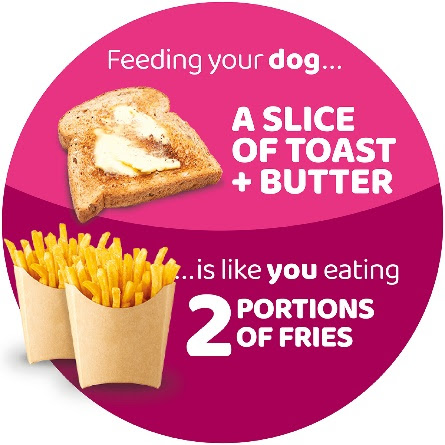
Human food is often high in fats and sugar, and can contribute to obesity and weight problems as well as potentially leading to an unbalanced diet for our pets. As per PDSA calculations, feeding a dog a slice of toast with butter, is the equivalent of a human eating two portions of fries.
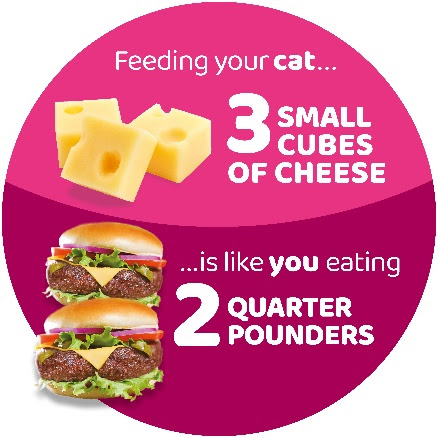
Similarly, feeding a cat three small cubes of cheese, is the equivalent of a human eating two quarter pounders!
PDSA Veterinary Surgeon, Lynne James said:“Our Weigh Up campaign was popular amongst pet owners who were keen to understand more about their pet’s weight, in order to keep them fit and healthy.
“Now we are taking the next step and launching PDSA Big Weigh In – where we are inviting owners to join in and visit a participating practice for a free weight check.
“We have also launched the PDSA #WeighUp Pet Weight Loss Support Group, for fellow pet owners to join, share their progress and access exclusive tips and content, including weekly Q&A’s with PDSA vets and vet nurses, all to help each pet owner with their pet’s weight loss journey.”
If you would like to find out more before visiting your local participating practice, please visit PDSA’s website.
Over two million1 kitties are eating away from home with potentially devastating effects on their health
One in six pet parents (14 per cent) have put their cat on a diet because they get fed seconds – and thirds! – by their neighbours
Cat behaviourist, Nicky Trevorrow, shares her tips for ensuring a healthy and happy cat
Cats are courting more than just other people’s affections according to a new survey which found that nearly a third of cat caregivers (30 per cent) suspect their neighbours of feeding their beloved kitty titbits, treats and even full meals2.
Makers of proper food for pets Lily’s Kitchen, which commissioned the poll, is urging people to serve up ‘tough love’ instead. With findings showing that one in six owners (16 per cent) believe their cat is overweight because of being fed by well-meaning neighbours, it highlights that ‘dining out’ can have an impact on our cats’ health.
14 per cent of those surveyed have even admitted to putting their feline friend on a diet as a result.
What is more, it appears our cats are regularly playing away, with nearly two-thirds of pet parents (64 per cent) saying their cat pays visits to ‘other humans’. Admitting their moggies stand them up, staying out all hours of the day and night, a third (34 per cent) say their outings last five or more hours every day.
But our cats’ intrepid nature can end up with more serious consequences than just missing your kitty. Highlighting the impact of treating someone else’s pet, 34 per cent said their cat ‘eating out’ was a real source of stress for them, while 17 per cent have fallen out with neighbours for feeding their feline without permission.
And proving just how damaging this can be, a worrying 19 per cent of owners questioned describe their cat as overweight.
Gaining some extra rolls isn’t the only cause for concern when it comes to feeding cats you don’t know. It’s not uncommon for cats to have allergies or other special dietary requirements related to medical conditions, so falling for the charms of a wide-eyed kitty could lead to more than just disgruntled neighbours.
However, despite pet parents feeling put out by neighbours feeding their own cat, and proving how hard it can be to ignore feline charm, 32 per cent of the same people admitted they themselves have fed local cats, with a whopping 73 per cent feeding them daily or weekly.
Nicky Trevorrow, Cats Protection’s Behaviour Manager, says: “Obesity is a significant welfare issue for our feline friends that can affect their health and behaviour. All cat caregivers should ensure that they feed a good quality, complete food and avoid feeding too many titbits.
It’s important for caregivers to keep an eye on their cat’s weight. You should be able to feel your cat’s ribs easily when you stroke their body lightly and you should clearly see a waistline when you look at them from above.
“If you are in any doubt, speak to a veterinary professional about your cat’s weight and how best to reduce it if necessary. However, even the most diligent owners can still face difficulties with their majestic moggy and their weight, if their cat has a penchant for scoping out food at the neighbour’s house.
“If a cat spends a lot of time at the neighbour’s house, it is important to consider why that may be. In a lot of instances it can be that they get extra food and treats there – this, of course, is very enticing and reinforces the cat’s inclination to visit.
“However, many cats will avoid their homes if there are a lot of stressors present, for example, non-socially bonded cats, toddlers or other stressors. It is therefore always worth evaluating your home set-up to see if it is actively encouraging your cat to go seeking other homes and additional meals.
“For all cats, but especially indoor-only cats, it is important to provide them with plenty of play and enrichment to keep them active and burning off calories. A few short play sessions, with a good fishing rod toy, spread throughout the day can help with this.”
How much a cat needs to eat depends on a variety of factors, but as a guide, on average, a healthy and active outdoor adult cat needs around 275 calories a day3. And it doesn’t take much over-feeding for them to start piling on the pounds.
Feeding your moggy proper, nutritious food could even stop them from popping out for sneaky seconds or hunting for ‘takeaways’. According to a recent study by the University of Exeter4, feeding a delicious meal rich in meat protein, such as Lily’s Kitchen recipes, resulted in a 36% reduction in hunting.
Samantha Crossley, Marketing Director at Lily’s Kitchen, comments: “As much as we love our cats, they are rebels whose affections often spread beyond their owners – and their food bowls. Outdoor cats can roam and do as they please, which can often mean neighbours find themselves at the mercy of a loveable kitty begging them for scraps; when they turn on the charm, it’s hard to resist!
“At Lily’s Kitchen we know the importance of good nutrition, and that means not only proper food and complete recipes, but the right quantity of that food. Lots of owners will know all too well that cats can very easily become overweight, and although the extra tummy rolls might mean an extra cuddly hug, it can have a detrimental effect on their overall health.
“As a pet parent, choosing proper food that your cat goes wild for may wellreduce the chance of them dining out, or prowling for a takeaway and piling on the pounds. Exeter University’s recent study found that feeding cats food containing proper meat has a number of benefits including a reduction in hunting behaviours… it may leave them satisfied enough to reduce their visits to no. 31 as well!”