New report breaks stigma around autism and periods this Autism Awarness Month

Although a discussion about neurotypical people’s period cycles has started in recent years, the same can’t be said for those on the autism spectrum.

Many feel unheard and uninformed, with almost half (49%) of autistic people reported not understanding their period, a third (30%) said it takes as long as four-to-five years to learn to manage it, over half (59%) aren’t comfortable enough to talk about it and 16% had to teach themselves about the cycle.

Intimate wellness brand, INTIMINA, has released a report which aims to breakdown the stigma around autism and periods. Whilst empowering and informing people about the challenges that those on the autism spectrum face and offering advice from experts, Psychotherapist Steph Jones (MBACP) andConsultant Obstetrician and Gynaecologist Dr Shree Datta, on how to cope.

On average it takes four-to-five years for almost a third (30%) of autistic people to learn how to manage their period, compared to just one year for a massive 38% of neurotypical people.

Reasons for this do vary but this new research shows that it could be down to autistic people having different experiences when it comes to their senses, mental health, physical effects, communication, and knowledge of the reproductive system and period products.  

Sensory 

Hyper or hyporeactivity to sensory input or unusual interest in sensory aspects of the environment, such as smelling or touching of objects is something that most autistic people experience. When asked if they notice the scents in menstrual products like tampons, menstrual cups and pads, 70% said yes, 66% said that it bothers them and 26% flagged odours as one of the main issues when they are on their period.

Mental Health & Physical Effects  

Most people with periods struggle with a whole range of mental and physical issues during the cycle, including bloating, depression, anxiety, headaches, back pain, cramps, cravings, tender and swollen breasts, fatigue and insomnia[1].

Almost all participants (96%) said that they experience emotional changes during a period, with over a third (38%) confirming that mood changes were in their top three worries that they had before their period.   

Alongside mood changes, 42% of autistic participants said that they were concerned about heavy bleeding during their period and 42% said they were most worried about period cramps.  

One of the autistic people who contributed a comment in the report went as far as to say that they suffered with “waves of depression, climbing anxiety, panic attacks and random crying outbursts” during their period.

Communication

The findings show that 41% of autistic people don’t feel confident talking to close friends or family about their period with another 18% feeling very unconfident. This is in contrast to the neurotypical sample where 74% said they felt either confident or very confident. Perhaps a struggle with communication is what has led 16% of autistic people to teaching themselves about periods.

Knowledge of the female reproductive system

Almost half (49%) of autistic people don’t understand their period cycle completely and when asked to identify the cervix on an image of the female reproductive system, a massive 39% of people on the autism spectrum failed to identify it correctly.

Using period products

Four out of five (83%) autistic people find period products difficult to use, with a third (34%) citing using sanitary products as the third biggest concern when it comes to their period. However almost a quarter (24%) of autistic people said that they prefer to use menstrual cups.

Psychotherapist, Steph Jones (MBACP), said: “Those on the autism spectrum, like myself, might struggle to talk about periods because they feel ashamed, or it might be connected to the social challenges experienced by many autistic people. For example, not asking for help because it leaves individuals open to the possibility of being dismissed, humiliated or invalidated.

“It’s also extremely common to experience some feelings of depression and anxiety just before a period starts. To help with this I would recommend keeping track of moods to determine whether they seem related to hormonal changes or reveal an underlying issue. Tracking will also help reduce the anxiety of not knowing when you are due to start your period. An easy way to track is to note it down in a journal or use an app to follow your cycle.”

Consultant Obstetrician and Gynaecologist for INTIMINA, Dr Shree Datta, adds: “Periods are the most natural thing in the world, with most people experiencing them, so always ask for advice because periods are part of our health cycle, not something anyone should feel embarrassed about.

“Don’t be shy to approach a doctor if simple measures such as hot water bottles, gentle exercise and pain relief do not help manage period pains. The next step may be being referred to a gynaecologist but remember that doctors help people who have heavy or painful periods every day of the week, so go and see them early if there’s a problem.”

Danela Zagar from INTIMINA, the brand behind the report, comments: “We’re on a mission to offer advice and support to everyone, no matter your background.

“As part of this, we have commissioned this research to help the voices of those on the autism spectrum be heard, help to understand the challenges that they face and overcome the stigma around this subject.

“We really hope that the report and advice within it helps many people on the autism spectrum and their families.”

As part of INTIMINA’s mission to break the taboo when it comes to talking about issues surrounding autism, the brand has made a donation to the National Autistic Society, which is the UK’s leading charity for autistic people and their families. They’ve spent decades working to provide support, guidance and advice to help create a society that works for autistic people.

Scotland’s Science Centres unite to create National Climate Campaign

The National Climate Campaign empowers underserved communities across Scotland with climate change knowledge

Building on their success during COP26, where they first united under the banner ‘Scottish Science Centres Together for Climate’, Science Centres in Glasgow, Edinburgh, Aberdeen, and Dundee have once again joined forces to form the National Climate Campaign (NCC). 

Together, the centres aim to continue the legacy of COP26 by informing, inspiring and empowering a diverse audience to tackle the climate crisis and ensure the discussion on climate change remains open.  

Working together to further climate science education in their communities, the National Climate Campaign saw each science centre deliver a coordinated and interactive campaign of over 89 events, reaching over 13,000 members of underserved and underrepresented audiences by the end of March 2022.

The programme strived to make science more relatable and helped learners develop their science skills to understand the world around them. 

The four science centres offered a programme of events tailored to different groups local to them, from both within the walls of their centres and outside in the community.

Glasgow Science Centre reached over 3,000 school pupils in remote, rural and deprived areas by providing access to their online and interactive ‘Learning Labs’, while also facilitating transport and visits to the centre from a variety of community groups, including Glasgow Disability Alliance, Yorkhill Green Space and African Challenge Scotland

The centre has brought together partners in science education to deliver the learning and engagement programme– including providing film screenings of The Ants and the Grasshopper in partnership with Keep Scotland Beautiful. 

In addition, Glasgow Science Centre organised litter pickings and climate café sessions, shining a light on the importance of science in the community and engaging with groups who are often the most affected by changes in our climate. 

Stephen Breslin, CEO of the Glasgow Science Centre said: “We set up the National Climate Campaign to ensure that there is a legacy of climate engagement left behind after COP26.

“We hope that by providing communities across Scotland with our knowledge and resources, we can act as a magnet for climate engagement and help empower young people to make considered decisions and learn what climate change means for them.”

A spokesperson for the NSPCC, who took part in visits to Glasgow Science Centre as part of the National Climate Campaign said: “Having the opportunity to go to the Science Centre inclusive of travel and lunch was invaluable to the families, as travel and access to food are barriers that are often forgotten about when providing activities free of charge to the public.’

“The visit to the centre allowed the children to broaden their horizons around science, a topic which has so many elements, but isn’t always understood.  Some of the children linked their school eco projects to the work at the science centre and shared this with the community team.

“The families expressed how much they enjoyed the experience, pointing out that they wouldn’t be able to afford the trip on their income and that both children and adults alike, learned so much and had a great day out.”

A highlight from Aberdeen Science Centre’s 20-event programme was last month’s Supper and Science Evening, where families came together to cook an evening meal at Northfield Academy.

While the meal was cooking, Science Centre staff ran a series of climate-themed workshop activities, including one where they recreated an oil spill with feathers and soap, to give the children some hands-on climate science experience.

In Edinburgh, Dynamic Earth delivered a packed programme of events including the delivery of STEM kits to a local children’s hospital. The boxes contain a variety of activities and experiments for young people on earth and environmental sciences with connections to climate change and marine environments.

Alongside their 10 in-person events and digital programme, the centre have also been running climate change workshops with community audiences, including the Edinburgh Young Carers Project Care for Carers, the Citadel Youth Centre and family learning activities with local primary schools.


Over 1,000 primary school pupils took part in Dundee Science Centre’s experiments and challenges during COP26 Schools Week, while the centre has created 150-climate themed community kids for young people, containing a mini solar-powered windmill as well as other items to show how environmental sciences connect to climate change. 

Environment Minister Mairi McAllan said: “Young people have been among the strongest voices calling for urgent global action to address climate change.

“This campaign will make sure that young people in communities across Scotland continue to play a key role in our journey to becoming a net zero nation, delivering a lasting legacy for COP26, and making their voices heard loud and clear.”

Kostas Minas, Head of Education and Learning at Aberdeen Science Centre said: “We are excited to be part of the National Campaign, which we hope will engage our local communities on what we can all do to help the environment and how our actions impact the planet, whilst demonstrating how science can help us understand our world and feel empowered by knowledge.

“We’re grateful to be able to work so closely with Scotland’s three other science and discovery centres and I’m sure this campaign will leave a legacy of collaboration between the organisations.”

Eilidh Massie, Marketing Director at Dynamic Earth said: “It is so important for people to not only learn about our amazing planet, but also to understand that the Earth’s climate system is something we have taken for granted for too long.

“At Dynamic Earth we’re committed to reminding people, young and old, that we need to act now before the damage is irreversible. 

“It has been a fantastic opportunity to work collectively with Scotland’s Science Centres as part of the National Climate Campaign to further these messages.”

Carlene Cura, Development and Fundraising Advisor, Dundee Science Centre said: “As COP26 approached, the climate emergency dominated the news and will, quite rightly, remain high on the news agenda.

“Now and in the future, Scotland’s Science Centres have a responsibility and an opportunity to bring these important global topics down to a grassroots level, into our local classrooms, community centres and homes, from city centre flats to rural communities. 

“We see it as a privilege to take these important messages, make them accessible and relevant to all and shape fun and engaging activities around them, creating impactful, memorable activities for our audiences and helping them understand and explore the role they can play in our futures.  

“It’s particularly important that these messages reach underserved communities who may not typically visit a science centre or have the digital resources to access our activities online, but whose potential to make a difference is exactly the same. That’s where our community outreach box has been extremely valuable, giving individuals and families the chance to get involved wherever they live, and whatever barriers they might face.” 

For more information on the National Climate Campaign and Scottish Science Centre’s climate change education programming visit:

 https://www.glasgowsciencecentre.org/discover/our-world-our-impact

Renaissance Care internal review

The leading Scottish care home group is undertaking a full review of culture across the organisation after two years of care staff fighting at the front line against the pandemic 

Leading Scottish care home group, Renaissance Care, has implemented a full review with its staff across each of its 16 homes to overhaul the traditional operations across the care home sector. 

Following interviews with staff across all levels, the group, which employs 1,200 people across the country, is reviewing the culture, working practice, and its health and wellbeing offering across the board, as it responds to rising resignations of care staff across the industry on the back of the pandemic. 

Staff across the homes will now be offered a range of new benefits including flexible working, a pay review across all roles, and a health and wellbeing package. 

In response to feedback around long shifts within the care sector, which have historically been 12 hour shifts as industry standard, Renaissance Care will now offer staff a flexible working pattern based on their individual requirements.

The move means that those who want to change shifts around childcare commitments, or want to cut down on long shift times can do so, while office staff will have the option to move to a four-day working week. 

The group will also implement a minimum 5% pay increase for all staff and has committed to becoming a Scottish Living Wage Employer.


In line with the review, the care group is also undergoing a project to promote inclusivity and security among its workforce.

It has committed to supplying sanitary items for female staff in all of its facilities, as well as becoming a menopause-friendly workplace with plans to roll out training for staff later this year, and is ensuring an inclusive environment for LGBTQ+ staff and residents with an understanding that identities can be complex. 

The home will also introduce a health and wellbeing package which includes free access to danceSing for all staff members – encouraging health and wellbeing through fitness classes with a saving of £400 per year for each individual. It is also to invest in upgrades to the staff rooms in each home to ensure its care teams have a space that promotes a positive culture throughout shifts. 

In addition, the care home operator is currently investing £500k on its operational management and accounting systems to improve administrative processing for all staff as it responds to feedback about time spent on paperwork throughout shifts. 

Louise Barnett, managing director at Renaissance Care, said: “It is absolutely clear that staff retention and recruitment across the care industry is a massive issue on the back of the pandemic. It comes as no shock that staff, who have had an incredibly difficult two years looking after our most vulnerable in society, would consider changing careers.  

“For most organisations, people are at the heart of the business, but within the care sector it is no exaggeration that staff play the most crucial role in ensuring that elderly residents receive care that goes above and beyond, and we see time and time again the difference that our teams make to peoples’ lives. 

“Operationally, the care sector has always functioned in a certain way but now, as we begin to recover from the pandemic, it is time to turn it on its head and set a high benchmark for what the industry will look like for years to come. We need to modernise the offering for care staff and ensure that they can remain dedicated to delivering the best quality care while having a work life balance that allows a career around family and personal life.”

Robert Kilgour, executive chairman of Renaissance Care, has been a consistent industry voice throughout the pandemic, calling for more support for care homes across the country.

Last year, he spearheaded a group of the country’s leading care home operators who joined forces to help uncover answers to the many questions around the handling of the coronavirus pandemic in Scotland. 

Robert Kilgour, executive chairman of Renaissance Care, said: “The last two years have been an incredibly tough time for residents, families and hard-working team members in care homes across the country and it is important to us that we provide the best possible care and facilities for our people.

“Despite all that we have been through since the start of the pandemic, we remain very positive about the direction of the business and at the heart of our plans for recovery is our people.

“We are investing, developing and working alongside our team, ensuring that we can attract and retain the very best of talent to perpetuate a person-centred approach across each of our homes for staff, as well as residents.” 

Renaissance Care has a strong people service strategy which focuses on learning and development for individual staff members, as well as onus on creating a person-centred culture of inclusivity and care.

Seasonal project-starts uptick hindered by rising material and energy costs

  • Seasonal uptick in project-starts stalled by rising material and energy prices
  • Value of underlying (less than £100million in value) construction work on-site falls 7% in Q1 2022
  • Residential project-starts struggle, falling 5% during Q1, down a third on a year ago
  • Non-residential work on-site sees uplift, increasing 2% against previous year but falls 2% against previous quarter
  • Steep decline for civil engineering project-starts, falling 31% on preceding quarter and 38% on same time a year ago

Glenigan, one of the construction industry’s insight experts, has released the April 2022 edition of its Construction Index.

The Index focuses on March 2022, covering all projects with a total value of £100m or less (unless otherwise indicated), with all figures seasonally adjusted.

It’s a report which provides a detailed and comprehensive analysis of year-on-year construction data, giving built environment professionals a unique insight into sector performance over the last 12 months.

Outside forces

Persistent rises in building material costs, coupled with inflation pressures, have negatively affected the traditional project-start ‘spring uptick’.

These ongoing supply chain issues have been further exacerbated by external influences, including the ongoing Russia-Ukraine War, stymieing growth and delaying forecast sector-wide recovery in the immediate future. 

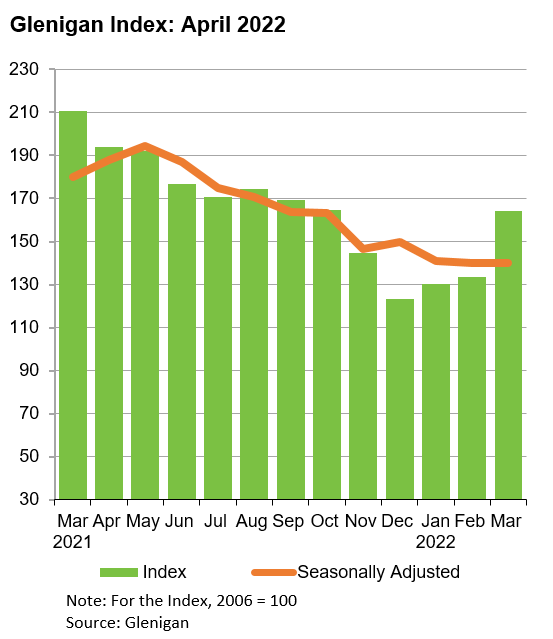
Against this disruption, starts were considerably lower than a year ago (22%), slipping back 7% on the previous three months (seasonally adjusted).

Glenigan Index April 2022.png

Sector analysis – residential decline

Residential struggled to improve on performance against the previous quarter, with the value of residential work falling 5% during Q1 2022 and was down 32% on the previous year.

Whilst there was a more optimistic outlook for private housing project-starts (-2%), witnessing a modest decline compared with the last quarter, figures were still 37% lower than a year ago.

Social housing project-starts fared worse, dropping 12% against the previous quarter and down 13% against the same period last year.

Sector Specific – offices on the rise

In the non-residential sector it was a mixed-bag in performance terms.

Office project-starts saw the greatest increase of any vertical over the past three months, increasing by over a quarter (28%) to stand 1% higher than a year ago. Education also saw a growth uplift, increasing 6% during Q1 2022, despite being down 9% on a year ago.

These were the only verticals to see growth against the last quarter.

Hotel and leisure project-starts fell by more than a fifth (-21%) during the quarter, despite growing 35% in the three months to January[1]. However, there was a value-increase of 11% against the previous year.

Industrial starts remained consistent with no growth against the previous quarter, but increased by over a fifth (22%) against the same period in 2021.

Civil works continued its downward trajectory, performing poorly during Q.1 2022. The value of project-starts fell by nearly a third on the previous quarter (31%), 38% lower than a year ago. A main driver for this was the poor performance by utilities, with work starting on-site dropping more than half (-52%) against the previous quarter, and -46% on last year.

Despite March’s Index indicating green shoots of recovery for infrastructure construction starts, it was down 16% against the last three months and by more than a third (-34%) on the same time period a year ago.

Regional Outlook

The North East maintained its position as the best performing region in the country, owing much of its strong performance to a number of projects coming online, including an £11 million office development in Middlesbrough. Work starting on-site was up 4% on a year ago and by over a fifth on the previous quarter (22%).

The outlook in Northern Ireland was also optimistic, which saw the UK’s greatest increase in project-starts against the previous year, up 29%. There was also an 18% rise on project-starts during Q1.

Wales also saw growth, reflecting major development plans including 269 residential units in Caldicot worth £45 million. It was also the only other area of the UK to experience project start growth against both the preceding quarter (10%) and previous year (3%).

The East of England saw project-starts rise by nearly a fifth (21%) during Q1 2022 but this was 17% lower compared to a year ago. A similar picture was painted in Scotland, rising 14% against the preceding three months, but down by 27% against the previous year.

The East Midlands and Yorkshire & the Humber also saw growth against the preceding quarter by 1% and 7%, respectively.

Commenting on the Index’s findings, Glenigan’s Senior Economist, Rhys Gadsby said, “At this point in the year, it’s normal to see an uplift in project-starts across the board, but outside influences such as choked supply chains and rising energy costs are preventing projects from getting off the ground on the level they should be. 

“Despite the challenges the construction industry is facing, there’s some real glimmers of hope, particularly on a regional level, where the North East continues to be a strong performer. Growth amongst Northern Ireland, Scotland and Wales against the past three months also show signs of gradual sector recovery.

“It will be a while until the full impact of current world events is fully realised but I have no doubts that the resilience of UK construction can weather the storm, no matter what lies in store.”

To find out more about Glenigan click here.

Creative fun at Collective: Easter Holiday Family Events

Collective is now open from Tuesday – Sunday, 10am—5pm

Visit Collective this Easter break to experience a range of creative workshops suitable for children of all ages – from workshops celebrating rainwater in partnership with Edinburgh Science Festival, to drop-in creative sessions exploring our PLAY programme, and a final weekend of activities inspired by our current exhibition H-E-L-L-O by artist Cauleen Smith.

Edinburgh Science Festival: Rain Harvest

9–10 April
11am—12.30pm & 2—3.30pm
£5 | Book in advance

Join in with the 2022 Edinburgh Science Festival and explore the beauty and vitality of rainwater in this hands-on, sensory workshop that blends art, science and play.

Book Here

Collective PLAY: Drop-in Sessions

11–22 April
Tuesday – Sunday, 10am—4pm
Free | No booking needed

Throughout the Easter holidays, families are warmly invited to drop in to Collective and join us at our Play Shelter and Hillside spaces to take part in a range of art activities related to our year-round Collective Play programme.

Collective PLAY Weekend: Vibrations

23–24 April, 11am—4pm
Free | No booking needed

Join us for a final Easter holiday weekend of free outdoor play and creative activities for children and families, inspired by our current exhibition H-E-L-L-O by Cauleen Smith.

A limited number of quiet slots are available on 23 April for families and children with autism or sensory learning disabilities.

Find out more

Citadel announce new Leith show

CITADEL ARTS GROUP present a performed reading of new Scottish comedy

NAN & RITA and the DEAR DEPARTED

By Edinburgh writer Carolyn Lincoln

Top actors Lynne McCallum (Still Game, Taggart) and Estrid Barton (Howard’s End, Still Game, Theodosia) will once again team up for the new Scottish comedy Nan & Rita and the Dear Departed by Edinburgh writer Carolyn Lincoln.

Directed by Adam Tomkins, this is the pandemic-postponed follow-up to Nan & Rita and the Holy Grail which won great feedback in 2018:

“Entertaining dialogue…very clever and genuine use of Scots… fine satirical touches.” “A breath of fresh air and a bloody good laugh.” “Full of energy…well performed… excellent timing… lovely warm performances.”

This lunchtime performance will be in the popular PLAY, PIE AND DOCKERS PINT format. Arrive at Leith Dockers Club at 12:30 for your pie and drink and the performance starts at 1pm. Make sure you allow for extra travelling time because of the current tram works.

Carolyn Lincoln is a former Glasgow Herald staff journalist, radio ‘soap’ writer and occasional contributor to The Scotsman.

Over the years Leith based registered charity Citadel Arts Group has sought to encourage older writers and creatives to take professionally-produced drama and new writing to places and people other Scottish drama doesn’t usually reach.

Performance details

Wednesday 27th April 2022.

Leith Dockers Club, 17 Academy Street, Leith, Edinburgh EH6 7EE.

People should arrive at 12.30 to collect their drink and pie (meat or veg). 

The show starts at 1pm.

Ticket price: £8 / £6 (senior citizens, students, unemployed)

Tickets can be reserved from lizhare@blueyonder.co.uk or paid for at the door, subject to availability. 

Further information: Adam Tomkins (Director) adam.paul.tomkins@gmail.com       

Most care homes in SE Scotland still use paper-based management systems

Researchers call for digital route map to prevent sector being left behind

CARE homes for older people in south-east Scotland are largely run using paper-based management systems, a new study into the sector’s digital readiness has revealed.

Only one in three (35 per cent) used an electronic care management system and only two in five (43 per cent) used an electronic system or software to manage medication.

Most care homes were also dogged by poor connectivity. Only two in five in SE Scotland (42 per cent) described their internet connection as “good” with fast loading of content and no interruptions.

And nearly two thirds (58 per cent) of the care homes which provided information reported that remote electronic access to resident information was not possible for any key health and community-based professionals.

The findings emerged from a study led by Edinburgh Napier researchers working in partnership with the University of Edinburgh’s Advanced Care Research Centre (ACRC).

Funded by the Data-Driven Innovation (DDI) programme, the work was set against a backdrop of Scottish Government proposals for a National Care Service and the related construction of a National Digital Platform.

However, the findings raise question marks about whether care homes are ready for a future in which digital innovation will be key to post-pandemic recovery and improved efficiency in health and social care.

Research lead Lucy Johnston, from Edinburgh Napier’s School of Health & Social Care, said fast connectivity, capacity for data capture and information sharing capabilities were “limited and unevenly dispersed”.

Calling for more support and coordinated resources for the sector, she concluded: “This targeted assessment of data and digital readiness exposes the fragile and insecure foundations of a care home data platform for Scotland.

“The findings confirm that care homes are only in the foothills of what is a complex, vast landscape where the direction of travel is rightly ambitious and therefore uphill and the pace is fast.

“To ensure care homes are not left behind, they require a trusted, well-informed and certain national and local route map, secure ties to the new and developing infrastructures and continued integration of health and social care services.”

The study – Landscape Assessment of Data and Digital Readiness of Scottish Care Homes (LADDeR) – was set up to map current data and digital readiness in terms of connectivity, systems for collecting resident data, and how this information is shared with other care partners.

Carried out from July 2021-January 2022, the LADDeR report drew on information from 55 per cent of the 200 registered residential care homes for older people in Edinburgh, Fife, the Lothians and the Scottish Borders, collected through an online survey, direct contact and additional research.

A third of homes gave the cost of introducing digital systems as a reason why they remain paper-based.

More than two-thirds (69 per cent) which are currently paper-based did plan to introduce electronic care management systems in the next 12 months, but these were overwhelming privately rather than local authority-owned.

The study suggested that what will primarily drive increases in digital capabilities may be the investment decisions of larger group providers.

Professor Bruce Guthrie, Director of the ACRC, added: “Improving access to, and making better use of, data is a core aim of what we are trying to achieve at the ACRC.

“COVID-19 brutally exposed how invisible care home residents are in data, and supporting the care home sector to develop their digital capacity is an important step in meeting this aim, which will, in turn, lead to improvements for care home residents.

“This study helpfully illustrates the scale of the challenge in care homes.”

A spokesperson for the DDI programme said: “This report provides an important insight into the care home sector’s challenge in embracing a digital future and we will use its findings in our work to support a more digitally integrated and data-driven health and care sector within SE Scotland and more widely.”

The Royal Edinburgh Military Tattoo’s Big Secret Finally Revealed

The Top Secret Drum Corps set for return to Castle Esplanade this summer following a week of classified activity for the big announcement –

Swiss drumming sensation, The Top Secret Drum Corps, has been revealed as the first confirmed international act to take to the Castle Esplanade when The Royal Edinburgh Military Tattoo – one of the world’s best known military spectaculars – makes its highly anticipated return this summer.

The iconic drummers will wow fans with their dynamic precision drumming showcase, which has received global recognition since first performing in the Show back in 2003.

Today’s announcement follows a week of ‘Top Secret’ activity from the Tattoo which drove intrigue in Edinburgh and right across the country. A ‘secret agent’ guard took to the streets of the capital with a VIP suitcase containing the highly classified first act details.

Passers-by had the opportunity to crack the code and win tickets by scanning an exclusive QR code which unveiled the Act in morse code. The code was also played on radio across the country and listeners had their chance to guess what it meant.

The Top Secret Drum Corps was founded in 1991 by seven young drummers who wanted to preserve Basel’s rich drumming heritage and began mixing the traditional style of drumming with other drum types and striking visual effects.

This year’s Tattoo theme is ‘Voices’ and the Show will represent the collective power and connection of voice through a spectacular combination of music, dance and military precision from some of the world’s leading armed forces and cultural performers as it returns with a bang this August 5-27.

The Royal Edinburgh Military Tattoo Creative Director, Michael Braithwaite, said: “We can’t wait to make our triumphant return this year and I’m thrilled that The Top Secret Drum Corps will be front and centre when we do so.

“They are one of the most dazzling drumming acts in the world and their sensational performance will light up what’s sure to be another incredible spectacular throughout August.

“Whether you’re excited to return to the esplanade or keen to experience the Tattoo for the first time, I’d urge people across the country to get their tickets and get set to be wowed by the show.

“It was great to see the buzz on the streets of Edinburgh today as we got ready for the big reveal. Excitement is undoubtedly building ahead of summer, so I’d encourage all Tattoo fans to keep their eyes and ears peeled as there is so much more to come, and we’ll be revealing all about this year’s production very soon.”

Top Secret’s drummers play in an upbeat and playful style, with sections of their routine featuring drumstick juggling, exploding flagpoles and a drummer’s duel to wow audiences.

The year’s Tattoo performance will celebrate people across the globe who, despite physical separation, continue to connect and share their voices creatively through spoken word, song, writing, music and dance – languages common to all.

Military acts will continue to play a central role in this year’s performance, with the Army confirmed as the lead service in 2022.

As well as the talents of The Top Secret Drum Corps, audiences this year will also enjoy the legendary sound of the Massed Pipes and Drums that will echo around the Esplanade as part of Voices, supported by Tattoo pipers and drummers, and musicians from UK Military Regiments. 

The Tattoo dancers and Tattoo fiddlers also join the line-up, with international acts and further details about Voices announced in the coming months.

SCVO: Voluntary organisations in Scotland are more vital than ever

Data shows scale of crucial voluntary sector impact in Lothian and beyond

Figures collated by the Scottish Council for Voluntary Organisations (SCVO) using data from OSCR, Volunteer Scotland, the TSI Network Scotland, and the Social Enterprise in Scotland Census have highlighted the crucial role of charities, social enterprises, and community groups in Scotland.

The data reveals that across Lothian alone there are currently 3,729 registered charities, generating a combined annual income of £4,342,612,905, and 1,125 social enterprises operating across the TSI area.

Along with employing 64,190 paid staff, an amazing 234,336 people from across the area also support organisations by volunteering their time and skills to help people, communities and groups, making an invaluable contribution to their local community in the process.

Nationally, Scotland enjoys the benefits of over 40,000 voluntary sector organisations, employing over 100,000 paid staff – a similar number to the Scottish digital and technology sector.

The Scottish Council for Voluntary Organisations (SCVO) and TSI Scotland Network believe that sharing this data will further highlight the indispensable contribution of the voluntary sector, particularly over the course of the Covid-19 pandemic, during which charities and voluntary organisations, both local and national, have played a vital role across Scotland.

Anna Fowlie, Chief Executive for the Scottish Council for Voluntary Organisations (SCVO) said: “We know that the voluntary sector is a major player in Scotland in terms of economic impact and employment.

“Our recent #NeverMoreNeeded campaign highlighted how crucial the sector has been during the pandemic across the country, and continues to be essential in recovery.

“These findings highlight not only how vital charities, social enterprises and community groups are in Lothian, but also the level of local support provided to these organisations through volunteering, which is really encouraging.”

A spokesperson for Edinburgh Voluntary Organisations’ Council (EVOC) said: “Scotland’s vibrant voluntary sector is a key asset in our communities, even more so over the last two years, but it is one which is often underestimated and overlooked.

“We hope that this data, which shows the size and scale of the sector, can emphasise just how vital the sector is and how much it supports us all, both locally and nationally.”

Foysol Choudhury, MSP for Lothian, said: “I welcome the figures produced by the Scottish Council for Voluntary Organisations (SCVO), particularly those that highlight the invaluable contribution that charities and voluntary organisations make in Lothian.

“The voluntary sector has been crucial throughout this pandemic, both in the local area and nationwide, and it’s important that we not just recognise that incredible contribution, but also explore how the Scottish Parliament can work better with the sector to maximise these efforts.”

Pupil poster designs to help boost school recycling rates across capital

Posters designed by primary and secondary school pupils in Edinburgh are to front a city-wide campaign aimed at boosting recycling rates in classrooms.

The six striking and colourful designs were chosen from more than 900 entries to a poster competition run by the City of Edinburgh Council for P4-S2 pupils.

And, as well as encouraging recycling, the posters highlight the benefits that recycling food, paper and plastics brings to Edinburgh and the natural world.

Posters by Kayleigh Mok from James Gillespie’s Primary School, Coral Creswell from St Thomas of Aquin’s RC High School and Charlotte McPhail from Flora Stevenson Primary School, will be displayed in all primary and special education needs schools across the city.

Artwork by Arran Smith from Davidson’s Mains Primary School, Arla Howe-Speirs from East Craigs Primary School, Elise Ballinger from Preston Street Primary School, will feature in all Edinburgh secondary schools.

The posters are part of a move by the City of Edinburgh Council to ensure a consistent approach to waste management in schools across the city.

From after the Easter holidays (April 25th) dry-mixed recycling and food bins will be offered to all primary, secondary and special education need schools in the capital.

Schools will be supported with information and materials helping to show what items can be placed in each bin, as well as materials, including lesson plans, aimed at raising awareness of the benefits of recycling as the city moves towards its target of net zero emissions by 2030.

The move follows on from a primary school Youth Climate Summit held in the run up to COP26 last year, which found that pupils overwhelmingly wanted more recycling facilities in their schools, to help tackle waste and support climate action. 

Leader of the Council, Adam McVey said: “We know for many schools in Edinburgh, taking steps to become more sustainable and cutting our carbon footprint has become part of daily life.

“These fantastic posters really help to highlight the importance of recycling and the benefits that it can bring to Edinburgh, from helping to protect our wildlife, to turning food waste into electricity.

“And, we hope this campaign will help to provide schools who just need a little extra support, to make it as easy as possible for pupils, teachers and school staff to make changes, that make a difference and help create a cleaner, greener city.”

Deputy Leader of the Council, Cammy Day said: “Highlighting the environmental and social benefits of cutting down on waste and making it even easier to recycle in schools across the city, will help introduce green habits to Edinburgh’s young people which will last a lifetime.

“It’s really important we all get in the habit of disposing of our waste correctly and reusing and recycling where we can. Making sure there are the same systems and approach to waste in schools across the city will make it even easier for pupils and school staff to help Edinburgh reach its climate targets.”