New government plan may save EV owners £1000 a year

Owners of electric vehicles are being told how they could save up to £1000 a year under the government’s latest plan to install smart charging across the UK.

Electric car experts at LeaseElectricCar.co.uk have researched how EV drivers can save money on their energy bills or make a profit from the National Grid under the new electric vehicle smart charging action plan.
The new government scheme sets out to unlock the potential of smart electric vehicle charging, helping owners of electric vehicles to save hundreds each year on their energy bills.

With the cap on the Energy Price Guarantee set to increase by 20% in April 2023, electric vehicle drivers will be able to minimise their spendings on energy bills.

The government states that the smart charging scheme plans to let motorists charge their EVs when the electricity is cheaper or cleaner.

Drivers can also use the electricity stored in their EVs to power their own homes, allowing them to benefit significantly from lower energy bills.

The scheme will also allow consumers to sell the electricity from their vehicles back to the National Grid for profit.

Bill payers who do not have an EV can also benefit from more sustainable and cheaper energy prices – reducing the demand when electricity is used on the grid from EV drivers will help contribute to reducing energy prices for everyone.

This new smart charging landmark initiative reports to use the latest energy innovations to deliver benefits to EV drivers as the country works towards its zero emissions target on UK roads.

With the ban on the sale of new petrol and diesel cars being introduced in 2030, the smart charging plan aims to further encourage more drivers to make the switch to electric.

The report states that the average electric vehicle driver could save around £200 a year, and a high mileage driver £1000 a year, with the introduction of smarter charging across the UK.

The government is aiming to make smart charging commonplace for EV drivers by 2025 – further initiatives like smart lamppost charging on the street will help make this move happen.

To further the smart charging scheme, £16 million will be invested into these innovative technologies which will harness the potential of the new way of charging.

Alongside smart lampposts, projects to enable domestic appliances to be able to merge into a whole smart energy system, like heat pumps, charge points and batteries, which will also be funded.

Tim Alcock at LeaseElectricCar.co.uk said: “It’s a great win for EV drivers – under the new smart charging scheme you may save up to £1000 on energy bills.

“The government has announced that this scheme will allow you to use electricity to power your homes, energy which is otherwise stored in your vehicle, as well as being able to sell back electricity to the National Grid to make some money.”

He said that it’s good news for those who don’t own an electric vehicle too.

Mr Alcock added: “By reducing the demand for electricity, such as pumping electricity from EVs into the home, this will in turn help contribute to lowering the overall demand and costs for bill payers across the country.

“As we head towards an increase of the energy price cap, the smart charging scheme is a positive step forward for the country to help reduce costs for all consumers.

“Investment into the smart energy system is also going to help EV drivers in the long run too. Smart lampposts and merging domestic appliances into the system will help make smarter charging easier for motorists.

“This recent announcement gives the electric vehicle industry hope that the right infrastructure is being put in place as the country moves towards the ban of new petrol and diesel cars in just seven years time.”

For more on the smart charging scheme and to find out further benefits for EV owners, head over to https://leaseelectriccar.co.uk/

New plan for smart electric vehicle (EV) charging could save consumers up to £1000 a year

  • New plan sets out steps to unlock the potential of smart electric vehicle charging, including allowing motorists to power their homes using the electricity stored in their electric vehicle
  • electric vehicle drivers could save hundreds of pounds each year while cutting emissions by smarter charging of their electric vehicles
  • billpayers without electric vehicles will also benefit from a more sustainable, secure and efficient electricity system
  • projects, including a street lamppost capable of charging electric vehicles and selling power back to the grid, will receive a share of £16 million funding

Electric vehicle consumers are set to benefit from lower energy bills and cheaper motoring thanks to a landmark plan to unlock the potential of smart electric vehicle charging.

The Electric Vehicle Smart Charging Action Plan published today (Tuesday 17 January) by the government and Ofgem, sets out steps being taken to seize on the significant potential of smart charging and make it the preferred method of long duration charging by 2025.

Smart charging harnesses the potential of energy use data and the latest energy innovations to deliver significant benefits for consumers, including allowing motorists to charge electric vehicles when electricity is cheaper or cleaner, allowing consumers to power their home using electricity stored in their electric vehicle, or even sell it back to the grid for profit. It is expected high mileage motorists could save up to £1,000 a year through smarter charging.

And to back this up further, the government has today also announced £16 million funding from the Net Zero Innovation Portfolio (NZIP) for technologies that harness the potential of smart charging, including a smart street lamppost which will enable motorists to access smart charging on the move, and projects that will enable domestic appliances, from heat pumps to electric vehicle charge points and batteries, to integrate into a smarter energy system.

Energy and Climate Minister Graham Stuart said: “We want to make smart charging an easier choice for drivers of electric vehicles, whether that is charging on the driveway, at the workplace, or parked on the street. To do that we need to build new network infrastructure at pace, using the latest available technologies.

“Today’s plan sets out how we will work with Ofgem and industry to kickstart the market for smart charging, which we are backing up with £16 million in innovation funding. This will let people take control of their energy usage, in the most convenient and low-cost way.

Ofgem Director for Strategy and Decarbonisation Neil Kenward said: “As energy regulator, we’re helping create the infrastructure to deliver Britain’s net zero future at the lowest cost to customers.

“This latest innovative plan will help to maximise the benefits of smart charging, offer vital savings to consumers and reduce the overall cost of energy by seizing the opportunities to use batteries to both power homes and fuel the wider grid.”

Today’s announcements build on the major steps already taken by the government to enable smart and flexible electric vehicle charging. As of July 2022, all new charge points sold for private now must have smart functionality and the UK is consulting on a new policy and technical framework to unlock the benefits of domestic smart, flexible energy, and enhance its cybersecurity.

Through the plan, the government will improve publicly available information and evidence on smart charging, support the implementation of robust consumer service standards and ensure private charge points are secure and compatible with the latest energy innovations.

The roll out of intelligent and automated smart charging will deliver a win-win situation for all consumers. Reduced electricity system costs will lower prices for everyone, motorists will pay less for charging their electric vehicle, and the electricity powering electric vehicles will be cleaner and greener.

The government and Ofgem will seek to remove the barriers that currently prevent the full development of a diverse and competitive smart charging market, while making sure the energy system is ready to respond to the upturn in energy demand that electric vehicles will bring.

Among those receiving funding today through the V2X (Vehicle to Everything) Innovation Programme for prototype hardware, software and business models, are:

  • £229,000 to a project led by Otaski Energy Solutions (Gateshead, Tyne and Wear) to develop a smart street lamppost capable of charging electric vehicles and sharing power back to the grid
  • £220,000 to V2X-Flex (Reigate, Surrey), a project led by EV Dot Energy Ltd to develop prototype software and a new business model which will reduce entry barriers for the domestic use of V2X bi-directional chargers to provide energy flexibility services
  • £165,000 to BEVScanV2X (London), a project led by Agile Charging Ltd to develop technology that could overcome battery degradation by creating a cost-effective tool to monitor and advise best approaches to maximise battery life and financial returns from smart charging

Among those receiving funding today through the Interoperable Demand-Side Response (IDSR) Programme, which supports technologies that allow consumers to remotely increase or decrease their energy use to take advantage of when energy is cheaper or more renewables are on the grid, are:

  • £510,000 to Energy Smart Heat Pump (Chertsey, Surrey), a project by Samsung Electronics UK and their project partners Passiv UK to design and develop a technology solution that is able to provide demand side response (DSR) services via Samsung Heat Pumps, giving greater control of their usage on the basis of cost or carbon savings
  • £1.2 million to Smart-DSRFlex (Manchester), a project by Landis & Gyr UK to demonstrate how DSR technology can help to manage a renewables-based electricity grid using the smart meter system
  • £29,000 to Open DSR for All (Manchester), a project by Carbon Co-op to explore the benefits and technical barriers to an accessible approach to domestic DSR, potentially enabling more products being able to offer DSR in future

Depending on tariff, mileage, and charging patterns, smarter charging could save an average driver up to £200, and a high mileage driver up to £1000 a year by delaying the power demand from electric vehicles at peak periods, such as 4pm to 9pm on winter evenings. By helping to efficiently balance when energy is generated and used on the electricity grid, the technology could contribute to reducing electricity prices for consumers across the network.

Delivering the steps set out in the Action Plan will help make smart charging the norm at home and work by 2025. It is the ambition that in the late 2020s smart charging will also become more commonplace at long-duration public charging, such as on-street or at transport hubs.

Brand new fuel costs calculator guides motorists on how much they can save

The RAC has warned motorists that petrol prices could be set to rise again, due to a cut in oil exports that could see prices rise at the pumps.

With petrol prices becoming an increasing concern for many commuters, it’s no surprise that commuters are considering making the switch to an Electric Vehicle (EV).

Sales of electric cars (including fully electric and plug-in hybrids) doubled in 2021 to a new record of 6.6 million. 

To help consumers better understand the savings that switching to an EV can make, Select Car Leasing has launched a brand-new Fuel Cost Calculator. The new tool summarises how much a motorist can save, on average, comparing traditional fuel vs electric cars. 

https://www.selectcarleasing.co.uk/guides/fuel-cost-calculator

Due to the Energy Price Guarantee, brought in on 1st October, the fuel cost per mile in an electric car is lower if you charge at home, compared to using a public rapid charger, where the average price per kilowatt hour (kWh) is 63.29p. Home electricity prices, on the other hand, have been capped at 34p per kWh. Charging at home can also often be cheaper if customers are on a dual-rate tariff that allows for off-peak plug-ins. 

How does the calculator work?

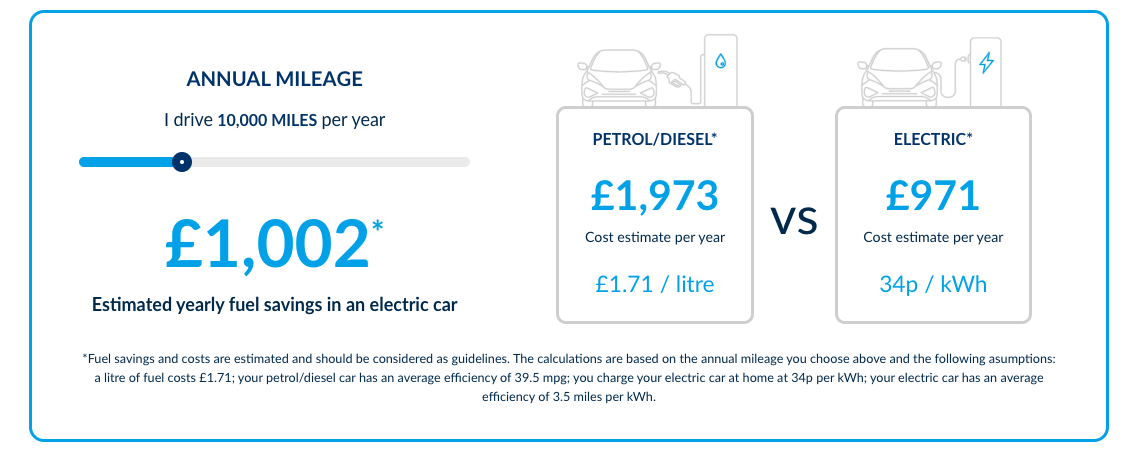
The fuel calculator works on the assumption that the cost of a litre of fuel is £1.71, in line with current petrol and diesel prices, and that a typical, traditionally-fuelled vehicle has an efficiency of 39.5 mpg. 

It also assumes that you’re charging an electric car at home at a cost of 34p per kWh, in line with the Energy Price Guarantee. It also works on the assumption that an electric car has an average efficiency of 3.5 miles per kWh – something Select says is a ‘conservative’ figure, with EVs often much more efficient. The Fiat 500 electric, for example, has an efficiency rating of 4.8 miles per kWh. 

By using the calculator’s slider, you can work out fuel prices depending on your annual mileage.

If you, for example, cover 10,000 miles annually, the calculator reveals that it would cost £1,973 to fuel a petrol or diesel car for the year, but just £971 to recharge an electric car. That’s a potential saving of £1,002. 

The table below shows how much petrol/diesel is per mile and illustrates how the electric vs petrol/diesel car comparison favours electric, especially when charging off-peak.

 Cost per MileVehicle EfficiencyFuel Cost
Electric Car – Off-peak2.1p3.5 miles per kWh7.5p per kWh
Electric Car – Energy Price Guarantee9.7p3.5 miles per kWh34p per kWh
Diesel Car19.0p43 mpg£1.80 per litre
Petrol Car20.6p36 mpg£1.63 per litre

What if I can only charge my electric car in public?

Some public charging points are free to use. For example, at Tesco you can often charge for free while you shop.

However, to use the more advanced, faster public chargers – known as ‘rapid’ chargers – you nearly always have to pay. Rates typically vary from about 30p per kWh to as much as 70p per kWh.

If you only use rapid chargers occasionally, you will still save a lot of money by switching to electric motoring.

If you do most of your charging at rapid charging stations, then your savings will be much less and it might even be cheaper in a petrol or diesel car, depending on what kWh rate you pay.

EV and hybrid drivers without breakdown cover vulnerable to unqualified recovery agents with ‘a truck and tow hook’

Motorists running modern EVs and hybrids who are tempted to cut costs by not investing in roadside assistance could be in for a shock from unskilled recovery agents warns leading breakdown provider Start Rescue.

As people tighten their belts, breakdown cover is often the first thing to go. But that could end up being a false economy and particularly for those with electric cars and hybrids.

With many modern vehicles having detailed recovery procedures, specialist and up-to-date knowledge is essential and particularly with modern EVs and hybrids. Failure to recover these vehicles correctly can result in costly damage to the crucial motors, transmissions and expensive electrical components.

Start Rescue says drivers of conventionally powered vehicles could find themselves shelling out £250 or more from inflated call-out charges and extra, unforeseen costs from freelancers, but for EV and plug-in hybrid owners who fall victim to unskilled traders it could mean thousands in unnecessary repair bills.

And if the vehicle is damaged during recovery there is the added worry as to whether the operator has the appropriate insurance cover; potentially leaving the driver footing the entire repair bill.

Start Rescue Managing Director Lee Puffett said: “It’s a false economy to skimp on breakdown cover but particularly for those running electric vehicles or plug-in hybrids. These motorists are risking not just their vehicle but leaving themselves open to massive additional bills if the recovery is botched.

“When you need help, you should ideally obtain assistance from a company which has a good reputation in your community or holds an industry recognised standard, such as PAS 43*. If they are PAS 43 registered, you can be very confident they have the necessary skills and technical training to recover your particular vehicle, whether it’s a car, van, motorcycle or a bus.

“Companies operating without a recognised recovery industry standard or lacking the experience of working with varying vehicle types, frequently don’t have the skills to recover a petrol or diesel vehicle correctly. So, if you have an EV or hybrid the risks of hugely expensive damage to these vehicles – which require a specific set of skills – are potentially higher.”

Without appropriate roadside rescue knowledge, these kind of ‘have-a-go’ operators are also potentially putting themselves and drivers at risk of injury, due to a lack of knowledge in appropriately recovering the vehicle or correctly managing the scene.

‘Have-a-go’ traders also may not have DBS or background checks, leaving vulnerable drivers at risk and recovery traders lacking a recognised recovery industry standard may exceed their allocated tachometer hours, increasing the risk of an accident due to fatigue.

Start Rescue is a 2021 Which? recommended breakdown cover provider.

Breakdown cover top tips

  • Get covered! If you don’t know a local reputable company, having no breakdown cover leaves you at the mercy of rogue traders
  • Use a reputable breakdown assistance provider such as Start Rescue
  • Have the breakdown cover’s contact details stored in your phone
  • Check the recovery company’s credentials. Reputable companies should show ID
  • Read your vehicle handbook to check for any special recovery instructions
  • Obtain a written and signed vehicle condition report before and after assistance has been provided and take photos of your vehicle both before and after assistance has been provided
  • Check for vehicle damage straight after recovery; report any problems immediately

Two out of three drivers won’t go electric unless ‘absolutely necessary’

As the cost-of-living rockets, price comparison experts Quotezone.co.uk asked consumers how they really feel about electric versus fossil fuel cars (petrol/diesel) and which they found most cost effective. 

The new survey reveals that 59.3% of petrol/diesel drivers will only consider buying an electric or hybrid vehicle ‘when I absolutely have to’.  26.2% said they would buy ‘within the next 5 years’, 10.3% said they would ‘buy now / as soon as is feasibly possible’ and only 4.3% said they’d buy ‘just before the deadline’ – 2030, when the government plan on banning the sale of new petrol and diesel cars.  

The research also found that the main barrier that is stopping people from buying an electric car is the price, with 35.7% of drivers saying they are too expensive, followed by 20% of people who said range anxiety was a major concern, while worries about the availability of public charging points were cited as an issue by 19.3% of respondents. 

Interestingly though, 57.8% of those with electric cars said they were saving over £100 per month compared to their previous fossil fuel vehicle – with 36.6% saving under £100 per month.  Only 5.6% didn’t believe they were making savings.  

When electric vehicle owners were asked what they didn’t like about their cars, 24.8% said there weren’t enough readily available charging points, followed by range anxiety (20%), broken charging points (19%) and rising energy costs (18%).  

The data, compiled by Quotezone.co.uk, was taken from a survey of 500 electric and petrol / diesel car insurance policyholders, completed in August 2022.  

Quotezone.co.uk’s Founder, Greg Wilson, comments: “It’s really interesting to see what’s holding people back from going electric and again, lack of infrastructure and car price, appear to be the top offenders that are making it impractical for many to make the switch.   

“The hike in car prices is most likely due to the new car shortage, brought about by lack of materials and logistical issues across Europe, causing a spike in shoppers choosing ‘nearly new’ second-hand petrol cars.  

“One positive point to bear in mind for those worried about costs is that electric car insurance is now more readily available as the majority of insurance providers have added electric cars to their offering – making it easier for consumers to shop around and get a competitive premium.”   

Currently only 2% of cars are hybrid and 3% are electric in the UK.  Data from Quotezone.co.uk shows a small increase in customers with electric or hybrid cars of 0.2% from June 2021 compared to June 2022 – with the average cost of those electric vehicles increasing by £5k from £34,000 to £39,000. 

The government has been increasing investment in charging points, including grants for motorists, as well as tax relief to help make electric vehicles more affordable.   

Quotezone.co.uk helps around 3 million users every year, with over 400 insurance brands across 60 different products including electric car insurance, Tesla car insurance and standard car insurance.

Quotezone.co.uk is recommended by 97% of reviewers on Reviews.co.uk. 

Green Home Festivalgoers to arrive in style  

Visitors to an upcoming show at the Green Home Festival will be travelling in all-electric style thanks to a partnership with Western Commercial Mercedes-Benz.

Festival organisers have teamed up with the auto experts to lay on electric vans for the Improving energy efficiency show on Wednesday 10 August.

Delegates will be ferried from the centre of Edinburgh to the show’s Murrayburn venue in a state-of the-art eVito Tourer, then bussed back afterwards.

One of the organisers, Gordon Nelson, Scotland Director of the Federation of Master Builders, said: “We are grateful to Western Commercial for this extremely generous gesture which is perfectly in keeping with the aims and spirit of the Green Home Festival.

“This is the perfect demonstration of low-carbon innovation in action and will add to the delegates’ experience of green living and the technology of tomorrow.”

Simon Murray, Van Sales Director at Western Commercial Mercedes-Benz, said: “We were only too happy to offer our services to the Green Home Festival and let delegates experience the next generation of electric vehicles (EVs) for themselves.

“We are excited about the possibilities that EVs bring to all our lives and we are delighted to be able to make the journey a green one for those attending the show in Murrayburn.”

The show will see A.C. Whyte & Co Ltd take visitors around a site where they are currently regenerating 29 blocks of four-storey flats for the City of Edinburgh Council.

Visitors will see how the contractor has delivered upgrades, learn how the project helped reduce heating costs, and learn what a fabric-first approach to energy efficiency means.

The show is one of 12 events for the Green Home Festival which has been organised by the Construction Industry Collective Voice (CICV) as part of the Edinburgh Festival Fringe.

The Festival will be opened tomorrow (Monday 8 August) by Scottish Government Minister Patrick Harvie.

The event will deliver a range of shows including:

·          Demystifying heat pumps – afascinating demonstration of the future of home heating and what kind of homes it’s suitable for

·          Protecting against floods –  flooding and its impact on people and buildings and how to access support and resources to protect your property

·          Hitting the road with EVs – what to consider when choosing an EV, current models and how to go about installing an EV charge point at your home

·          Retrofitting a tenement – how renewable renovations can reduce heating costs and cut carbon emissions in Scotland’s traditional buildings

·          Living safely in the future – the potential dangers of the domestic gadgets of tomorrow – and how we can ensure our high-tech homes are safe to live in.

Live sessions will take place at the Royal Institution of Chartered Surveyors (RICS) at 10 Charlotte Square in central Edinburgh, with six other sessions available online via webinar.

Full details, including how to book tickets for each event, are available on the Festival’s website at greenhomefestival.co.uk.

The festival is the latest in a string of practical and constructive initiatives launched by the CICV since its creation at the start of the pandemic in March 2020.

Made up of 29 trade associations, professional services bodies and companies, it has maintained a steady supply of information and practical advice to the sector as well as carrying out surveys, producing animations and posters, hosting webinars and maintaining close dialogue with Scottish Government ministers.

Bridgestone survey: Scottish motorists charging towards EV travel

A survey of 200 motorists by Bridgestone has confirmed that Scottish consumers are beginning to accelerate towards electric vehicle travel, with 70% preparing to ditch their petrol and diesel cars for good. 

The UK YouGov survey commissioned by Bridgestone confirms that transition is in the air, with over two-thirds stating that they’ll make the change and will not be keeping a standard vehicle (petrol/diesel) alongside it when they do. 

The research confirmed that the majority see and acknowledge the benefits of EV travel, with  

  • 62% citing environmental positives and 
  • 48% looking forward to making fuel savings. A further 23% reference tax benefits as a reason for the switch and  
  • 7% are looking forward to a reduction in noise emissions as their primary reason. 

In addition,  

  • 41% are keen to know more about EV maintenance and how it differs to standard makes and models. 

Bridgestone has already developed its tyre technology to ensure that EVs can travel further between charges whilst prolonging battery life, and has also committed to install up to 3,500 new charging points across Europe over the next five years through a partnership with EV Box, with plans for the first of the EV Box roll-out in the UK set to be announced soon. 

Bridgestone’s ENLITEN Technologyreduces the rolling resistance of a tyre by up to 30%, and weight by up to 20%.  It extends the driving range of EVs and also contributes to reducing environmental impact thanks to improved resource productivity.

This not only ensures that less raw materials are used to manufacture the tyres, but also contributes to the reduced rolling resistance, meaning electric vehicles can do more miles per range and be recharged less. 

And its TECHSYN technology extends the designed lifespan of a tyre by up to 30 per cent3. As a result, TECHSYN reduces overall fuel consumption and CO2 emissions5, enhances tread mileage6 to extend a tyre’s designed life and cuts raw material consumption in the long term. 

The YouGov survey also suggests that Scottish motorists are well informed on changes ahead, with  

  • 58% aware that all new car sales must be zero emission by 2035.  
  • Of that figure, 23% are keen to see this target brought forward to 2030.  
  • 27% would also like to learn new driving tips to help them get more from their electric vehicle. 

Bridgestone North Region Vice President Andrea Manenti said the results offered further justification for the company’s commitment to EV travel: “We are investing in our mobility solutions like never before, with new products, charging points and training in place for the full integration of EV travel. 

“With this in mind, it is great to see that Scottish motorists are also on board with the technology and the huge changes that are beginning to be seen. Our original tyre fitments specifically engineered for EVs will reach 20% of our overall portfolio by 2024. 

“We are investing to make electric mobility more efficient and accessible by pioneering premium tyres and tyre technologies for EVs and dedicated fleet and mobility solutions. We’re also partnering with leading EV manufacturers and developing an EV-ready retail and service network.” 

“The survey tells me that we’re all moving in the same direction when it comes to EV travel and we’ll continue to push the boundaries to ensure that Bridgestone is a pioneering company in this area of mobility solutions.” 

Scotland leads way in switch to green motoring

Scotland is at the forefront of the country’s switch to greener motoring according to new figures from the Department for Transport.

The figures reveal that from 1 October 2021 to 1 January, Scotland had the highest ratio of publicly accessible rapid charging points for electric vehicles with 12.9 devices per 100,000 residents.

Following Scotland are the South East and North East with 8.6 devices per 100,000 population. The average across all regions was 7.7 per 100,000.

After London with 102 charging devices per 100,000 residents, Scotland had the best accessibility to public (non-rapid) charging points with 52 for every 100,000. The national average is 42 devices per 100,000.

Nationwide, new charging points for public use went up by 9% in the three months to 1 January. There are now 2,448 more available charging devices across the country. Publicly accessible rapid charging devices increased by 233, a 5% rise over the same time period.

This brings the total of publicly accessible charging points nationwide to 28,375, of which 5156 are rapid charging devices.

Greg Wilson, founder of www.quotezone.co.uk’s comments: “It’s likely that Scottish drivers, like those across other parts of the country, are nervous that the 2030 deadline for car dealerships to cease selling new fossil fuel vehicles isn’t that far off and that the infrastructure to charge electric vehicles isn’t ready.

“But this boost in activity in the last three months in Scotland, building on an already established upward trend, is reassuring. 

“Let’s hope this pace continues so that Scottish drivers feel the electric option is a valid one, and that barriers to the green motoring revolution such as ‘range fear’ are a thing of the past, with a wide and evenly distributed network of rapid charge and electric charging facilities.”

Tanya Sinclair, Policy Director UK & Ireland at ChargePoint, said: “We welcome the Scottish government’s commitment over the next four years to invest in charging points across the country.

“The investment goes further than just a cash boost and is specifically designed to attract private investment in EV charging, which is what makes this investment really positive for the EV charging sector. In contrast, funds in England are channelled to local authorities who are resource constrained and shouldn’t be expected to provide EV charging on top of the essential services we rely on them for.

“To increase the overall adoption of EVs in the UK, we would encourage the other devolved nations to follow Scotland’s lead to help increase the amount of chargers. The government has earmarked money to solve the issue of rural charging infrastructure but it has not yet been spent.

“Along with this funding, the UK government must also drive the installation of charging stations, as it is vital that chargers are easily accessible throughout the country, not just big cities.

“As well as  increased investment in on-street electric car charging, the government must also focus on helping key charging locations such as workplaces electrify in a cost effective manner.

“This needs to be  done quickly but correctly – it’s not just about needing a large concentration of charging stations but the speed, location, ease of use and incentives need to be carefully considered.

Recommended by 97% of reviewers, Quotezone.co.uk helps around 3 million users every year, with over 400 insurance brands across 60 different products including electric car insurance -recommended by 97% of reviewers.

Electric Kia EV6 crowned What Car? Car of the Year

  • Brilliant EV6 voted best car for 2022, offering 328 miles of range, super-fast charging capability, space, refinement and class-leading warranty
  • Victory marks breakthrough Korean manufacturer’s second overall win at the Awards, known as the UK’s motoring Oscars, in past four years
  • What Car? Car of the Year Awards 2022 in association with MotorEasy held at Grosvenor House hotel in London’s Mayfair
  • BMW takes the most class wins with five victories; Ford wins awards for best small SUV and best performance SUV; Tesla Model 3 is best large electric car
  • To find out more, visit: www.whatcar.com/awards

The Kia EV6 electric car has been crowned What Car? Car of the Year 2022. Its victory was announced at a glittering ceremony at the Grosvenor House Hotel in London, with the awards held in association with MotorEasy.

It is the second time Kia has won the overall What Car? Car of the Year Award – and the second time it has won with a new electric car, having taken its maiden victory in 2019 with the Kia e-Niro.

Underlining the breakthrough progress enjoyed by Kia in the electric era, it is only the third non-European manufacturer to win the top prize at the What Car? Awards, which began in 1978.

The Kia EV6 stood out for setting new benchmarks for electric cars, offering an official range of 328 miles, and managing 224 miles on a charge when What Car?’s testers ran it in near worst-case low temperature conditions. It is also capable of super-fast, 800V charging, with its battery capable of going from 10-80% in as little as 18 minutes.

In addition, the EV6 earned praise from the judges for being hugely spacious, very refined even by electric car standards and for being sold with the reassurance of a standard-setting seven-year warranty.

What Car? editor Steve Huntingford said: “Once again, Kia has set a new benchmark for an electric vehicle. The EV6 is a terrific all-rounder that answers electric car buyers’ questions around range and charging times brilliantly, and which offers terrific space, refinement and value for money.

“Kia’s progress has long been impressive, but it is the way that it has seized the opportunity offered by the transition to electric cars that has made it a leader in the market. Coming hot on the heels of its victory with the e-Niro in 2019, this Car of the Year win cements its position alongside Tesla as one of the most exciting electric car makers on the planet.”

Kia UK President and CEO Paul Philpott added: “It’s a great honour for Kia to win Car of the Year at this year’s What Car? Awards, particularly given the high regard with which they are held by customers across the UK.

“The EV6 is a truly exceptional car and it’s just the beginning of things to come from Kia on our rapid journey to electrification. This is tangible recognition that Kia is fast becoming a true leader in electric vehicles having also won this award with e-Niro in 2019.”

Other big winners on the night included BMW, which recorded an amazing five category victories. It won the prizes for the best Luxury SUV (with the BMW X5),  Executive car (BMW 3 Series), Luxury car (BMW 5 Series), Coupé (BMW 4 Series) and Convertible (BMW 4 Series Convertible).

Ford was the next most successful manufacturer, with three category wins: Small SUV, sponsored by Solera cap hpi, (Ford Puma), Sports SUV (Ford Puma ST) and Pick-up (Ford Ranger). Tesla was also a notable winner after recording a record-breaking year for sales, taking the Large Electric Car category, sponsored by Ohme, with its Model 3.

What Car Car of the Year Awards 2022 in association with MotorEasy

OVERALL WINNER
Car of the Year: Kia EV6 RWD GT-Line

CATEGORY WINNERS
Small car: Honda Jazz SR
Family car: Seat Leon 1.5 TSI 130 Evo FR
Small SUV, sponsored by Solera cap hpi: Ford Puma 1.0 Ecoboost Hybrid (mHEV)
Family SUV, sponsored by MotorEasy: Volvo XC40 Recharge T4 Plus (Dark Theme)
Electric SUV: Kia EV6 RWD GT-Line
Large SUV, sponsored by Quotezone: Hyundai Santa Fe 4WD Premium
Luxury SUV: BMW X5 xDrive45e M Sport
Sports SUV: Ford Puma ST 1.5 Ecoboost 200 Performance Pack
Hybrid (plug-in): Lexus NX 450h+ F Sport Premium Plus Pack
Small electric car, sponsored by Ohme: Cupra Born 58kWh V2
Large electric car, sponsored by Ohme: Tesla Model 3 Long Range
Executive car: BMW 3 Series 330e M Sport (M Sport Pro Package)
Luxury car: BMW 5 Series 530e M Sport (M Sport Pro Package)
Estate: Skoda Superb Estate 2.0 TDI 150 SEL
MPV: Volkswagen Touran 1.5 TSI 150 SE
Pick-up: Ford Ranger 2.0L EcoBlue 213PS Wildtrack auto
Hot hatch: Mercedes-AMG A45 S Plus
Performance car: Porsche Taycan Cross Turismo 4S
Coupé: BMW 4 Series 420i M Sport (M Sport Pro Package) 
Convertible: BMW 4 Series Convertible 420i (M Sport Pro Package)
Sports car: Porsche Cayman GTS 

SPECIAL AWARDS
Reliability Award, in association with MotorEasy:
 Lexus
True MPG Award: Toyota Yaris Cross 1.5 petrol hybrid
Innovation Award, in association with Thatcham Research: Gridserve
Safety Award, in association with Thatcham Research: Nissan Qashqai
Tow Car Award, in association with the Camping and Caravanning Club: Kia Sorento 2.2 CRDi 3 DCT
Reader Award: Range Rover

Scottish electric vehicle registrations up 75% in a year

Ultra low emission vehicles (ULEVs) registrations across Scotland shot up by 75% between July-September compared to the same time a year before.

The Department for Transport’s (DfT) figures show that at the end of September, 38,600 vehicles belonged to Scottish residents, up from 22,100 for July-September 2020.

The data shows the longer-term pace of moving to electric vehicles went-up by 50% from Q3 2019 to Q3 2020.

North Lanarkshire – 104%, Shetland Islands – 98% – and Stirling – 93% – had the strongest take-up of electric vehicles. The lowest ULEV registration growth was in the Orkney Islands – 22% – and Na h-Eileanan Siar – 46% – with all other local authorities posting rises over of 50% for electric car ownership.   

Across Great Britain ULEV registrations hit 40%, with ULEVs making up 15.3% of all new registrations in the third quarter, some 83,000 vehicles.

More battery electric cars (BEV) – 51,000 – were registered for the first time than diesel cars -35,000 units. This followed a 44% increase in BEV car registrations in Q3 2021 than the same period a year before.

Petrol car registrations fell 41% and diesel by 66%. Average CO2 emissions for cars registered for the first time in the UK went down by 14%.

Greg Wilson, Founder of Quotezone.co.uk, a leading insurance comparison website, comments: “Scottish motorists are firmly at the forefront of the green industrial revolution when it comes to motoring.

“Government initiatives such as more public charging points and more home charging grants can only fuel Scottish electric vehicle registration growth over this year.”

Quotezone.co.uk compares prices across all types of car insurance, including electric car insurance, helping around 3 million users every year find better deals on their insurance, with over 400 insurance brands across 60 different products. Recommended by 97% of reviewers on Reviews.co.uk