Heart Research UK Healthy Heart Tip, written by the Health Promotion and Education Team at Heart Research UK
Healthy Heart Tip: National Simplicity Day
What could a little simplicity bring to your life? Simplicity means something a little different for each person and finding the right balance for your life will always be the best path forward.
Tuesday 12th July was National Simplicity Day, an event inspired by the life and work of American philosopher Henry David Thoreau. Here, we explore a few ways to bring more simplicity to your everyday life.
Acknowledge Positive Emotions
Keep in mind that joy can be found in the little things. This could be a scent that reminds you of home, your favourite song on the radio, your morning coffee, or a telephone call with a friend. In these moments, aim to be fully present and be aware of any emotions you feel.
Enjoy Regular Movement
We know that physical activity makes you feel good. So, to feel better, think about what type of exercise you like to do, stick to it, and make it part of your routine! Even a simple walk can boost your mood.
Be Present
It can be easy for our minds to focus on the future, especially when doing tasks we may not particularly enjoy. Yet we know that being present can benefit our minds, increase happiness and reduce feelings of overwhelm.
So next time you are doing your daily chores, aim to direct your mind towards the task at hand and be aware of any changes in how you feel as a result.
There are many more ways you can simplify your living, hopefully this has given you food for thought.
UK Health Security Agency (UKHSA) releases level 3 heat-health alert for parts of UK
Forecasters warn temperatures will continue to climb and soar past 30 degrees C in some parts of the country
TUC calls on employers to make sure staff are protected from the sun and heat
The TUC has urged employers to make sure their staff are protected from the sun and heat after the UK Health Security Agency (UKHSA) issued a heat-health alert yesterday.
A Level 2 heat-health alert has been issued for the South West, East Midlands, West Midlands, North West and Yorkshire and the Humber regions.
And a Level 3 alert has also been issued for the East of England, South East and London regions.
Both alert levels are in place until 9am on Friday (15 July), with warm weather forecast across the country throughout the course of next week.
Climate change means that the UK will be subject to more frequent and intense heat waves – putting workers at greater risk.
Health warning
Working in hot weather can lead to dehydration, muscle cramps, rashes, fainting, and – in the most extreme cases – loss of consciousness. Outdoor workers are three times more likely to develop skin cancer.
The TUC says employers can help their workers by:
Sun protection: Prolonged sun exposure is dangerous for outdoor workers, so employers should provide sunscreen.
Allowing flexible working: Giving staff the chance to come in earlier or stay later will let them avoid the stifling and unpleasant conditions of the rush hour commute. Bosses should also consider enabling staff to work from home while it is hot.
Keeping workplace buildings cool: Workplaces can be kept cooler and more bearable by taking simple steps such as opening windows, using fans, moving staff away from windows or sources of heat.
Climate-proofing workplaces: Preparing our buildings for increasingly hot weather, by installing ventilation, air-cooling and energy efficiency measures.
Temporarily relaxing their workplace dress codes: Encouraging staff to work in more casual clothing than normal – leaving the jackets and ties at home – will help them keep cool.
Keeping staff comfortable: Allowing staff to take frequent breaks and providing a supply of cold drinks will all help keep workers cool.
Talking and listening to staff and their union: Staff will have their own ideas about how best to cope with the excessive heat.
Sensible hours and shaded areas for outdoor workers: Outside tasks should be scheduled for early morning and late afternoon, not between 11am-3pm when UV radiation levels and temperatures are highest. Bosses should provide canopies/shades where possible.
The law
There’s no law on maximum working temperatures. However, during working hours the temperature in all indoor workplaces must be ‘reasonable’.
Employers have a duty to keep the temperature at a comfortable level and provide clean and fresh air.
The TUC would like to see a change in the law so that employers must attempt to reduce temperatures if they get above 24 degrees C and workers feel uncomfortable. And employers should be obliged to provide sun protection and water.
The TUC would also like ministers to introduce a new absolute maximum indoor temperature, set at 30 degrees C (or 27 degrees C for those doing strenuous jobs), to indicate when work should stop.
With climate change bringing higher temperatures to the UK, the government needs a plan on how to adapt and keep workers safe.
TUC General Secretary Frances O’Grady said:“We all love it when the sun comes out. But working in sweltering conditions in a baking shop or stifling office can be unbearable and dangerous.
“Indoor workplaces should be kept cool, with relaxed dress codes and flexible working to make use of the coolest hours of the day.
“And bosses must make sure outdoor workers are protected with regular breaks, lots of fluids, plenty of sunscreen and the right protective clothing.”
Detectives are appealing for information following a robbery and assault in Edinburgh.
In the early hours of Tuesday, 5 July, 2022, a 25-year-old woman was pushed from behind down the stairs and had her bag stolen near Greenside Place, between Omni Centre and Edinburgh Playhouse.
The woman sustained serious injuries and attended at the Royal infirmary of Edinburgh for treatment.
Detective Constable Kieran Keddie, of Gayfield CID, said: “The victim sustained serious injuries as a result of the incident and our enquiries are ongoing.
“We believe that members of the public helped the woman following the incident and we would urge those that assisted to contact officers as soon as possible.
“Anyone who may have witnessed the incident or has any information that can assist with our investigation should contact Police Scotland via 101, quoting incident number 1508 of 6 July.
“Alternatively, a call can be made anonymously to the charity Crimestoppers on 0800 555 111.”
Police are appealing for the public’s help as part of our efforts to trace Douglas Bramley, who has been reported missing in Edinburgh.
There are growing concerns for the 33-year-old, who lives in Edinburgh area and was last seen near the Grange area around 9pm on Sunday, 10 July.
Douglas is described as white, 6ft in height, slim build, with short dark brown hair and facial stubble. He is wearing jeans and a black T shirt.
Anyone who may have seen Douglas, or who has any information on his whereabouts, is urged to contact Police Scotland via 101 quoting incident number 2234 of 11 July
Half a million people across Scotland who are dependent on cash risk being forgotten by banks due to the unprecedented rate of closures. Since 2015, 53% of Scotland’s bank branches have closed, which represents the highest percentage loss across the UK’s four nations.
From difficulties adapting to a society built on digital payments, to older people on lower and fixed incomes using it as a budgeting tool, many people opt to use cash for a number of reasons.
However, Westminster’s Scottish Affairs Committee raises concern that not enough support is being offered to support these individuals as the UK transitions to an increasingly digital society, nor has adequate research been undertaken to understand the full implications of such a move.
The Committee welcomes the Government’s introduction of its Financial Services and Markets Bill, which includes added protections on access to cash. The then-Treasury Minister John Glen, when appearing before the Committee, recognised the need for a more detailed picture of cash usage in Scotland.
The Committee is concerned that the rapid rate of bank branch closures may be as a result of banks rushing to close branches before legislation can take effect to protect access to cash and banking services.
In addition to Government legislation hoping to support access to cash, there have also been a number of voluntary agreements championed within the sector. This includes LINK’s Financial Inclusion Programme, which provides free access to cash via free-to-use ATMs in the most rural and deprived areas of the UK.
The Committee is of the view however that this should not be left to a voluntary agreement which leaves it vulnerable: future legislation should complement industry-led initiatives to guarantee free access to cash.
While access to cash in Scotland paints a deeply concerning picture, the Post Office has filled the void of many banking services within communities. It is deeply disappointing that Scotland has seen the highest percentage of Post Office closures anywhere in the UK, yet its resource and the service it offers appears to be steady.
In recent years, its offering of banking services has grown, and now offers customers more services than ever before, with the recent renewal of the Banking Framework Agreement. The Committee recommends that a long-term commitment is sought from banks to maintain appropriate banking services for their customers using the Post Office network.
Scottish Affairs Committee Chair, Pete Wishart MP, said: “Access to cash across Scotland has been decimated in recent years, leading to Westminster Committees investigating the issue multiple times.
“While the move to digital banking and payments has offered a method at which to do transactions that many of us enjoy, we cannot forget the 500,000 people in Scotland who rely on cash in their day-to-day lives. With the cost-of-living crisis deepening, many people are using cash for budgeting.
“But what is deeply worrying is that bank branches are closing at a record rate with very limited research or thought conducted of the possible widespread implications.
“Since the predecessor Committee’s inquiry considering this very issue, it is welcome that the Government is legislating to protect access to cash. However, this positive announcement is beset by the risk that banks may close their doors before legislation on this matter comes into force.
“We are aware of the commercial considerations affecting banks, which has played a role in the recent increase of branch closures. We welcome the effort taken by the banking industry to protect access to cash, although we still feel that there is a clear need for legislation.
“In our report today, we are calling for more research into the implications of a cashless society and more secure and longer-term agreements to ensure the continued access to cash. The Government appears to be in listening mode on this issue, and I look forward to its response in due course.”
Recommendations
The Committee’s recommendations are:
The UK Government should consider asking the Financial Conduct Authority (FCA) to investigate and monitor cash acceptance levels across the UK.
If the FCA find a substantial number of retailers refusing to accept cash, the UK Government should introduce additional protections to ensure that consumers reliant on cash are not disadvantaged.
The UK Government should clarify how the Financial Services and Markets Bill will interact with pre-existing industry-led solutions such as LINK’s Financial Inclusion Programme.
We recommend that the UK Government consider legislating in the Financial Services and Markets Bill to mandate the membership of LINK for card issuers and ATM operators to ensure that the Financial Inclusion Programme can continue to provide free access to cash for as long as it is needed.
Attempts to introduce deposit-taking ATMs for both consumers and SMEs have been constrained by a considerable lack of progress from both the banking industry and the UK Government. Considering the strength of the evidence to support their introduction, we repeat our predecessor Committee’s recommendation that the UK Government set up a working group with industry to introduce network-wide deposit-taking ATMs.
Building on the structure and objectives of the Banking Framework Agreement, we recommend that the UK Government seek a long-term commitment from banks to maintain appropriate banking services for their customers using the Post Office network, to guarantee access to cash and basic banking services for all communities in Scotland.
Work to begin on eight-meter installation with vital environmental message
A MURAL made up of 27,000 pieces of plastic collected from East Lothian beaches to illustrate the concerning levels of marine waste along Scotland’s coastline is going through the planning process.
The intricate artwork – which will depict a beach scene and image of Bass Rock – will span eight-metres along North Berwick’s harbour wall and will be accompanied by an interpretation board explaining the meaning behind the artwork and urging people to act now.
Both the family-run campervan convertor and the horticultural products producer are the main financial contributors towards the project, inspiring other local business to also make donations.
Simon Poole, co-founder of Jerba Campervans said: “The planned mural will not only be visually breath taking, but will also send a clear message about the real harm that waste plastic is causing to our seas and beaches.
“We’re delighted to have Julia on board with this project as it is an important message that hopefully will chime with a range of audiences, locally and also out with the area.
“As a company that is enthusiastic about all things outdoors, these initiatives are so important to us as we strive to preserve the beautiful coastlines and natural land. A plastic-free beach shouldn’t be a novelty, but should be something that is standard.
“East Lothian is becoming increasingly popular with tourists, with so many visiting North Berwick’s Harbour, so the visual representation will be seen by hundreds. We expect it to very quickly become a local talking point and quite possibly a tourist attraction in its own right.”
In addition to being one of the primary sponsors, Jerba has also helped Julia prepare eight individual panels required for the base of the artwork which have been treated and cut to size before being delivered to the artist.
The 27,000 fragments of plastic were collected by one dedicated local who spent 100 days gathering the pieces along Longniddry Bents and the intricate artwork is expected to take Julia over two months to produce.
Kate Miller, Marketing, Communications and Environmental Manager at Caledonian Horticulture said: “We are committed to being a business with a positive environmental and social impact, as we’ve seen first-hand the damage marine waste is causing to our wildlife.
“Simon from Jerba got in touch after being inspired by another educational marine plastic mural and reading about our beach cleans. It was suggested we create something similar in East Lothian – it was an opportunity we couldn’t turn down!
“An East Lothian local, Lil Vischer, who was just about to complete a challenge she had set herself over lockdown to achieve 100 beach cleans on a 200m stretch of beach at Longniddry Bents removed around 27,000 pieces of plastic over her challenge. Her collection of marine plastic is being used to create the mural, raising awareness of the issue that is so close to our hearts.”
The planned artwork will last for many years in the sea spray environment and its impact is hoped to be maximised as tourists flock to the hotspot.
Julie Barnes, whose most recent project comprised a life-sized seal structure made from waste plastic for an environmental competition, said: “Art can speak a thousand words and I hope that this important mural will make a connection with the viewer.
“Alongside my regular work as a painter, I use the power of art to provoke emotional and practical responses to environmental issues facing us all.
“It’s an honour to do the installation and the visual power of art is an incredible way to inspire, educate and bring vital behaviour change across society as a whole.”
The North Berwick Harbour Trust, a small local charity that aims to maintain, conserve and improve North Berwick Harbour commissioned the co-operative project across the supporting companies, Jerba Campervans and Caledonia Horticulture and the artist, Julie Barnes.
The charity believes that all participants in the project are enhancing the Harbour and enlightening the massive numbers of visitors and locals at the community asset.
Current additional sponsors who have each pledged a donation towards the artwork include Peppermint Beach, Turnbulls Home Hardware, North Berwick Trust, Steampunk, Meg Maitland, Fidra Charity and The Lobster Shack & Rocketeer.
The Scottish Environment Protection Agency (SEPA) is demonstrating its commitment to tackling climate change by shifting focus from ambition and targets to action and innovation.
Climate change won’t wait, and it is widely accepted that it now affects every country on the planet. Extreme weather events and rising sea levels are having a detrimental impact on communities, and Scotland is no exception. Flooding in particular remains a growing threat in cities, towns and villages here. The risk to homes and businesses can be severe and the damage devastating.
In announcing her Resource Spending Review last month, Scottish Government Finance Secretary Kate Forbes revealed tackling climate change as a top priority, as well as the need for digital reform – both of which SEPA is focused firmly on.
SEPA is Scotland’s national flood forecasting, warning and strategic flood risk management authority. In 2011, the organisation began operating the Floodline direct warning service to warn the public when flooding is likely to occur.
Those signed up can receive regional flood alerts and local flood warnings 24 hours a day, 365 days a year. However, as the frequency of flooding increases with climate change, so too does the demand for more information sooner.
Project Manager at SEPA, Laura Paterson, was part of the team faced with addressing this around three years ago. She said: “I began speaking to people across the country who were victims of flooding and heard from them why it was important to receive earlier notice where possible.
“One woman told me about the fear and panic she felt when she could see the water rising outside her home. A man described a time where he was frantically knocking on neighbours’ doors to help them escape during flooding, and another revealed how he would stay awake all night just in case water came into his house. It was clear to me from the start that flood forecasting was not just about convenience, it was about people’s lives.”
More user research was carried out, which revealed a need for clearer geographical information and reassurance when flooding is not expected. Workshops were hosted with the general public and community groups to involve them in the design of a new forecasting product in partnership with the Met Office, which would be available alongside the current Floodline service.
After developing customer journeys and prototypes, a test version of the new Scottish Flood Forecast was launched on SEPA’s website in May this year to give communities warning of flooding three days in advance.
The colour coded map is reviewed and published every morning and describes what the impacts of any flooding are expected to be. Information and advice is also offered on what steps people can take to protect their homes and their businesses.
Laura added, “This project has been the biggest change of SEPA’s flood warning service since we started issuing direct messaging in 2011, giving people the earliest indication possible of when flooding is likely and a better chance to take action.
“I am delighted it has reached this milestone, especially as the pandemic and cyber-attack on SEPA slowed a lot of work down. Despite these challenges, the people this service is designed to help remained at the forefront of all our minds and kept momentum up within the project team.
“This is the first step on a journey to helping communities become more resilient to flooding and climate change. The Scottish Flood Forecast is currently being tested at a national level, but the aim is for the final version to display more localised information, which we know will make the biggest difference to people’s lives.”
While the new Scottish Flood Forecast is piloted this year, work continues on other innovative projects within SEPA’s flooding team including a new Future Flood and Incident Messaging Service (FFIMS). This extension of the current Floodline system will incorporate other hazard notifications for communities and businesses across Scotland and make use of more digital technology to issue alerts such as social media and Google.
New pluvial flood maps, which show surface water flooding, are also in development for 2023-24. They have been publicly available on the SEPA website since 2013, however a 2018 National Flood Risk Assessment identified surface water as the biggest flood risk affecting Scotland. The new maps will provide a complete refresh using the most up-to-date data on current and future rainfall projections, ensuring maximum confidence of where surface water flooding is likely.
Laura concluded: “All of these changes are driven by the need to respond to climate change and support Scottish communities to do the same. I joined SEPA more than ten years ago to work on projects just like this, which are meaningful, worthwhile and provide a valuable service to people.
“Our climate is changing for the worst. I have a ten-year-old daughter, and I know that our children are worried about the way it is going. I’m thinking of her and the future.
“If Scotland is to be a successful country where our communities and businesses flourish, it is vital that we continue to understand the potential implications of climate change for flood risk and create tools which will ensure the resilience and wellbeing of everyone affected.”
We are delighted to announce the participants of Satellites Programme 2022 following our open call and selection process earlier this spring.
Satellites is Collective’s development programme for emergent creative practitioners based in Scotland and lies at the core of our mission and creative vision. We aim to support participants to better understand and navigate the sector; equipping them to sustain a creative practice and foster criticality through peer development and reflection.
This year’s practitioners were selected by artist Rabiya Choudhry, curator Sara Greavu, and writer and artist Jeda Pearl:
Thomas is a Glasgow-based artist and curator. His work often focuses on complex questions concerning gender, race, sexuality and class, and centres around the challenging of societal power structures. Recent projects include The School of Abolition; You’re Never Done, and the Glasgow Seed Library.
Kaya is a multi-disciplinary artist based in Perth. Kaya works with analogue photography, film, writing and sound to explore the rose-tinted memories of working-class upbringings – her own included. Kaya has worked with Creative Dundee on the Full Picture commissions and held the position of Socially Engaged Artist in Residence 2021 at Mount Stuart, Isle of Bute.
Matthew is a Glasgow-based artist who creates succulent and vibrantly coloured sculptures, drawings and paintings concerned with the ideologies of nature. He also explores the relationship between plastic and queerness. Recent exhibitions and events include Shocked Quartz, Ugly Duck, London (2022); First Outing, Abingdon Studios, Blackpool (2021), and Air Diving, 16 Nicholson Street, Glasgow (2021).
Rabindranath X Bhose is an artist and writer based in Glasgow. He graduated from the School of the Damned D.I.Y. MFA in 2019. His work centres around sacred transness, spiritual transformation, and (healing from) trauma. Recent projects include In Touch, Embassy Gallery (2021) and group show Platform: 2020, Edinburgh Art Festival (2020).
We are excited to support these practitioners over the coming months. Some of the new works produced will be presented as public events, exhibitions, publications and workshops: watch this space!
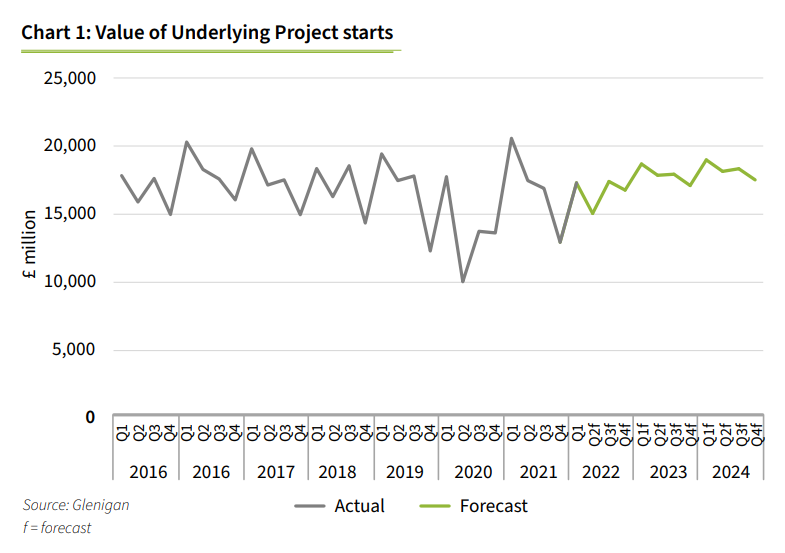
The key takeaway from this Forecast, which focuses on the next three years (2022-2024) indicates the construction industry will face challenging economic conditions.
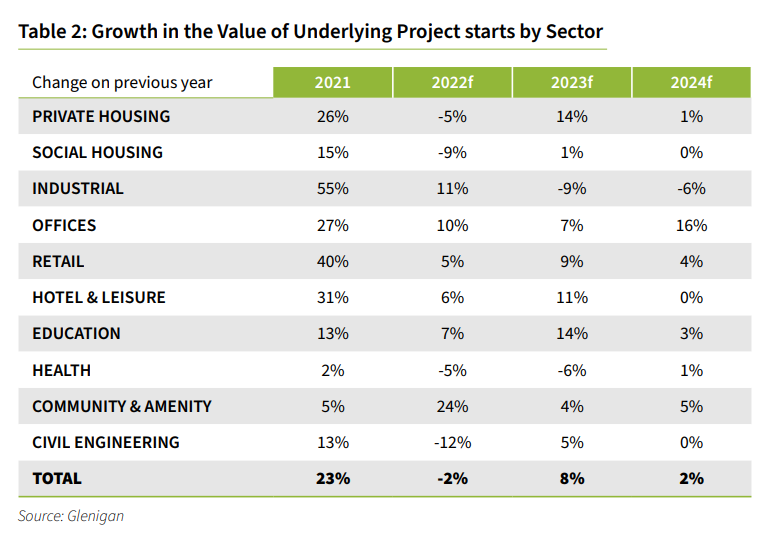
However, whilst growth will be stifled in 2022 (-2%), 2023 is predicted to see a modest 8% increase and a smaller 2% lift in 2024, representing an average rise of 2.6% over the Forecast period.
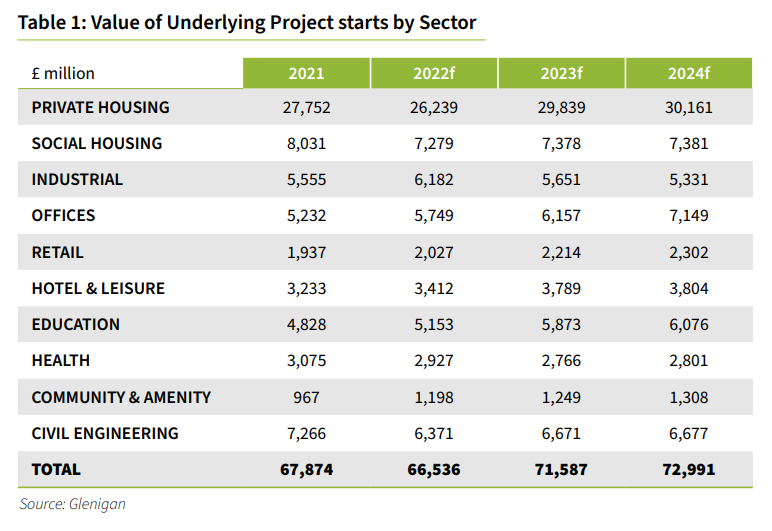
This report is predominantly focused on underlying starts (< £100m in value), unless otherwise stated, and contains a comprehensive overview of the current state of the construction industry. Crucially, it provides overall sector and vertical-specific insight into performance over the next few years.
Significant disruption stifles short-term growth
The next few years will be challenging for the construction industry as a whole. The war in the Ukraine is creating considerable economic uncertainty which is having a direct, current effect on output, derailing post-COVID recovery. As a result, overall project starts are forecast to slip back 2%.
Aside from this ongoing conflict, current inflation spikes, higher taxes and rising mortgage costs are expected to constrain activity in consumer-related areas, such as private housing, retail and hotel & leisure.
In contrast, a firm development pipeline is predicted to lift industrial and office starts in 2022, as well as Government-funded areas such as education, health and community & amenity.
More positively, the value of project starts is expected to rise in 2023, as the UK economy stabilises and short-term supply chain pressure ease. However the lingering impact of higher construction, material and energy costs means this growth will be significantly lower than predicted in previous forecasts.
Housing Starts Depressed
Although a buoyant housing marked helped to lift new housebuilding activity in 2021, with starts rising 26%, this recent surge is fading.
Predicted to drop 5% in 2022, following the removal of temporary Stamp Duty relief and dwindling homebuyer confidence, higher taxes and mortgage costs, housebuilders are expected to moderate project starts and focus on building out developments already on-site.
However, this slowdown appears temporary, with a renewed build-for-sale starts recovery anticipated in the second half of the Forecast period, rising 14% in 2023 and 1% in 2024, as household financial positions and UK economic prospects improve. Furthermore, a strong development pipeline has also be registered for Build-to-Rent starts, following a productive 12 months in 2021.
Bright spots for non-residential work
Industrial starts, particularly warehouse and logistics, are set to remain a growth area, building on the ever-increasing appetite for online retail, which accelerated during the pandemic. With e-commerce expected to be a significant growth market in the coming years, 2022 will see start value increase by 11%.
However, the online shopping boost has hit physical retail hard, with high street and outlet footfall remaining far lower than pre-pandemic levels. Unsurprisingly, lower consumer spending power, an overhang of empty retail premises and a greater share of the market moving online, means growth will be tempered over the Forecast period. Here, increased investment by the deep discount supermarkets, Aldi and Lidl, will be the primary drivers of the predicted 6% average uplift between 2022 and 2024.
The leisure and hospitality sector, hit hard by the pandemic, is also only set to expect modest recovery over the Forecast period due to reduced consumer discretionary spending during a tighter economic climate.
Moving from play to work, office starts bounced back sharply last year (+27%) and are predicted to benefit over the forecast period (av. +11%). This potential growth can be attributed to a rise in refurbishment projects as tenants and landlords adapt premises to accommodate changing working practices. However, new build office projects will likely be slower to recover as tenants and developers assess the effects of the shift towards remote and hybrid working on the long-term demand for office accommodation.
Public Sector Pick-Up
Public sector investment is set to be an important driver for construction activity over the Forecast period. However, the latest Spending Review revealed only modest growth in capital funding for a handful of central Government departments over the next three years.
Whilst the value of social housing starts is set to dip almost 10% this year, following a 15% surge in 2021, the vertical is predicted to rally for the remainder of the Forecast period, helped by a strong pipeline of already approved projects commencing on site.
Education construction is a vertical predicted to grow significantly over the next few years (av. +8%), partly driven by the Government’s commitment to building 500 new schools over the next decade. This is supported by a modest rise in universities capital spending during the second half of the Forecast period
The outlook for the health sector is also brightening. Starts remained high in 2021 post-Pandemic and the increase in capital funding and a growing development pipeline means the value of starts are expected to remain steady over the Forecast period, will slight declines this year (-5%) and next (-6%) .
Focusing on civils and infrastructure, a significant funding increase in areas such as roads, especially to address the maintenance backlog on the nation’s local roads, is helping to lift the value of project starts.
Investment in rail projects and utilities development, as well as ongoing work on major infrastructural projects such as Thames Tideway, HS2 and Hinkley Point are also set to support vertical activity over the Forecast period.
Commenting on the Forecast, Glenigan’s economic director Allan Wilen says, “Circumstances have changed significantly since the November 2021 Forecast and, whilst the short-term picture appears challenging, we should adopt a sanguine approach for the next few years.
“Markets sent into turmoil by the Russia-Ukraine War are starting to stabilise as new supply chain solutions are developed and established.
“Of course, in the near future construction and building product costs will remain high. However this situation will no doubt encourage a burst of imagination and innovation which will see the sector weather the current storm and progress to, if not sunny uplands, then at least towards a trajectory of upward growth.”
To download Glenigan’s UK Construction Industry Forecast 2022-2024 click here.
To find out more about Glenigan, its expert insight and leading market analysis, click here.