Everyone Aboard: Scotland’s political leaders urged to commit to expansion of free bus travel

Over 100 organisations from across Scotland have today written to the leaders of Scotland’s political parties, urging them to commit to a radical extension of free bus travel, in a move that they say would have a transformative impact on the lives of people across Scotland’s communities. 

The call has been made as part of the Poverty Alliance’s Everyone Aboard campaign, which asks for their support in extending fre bus travel to under 25s and people on Universal Credit and other low-income benefits. 

The coalition of organisations – coordinated by the Poverty Alliance and including Friends of the Earth Scotland, the Scottish Youth Parliament and Barnardo’s Scotland – are making the call at a time of growing poverty in Scotland, with recent Scottish Government statistics showing over 1 million people in Scotland are now living in the grip of poverty. 

Bus travel will, the letter states, be critical in stemming the rising tide of pandemic-related youth unemployment, with bus travel particularly important for young people and people on low incomes to help them access the labour market. Without this action, the organisations have warned, they “risk being left behind in our economic and social recovery.” 

Peter Kelly, Director of the Poverty Alliance, said: “We are calling on the leaders of Scotland’s political parties to take the bold, far-reaching action to help loosen the grip of poverty on people’s lives. Removing the barrier to transport would be a significant step towards building a Scotland where everyone is included, no matter their income.   

“This move would also help advance gender equality, as women disproportionately rely on public transport to access jobs, healthcare and activities to boost their wellbeing.

“Lone parents, who are predominantly women, would particularly benefit. Expanding the use of public transport will play an important role in reducing Scotland’s emissions and responding to the climate emergency.

“Extending free bus travel is a key way the next Scottish Government can help make Scotland a greener and more just place for us all to live.” 

Mollie McGoran MSYP, Trustee of the Scottish Youth Parliament, said: “Young people and people on low incomes have been some of the hardest hit by the COVID-19 pandemic and so must be put at the heart of the recovery.

“That’s why we support the aims of the Poverty Alliance’s Everyone Aboard campaign to provide free bus travel for young people and people on low incomes in Scotland. 

“We believe that Transport Scotland and the Scottish Government should provide funding to support initiatives which make it easier, cheaper, and safer for young people to use active and sustainable travel options.

“Our 2018 national campaign All Aboard found young people feel bus fares are too high. The cost of public transport creates barriers to participation which are denying young people and those on low incomes access to opportunities, and this proposal would be a great step in the right direction.”  

Gavin Thomson, Air Pollution Campaigner, Friends of the Earth Scotland, said: “Transport is the biggest emitting sector in Scotland. To meet our climate change targets, bold action must be taken to promote cleaner forms of travel, like public transport, and lead a just transition away from fossil fuel private car use.  

“Extending free bus travel to all young people under 25 and those on Universal Credit will form an important part of the solution and help ensure no one is left behind as we transform our transport system.

“The upcoming Scottish Parliament election provides political parties an opportunity to demonstrate their commitment to tackling climate change. We must seize it.” 

The full letter can be read here: Everyone Aboard letter to Scotland’s party leaders

Global Travel Taskforce: Travel has its wings clipped by cautious UK Government report

Vague and costly recommendations are not enough to reboot aviation and tourism sectors facing another summer without international travel, says Westminster’s Transport Committee.

Lack of clarity

In an analysis of the Government’s Global Travel Taskforce Report, the  Committee concludes that the Report sets out a framework without the detail required to restart international travel. Where detail is provided, the costs may be disproportionate to the risk and add £500 on to the cost of a family of four travelling to the safest parts of the globe where the vaccine roll-out is comparable to the UK.

This distinct lack of clarity does not offer confidence to industry or consumers to plan, invest or recover from the coronavirus pandemic. It leaves the planned safe restart of international travel on May 17 in jeopardy.

The UK’s aviation and tourism sectors were poised to accommodate the public’s desire to travel for business, study, holidays and to visit loved-ones. The UK [aviation industry] has been one of the hardest hit by the pandemic, according to the European Organisation for the Safety of Air Navigation. Another summer without international travel heralds significant economic adversity.

Recommendations

In its Report, the Committee sets out four clear recommended actions for Government:

  • Populate the traffic-light framework with destination countries by May 1 and announce the details in a statement to Parliament.
  • Explain the criteria and mechanism by which countries will move between risk categories by May 1.
  • Offer an affordable testing regime that supports public health and safe travel for everyone by maximising the role of lateral flow tests and ensuring the provision of affordable polymerase chain reaction (PCR) tests, where required.
  • Act immediately to reduce waiting times and queues at the UK border, including working bilaterally with partner countries to agree mutual recognition of travel health certification, deploying more staff at the border, processing passenger locator forms before passengers arrive in the UK and establishing an efficient system based on a single digital app to process health certification submitted in a range of languages.

Transport Committee Chair, Huw Merriman MP, said: “The aviation and travel sectors were crying out for a functional report, setting out clear rules and offering certainty. This is not it.

“Where the industry craved certainty, the Government has failed to provide it. For UK citizens seeking to travel to the parts of the globe where the vaccine has been delivered as rapidly as the UK, the cost to families from testing could be greater than the cost of the flights. 

“This is a missed opportunity for the Government to capitalise on the UK’s world-leading ‘vaccine dividend’. How can it be right that hauliers, arriving from parts of the globe where the vaccine roll-out is slow, are able to use cheaper lateral flow testing whilst a trip back from Israel requires a PCR test which is four times as expensive?

“This was an opportunity to provide a global lead with standardised rules on international health certification and promoting app-based technology, making the processes at borders more secure and less time consuming. The urgent situation facing the aviation and travel sectors warrants a clear action plan to green light our travel – and the Government must urgently set it out.”

Rory Boland, Editor of Which? Travel, said: “The government is reliant on factors outside its control in restarting international travel, including high and changing infection rates in many countries, so it’s understandable that it cannot provide clarity on where people can go yet. However, it needs to do a better job of fixing the issues it does control.

“Given the government has now dropped its advice not to book holidays, consumers need clarity on how the traffic light system will work and reassurance that last-minute changes won’t leave them facing thousand pound bills – as they did last summer.

“Test costs remain too high and risk pricing millions out of travel, while the problem of passengers queuing for several hours at border control at some UK airports has been going on for months.

“If people are to travel this summer, whether to see loved ones or on holiday, they need the government to make sure it is affordable and safe.”

Singh 4 Your Supper!

Social Bite launch ‘at home’ boxes with celebrity chef Tony Singh

Homelessness charity, Social Bite, has launched its very first At Home dining box, giving people across the central belt the chance to enjoy delicious, restaurant-quality dishes at home while supporting those who have experienced homelessness.

The Singh 4 Your Supper menu, is in partnership with Scottish celebrity chef and restaurateur, Tony Singh.

The Indian-themed dining box explores a variety of fresh, rich and aromatic flavours and is a delectable feast for two including eight dishes and a selection of sauces.

Priced at just £60, the menu is perfectly portioned for two people, making it ideal for cosy date nights or to enjoy some alfresco dining with friends.

Each box comes with an easy-to-follow preparation, cooking and plating instructions so that you can create great-tasting food from home but food lovers will have to be quick, with only a limited number of boxes available.

Josh Littlejohn MBE, CEO and Co-Founder of Social Bite, said: “It’s been great to work with the incredibly talented Tony Singh to help produce our first ever home dining boxes.

“The menu we’ve created gives people a real taste of India and allows them to enjoy the recommendations of one of the country’s top chefs from the comfort of their own home.

“As the world starts to open back up it’s really important to us that we continue to find new ways for people to support the mission of ending homelessness while also enjoying the easing of restrictions.

“Every box purchased helps us in our mission of providing real jobs, permanent homes and support to help get people back on their feet, as well as the wider mission of ending homelessness.”

Each dish has been lovingly prepared by Tony and the Social Bite team at Social Bite’s Central Kitchen in Livingston.

Chef Tony Singh (above) said: “Social Bite is such an incredible cause so when they asked me to get involved in creating some home dining boxes, it was an easy yes.

“My passion is creating delicious, high-quality food, that can be shared together. But what makes these boxes even more special, is that these will be helping to support Social Bite’s mission of ending homelessness.”

To get your hands on this limited-edition box, you can order online from today – Thursday 22nd April. Boxes can be collected from Social Bite Cafes in Edinburgh and Glasgow city centre, as well as their Central Kitchen in Livingston on the 7th and 8th of May.

The Singh for Your Supper menu includes four main dishes: Kerala King Prawn, Butter Chicken, Aloo Chole and Gulab Jamun for dessert along with four sides: Spiced Fur Fur, Paratha, Jeera Pilau Rice and spiced onions with a selection of sauces; mango, mint, yoghurt and tamarind.

These are all the dishes that Tony would usually cook at home for his family so you can dine like a chef and eat like a Singh!

To order your own home dining box or to find out more information, please visit: shop.social-bite.co.uk/singh

Aldi donates 12,088 meals to Lothian charities over the Easter School Holidays

Local charities in the Lothians helped Aldi donate 12,088 meals to people in need over the Easter school holidays. 

The supermarket paired up its stores with local charities, community groups and foodbanks to donate surplus food, prioritising donations to those focused on feeding children. 

Around 36 tonnes of food were donated throughout Scotland, with more than 61,000 meals, including over 47,500 meals for children, donated to causes supporting families and children in need. 

The donation is part of Aldi’s commitment to donate 10 million meals across the country in 2021, in partnership with community giving platform Neighbourly.  

So far this year, Aldi stores across the UK have already donated more than two million meals to good causes.  

Mary Dunn, Managing Director of Corporate Responsibility at Aldi UK, said: “We’re proud to support good causes in the Lothians, helping them to provide meals to those in need over the Easter period.  

“At a time when more people are experiencing financial hardship and food insecurity due to Covid-19, we are committed to doing what we can to donate more meals in 2021 than ever before.” 

Steve Butterworth, from Neighbourly, added: “The school holidays are often a busy time for the nation’s charities and food banks. I’m sure Aldi’s donation will have been a massive help for so many of these vital organisations.” 

Constitution Reform Group launches a ‘Third Way’ for the future of the United Kingdom

Replace the House of Lords with a National Parliament
– Establish an English Parliament
– Create a UK Central Bank
– Reset the mechanisms of the United Kingdom’s constitution
Protect and maintain this historic and successful Union 
The Constitution Reform Group (CRG) has launched its new Act of Union Bill 2021, which would establish a new political and financial framework for equal cooperation between England, Scotland, Wales and Northern Ireland.

The Bill has been launched to initiate a much-needed nationwide conversation on a ‘third way’ for the future of the United Kingdom, to break the restrictive dichotomy of ‘status quo versus independence’ being maintained by regional separatist movements. 

The CRG is calling on all pro-Union political parties to express their support for its core aim, which is to debate, introduce and complete any reform necessary to save the Union.

It is also calling on all separatist movements to confirm publicly whether they would seek to renegotiate the framework of the United Kingdom before supporting its dissolution. 

For the past six years, the CRG has worked with leading constitutional lawyers and experts to draft this extensive legislation, which is comprehensive and internally logical and consistent.

The Bill’s implementation would provide the four constituent parts of the United Kingdom a clearer view of their local autonomy and clearly define the scope and purpose of their cooperation.

It includes options for consideration by Parliament and the electorate to replace the House of Lords with a National Parliament and another to establish an English Parliament.

It also includes provisions to reset the mechanisms of the Union, such as the creation of a UK Central Bank, which would better and more equally serve the interests of all parts of the United Kingdom.

Before Royal Assent, the Bill would be put to the people of the United Kingdom for approval in a referendum. 

Robert Salisbury, Chairman of the CRG’s Steering Committee, said: “The Group is convinced that the break-up of the United Kingdom would be a tragic and fundamental strategic blunder and end an intimate partnership that has been astonishingly successful, culturally and economically, and which has stood as a powerful defence of its people’s values and liberties in a dangerous world.

“If the Union is to endure and prosper, the U.K. must be refashioned, and a new constitutional settlement is a necessary part of that refashioning.” 

The CRG was established after the 2014 Scottish independence referendum to devise a new path for the Union by addressing existing and developing constitutional inequalities between the four parts of the United Kingdom.

Its membership includes former First Ministers of Scotland, Wales and Northern Ireland and senior figures from across the political spectrum, who cooperate with the common belief that the United Kingdom is stronger together.

The Group believes that reform of the United Kingdom’s constitution, although complex, is a significantly more desirable task than negotiating its undoing.
They are therefore trying to raise awareness of the feasibility of a ‘third way’ and of the need for a wider national conversation on what must be done to ensure the United Kingdom stays together as one family. 
Constitution Reform Group Steering Committee:

Marquess of Salisbury KG KCVO PC DL, Chairman
Bim Afolami MP
David BurnsideThe Rt Hon the Lord Campbell of Pittenweem CH CBE QC
Shana Fleming OBE
Joanna George
Daniel Greenberg CB
The Rt Hon the Lord Hain
The Rt Hon Carwyn Jones AM
Sir Andrew Large
Lord Lisvane KCB DL FLSW
Seema Malhotra MP
The Rt Hon the Lord McConnell of Glenscorrodale
David Melding AM CBE
Sir Paul Silk KCB FLSW
The Baroness Stuart of Edgbaston
The Rt Hon the Lord Trimble 

Constitution Reform Group Sub-Committee on Public MoneyMembers include:

Sir Andrew Large (Chairman) – Deputy Governor of the Bank of England and a member of its Monetary Policy Committee from September 2002 to January 2006.
Sir John Gieve KCB – Former British civil servant, Deputy Governor for Financial Stability of the Bank of England and ex officio member of the Monetary Policy Committee, 2006 to 2009.
Lord Macpherson of Earl’s Court GCB – Permanent Secretary to the Treasury, 2005 to 2016.
David Peretz CB – Former Under Secretary for Home Finance and Monetary Policy HM Treasury, Executive Director of the IMF and World Bank, G7 Financial Sherpa, and Chair of Bermuda’s independent Fiscal Responsibility Panel.

Interactive map highlights food growing opportunities

Launch of Edinburgh’s first Food Growing Strategy

A new interactive map highlighting Edinburgh’s food growing sites and projects has been launched to mark the release of the city’s first Food Growing Strategy.

The Edinburgh Food Growing and Projects Map provides detailed information on community growing projects, HRA community gardens, council and independently run allotments in the Capital, making it easier for people to find out more about and get involved in local food growing activity in their area.

Its publication marks the launch of ‘Growing Locally’, Edinburgh’s first Food Growing Strategy, which aims to increase the opportunities for people and communities to grow food in Edinburgh, encourage more people to buy and enjoy locally grown food, and encourage more people to become involved in food growing and local food projects.

The strategy outlines plans to increase the amount of food growing space in Edinburgh and develop a local food market, looking at the feasibility of establishing an indoor market and local food distribution hub.

It also sets out ways in which the city can tackle food insecurity and improve access to fresh food.

Councillor George Gordon, City of Edinburgh Sustainability Champion and Chair of Edible Edinburgh said:I am delighted to publish the first food growing strategy for the City of Edinburgh Council. We have faced difficult times over the last year where the importance of food to our physical health and our emotional and mental wellbeing have been evident for all to see.

“By working closely with the Poverty Commission, Growing Locally seeks to address food insecurity in the city and improve people’s access to fresh food, as well as supporting and promoting food growing across the city.

“It also celebrates the role that food plays in our lives – from bringing people and communities together, to improving biodiversity and mitigating against the effects of climate change by providing access to locally produced, low carbon food.

“Along with the map, the strategy brings together our proposed approach to encouraging more local production, more sustainable management of food growing and perhaps most importantly of all, an ongoing discussion as a city about what a diverse and vibrant food economy looks like, so that the benefits of local food growing can be realised by as many of our citizens as possible.”

Brenda Black, CEO of Edinburgh Community Food said: “Food is key to Edinburgh’s identity and economy and the Edinburgh Food Growing and Project Map provides a gateway for everyone to be involved in making positive food connections within their communities across the city, building better understanding of food and its impact on climate change.

“As Edinburgh moves to meet its climate targets, providing access to growing spaces for its citizens will be a huge step forward in creating a vibrant, low-carbon, food economy for all. 

“The pandemic has highlighted how fragile our food supply chains to the most isolated people in our city can be and the Edinburgh Food Growing and Projects Map is an opportunity for citizens to become actively involved in making connections within – and between – communities:  growing, preparing/cooking, sharing and selling food.  

“Active food communities build strong bonds that transcend religion, age, nationality and culture, and lead to a joint sense of purpose and care for local areas; furthermore, increasing the variety of food sources builds resilience and improves the City’s food security. 

“Edinburgh needs a food identity that not only delivers local, seasonal, quality food to visitors but has the power to nurture healthier generations who are able to grow and make their own fresh food. 

“Edinburgh Community Food will work together with the Edible Edinburgh partnership to ensure The Edinburgh Food Growing and Projects Map becomes a foundation of this initiative across the city.”

The Edinburgh Food Growing and Projects Map can be viewed at: 

https://www.edinburgh.gov.uk/council-planning-framework/food-growing-strategy?documentId=13128&categoryId=20204

Missing teenager: Can you help?

Police are appealing for information to help trace a missing teenager last seen in the Calder Gardens area. Vo Van Tu (17) was last seen around 7.30am yesterday (Wednesday 21 April).

He is described as being Vietnamese, around 5ft 6, slim to medium build, with short dark hair. He is believed to be wearing a red puffer jacket and dark trousers.

Police are concerned for his wellbeing and are asking for anyone with information on his whereabouts to come forward.

Inspector Caroline Flynn, from Drylaw Police Station, said: “We have growing concerns for Vo Van Tu’s wellbeing, partly due to his limited English and the length of time since he was last seen.

“If you believe you have seen him in Edinburgh, or may know his whereabouts, please contact police on 101, quoting incident 2896 of 21 April.”

Woman assaulted in Drylaw

Police are seeking witnesses to an assault which happened outside a convenience store in Drylaw.

Around 9pm on Saturday, 10 April, 2021, a 34-year-old woman was outside the Day Today store in Easter Drylaw Place. She sustained a serious facial injury in an assault but did not require hospital treatment.

Officers are following a positive line of enquiry in relation to the assault but are seeking witnesses to come forward.

A member of the public came to her aid and officers are especially keen to hear from her.

Despite the time in the evening the area around the shops was busy with people and officers continue to check CCTV from nearby premises and carry out door-to-door enquiries in relation to the enquiry.

If anyone has any information, please call Police Scotland via 101, quoting incident number 1142 of 12 April, 2021.

Alternatively, please call Crimestoppers on 0800 555 111 where you can give your information anonymously

Invest in Scottish maternity to tackle deprivation, says RCM in message to next government

Tackling Scotland’s social deprivation and inequalities by investing in maternity services and staff must be at the heart of the next government’s policy. That’s the message from the Royal College of Midwives (RCM) in a Blueprint for maternity services published this week.

In five areas for action, it also calls for an end to Scotland’s midwife shortage, saying some areas of the country struggle to attract enough midwives. 

The pandemic has also exposed starkly existing inequalities hitting vulnerable women and those from Black, Asian and minority ethnic communities.  Maternity and other areas of healthcare have a key role to play in efforts to address these inequalities, says the RCM 

The RCM’s five areas for action for the next Scottish Government are: 

  • tackling social deprivation; 
  • delivering the best maternity care for all the people of Scotland; 
  • supporting NHS staff to recover from the pandemic; 
  • ensuring Scotland has birthplaces that are fit for the future; and 
  • ending Scotland’s midwife shortage for good. 

Pulling no punches, the Blueprint says the pandemic ‘has been brutal’ on maternity and other NHS staff, who have worked throughout to ensure safe and high-quality care for women. This has hit their mental and physical health and they must be given the time and support to recover from it. 

Jon Skewes, Executive Director for External Relations at the RCM, said: “There has been a monumental effort from midwives, maternity support workers, and maternity care assistants through the pandemic. It is time to step-up and really invest in them, in their pay and in their working conditions.

“Right now, we have a demoralised and exhausted workforce and women falling through the cracks and not getting the care they deserve. Staff are also often working in old, poorly designed buildings that are simply not fit for purpose. The pandemic has exposed the extent and the impact on care of this crumbling infrastructure.” 

Additional training places for student midwives are also needed in more of Scotland’s universities. When they qualify new midwives generally stay within the regions they trained in leaving the chances of recruiting staff stacked against other areas without midwifery courses.  

Jon Skewes added: “Tackling deprivation goes way beyond maternity and the wider NHS. Fixing it must be done through multiple channels including social care, education, and others.

“Maternity is a very good place to start improving the health of the nation, reduce inequalities and indeed, save lives that should not be lost. This has been a really tough year for the NHS and the people using it as it creaked under the weight of pandemic demands.

“It has also been a remarkable year because of how its staff and the service responded. Now is the time to invest to make it fit for the future.” 

North and Midlands leads UK’s jobs recovery

  • Nine out of 63 cities and large towns have recovered to their pre-pandemic level of job postings, with the North and Midlands outperforming the South and South East
  • Barnsley, Mansfield and Stoke recorded strongest job posting recovery to date; Aberdeen, Belfast and Crawley experienced the weakest
  • Areas with high claimant counts and slow recovery in job opportunities in greatest need of policy support, according to new research by global job site Indeed and the Centre for Cities 

Britain’s resurgent jobs market is being led by cities and towns in the North and Midlands, according to new research by global job site Indeed and the Centre for Cities think tank.

Hiring gathered pace after the UK Government’s reopening roadmap was announced on 22 February but new analysis shows job growth is unevenly spread across the country.

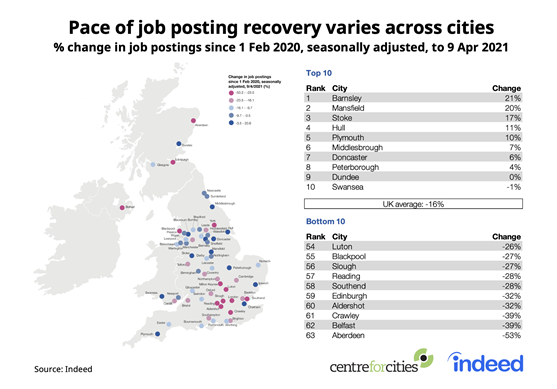
Indeed and the Centre for Cities analysed job vacancies in 63 cities and large towns and found that in some parts of the country job postings now exceed their pre-pandemic level with those in the North and Midlands having so far witnessed the strongest recovery in job postings.

In total, nine cities or towns – led byBarnsley (+21%), Mansfield (20%) and Stoke (17%) – now have more job postings than before the pandemic started.

In contrast, Aberdeen (-53%), Belfast (-39%) and Crawley (-39%) are the three places where job postings have recovered the least, together with other cities and large towns predominantly in the South East of England.

London too is among the places with the slowest recovery: job postings in the capital are still 26% below their level before the pandemic, making it the 11th city with the slowest recovery.

Pace of job posting recovery varies

Indeed.png

The improving jobs landscape in the North and Midlands is partly driven by the mix of available jobs.

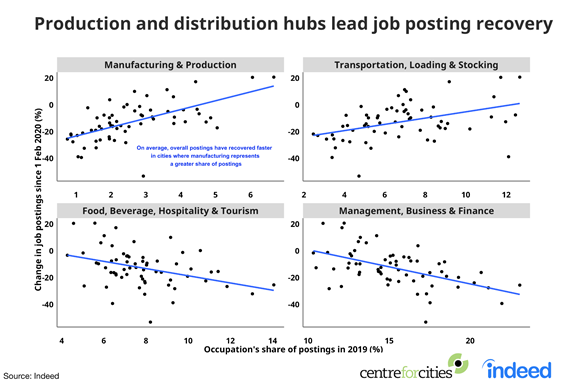
Recoveries have been strongest in areas with a greater pre-pandemic share of postings in occupations related to the production and distribution of goods, such as manufacturing, driving and loading & stocking, as well as essential services like healthcare, social care and education.

On the other hand, places with a higher share of pre-pandemic job opportunities in food & beverage service and hospitality & tourism are lagging behind.

Production and distribution hubs lead job postings recovery

Indeed 2.png

New analysis of claimant counts and job vacancies points to which jobs markets were hardest hit by Covid-19 and might take longest to return to their February 2020 level.

Places with high claimant count and low job postings include Brighton, Crawley, Slough as well as London in the south and Blackpool and Manchester in the north. These cities and large towns — which have a dependency on tourism and bustling workplaces — are the hardest hit by the pandemic as recruitment activity is lagging and more people are looking for jobs.

In contrast, places with low claimant count rates and whose job postings have mostly recovered to their pre-pandemic level – such as Mansfield, Swansea and Warrington – appeared to have been relatively sheltered from the economic impact of Covid-19.

Pawel Adrjan, head of EMEA research at the global job site Indeed, comments: “As hiring activity picks up across the country it’s clear there is a two-step jobs recovery underway in Britain.

“Cities and towns in the North and Midlands that have been buoyed by rising manufacturing, distribution, healthcare and education jobs but at the same time areas reliant on hospitality, tourism and higher paying jobs that can be performed from home have seen only sluggish growth.

“Just nine urban areas out of 63 have back above their pre-pandemic level and while the partial reopening of the economy earlier this month rode to the rescue of many businesses and workers our research shows that it alone was not enough to lift ailing area’s jobs levels significantly.

“We’ve seen how quickly the jobs market reacts to policy and public health announcements and policy makers will hope the eventual unwinding of Covid-19 restrictions will help level up the jobs recovery.”

Elena Magrini, senior analyst at the Centre for Cities, said: “Not everywhere is seeing yet the beginnings of post-pandemic recovery. Places reliant on tourism, aviation and office workers have been particularly hard hit and still have high shares of people who are unemployed or on furlough.

“Despite this, we have reasons to be optimistic, particularly given the pace of the recovery in the North and Midlands. Once we have reopened the economy, policy makers need to focus on building back better – growing the economy by creating better paid, higher skilled jobs for people right across the country.”