Join the Walking Group this Monday, 9th March at 10am for our next walk to Davidson’s Mains Park.
We’ll be setting off for a fun-filled morning of exploration, so don’t forget to bring your walking shoes, a waterproof jacket, and a bag for your essentials.
This is a fantastic opportunity to connect with like-minded individuals and immerse yourself in the beauty of our local areas.
Date: Monday 9th March
Time: 10am -1.30pm (meet at the centre for 10am)
Lunch: Picnic lunch provided, but bring a bag, walking shoes and a waterproof jacket, please
Open Farm Sunday sticker competition offers youngsters the chance to get naturally creative
Budding young artists are invited to get creative and celebrate the 20th anniversary of Open Farm Sunday (OFS) by taking part in an exciting new sticker competition.
Launched by OFS organisers LEAF (Linking Environment And Farming), the competition encourages children and young people under the age of 18 to design a sticker inspired by the theme of ‘farming with nature’.
The winning designs will be turned into official OFS stickers and showcased at hundreds of events across the country when farms open their gates to the public on 7 June.
For two decades, OFS has enabled people of all ages to discover more about how farmers work with nature to produce food sustainably – something LEAF wants to celebrate with this special competition.
Entrants can let their imagination run wild to show what farming with nature means to them. From wriggly earthworms who keep soils healthy; insect pollinators; cattle grazing and providing natural fertiliser; to carefully managed hedgerows, woodlands and wildflower meadows busting with biodiversity – farmer’s support the natural world while feeding us every day.
LEAF’s Open Farm Sunday manager, Annabel Shackleton, says: “Each year, Open Farm Sunday welcomes more than 200,000 visitors and gives families a unique opportunity to discover how their food is produced and learn more about sustainable farming.
“In this special anniversary year, young designers have the chance to see their artwork become part of this nationwide celebration.”
Children need to use the official downloadable template to create their sticker, whether that is with crayons, paints, pens or collage. Designs must be flat so they can be reproduced as printed stickers.
The competition is open to UK residents under the age of 18, with one entry permitted per person.
Entries must be submitted by 11:59pm on 6 April 2026 either by email to: openfarmsunday@leaf.eco or by post to: LEAF (Linking Environment And Farming), Avenue J, Stoneleigh Park, Warwickshire, CV8 2LG.
A panel of judges appointed by LEAF will select the winners, who will be notified by 20 April 2026 and publicly announced on or before 26 April 2026.
Up to eight winners will be selected, with their designs printed as official stickers and displayed at OFS events across the country.
Winners will also receive a personalised notebook featuring their design, creating a lasting keepsake from the competition.
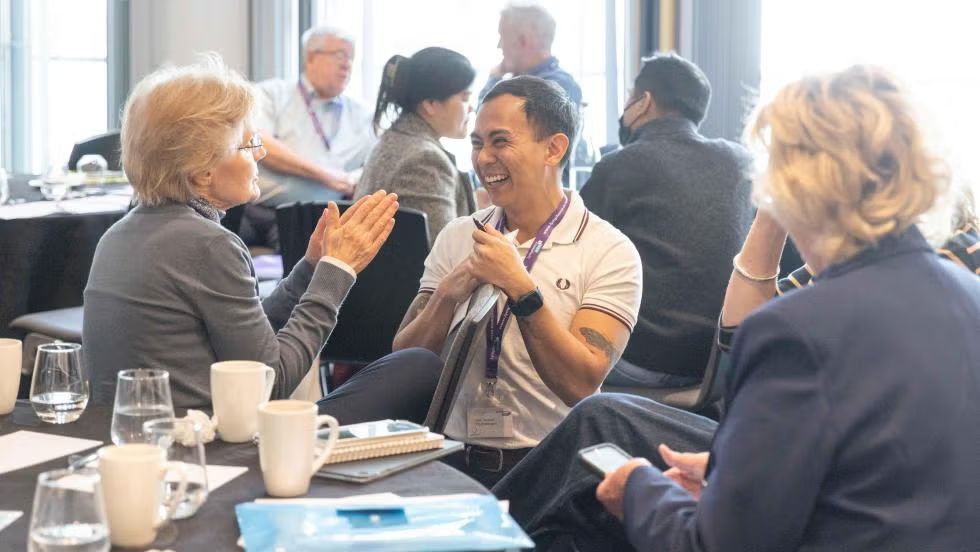
Lymphoma Action are delighted to announce the return of our National Conference, taking place on Friday 8 May in York. Anyone affected by lymphoma is welcome to attend, whether they have received a diagnosis themselves or are supporting a loved one.
Readers might be interested in this unique opportunity to hear from lymphoma experts, meet others affected by the condition, ask questions and share experiences.
We will be joined by medical professionals who will talk about why lymphoma causes symptoms and the side effects of treatment, and our dedicated wellbeing sessions will offer practical tips for day-to-day living. Attendees will also hear the personal story of someone with a lived experience of lymphoma.
There will be plenty of time to connect with others affected by lymphoma throughout the day, and to find out more about the services and support Lymphoma Action has available as the UK’s leading charity dedicated to this type of blood cancer.
Our National Conference will be held on Friday 8 May at The Milner York Hotel in York. Tickets cost £30 per person (including lunch and refreshments) and prior booking is essential.
For further information, or to book your place, please visit:
Leith-based charity Compass Therapy Support Community has rebranded and is now The Neuro Therapy Place.
The Neuro Therapy Place supports people living with neurological conditions through a range of affordable therapies including oxygen therapy, specialist physiotherapy, and other targeted therapeutic interventions.
Our historical and ongoing commitment to fundraising in support of our charitable mission and to improve the lives of our neurological clients, enables us to subsidise our therapies meaning our clients can access them at significantly reduced rates.
Services are also available to individuals without non-neurological conditions at a lower level of subsidy, helping to generate income that supports the charity’s wider mission.
Why The Neuro Therapy Place?
“This change has come from listening,” said Genevieve Harrison, CEO. “When we spoke with the people who know us best, there was a strong sense that our name should clearly reflect both our expertise in neurological therapy, and the sense of belonging people feel when they walk through our doors.
“The Neuro Therapy Place captures who we are: specialist, supportive, and rooted in community. We’re incredibly proud to step into this next chapter with a name that feels truly aligned with our purpose.”
The new name has been carefully selected to reflect the organisation’s specialist focus on neurological conditions, while strengthening its ability to communicate clearly with clients, healthcare professionals, funders, and partners.
The decision follows consultation with external marketing and branding specialists, alongside feedback from members, client representatives, volunteers, and supporters. Research indicated that the previous name did not convey the charity’s specialist focus to prospective clients, health professionals, or funding partners.
Why the change?
The Neuro Therapy Place was selected for several key reasons:
Clarity – The name immediately communicates the organisation’s neurological focus.
Distinctiveness – It stands out within the health and wellbeing sector.
Accessibility – It feels welcoming, personal, and easy to understand.
Referral friendly – Clear and memorable for busy healthcare professionals.
Stronger fundraising potential – Clearer messaging enables donors and funders to better understand and connect with the charity’s impact.
Strengthening Partnerships and Sustainability
The name change coincides with a renewed strategic focus on long term sustainability and partnership development. In 2025, the organisation appointed a Business Development Manager, and Community Fundraiser to expand external partnerships, increase awareness, and connect with members of the community who may not yet know about its services.
Commitment to Community Remains Unchanged
While the name is changing, the charity’s mission remains constant: to provide high quality neurological and oxygen therapy, alongside community-based programmes, delivered at subsidised, affordable rates.
This rebrand is not about leaving the past behind. It is about ensuring the organisation’s identity accurately reflects the vital specialist work it delivers today and positions it confidently for future growth.
With continued support from funders, partners, and the wider community, The Neuro Therapy Place aims to reach more people, strengthen partnerships, and deepen its impact in the years ahead.
Accidental poisonings (excluding narcotics and hallucinogens) have soared by 63% in a decade, with 5,770 deaths in 2024.*
Older adults are at highest risk — people aged 65+ are more than twice as likely to die from a poisoning of this type as the general population.
Hospitals in England saw 17,252 non-narcotic and hallucinogen poisoning‑related admissions last year, including nearly 5,000 older adults, who were 55% more likely to require hospital care.
Accidental poisoning is fast becoming a hidden home‑safety crisis, The Royal Society for the Prevention of Accidents (RoSPA) has warned, as new figures show 5,770 people died from accidental poisonings in 2024, a 63 per cent increase in just ten years.
Older adults are bearing the brunt: 2,371 lives lost were among people aged 65+, making them more than twice as likely to die from a poisoning as the general population. To tackle this, RoSPA has published new guidance, highlighting how people living with dementia are among those at particular risk.
The surge isn’t only seen in fatalities. Hospitals in England recorded 17,252 poisoning‑related admissions last year — almost 5,000 involving older adults, who were 55% more likely to require urgent care.
The charity’s guidelines help households protect vulnerable loved ones and include simple steps to prevent dangerous chemicals from being mistaken for everyday items. Many products in the home can be opened and swallowed in moments, especially when confusion, memory loss or impaired visual recognition makes hazardous substances look harmless.
These cognitive changes can turn ordinary domestic spaces into high risk environments, with the sharp rise in poisoning incidents tragic evidence that too many preventable emergencies are happening in homes across the UK, often without families realising how quickly a situation can escalate.
Rebecca Guy, Senior Policy Manager, said: “Families with vulnerable relatives can often deal with genuinely frightening moments. Turning away for just a few seconds and realising someone has swallowed a cleaning product is sadly a reality that some of the public have experienced.
“These aren’t freak accidents. They are predictable, preventable events, and our new guidance is designed to help people act fast to make their homes safer.”
What you can do RIGHT NOW now to lower the risk
Lock away cleaning and laundry products: high cupboards or secured storage only.
Keep medicines tightly controlled: use organisers, track doses and store out of sight.
Check packaging: ensure harmful products stay in their original containers.
Supervise more closely when unfamiliar items, visitors or new products are around.
Conduct weekly hazard sweeps of kitchens, bathrooms and utility areas.
Paul Edwards, Chief Nursing Officer at Dementia UK, said: “Laundry and cleaning products are often easily accessible in our homes, and many have brightly coloured packaging which can cause confusion for people with dementia, who may mistake them for other, edible items.
“One of the challenges of supporting someone with dementia is balancing the risk between an individuals’ autonomy against their safety.
“It is impossible to eliminate risk completely, but these guidelines offer simple steps people can take to reduce the chance of these accidents happening, and provide a helpful checklist for both professional care environments and in the home.”
Alzheimer’s Society Senior Knowledge Officer, Simon Wheeler, said: “Staying safe is important for people with dementia who want to keep living at home for as long as possible, as well as for those who support them.
“As a person’s dementia progresses, they might have trouble telling the difference between something that’s safe to eat and something that isn’t.
“If you want to reduce the risk of accidents, make sure that you store your cleaning products like laundry detergents safely in a cupboard and out of sight.
“Don’t leave them out on a worktop or near any food or drinks, especially if they might be mistaken for sweets or drinks.”
RoSPA’s latest advice underscores a growing national concern: without simple protective steps, vulnerable people are at real and immediate risk inside their own homes.
The Real Mary King’s Close is celebrating International Women’s Day with a specially curated Herstory Tour. The underground experience invites visitors to journey underneath The Royal Mile and learn all about the incredible lives of the women who once lived and worked on the now hidden streets of Edinburgh.
The one-hour tour will include fascinating revelations about some of the most famous women in Scottish history. The tour is guided by a former resident of The Close, including Janet Chesney, a member of the last family to leave the historic street behind.
Guests will even get to meet Mary King herself and find out how she obtained voting rights nearly 300 years ahead of her time. They will also hear how revolutionary thinkers like Sophia-Jex Blake and the other medical students who formed the Edinburgh Seven pioneered gender equality.
The Herstory Tour shares stories of the women who faced suppression and persecution over the centuries but also of how Auld Reekie’s most influential women shaped the city’s history and impacted our lives today.
Mary King’s Close is known for having been “a haven for independent women” with 45% of properties having a female head of the household.
The Close is the perfect place to celebrate International Women’s Day, learning about the achievements of the women of the Close.
Paul Nixon, General Manager at The Real Mary King’s Close, said: “Telling stories of the past, shining a light on Edinburgh’s history and those who came before us are things we are extremely passionate about.
“We are delighted to be sharing the less popular stories of some of the remarkable women who once occupied the Close.
“We can’t wait to welcome everyone on the Herstory Tour and explore a hidden world together.”
Tours will run on Sunday March 8th at 1400 and 1600.
Prices are £30 per adult / £24 per child (5 to 15yo – no under 5 allowed).
150 years since the first phone call was made, the lines are about to go silent
Exactly 150 years since the first telephone call was made by the Scottish innovator, Alexander Graham Bell, one West Lothian telecommunications company is urging people to future-proof their phone systems before the lines go quiet forever.
Born in Edinburgh, the revered inventor, scientist and engineer Alexander Graham Bell was granted a patent for “transmitting vocal or other sounds telegraphically” on 7th March 1876, and three days later on 10th March, he made the first ever telephone call to his assistant Thomas Watson.
This landmark moment in history transformed the way we communicate, replacing slow, written correspondence with instant, real-time conversations.
But as our communication needs have continued to evolve, the traditional phone system is no longer able to keep pace. And so in January 2027, BT Openreach will shut down the Public Switch Telephone Network (PSTN), the technology behind analogue landline phones.
Commenting on the PSTN switch-off, Workflo Solutions’ managing director Michael Field said; “This change has been deemed necessary because the network of traditional copper lines is no longer equipped to handle the demands of today’s advanced digital world.
“Bandwidth limitations restrict its ability to support features such as video conferencing and data sharing – crucial tools for modern businesses. And maintaining this ageing infrastructure has become increasingly expensive and impractical.”
Any equipment that currently uses the PSTN will stop working in January 2027. From phonelines to security alarms, door entry systems to CCTV, any technology that relies on the old copper lines will be affected.
And so to coincide with the 150th anniversary of the very first phone call, the telecommunications experts at Workflo Solutions are urging people to move to a single, digital Internet Protocol (IP) network that primarily uses full-fibre connections.
Described by Workflo Solutions as the next generation of business communication, IP leverages the power and flexibility of the internet to deliver voice, data and video services over a single, high-speed fibre optic network. This shift to IP signifies a major technological leap forward in terms of speed, reliability and functionality.
Speaking ahead of the150th anniversary of the first phone call, Michael Field said; “That iconic dial tone, the audio signal that once indicated when the exchange was ready for a number, is set to go silent in just a matter of months. So it is imperative that businesses act now to avoid disruption as the UK moves to a fully digital telecommunications system.
“The 150thanniversary of the first telephone call serves as an important reminder of just how reliant we have become on instant, uninterrupted communications. The future is calling, but if you’re unsure what you need to do to keep up with these technological developments, don’t worry.
“Workflo Solutions is offering free assessments to help guide businesses through this important transition to ensure the changeover is as seamless as possible.”
Sarah Boyack hosted families of children with Tourette’s in Holyrood on Thursday to meet with a Minister and Scottish Government officials.
The roundtable, which was co-organised with Tourette’s Scotland allowed families to raise the lack of support facing their children in Scotland’s education system.
Natalie Don-Innes attended the meeting in her capacity as Minister for Children and Young People, alongside the Unit Head for Additional Support for Learning and the Promise.
Every parent agreed that many issues stemmed from the lack of training for teachers and school staff.
Many attendants highlighted that their children had been punished due to their involuntary tics because of a lack of understanding of Tourette’s.
Tourette’s Scotland offers training for schools and creates bespoke profiles for each child with Tourette’s for their new school to utilise but both the training and reading of the reports are optional.
One participant revealed that their child was told they weren’t allowed to do one of their tics in the classroom and would have to go to the bathroom to do it, despite tics being involuntary.
Another highlighted that despite having a horrible time in school, their daughter was now thriving in university and getting far better support for her Tourette’s.
The Minister, along with the Scottish Government official, agreed to liaise further with Tourette’s Scotland to examine these issues.
The roundtable came after awareness of Tourette’s has skyrocketed due to the success of “I Swear”.
Ms Boyack also hosted a Holyrood debate about Tourette’s at the start of the year where she highlighted the challenges facing kids in the education system with the condition.
Speaking after the roundtable, Sarah Boyack said: “I was honoured to host this roundtable and give parents the opportunities to tell their stories to the Minister.
“I was deeply moved by the stories I heard of children suffering due to a lack of understanding from those in the education system and the stress it has caused their parents.
“It is obvious that with a greater understanding and robust training, the education system can be a place for those with Tourette’s to thrive in rather than a challenge they have to manage.
“I hope that the next parliament picks up the baton on this issue and ensures increased support for Tourette’s is a priority.”
Tourette’s Scotland commented:“We were delighted to have the opportunity for our families to share their stories directly with the minister for children and young people.
“Our families felt heard and that it was a productive meeting with lots of ideas on how to progress with awareness and understanding.”
You can find more out about Tourette’s Scotland and their work here:




 Details here:


