A newly established Citizens’ Panel will meet for the first time this weekend (28th – 30th October) in the Scottish Parliament to help shape how Parliament engages with the people of Scotland.
The Citizens’ Panel, comprised of 22 people broadly reflecting the demographic make-up of Scotland, will come together to deliberate how the Scottish Parliament can best work with communities to ensure their needs are reflected in its work.
The Citizens’ Panel will meet for two full weekends at the Scottish Parliament and three shorter evening sessions online.
Earlier this year, the Citizen Participation and Public Petitions Committee launched an inquiry into Public Participation, looking at how people’s voices are heard in the work of the Parliament.
The Citizens’ Panel will assist the inquiry by making recommendations on improving how Holyrood’s work involves, reflects, and meets the needs of the full range of communities it represents, focusing on improving engagement for those currently under-represented.
Throughout the sittings, the Citizen’s Panel will have the opportunity to hear from MSPs and leading academics about democracy and public participation to help facilitate discussion and inform their findings.
Citizen Participation and Public Petitions Convener Jackson Carlaw, MSP, said:“Our inquiry into Public Participation is important because we know that the Parliament doesn’t hear enough from some groups and communities.
“We want to make sure that the views and opinions of everyone in Scotland are included in the work of the Parliament, and the Citizens’ Panel will be crucial to helping us understand how we can improve this.
“Ensuring the Scottish Parliament is accessible to a diverse range of people, particularly when developing new laws or policies that affect them, is essential and the Committee will eagerly anticipate the Citizens’ Panel recommendations.”
A new report by Westminster’sinfluential Business, Energy and Industrial Strategy Committee has urged the Government to publish a draft Digital Markets Bill that would help deter predatory practices by big tech firms ‘without delay’.
Proposals for a Digital Markets Competition and Consumer Bill were trailed by the Government in the Queen’s Speech. It announced measures that would empower the Competition and Markets Authority’s (CMA) Digital Markets Unit (DMU) to rein in abusive tech giants by dropping the turnover threshold for immunity from financial penalties from £50 million to £20 million, and hiking potential maximum fines to 10% of global annual income.
The Committee concluded that fines have been viewed as ‘a small business cost’ by large companies, adding that there is ‘strong evidence of abuses of market dominance’ within digital markets. It warned that ‘consumers and others are at risk’ until a Bill is published and passed.
BEIS Committee Chair Darren Jones said: “The Competition, Consumer and Digital Markets Bill has wide support and should be prioritised, especially given the difficulty the Government currently has at passing other laws which are more controversial.
“There are many areas in the economy where stronger competition is required in the interests of consumers, small business and economic growth and this bill is an essential stepping stone to driving this issue forward.”
The report also called on the Government to ‘end [the] uncertainty’ caused by its failure to publish final guidance on the post-Brexit subsidy control regime, which the Committee found had left subsidy awarding bodies ‘in limbo’. The guidance needs to be published as soon as possible, MPs said.
Passed in April, and due to come into full force in early January, the Subsidy Control Act omits key details of the regime for public authorities to follow when awarding money. These gaps are due to be filled in by final guidance, which authorities will need if they are to have confidence when preparing bids for funding from the Shared Prosperity Fund. The Fund is a replacement for money formerly awarded through EU structural funding.
Mr Jones added: “The Government promised to replace previous EU funding into projects across the country as part of its Brexit and levelling up offers to the public. This has not yet been delivered and without full guidance and proper financing of the new subsidy schemes, funds that help deliver projects will be further delayed.
“The public will no doubt be disappointed to have not yet seen the so called ‘Brexit opportunities’ that were promised to level up their local community.”
Prime Minister Rishi Sunak’s statement on the steps of Downing Street
Good morning, I have just been to Buckingham Palace and accepted His Majesty The King’s invitation to form a government in his name.
It is only right to explain why I am standing here as your new Prime Minister.
Right now our country is facing a profound economic crisis.
The aftermath of Covid still lingers.
Putin’s war in Ukraine has destabilised energy markets and supply chains the world over.
I want to pay tribute to my predecessor Liz Truss, she was not wrong to want to improve growth in this country, it is a noble aim.
And I admired her restlessness to create change.
But some mistakes were made.
Not borne of ill will or bad intentions. Quite the opposite, in fact. But mistakes nonetheless.
And I have been elected as leader of my party, and your Prime Minister, in part, to fix them.
And that work begins immediately.
I will place economic stability and confidence at the heart of this government’s agenda.
This will mean difficult decisions to come.
But you saw me during Covid, doing everything I could, to protect people and businesses, with schemes like furlough.
There are always limits, more so now than ever, but I promise you this
I will bring that same compassion to the challenges we face today.
The government I lead will not leave the next generation, your children and grandchildren, with a debt to settle that we were too weak to pay ourselves.
I will unite our country, not with words, but with action.
I will work day in and day out to deliver for you.
This government will have integrity, professionalism and accountability at every level.
Trust is earned. And I will earn yours.
I will always be grateful to Boris Johnson for his incredible achievements as Prime Minister, and I treasure his warmth and generosity of spirit.
And I know he would agree that the mandate my party earned in 2019 is not the sole property of any one individual, it is a mandate that belongs to and unites all of us.
And the heart of that mandate is our manifesto.
I will deliver on its promise.
A stronger NHS.
Better schools.
Safer streets.
Control of our borders.
Protecting our environment.
Supporting our armed forces.
Levelling up and building an economy that embraces the opportunities of Brexit, where businesses invest, innovate, and create jobs.
I understand how difficult this moment is.
After the billions of pounds it cost us to combat Covid, after all the dislocation that caused in the midst of a terrible war that must be seen successfully to its conclusions I fully appreciate how hard things are.
And I understand too that I have work to do to restore trust after all that has happened.
All I can say is that I am not daunted. I know the high office I have accepted and I hope to live up to its demands.
But when the opportunity to serve comes along, you cannot question the moment, only your willingness.
So I stand here before you ready to lead our country into the future.
To put your needs above politics.
To reach out and build a government that represents the very best traditions of my party.
Together we can achieve incredible things.
We will create a future worthy of the sacrifices so many have made and fill tomorrow, and everyday thereafter with hope.
Liz Truss has given her final speech as Prime Minister on the steps of Downing Street:
It has been a huge honour to be Prime Minister of this great country.
In particular, to lead the nation in mourning the death of Her Late Majesty The Queen after 70 years of service,
and welcoming the accession of His Majesty King Charles III.
In just a short period, this government has acted urgently and decisively on the side of hardworking families and businesses.
We reversed the National Insurance increase.
We helped millions of households with their energy bills and helped thousands of businesses avoid bankruptcy.
We are taking back our energy independence…
…so we are never again beholden to global market fluctuations or malign foreign powers.
From my time as Prime Minister, I am more convinced than ever we need to be bold and confront the challenges that we face.
As the Roman philosopher Seneca wrote: “It is not because things are difficult that we do not dare. It is because we do not dare that they are difficult.”
We simply cannot afford to be a low growth country where the government takes up an increasing share of our national wealth…
and where there are huge divides between different parts of our country.
We need to take advantage of our Brexit freedoms to do things differently.
This means delivering more freedom for our own citizens and restoring power in democratic institutions.
It means lower taxes, so people keep more of the money they earn.
It means delivering growth that will lead to more job security, higher wages and greater opportunities for our children and grandchildren.
Democracies must be able to deliver for their own people…
We must be able to outcompete autocratic regimes, where power lies in the hands of a few.
And now more than ever we must support Ukraine in their brave fight against Putin’s aggression.
Ukraine must prevail.
And we must continue to strengthen our nation’s defences.
That is what I have been striving to achieve… and I wish Rishi Sunak every success, for the good of our country.
I want to thank Hugh, Frances, Liberty, my family and friends, and all the team at No10 for their love, friendship and support.
I also want to thank my protection team.
I look forward to spending more time in my constituency, and continuing to serve South West Norfolk from the backbenches.
FORMER Prime Minister Boris Johnson issued the following statement last night:
Johnson’s final acceptance that the anticipated support just isn’t there for him clears the way for a run-off between hot favourite Rishi Sunak and Penny Mordaunt – but only if the latter can attract enough votes among her fellow Tory MPs. That’s looking increasingly unlikely.
If she can’t reach the 100 vote target, we can look forward to the anointing of Rishi Sunak as our new Prime Minister, with the Tory party membership having no say.
Monday morning seems like an age ago, and the political circus is likely to continue into next week (writes Fraser of Allander Institute’s MAIRI SPOWAGE).
On Monday, the new chancellor undid pretty much every tax measure in the ex-Chancellor and soon-to-be ex-PM’s “mini”-budget. Only those already legislated for will proceed (the scrapping of the health and social care levy and the stamp duty cuts in England will still happen).
Although the PM has resigned, it still looks like the Fiscal Plan will be presented on 31st October, which is an interesting political situation given that presumably means that Jeremy Hunt will remain as Chancellor whoever wins the leadership election over the next week. But perhaps the last wee while has taught us that presuming anything is foolish!
For Scotland, the extra funding that was going to be generated by these tax measures for the Scottish Budget has now largely disappeared, with only the stamp duty reductions generating additional funding for Scotland.
This presents significant challenges for the Deputy First Minister in managing an already very stretched budget.
Economic Case for Independence published
Somewhat overshadowed by events at Westminster, the Scottish Government published the third in their series of papers to set out a new case for independence on Monday. This paper, “A stronger economy with independence” was expected to set out the economic case, covering issues such as currency, trade, and public sector finances.
We published analysis of the paper on Monday – and look out for our Guide to the Economics of Independence which we’ll be publishing soon and updating as more information is released by the Scottish Government.
Inflation goes back above 10%
The Office for National Statistics (ONS) published September inflation data, which showed that CPI inflation had gone back into double digits, running at 10.1%.
Underneath the headline rate, food and non-alcoholic beverages inflation is now estimated to be 13.1%. There was a slight downward pressure from motor fuels, as the prices at the pumps fall back from the peaks they reached in July.
These data still do not capture the energy price rises households are now experiencing as of 1st October, so expect there to be further increases in the rate when that data is published next month.
Interestingly (well, if you are interested in economic statistics, come on!) it may be that the change in the way the government is supporting households on energy may change the outlook for inflation. If, as is expected, the help after April is more targeted as cash transfers to those households most in need, then this will not put downward pressure on the actual price of energy.
We’ll be looking out for the OBR and Bank of England’s (3rd November) view on the pathway for inflation given these changes.
New Public Sector Finance Data published this morning (Friday)
ONS have also put out the latest public sector finances release, which contains public finance statistics (including deficit and debt) up to September 2022.
These have the first statistics on revenue generated by the Energy Profits Levy, which shows that £2.7 billion was generated from this tax in the year to date. It will be interesting to get the OBR’s independent view of the likely take from this tax over the next few years – and obviously to see if the Chancellor chooses to extend this in some way in the Fiscal Statement.
More broadly, it contains up-to-date statistics on the size of the UK National Debt. Debt has reached £2.5 trillion, which is equivalent to 98% of GDP – levels not seen since the 1960s.
This reminds us of the challenging fiscal environment, which sets the backdrop for the statement by the Chancellor in 10 days time.
No confirmation on the Scottish Government’s Emergency Budget Review
As we write this, we have no confirmation whether the Scottish Government’s Emergency Budget Review (EBR) will go ahead next week, as previously indicated.
Remember, this review is to look at in-year (2022-23) spending to balance the budget in the face of higher than expected (at the time of the last budget) inflationary pressures, particularly in relation to the public sector pay bill.
We wrote yesterday about employability support, one of the areas that John Swinney has already indicated will be cut. A number of questions remain to be answered. and we hope the EBR will be clear in laying out the evidence considered when deciding where the axe will fall.
The response to whatever is set out by the UK Chancellor on the 31st October will come in the Scottish Government’s draft budget for 2023-24 on the 15th December. For fiscal fans, the fun is due to continue for some months yet!
Following the news about the closure of the Modern Two art gallery in Edinburgh until next year due to rising energy bills, Sarah Boyack MSP, Scottish Labour’s Spokesperson for Culture and MSP for Lothian, highlighted the wider issues the sector is facing and called on the Scottish Government to deliver urgent action.
The Scottish Labour MSP commented: “Our arts and culture organisations are on the brink of collapse – many are fighting for survival, they are struggling to cope with the perfect storm of reduced incomes, skyrocketing energy bills and inflation.
“Earlier this month, we found out that Falkirk Town Hall, the Filmhouse in Edinburgh, the Belmont in Aberdeen and the Edinburgh International Film Festival have all gone under.
“The Scottish Government reassured us that Scotland’s National Collections will remain open to the public free of charge. However, the reality on the ground tells us a very different story.
“Instead of rhetoric and empty promises, we need the Government to deliver the urgent action the arts and culture sector needs at this moment of crisis.”
In his written response to Sarah Boyack MSP, on 30th September, Culture Secretary Neil Gray said: “the National Collections are an important part of Scotland’s culture.
!”As part of setting and reviewing annual budgets for grant in aid, the Scottish Government maintains close contact with National Museums Scotland and the National Galleries of Scotland about their cost and revenue, in order to continue to ensure that their permanent collections remain open to the public free of charge.”
PRIME Minister Liz Truss has resigned after just six weeks in post.
Truss, who yesterday declared she was ‘a fighter, not a quitter’, has, well, quit after just 45 days in the job.
Her resignation statement was equally short:
I came into office at a time of great economic and international instability.
Families and businesses were worried about how to pay their bills.
Putin’s illegal war in Ukraine threatens the security of our whole continent.
And our country had been held back for too long by low economic growth.
I was elected by the Conservative Party with a mandate to change this.
We delivered on energy bills and on cutting national insurance.
And we set out a vision for a low tax, high growth economy – that would take advantage of the freedoms of Brexit.
I recognise though, given the situation, I cannot deliver the mandate on which I was elected by the Conservative Party.
I have therefore spoken to His Majesty The King to notify him that I am resigning as Leader of the Conservative Party.
This morning I met the Chair of the 1922 Committee Sir Graham Brady.
We have agreed there will be a leadership election to be completed in the next week.
This will ensure we remain on a path to deliver our fiscal plans and maintain our country’s economic stability and national security.
I will remain as Prime Minister until a successor has been chosen.
Thank you.
Scotland’s First Minister Nicola Sturgeon tweeted:”There are no words to describe this utter shambles adequately. It’s beyond hyperbole – & parody. Reality tho(ugh) is that ordinary people are paying the price.
“The interests of the Tory party should concern no-one right now. A General Election is now a democratic imperative.”
Labour leader Sir Keir Starmer said: “After 12 years of Tory failure, the British people deserve so much better than this revolving door of chaos. We need a general election, now.”
His full statement:
Truss will remain as PM until her successor is elected – not by the people of Great Britain, but by Tory MPs.
THIS week the government replaced one catastrophic plan with another (writes TUC’s GEOFF TILY). A new course to placate financial markets is traded off against likely massive hits to household budgets and fears about the future.
Support for energy bills was cut, public services already stretched beyond breaking point will be hit again, little was offered on soaring borrowing and mortgage costs, and nothing about already deeply inadequate benefits and universal credit falling further behind inflation.
There is another way to deliver an economy that works for working people, but the government couldn’t be further from it,
Dealing with failure
The Truss government were right about one thing, the economic policies of the past decade and more have been a disastrous failure. As Kwasi Kwarteng admitted, growth has been ‘anaemic’. In the ONS words: the UK is the only G7 economy yet to recover above its pre-coronavirus pandemic level in Quarter 4 2019. The UK has the lowest investment as a share of GDP (see our ‘companies for the people report’, Figure 7) In Spring OECD figures showed UK real wages would fall furthest of all G7 economies.
Mini budget catastrophe
But the mini budget was catastrophically wrongheaded. Truss and Kwarteng took the fundamental problem of an economy serving wealth not work and turned it into the solution. The flip side of support for energy bills, was lavish tax breaks for those least in need – under the spurious and long discredited fallacy of ‘trickle down’.
On top of this their intention was to borrow to fund this extreme project. They did so the day after the Bank of England had confirmed that they would be reducing support for government borrowing, and implementing a £80billon programme of ‘quantitative tightening’ [i.e. selling back government bonds to financial markets] from the start of October. (Regardless of anything else this revealed staggering lack of coordination on the part of both institutions – the excellent Daniella Gabor called this ‘uncoordinated class war on the British public’.)
Financial markets took fright and instead of buying started to dump government debt, but this was also intimately connected to a third factor. The complex financial strategies – so-called liability driven investments (LDI) – that pension funds have been deploying (unnoticed by most) for the past 20 years began to unravel in the face of these rate rises.
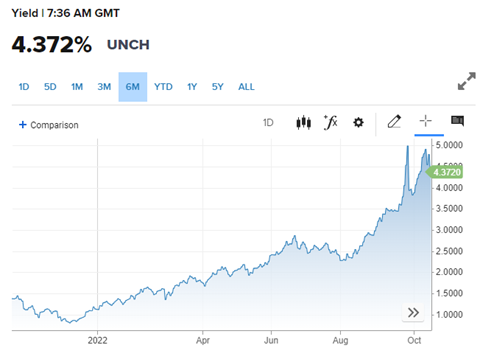
The Bank of England was obliged to step in to halt a vicious cycle – or doom loop – of bond sales leading to higher interest rates and so more bond sales. The spike in the chart below of interest rates on UK 30-year bonds shows how the episode was at least momentarily brought under control.
And in the meantime the government came under sustained assault for ‘fiscal irresponsibility’.
U-turn to a worse economy
After two U-turns (on the 45p top rate and corporation tax reductions), yesterday they U- turned on pretty much the whole thing.
But reversing a wrong doesn’t make a right, far from it.
We are now on the brink of a deep and damaging recession that threatens millions of jobs. But the latest Conservative chancellor has now announced the same basic approach that got us into this mess.
He warned of “more difficult decisions” on tax and spending to come. And immediately that “Some areas of spending will need to be cut”.
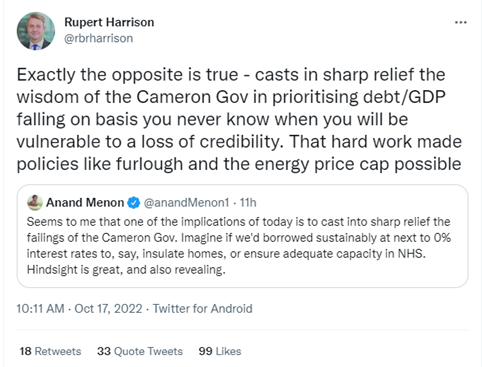
The Chancellor not only announced austerity. He not only sought once more – as did his George Osborne – to make a political virtue about imposing misery. He even invited George Osborne’s favourite adviser Rupert Harrison (now at Blackrock, one of three key institutions in LDI strategies) back to the Treasury to head a new panel of ‘economic advisers’ to deliver this reborn monstrosity.
Yesterday morning Rupert gave his City-oriented perspective on austerity
But this is a seriously misleading statement. The Osborne government did not repair the public finances. Over 2010-2019 the public debt ratio increased by 22 percentage point of GDP – the worse performance over a decade of economic recovery for a century (here).
For workers, this meant the worst pay crisis for 200 years. As Frances O’Grady spells out today, now expected (and this was before yesterday) to last at least two decades.
But the context for policy today is even more worrying than in 2010. Central banks, led by the Federal Reserve in the United States, are engaged in a forceful (their word) tightening of monetary policy.
This amounts to ending a strategy that has been in place since the start of the global financial crisis. In the wake of the last increase to 3.0 to 3.25 per cent, a Fed committee member has pointed to rates at up to 4.5 to 5 per cent. Fear of the impact of these rate rises on mortgage rates is likely common to all countries – for example in the US rates on a 30-year mortgage are up from 2.7 per cent at the start of 2021 to 6.9 per cent now.
And while in the UK the spike was brought under control, government interest rates are still seriously elevated and will carry on feeding through to mortgages.
In the UK money expert Martin Lewis has offered a grim rule of thumb: “For each 1 percentage point your mortgage rate increases, expect to pay roughly £50 more a month (£600/year) per £100,000 of mortgage debt.” The Resolution Foundation reckoned five million families would see annual payments rising by an average of £5,000 between now and the end of 2024.
Standing further back, the Financial Stability Board (Dietrich Domanski on the Today programme, 6 Oct.) have warned of the challenges of raising interest rates to deal with inflation under the conditions of the high global indebtedness that prevail today.
Likewise the IMF last week warned of “hidden leverage”, “waves of deleveraging”, and in particular the risk to ‘non-bank financial institutions’ – the latter including pension funds.
In terms of countries, first in the firing line are emerging market economies – with 20 countries “in default or trading at distressed levels”.
While the immediate trigger for central bank policies is the inflation set in motion by the end of lockdowns and Putin’s brutal invasion of Ukraine, the scale of the dislocation reflects a wider failure to set the economy right since the global financial crisis of 2008-09 exposed deep underlying failings. Summing up, the IMF offered the chilling: “the level of risk we are flagging at the moment is the highest outside acute crisis”
As the Biden administration has argued, for 40 years the interests of wealth have been prioritised over those of workers. The economy crashed in the first place because these financial interests proved wildly at odds with the interests of the population as a whole. An economy of speculation and debt crowded out production and decent pay and work.
The chancellor’s new advisory panel puts these interests back front and centre of policymaking at the Treasury. The other members so far announced are also from the City of London, not least securing J.P. Morgan a seat at the table.
Yesterday the Financial Times reported that the Bank of England’s programme of quantitative tighten has been put on hold, likely to protect the casino capitalism around pension funds.
Ahead of the mini budget the TUC issued a plan for a budget ‘on the side of working people’. We desperately need a government that will put first our interests not those of wealth. But instead once more the interests of the city of London are put ahead of those of workers and the country.
Responding to the latest figures showing the Royal Infirmary of Edinburgh sees only 40.6% of A&E patients within 4 hours, Foysol Choudhury MSP said:“The figures for patients being seen at A&E within 4 hours in Edinburgh remain alarmingly low, even before the anticipated winter crisis hits.
“The Cabinet Secretary for Health has said that ‘recovery from Covid will not happen overnight’, but we are yet to see any evidence of recovery at all. The 4-hour figures for NHS Lothian last averaged above 90% in March 2021, while the figures for Edinburgh Royal last averaged above 90% in October 2020. The trend has been downwards since then.
“Hard-working NHS staff are doing their best for patients in very difficult circumstances, but they are being let down by long-running structural failures which remain unresolved by this SNP-Green government.
“The Scottish Government needs to take urgent action now to arrest two years of decline in our health service, or risk putting patient safety in jeopardy over winter.”
The Scottish Conservatives said: “This week, A&E waiting time figures showed 1506 patients waiting more than half a day in emergency departments.
“Hardworking NHS staff are being pushed beyond their limits and patients are suffering needlessly as a result of SNP inaction.”
Mr Yousaf said: “A&E departments are working under significant pressure and, in common with other healthcare systems across the UK and globally, the pandemic continues to impact performance.
“Recovery from Covid will not happen overnight, which is why we are continuing to work with boards on a number of measures to reduce pressure this winter.”