TUC: ‘we look set to remain trapped in the doom loop of austerity politics’

- Tackling inflation is top of the priority list to stop it eating into paycheques and savings, and disrupting business growth plans.
- To protect the most vulnerable the Chancellor unveiled £26 billion of support for the cost of living including continued energy support, as well as 10.1% rises in benefits and the State Pension and the largest ever cash increase in the National Living Wage
- Necessary and fair tax changes will raise around £25 billion, including an increase in the Energy Profits Levy and a new tax on the extraordinary profits of electricity generators.
- Decisions on spending set to save £30 billion whilst NHS and Social Care get access to £8 billion and schools get an additional £2.3billion reflecting people’s priorities.
- To deliver prosperity, he’s also committed to infrastructure projects including Sizewell C and Northern Powerhouse Rail, along with protecting the £20billion R&D budget.

The Chancellor has today (Thursday 17th November) announced his Autumn Statement, aiming to restore stability to the economy, protect high-quality public services and build long-term prosperity for the United Kingdom.
Jeremy Hunt outlined a targeted package of support for the most vulnerable, alongside measures to get debt and government borrowing down. The plan he set out is designed to fight inflation in the face of unprecedented global pressures brought about by the pandemic and the war in Ukraine.

The Chancellor of the Exchequer Jeremy Hunt said: “There is a global energy crisis, a global inflation crisis and a global economic crisis. But today with this plan for stability, growth and public services, we will face into the storm. We do so today with British resilience and British compassion.
“Because of the difficult decisions we take in our plan, we strengthen our public finances, bring down inflation and protect jobs.”
To protect the most vulnerable from the worst of cost-of-living pressures, the Chancellor announced a package of targeted support worth £26 billion, which includes continued support for rising energy bills. More than eight million households on means-tested benefits will receive a cost-of-living payment of £900 in instalments, with £300 to pensioners and £150 for people on disability benefits.

The Energy Price Guarantee, which is protecting households throughout this winter by capping typical energy bills at £2,500, will continue to provide support from April 2023 with the cap rising to £3,000. With prices forecast to remain elevated throughout next year, this equates to an average of £500 support for households in 2023-24.
Working age benefits will rise by 10.1%, boosting the finances of millions of the poorest people in the UK, and the Triple Lock will be protected, meaning pensioners will also get a rise in the State Pension and the Pension Credit in line with inflation.
The National Living Wage will be increased by 9.7% to £10.42 an hour, giving a full-time worker a pay rise of over £1,600 a year, benefitting 2 million of the lowest paid workers.
The Chancellor also announced a £13.6 billion package of support for business rates payers in England. To protect businesses from rising inflation the multiplier will be frozen in 2023-24 while relief for 230,000 businesses in retail, hospitality and leisure sectors was also increased from 50% to 75% next year.
To help businesses adjust to the revaluation of their properties, which takes effect from April 2023, the Chancellor announced a £1.6 billion Transitional Relief scheme to cap bill increases for those who will see higher bills.
This limits bill increases for the smallest properties to 5%. Businesses seeing lower bills as a result of the revaluation will benefit from that decrease in full straight away, as the Chancellor abolished downwards transitional reliefs caps. Small businesses who lose eligibility for either Small Business or Rural Rate Relief as a result of the new property revaluations will see their bill increases capped at £50 a month through a new separate scheme worth over £500 million.
To protect high-quality front-line public services, access to funding for the NHS and social care is being increased by up to £8 billion in 2024-25.
This will enable the NHS to take action to improve access to urgent and emergency care, get waiting times down, and will mean double the number of people can be released from hospital into care every day from 2024.
The schools budget will receive £2.3 billion of additional funding in each of 2023-24 and 2024-25, enabling continued investment in high-quality teaching and tutoring and restoring 2010 levels of per pupil funding in real terms.
All other departments will have their Spending Review settlements to 2024-25 honoured in full, with no cash cuts, but will be expected to work more efficiently to live within these and support the government’s mission of fiscal discipline.
To improve public finances, from 2025-26 onwards day to day spending will increase more slowly by 1% above inflation, with capital spending maintained at current levels in cash terms. This means departmental spending will still be £90 billion higher in real terms by 2027-28, compared with 2019-20 while £30 billion of public spending will be saved.
To raise further funds, the Chancellor has introduced tax rises of £25 billion by 2027-28. Based around the principle of fairness, all taxpayers will be asked to contribute but those with the broadest shoulders will be asked to contribute a greater share.
The threshold at which higher earners start to pay the 45p rate will be reduced from £150,000 to £125,140, while Income Tax, Inheritance Tax and National Insurance thresholds will be frozen for a further two years until April 2028. The Dividend Allowance will be reduced from £2,000 to £1,000 next year, and £500 from April 2024 and the Annual Exempt Amount in capital gains tax will be reduced from £12,300 to £6,000 next year and then to £3,000 from April 2024.
The most profitable businesses with the broadest shoulders will also be asked to bear more of the burden. The threshold for employer National Insurance contributions will be fixed until April 2028, but the Employment Allowance will continue to protect 40% of businesses from paying any NICS at all.
In addition, the government is implementing the reforms developed by the OECD and agreed internationally to ensure multinational corporations pay their fair share of tax. And as confirmed last month, the main rate of Corporation Tax will increase to 25% from April 2023.
To ensure businesses making extraordinary profits as a result of high energy prices also pay their fair share, from 1 January 2023 the Energy Profits Levy on oil and gas companies will increase from 25% to 35%, with the levy remaining in place until the end of March 2028, and a new, temporary 45% levy will be introduced for electricity generators. Together these measures will raise over £55 billion from this year until 2027-28.
To ensure fiscal discipline while providing support for the most vulnerable, the Chancellor has introduced two new fiscal rules, that the UK’s national debt must fall as a share of GDP by the fifth year of a rolling five-year period, and that public sector borrowing in the same year must be below 3% of GDP. Overall, the Autumn Statement improves public finances by £55 billion by 2027-28, and the OBR forecasts both of these rules to be met a year early in 2026-27.
To ensure prosperity in the future, the Chancellor recommitted to the £20 billion R&D budget and made numerous infrastructure commitments. Sizewell C nuclear plant will go ahead, with the EDF contract to be signed at the end of the month, providing reliable, low-carbon power to the equivalent of 6 million homes for over 50 years.
The Chancellor also confirmed commitments to transformative growth plans for our railways including High Speed 2 to Manchester, the Northern Powerhouse Rail core network and East West Rail, along with gigabit broadband rollout.
Plans for the second round of the Levelling Up Fund were confirmed, with at least £1.7 billion to be allocated to priority local infrastructure projects around the UK before the end of the year.
In further efforts to level up the UK, a new Mayor will be elected in Suffolk as part of a devolution deal agreed with Suffolk County Council, and the government is in advanced discussions on mayoral devolution deals with local authorities in Cornwall, Norfolk and the North East of England.

Many of today’s tax and spending decisions apply in Scotland, Wales and Northern Ireland.
As a result of decisions that do not apply UK-wide, the Scottish Government will receive around an additional £1.5 billion over 2023-24 and 2024-25, the Welsh Government will receive £1.2 billion and the Northern Ireland Executive will receive £650 million.
As a result of today’s tax and spending decisions, the Scottish Government will receive around an additional £1.5 billion over 2023-24 and 2024-25.
The Chancellor has reconfirmed the UK Government’s commitment to work with the Scottish Government on options to improve the A75, in line with the findings from the Union Connectivity Review.
He also confirmed that funding for the UK’s 9 Catapult innovation centres will increase by 35% compared to the last funding cycle, this includes the offshore renewable catapult in Glasgow.
The Chancellor of the Exchequer Jeremy Hunt said: “This Autumn Statement will help deliver economic stability across the UK. We’ve made tough decisions to tackle inflation, but we’re committed to protecting the most vulnerable against the rising cost of living.
“Scottish families will receive billions of pounds of UK Government support, such as inflation-matching increases in benefits and the state pension, and the Scottish Government is receiving an additional £1.5 billion over the next two years to help protect vital public services and drive prosperity through the challenging times ahead.”

Scottish Secretary Alister Jack said: “We are facing complex global challenges, and the Chancellor has had to take some difficult decisions. By reducing our borrowing, tackling the root causes of inflation and putting our public finances on a stable footing, we will create the economic stability we need for our long-term prosperity.
“As we promised, we have put in place extra support for those who need it most, with support on energy bills and increases in pensions, benefits and the National Living Wage.
“The Scottish Government will receive an additional £1.5 billion, to help support public services in Scotland. We are also putting extra money into two key projects in Scotland. Catapult will help grow our offshore energy capability, and a feasibility study to upgrade the A75 will pave the way for much improved connectivity between Scotland, Northern Ireland and England.”
COMMENT and REACTION
Households ‘paying a steep price for UK economic mismanagement’ – Swinney
The UK Government’s Autumn Statement fails to address the pressure on devolved budgets to help people with the cost of living crisis, support public services, and finance fair pay offers, according to Deputy First Minister John Swinney.
Reacting to Chancellor of the Exchequer Jeremy Hunt’s fiscal announcement, Mr Swinney expressed dismay at his failure to address the impact of inflation on the Scottish Government’s budget, when businesses and households continue to face financial uncertainty and £1 billion in savings have had to be found to help those who need it most.
The Deputy First Minister said: “Today’s statement shows that households across Scotland are paying a steep price for the economic mismanagement of the UK Government, with average household disposable incomes forecast to fall by 7% in real terms according to the Office for Budget Responsibility.
“This would erode just under 10 years of growth in living standards, taking them back to levels not seen since 2013-14, meaning they would not recover to pre-pandemic levels until after 2027-28 – a devastating indictment of the UK Government’s management of the economy.
“Inflation is eating away at the Scottish budget, and due to the lack of additional funding in 2022-23 and the financial restrictions of devolution, we have had no choice but to make savings of more than £1 billion.
“I welcome the Chancellor’s decision to increase benefits in line with inflation from next financial year and retain the triple lock on pensions – both measures we have consistently called for. However, the higher energy price cap from April is still unsustainable for many households.
“The proposals may limit the impact for some consumers, but the UK Government needs to carefully consider the affect a £500 rise in energy bills will have on those who are in or at risk of fuel poverty. And there’s still no certainty on how businesses struggling to stay afloat will be supported from April after the Energy Bill Relief Scheme ends.
“The constant U-turns on tax by the UK Government have made planning for the Scottish Budget more challenging this year. We will take time to consider the implications for Scotland before setting out our own plans as part of the normal budget process.
“I am pleased the Chancellor has finally listened to our calls to tax more of the windfall gains in the energy sector, but he should have gone further to remove the poorly targeted investment allowance, which only serves to encourage short-term investment in fossil fuels rather than promoting long-term, sustainable energy solutions.
“This leaves me with the difficult task of setting Scotland’s Budget for 2023-24 with no hope of financial flexibility to make a real difference in the lives of those who need it most.”
HEALTH

Amanda Pritchard, NHS Chief Executive, said: “When the government – and the country – face such a daunting set of challenges, we welcome the chancellor’s decision to prioritise the NHS with funding to address rising cost pressures and help staff deliver the best possible care for patients. This shows the government has been serious about its commitment to prioritise the NHS.
“The NHS is already one of the most efficient health services in the world and we are committed to delivering further efficiencies, with over £5 billion already freed up for reinvestment in patient care this year.
“NHS staff are delivering a huge amount in the face of record demand with 10% more GP appointments than before Covid, an extra 35 million in a year, more support than ever for peoples’ mental health and the highest level of cancer checks while transforming peoples’ lives with innovative treatments such as laser therapy for epilepsy and genetic testing for sick babies and children.
“While I am under no illusions that NHS staff face very testing times ahead, particularly over winter, this settlement should provide sufficient funding for the NHS to fulfil its key priorities. As ever, we will act with determination to ensure every penny of investment delivers for patients.”
SCHOOLS
Leora Cruddas CBE, Chief Executive, Confederation of School Trusts said: “We are delighted that the Government has prioritised schools in the Autumn statement.
“We know economic times are tough. But investment in the education of our children is an investment in our future.
“Schools and school trusts have the talent and expertise to find innovative and cost-effective ways to keep improving education and supporting their local communities, and the announcement today will help them to plan ahead.”
INFLATION
Helen Dickinson, Chief Executive, the British Retail Consortium, said: “High inflation remains a major threat to the UK economy and we support the government’s objective of bringing this down.
“Inflation is making people poorer, damaging consumer confidence and holding back demand. It pushes up the costs to businesses which further increases prices for consumers. As the retail industry enters the crucial Christmas period, it is vital that inflation is brought to heel.”
NATIONAL LIVING WAGE
Bryan Sanderson, Chair, Low Pay Commission, said: “The rates announced today include the largest increase to the NLW since its introduction in 2016 and will provide a much-needed pay increase to millions of low-paid workers across the UK, all of whom will be feeling the effects of a sharply rising cost of living.
“For a full-time worker, today’s increase means nearly £150 more per month. The tightness of the labour market and historically high vacancy rates give us confidence that the economy will be able to absorb these increases.
“Businesses also have to navigate these economically uncertain times and by ensuring we remain on the path to achieve our 2024 target, employers will have greater certainty over the forward path. These recommendations have the full support of the business, trade union and academic representatives who make up the Commission.”
BUSINESS RATES – ONLINE SALES TAX
Baldock, CEO, Currys plc, said: “We’re happy that the Treasury listened to our concerns on business rates, and acted quickly.
“I’m also delighted at the ditching of the Online Sales Tax, which would have added costs for consumers and depressed business investment. We will continue to support customers and colleagues through this cost-of-living crisis, keeping prices low, jobs well-paid, and helping everyone enjoy amazing technology.”
James Lowman, Chief Executive, Association of Convenience Stores (ACS) said: “We welcome the freeze of the business rates multiplier for another year. The extension and increase in the retail, hospitality and leisure relief scheme will be warmly welcomed by small business in particular.
“Scrapping downward transition will help the businesses most adversely impacted by the pandemic and other market factors, and the Supporting Small Business Scheme will help those who have grown their business to the point where they lose some business rates relief they previously claimed.
“This package of business rates measures meets our asks to the Chancellor and we are delighted that he has listened. We will continue to work with the Treasury and other departments on modernising the whole business rates system.”
A spokesperson for ASOS said: “We welcome the Chancellor’s decision to rule out an Online Sales Tax after considering the evidence and arguments.
“Like other online retailers and major High Street names, we opposed this new sales tax which would have added significant business costs against the backdrop of the current challenging economic environment and risked higher prices, so this decision is good news for consumers and businesses alike.”
Reserch & Development
A spokesperson for GSK said: “We welcome the Government’s continued commitment to increase investment in R&D and boost incentives for businesses to invest in innovation.
“Given the challenging economic circumstances we face, it’s even more important that the Government continues to take steps to secure the UK’s leadership in science and technology, including life sciences which are a key source of jobs and growth, and we look forward to working with the Government to deliver this ambition.”
Richard Torbett, Chief Executive, The Association of the British Pharmaceutical Industry (ABPI), said: “The Chancellor has delivered a pragmatic Autumn Statement, taking some tough decisions while recognising the vital role innovation must play in setting the economy back on the path to recovery.
“The decision to protect spending on research and development, as well as increasing the R&D expenditure credit from 13 to 20 percent are both essential to boosting the UK’s share of global pharmaceutical R&D spending and investment.
“The life sciences industry is uniquely well-placed to deliver the innovation-led growth the UK needs. To realise this opportunity, the government must continue striving to make the UK a more competitive and attractive place to invest. This journey is already well underway, but we need to raise our ambitions even further if we are to truly make the UK a life science superpower.”
SOLVENCY II
Hannah Gurga, Director General, The Association of British Insurers (ABI), said: “We strongly welcome these changes to the Solvency II regime which will allow the UK insurance and long-term savings sector to play an even greater role in supporting the levelling up agenda and the transition to Net Zero.
“Meaningful reform of the rules creates the potential for the industry to invest over £100bn in the next ten years in productive finance, such as UK social infrastructure and green energy supply, whilst ensuring very high levels of protection for policyholders remain in place.
“More broadly, it will encourage a thriving and competitive industry which will ultimately benefit the UK economy, the environment and customers. This meets the objectives that HM Treasury set out to achieve and which the industry has supported throughout.”
TUC: Working people take the hit for Tory economic failure

In his Autumn Statement today, Jeremy Hunt, the fourth Conservative Chancellor this year, announced that the UK economy is in recession. The documents that accompanied his statement warned of half a million job losses. Staggeringly workers face in 2022 and 2023 the worse years of a pay crisis that is now reckoned to be lasting basically for two decades.
Rightly protections were announced against further energy price rises, and social security protection was uprated in line with inflation. The government took the advice of the low pay commission to increase the minimum wage to £10.42 an hour.
But this support is paid for by steep cuts to departmental budgets from 2024-25 onwards. And immediately there was no extra money to support public servants in the face of double-digit inflation.
As Frances O’Grady said: ““This is a recession made in 10 Downing Street, which will put jobs at risk and hit workers’ wages. We are all paying the price for the last decade of Tory governments, which decimated growth and living standards.
“Today’s statement shows it will be two decades until real wages recover. Millions of key workers across the public sector – who got us through the pandemic – face years of pay misery as departmental budgets are brutally squeezed.”
Real pay and jobs
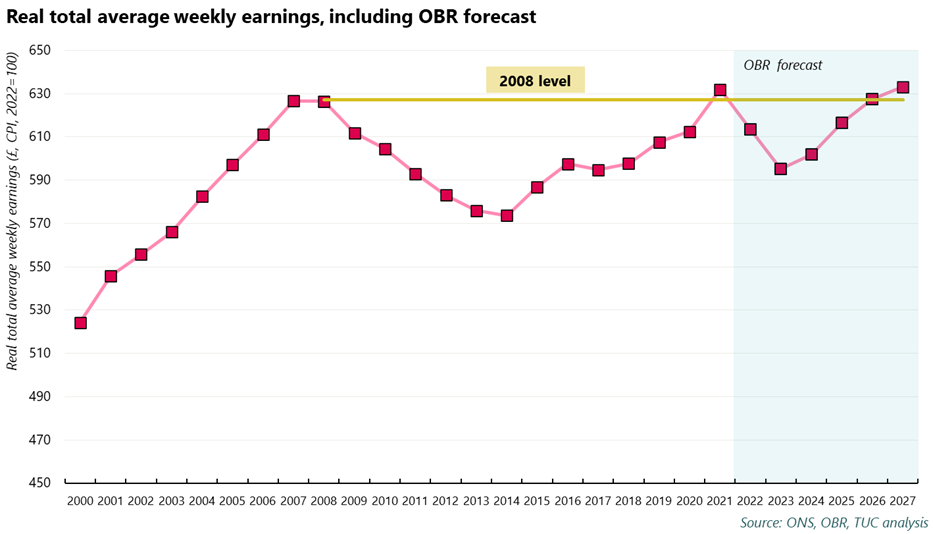
The OBR forecast expects that the real pay squeeze that’s already in its fourteenth year is set to last another five. Real average weekly earnings aren’t expected to go back above 2008 levels until 2027 – a 19-year pay squeeze that’s hit workers hard and is longer than any other since the Napoleonic times. The statement itself did little to help. The minimum wage has increased, but by less than inflation and still below the level of a real living wage. There was nothing to suggest public sector workers will get pay rises to help face the rising cost of living, after a decade in which their pay has been squeezed time and time again.


In terms of the labour market, the OBR has forecast a sustained fall in employment, still flatlining economic participation, and a rise in unemployment, which is not expected to return to the pre-crisis level until beyond the end of the forecast period in 2027. In terms of headcount the rise in unemployment is half a million – though the Bank of England is forecasting that it will rise by double this.
Policies to support working people and households
Ahead of the disastrous mini budget we called for protection against rising bills, with any costs shared fairly. And we called for a plan to grow the economy. The most prominent feature of the Chancellor’s plan was also the most worrying – to celebrate Nigel Lawson’s big bang that scrapped regulation on the city and set the trajectory to the global financial crisis.
Protection against inflation
A universal protection against rising energy bills was replaced with a more targeted approach, with bills now allowed to rise to an average of £3,000 p.a. (up from £2,500), but extra support for those on means tested benefits, pensioners, and disabled people. But energy are not the only bills that are soaring – CPI inflation is now at a forty year high of 11.1 per cent. Food inflation is at a record level, fuel prices are very high and prices are up across the board. The ONS reported this week that inflation rates hitting the lowest earners are three percentage points higher than those for the highest earners.
Benefits
Chancellor said, ‘I am proud to live in a country with one of the most comprehensive safety nets anywhere in the world.’ This comment is beyond belief, as since 2010 this Government have implemented cuts which have decimated the social security system.
The benefit uprating by the Chancellor today has been the bare minimum. The standard out of work benefit is now worth just 13% of average weekly earnings. And the basic amount of universal credit will be worth £43 a month less than in 2010 even after this uprating is in place.
The state pension has fared better than working age benefits thanks to the triple lock, but ours remains one of the least generous in Europe. So the decision to return to the triple lock formula and increase pensions by CPI inflation after this year’s real terms cut, and to increase pension credit in line with prices too, was the bare minimum.
The autumn statement also contained a strong hint that the government was preparing to axe its formula linking state pension age rises to improvements in life expectancy and bring forward its planned increase. The savings to government – and cost to the public people – of this move would dwarf the impact of pension increases resulting from the triple lock in any given year.
The minimum wage will be raised to £10.42 in 2022/23. Significant increases are needed especially after real terms declines over the last couple of years. But the announced increase will still leave the real value of the minimum wage 1.1 per cent below where it was two years before. The government must, instead, put the minimum wage on a growth path to £15 as soon as possible.
Infrastructure investment
The Chancellor warned that capital investment was too soft a soft target for austerity (like under George Osborne), then proceeded to cut planned spending by £5bn in 25-26, £9bn in 26-27 and £15bn in 27-28.
This will have major impacts on delivering the infrastructure needed to keep people moving, the UK economy competitive, and to hit climate targets.
Taxing wealth and windfalls
The Chancellor was duty bound to hit the better off. But these were not big changes in the great scheme of things. The biggest hits came on the energy profits levy and the electricity generator levy, raising £14bn in 23-24 and £11bn in 24-25. The wider hit from the 20% income tax thresholds will earn the Treasury a cool £6bn a year, compared to less than £1bn raised from lowering the threshold for paying the top rate of tax. All these changes are however dwarfed by the reversal of Rishi Sunak’s health and social care levy which costs £16-£17bn a year.
More pay misery for millions of public sector workers and the services they deliver
A strong economy relies on strong public services. Welcome words from the Chancellor as he set out his fiscal statement. Yet, warm words failed to match spending plans.
The Chancellor confirmed government would stick to cash spending plans set out in the Comprehensive Spending Review 2021. Meaning departmental budgets would not be adjusted to account for soaring inflation, placing unsustainable pressure on public services and creating more years of pay misery for the millions of key workers across the public sector who got us through the pandemic.
Analysis carried out by NEF for the TUC ahead of the budget showed, departmental budgets needed an additional £43 billion just to remain at the level set out in the Comprehensive Spending Review 2021 and keep public sector pay in line with the cost-of-living. This did not materialise.
Some relief was provided for key government departments such as the NHS, social care and schools. Nothing for public sector pay rises or cash starved areas like the court system, prisons, HMRC and local government.
Schools will receive an additional £2.3 billion in funding for 2023-24 and 2024-25, representing an overall spending increase of 4 per cent, returning per pupil spending to 2010 levels.
But no additional funding was provided for adult education, where spending fell by 49 per cent between 2009 and 2019 – surprising given the Chancellor’s emphasis on the importance of skills to economic stability and growth.
Nor for the cash-strapped early years sector, where the number of providers fell by 4,000 between 1 April 2021 and 31 March 2022, in large part due to a toxic combination of unsustainable funding levels and soaring costs for essential expenditure such as energy and food.
Health and social care will receive additional funding of around £7.5 billion. An estimated £1.6 billion of the money identified for social care requires local authorities generating additional revenue through rises to council tax.
At a time when millions of households are struggling with the cost-of-living, it is hard to see how councils will do this without putting even more financial strain on families.
Councils in areas of high socio-economic deprivation, often the most cash strapped when it comes to social care, will have the hardest time raising additional revenue.
The additional £3.3 billion for the NHS represents less than 1% of it’s overall budget. A drop in the ocean. Only a fraction of what our NHS and its workforce needs this winter. With NHS vacancies at a record-high, one in ten posts unfilled, what the health system desperately needed was investment in its workforce.
Indeed, across the public sector, what was needed and missing from today’s fiscal statement was a recognition that after twelve years of government imposed pay restraint and real terms pay cuts, our public sector workforce are on their knees. To deliver world class, high-quality public services, we need to treat the people that deliver them, with respect and dignity. That starts with spending plans that deliver cost-of-living proof pay rises in 2022 and beyond.
Public spending, GDP and the government finances
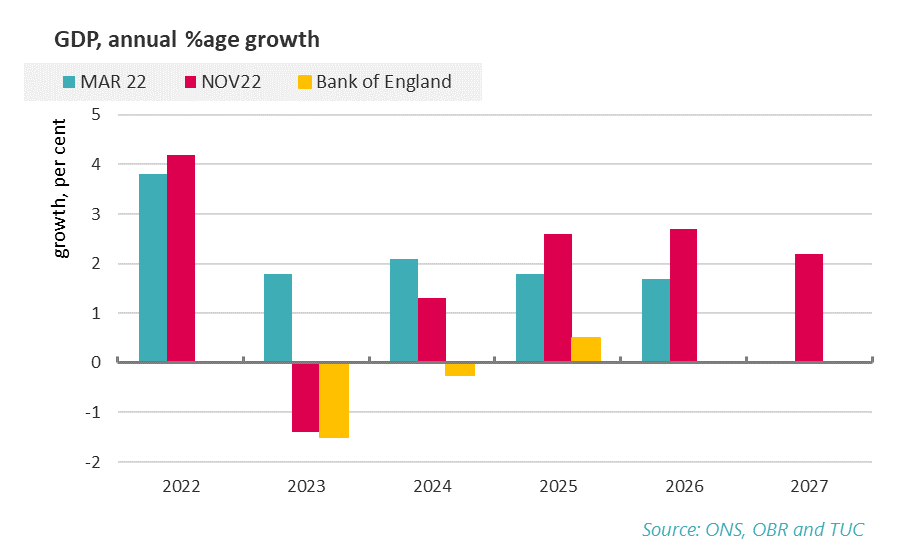
In spite of all this pain, the biggest risk is still the economy. Here the OBR have let the government off lightly. While the recession means a decline in GDP next year of 1.4 per cent, activity recovers quickly into 2024 and then continues at rates that would be exceptional given the experience since 2008. When asked at their press conference why the forecasts were so much stronger than those of the Bank of England, the OBR offered – ‘ask the Bank’.

This vigour comes in spite of much higher than anticipated central bank interest rates, virtually unchanged government support on the immediate horizon, and heavy austerity into the future (at the press conference the OBR equivocated whether it was comparable to Osborne’s).
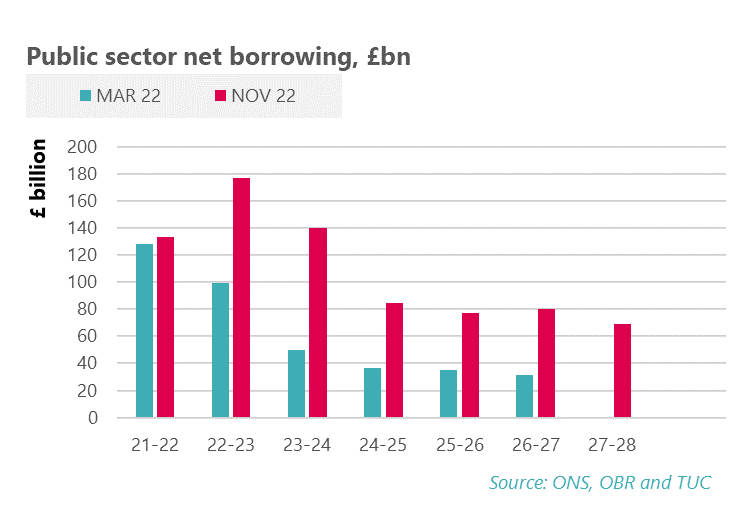
In a way we are lucky. Better projected GDP outcomes protect against the need for even tougher austerity, given the vogue for fiscal rules. Nonetheless the government have also accepted a fairly substantial increase in borrowing over coming years, with public sector debt is expected to peak at 97.6 per cent of GDP in 2025-26.

There are no game changers here, and there is very little protection against a steeper deterioration. In the meantime workers face yet another severe reduction in the standard of life. But sadly nothing here is new. Until we have a government that has a serious plan to put work before wealth, we look set to remain trapped in the doom loop of austerity politics.
We know that today’s choices weren’t inevitable. There is a better plan to grow the economy, protect our public services, and get wages rising. Now we need a government prepared to deliver it.