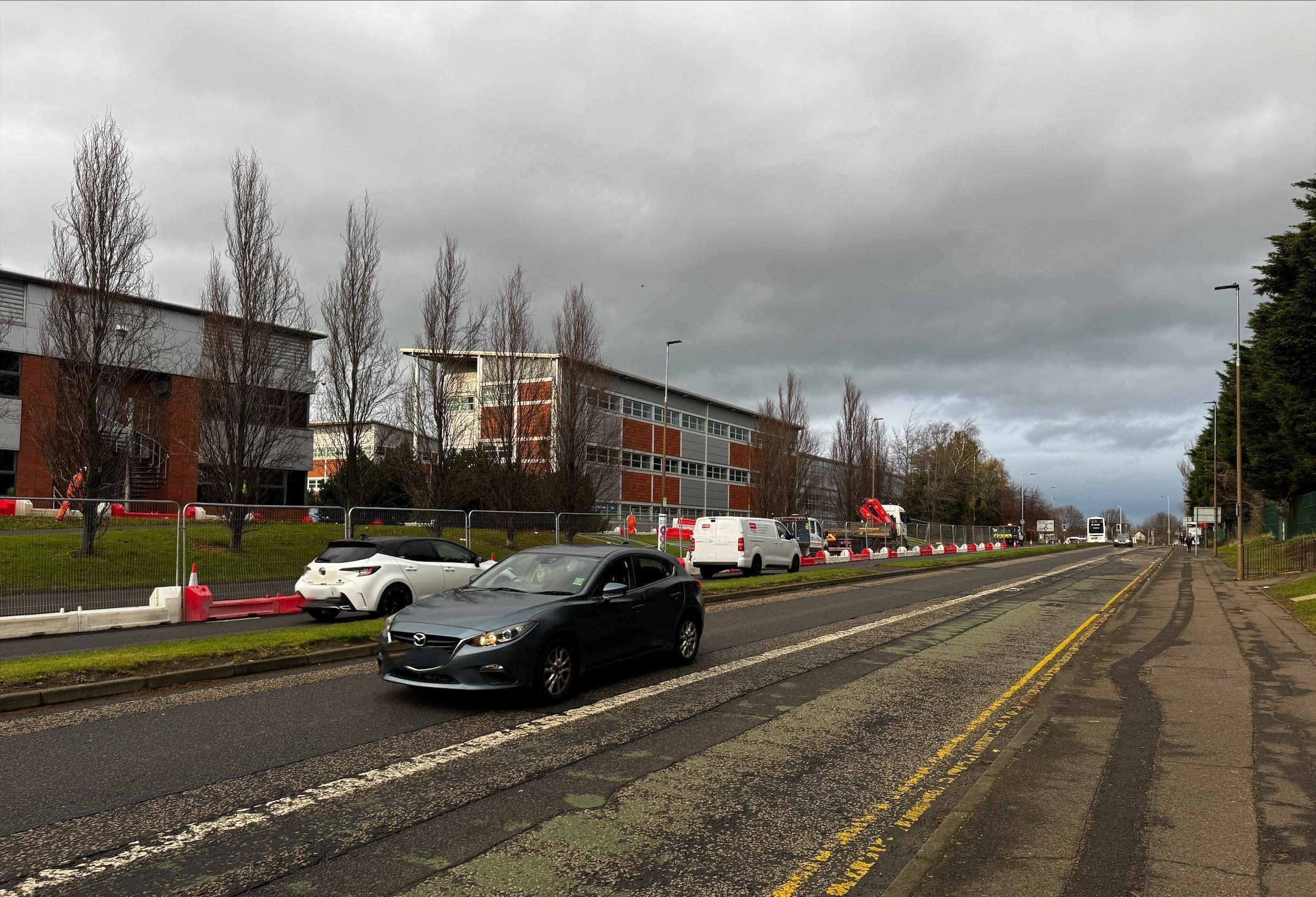
BALFOUR Beattie started work on the West Edinburgh Link this week (December 3). The West Edinburgh Link (WEL) will transform provision for cycling, walking, and accessibility around one of Scotland’s key business parks, whilst better connecting local communities to places of work, retail, leisure, and education.
WEL will also link up with key active travel routes to the city centre, including Quiet Route 8, the Union Canal and the Water of Leith Path.
Some of the work the city council is undertaking in the first phase includes new segregated cycleways on South Gyle Access and Bankhead Avenue, along with widening, surfacing, and improving lighting on the Torwood Path.
Transport and Environment Convener, Councillor Stephen Jenkinson said:“It’s brilliant to see this new work getting underway in the west of the city.
“Properly connecting our communities and encouraging our residents to travel in more sustainable and healthy ways remain key priorities for us. WEL is an important project under our ambitious City Mobility Plan as we keep Edinburgh moving.
“From revitalising active travel provision on the Torwood Path to improving access to Edinburgh College at Sighthill, alongside a host of other improvements, I’ve no doubt that local people will experience real benefits once this transformational project is complete.”
A report highlighting achievements and progress in attainment among learners for academic session 2024-25 was discussed at Education, Children and Families Committee last week (27 November).
In a positive step forward, across several measures, the report showed that the gap between the least and most disadvantaged learners is narrowing. This includes at National 5 and Higher, or equivalent, level where the performance of the least advantaged learners in the city has improved in almost all measures.
The report shows an increase in attainment during the senior phase of secondary school, with the measure relating to leaver destinations the best on record. The percentage of learners gaining five Highers has improved each year since 2022.
Reflecting an increased offering of vocational courses across secondary schools, the number of vocational qualification passes, National Progression Awards (NPA), has almost doubled in recent years – from 941 NPA passes in 2023 to 1944 in 2025.
Figures highlight pupils’ appetite for this expanded curriculum offer with the number of learners taking part in the foundation apprenticeship pilot increasing from 16 young people in 2023-24 to 200 young people this academic year.
In primary schools, the attainment gap in literacy, which includes reading, writing, listening and talking, has decreased significantly. In numeracy combined data for P1, P4 and P7 shows that the numeracy attainment gap is at the lowest level for 5 years.
Despite the positive progress, there is more to be done to close the poverty related attainment gap and the report highlights measures to do this, including ongoing focused work providing guidance and support to priority schools, supported by partnership working with the Education Scotland Attainment Adviser and Equity Lead officer.
Commenting on the report, Councillor James Dalgleish, Education, Children and Families Convenor said: “This report demonstrates positive leaps forward in attainment outcomes in our schools.
“I am particularly pleased to note the progress we’ve made in narrowing the gap between those children and young people who are most and least advantaged.
“Regardless of a child’s background, it is crucial that every child or young person in our schools is supported to reach their aspirations and ambitions.
” In our secondary schools we continue to offer an increasing number of vocational course options, which not only support young people to make informed choices about life beyond school but equip them with qualifications and a route into the world of work.
“It is disheartening to see that there are gaps in attainment for certain cohorts of our pupils and I am committed to working closely with officers to understand why this is the case and how we can work to close the poverty related attainment gap.”
Making more social rent homes available would allow households currently using unsuitable temporary accommodation, such as bed and breakfasts, to access more appropriate settled accommodation. This would return B&Bs to their intended uses of shorter-term guests.
It is expected the Fund would support three new build developments – at Fountainbridge, Meadowbank and Coatfield Lane in Leith – with around 361 social rented homes and around 111 mid-market rent homes.
The investment is subject to approval from Council at the budget meeting on 26 February 2026. If it proceeds, the performance of the delivery programme will be reported to the Housing, Homelessness and Fair Work Committee on an annual basis.
The levy applies to paid overnight accommodation booked after 1 October 2025, if the stay takes place from 24 July 2026 onwards. It is a 5% payment on the accommodation-only cost and applies to the first five nights’ stay.
The scheme is projected to raise up to £50 million a year to invest in developing, supporting and sustaining services for visitors to the city, and enhancing Edinburgh’s worldwide appeal as a place to visit and live.
Council Leader Jane Meagher said:“Many of those working in our city’s thriving visitor economy and cultural sectors are often unable to find affordable housing in the city, making it difficult for them to live close to where they work.
“In addition, the Council has declared a housing emergency, with more and more people presenting as homeless and not enough social homes available to meet this demand, and so too many residents have to use temporary accommodation, often in bed and breakfasts or hotels, taking vital capacity away from what should be tourist accommodation.
“That’s why it’s so important that this new funding is being committed towards a Housing and Tourism Mitigation Fund, which will be used alongside our existing investment programme for house building.
“This will ensure affordable homes are available for visitor economy workers in the city and means that bed and breakfast and hotel rooms can be used for their intended purpose – to welcome visitors to Edinburgh.
“This is the first fully agreed use of the Edinburgh Visitor Levy’s funds and will help deliver our objectives of developing, supporting and sustaining the quality public services and infrastructure that Scotland’s capital city must deliver for all visitors, residents and businesses.”
The money generated by the Visitor Levy scheme will be reinvested directly into initiatives that benefit residents and enhance visitor experiences.
In addition to housing, the investment streams include: city operations; destination and visitor management; culture, heritage and events; and a participatory budgeting programme, which will further allow residents and communities to have a say in how investment can be made to enhance the visitor experience in their area.
These investment streams are being developed by officers, and the Visitor Levy Advisory Forum will be consulted on all proposals. The proposals will be presented for final approval from relevant Council committees in January and February 2026.
Fiona Campbell MBE, Chief Executive, Association of Scotland’s Self-Caterers and Vice Chair of Scottish Tourism Alliance (STA) Policy Group said:“The ASSC fully supports the delivery of more affordable housing but this is not the right way to go about it.
!The levy was meant to support visitor infrastructure and services, not fund housing projects. Tourism businesses are once again being scapegoated for issues far beyond their making.
“It is deeply regrettable that Edinburgh Council now lays itself open to further avoidable legal and reputational damage. Instead of brushing aside reasonable concerns, the Council should listen to industry partners who will ultimately be the ones administering their visitor levy scheme.
“We urge the Council to halt these plans immediately until the legal risk has been properly evaluated.”
A new pilot aimed at preventing people from becoming homeless has officially been given the go-ahead in the Capital after the Council and partners were awarded funding from the Scottish Government.
The System Wide Approach to Prevention (SWAP) – ‘Ask and Act’ initiative will be piloted in Wester Hailes, providing earlier interventions and practical support to help people at risk of homelessness to remain in their homes.
The launch follows the recent passing of the Housing (Scotland) Act 2025 which places new legal duties on public bodies to ask about a person’s housing situation and take action to prevent homelessness before it happens.
Across Scotland, 15 projects are sharing £4 million through the Homelessness Prevention Pilot Fund, administered by Advice Direct Scotland on behalf of the Scottish Government, to develop and test prevention pilots.
A team will now be created in the Capital which will include public and third-sector partners. They will be trialling new models of working to provide co-ordinated and timely support for individuals and households at risk of homelessness.
The ‘Ask’ and ‘Act’ duties will be embedded in everyday services provided by partners in the Wester Hailes area.
The services working in partnership with the Council to deliver these duties are NHS Lothian, Police Scotland, Prospect Community Housing, Social Security Scotland, Scottish Prison Service and Crisis.
This approach will allow them to identify what people need help earlier, offer support directly, and request further help and support via a single point of contact within the Council’s prevention services.
Housing, Homelessness and Fair Work Convener, Tim Pogson said: “This is fantastic news, being awarded just over £600k from a £4 million fund for the whole of Scotland is a tremendous endorsement of our proposal, and I’m grateful to the team who brought it together and partners for agreeing to be part of this.
“It will also help us boost our efforts to tackle the housing emergency facing the city. It’s exciting that work is already under way, and I’m confident we’ll see positive results in the new year.
“Preventing homelessness and supporting tenants before they reach crisis point is essential to ensuring as many people as possible have a secure home.
“Last year alone, our homelessness prevention services helped 2,622 households as part of our Local Housing Strategy, the city’s overarching strategy for housing and homelessness.”
Màiri McAllan, the Housing Secretary, Scottish Government, said: “We are determined to end homelessness – and the best way to do this is to prevent homelessness in the first place.
“This investment in prevention pilots will help us test and scale up innovative approaches to help people stay in their homes.
Funding from Historic Environment Scotland and the National Lottery Heritage Fund will protect the built heritage of Granton Waterfront
Historic Environment Scotland (HES) are investing £1.34 million and the National Lottery Heritage Fund (NLHF) are investing £1.24 million from their jointly funded Heritage and Place Programme into Granton Waterfront.
With the funding, the City of Edinburgh Council will bring the area’s historic buildings and structures back to life through restoring, upgrading and connecting these facilities with the wider community. The money will also be used to support new opportunities for the community to explore and celebrate Granton’s heritage.
Each building and structure awarded the funding has its own unique story to tell about the history of Granton Waterfront, stretching from the late Victorian era to the early modern period. Together, they reflect the area’s rich industrial and cultural heritage. The funding secured will ensure that future generations will enjoy what they have to offer in the years to come.
Restoration projects
Granton Lighthouse
At Granton Lighthouse, a full refurbishment of this nineteenth century C-listed building, including major fabric repairs and accessibility enhancements, will create a new flexible, creative, learning, enterprise and community development space, operated by arts charity Out of the Blue.
Madelvic House
Madelvic House, a B-listed building from the 1890s, will also benefit. Once the headquarters for the UK’s first car factory, it will undergo roof and window restoration, interior upgrades, and accessibility improvements so it can be used by local arts and heritage organisations.
Granton Station building platforms
The magnificent Edwardian former Granton gasworks railway station building is one of the capital projects that will benefit from the funding. It has already been beautifully refurbished and is occupied by social enterprise charity WASPS.
The funding will be used to carry out upgrades to the disused platforms and introduce a heritage arts installation with green space that supports biodiversity.
Granton Castle Walled Garden
The Council is also working with the Friends of Granton Castle Walled Garden to carry out structural restoration to the boundary walls and doocot. This will build on initial works the Council has already carried out, helping to ensure its continued use as a community garden and food education hub.
Beyond physical restoration, the project places strong emphasis on community engagement and skills development.
As part of the funding secured, a dedicated Community Heritage Officer will be appointed to lead a programme of heritage activities, including open days, exhibitions, walking tours, and volunteering opportunities.
These events will be developed with local people and organisations to make sure they reflect the community’s interests, aspirations and the heritage that they care about.
Numerous community organisations are involved in the initiative, including Friends of Granton Castle Walled Garden, Wasps, Granton:Hub, and Out of the Blue Arts and Education Trust.
Their collaboration ensures that the heritage investment not only preserves the past but also empowers the present and future generations.
The work will all be completed by 2030 and as it continues interpretation boards will also be installed to support navigation, explain the significance of the place and improve visitor experience and engagement.
Sir Mark Jones, Chair of the Board at Historic Environment Scotland, said: “Heritage has always played a vital role in shaping places and communities, and it’s important that it continues to do so.
“Through our Heritage and Place Programme investment in Granton Waterfront, we’re supporting a place‑based approach that not only conserves historic buildings but reconnects them with the people who live here today.
“From local landmarks like the Lighthouse and Madelvic House, to community assets like the walled garden and industrial heritage embedded in Granton Station, each helps to tell the story of Granton’s past.
“By restoring and upgrading them, we’re ensuring they remain at the heart of its future – creating inclusive and accessible spaces for generations to come.”
City of Edinburgh Council Leader Jane Meagher said: “We’re very grateful to be awarded this funding to carefully restore the built heritage of Granton Waterfront as part of the wider £1.3bn regeneration of the area.
“A key aim of the project is to involve the local community in our plans for these listed buildings and structures as we bring them back to life for local people and visitors to use and enjoy for generations to come.
“As part of the restoration work we will deliver traditional skills training in partnership with Edinburgh College and local contractors will focus on construction and conservation skills that support career development and contribute to the long-term sustainability of the area’s heritage.
“The regeneration of Granton Waterfront is guided by a “place first” approach and we’re aiming to reconnect heritage sites and create inclusive, accessible spaces that foster wellbeing, creativity, and social cohesion.
“The project will also support activities at Granton Castle Walled Garden, enhancing local food production and education, and helping to alleviate food poverty.
“This project, along with the recent refurbishment of the gasholder and creation of Gasholder 1 Park, demonstrates our commitment to celebrate the historical legacy of the area.”
Caroline Clark, The National Lottery Heritage Fund Director for Scotland, said: “Granton is in the midst of major regeneration which will deliver exciting new opportunities for the area, creating new homes and bringing existing and new communities together.
“In that context, Granton’s heritage offers strong anchor points for community connections and our investment of £1,248,86, thanks to National Lottery players, will ensure heritage sits at the heart of Granton’s regeneration underpinning its character and values.
“Heritage connects people, cultures and communities to a place. We are investing in Granton as a place that supports community, embraces cohesive and sustainable economic regeneration, and cultural connections with a genuine pride in place.”
granton:hub responded: “We are absolutely delighted to be able to announce that granton:hub has been included in a £2.9 million investment as part of the Granton Waterfront Regeneration project
“Madelvic House which is ‘B’ listed and from the 1890s will also benefit.
“Once the headquarters for the UK’s first car factory, it will undergo roof and window restoration, interior upgrades, and accessibility improvements so it can be used by local arts and heritage organisations.
“We are thrilled to be in fantastic company alongside @grantoncastlegarden @ootbdrillhall and look forward to seeing their projects expand and develop for the local community in Granton.”
The Granton:hub AGM takes place this Saturday 29th November, from 11am – 2pm.
This is a chance to come together as a community, hear about everything we’ve been up to@over the last year, and find out what’s ahead for 2026.
Next year marks a significant step forward for the hub, as we look to renovate our historic building – preserving its heritage for future generations while making it more accessible and welcoming for everyone in the community.
‘Evidence remains insufficient to justify years of disruption‘
The Cockburn Association, Edinburgh’s oldest civic society, is dedicated to preserving and enhancing the city’s heritage, landscape, and quality of life. We welcome the opportunity to contribute to the City of Edinburgh Council’s consultation on the proposed tram extension, and we appreciate the constructive dialogue with the Future Trams Team throughout this process, as well as their commitment to public consultation.
The Cockburn Association remains committed to supporting a transport future that is sustainable, inclusive, affordable, efficient, and sensitive to Edinburgh’s unique historic environment.
As the City faces the challenges of the housing crisis and increasing congestion and works towards the laudable ambition of Net Zero by 2030, it is vital that any transport solution alleviates these pressures and complements the city’s existing asset base of spectacular heritage, civic amenities, existing transport networks and public green space.
As both a UNESCO World Heritage Site, and Scotland’s capital, Edinburgh deserves a bold vision for the future, and one which seeks to address the City’s challenges.
Though we understand that the Future Trams Team have undertaken much detailed work in preparation of this consultation, we consider that the evidence base is, as yet, insufficient to explain and justify why an investment of such magnitude, and the inevitable years of disruption to resident and commercial communities is the best option for the City.
Given the far-reaching and multigenerational impact of this development, we have sought the views of our members on the proposed tram extension. Of those who responded, respondents supported the general principle of extending Edinburgh’s transport network; however, concerns were expressed about the execution and governance of tram projects to date, with particular reference to the multiyear disruption on Leith Walk.
Any transport extension must be developed in close alignment with the City Mobility Plan, City Plan 2030, the Active Travel Action Plan, the 2030 Climate Strategy and the Local Place Plans. Together, these frameworks set out a shared vision for a sustainable, inclusive, and people-centred city, which capitalises on its historic and natural assets, and preserves and enhances them for future generations.
At this strategic stage, detailed design information, including street-level treatments, traffic management, pedestrian and cycling provision, and heritage impact assessments have yet to emerge. We therefore reserve detailed comment until these plans are available. Nonetheless, we emphasise that heritage, landscape quality, and local character must remain central to the design process.
We are aware of concerns about the capacity of South Bridge to carry modern trams and the need for independent assurance of its ability to accommodate such loads without risk to this Category A-listed structure within the World Heritage Site.
These issues reinforce the importance of thorough engineering and heritage assessments before finalising any proposed routes.
The Cockburn Association is committed to engaging constructively as the proposals develop. We offer our expertise in heritage, planning, and civic matters to help shape a transport system that enhances Edinburgh’s sustainability, accessibility, and distinctive sense of place.
We look forward to contributing to future stages of consultation and to continuing to advocate for a transport network that supports residents and local businesses while respecting the historic fabric of our city.
The Cockburn Association thanks the City of Edinburgh Council and the Future Trams Team for the opportunity to participate in this important consultation and welcomes further dialogue to ensure that future proposals deliver lasting benefits for Edinburgh’s people, heritage, and urban environment.
Want to know more?
Readers interested in exploring the Cockburn Association’s long-standing engagement with Edinburgh’s transport landscape in greater depth are encouraged to purchase our 150th Anniversary publication, Campaigning for Edinburgh.
This richly illustrated volume traces the Association’s historic role in shaping the city’s civic and infrastructural development, including its sustained involvement in debates around city-wide transport and urban mobility.
Edinburgh’s iconic Christmas tree on the Mound was officially lit on Tuesday (18 November) in a special ceremony led by Lord Provost Robert Aldridge.
He was joined by representatives from Edinburgh Candlemakers, County Mayor of Vestland Jon Askeland, the Norwegian Embassy and the Norwegian Honorary Consulate General, marking the start of the city’s festive celebrations.
The event saw Lord Provost Robert Aldridge and County Mayor Jon Askeland come together to switch on the lights of the stunning 18-metre-tall tree. This cherished annual tradition celebrates the strong ties between Scotland and Norway, honouring the Scottish people’s unwavering support for Norway during World War II.
Gifted by Vestland (formerly Hordaland), the tree stands as a symbol of Norway’s gratitude for Scotland’s assistance during its darkest days.
The tradition of gifting the tree began in 1986, and although it has been sourced from Scotland since 2008, it remains a meaningful token of friendship and solidarity between the two nations.
Edinburgh’s Christmas officially opened on Saturday 15 November, and following last night’s Mound light night a number of community light switch on events will be taking place across the city.
The wet weather couldn’t dampen festive spirits last night as the Mound Christmas tree lights were officially switched on!
Lord Provost Robert Aldridge said: “The Christmas tree on the Mound is a cherished Edinburgh tradition, marking the start of the festive season and symbolising the enduring friendship between Scotland and Norway.
“The annual gift from Vestland is a heartfelt reminder of the solidarity shared since World War II, reflecting the universal values of friendship, compassion and unity. Sincere thanks to the people of Vestland for their continued generosity, as well as to our partners Field and Lawn for their support and Bernard Hunter for their kind donation of crane services.
“As Edinburgh’s Christmas celebrations begin, the tree’s sparkling lights bring a festive glow to the city centre. With more community switch-on events planned across the city, residents and visitors are invited to share the joy, hope and goodwill that define this special time of year.”
County Mayor of Vestland, Norway Jon Askeland said: “Every year since 1986, Vestland County has gifted a Christmas tree to Edinburgh Christmas Market as a token of our close friendship.
“It is also seen as a gratitude for the support Scotland gave Norway during the Second World War when Scotland became a safe haven for Norwegian forces, sailors and civilians during the years of occupation.
“This Christmas tree remind us of what we share: resilience, generosity, and a love for community. It stands as a beacon of light and hope – values that unite us in challenging times and joyful ones alike.”
The city council has been awarded the David Kennedy Excellent People Award at the annual COSLA Awards.
This special award recognises the exceptional people who are at the heart of local government excellence. As a finalist nominated in one of the five overall categories, the Council were selected for their outstanding impact while rising to the challenges of day-to-day service delivery.
🌟 Well done to @Edinburgh_CC, winners of the David J. Kennedy Excellent People Award!
The Council’s Construction Skills pathways project was recognised for its work in building brighter futures for young people.
The project is focused on improving outcomes for learners by getting more school leavers into jobs within the construction industry. Not only does this improve attainment through relevant and engaging courses but responds to labour market needs.
The Construction Skills work is raising the attainment of Edinburgh school leavers, with the national benchmarks for school attainment improving across most measures. The number of National Progression Awards achieved by City of Edinburgh School Leavers has increased from 900 in 2023 to 1944 in 2025.
This is achieved through partnership working with Edinburgh College who have expanded their construction courses into school-based sites across Edinburgh, with delivery supported by Kier Construction and Balfour Beatty.
Courses focus on traditional skills, including a National 5 qualification in stonemasonry, matched to local skills shortages. Supported by funding from community benefits and in partnership with Historic Environment Scotland and Scottish Traditional Building Forum, these organisations work alongside teachers to deliver the course. In addition, a partnership with local firm, Compass Roofing, supports delivery of a National 5 roofing qualification.
Councillor James Dalgleish, Education, Children and Families Convener said: “This award is a fantastic acknowledgement of the innovative and proactive approach we as a Council are taking to improve outcomes for young people in Edinburgh.
“We want to narrow the gap between the most and least disadvantaged learners in Edinburgh, and our construction pathways work is one of the ways we are doing this.
“The attainment outcomes speak for themselves, with over double the number of National Progression Awards achieved by Edinburgh young people since 2023.
“This work is helping even more learners to see the relevance of their learning in relation to real-world career opportunities and supporting them to map out their journey beyond school.”
Edinburgh’s Housing, Homelessness and Fair Work Convener Councillor Tim Pogson writes about homelessness services
As I embark on a new role as Edinburgh’s Housing, Homelessness and Fair Work Convener, I’m all too aware of the severe pressures facing the city.
We’re now two years on from declaring a housing emergency in the Capital and demand for safe, comfortable homes is as high as ever. Edinburgh has the lowest amount of social housing per head of population in Scotland with only 14% social housing compared to a national average of 23%.
Here, 80,000 residents live in relative poverty, including one in five children. There are around 6000 homeless households in Edinburgh being supported in temporary accommodation – approximately 11,500 individuals.
These figures are stark, and as we enter colder winter months the necessity to provide warm, accessible accommodation is particularly urgent. Preventing people from becoming homeless in the first place and helping tenants to avoid reaching crisis point is the best way to make sure as many people as possible have somewhere to call home.
I’ve been really impressed by the range of preventative work already being carried out by Council officers, the third sector and other partners to assist households on the verge of homelessness.
Last year, through homelessness prevention services we helped prevent homelessness for 2,622 households under the umbrella of the Rapid Rehousing Transition Plan, the city’s comprehensive strategy to tackle and eradicate homelessness. The team works tirelessly to intervene early, supporting people to access settled accommodation as quickly as possible, to reduce the number of people sleeping rough and to create better outcomes for tenants.
Our Housing Emergency Action Plan (HEAP) sets out clear actions to reduce the number of households without settled accommodation and to ease the strain on those most affected by the crisis.
I’m pleased to say we’re making progress in meeting our targets and our continued work to increase affordable housing supply and provide vital support to those at risk of homelessness is beginning to make a real difference.
However, we know this challenge cannot be solved by one organisation alone. A city-wide response is essential. I call on partners across the city from housing associations and charities to community groups, businesses and public services to join us in this collective effort.
Grant funding is critical in the delivery of affordable homes. Whilst we welcome the additional monies that Edinburgh has received over the last few years from the Scottish Government, more is required to truly address the housing emergency. I will not hesitate in advocating to the Scottish Government for Edinburgh to receive both its fair share of affordable housing funding and the investment necessary to tackle its pressing housing needs.
Long term plans like our ambitious housebuilding programme, efforts to acquire new homes directly from providers and bringing empty homes back into use aim to increase our quality housing stock, minimising the need for temporary accommodation.
These kinds of developments give me real encouragement that, while the housing strain can seem bleak, we’re doing everything we can to find solutions and provide residents with the quality of life they deserve. I’m ready for that challenge and look forward to working closely with colleagues and partners across the city to take it on.
This article first appeared in Edinburgh Evening News