More than one million claimant families receiving tax credits, and no other means-tested benefits, will get their second Cost of Living Payment from Wednesday 23 November 2022, HM Revenue and Customs (HMRC) has confirmed.
This £324 UK Government payment will be paid automatically into most eligible tax credit-only customers’ bank accounts between 23 and 30 November 2022 across the United Kingdom.
Angela MacDonald, HMRC’s Deputy Chief Executive and Second Permanent Secretary, said:
“This second Cost of Living Payment will provide further financial support to eligible tax credit-only claimants across the UK.
“The £324 will be paid automatically into bank accounts, so people don’t need to do anything to receive this extra help.”
The second payment will see more than 8 million households across the UK receive their £324 cost of living cash boost by 30 November and follows the first cost of living payments of £326, which eligible families received from Department for Work and Pensions (DWP) from July and HMRC from September.
The UK Government recently announced that households receiving DWP benefits will get their second Cost of Living Payment from 8 November continuing through to 23 November. This includes tax credit claimants who also receive other income-related benefits from DWP.
HMRC is making payments shortly after DWP in order to avoid duplicate payments.
This latest payment comes on top of wider UK Government support with the cost of living this autumn and winter, including:
· the £150 Disability Cost of Living Payment, already paid to around 6 million disabled people
more than 8 million pensioner households who will receive an extra one-off £300 Winter Fuel Payment this year
This is in addition to an extension to the Household Support Fund, which is providing an extra £421 million for use between October 2022 and March 2023 to help vulnerable people with the essentials. A £150 Council Tax rebate was sent earlier this year to those in Council Tax bands A to D in England, creating at least £1,200 in direct support for millions of households.
A £400 reduction on energy bills is also being given to all domestic electricity customers over the coming months, and the Energy Price Guarantee is protecting households from significant rises in their energy bills this winter.
The UK Government is offering help for households. Customers should check GOV.UK to find out what cost of living support they could be eligible for.
Additional Information:
Cost of living payments were announced in May 2022. Details of the first DWP and HMRC payments were publicised in June,JulyandAugust2022. In October 2022 the DWP announced details of their second payment.
The latest payment schedule information, which will be updated on 20 October to show that the second HMRC payments will be made between 23 and 30 November, is available here.
Tax credit-only customers, who will receive the second payment between 23 and 30 November 2022, must have received a payment or an annual award of at least £26 of tax credits for any day in the period 26 August 2022 to 25 September 2022, or later found to be entitled to tax credits for this period.
For joint claimants, where one claimant receives Working Tax Credit and the other claimant receives Child Tax Credit, payments will be made into the same bank account as the Child Tax Credit.
To be eligible for the second DWP payment, families must have been entitled to a payment (or later found to be entitled to a payment) of either:
Universal Credit for an assessment period that ended in the period 26 August 2022 to 25 September 2022
income-based JSA, income-related ESA, Income Support or Pension Credit for any day in the period 26 August 2022 to 25 September 2022
Customers do not need to apply for this payment. If customers are eligible through receiving tax credits only, HMRC will make the Cost of Living Payment automatically into the bank account where claimants already receive their tax credits. Customers might find that their payment is delayed if they have recently closed the bank account their tax credits are usually paid into.
If customers have not let HMRC know that their bank account has changed, HMRC will pay the money into their old bank account, meaning the payment will be rejected. If this happens, HMRC will follow this up by letter to the customer, letting them know that we need updated bank details.
If tax credit customers believe they are eligible but have not received a payment between the published payment dates, they should wait until 7 December at the earliest to contact HMRC. This is to allow time for their bank, building society or credit union to process the payment. We won’t be able to provide customers with any further information before this date.
More than 8 million families on means-tested benefits will receive up to £650 this year, made in two payments. This includes all families entitled to a payment of the following benefits: Universal Credit, Income-based Jobseekers Allowance, Income-related Employment and Support Allowance, Income Support, Working Tax Credit, Child Tax Credit and Pension Credit.
This payment is tax-free, will not count towards the benefit cap, and will not have any impact on existing benefit awards.
These payments are being delivered in two slightly different amounts of £326 and £324. The distinct value relates to a specific qualifying period, so it is simpler to determine if a payee received the correct payments, reducing the fraud risk of people who claim not to have had one of the specific two payments, as HMRC and DWP will be able to clearly track those who have.
Beware of scams targeting cost of living payments. If someone contacts you about cost of living payments saying they are from HMRC, it might be a scam.
You don’t need to apply for this payment. HMRC will never ask for your bank details by SMS or email. Don’t let yourself be rushed. Check advice on spotting scams by visiting GOV.UK and searching ‘phishing and scams’. You can find phone numbers, and other ways to contact us, on GOV.UK – search ‘Contact HMRC’ and choose ‘tax credits’.
The Centre, Livingston is appealing for little ones to join them in its first-ever Elf Toddle Walk on Sunday, 6th November at 9am to take part in a one-mile walk around the mall and raise funds for Children’s Hospices Across Scotland, CHAS, which provides the country’s only hospice services for children and young people with life-shortening conditions.
Little ones and their adults are being encouraged to dress up in their favourite festive attire and join a team of Santa’s elves on a one-mile lap of the shopping centre, which has easy access for buggies.
Go Radio Breakfast Show Presenter Crofty will be there on the day alongside Go Radio Dance’s Zoe Kelly playing all the big Christmas tunes and taking part in the countdown warm-up to help get the little ones off to a great start.
Along the way children will encounter some special Christmas surprises and treats and on completion will be awarded with a commemorative medal for taking part at the ‘Selfie Elfie’ zone.
Once registered, a personal walk number and elf hat can be collected from the Customer Service Desk at The Centre, Livingston between the 31st October and 5th November, with proof of ticket, to enable participants to take part on the day.
Parents can either pick up sponsor forms in advance at the Customer Service Desk, download them from the website, www.thecentrelivingston.com or bring their own. All sponsored donations will go to charity. Full details are on the website
Hayley Smith, Community Fundraiser at CHAS, said: “We are so incredibly grateful to The Centre, Livingston for choosing to support CHAS through their Elf Toddle Walk.
“The funds raised will not only help us to provide care for children but also to help families make wonderful memories together.”
Ashley Bisland, Deputy Centre Director at The Centre, Livingston, said: “We’re really excited to be partnering with the charity CHAS to host our first-ever Elf Toddle Walk around the mall to help raise money for such a great cause.
“It’s a brilliant way to show kids that you can have fun getting a little bit of exercise in whilst helping other people at the same time.”
The nation’s leading nursery group, Busy Bees, started the month with a buzz as Scotland’s first graduation ceremony for early years practitioners was held at Edinburgh’s Assembly Rooms.
On Saturday 1October the qualification provider, Busy Bees Education and Training, invited 37 practitioners from across Scotland to don their gowns in celebration of achieving their Social Services Children and Young People SVQ 3 and SVQ 4 qualifications.
The ceremony comprised presentations of the graduates in front of their families and loved ones, as well as addresses from Yvonne Smillie, Busy Bees Scotland Managing Director; Cheryl Creaser, Group COO and Marg Randles, Busy Bees Co-Founder.
For some, the occasion was extra special, signifying the first member of their family to have achieved a higher qualification. Among those celebrating was a mother and daughter team from Dunfermline Castle View, Andrina June and Andrina Becky Francis, 58 and 21 respectively, who supported each other throughout their journeys to achieve their SVQ3.
Caroline Black, Childcare Assessor and Trainer at Busy Bees Education and Training Academy,said: “Andrina June was an amazing practitioner and her rapport with the children, staff and parents shone through. During the training programme she gained more confidence in her abilities and technology skills.
“Her daughter, Andrina Becky, was a committed learner from day one, she always used her initiative and was a super role model for other colleagues”, Caroline added.
Many graduates also conquered personal battles while studying for their qualification, with others continuing to provide the highest early years education and care for the children of key workers during the pandemic.
One graduate, 19-year-old Ailey from Edinburgh’s Newhaven centre, felt she didn’t have the confidence to undertake her SVQ3, saying “I didn’t do well at school; I was rubbish at everything!”
Ailey thought there was no chance she could complete a qualification, however, Caroline Black, saw great potential in her. She said: “Ailey was doing so well practically in the nursery, and had super knowledge of the specific needs of the children in her care.
“You wouldn’t believe her transformation! Going from a young girl who needed a boost in confidence to believing she is really good at what she does. She has gained much more experience in a variety of different areas, is now Room Manager of the Baby Room and has now started her SVQ4.”
In July 2022, Busy Bees was named one of the top 100 apprenticeship employers in the UK and since 2001 has offered additional support for those who want to earn early years qualifications. The apprenticeships help their teams across the country reach new heights and give children the best start in life.
Speaking at the event, Marg Randles, who co-founded Busy Bees nurseries nearly 40 years ago, said: “It is fantastic to recognise the achievements of all our graduates, especially in such challenging circumstances over the last two years. For many, this is their first formal qualification, and it means a lot to be able to support them on their learning journey.
“There is something special about seeing early years education as a profession with the opportunity to progress and develop. Many of us within the Busy Bees’ leadership team have followed that journey, and I’d urge anyone with a genuine passion for children to consider it as a profession.”
The graduation event celebrated 37 learners from Busy Bees’ 20 centres across Scotland, including 21 colleagues who achieved SVQ3 qualifications in Social Services (Children and Young People) SCQF Level 7.
A further 16 completed a Leadership qualification at SVQ4 (SCQF Level 9), many of whom have progressed through various roles within the nurseries to take on leadership positions, including becoming Centre Directors.
Busy Bees is currently recruiting for 30 positions for qualified educators and has openings for school and college leavers through its apprenticeship scheme who want to join and learn on the job.
To find out more about opportunities at Busy Bees in Scotland, please visit:
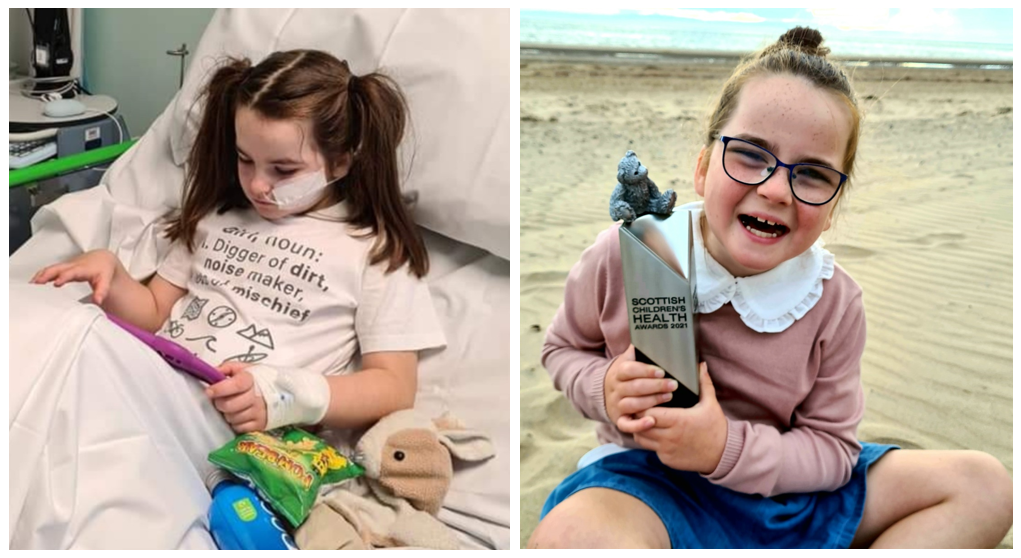
The mother of a patient at the Royal Hospital for Children in Glasgow has praised the incredible impact the Play Team have had on her daughter.
Since birth, Emily Donn displayed issues with feeding and has been in and out of hospital for appointments with gastroenterology and urology consultants, surgeons and specialist nurse teams for bowel and bladder.
Emily’s symptoms have resulted in several hospital stays, tests, scans, theatre visits, procedures and treatments over the years, which have led to high levels of anxiety and stress at times.
However, while it’s been a lot to take on physically and emotionally, the RHC’s Play Team have played a key role in helping Emily, who is now eight, to learn more about complex medical procedures while helping to ease her concerns and comfort her.
Emily’s mum Julie said: “Emily first met the play team when she was four and interactions with them have been the key to the success of most of the things that Emily has been able to achieve. When she first came to the hospital she was very nervous about what the experience would be like and was a bit scared of what would happen.
“The Play Team have seen her through so many procedures. We use them both before appointments for preparation and after to allow her a pressure-free space to relax. I’m also so grateful for the support they have given myself.
“They talk me through different ways I can help Emily and help me to think outside the box when things are tough. They are also so incredibly easy to talk to and can make the most difficult days better just by listening and chatting. Sometimes I need the support as much as Emily and they are always there to help.
“They have also worked with Emily’s sister on occasions when she has been at the hospital with her to ensure she doesn’t feel left out and that she understands what is happening with Emily as well.”
When people hear the term ‘Play Team’ they may think of a service that gives children the chance to have fun while they spend time in hospital. And while the team build great relationships and encourage learning through play, they do so much more.
Over the years, Emily, who is from Lochwinnoch, Renfrewshire, has worked closely with the Play Team, but has a particular bond with Teri Wright, who is one of the Health Play Specialists at the RHC.
Whether it’s listening to her concerns, playing games or explaining procedures in an interactive way at the site’s Teddy Hospital, which is the only one of its kind in Scotland, Teri has always been able to find a connection with Emily.
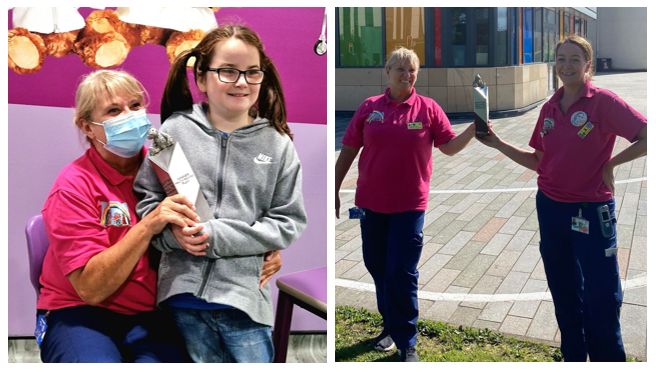
Last month, Teri and her colleague Wendy McKechnie, who is a Play Assistant, were recognised by the Children’s Health Scotland Awards for their amazing work, with Teri finding out after the event that Emily nominated her.
Julie added: “Teri has helped Emily through some of the most challenging times, she can tell if she is having an off day and is really attentive to her interests and knows how to get her engaging.
“The impact was so clear during COVID-19 – I think that time really highlighted the importance of the team. You could really see Teri’s smile behind the mask which was so important in keeping Emily positive and interested. Despite the masks Teri’s friendly face was still shining through keeping fun and familiarity as the focus at an otherwise really uncertain time.
“Teri also nominated Emily for a young achievers award at the same awards last year, so when she found out she could put Teri forward she was desperate to do it. We can’t thank Teri and the team enough for what they have done and continue to do for us.”
From October 10 until October 14, Play Teams across the country are celebrated as part of National Play In Hospital Week for the work they do with children like Emily and the positive impact they have on their mental health wellbeing and recovery.
Teri said: “It was excellent to hear that we had been nominated by Emily. I have worked with her for a long, long time and she has had a very hard time of it. She is still attending here and we have such a great relationship.
“I nominated her for the young achievers previously because she had gone through so much and still continued to get on with things as best she possibly could. It affects the whole family when a child is unwell, it impacts on everything, their mental health, their schooling, their social life.
“In this job, for me, when you can see a child engage with our approach and you see the fear and anxiety is removed, that’s the most rewarding thing. When a parent comes up and thanks you or a patient comes back and recognises you years on for the work you’d done for their family, that’s when you know you’re helping to make a difference.
“I’m not a nurse, but I am there to support the children and their families at what can be a hugely stressful time. I think they see us as a friend. What we do is all play based, at the Teddy Hospital we explain what will happen through role play, with a teddy or doll, and we take them on visits to meet the staff and learn about procedures we do as many sessions as needed to help with their nerves and anxiety.”
Mandy Meechan, Interim Chief Nurse for NHS Greater Glasgow and Clyde, said: “We are all so proud of Teri, Wendy and our entire Play Team at the Royal Hospital for Children who do such an amazing job to support the children in our care and their families.
“You can see how strong a connection they have with the patients they work with on a daily basis. The role of play in helping children understand procedures and treatment, which helps to ease worries and anxieties they may have, cannot be understated. Congratulations on your much deserved recent award.”
The work of the RHC’s Play Team, and the site’s Teddy Hospital also receives support from the Glasgow Children’s Hospital Charity, who have witnessed the impact of play on patients and their families.
Kirsten Watson, the charity’s CEO, said: “We have proudly supported the hospital’s play programme for more than 20 years, and believe it to be an indispensable part of a child’s hospital journey.
“Last year we invested more than £519,000 in play services, funding play staff, specialist equipment and fun events to relieve anxiety, support mental health and give children a positive experience in hospital.
“We are incredibly grateful to our donors and fundraisers for raising the vital funds that enable us to provide a structured play programme, which aims to give every child in hospital the chance to play.”
Homebuilder donates high-vis vests to school children
It’s Walk to School month, and leading homebuilder, Miller Homes, is helping children in Edinburgh travel to and from school safely by donating high-vis vests to children local to its West Craigs Manor development, as part of its Home Safe initiative.
After a successful two years in Scotland, Miller Homes has expanded its Home Safe campaign for a third year, this time across the entire UK. Children’s high-vis vests will be available to collect from the marketing suite at Miller Homes’ development on Craigs Road.
As the morning and afternoon walks get a little darker, it’s hoped the bright yellow bibs will ensure local children are visible to drivers whether they are walking, cycling or scootering to school.
According to the most recent Government reports, the national average for children who walk to school is 46%. This is likely to increase in 2022, as families look to be healthier and more energy efficient.
Lynsey Brown Regional Sales Director for Miller Homes Scotland East said: “Getting to and from school safely is such an important part of a child’s routine, and being active while doing it is great for both their mental and physical wellbeing.
“Our Home Safe initiative is designed to help kids to be as safe as possible on those journeys, educating them on the importance of being visible to road users, especially as the days get darker, which will encourage good safety habits for years to come.”
Suitable for all primary school children, the high-vis vests will be available on a first come first served basis and can be collected from the marketing suite at West Craigs Manor from Thursday to Monday, 10:30-5:30pm.
For more information on Miller Homes and the Home Safe initiative, visit the website:
This October Half-Term Break, McLarens on the Corner in Morningside is introducing a limited offer to celebrate grandparents with a “Grans Eat Free” deal throughout the October holidays.
The family-friendly restaurant that believes in serving up sumptuous food, delicious cocktails, and a whole lot of love has created the offer as a thank you to the grandparents that will be home with the kids while they’re off from school.
Grandparents are beloved for spoiling their grandchildren with love, affection, and all the treats mum usually doesn’t allow. It’s time that they get spoiled in return! Signature Group has decided to turn the tables, and instead of having kids eat free this half-term holiday, we’re giving the free meal to Gran.
The deal was created to acknowledge the unsung heroes at the heads of our families that rarely get a day devoted to treating them with the same care that they exhibit each day.
Including anything from a bacon cheeseburger for lunch to blackened salmon for dinner, grandparents can choose the entrée that suits their appetite for no charge for two weeks in October. Now, the kids can start pooling together their pocket money and get ready to pick up the bill for their meal, because this meal is on them.
The limited offer will be available on weekdays between 10th and 21st October. One grandparent can receive a free main course per visit when they dine with their grandkids. Kids must also order a main dish from the children’s menu or main a la carte menu. Free main excludes steak.