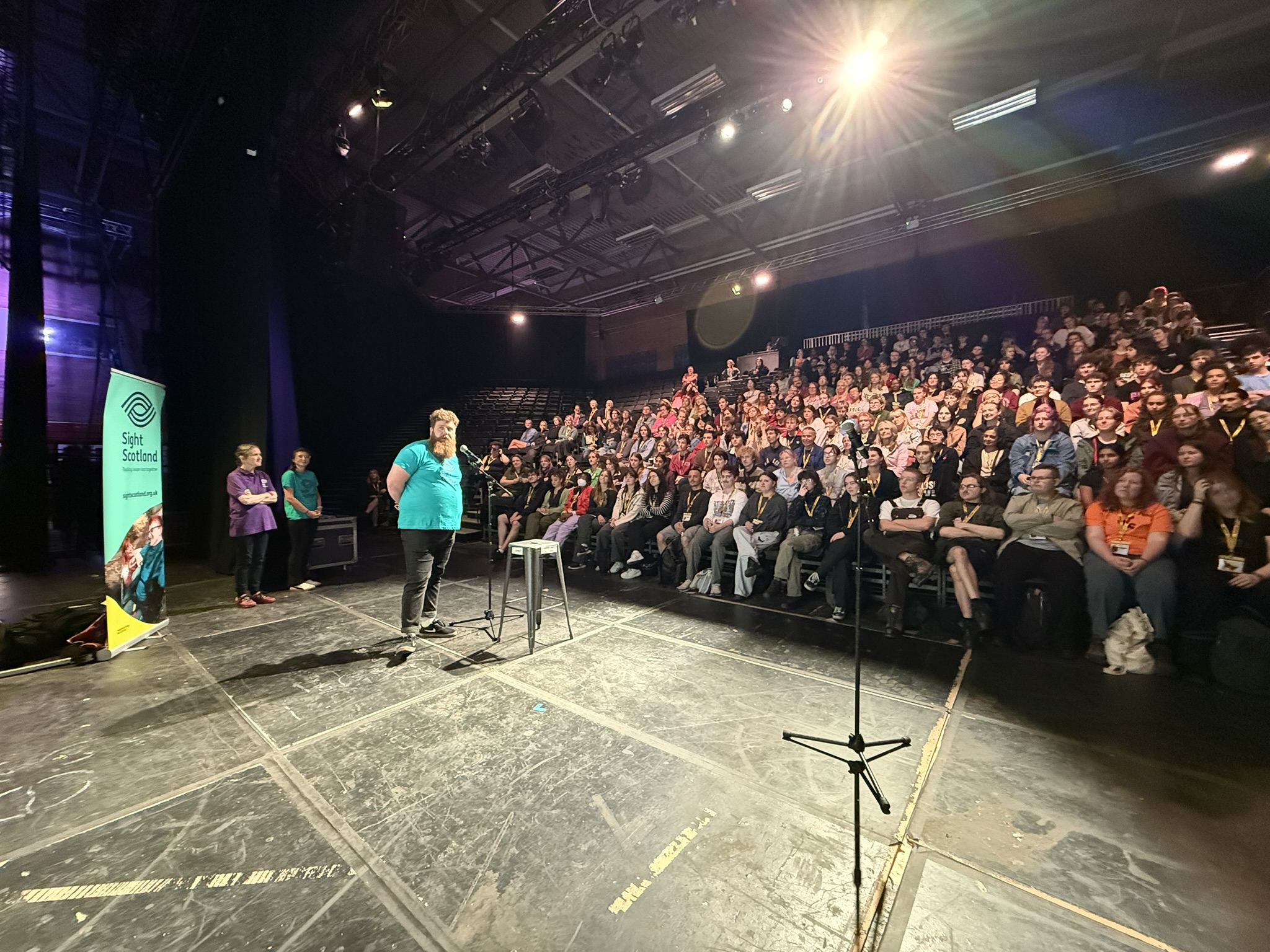
Visually impaired secret shoppers are going undercover at Edinburgh Festival Fringe venues to put accessibility to the test, assessing whether training and awareness work are translating into a better experience for disabled audiences.
The volunteers, who have helped deliver accessibility training to Fringe staff and performers over the past two years, have been carrying out unannounced visits across the city to identify what’s working, highlight barriers, and help drive further improvements.
The secret shoppers, who are members of Sight Loss Councils Scotland and Sight Scotland’s Policy Group, have welcomed the progress made so far, highlighting accessibility training and stronger collaboration with venues as key drivers of change. However, they emphasise that accessibility must remain a year-round priority, with all venues continuing to build on recent improvements to ensure they are welcoming, inclusive and accessible to everyone.
Over the past two years, Callum Lancashire, Engagement Manager for Sight Loss Councils Scotland, who has macular degeneration, has helped deliver accessibility training to venues at the Fringe and at Glasgow’s Celtic Connections festival, helping staff develop the skills and awareness needed to better support visitors with visual impairments.
He explains: “We have seen first-hand how accessibility is improving, particularly when venues are willing to listen, learn and take practical steps to make a difference.
“Over the past two years, we have worked alongside our rehabilitation colleagues at Sight Scotland to deliver accessibility training for venues across the Edinburgh Festival Fringe, including the Pleasance, and it has made a big difference.
“What is really encouraging is that we don’t just deliver the training and walk away. Afterwards, our volunteers go back as secret shoppers, visit the venue, attend shows and experience the customer journey for themselves. That gives us a unique insight into whether the training is making a difference, and in many cases the impact has been huge.
“Many of the changes we’re talking about are simple to implement. Often, it’s just about raising awareness and helping people understand the small adjustments that can make a big difference. It’s about making staff aware of visual impairment, helping them understand the barriers people can face, and giving them the confidence to offer assistance when needed. Those aren’t major changes for a venue to make, but they can make a huge difference to somebody’s experience.
“Something as simple as clearly introducing yourself, offering sighted guidance, explaining the layout of a space, or proactively asking if someone needs help can completely transform a visit. It helps people feel welcome, included and able to enjoy the festival independently.
“We have now worked with venues across the Edinburgh Festival Fringe, supported organisations involved in Celtic Connections, and have a number of new partnerships in the pipeline.
“We know this approach works because we’ve seen the impact first-hand. More and more venues from across Scotland are reaching out to us to take part in our accessibility training and events, which is hugely encouraging.
“Accessibility is improving, but there is still more to be done. Every venue has a responsibility to make it a priority. A person with a visual impairment should be able to enjoy a show just as much as anyone else.”
Colette Walker, Co-Chair of Sight Scotland’s Policy Group and a guide dog user, adds: “This training is a gamechanger.
“By equipping frontline teams with the awareness, empathy and practical understanding they need, we empower venues to go far beyond basic compliance, to truly see people, anticipate barriers, and offer support that feels natural, respectful and empowering.
“For me and thousands of others with visual impairments, that means being able to walk into a festival venue with my guide dog, navigate with confidence, and enjoy every moment just like anyone else.
“It’s not just about ramps or wide doors, its clear information, thoughtful signage, straightforward ticketing, and staff who know exactly how and when to step in and use clear communication. These are often small, simple changes, yet they make a life changing difference: the freedom to choose, to attend independently, to belong.
“This builds powerfully on the findings from Sight Scotland’s Accessible Venues Report proving that when we listen, act, and design for everyone, we all win.”
Sight Scotland and Sight Scotland Veterans have also been working with Extant, the UK’s leading professional performing arts company of blind and visually impaired artists, to promote and celebrate visually impaired talent while advancing accessibility across the festival.
We are concerned by the nature of the media attention focused on the election of Dr Q Manivannan to the Scottish Parliament at the recent election. Rather than celebrating the improvement in representation of Scotland’s diverse population Dr Manivannan’s election represents, our public sphere has been fixated on debating their right to be an MSP.
Less than eighteen months ago, the Scottish Parliament unanimously passed, with every party voting in favour, the Scottish Elections (Representation and Reform) Act. This gave the right to stand for election to anyone with leave to remain in Scotland, whether temporary or permanent. It is therefore clear that Dr Manivannan had a legal right to seek and win election.
That law built on earlier efforts to make the Scottish electoral system more democratic and inclusive.
The Elections (Franchise and Representation) Act 2020 expanded voting rights for the Scottish Parliament and Scottish local authorities to most people legally living in Scotland, regardless of their citizenship status. This was a recognition of the contributions that everybody living, working, raising families and studying in Scotland make to our communities and economy. It was an affirmation of the principle that Scotland is governed by and for everyone who lives here.
Dr Manivannan’s success in being elected is one of the intended results of this widely supported legislation. The people who choose to make their homes here should be included, supported and electorally represented.
It is a sad sign of the times, and the state of our public discourse, that what should have been a proud moment for Scottish democracy has been marred by partisan spin, attacks on Dr Manivannan’s identity both as an immigrant and non-binary person, and media failures to confront disinformation.
This treatment of Dr Manivannan risks further cementing barriers to public office for women, disabled people, LGBTQIA+ people and people from minority ethnic backgrounds.
Research on experiences of seeking elected office in Scotland suggests that harassment on social media and hostile media coverage is a significant factor in discouraging potential candidates from underrepresented groups.
This needs to change – especially in light of the decline in women’s representation in the current parliament.
We welcome the election of Dr Manivannan as an example of what we hope will be a more open and inclusive democracy that welcomes immigrants as both voters and representatives. We hope that the new parliament will represent all of the people of Scotland, promote tolerance and respect in the chamber, and work to uphold the rights and dignity of all.
Organisations supporting the statement include:The Young Women’s Movement, Scottish Trans, Equality Network, LGBT Youth Scotland, Inclusion Scotland, CRER (Coalition for Racial Equality and Rights), Equal Representation Coalition, LGBT Health and Wellbeing, CEMVO Scotland, ElectHER and Engender
Rural communities continue to face barriers that limit access to essential services, including healthcare, childcare, specialist support, legal advice and public transport, according to a new report from Holyrood’s Equalities, Human Rights and Civil Justice Committee.
A shortage of affordable housing and adequate infrastructure, combined with a higher than average cost of living, were also found to pose significant challenges to the sustainability of rural communities.
The Committee’s report calls for targeted action to be taken to ensure that these communities are able to fully access their rights. The Committee want to see the Scottish Government recognise the distinct needs of different rural areas, consider rural populations throughout all stages of policymaking, and factor the findings of the report into a future Scottish Human Rights Bill.
While the Scottish Government acknowledged the issues raised during the Committee’s inquiry and highlighted the work it is doing, the Committee’s report says that this has yet to translate into sufficient improvements in the lives of people living in rural areas.
The report backs calls for the Government to carry out multi-year engagement with, and investment in, community-led organisations. The potential of these organisations, who are often best placed to understand local need and design effective solutions, appears to the Committee not to be currently being used to its full potential.
The report also highlights concerns over rural housing shortages. The shortage undermines workforce recruitment, drives depopulation and restricts the ability of young people to remain in their communities. It calls on the Government to provide an update on what it is doing to improve the situation.
The Committee also heard about barriers to health that were created by distance and travel costs. In its report it calls for urgent action to be taken to address the centralisation of essential health services, such as those relating to maternity in regions such as the Highlands.
Karen Adam MSP, Convener of the Equalities, Human Rights and Civil Justice Committee, said:“Rural communities deserve equitable access to services, opportunities and rights and often face greater financial challenges than urban areas of Scotland.
“During this inquiry rural people clearly told us that they cannot access essential services, including healthcare, childcare, specialist support, legal advice and public transport.
“We want to see the Scottish Government build on its work to date by undertaking targeted action to deliver better access to services and combat the rural premium.”
Young people with experience of being out of education, employment and training will help shape policy as part of a new Youth Guarantee Advisory Panel in England
New panel of young people to advise the Government on shaping employment support for the next generation launched in Youth Employment Week.
Group identifies mental health challenges and a lack of focus on apprenticeships in schools as some of the biggest barriers to getting into work or training.
Panel marks major milestone in building the Youth Guarantee to give every 18-21-year-old the chance to earn or learn and break down barriers to opportunity as part of the Plan for Change.
Young people with experience of being out of education, employment and training will help shape policy as part of a new Youth Guarantee Advisory Panel.
The panel, made up of 17 young people aged 18 to 24, will regularly meet to discuss the biggest barriers they face to building their careers and advise what can be done to break these down.
It comes as the latest data shows one in eight young people are currently not in education, employment or training – demonstrating the urgent need for reform to ensure the next generation get the support they need to get on in work and in life.
Officially launched in Youth Employment Week, the step to put young people’s voices at the heart of decision-making marks another major milestone in building the UK Government’s Youth Guarantee to ensure all 18-to-21-year-olds in England get the chance to earn or learn.
Panel members were recruited with the help of our partners, Youth Futures Foundation and Youth Employment UK. These key organisations support the Department for Work and Pensions and the Department for Education to run the sessions.
Early insight from the panel has found that some of the most significant obstacles include mental health challenges and an overemphasis in school on UCAS applications instead of tailored careers advice, including alternative options like apprenticeships and training. Lack of public transport and access to digital tools and devices have also been raised as barriers.
The Government has already started making changes to address these challenges – including reforming the apprenticeship system, providing access to mental health support in every school and college and maintaining the £3 bus fare cap on single bus fares in England outside of London.
This comes alongside wider Get Britain Working reforms to transform Jobcentres and roll out eight Youth Guarantee trailblazers across England to test and deliver targeted skills and employment support for young people.
All views shared in the panel meetings will go on to inform policy to ensure that the Youth Guarantee best serves young people.
Giving every young person the best start in life is central to the Government’s mission to break down barriers to opportunity in every part of the country as part of the Plan for Change.
Work and Pensions Secretary Liz Kendall said: “Young people know better than anyone the challenges they face – and the support they need to succeed.
“That’s why their voices will shape how we will deliver a Youth Guarantee that truly works, opening up real opportunities for every 18-to-21-year-old to be in work, training or education.
“Backed by our £45 million investment in targeted youth employment support, this is about unlocking potential, tackling inequality and transforming lives.”
Education Secretary Bridget Phillipson said: “For too long, young people have been talked down to and had their opinions dismissed. The Youth Advisory Panel’s contributions so far have been incredibly insightful, and we are already starting to implement some of their suggestions.
“We have started to reform the apprenticeship system, reprioritising funding to young people, cutting red tape to make it easier to start or complete an apprenticeship and introducing foundation apprenticeships to give young people a route into careers in critical sectors.
“We are also committed to improving careers advice, as well as delivering two weeks’ worth of work experience for every secondary school pupil and providing access to mental health support in every school and college.
“We will ensure the Youth Advisory Panel’s views continue to be taken into account as we continue to break down barriers to opportunity to help young people thrive through our Plan for Change.”
Barry Fletcher, CEO, Youth Futures Foundation and Laura-Jane Rawlings MBE, CEO, Youth Employment UK said: “We are proud to jointly support the launch of the Youth Guarantee Advisory Panel and welcome the decision by the Department for Work and Pensions and the Department for Education to involve young people from the outset in the design of this policy.
“This partnership is about ensuring young people have a meaningful role in shaping the Youth Guarantee, and it’s encouraging that trailblazers are actively exploring how to do this locally.
“Panel members are already highlighting barriers to education and employment and offering critical insights into the support young people need to succeed.
“We look forward to continuing this work to build a system that works for all young people, regardless of their background or circumstances.”
Shana Fatahali, Youth Advisory Panel member and Future Voices Group Ambassador, Youth Futures Foundation said: “It has been empowering to be a member of the Youth Guarantee Youth Advisory Panel.
“I’ve had the opportunity to make connections with other young people who share my passion for creating a better future. Since we are the ones using the system, we are aware of its challenges and where it needs to be improved. For this reason, youth voices are important.
“I’m honoured to be a member of an organisation that is influencing actual decisions and introducing alternative perspectives. I can’t wait to keep advocating for a system that genuinely hears, involves, and supports all youth.”
Brewster, Youth Ambassador, Youth Employment UK said: “During the time I have spent with the Youth Advisory Panel, it has been amazing to see others engage in the activities and discussions.
“I really love how committed my fellow Youth Ambassadors, Youth Employment UK, Youth Futures Foundations, the Department for Work and Pensions and the Department for Education are to change things for the better for the youth.
“I’m really proud to see this happening with my own eyes. I can’t wait to see what things will happen that will positively affect young people. I can’t wait to learn more and work towards making a positive difference to young people.’’
In May, the Government officially launched eight Youth Guarantee trailblazers across England.
Backed by £45 million, the trailblazers are testing a new form of local delivery, matching young people to local job or training opportunities. The trailblazers will provide all-important learnings to inform the national roll-out of the programme.
This comes alongside record investment in skills and apprenticeships, providing a more personalised system for employers and those looking for work.
The Westminster Government has also taken further action to boost employment and drive-up living standards through boosting the National Living Wage, creating more secure jobs through the Employment Rights Bill and overhauling jobcentres as part of the Get Britain Working White Paper.
Further information
The Youth Guarantee Advisory Panel has held some early sessions and will meet every six to eight weeks moving forward.
Officials from DWP and DfE may test ideas related to the development of the Youth Guarantee to ensure the policy effectively answers the needs of young people today.
Insights will be fed back to relevant senior officials and ministers after sessions.
The eight youth trailblazers are in: Liverpool, West Midlands, Tees Valley, East Midlands, West of England, and Cambridgeshire & Peterborough and two in London.
The Youth Guarantee is an England only initiative as Skills, Education and Employment support are devolved in Scotland, Wales and Northern Ireland.
We are working closely with the devolved governments to share experiences and lessons learned.
New report reveals harrowing accounts from children facing unsafe housing, food insecurity and barriers to education – with many normalising deprivation
Children express clear understanding of systemic failures, calling for more accessible and compassionate support and services
Urgent reforms across housing, transport, education and community safety needed to break the link between a child’s background and future opportunities
Children in England are facing ‘Dickensian levels’ of poverty, going without basic needs like heating, a place to wash, somewhere to eat breakfast, or safe transport to school.
Frank testimonies from school-age children, shared in new research by the Children’s Commissioner, expose a crisis of hardship, shame and systemic failures and illustrate the stark reality of what it means to live on a low income in 2025.
The Children’s Commissioner Dame Rachel de Souza has set out practical recommendations for tackling – and ending – child poverty based on the insights children have shared with her.
These have been shared with the government’s Child Poverty Unit to shape its forthcoming strategy and ensure it reflects the many ways children experience poverty: going hungry, feeling unsafe at home, travelling hours to get an education and being stigmatised for having less that their peers.
‘Every time I got [food packages] the food was always out of date and mouldy…I know I’m poor but I’m not going to eat mouldy food.’ – Boy, 15
‘The system’s so muddled up that they make you feel greedy for even wanting it…. it’s our rights. We didn’t choose to be poor.’ – Boy, 18
‘Some of it [free school meals] looks like food you wouldn’t feed to a dog’. – Boy, 15.
‘Sometimes if I have the money, I catch the bus, but sometimes I have to walk and I just feel very uncomfortable… at nighttime.’ – Girl, 14.
Recommendations include the introduction of a ‘triple-lock’ on all child-related benefits, to help alleviate the severe conditions children and their families are living through, and to deliver greater financial security for hundreds of thousands of children. All four UK Children’s Commissioners – from England, Scotland, Wales and Northern Ireland – have jointly backed this call, alongside a repeated call to end the two-child benefits limit to prevent hundreds of thousands of children being driven into poverty.
Other proposals from Dame Rachel de Souza include free bus travel for all school-age children, priority for housing to be given to children in low-income households, auto-enrolment for free school meals for all eligible children, improved communication and data-sharing between schools, GPs and local authorities.
Children’s Commissioner Dame Rachel de Souza said: ““Since becoming Children’s Commissioner, I have been struck by the change in how children talk about their family lives over that four-year period. Issues that were traditionally seen as ‘adult’ concerns are now keenly felt by children, who see their parents’ worries and the struggles they face: the hours they work, the homes they live in and the ability to put food on the table.
“Children shared harrowing accounts of hardship, with some in almost-Dickensian levels of poverty. They don’t talk about ‘poverty’ as an abstract concept but about not having the things that most people would consider basic: a safe home that isn’t mouldy or full or rats, with a bed big enough to stretch out in, ‘luxury’ food like bacon, a place to do homework, heating, privacy in the bathroom and being able to wash, having their friends over, and not having to travel hours to school.
“Children spoke to me about the sense of shame that comes from knowing you have less – but, as one of the richest societies in the world, it is decision makers who should be ashamed that children are growing up knowing their futures are being determined by their financial circumstances.
“We have seen some positive steps by the government to get more money into families’ pockets – but we need leaders at every level: government, business, transport and every public service to commit to bold, practical measures that break the link between a child’s background and their opportunities.”
In interviews and focus groups with 128 children aged between six and 18, children didn’t talk about ‘poverty’ directly but were acutely aware they were growing up not having enough money to do the same things as their peers and feeling a sense of shame at being seen as ‘lesser’.
Everyday impact of poverty: Children spoke about their families going without heating, food, and other essentials, often accepting these hardships as normal. Many experienced poor-quality, overcrowded and unsafe housing, as well as frequent moves while facing long waits from housing providers and prolonged stays in temporary accommodation, leaving children with no stability or space to thrive, which impacted their wellbeing and education;
Food insecurity and health inequality: Rising costs mean many families have limited access to nutritious food, relying on food banks, school parcels or poor-quality free school meals, about which children raised concerns around the quality and stigma of receiving. Children also face long waits for healthcare and unequal access to mental health services, with a perception of a two-tier system, where those who can afford private care receiving faster treatment.
Barriers to education and opportunity: Children highlighted the cost of uniforms, limited transport meaning long walks or complicated commutes to school, and access to extracurricular activities as major obstacles. Schools play a crucial role in supporting children, but reported support was inconsistent. Limited career guidance and low pay were also cited as restricting the prospects for young people experiencing poverty.
Broken system and inaccessible support: Children showed a striking awareness of their family’s access to social security benefits, including the need for benefit rates to be increased. Many spoke of the need to make the system easier to navigate and with better access to services like housing, repairs, GPs, and school-based initiatives.
Unsafe and isolated communities: High crime, unsafe streets and unaffordable transport left children feeling vulnerable and cut off. Despite this, strong community bonds offer a sense of belonging and resilience in the face of hardship.
In response to children’s evidence, the Children’s Commissioner highlights the need for changes beyond the social security system to the public services that children rely on. Her recommendations include:
Uplifts to all child-related benefits on an annual basis as costs rise, so families can meet their children’s basic needs, and removing the two-child limit;
Housing reforms to ensure no child or family is housed in any B&B-type accommodation for more than six weeks. Children in low-income households should be prioritised for affordable housing and no child should ever be placed in temporary accommodation alongside other single adults;
Improved access to transport so as many children as possible benefit from free bus travel – as a minimum, all school age children in England should have free bus travel;
Improved oversight of Free School Meals, with better assessment and enforcement of school food standards to ensure all children receive nutritious, high-quality meals – and for all eligible children to be auto-enrolled to receive them;
Increased safety in communities, with visible reforms for children including prioritising the rollout of PCSOs, increased street lighting and more neighbourhood watch style initiatives in areas with children on low incomes.
Long-term vision for youth activities with children from low-income households front and centre of the government’s forthcoming National Youth Strategy, as well as a commitment to funding the Holiday Activities and Food programme beyond April 2026.
Children’s testimonies:
‘I would…change the amount of money people get from Universal Credit…because £920, is that enough for one month?’ Girl, 11.
‘In our area sometimes there’s stuff like robbing and sometimes there’s drunk people and stabbing … It’s not really a nice because sometimes it can be really dangerous… but sometimes it can be a nice merry community.’ Boy, 8.
‘Sometimes when I need to take a bath or have a shower, the water doesn’t really work sometimes… so sometimes when [children] don’t have enough water to take a shower, they always just have to go to school not clean and they didn’t shower.’ Girl, 10.
‘They’d make you walk in the cafeteria with everyone there, so everyone knows you’re poor because you have to wear a lanyard or a band on your wrist…Everyone had regular water bottles, but they had different ones for free school meals that were smaller than everyone else’s.’ Boy,18.
‘Sometimes when we go to my auntie’s house, she gives us food to take because she cooks out of home…that’s the only time I eat normal food and not take out.’ Boy, 13.
‘I remember when my sister was just born…you have to keep the house warm. But you can’t keep the house warm…because there was six of us in the house at the time…you’re trying to feed everyone, keep everyone warm and then pay for every expense around the house, so it’s quite a lot’. – Girl, 16.
‘[My mum’s] always encouraged me to reach out and try and find jobs or…some kind of income because we are quite low on the ground.’ Girl, 16.
‘I grew up in a household where my mum has [severe illness], so I’m a young carer, I have been since I was 8…I still can’t get carers allowance because I’m in full time education but the second I get in, I’m still doing all my jobs, still looking after them. What am I meant to do? Not go to college or uni? You have to give up your whole life just to care for your family, it’s all good but…you need a future.’ – Boy, 18.
‘In my house, the heating doesn’t work. Every time we [put the heating on] it’ll take like £10 a day from our electricity. And sometimes the electricity just turns off.’ Girl, 10.
‘It took [the council] three months to move us out, which was…so much stress …and the mould was making me so ill…We got home and there was a hole in our floor and the mould wasn’t done properly…It feels like you’re fighting a one-way battle because they they’re not actually doing what they can do to support us.’ Girl, 17.
‘There are a bunch of people who walk by going to a club – when they leave, they’re always drunk and chucking glass around.’ Boy, 10.
A new report by the Patients Association, funded by Bristol Myers Squibb, sheds light on the stark health inequities faced by patients living with cancer and/or blood disorders, revealing significant disparities driven by social determinants of health, systemic barriers, and discrimination.
The report also offers recommendations to improve access to equitable healthcare.
The report identifies critical issues such as economic and social factors, mistrust in healthcare services, systemic racism, and lack of joined-up care, all of which exacerbate health inequalities for underserved communities.
The report calls for a patient-centred approach that prioritises shared decision-making to ensure cancer and/or blood disorder patients are treated as equal partners in their care. It also calls for a multi-agency approach to tackle health disparities, aligning national and local strategies, such as NHS England’s Core20PLUS5 framework, to enhance access to early cancer diagnosis.
The report finds that cancer and/or blood disorder patients from underserved communities consistently experience worse health outcomes and lower standards of care. Contributing factors include delays in diagnosis, lower uptake of screening programmes, and mistrust of healthcare systems. Barriers such as low health literacy, cultural insensitivity from staff, and systemic discrimination further hinder equitable access to care.
Patients interviewed for this report highlighted several critical issues, including difficulty navigating healthcare systems and insufficient communication about their rights and available benefits. Many patients reported transportation and medication costs causing financial difficulties.
Organisations working with underserved communities reinforced these findings, emphasising the pervasive mistrust in the health among marginalised communities. This mistrust often results from discrimination, such as delayed diagnoses and unequal access to treatment. LGBTQ+ patients and those with sickle cell disease described particularly hostile or dismissive interactions with healthcare providers.
The report also draws attention to the role of social determinants of health, such as inadequate housing, poverty, and living in a deprived neighbourhood. These factors are closely linked to higher rates of cancer and mortality, as well as reduced access to essential healthcare resources.
Tackling these challenges requires urgent action at both a national and local level. The Patients Association calls on policymakers, healthcare professionals, and community organisations to work together to ensure equitable access to care for all.
Reflecting on the report, Rachel Power, Chief Executive of the Patients Association said: ““Equitable healthcare is an urgent necessity. It is deeply concerning that barriers such as systemic discrimination, financial hardship, and mistrust of the health and care system persist, disproportionately affecting underserved communities.
“Only by addressing these disparities can we achieve a health and care system that provides equality and dignity for all. We call on the government and the health and care system to align national and local strategies, address the social determinants of health, and foster trust between patients and healthcare providers.
“We must work together to close these gaps and build a system rooted in fairness, trust, and accessibility.”
A trailblazing partnership between the national membership body for Scotland’s voluntary organisations and the Scottish Government has launched a milestone charter to improve digital inclusion.
Scotland’s Digital Inclusion Charter is a collaborative initiative between the Scottish Council for Voluntary Organisations (SCVO) and the Scottish Government, aiming to ensure that, if they choose to, every individual and community across Scotland can benefit from the digital world.
The Charter, hosted and managed by SCVO, states that digital inclusion is “everyone’s responsibility”, and demonstrates how people can get involved in supporting further digital equity in Scotland.
The initiative commits organisations to tackling digital exclusion in any way that they can. By providing a framework for action, organisations can use the Charter to structure and resource digital inclusion work regardless of who they work with.
Currently, around 700,0001 people don’t have access to the Internet in Scotland. This significantly impacts their ability to access health services, banking, online shopping, better deals and savings and communicating with loved ones.
Sally Dyson, Head of Digital and Development at SCVO, underscored the vital role of the voluntary sector in achieving digital inclusion. She said: “SCVO has been leading the charge for digital inclusion in Scotland for more than ten years now.
“We work collaboratively across our sector and beyond to make sure that we drive home the message that everyone is responsible for digital inclusion
“We know that the digital divide seems to be widening over time, and we think that every organisation in Scotland can get involved in supporting the people they work with.
“SCVO is proud to have developed and established Scotland’s Digital Inclusion Charter in partnership with Scottish Government, and we’re looking forward to supporting organisations of all sizes to sign up and show their support.”
Ivan McKee, MSP and Minister for Public Finance, represented the Scottish Government and highlighted the importance of this initiative for Scotland’s future. He said: “I pleased to see the relaunch of the Digital Participation Charter as Scotland’s Digital Inclusion Charter.
“The Charter has been a collaborative effort between Scottish Government and SCVO and includes five new pledges to support organisations take ownership of digital inclusion.
“Digital inclusivity is fundamental to the Scottish Government in achieving our key priorities, and through working with SCVO we are able to support organisations to make substantial impact on the lives of people vulnerable to digital exclusion.”
The launch event, held at Standard Life House and hosted by Standard Life, brought together key stakeholders in a united effort to bridge the digital divide.
Andy Young, representing Standard Life, part of Phoenix Group, said: “We are a digital-first organisation, but we recognise that digital can be a barrier for some people, so we’ve made it a priority to help those who need extra support through delivery of our digital inclusion strategy.
“We welcome and support the work that SCVO is doing in this space, and are pleased to commit to the principles outlined in the Digital Inclusion Charter, which will provide a vital framework for organisations across all sectors to help those who want to become more comfortable using technology in their everyday lives.”
Find out more about Scotland’s Digital Inclusion Charter at digitalinclusion.scot.
A bold new government-backed review has set out a vision for workplace culture changes to support autistic people to start and stay in work
Review sets out 19 recommendations to support more autistic people to start, stay and succeed in work.
Despite most autistic people wanting to work, just 3 in 10 are currently in employment due to stigma and lack of understanding of their needs.
More neuro-inclusivity in the workplace can help fill vacancies and grow the economy by unlocking the potential of thousands more people.
A bold new government-backed review has set out a vision for workplace culture changes to support autistic people to start and stay in work.
DWP figures show only around 30 percent of working age autistic people are in employment, compared with half of all disabled people and 8 in 10 non-disabled people, despite the majority saying they would like to be employed.
Commissioned by Secretary of State for Work and Pensions Mel Stride and led by Sir Robert Buckland KC, the Review’s 19 recommendations for businesses and government include:
signing up for the Autistica Neurodiversity Employers Index to access guidance on designing inclusive processes and procedures
encouraging career progression by developing packages of training focused on autistic staff
improving recruitment by ensuring careers advisers can provide appropriate advice to autistic jobseekers
supporting autistic people who are already in the workplace by producing “autism design guides” to create appropriate premises, furnishings and equipment
working with software suppliers to develop IT systems that meet autistic people’s needs.
The Buckland Review of Autism Employment was supported by charity Autistica and includes the views of hundreds of employers and autistic people.
It sets out how businesses and government can work together over the next five years – whether that is showcasing the successes of autism employment, developing pilot programmes in national and multinational companies, or providing tailored support for autistic staff at work.
Secretary of State for Work and Pensions, Mel Stride MP, said: “I want autistic people to have every opportunity to benefit from work, and recognise that businesses and government must come together if we are to create the cultural change needed to move the dial.
“Backed by the extra employment support provided through our £2.5 billion Back to Work Plan, this report provides employers with practical and inexpensive steps to open up workplaces to autistic people, boost employment rates and, above all, change autistic people’s lives.”
Sir Robert Buckland KC MP said: “It has been a tremendous privilege to compile this report, and to hear from hundreds of autistic people about their experiences. This is all about them, and we couldn’t have done it without their help.
“The review can make a truly radical difference to the lives of autistic people and their families. I call on employers and government to lead this change and make these recommendations a reality.”
It is all part of the Government’s long-term plan to build a stronger economy – which has seen unemployment compared to 2010 decline, with four million additional people in work.
The Government has already succeeded in getting one million more disabled people into employment by 2027, five years ahead of schedule, with tailored support helping claimants realise their potential.
Access to Work grants worth up to £66,000 made working easier for nearly 50,000 people last year. The Government’s flagship Universal Support programme is set to provide up to 25,000 people with highly personalised employment support, working closely with employers to navigate any workplace adjustments required to accommodate individual needs.
Minister for Disabled People, Health and Work, Mims Davies MP, said: “There are so many benefits and positives autistic people can bring to the workplace, and this is matched by what employment can bring to them. We must make sure they get the work opportunities they want and deserve.
“This welcome and important review will help ensure autistic people can thrive and progress in the labour market. I am keen employers get behind these recommendations, and partner with us to truly make our workforce more inclusive and welcoming.”
Minister for Social Care, Helen Whately MP, said: “We want autistic people to have equal opportunities to flourish in society and contribute to the economy.
“For too long there have been too many barriers for them in the workplace; this review is a major step to changing that.
“This builds on our five-year autism strategy and shows our continued commitment to helping autistic people are able to lead happier, healthier and more fulfilling lives.”
The review is the latest milestone in the Government’s mission to make the UK the most accessible place in the world, following the publication of the Disability Action Plan earlier this month, the launch of the Lilac Review, which will investigate the barriers disabled entrepreneurs face, and the longer-term National Disability Strategy, which will transform disabled people’s everyday lives for the better.
It also builds on the Government’s employment and welfare reforms – including the new £2.5 billion Back to Work Plan which will help thousands more disabled people and people with health conditions to start and thrive in work.
The Scottish Government has announced additional funding for a new project to support LGBTQI+ children and young people’s mental health.
LGBT Youth Scotland will receive £50,000 to establish a new Mental Health LGBT Youth Commission.
LGBTQI+ young people continue to experience significant health inequalities and face real barriers to accessing healthcare.
The Commission will explore barriers and challenges LGBTQI+ young people face when accessing mental health support and services. This work, will be taken forward with young people, and their lived experience will help inform future work, designing targeted and tangible solutions, formulated by the LGBT Scotland Youth Scotland Mental Health Ambassadors.
This project has been developed based on the feedback and recommendations of children, young people and families and will provide important additional mental health support to the LGBTQI+ young people in Scotland.
Mental Wellbeing Minister Maree Todd said: “I am happy to announce this additional support for LGBT Youth Scotland on top of the substantial investment we are already making in improving the mental health and wellbeing support provided to children, young people and their families.
“We have listened to children, young people and families, and are taking direct action in the areas where they have told us more support is needed.
“Making sure all children and young people can get the mental health and wellbeing support they need, at the right time, is important to this government as our continued record investment in this area goes to show.”
LGBT Youth Scotland, Chief Executive, Dr Mhairi Crawford said: “There is a tremendous amount of work still needed to ensure that the voices of LGBTQ+ young people in Scotland are heard. However, this funding represents a step in the right direction.
“We recognise the current pressures on the NHS, but even during times of crisis, we cannot deprioritise the needs of marginalised groups.
“LGBT Youth Scotland’s Mental Health Youth Commission will see young people share their lived experience to drive change and inform solutions.
“We thank the Scottish Government for supporting this project which will amplify the voices of LGBTQ+ young people, have a significant impact on services and help LGBTQ+ young people across Scotland thrive.”
A new plan brought in by the UK Conservative Government is yet another attempt to remove genuine asylum seekers from the UK (writes FOYSOL CHOUDHURY MSP).
The scheme will require asylum seekers from Afghanistan, Eritrea, Syria, Yemen, and Libya, who may have been in the UK for up to 18 months, to answer the 11-page document that consists of 50 questions, ranging from political persecution to trafficking experiences.
More shockingly, this form must be answered within 20 days to avoid refusal and must be completed in English.
These demands being made of the most vulnerable in society are unreasonable and undermine genuine claims of asylum seekers who are traumatised from experiences of conflict or persecution.
Firstly, the language barrier to filling out highly complex questionnaires will automatically exclude those who do not speak English and may also lead to people paying to use translation tools when they can ill afford to do so.
Secondly, the time frame to complete this is unjustified and will exacerbate inequalities between asylum seekers who do not have the assistance to fill in the form.
Legal experts say that a 20-day timeframe is not enough time to seek and receive any legal advice, which could overwhelm our legal system here in Scotland when the service is already under crippling pressure. Due to the crisis in immigration legal aid, there are simply not enough immigration legal aid representatives to assist all the individuals who must complete their questionnaires within short timeframes or face the grave repercussions of their claim being withdrawn.
This scheme comes at a time when the UK Government is introducing a controversial bill, the Illegal Migration Bill, which means those arriving into the UK by boats are not eligible for asylum claims and could lead to them being deported to a third country, like Rwanda.
Recent rhetoric by Suella Braverman, Home Secretary of the United Kingdom, fuels anti-migration ideology and the tagline “stop the boats” to control the supposed “waves of illegal migrants” create a negative and manipulated image of asylum seekers.
This is echoed by the Prime Minister, who joins in this discourse of hostility towards those fleeing conflict. The UK government are using their ‘fear of the other’ rhetoric to stoke fears and racism to deflect attention from its policy failures and see it as a vote winner for the next general election. They are using people seeking safety for political gain, trying to deflect attention from the cost-of-living crisis, the NHS crisis and their unpopularity in the polls.
Despite the false narrative spread by Westminster of an “invasion” of asylum seekers, the UK accepts fewer asylum seekers than other European countries. Whilst the UK issued 10,492 positive decisions in 2021, seven European countries issued more positive decisions than this. These include Germany (59,850), France (33,875), Italy (21,805), Spain (20,405), Greece (16,575), Austria (12,105) and the Netherlands (12,065).
Furthermore, Westminster is attempting to drive a false narrative that asylum seekers all choose to come to the Global North, and the UK. Suella Braverman has suggested that 100 million displaced people around the world are attempting to enter the UK. Despite this dominant discourse, the reality is very different. Most asylum seekers move to a neighbouring country and currently, 84% remain in the Global South.
Human rights groups and the United Nations High Commissioner for Refugees (UNHCR) claim that the “stop the boats” policy would make the UK an international outlaw under European and UN conventions on protecting asylum seekers.
Fundamentally, seeking asylum is not illegal. The UK was at the forefront of signing the 1948 Universal Declaration of Human Rights (UDHR) and the 1951 Refugee Convention, which are historic developments to protect and uphold basic human rights.
Under the Refugee Convention, asylum seekers are under no obligation to apply to the first safe country they reach; enter a country by regular means; or provide documentation. It is important to note that the UNHCR has condemned this bill and has urged the UK Government and all MPs to consider the humanitarian impacts of pursuing this bill.
What is also concerning, are the claims that right-wing Tory MPs are attempting to amend the bill which would pull the UK out of the European Convention on Human Rights (ECHR). Alongside this, Braverman has been advocating for the government to leave the ECHR already, which is worrying to anyone committed to safeguarding fundamental rights. Leaving the convention would put everyone’s rights at risk. It’s a person’s last resort for holding the state to account when it has abused their rights.
Although asylum is a reserved matter for the UK Government, this new plan for applications will have a direct impact on Scotland. Scotland’s Dungavel immigration detention centre will likely see an increase in the number of people detained here, as the process for securing a successful asylum application will become much harder due to these restrictive rules. As this centre is based in Scotland and we will be impacted by the higher number of asylum seekers detained, Holyrood must hold discussions with Westminster to ensure that the UK’s commitment to the UNDHR and the Refugee Convention is upheld.
We must ensure support is provided to asylum seekers to guarantee they face a fair process. The Scottish Refugee Council are working alongside lawyers and experts to propose changes to the current plan.
These suggested amendments to the questionnaire include simplifying the document; providing translations in relevant languages; creating a user-friendly guide for completion of the questionnaire and providing an extension for all unrepresented individuals.
In response to this plan and the Illegal Migration Bill, we need to encourage the Scottish Government to support asylum seekers with the application form and recognise the importance of entering into a discussion with Westminster, so that commitments in international law can be upheld.
To raise my concerns about the new bill, last Thursday I asked Shona Robison, the Cabinet Secretary for Social Justice, Housing and Local Government, what impact the UK Government’s proposed Illegal Migration Bill could have on Scotland’s legal aid services.
The Cabinet Secretary was unable to assess the overall impact this will have but agreed that it is likely to cause a magnitude of issues. I will continue to press these issues in the Scottish Parliament to ensure legal professions are best supported, which will ensure effective assistance is provided to asylum seekers.