University of Edinburgh invests further £1 million through Social and Sustainable Capital to enable UK charities and social enterprises to provide homes for service users
The University of Edinburgh has announced further investment of £1 million in a social housing fund. Managed by Social and Sustainable Capital, the SASH II fund loans charities and social enterprises the finance to purchase residential properties, which are then leased to people at risk of homelessness.
The University hopes to build on the success of its previous £1 million investment in the first Social and Sustainable Housing Fund (SASH I), which raised £64.5 million and supported 20 social impact organisations across the UK.
SASH II aims to continue the success of the first fund, helping more organisations to provide decent homes for vulnerable people.
Over £35 million has been committed to date, with The Scottish National Investment Bank investing £15 million for allocation to Scottish organisations.
Life-changing impact across Scotland
The Scottish organisations supported by the SASH I portfolio were Simon Community Scotland, the Positive Steps Partnership and the social enterprise Homes for Good Glasgow.
Using a £5 million loan from SASH I, Simon Community Scotland purchased 15 properties across Edinburgh, providing affordable accommodation for up to 30 vulnerable adults at risk of homelessness.
This has been life-changing for Greig, a tenant of the Simon Community Scotland Homes scheme in Edinburgh. He said, “Having a new home has changed my life in so much of a great way. I’ve got so much freedom to go out walking, to do my artwork – and I feel it’s helping with my mental health as well.
Dundee’s Positive Steps Partnership, is a charity helping ex-offenders and adults suffering drug addiction to transition from prison release to independent living. The £1.8 million investment from SASH I enables the Positive Steps Partnership to purchase 30 properties across Dundee for its service users.
Homes for Good Glasgow is an award-winning social enterprise, using the £3.5 million loan from SASH I to purchase 47 properties in Glasgow and Ayrshire, providing quality rented accommodation for people living with mental health issues, family breakdown and recovery from drug dependency.
Investing for social good
Announced in 2019, the University’s Social Investment Fund has invested £8 million in funds that deliver a social benefit alongside a traditional financial return.
Dave Gorman, Director of Social Responsibility and Sustainability at the University of Edinburgh said, “As values-driven institutions with commitments to social and civic responsibility, universities can use their finances to address social issues, whilst generating a return on investment.
“That has been the mission of our Social Investment Fund. We are delighted to support SASH II, having seen the positive impact that affordable housing can bring to vulnerable people here in our city and across Scotland.“
Mark Bickford, CEO of Social and Sustainable Capital said, “We are looking forward to building on the success of SASH I with fantastic, people-first organisations – all delivering significant social impact.
“We’re pleased to receive further investment from the University of Edinburgh, which demonstrates the potential of universities as social impact investors.
Alongside the University and the Scottish National Investment Bank, investors in SASH II include Better Society Capital, Greater Manchester Combined Authority, the Church of England’s Social Impact Investment Programme, Ceniarth, and Ogelsby Charitable Trust.
Detectives are appealing for witnesses after an assault and robbery which took place in Edinburgh on Wednesday (3 July, 2024).
Around 12.30pm a 74-year-old man was travelling on an electric bike and stopped at traffic lights at the junction of Dalkeith Road and Salisbury Road, near to the Commonwealth Pool.
While he was waiting he was approached by a man who punched him to the head, causing him to fall to the ground.
The man then made off on the victim’s bike, cycling down Dalkeith Road towards Cameron Toll.
The suspect is described as being white, around 6ft tall and of slim build. He was wearing a black balaclava, a black padded jacket, a black tracksuit and black and grey Nike trainers.
The victim did not require hospital treatment.
Detective Sergeant Mike Campbell said: “Extensive enquiries are ongoing into this shocking incident and it is vital that anyone with information which could assist us in identifying the person responsible comes forward.
“The surrounding area was relatively busy at the time and we are asking anyone who either witnessed what happened, or who has private CCTV or dashcam footage which could be of significance, to please get in touch.
“Anyone with information can contact Police Scotland on 101 quoting incident number 1365 of Wednesday, 3 July, 2024. Alternatively you can call Crimestoppers anonymously on 0800 555 111.”
Rishi Sunak gave his final speech as Prime Minister on the steps of Downing Street
Good morning, I will shortly be seeing His Majesty the King to offer my resignation as Prime Minister.
To the country, I would like to say, first and foremost, I am sorry.
I have given this job my all. But you have sent a clear signal that the government of the United Kingdom must change …and yours is the only judgement that matters.
I have heard your anger, your disappointment; and I take responsibility for this loss.
To all the Conservative candidates and campaigners who worked tirelessly but without success …I am sorry that we could not deliver what your efforts deserved.
It pains me to think how many good colleagues…who contributed so much to their communities and our country…will now no longer sit in the House of Commons.
I thank them for their hard work, and their service.
Following this result, I will step down as party leader… not immediately, but once the formal arrangements for selecting my successor are in place.
It is important that after 14 years in government the Conservative Party rebuilds…but also that it takes up its crucial role in Opposition professionally and effectively.
When I first stood here as your Prime Minister, I told you the most important task I had was to return stability to our economy.
Inflation is back to target, mortgage rates are falling, and growth has returned. We have enhanced our standing in the world, rebuilding relations with allies… leading global efforts to support Ukraine… and becoming the home of the new generation of transformative technologies.
And our United Kingdom is stronger too: with the Windsor Framework, devolution restored in Northern Ireland, and our Union strengthened.
I’m proud of those achievements.
I believe this country is safer, stronger, and more secure than it was 20 months ago.
And it is more prosperous, fairer, and resilient than it was in 2010.
Whilst he has been my political opponent, Sir Keir Starmer will shortly become our Prime Minister. In this job, his successes will be all our successes, and I wish him and his family well.
Whatever our disagreements in this campaign, he is a decent, public-spirited man, who I respect.
He and his family deserve the very best of our understanding, as they make the huge transition to their new lives behind this door …and as he grapples with this most demanding of jobs in an increasingly unstable world.
I would like to thank my colleagues, my Cabinet, the Civil Service – especially here in Downing Street…the team at Chequers, my staff, CCHQ…but most of all I would like to express my gratitude to my wife Akshata and our beautiful daughters.
I can never thank them enough for the sacrifices they have made so that I might serve our country.
One of the most remarkable things about Britain is just how unremarkable it is that two generations after my grandparents came here with little, I could become Prime Minister…and that I could watch my two young daughters light Diwali candles on the steps in Downing Street.
We must hold true to that idea of who we are… that vision of kindness, decency, and tolerance that has always been the British way.
This is a difficult day, at the end of a number of difficult days. But I leave this job honoured to have been your Prime Minister.
This is the best country in the world and that is thanks entirely to you, the British people … the true source of all our achievements, our strengths, and our greatness.
On 19 March of this year, the Shadow Chancellor Rachel Reeves delivered the 36th Mais Lecture at Bayes Business School in London (writes Fraser of Allander Institute’s João Sousa).
This was an opportunity for Labour to set out their stall on economic policy, and Rachel Reeves used it as a chance to outline her proposed fiscal rules.
In doing so, she said: “[O]ur fiscal rules differ from the government’s. Their borrowing rule, which targets the overall deficit rather than the current deficit, creates a clear incentive to cut investment that will have long-run benefits for short-term gains.
“I reject that approach, and that is why our borrowing rule targets day-to-day spending. We will prioritise investment within a framework that would get debt falling as a share of GDP over the medium term.”
The borrowing rule currently in place that Rachel Reeves refers to is the supplementary target, which is defined in the Charter for Budget Responsibility, and which says that public sector net borrowing (PSNB) must be below 3% of GDP in the final year of the forecast period that the OBR projects. This is five years into the future, and so the current end is 2028-29 – but whenever the next forecast is, it will roll over to 2029-30.
Labour’s proposal means that will no longer use this rule and will instead make sure that it keeps the current budget in surplus in 2029-30, while maintaining the fiscal mandate – the rule that debt should be falling as a share of GDP in the final year of the forecast. This seems like it would be a clear dividing line in terms of macroeconomic policy.
The current forecasts for net borrowing and the current budget
The current budget deficit is simply defined as net borrowing excluding net investment. So in a formal sense, Rachel Reeves is right – her proposed rule does not formally limit investment. Though neither does the current one: it is perfectly possible for the government to meet the 3% borrowing rule with more or less investment.
Net borrowing is forecast by the OBR to be below 3% in every year of the forecast, and falling in every year. By 2028-29 – the year in which the rule was assessed in March – net borrowing was forecast to be 1.2%, and a full £43 billion lower than it would have had to be for the 3% threshold to be breached.
Chart 1: PSNB forecast and comparison with the borrowing rule
Source: OBR, FAI analysis
This ‘headroom’ appears very large in recent memory, and larger than the headroom any Chancellor left themselves since George Osborne in the 2014 Autumn Statement, and if that were the only constraint, it would mean there was significant room to increase spending borrowing without breaching that rule.
This ‘headroom’ against the 3% borrowing rule is also substantially larger than the one against Rachel Reeves’ favoured rule. But note that the current budget is already forecast to be in surplus by 2028-29 to the tune of £14 billion. This means that the current Government’s plans already meet Rachel Reeves’ rule, and this is likely to remain the case whatever happens. It’s not a particularly demanding rule to meet, mind: the UK ran a current budget surplus in 2018-19 and very small deficits in many other years of the 21st century.
Chart 2: Current budget deficit and comparison with the Labour-proposed current budget rule
Source: OBR, FAI analysis
In fact, on their own, meeting the two is pretty manageable. If these were the only rules, the Government could borrow an additional £30 billion a year for capital spending and still meet both rules – with a historically low cushion, but not dissimilar to Jeremy Hunt’s in the last few events.
The difficulty is in getting debt falling
The reason why the Government is constrained much more than it would appear in the first place is that debt is barely on a falling path in the final year of the forecast. The underlying debt stock only has to rise by just under £9 billion for it to no longer fall – which is a minuscule difference, and also a historically very low level of cushion against economic shocks and forecast uncertainty.
As the chart below illustrates, it’s the debt rule rule that bites in any of the scenarios with additional capital investment – and therefore that is the real constraint on how much additional investment comes from this rule, not the current 3% rule or a hypothetical current budget rule. Changing from the borrowing rule to the ‘borrow-to-invest’ rule does nothing to change the fiscal space available to the Government so long as it remains committed to getting debt on a falling path by the end of the forecast.
Chart 3: Headroom against current and proposed fiscal rules in the OBR’s central forecast and for different scenarios of additional capital spending
Source: OBR, FAI analysis
Of course, it wouldn’t be the first time we saw a government play about with the timing and profile of capital spending to ensure that it increases earlier in the forecast, making it easier for indicators to be hit at the end. And it’s certainly something that we will be keeping an eye out for – not least because that’s the sort of tricks that seem to work in the short run, but actually are incredibly detrimental to the stability that Rachel Reeves claims she wants to instil.
Reading between the lines – could Labour be trying to wrest some fiscal room for manoeuvre?
It’s worth circling back to Rachel Reeves’ statement about the fiscal rules, both in what it says and what it doesn’t say.
It’s obvious what the current budget rule will be, which is for it to be in surplus. It’s less immediately clear that the debt metric used will be PSND ex BoE – the current metric chosen by Jeremy Hunt.
The choice of PSND ex BoE – or ‘underlying’ debt, as it’s often called by the Treasury – means that it creates an artificial barrier within the public sector in the National Accounts. For a large part of the 2010s, during expansions in quantitative easing, this benefitted the Treasury – it was much easier to get ‘underlying’ debt down by excluding the effects of the Bank’s policy.
Chart 4: PSND and PSND ex BoE as a share of GDP
Source: ONS
But that is no longer the case. With higher interest rate losses accumulating with quantitative tightening and the Treasury indemnifying the Bank for those losses through capital transfers, ‘underlying’ debt is now rising much faster than PSND.
PSND looks through these artificial intra-public sector boundaries, ignoring whether the Bank or the Treasury holds these liabilities – both are ultimately arms of the government, and therefore what matters is whether they reside in the public or private sector.
The situation regarding headroom against getting PSND falling as a share of GDP in the final year of the forecast is much healthier. As the chart below shows, an additional £20 billion in capital spending per year would see the PSND/GDP being met with roughly the same headroom that the ‘underlying’ debt rule is met currently.
Chart 5: Headroom against current/proposed fiscal rules and PSND falling in the OBR’s central forecast and for different scenarios of additional capital spending
Source: OBR, FAI analysis
Was Rachel Reeves leaving herself some room for this by not mentioned underlying debt anywhere in the Mais Lecture?
Yes, it’s a slightly different metric, but one that arguably is a better indicator of the state of the public finances – and a Chancellor would have no better time to institute this than at the start of a new Parliament with a change in the political weather.
The graves of six soldiers from Welsh regiments, who went missing in France and Belgium during World War One, have now been marked more than a century after their deaths
Though all six soldiers had been buried at the times of their deaths, their names had been lost. Their graves were only identified recently after researchers submitted cases to the Commonwealth War Graves Commission’s (CWGC).
Further research by the MOD’s Joint Casualty and Compassionate Centre (JCCC), also known as the ‘MOD War Detectives’, the CWGC, and the National Army Museum, used sources such as war diaries, service records, grave registration reports and other documents. Following this, the original findings were confirmed allowing each soldier to be commemorated by name.
The grave rededication services were organised by JCCC, and saw named headstones provided for Second Lieutenant (2/Lt) Noel Osbourne Jones; 2/Lt Herbert Taggart; Private (Pte) Lionel Grove and Captain (Capt) Clifford Nichols, all of the Royal Welsh Fusiliers, as well as Lance Corporal (L/Cpl) Arthur Dowding of the Monmouthshire Regiment and Pte George Price of the South Wales Borderers. The services were attended by serving soldiers and representatives of The Royal Welsh.
The services were held in France on 2 July at CWGC’s Bellicourt British Cemetery and Cabaret Rouge British Cemetery, as well as in Belgium, on 3 July, at Bedford House Cemetery and Chester Farm Cemetery. The family of Captain Nichols attended.
JCCC Caseworker, Alexia Clark, said: “Researching these six men and getting to know their individual war stories has been a fascinating journey. It has been a privilege to have played a part in the conclusion of those stories and to know that their families finally have answers to what happened to them.
2/Lt Noel Osborne-Jones, 2/Lt Herbert Taggart, and Pte Lionel Grove were all killed on 8 May 1916 while conducting a trench raid. Their bodies were recovered by the Germans and buried by them at Fournes, before being moved to the Cabaret Rouge Cemetery after the war.
Unfortunately, the Germans did not know their names, and as such they identified their bodies only by rank and regiment. Following the war, all three men were named on the Memorial to the Missing at Loos.
L/Cpl Dowding was killed in action near Ramicourt in October 1918, just weeks before the end of the war. Although he was buried at the time of his death, key information about his grave was lost in the chaos of conflict, and after the war he was named on the Vis-en-Artois Memorial.
The military party stands behind the headstone of L/Cpl Dowding (Crown Copyright)
Captain Nichols was killed during the Battle of Passchendaele on 31 July 1917. At the time of his death, he was listed as a member of the Royal Welsh Fusiliers who had been attached to 164 Machine Gun Company.
His body was recovered from an unmarked field grave near Spree Farm in 1923, and his rank and regiment were identified by his buttons and badges. Unfortunately, there was nothing to indicate his name at the time, and he was buried as an unknown officer.
Following the war, Capt. Nichols was commemorated on the Menin Gate Memorial to the Missing in Ypres.
The family of Captain Nichols stands with the military party at the graveside (Crown Copyright)
Private Price was killed in action near Hill 60, Belgium in October 1917. He was originally buried in a field grave, but by the end of the war all recordings of his name had been lost.
He was commemorated on the Tyne Cot Memorial to the Missing.
Wreaths and flowers laid at the grave of Pte Price (Crown Copyright)
The services were conducted by The Reverend Richard Mutter CF, Chaplain to 1st Battalion The Royal Welsh. The Reverend Richard Mutter CF said: “To restore the names to these young men and to honour their sacrifice here in this place is a very special thing.
“I am pleased to have led these services of rededication and to help close the final chapter of these men’s stories.”
The headstones over the graves were replaced by CWGC. Xavier Puppinck, France Area Director at CWGC, said: “It is an honour for the CWGC to care for the graves of these six valiant soldiers of the Royal Welsh Fusiliers, the Monmouthshire Regiment and the South Wales Borderers who went missing in France and Belgium during World War One.
“They paid the ultimate price while fighting on the Western Front, more than 100 years ago. And now it is our privilege and duty to care for their graves in perpetuity.”
POLICE are appealing for information following a serious assault in Edinburgh.
The incident happened around midnight on Tuesday, 2 July, 2024 at the number 30 bus stop on Princes Street, travelling west between Charlotte Street and Castle Street.
A 47-year-old man was seriously assaulted after he tried to intervene in an argument involving a man and woman. He later attended at the Royal Infirmary of Edinburgh with serious injuries.
Around 12.05am, the suspect and woman boarded the N11 Lothian Bus at Lothian Road, travelling towards Morningside.
Detective Constable Ryan Webster said: “Our enquiries are ongoing and we are appealing to anyone who may have information to contact us.
“We are asking anyone who may have witnessed the incident or been at the bus stop to please get in touch.
“We are also looking to speak to a couple onboard the N11 bus who interacted with the suspect and the woman on the top deck.”
Anyone who can help is asked to contact police on 101, quoting incident 1035 of 2 July, 2024. Alternatively, Crimestoppers can be contacted on 0800 555 111, where anonymity can be maintained.
A final insult from the outgoing Tories – and Starmer’s Labour plays the game
AWARDS FOR ‘POLITICAL AND PUBLIC SERVICE’ … REALLY?
‘The King has been graciously pleased to signify His intention of conferring the following Honours’:
Damehood of the Order of the British Empire
The Rt HonThérèse Coffey PC – Formerly Deputy Prime Minister, Secretary of State for Environment, Food and Rural Affairs, Secretary of State for Health and Social Care, and Secretary of State for Work and Pensions. For political and public service.
Knight Commander of the Order of the Bath
The Rt HonOliver Dowden CBE PC – Deputy Prime Minister, Chancellor of the Duchy of Lancaster and Secretary of State for the Cabinet Office. Formerly Secretary of State for Digital, Culture, Media and Sport, and Chairman of the Conservative Party. For political and public service.
The Rt HonJulian Smith CBE PC – Formerly Government Chief Whip and Secretary of State for Northern Ireland. For political and public service.
The Rt Hon RobertBen Wallace PC – Formerly Secretary of State for Defence. For Political and public service.
Knighthood of the Order of the British Empire
The Rt Hon Alister Jack DL – Formerly Secretary of State for Scotland. For political and public service.
All individuals nominated for honours have gone through probity checks by the Cabinet Office.
Dissolution Peerages 2024
The King has been graciously pleased to signify His intention of conferring Peerages of the United Kingdom for Life upon the undermentioned:
Nominations from the Leader of the Conservative Party
The Rt Hon Sir Graham Brady PC – Lately Member of Parliament for Altrincham and Sale West, and Chairman of the 1922 Committee.
The Rt Hon Chris Grayling PC – Lately Member of Parliament for Epsom and Ewell, and former Secretary of State for Transport, Lord Chancellor and Secretary of State for Justice and Leader of the House of Commons.
The Rt Hon Dame Eleanor Laing DBE PC – Lately Member of Parliament for Epping Forest, lately Deputy Speaker of the House of Commons.
Craig Mackinley JP – Lately Member of Parliament for South Thanet.
The Rt Hon Theresa May PC – Lately Member of Parliament for Maidenhead, former Prime Minister and Home Secretary.
The Rt Hon Sir Alok Sharma KCMG PC – Lately Member of Parliament for Reading West and former Secretary of State for Business, Energy and Industrial Strategy, Secretary of State for International Development and President for COP26.
Liam Booth-Smith – Lately No10 Downing Street Chief of Staff.
Nominations from the Leader of the Labour Party
The Rt Hon Dame Margaret Beckett GBE PC – Former Foreign Secretary and former Deputy Leader of the Labour Party.
John Cryer – Lately Member of Parliament for Leyton and Wanstead.
The Rt Hon Harriet Harman KC PC – Lately Member of Parliament for Camberwell and Peckham, and formerly Deputy Leader of the Labour Party.
The Rt Hon Dame Margaret Hodge DBE PC – Lately Member of Parliament for Barking and former Minister of State for the Department for Culture, Media and Sport.
The Rt Hon Kevan Jones PC – Lately Member of Parliament for North Durham and former Minister for Veterans at the Ministry of Defence.
Barbara Keeley – Lately Member of Parliament for Worsley and Eccles South and formerly Shadow Minister for Music and Tourism.
The Rt Hon John Spellar PC – Lately Member of Parliament for Warley and formerly Comptroller of the Household in the Whips’ Office.
The Rt Hon Dame Rosie Winterton DBE PC – Lately Member of Parliament for Doncaster Central and former Deputy Speakers in the House of Commons.
Nominations from the Liberal Democrat Party
Caroline Pidgeon MBE – Lately Leader of the Liberal Democrats in the London Assembly.
Nominations from the Ulster Unionist Party (UUP)
Thomas Elliott MLA – Member of the Legislative Assembly for Fermanagh and South Tyrone and former leader of the Ulster Unionist Party.
Nominations for Crossbench Peerages
Minette Batters – Former President of the National Farmers’ Union of England and Wales.
Dr Hilary Cass OBE FRCN FRCGP – Former president of the Royal College of Paediatrics and Child Health.
All individuals nominated for peerages have gone through vetting checks, and the Chair of the House of Lords Appointments Commission has confirmed to the Prime Minister that all individuals are supported by the Commission.
The UK Parliamentary General Election results for Edinburgh’s five constituencies were announced at the Royal Highland Centre this morning (Friday 5 July).
The Members of Parliament for each constituency are:
Edinburgh East & Musselburgh: Chris Murray, Scottish Labour Party (majority 3,715) – LAB GAIN
Outgoing MP Tommy Sheppard said: “Thank you to everyone who supported me at this election and I’d like to congratulate Chris Murray and wish him well.
“It’s been the privilege of my life to represent East Edinburgh and I will continue to play a part in building a future as an independent Scotland.
Edinburgh North & Leith: Tracy Gilbert, Scottish Labour Party (majority 7,268) – LAB GAIN
Outgoing MP Deirdre Brock said: “Thank you to everyone who supported me and all the wonderful people I met over the last nine years representing the best constituency in the country.
The results were announced by the Returning Officer for Edinburgh, Paul Lawrence, who said: ’d like to sincerely thank our fantastic colleagues in the Elections team and across the Council for their hard work, dedication, and diligence in what has been a challenging election to deliver under tight timescales.
“This is truly public service at its very best and one of the most important duties that we’re bound to carry out. I’d also like to thank Police Scotland, the candidates, agents, and media for working alongside us to conduct proceedings properly and efficiently.
“Our new MPs have my best wishes and I’m sure they will all be great representatives of our city and its people.
“Finally, I’d like to thank our residents for making their voices heard and taking the time to cast their votes.”
In what was a historic night for Labour, Scottish leader Anas Sarwar said:
In a dreadful night for nationalists, Edinburgh finds itself with NO SNP MPs. Deirdre Brock, Joanna Cherry and Tommy Sheppard all lost their seats in the Labour landslide.
The party lost FORTY seats across the country – including all of their seats in Edinburgh and Glasgow -and has been reduced to just nine seats across Scotland.
SNP leader John Swinney acknowledged: “I am sorry for the valued colleagues who have lost their seats. We need to learn from this setback, listen to the public and pick ourselves back up.
“We have to do that because we want to do the best for Scotland.”
The sentiment was echoed by local SNP North and Leith MSP Ben Macpherson, who said on X (Twitter): “A difficult night for @theSNP. I’m particularly sad for my two excellent local colleagues @DeidreBrock & @TommySheppard, & their brilliant teams.
“Thank you to them & all of our great @snpenl activists.
“We will learn, reflect & respond. For me the work continues later. #Persevere.”
The SNP has just two years until the next Scottish Parliament elections.
AN exit poll by IPSOS for BBC/ITV News/Sky News is predicting a Labour landslide.
Labour has enjoyed an average twenty percentage point for a long, long, time and it seems the widely predicted Tory party collapse has indeed come to pass.
Simply put, the country is pig sick of the Tories, and they have voted accordingly.
The Exit Poll predicts:
LABOUR 410
Conservative 131
Lib Dems 61
Reform Party 13
SNP 10
Plaid Cymru 4
Green 2
Others 19
Early indications are that it’s looking like a bruising night for the SNP who are facing a raft of losses, but a brighter one for the Lib Dems – it seems Ed Davey’s jolly japes during an otherwise dull general election campaign have paid dividends.
IT’s worth repeating that this is only a poll, and that no results have yet been declared.
Even at this stage though, with the Tories facing slaughter, you wonder how many potential Conservative leadership contenders will lose their seats tonight – and who will be left to replace Rishi Sunak who will surely resign before the weekend is out.
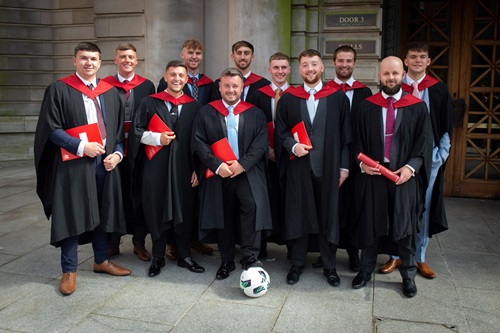
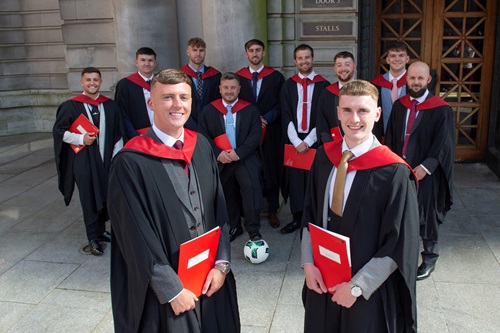
The first group of students from a trailblazing football coaching degree – delivered by Edinburgh Napier University (ENU) and the Scottish Football Association – have celebrated their graduation.
Following four years of study, which included teaching for UEFA and Scottish FA qualifications alongside skills such as performance analysis, sport science, and leadership, fifteen students have completed the course.
They joined fellow students from ENU’s School of Applied Sciences in collecting their degrees during a graduation ceremony at Edinburgh’s Usher Hall today.
New graduates from the course have spoken with pride on difference the course has made to their fledgling careers in the game.
Ewan McLevy, who is now working as an academy coach at Scottish Premiership side Kilmarnock, is among them.
The 24-year-old from Troon said: “I look at back at the course with fond memories, it was excellent.
“We came in in September 2020 and we were a brand new group. There was a bit of trial and error as we got used it.
“After a couple of months, I caught the bug and never looked back.
“The beauty of the course is that it touched on the things you might not consider, like psychology, analysis and sports science. I think I speak for all the group when I say it was a real eye-opener.
“The lecturers were amazing and really helped us understand it all. They took examples from other sports, which helped it all come together.
“I couldn’t recommend the programme any higher. For someone starting on the pathway, given the links with the Scottish FA, it couldn’t give you a better opportunity.
“If football is your passion, it will open doors.”
Fellow graduate Aidan Spalding, who’s also 24 years old and from Glasgow, has recently started working as a first team analyst at Hamilton Academical. He said: “I’m gutted to leave to be honest! The four years have been unreal – I’ve loved it.
“Having that one interest of working in football all the time has made us really close as a group.
“It was very well rounded and gave us a chance to learn about other sides of the game.
“Without this I wouldn’t have had the opportunity to get a full-time analysis job – or have had experiences like going away with Scotland Women’s development teams.
“If you enjoy football, the course is for you. It will take your coaching to the next level.”
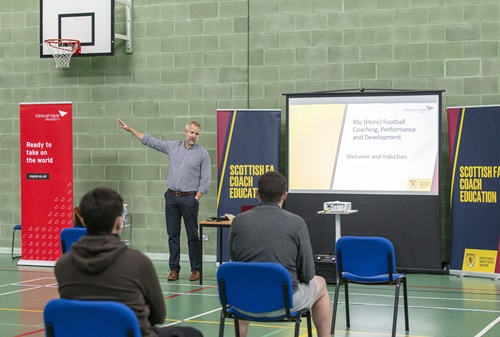
Dr Cedric English, Programme Leader and Associate Professor at Edinburgh Napier University, said: “We were pretty excited to see the Scottish FA put out a tender for developing a degree programme that linked in a lot of their licences, so we put in an application and we were successful.
“That was the beginning of the process, six years ago, and it took us time to work out how we would incorporate the licences in because that’s the uniqueness of the collaboration.
“It’s a great feeling to now see the hard work coming to fruition and I would echo the congratulations to the students who have worked incredibly hard to get to this point.”
Prospective students can find out more about the BSc (Hons) Football Coaching, Performance and Development, which offers a holistic view of coaching within a football setting, here.
Pictured top: Football Coaching graduates outside the Usher Hall with their degrees
Middle: The group with Ewan McLevy (left) and Aidan Spalding (right) in front
Bottom: Dr Cedric English speaking at the introduction to the programme in 2020