Support of over £2,600 available through pregnancy and early parenthood
The birth of a new baby can put financial pressure on household budgets, but there’s a wide range of financial support available from the Scottish Government to ensure children have the best start in life.
Families receiving Universal Credit or certain benefits could be eligible to more than £2,600 in financial support during pregnancy and their child’s first year of life, helping with the costs of welcoming a new baby.
Expectant families can apply for the Best Start Foods pre-paid card as soon as they find out they are pregnant, helping ease the costs of buying healthy food.
Families can also apply for Pregnancy and Baby Payment from the 24th week of pregnancy. The one-off payment can be used to purchase anything families might need for having a baby, such as a pram, toys or baby clothes.
Scottish Child Payment is also available once the child is born to help with anything needed to help raise their new baby.
Cabinet Secretary for Social Justice, Shirley-Anne Somerville, said:“Welcoming a new baby is a special and exciting time, and families should have the support they need as they prepare for the arrival of their child.
“This package of support, worth thousands of pounds for eligible households, provides extra help from pregnancy through to a baby’s first birthday and beyond. Backing families in those vital early months is central to our mission to eradicate child poverty, helping parents provide the opportunities every child deserves and giving them the best possible start in life.”
Danielle turned to her local Citizens Advice Bureau after struggling to meet essential costs while caring for her 7 month old baby alone. Financial pressures had become so severe that she was considering selling her home.
But with support from Scottish Child Payment and Best Start Foods helping to ease food shopping bills, Danielle said she and her baby had enough to eat and did not need to use a food bank.
Assistant Director for Policy and Research at Citizens Advice Scotland, Emma Jackson, commented:“Evidence from across the Citizens Advice network shows the important role that pregnancy and early years payments can play in helping families through periods of financial insecurity and change.
“Support such as Best Start Grant, Best Start Foods and Scottish Child Payment can help ease financial pressures, enabling families to afford the essentials and support children to get the best possible start in life.
“Local Citizens Advice Bureaux are there to provide free, confidential and expert advice that’s available online, over the phone or in-person to help people apply for the support they’re entitled to and make sure they don’t miss out on payments that can make a real difference to their family.”
Energy Secretary gives go ahead to controversial Jackdaw gas field, as Chancellor announces new Energy Wealth Fund
The Energy Secretary has agreed that the regulator can grant consent for gas to be produced at the licensed Jackdaw field.
The project will start to supply gas to British homes and businesses from as early as the end of this month, helping heat millions of homes and protecting hundreds of jobs.
New Energy Wealth Fund to be established by the Chancellor with a £2 billion downpayment to reinvest oil and gas revenues into the climate transition.
Still no decision on Rosebank
Jackdaw will start to supply gas to British homes and businesses from the end of this month, after the Energy Secretary agreed that the regulator can grant consent for gas to be produced at the field.
The Jackdaw decision is expected to increase domestic gas production by around 6% at its peak – supporting the UK’s gas supply over its lifespan of up to 11 years, boosting our energy security, protecting hundreds of jobs and adding an estimated £2.9 billion to the UK economy.
Recent events in the Middle East have triggered global energy shocks and pushed up bills for families across the country. At a time of global instability, homegrown energy can be a source of national strength.
The Chancellor is also announcing today the establishment of a new Energy Wealth Fund, which will use tax revenues from North Sea oil and gas to invest in renewable and low carbon energy projects and support the green transition. Reflecting our commitment to the North Sea, this will start with an initial £2 billion injection of funding, with future revenues from the North Sea flowing into the fund over time.
The announcement comes ahead of the Budget, which will set out the government’s plan to deliver good growth in every postcode. By reinvesting Britain’s energy wealth in renewable and low carbon energy infrastructure, the Fund will unlock investment, back the industries of the future and create skilled jobs across Scotland and the UK.
This investment in renewable energy will substantially delink gas and electricity by the end of this Parliament. By investing in and building more renewable and low carbon power, gas will set the price of electricity less often, helping end Britain’s exposure to volatile international gas markets and help get bills down for good in the long term.
The Energy Secretary assessed among other points, that the Jackdaw project will not prevent the UK from being able to meet its legally binding limits on carbon emissions and achieve net-zero by 2050.
The heatwaves and extreme weather events experienced this year highlighted the importance of tackling the climate crisis. The Government remains committed to the green transition and net zero – moving away from fossil fuels and towards renewable and nuclear energy. But even on the path to net zero, the UK will still require oil and gas as part of our energy needs for decades to come.
The decision is consistent with the government’s manifesto commitment not to issue any new licences to explore new fields while managing existing fields for the entirety of their lifespan. The Jackdaw gas field is already licensed and the North Sea Transition Authority’s decision to grant consent now gives the developer the green light to begin operations at the field.
It follows the Supreme Court’s ruling on the Finch case in 2024, which means North Sea operators are now required to consider the impact of burning the extracted oil and gas in environmental impact assessments. This meant the Energy Secretary had to consider a new environmental framework alongside all relevant factors in the case, including responses to the public consultation.
Energy Secretary Miatta Fahnbulleh said:“Following careful consideration of all relevant factors I have agreed that the regulator can grant consent for gas to be produced at Jackdaw, which will begin to supply the UK with gas from this winter thanks to the highly skilled and vital North Sea workers.
“This decision will support the country’s energy security with homegrown gas this winter and help minimise the UK’s use of imported higher emission fuels as we continue our transition to renewables and nuclear.
“The decision is compatible with our legally binding climate commitments, and we remain resolute in ending new licences for oil and gas and achieving net zero by 2050.
Prime Minister Andy Burnham said: “I welcome the Energy Secretary’s decision, which will protect hundreds of jobs and help keep millions of homes warm this winter. At a time when people are really struggling, it’s right that we look in a responsible way at maximising the existing energy reserves we have in Britain that could help.
“We’re committed to moving towards renewable energy and reaching net zero by 2050. But even on our ambitious climate path, we’ll still require oil and gas as part of our energy needs for decades to come.
“That’s why we’re taking a pragmatic approach to the North Sea. We’re also establishing a new Energy Wealth Fund to invest in renewable energy, support the green transition and help reduce energy bills over the long-term.
“Our approach will ensure we can boost our energy security, back British workers, ringfence future North Sea proceeds to speed up the green transition, hit our ambitious climate targets and – crucially – bring down bills.”
Chancellor of the Exchequer John Healey said:“I want Britain’s energy wealth to spark a new wave of clean power to work for the British people.
“Since North Sea gas and oil were discovered decades ago, the benefit of our existing nation’s natural resources have not been turned into the long-term investment our country needs.
“Through our new Energy Wealth Fund, we will invest in the clean energy industries of the future, creating jobs, driving growth and strengthening Britain’s energy security.”
Secretary of State for Scotland Douglas Alexander said: “This decision to approve Jackdaw is a win for Aberdeen, a win for Scottish workers and a win for Britain’s energy security. The North East has helped power the country for half a century, and will continue to do so for decades to come.
“This will harness the homegrown skills and assets we have in Scotland and right across the UK in a boost for the economy, as we continue to invest in and grow clean energy resources, and work towards the transition.”
Stuart Payne, Chief Executive of the North Sea Transition Authority (NSTA) said:“After robust scrutiny we have today granted consent for the Jackdaw Field development which allows the owners to proceed with their project and produce gas from the field upon completion of development work.
“This project will support the UK’s energy security by providing domestically produced gas, generate tax revenues, safeguard supply chain jobs, use existing infrastructure, and have an emissions intensity well below the UK average.
The Energy Wealth Fund will support investment in the renewable and low carbon energy industries that will power Britain’s future. It will help ensure more value from Britain’s energy resources is invested for the long term, supporting the green transition and creating a lasting national asset for future generations.
Alongside supporting the North Sea oil and gas sector, the government will continue to invest in the new energy industries that will support Scotland’s long-term jobs and prosperity. Since 2024, the UK has seen more than £100 billion of investment in renewable and low carbon energy.
Most recently, Sumitomo announced the opening of a £350 million into a cable factory at the Port of Nigg earlier this week. And SSE yesterday confirmed that 400 skilled jobs will be supported across Scotland through its new supply chain contracts for the Berwick Bank B offshore wind farm.
The government is taking a pragmatic approach to the North Sea that will support existing oil and gas production and back the highly skilled workforce as opportunities grow in renewables and wider sectors.
As announced last year, new Transitional Energy Certificates will allow for some oil and gas production in already-explored areas that are near licensed fields, linked via a tieback – ensuring existing fields can remain economically viable.
The government has therefore confirmed today that it is asking the regulator to consider urgent cases that could benefit from similar measures now, before legislation on these new certificates is in place. This will ensure the sector can support existing oil and gas fields, while still preventing exploration in new unlicensed areas.
It comes as discussions with industry leaders begin on a refresh of the North Sea Transition Deal to ensure domestic oil and gas production continues to benefit the UK and build the energy industries of the future. First agreed in 2021, the deal aims to provide a clear path for the industry to support the UK in reaching net-zero carbon emissions by 2050, while protecting jobs and supporting energy security.
The changing nature of the North Sea basin also opens up new opportunities to expand the UK’s decommissioning sector – which is expected to support up to 25,000 skilled jobs over the next decade and attract up to £25.6 billion in investment, according to independent analysis.
To help unlock this potential, the government has launched a consultation on new guidance to support decommissioning of complex infrastructure. The government has also formally asked Shell to submit their Brent decommissioning programme for the Energy Secretary to consider, with the aim to unblock a longstanding decision process that has been under review since 2017.
The UK Government’s approval of the Jackdaw gas field is a betrayal of our children’s future and outright climate vandalism, the Scottish Greens have said.
Labour has approved Jackdaw today even though it will do nothing to lower household bills and will only help greedy shareholders rake in obscene profits.
Jackdaw will have no meaningful impact on the UK’s energy security. Over its roughly 10-year lifetime it will provide only 2% of UK gas demand.
Labour approved the field despite the repeated heatwaves and devastating wildfires which hit the UK this summer, the latest round of extreme weather driven by the climate emergency.
Scottish Greens co-leader Ross Greer said:“Labour’s decision to approve Jackdaw is climate vandalism. It is a devastating betrayal of our children’s future and it won’t even lower energy bills in the here and now.
“Andy Burnham’s Government had the opportunity to reject the greed of oil and gas companies. They could have focused instead on lowering bills and protecting our planet by investing in clean, green renewable energy. Instead, this Labour Prime Minister has caved in to the fossil fuel lobby and continued to devastate our climate.
“The UK has just endured a summer of repeated heatwaves and devastating wildfires. This winter we’ll likely see extreme levels of flooding. The climate emergency is here already and it’s costing lives.
“Jackdaw will make the UK even more dependent on gas despite its wildly fluctuating prices in the global market. That will do absolutely nothing to lower household energy bills and it is dishonest to pretend that it will.
“Labour’s climate credentials are now in shreds. Families across the country are struggling to afford the rising costs of heating their homes. The money being thrown at oil and gas companies in the form of tax breaks should instead be used to insulate homes and help people swap out their gas boilers for heat pumps.”
Ross Greer added:“The Scottish Greens are now the only party standing up for our planet and against the greed of oil and gas companies.
“Our children and all future generations will not forget Labour’s climate vandalism.
“Scotland has a huge wealth of clean, green renewable energy sources, but we are constantly held back by Westminster. The UK Government has once again bent to the whim of the fossil fuel lobbyists who only care about making obscene profits for their shareholders, regardless of the ruin they are leaving for everyone else.”
Greenpeace UK press briefing
The Government looks set to approve more oil and gas drilling in the North Sea. Based on the facts set out below, Greenpeace wants to know, why?
This brief sets out the latest facts about the climate, energy bills, jobs and energy security for both Jackdaw and Rosebank and suggests 10 questions for journalists to ask ministers and spokespeople ahead of the decision.
Jackdaw key facts
Adura claims Jackdaw brings massive economic benefits, but in their own environmental statement they admit that it will create just 27 new full-time jobs. Most of the workforce already works on the existing Shearwater platform.
Using government calculations for climate harm, burning Jackdaw’s gas will cause an estimated £16.1 billion in global damage and over 8,000 heat-related deaths.
Adura argues that Jackdaw’s emissions are only a tiny percentage of global pollution. However, existing oil and gas fields worldwide will already produce more than double the amount of carbon the planet can handle to limit warming to 1.5°C. We already have more than enough gas to meet global supply.
Rosebank key facts
Burning Rosebank’s 254 million tonnes of Scope 3 emissions will cause an estimated 57,000 global heat-related deaths under peer-reviewed climate models.
Using standard UK Treasury figures for life valuation, Rosebank inflicts over £114 billion in global climate damage, wiping out its claimed £24.3 billion in economic value nearly five times over.
90% of Rosebank’s oil reserves are destined for international markets and all of it will be sold at global market prices, meaning no cheap oil reserved for UK consumers.
Rosebank would generate a total of 254 million tonnes of CO₂ equivalent in greenhouse gas emissions over its lifetime. That’s the equivalent of nearly 70% of the UK’s entire annual emissions in 2024.
The climate pollution from Rosebank’s reserves would be greater than the combined annual CO₂ emissions of the 73 lowest-emitting countries and territories (representing over 114 million people).
Shell’s Q2 profits were £7.4 billion, while the world’s five biggest oil companies made half a billion dollars per day in the second quarter of 2026 due to the Iran war.
UK taxpayer-funded subsidies to fossil fuel companies are worth £13.3 billion for the last seven years. That amount could fund seven years of support for North Sea workers to transition to renewable industries, at the level called for by unions and environmental NGOs.
10 Questions for Government Ministers and Spokespeople
Bills: How much will Jackdaw or Rosebank reduce household energy bills, and by when? If their oil and gas are sold at international market prices, what is the mechanism for delivering cheaper energy?
Energy security: If Jackdaw reduces annual gas import dependency by only 2% on average, how does that justify its climate damage? How does Rosebank improve UK energy security when 90% of its oil is destined for international markets?
Jobs: How many new, permanent UK jobs will each project create? How do ministers reconcile claims of major employment benefits with Adura’s own figures that Jackdaw provides just 27 permanent new jobs?
Trump: What commitments did the PM give to Donald Trump on North Sea drilling and is the US president now dictating UK energy policy?
Growth: How will licensing more drilling deliver good growth in every postcode? What lasting growth will these projects deliver, and why is further drilling a better investment than backing the UK’s surging green economy?
Public money: Why should taxpayers effectively shoulder over 80% of Rosebank’s development costs? What is the expected net return to the public after tax reliefs and climate damage are taken into account?
Climate damage: How do ministers justify Rosebank’s estimated £114 billion in global climate damage against its claimed £24.3 billion economic value? What weight have they given to the estimated heat-related deaths from both fields?
Pragmatism: Ministers have promised a pragmatic approach. What is pragmatic about approving projects that add to climate damage without delivering cheaper energy or a secure long-term future for workers?
Political pressure: What role has lobbying by fossil fuel companies played in these decisions? Will ministers publish the evidence and records of relevant meetings?
Rosebank: If the Government approves Jackdaw but delays Rosebank, why is it postponing a decision on the more damaging project? When will ministers give a definitive answer?
Remembering those who lost their lives in a man-made disaster on this day in 1966.
Despite the evidence no person or organisation was held responsible and successive governments refused to act to right a wrong inflicted on a small Welsh mining community.
SHAMEFUL.
The Welsh Government said this morning: ‘At 9:15am today, Wales will fall silent to remember those who were taken from us in the Aberfan disaster.
’60 years may have passed, but we will never forget them’.
A message from James Dalgleish, convenor Education, Children and Families and Amanda Hatton, Corporate Director Children, Education and Justice Services was issued yesterday:
Schools in Edinburgh, as well as throughout the UK, were targeted yesterday (Monday) in a hoax threat.
We took immediate action to ensure the safety of our pupils, teachers and staff and followed the advice of Police Scotland as well as our own established safety policies.
The police conducted a thorough investigation into the claims and determined it was a hoax and there was no risk identified.
The safety of our school community is always our top priority. With Police assurance all Council nurseries, primaries and high schools reopened today, Tuesday 20 October.
This situation has caused alarm and misinformation to be spread amongst the school community. Understandably as a result attendance rates have been lower than average today.
We want to reassure parents, carers, pupils and staff that safety is a priority and there is no safety risk for pupils.
If you have any concerns, please speak to your child’s school. Staff can support pupils in their return to learning.
Plus new Kick Off Concert, return of community tickets and free events at the Ross Bandstand
Free tickets to be distributed to communities across Edinburgh and Lothians
Edinburgh’s Winter Festival producers Unique Assembly have today announced software management company Halo as new title sponsor of both Edinburgh’s Christmas & Edinburgh’s Hogmanay events.
The partnership will see Halo visible throughout Edinburgh’s festive celebrations, lighting up the capital and presenting a brand-new Kick Off Concert to start next month’s festivities, plus the return of a free programme of events at the Ross Bandstand.
The inaugural free Edinburgh’s Christmas Kick Off Concert at the Ross Bandstand on 14 Nov marks the beginning of seven weeks of Edinburgh’s Christmas with Halo celebrations and will be headlined by the bagpipe supergroup Red Hot Chilli Pipers.
The concert, supported by new headline partner Halo, kickstarts the programme of free community focussed and family-friendly events at the Ross Bandstand, spanning five weekends across the Christmas season.
The Ross Bandstand Programme will also include Edinburgh’s Christmas supporting Edinburgh Diwali to deliver Diwali celebrations on Sun 15 Nov, Light Night on Sun 22 Nov, a weekend of St Andrew’s Day celebrations on Sat 28 & Sun 29 Nov complete with free outdoor ceilidh, and the Santa Fun Run and Santa Paws in aid of charity partner When You Wish Upon a Star on Sun 6 Dec, plus much more…
Edinburgh’s Winter Festival welcomes Halo as the event’s new headline partner, allowing Edinburgh’s Christmas and Hogmanay to join the line-up of Scottish events supported by Halo, including Scottish Rugby and the Scottish FA, as Halo commit to supporting large scale sporting and cultural events across Scotland.
On joining Edinburgh’s Christmas and Hogmanay, Halo said: “Edinburgh’s Christmas and Hogmanay is one of the great winter celebrations in the world, and we’re proud to be part of it.
“Founded in the Highlands, Scotland has always been special for Halo, and through our sporting partnerships that connection is as strong as ever. We believe in supporting the moments that bring people together, and there are few bigger than Hogmanay in Edinburgh, welcoming locals and visitors from every corner of the globe. We can’t wait to see the city light up this winter.”
Also announced today, Edinburgh’s Christmas community tickets initiative is back after a hugely successful year in 2025. Giving out tickets to community groups across Edinburgh and the Lothians, the community initiative offers free tickets to attractions including the LNER Big Wheel, Family Ice Experience with Icelandair, Around the World Star Flyer and much more.
Applications for community tickets are open now, Tue 20 Oct and close Wed 04 Nov. The Community Tickets initiative is intended to give back to the communities that host Edinburgh’s Christmas, and supports tickets for free-to-attend community-funded outreach groups and charities in and around Edinburgh.
Edinburgh Christmas, West Princes Street Gardens, Santa Stories, Lightnight Concert
On the community tickets initiative, Unique Assembly said: “We’re delighted to announce the return of our Community Tickets initiative, this year supported by our new headline partner Halo.
“We’re thrilled to be able to give back to the communities that host us, and to give out festive treats to those who need it most!”
Edinburgh Christmas, West Princes Street Gardens, Santa Stories, Lightnight Concert
Council Leader Jane Meagher said: “It’s fantastic to see another event being added to an already packed festive programme, giving people even more to look forward to as the festive season gets underway.
“With tickets being made available to local communities and charities, I’m delighted that more residents will be able to experience the magic and atmosphere of Edinburgh’s Christmas.
“It’s also a lovely way to recognise and thank the organisations that make such a positive difference to people’s lives throughout the year.
“I’d encourage community groups and charities to put forward an application and take advantage of this opportunity.”
The full Ross Bandstand programme can be found on edwinterfest.com with more events still to be announced.
Poppyscotland has officially launched the 2026 Scottish Poppy Appeal, with this year’s poignant theme centring around, ‘When someone serves in the Armed Forces, their family serves too’.
The annual campaign, which raises vital funds to support veterans, serving personnel, and their dependents across Scotland, officially got underway today (Tuesday, 20th October).
To launch the 2026 appeal, Poppyscotland welcomed charity beneficiaries and their families to Lady Haig’s Poppy Factory in Edinburgh. Each had received Poppyscotland’s support during a time of need.
Photo Caption:- Left Reverend Peter Meager and 11 year old Ava Mitchell celebrate Poppy Launch 2026 at New Haig House.
Former RAF radiographer Sylvie Ibie sought help from the charity after suddenly losing her job and home and being forced to sleep on a church floor.
Poppyscotland referred Sylvia and her teenage daughter to an organisation that found them a property, then provided white goods, bedroom furniture and other essentials for their new home. The charity also supplied food and clothing vouchers to help them get back on their feet before Sylvia secured a senior NHS role.
Former military police officer Derek Loughran says Poppyscotland’s “life-changing” support enabled him to return to work. After injuries sustained on active duty, which saw him away from his family for long periods of time, the charity provided a state-of-the-art treadmill to aid his recovery.
As his wife Christine’s Alzheimer’s became more difficult to manage, Reverend Peter Meager, a former Royal Army Chaplains’ Department chaplain, sought help from Poppyscotland’s Admiral Nurse service. Admiral Nurse Kath arranged treatment, respite and care support, and helped Peter better understand the condition and access mental health support as Christine’s carer.
All three former Armed Forces members expressed deep gratitude for Poppyscotland’s welfare support, which transformed their families’ experiences.
The launch was also attended by 11-year-old Ava Mitchell, the Poppy Appeal’s youngest volunteer. Inspired by relatives who served in the Armed Forces and received support from Poppyscotland, she has volunteered since the age of five to give back to the charity for helping the country’s veterans.
Photo Caption:- Left Reverend Peter Meager and 11 year old Ava Mitchell celebrate Poppy Launch 2026 at New Haig House.
The charities Head of Scotland, Leanne Bonner said: “This year’s campaign shines a dedicated spotlight on the vital, yet often unsung, support network behind every uniform. Military families experience unique challenges – including long separations, frequent relocations, and the constant anxiety of having a loved one deployed.
“Poppyscotland aims to remind the public that the sacrifices of service extend far beyond the frontline.
“We want to ensure that military families receive the recognition and support they rightfully deserve. Every donation to the Scottish Poppy Appeal goes toward providing life-changing financial aid, housing support, employment advice, and mental health services to our community here in Scotland.”
Photo caption:- Ava Michell and Mum Jenni in the Lady Haig Poppy Factory. Aya is a huge poopyscotland volunteer raising hundreds of pounds in her last 5 years.
From late October, millions of iconic Scottish four-petal poppies will be distributed by a dedicated network of volunteers cross country in high streets, supermarkets, train stations, and schools.
The Scottish Poppy Appeal is Scotland’s biggest fundraising appeal, with all funds raised helping Poppyscotland continue to provide life-changing support and advice to Scotland’s Armed Forces community.
The Chair of the UK Covid-19 Inquiry, Baroness (Heather) Hallett, has today published her sixth report. She concludes that, in the early stages of the pandemic, not enough was done to protect people in care settings and that the adult social care sector appeared to be “something of an afterthought”.
There were more than 43,000 recorded deaths involving Covid-19 in care homes between March 2020 and July 2022. A lack of proper planning, plus failures to implement lessons from earlier pandemic planning exercises, meant the UK government and devolved administrations took critical decisions in the early weeks without the information they needed. Action to protect carers and care users came too late, with devastating consequences.
Module 6, the sixth of the Inquiry’s 10 investigations, examined the impact of the pandemic on the publicly and privately funded adult social care sector in England, Scotland, Wales and Northern Ireland, including infection prevention, visiting restrictions, the experiences of the care workforce and decisions on discharge from hospitals.
The ‘Care Sector’ (Module 6) report concludes that while the UK government and devolved administrations knew, prior to the pandemic, of the extreme vulnerability of care home residents to respiratory viruses, care homes received insufficient protection at the time they most needed it.
The claim that “a protective ring” had been put in place around care homes “right from the start” of the Covid-19 outbreak was unfounded.
Not enough was done to protect people in care settings between March and mid-April 2020. The decision to speed up the discharge of patients from hospitals into care homes was necessary to free up hospital beds. But the decision to do so was taken in March 2020 when there was not enough testing capacity to know patients’ Covid-19 status.
At the time, isolating discharged patients inside care settings was one of the few effective protections available. Yet, in March 2020, England, Wales and Northern Ireland did not initially advise this, a failure the Inquiry calls “a significant omission”.
Today’s report shows how, as the deadly virus spread rapidly, care home residents were left feeling isolated, abandoned and alone as visiting restrictions cut them off from loved ones, in some cases for months.
Some people were not allowed to be with dying friends or relatives in their final moments, leaving bereaved people grief-stricken.
They could not help their loved ones with daily tasks such as eating, drinking and washing, support which can be vital for some residents.As a result, Baroness Hallett concludes: “Many remain wracked by a guilt that they do not deserve to carry.”
Visiting restrictions did not begin to ease until the summer of 2020. The report concludes that the severity and duration of these restrictions caused “profound and enduring effects” inside care homes, particularly for residents with complex cognitive conditions such as dementia.
Many millions of people across the UK receive adult social care. This includes older people, people with dementia and people living with physical and learning disabilities. For them and the people who dedicate themselves to providing their care, the pandemic totally disrupted their daily lives and had a devastating impact.
Baroness (Heather) Hallett, Chair of the UK Covid-19 Inquiry said: “At the critical early stages of the pandemic, not enough was done to protect those living and working in care homes. The mantra at the time of ‘protecting the NHS’ sometimes came at the expense of the users and providers of care. The adult social care sector as a whole appeared to be something of an afterthought.
“The profound isolation and sense of abandonment felt by residents as a result of the visiting restrictions resulted in immense emotional harm. Most distressingly, some people were not permitted to be with their dying loved ones. Many remain wracked by a guilt that they do not deserve to carry.
“During the pandemic, the action taken by the UK government and devolved administrations to try and protect workers and users of adult social care came too late. The failures were the direct result of an absence of proper pandemic planning for the adult social care sector. It underlines why my recommendations in this report must be acted upon now before the next pandemic strikes.”
The Covid-19 pandemic exposed and exacerbated the underlying fragility of the adult social care workforce. A workforce of at least 1.5 million people – including care in the home (domiciliary care) – provided care during the pandemic. Many put their own lives at risk.
Severe shortages of personal protective equipment (PPE) meant that some care workers were left having to wear waterproof ponchos from festivals, painters’ overalls, or home-made PPE made from fabric, bin bags and bed linen.
The report describes this as “wholly unacceptable”, finding that care workers were left “without the protection they needed”. It concludes that while PPE shortages were a global problem, better planning could have ensured a much better supply from the outset.
Many care workers suffered burnout. Some left the profession entirely. Changes to sick pay were introduced in England, Scotland and Northern Ireland between March and May 2020, but not in Wales until November 2020.
The UK’s 5.8 million unpaid carers were also heavily relied upon, providing complex care for longer hours with little or no respite. The Inquiry concludes that support for unpaid carers came too late and that for too long the adult social care sector as a whole has been undervalued and under-recognised.
The Inquiry’s latest report also examines concerns about the use of Do Not Attempt Cardiopulmonary Resuscitation (DNACPR) decisions, echoing concerns raised in its Module 3 report that some decisions were made inappropriately or without proper consultation, based on a person’s age, health condition or learning disability.
While finding no evidence of national policy encouraging blanket use of DNACPRs, the report recommends mandatory end-of-life care training for health and social care workers, who often lacked the skills to have these conversations thoughtfully and compassionately.
Ultimately, the report finds that these failures and others stemmed from an absence of proper pre-pandemic planning for the adult social care sector.
Exercise Cygnus, a pandemic preparedness exercise conducted in October 2016, recommended developing ways to assess social care and surge capacity, but this work had not been completed by the time the Covid-19 pandemic struck. As a result, ministers were left making decisions without the information they needed about the sector.
The Chair makes eight key recommendations to ensure the adult social care sector is better protected and better equipped to respond to the next pandemic, including:
Improving arrangements for pandemic planning to ensure clearer structures, roles and responsibilities.
Better planning for the safe isolation of care home residents.
Implementing financial support schemes ready to be rolled out to support adult social care staff to self-isolate or to limit staff movement.
Publishing guidance on visiting restrictions.
Maintaining inspection and oversight by developing protocols to enable inspections to continue, including, where possible, on-site inspections.
Improving the collection of data about deaths in the adult social care sector.
Establishing mandatory end-of-life care training for relevant health and social care workers.
Introducing a voluntary register for the social care workforce in England, recognising and supporting a workforce that already benefits from such registers in Scotland, Wales and Northern Ireland.
A four-page brief summary of the report can be found on the Inquiry’s website and is available in a variety of languages and accessible formats.
In total, 57 witnesses gave oral evidence during Module 6 public hearings, held between 30 June and 31 July 2025. The Inquiry heard from care home residents and their families, unpaid carers, care workers and sector representatives, as well as healthcare professionals, policy-makers, regulators and relevant experts, including serving and former senior politicians and civil servants.
The Inquiry has already published reports for Modules 1 to 5, all of which are available on the Inquiry’s website. Baroness Hallett notes the action taken to date by the four governments of the UK and expects that all recommendations from all published reports will be implemented promptly and in full.
The Inquiry’s seventh report, Module 7 ‘Test, Trace and Isolate’, will be published on Thursday 19 November 2026. The remaining three reports – Module 8 ‘Children and Young People’, Module 9 ‘Economic Response’ and Module 10 ‘Impact on Society’ – will be published in the first half of 2027.
Hourglass has called for the Covid-19 Inquiry’s care sector report to lead to lasting changes in how older people are protected from abuse and neglect, after the Inquiry recorded that the UK government knew about rising demand for the charity’s helpline during the first lockdown.
The report states that government was aware calls to Hourglass had increased by at least 30%, including a sharp rise in reports of neglect, particularly in care homes. It also finds that the suspension and subsequent limitation of in-person inspections likely contributed to safeguarding concerns going unidentified and unreported.
Hourglass, the only UK-wide charity dedicated to ending the abuse of older people, has campaigned for scrutiny of the pandemic response since 2020, when it joined legal action seeking an urgent inquiry into PPE failures.
Chief Executive Richard Robinson subsequently gave both written and oral evidence to the Inquiry’s Module 10 domestic abuse and safeguarding roundtable in April 2025, describing how older victims were trapped with perpetrators and cut off from support.
Responding to today’s Module 6 report, Hourglass CEO Richard Robinson said:“This report records that government knew our helpline was receiving more calls, including a sharp rise in reports of neglect in care homes. The warning signs were there while the crisis was unfolding. Older people and their families are entitled to ask why that knowledge did not translate into better protection.
“The consequences described by the Inquiry are appalling: neglect, failures of basic care, suffering that went unseen and families prevented from being with someone they loved at the end of their life. These were people whose safety depended on systems that failed them.
“Hourglass warned during the pandemic that isolation could increase the risk of abuse and make it harder to seek help. When family visits were restricted and routine inspections suspended, vital opportunities to identify harm were lost. The Inquiry finds that reduced in-person inspections likely contributed to abuse and neglect going unidentified and unreported.”
“In our written evidence to the Inquiry, Hourglass described older victims as ‘locked in and left behind’. Today’s findings on the care sector reinforce the need to confront how easily older people’s voices, rights and safety can be overlooked when decisions are made on their behalf.
“The recommendations on visiting, inspection and end-of-life care training must now be implemented, with named responsibility, published deadlines and scrutiny of delivery. Older people must retain access to trusted people, independent oversight and a means of reporting abuse, including during an emergency.
“But our ambition must extend beyond preparing for another pandemic. We need a comprehensive Safer Ageing Strategy that tackles ageism and abuse, backed by sustained, ring-fenced funding for specialist services supporting older victim-survivors.
“For bereaved families and those who survived abuse or neglect, the test will be whether this report changes what happens when an older person needs protection. That is the responsibility governments must now fulfil.”
Road policing officers are continuing enquiries following a fatal road crash on the A8 near Newbridge, Edinburgh, which occurred on Monday, 7 September, 2026.
Between 8am and 12pm on Saturday, 24 October, 2026, the west-bound carriageway of the A8 will be closed between Edinburgh Airport and Newbridge Roundabout to allow officers to conduct investigatory work.
Access to Edinburgh Airport will be maintained during this time.
Edinburgh College recently welcomed a delegation of TVET colleagues from Mauritius, made up of training staff from project lead Saint Gabriel Technical College (SGTC) and the Mauritian Institute of Training and Development (MITD), as part of a British Council-funded project helping partner organisations develop their electric bus maintenance skills, while sharing their own expertise and approaches.
The group of four personnel – SGTC’s Bruno Chellamootoo and Terry Leveque, along with the MITD’s Vijaysingh Chuttur and Khemrajsingh Rampersand – undertook an intensive three days heavy electric vehicle maintenance course, achieving a UK IMI Certificate Level 3 at the Sighthill campus.
The College’s Kieran Lydon, Curriculum Team Manager for Automotive Engineering and Alan Phillips, Automotive Lecturer led the training on specialised equipment, including the recently acquired Ford Transit EV trainer. The chassis allows for in-depth views of its inner workings, while a range of faults can be inserted to simulate real-world problems.
The group also enjoyed a visit to the College’s wider Engineering facilities at the Midlothian campus, observing workshop layouts with guidance from Fraser Wilson, Curriculum Team Manager for Engineering and Advanced Manufacturing, while lecturer Daniel Wright provided our guests with a chance to try out some virtual reality welding equipment.
The areas of Equality, Diversity and Inclusion (EDI) and STEM were also of particular interest to the delegation, with EDI Lead Nina Munday and STEM Co-ordinator for Engineering Catherine Brotherton giving presentations on how those principles are applied at Edinburgh College.
This international skills partnership, supported by funding from the British Council’s Going Global Partnerships programme, focuses on supporting trainers in Mauritius to develop their own heavy electric vehicle maintenance skills and to enhance their knowledge of working with the technology, while allowing them the opportunity to share their own methods and expertise, with a view to informing the approach moving forward.
Upon their return, the participating trainers will support the transfer of knowledge and skills within their respective institutions, helping to build sustainable local training capacity in heavy electric vehicle maintenance.
With electric bus fleets having been introduced in Mauritius, this project is contributing to its wider ambitions to modernise public transport, build local technical capacity and support the transition towards cleaner and more sustainable mobility solutions.
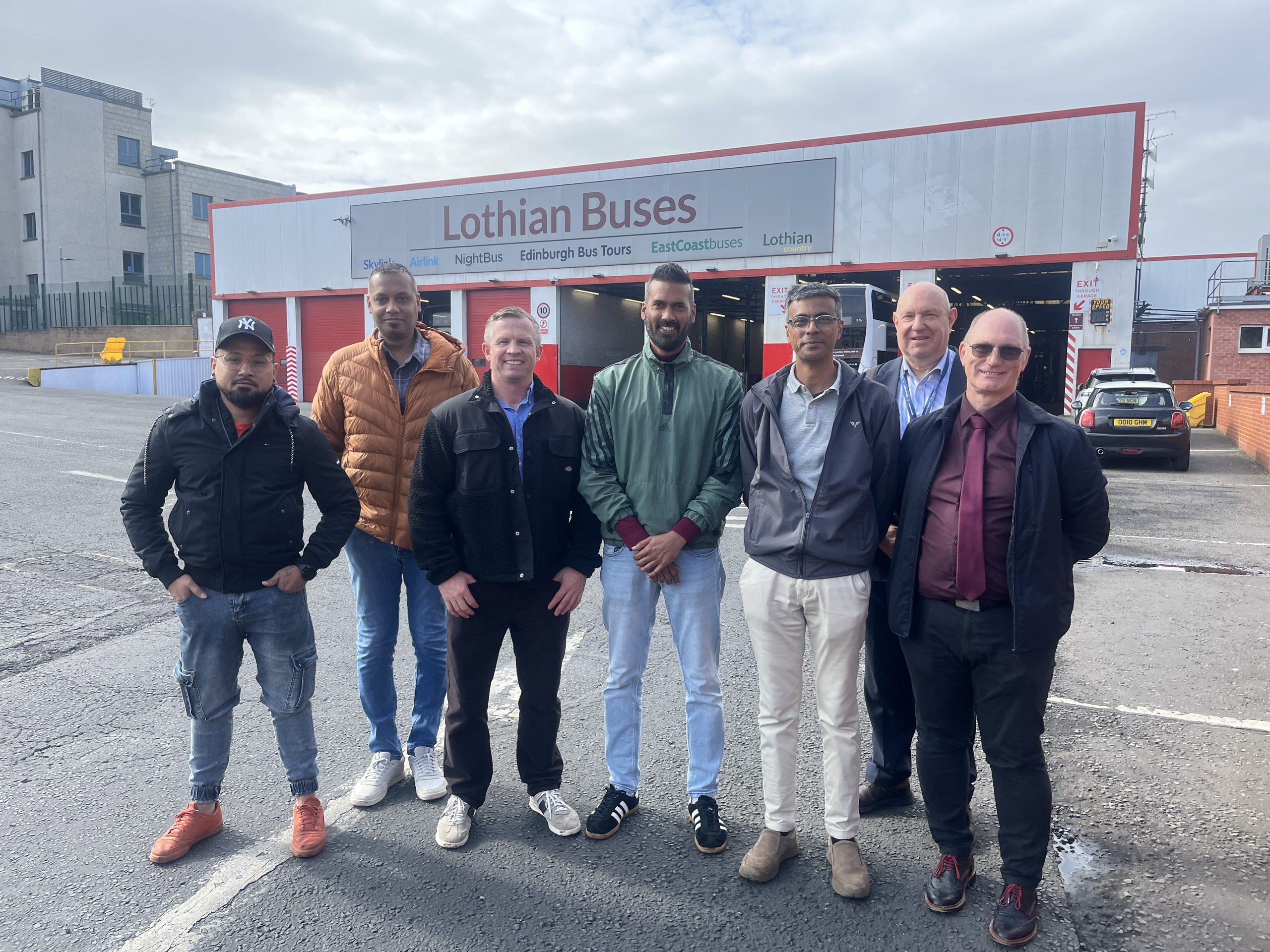
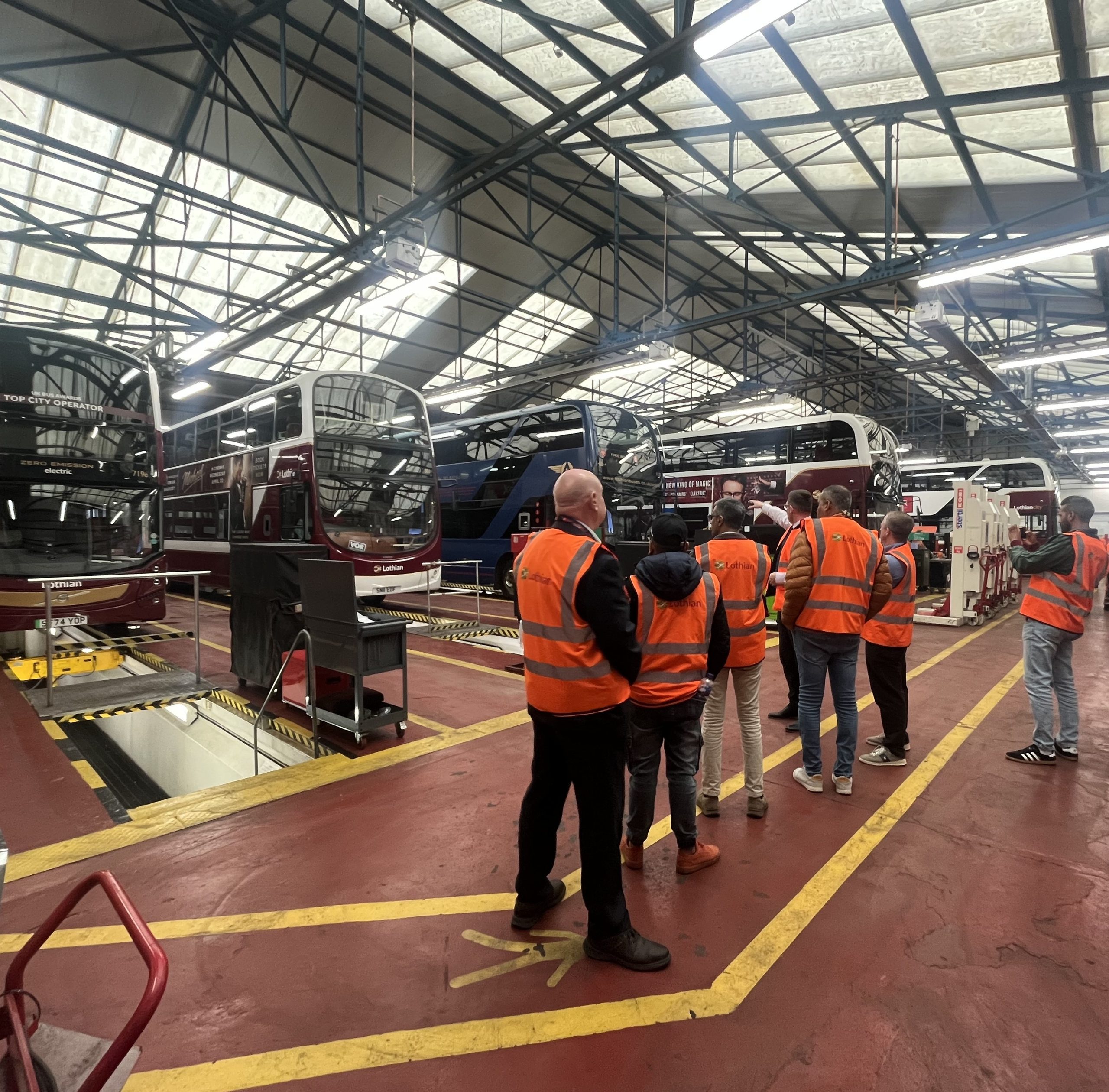
A highlight of the week in Edinburgh was an opportunity to visit the Lothian Buses central depot and head office at Annandale Street. Lothian Buses is the UK’s largest municipally owned bus company and is the holder of the November, 2025 UK Bus Awards ‘Top City Operator’ and Bus Operator of the Year 2026 at the UK National Transport Awards.
The group was welcomed to Lothian Buses by Dylan Dastey, Lothian Buses Engineering Director and Paul Baxter, Chief Engineer. They were shown the organisation of the maintenance facility, a number of electric vehicles and also the tracking systems employed for seeing the citywide charging status of vehicles out on operations.
Dylan Dastey of Lothian Buses said: “We were delighted to welcome delegates to Lothian and offer an insight into our Engineering function, including our highly regarded apprenticeship scheme.
“As the city’s main public transport operator, we are committed to working with key partners, sharing best practice to maintain high standards and support compliance across the sector. As new technologies emerge and evolve, sharing best practice and learning from operators and suppliers across the industry is more important than ever.”
Jon Buglass, Deputy Principal added: “It was wonderful to welcome the delegation from Mauritius, and show them first-hand the important work we are doing teaching our students how to properly maintain and service electric buses.
“The skills needed to work on electric vehicles are becoming increasingly vital as Scotland transitions towards a net-zero future, and we are proud to share our expertise with international partners who are pursuing their own green objectives.”
A cultural close to the week was an Edinburgh Bus Tours open top bus trip around the city’s key sights.
British Council Going Global Partnerships support universities, colleges and wider education stakeholders around the world to work together towards stronger, equitable, inclusive, more internationally connected higher education, science and TVET.
The partnership has also engaged with stakeholders which include the Mauritius Qualifications Authority (MQA), the National Transport Corporation (NTC), HSBC Mauritius and government representatives to support this wider development of electric vehicle maintenance skills in Mauritius.
The Tour de France Grand Départ Trophy visited Portobello yesterday to celebrate the first ever time the race will start in Scotland.
The Tour de France will begin at Edinburgh Castle in July 2027, and ahead of the history-making departure the trophy was brought to Portobello promenade to recognise the work to encourage cycling within Portobello High School.
The school has done incredible work to encourage cycling within it’s community, including the launch of Girls Gone Cycling – a scheme to inspire female pupils to take up cycling.
Ten pupils from the Girl Gone Cycling team are heading to Paris this week to speak at the British Embassy on how they grew the initiative from an idea in June 2026, to within six months, including over 70 pupils and now being replicated in schools across Edinburgh and the East of Scotland.
Council leader Jane Meagher said: “I am really excited and proud to be welcoming the Tour de France trophy to Portobello High School before the tour comes to Edinburgh next summer.
“The Girls Gone Cycling initiative has been incredibly successful in encouraging girls to the sport and, in just a few months, is now being replicated at schools across the East of Scotland.
“The school has been instrumental in encouraging cycling within Portobello and Craigmillar and removing barriers to ensure biking is accessible to all.
“The Tour de France coming to Edinburgh for the first time is very exciting. We are investing £1.7million – money that has been generated from the Visitor Levy – to improve roads for the event and it’s set to bring in millions of pounds for the local economy.
““This will be another event that puts Edinburgh on the worldwide stage and I cannot wait to see the yellow jersey set off with the world famous Edinburgh Castle in the background.”
Headteacher at Portobello High School Greg McDowall said: “Our Pedal Power Porty has been a great success and encouraged so many children to use their bikes. We have a library of bikes for pupils to use so that cycling has no barriers and the older pupils teach basic bike skills and maintenance to the younger children.
“Having the Tour de France trophy come to Portobello is incredible and can only encourage more kids to take up cycling. I know a lot of our pupils are counting the days until the Grand Départ set off from their home city.”