We are excited to invite you along for our annual Summer BBQ! Held at our fully accessible hub at LifeCare 2 Cheyne St in Stockbridge.
Look forward to a bouncy castle, children’s activities, games and of course a proper BBQ all completely free. Everyone welcome! We can’t wait to see you there
Donations are welcome in order to support the work we do as a charity.
Milestone anniversary of 20 years of Jet2 at Edinburgh Airport and 15 years from Glasgow Airport this year
UK’s favourite airline and tour operator marked the occasion with a celebration at Edinburgh Airport
91 routes now on sale from Scottish bases, representing significant growth and expansion since first flights took off
Jet2 20th Aniversery Edinburgh Airport
Jet2is celebrating 20 years of operating award-winning flights and holidays from Scotland.
The UK’s favourite airline and tour operator has reached the key milestone after seeing its first flight from Edinburgh Airport take off in 2006 and from Glasgow Airport in 2011. Since the start of operations from two of Scotland’s busiest airports, over 22 million customers have travelled with Jet2 and experienced its VIP customer service the company has become known for.
To mark the occasion, during the busy morning of departures from Edinburgh Airport yesterday (22nd April) customers and colleagues came together to celebrate the long-established partnership.
The check-in area at Edinburgh Airport was adorned in red, holidaymakers received a famously friendly welcome from Jet2’s Red Team, and one lucky customer was surprised with a free pair of return flights with Jet2.com, to mark 20 years of the airline flying from the airport base.
When Jet2’s first flight took off from Edinburgh Airport to Murcia 20 years ago and from Glasgow Airport to Alicante 15 years ago, the airline and tour operator had just two destinations on sale from Edinburgh Airport and seven from Glasgow Airport. Since its inaugural flights departed, the company has experienced continued growth and success to become the UK’s third largest airline, with Jet2holidays taking the top spot as the UK’s largest tour operator.
As a result of that growth, Jet2 now has 51 destinations on sale from Edinburgh Airport. From Glasgow Airport, the airline and tour operator operates to 40 sun, ski and city destinations, offering customers and independent travel agents in Scotland fantastic choice and flexibility when it comes to reaching their favourite hotspots across Europe, the Mediterranean, North Africa and the Canary Islands.
Jet2continues to expand its offering from Edinburgh Airport, with three new routes on sale for Summer 2026. The new routes are to Girona, Kalamata and Kefalonia and means Jet2 is operating its biggest programme to date from Edinburgh Airport. Looking further ahead, the airline and tour operator will also introduce even more new destinations, including Strasbourg, Sharm El Sheikh, Chania, Skiathos and Pula from Edinburgh Airport.
As Jet2 also celebrates 15 years of operating from Glasgow Airport, its expansion further into Scotland was a strategic move and marked the opening of the airline’s eighth base, establishing it as a key leisure carrier in Scotland.
Jet2has continued to grow its presence at Glasgow Airport and has two new routes on sale from the Scottish base for Summer 2026, including services to Dubrovnik and Kos. From February 2027, flights and holidays will also launch to Hurghada.
In Summer 2026, Jet2 has over 200 flights departing per week and more than 2.2 million seats on sale from Scotland, meaning customers and independent travel agents have plenty of choice and flexibility.
Over the past two decades, Jet2.com’sVIP customer service, friendly low fares, 10kg hand baggage allowance and great flight times have proven popular amongst customers travelling from Scotland, enabling the company to expand significantly at Edinburgh and Glasgow Airports. As a result of this industry leading customer service, Jet2.com has repeatedly won renowned accolades including being named a Which? Recommended Provider for 11 consecutive years.
Now the UK’s largest tour operator, package holiday specialist Jet2holidays was launched in 2007 on the back of the airline’s success. With its ATOL protected package holidays combining a choice of 2 to 5 star accommodation, in-resort Customer Helpers, return transfers, plus flights including 22kg hold luggage, this award-winning formula has proven extremely popular amongst holidaymakers.
Jet2 20th Aniversery Edinburgh Airport
Steve Heapy, CEO of Jet2.com and Jet2holidays, said: “Celebrating 20 years of operations in Scotland is a massive milestone for us and we are proud to be marking this significant event.
“Edinburgh and Glasgow Airports remain key UK airport bases for Jet2, and just like the last 20 years, we have no doubt that our offering from Scotland will continue to grow as we remain committed to our long-established partnership with the Scottish bases.
“As well as looking back at all that we have achieved over the last 20 years, we are looking ahead to even more success at Edinburgh and Glasgow Airports and look forward to many more years of operating our award-winning flights and holidays.”
Jet2 20th Aniversery Edinburgh Airport
Stephanie Wear, Chief Commercial Officer at Edinburgh Airport, said: “Jet2 has been a hugely important partner for Edinburgh Airport over the last 20 years.
“Since launching its first flight from Edinburgh in 2006, Jet2 has become a key part of our connectivity, providing millions of passengers with fantastic choice.
“The continued expansion of Jet2’s routes, including new ones for summer 2026, demonstrates the strength of demand from Scotland and our shared commitment to offering passengers even more choice when they travel.
“We look forward to building on this partnership for many years to come.”
Local residents are welcome to join us to find out more about the community council, or to raise an issue for discussion!
This is a hybrid meeting – if you’d like to attend online, please get in touch for the MS Teams link. Alternatively, we can raise any issues for discussion on your behalf.
New agreement between the UK and France to step up patrols and intelligence operations in France to reduce illegal crossings
The United Kingdom and France yesterday signed an agreement to strengthen operations to combat illegal migration in northern France to prevent crossings to the United Kingdom with a significant increase in dedicated human, technological and intelligence resources.
Since the 2024 UK election, work between the UK and France has prevented more than 42,000 illegal migrants from crossing the Channel. The joint action also led to the arrest of 480 smugglers in 2025.
The new partnership will build on these encouraging results to reduce the number of illegal Channel crossings.
For the first time, UK funding will include a flexible part to support actions to strengthen the effectiveness of the scheme. These actions will be subject to a regular joint evaluation in order to analyse their impact on reducing the flow of illegal immigration.
The personnel (nearly 1,200 agents of the police force, the intelligence services and the maritime prefecture) already deployed will be renewed and reinforced in the North to prevent illegal crossings from France.
The new partnership aims to increase the number of personnel deployed by 53% – 907 personnel funded in the 2023-2026 cycle and 1,392 in the 2026-2029 cycle, as well as a CRS unit dedicated to the fight against illegal immigration, managed by France. This will be accompanied by the deployment of new technologies to reduce the number of departures of small boats, in particular water taxis.
Under the new partnership, £500 million (€580 million) will be invested to strengthen the control system in northern France and a further £161 million (€187 million) will fund new actions based on their impact on crossing prevention. If these new measures do not yield sufficient results, on the basis of a joint annual evaluation, funding will be redirected to new actions.
This new partnership includes:
Reinforcement of staff on the ground: currently, 907 people are deployed on the ground and have prevented 42,000 crossing attempts since the 2024 UK elections. This new partnership provides for a 53% increase in the workforce, including the creation of a new specialized unit (SIPAF – Interministerial Border Police) of 80 people.
The completion of major real estate projects and new investments: the administrative detention centre in Dunkirk and the future CRS cantonment in Calais, which will increase the efficiency of the police forces.
The strengthening of intelligence and judicial police units: this unit, the GAO, composed of 18 people, led to the arrest of 480 smugglers in 2025. The number of personnel in this unit will be increased to 30 in order to intensify the fight against smuggling networks in the northern zone
Strengthen surveillance capabilities and infrastructure using drones, helicopters and electronic means to better prevent crossing attempts.
These measures are complemented by the desire to combat the phenomenon of illegal immigration to the United Kingdom upstream, by strengthening joint actions in countries of origin and transit.
As the Channel is an external border of the European Union, the partnership between the United Kingdom and France is part of a broader European cooperation that both countries wish to strengthen.
Home Secretary, Shabana Mahmood, said: “Our collaboration with the French has prevented tens of thousands of illegal migrants from boarding the boats bound for Britain.
“But we need to go further. This historic agreement will prevent illegal migrants from making the perilous journey and put smugglers behind bars.”
French Minister of the Interior, Laurent Nunez, said: “This new agreement gives our security forces the means to continue their decisive commitment in the fight against dangerous Channel crossings and to strengthen the security of coastal residents.
“I also welcome Frontex’s commitment, which is intended to be amplified in the context of enhanced European involvement in the surveillance of this external border of the European Union.
“I also recognise Frontex’s commitment to be strengthened as part of a stronger European involvement in the surveillance of this external border of the European Union.
“A large part of the resources provided for in this partnership will be concentrated from the beginning of the summer and during the summer period, which is traditionally the busiest period for small craft crossings.”
This partnership complements the important reforms undertaken by the UK government to reduce the pull factors that push irregular migrants across the Channel and to intensify the expulsion of irregular foreign nationals from British territory.
Nearly 60,000 illegal migrants and foreign criminals have been sent back or deported since this UK government came to power, an increase of 31%.
Immigration control measures to combat illegal working have reached levels unprecedented in British history, with an 83% increase in arrests and a 77% increase in police interventions under this government.
The UK government is also closing all reception hotels for asylum seekers and transferring them to accommodation centres, especially those on former military sites.
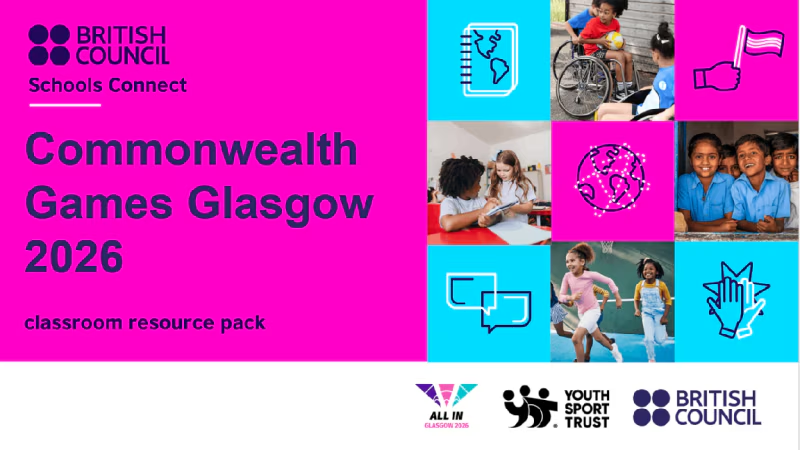
Ahead of this summer’s Commonwealth Games in Glasgow, the British Council has joined forces with children’s charity Youth Sport Trust to produce a new classroom resource pack for schools.
Designed to support learning and activities for young people, the pack celebrates the return of the Commonwealth Games to Glasgow this summer from 23 July – 2 August and the work of the Commonwealth to improve the lives of its citizens.
The resource forms part of the Glasgow 2026 Schools Programme and is inspired by All In – the nationwide call to action for this year’s Games, inviting communities to celebrate the Games in their own ‘altogether brilliant’ way.
The pack was launched yesterday at St John Paul II School in Castlemilk, Glasgow, where teacher and former Glasgow 2014 ceremony cast member, Jacqueline Hart and her pupils were visited by gymnast Cameron Lynn who, following his appearance at Birmingham 2022, is aiming to represent his country again at Glasgow 2026; and Glasgow 2026’s official mascot Finnie, the sport-loving unicorn.
Featuring a series of interactive learning activities and materials, teachers can use the resource pack to raise awareness of the Commonwealth and its values and help young people feel connected to the Games, their local community, country and the wider Commonwealth.
Schools can find out more and download the pack here.
Pupils will be introduced to the Games’ values of Humanity, Destiny and Equality through sessions exploring connection, fairness and inclusion. This echoes the British Council’s work building connections, understanding and trust between people in the UK and other countries through arts and culture, education and English language.
Designed for pupils aged between 7 and 11, the activities in the pack are flexible and adaptable. Teachers can use them as starting points for individual lessons or to form part of a larger cross-curricular project with a partner school overseas.
The British Council is also inviting any schools wishing to participate with an overseas partner to use their PartnerFinder database free of charge, to search for like-minded schools around the world.
The classroom resource builds on the British Council’s Schools Connect programme, which supports young people in the UK and around the world to build the skills, knowledge and attitudes they need to respond to global challenges and develop international understanding.
Glasgow 2026 is set to be ‘the most inclusive, community-driven and connected Commonwealth Games yet’, with 3,000 athletes from 74 nations and territories set to compete in an 11-day programme of 10 sports and six Para sports across four iconic venues.
Beyond its credentials as a major historical sporting event, The Commonwealth Games is also a chance for people from around the world to come together, celebrate their cultures and learn from each other.
Claire de Braekeleer, Director, British Council Scotland, said:‘The Commonwealth Games 2026 is not just a sporting event, it is a chance for people from around the world to come together, celebrate their cultures and learn from each other.
“This classroom resource pack will enable children and young people to connect internationally on critical themes, such as equality and fairness, and celebrate the Game’s focus on inclusion and sustainability.
“While we proudly shine a light on Glasgow and Scotland as this year’s hosts, the pack is available for all and we hope that teachers and pupils across the whole of the UK will benefit from the resources available.’
Emily Reynolds, Director, Youth Sport Trust, added:‘The Youth Sport Trust are delighted to be working in partnership with the British Council and Glasgow 2026 to bring this engaging resource to schools and teachers.
“The Commonwealth Games offer a powerful opportunity to connect young people to Glasgow, the values that unite the Commonwealth, and the wide range of sports that make the Games so special.
“Multi-sport events like the Commonwealth Games can inspire children and young people of all backgrounds, helping them to discover new sports, develop curiosity, and build a lifelong relationship with physical activity.
“This resource is designed to support teachers to bring that inspiration into the classroom and empower young people to learn through sport.’
Phil Batty OBE, Chief Executive, Glasgow 2026, said:“‘The Glasgow 2026 Schools Programme is helping to bring the Games to life in classrooms across Glasgow and Scotland, ensuring that young people feel genuinely connected to what these Games represent. It’s vital that young people across the country see themselves reflected in Glasgow 2026, and this programme plays a key role in making that happen.
“Developed with the support of partners including the British Council and the Youth Sport Trust, the programme gives pupils the opportunity to explore the cultures that make up the Commonwealth, increase participation in sport and develop positive, healthy habits that can last a lifetime.
“The resources have been carefully designed to be inclusive and adaptable for all learners and educational settings, while reflecting the vision and values at the heart of these Games.
“With Glasgow 2026 set to deliver the largest-ever Para sport medal programme in Commonwealth Games history, it’s especially powerful to see that same ambition and commitment to inclusion championed through the Schools Programme.’
As Scotland marks the National Year of Reading, the Edinburgh International Book Festival will launch its 2026 Schools Programme (running Monday 24 – Friday 28 August 2026) with a week of author events, creative activity and classroom resources designed to support teachers, school librarians and home educators at the start of the academic year.
The timing is pointed. New research from the National Literacy Trust (published January 2026, based on a survey of 7,739 children and young people aged 8-18 across 61 Scottish schools) reports that 30.3% of children and young people in Scotland say they enjoy reading in their free time, and only 1 in six read daily – a sharp reminder of how much reading cultures need practical, confidence‑building support.
The 2026 Schools Programme offers multiple routes for participation: schools can visit in person, join selected events via livestream (with on‑demand access afterwards), and draw on a bank of Learning Resources intended for standalone lessons or to expand a Book Festival visit. Digital participation options are explicitly free.
For in‑person visits, pupils will be able to see writers and illustrators live, take part in event Q&As, and, on Wednesday 26 August and Thursday 27 August, explore the Discovery Zone(drop‑in activities 10:00–14:00, located on Level 2) delivered with partner organisations including Edinburgh Libraries, Super Power Agency, and Kids in Cyber.
Across the programme, the Book Festival’s emphasis is on access: every pupil receives a free book, thanks to the support of Claire and Mark Urquhart, and schools can apply for free tickets for pupils who might otherwise miss out, as well as support from a transport fund. Tickets are priced at £4 per pupil, with one free adult ticket per ten pupil tickets (with flexibility where higher ratios are needed for access reasons).
Author highlights (2026)
The programme features a wide range of writers and illustrators for primary and secondary years, including Jacqueline Wilson, Paterson Joseph, Patrick Ness, Katherine Rundell, Manjeet Mann, and others across the week, with themed days including a Primary School Gala Day (Wed 26 Aug) and Secondary School Teen Takeover Day (Thu 27 Aug).
A glamorous, never-before-exhibited portrait of Queen Mary and a miniature sleigh made of rock crystal will be among highlights on show in Scotland for the first time in a major exhibition opening tomorrow.
The Edwardians: Age of Elegance will explore the glitzy world of two of Britain’s most fashionable royal couples – King Edward VII and Queen Alexandra, and King George V and Queen Mary – through their family connections, royal events, global travels and art collecting.
The exhibition will open in Edinburgh following a successful run in London and is the first Royal Collection Trust exhibition to explore the Edwardian era. It will bring together more than 150 items including fashion, paintings and books, as well as personal items such as jewellery, photographs and chinaware, more than half of which are on show in Scotland for the first time.
Visitors will see works from the Royal Collection by many of the period’s most celebrated names, including Fabergé, Tiffany & Co, and Edward Burne-Jones, and depictions of famous faces including composer Sir Edward Elgar.
Curator Kathryn Jones said: ‘The Edwardian era was a golden age of glamour and parties, but it was so much more than that; it was a fast-paced period making great advances in technology.
“Our royal couples wanted to make the most of it all, living lavishly and embracing new trends, before the sobering arrival of war. Throughout, they were collecting art as a way to hold onto tradition and capture the rapidly changing world around them. We hope that visitors to the exhibition will enjoy stepping back in time to this exciting period.’
In 1863, Queen Victoria’s eldest son Albert Edward married Princess Alexandra of Denmark. The marriage of the fashionable young couple – the future King Edward VII and Queen Alexandra – initiated a glamorous new era for the royal family, with Queen Victoria still in mourning and away from public life.
Edward and Alexandra established a new, vibrant court filled with opulent balls, society events and contemporary art – a lifestyle continued by their son, the future King George V, and his wife Queen Mary.
Full-length portraits of the two Queens will open the exhibition, showcasing the spectacular fashions of the era. The portraits of Queen Alexandra by François Flameng, and Queen Mary by William Samuel Henry Llewellyn (which has never before been on public display) will be shown alongside marble busts of their husbands, Kings Edward and George.
Both couples were fond of Scotland, with Edward having studied at the University of Edinburgh and George and Mary making regular visits and devotedly modernising the Palace of Holyroodhouse to make it once again suitable for royal entertaining.
Displays will evoke the interiors of the royal couples’ private residences, Marlborough House and Sandringham House, where the Edwardian fashion of filling every cabinet and covering every surface small decorative objects or family photographs reigned.
A star object on display for the first time in Scotland is a paperweight shaped like a tiny 10cm-tall sledge with a figure lying on it by Robert Colquhon. Thought to have been Scottish, Colquhon was a goldsmith based in Russia who made small-scale decorative objects from rock crystal and silver of snowy subjects like sleighs and bears on ice floes.
Edward and Alexandra collected several of his works – with one of his sleighs appearing in a photograph of Alexandra’s desk in Marlborough House in the 1890s.
Visitors will also learn of the relationships linking the family to the rest of Europe. Fabergé was introduced to the British royal family through Alexandra’s sister Dagmar, who had married Alexander III, Tsar of Russia.
The royal patronage caused the popularity of Fabergé to soar in the UK, and on show will be 21 items from the firm, including an ornate picture frame holding a photograph of Princess Louise, Duchess of Fife; a cigarette case famously given to Edward by his official mistress Mrs Keppel; and six miniature figures of the royal couple’s favourite animals on the Sandringham estate.
As enthusiastic patrons of the arts, the Edwardians embraced new artistic movements including Art Nouveau and Arts and Crafts, and the burgeoning medium of photography. Alexandra was particularly taken with the drawings of the Pre-Raphaelite artist, Edward Burne-Jones, whose study for a larger painting inspired by Sleeping Beauty will be on display. A soft-focus photograph of Alexandra by photographer Alice Hughes was typical of her pioneering yet delicate style, and both are on display in Scotland for the first time.
Garden parties formed an essential part of the Edwardian social calendar, with the first taking place at the Palace of Holyroodhouse during the much-anticipated visit of George and Mary in 1911. Danish painter Laurits Tuxen had been introduced to Queen Victoria through her daughter-in-law Alexandra, and his painting of a garden party at Buckingham Palace captures the spirit of the joyous occasion.
Contributions to society were also celebrated through the founding of the Order of Merit in 1902 to recognise prominent figures in cultural, scientific or military life. George commissioned a portrait of each recipient – a tradition that continues to this day – and drawings of Sir Edward Elgar and the physicist Sir J.J. Thomson by Scottish artist William Strang will be on display for the first time in Scotland.
The turn of the century saw great improvements to methods of travel, and the Edwardian royals travelled further than any previous members of the royal family – collecting and receiving gifts as they went. In February 1901, George and Mary set sail for 10 months on HMS Ophir to open the new federal parliament in Melbourne, Australia. To mark the occasion, the ‘Ladies of Adelaide’ gave Mary a richly embroidered silk hanging featuring a eucalyptus tree and local varieties of irises and orchids.
George and Mary visited the Palace of Holyroodhouse in July 1914, only a few weeks before the outbreak of the First World War. The glamour of the Edwardian era was being eclipsed by a serious atmosphere of duty – a sentiment led by the King, as Herbert Arnould Olivier’s study of King George V and Frank O. Salisbury’s painting The Passing of the Unknown Warrior, King George V as Chief Mourner, Whitehall attest.
Collecting had now become a way to honour the many sacrifices made in the Great War; a more restrained and dutiful monarchy had emerged.
The King’s Gallery will continue to offer £1 tickets for visitors receiving Universal Credit and other named benefits. Other concessionary rates are available, including discounted tickets for Young People, half-price entry for children (with under-fives free), and the option to convert standard tickets bought directly from Royal Collection Trust into a 1-Year Pass for unlimited re-entry for 12 months.
The Edwardians: Age of Elegance is at The King’s Gallery, Palace of Holyroodhouse, 24 April – 6 December 2026.
Visitor information and tickets for The King’s Gallery, Palace of Holyroodhouse: www.rct.uk, T. +44 (0)303 123 7306.
The King’s Gallery will be open seven days a week from opening until 7 September 2026, when it will be open for five days (closed Tuesdays and Wednesdays) until 6 December 2026.
Two brothers have been jailed as part of a large-scale investigation into serious and organised crime.
Kieran and Aaron Miller, 31 and 34 respectively, plead guilty on Thursday, 12 March, 2026, at the High Court in Glasgow to offences relating to supplying drugs and using encrypted devices between November 2019 and June 2020.
Yesterday, Wednesday, 22 April, 2026, they were each sentenced at the same court to six years in prison.
Their part in sourcing and distributing illicit drugs worth over £1 million was uncovered as part of Operation Enchanting, closely linked to Operation Venetic – a Europe-wide investigation to identify and dismantle organised crime groups utilising encrypted devices.
The brothers are believed to have been supplying dealers rather than end users and, on a weekly basis, were found to be moving large quantities of cocaine, diamorphine, MDMA, cannabis, amphetamine and diazepam in the Fife and Central Scotland areas.
During the investigation, detectives uncovered that the pair sent over 36,000 messages via EncroChat devices, including images of cash and drugs.
Detective Inspector Craig Davies said: “Drugs cause misery in our communities and we are committed to use every tool and tactic at our disposal to bring those responsible for the sourcing and distribution of illicit drugs to justice.
“This result has taken a significant quantity of Class A and Class B drugs off the streets, and the people behind the deal will now face the consequences of their actions.
“This operation and our other recent successes underline our unwavering commitment to working with partners, including the NCA, Border Force and SOC Taskforce, to disrupt this sort of criminality.
We’re down to the final week of #SpringCleanScotland and we want to capture all of your brilliant efforts!
If you register your litter pick before midnight on Friday 24 April you’ll be in with a chance of winning one of four £100 Helping Hand Environmental vouchers!
We have one voucher for uniformed groups, one voucher for sports clubs and/or organisations, and two further vouchers for any group or individual who registers their pick. All previous registrations also count towards the prize draw.
Have you taken part in a litter pick recently?
Enter your event’s details on our website for a chance to win a #SpringCleanScotland prize!