Taiko Drummers marked the opening of the global apparel retailer’s store on Princes Street yesterday.
UNIQLO boasts a spacious retail space spanning approximately 1,430 sq meters across two floors featuring the full collection of LifeWear for men, women, kids and babies.
Alessandro Dudech, Chief Operating Officer at UNIQLO U.K, Erhan Demir, UNIQLO Edinburgh General Manager, cut the ribbon to UNIQLO’s first Scottish store with special guests from the Japanese Consulate, Mr Tadashi Fujiwara and Ms Minori Ishii, and UNIQLO People Campaign cast member, Aisha Fatunmbi Randall, who has been at the forefront of the restoration of Leith Theatre in her role as Marketing and Digital Coordinator.
To mark the grand opening, UNIQLO Edinburgh is hosting special promotions and events, offering customers the chance to discover the latest styles and enjoy exclusive offers.
UNIQLO app customers will be in with the chance of winning a trip to Tokyo, by scanning the app with any purchase during opening weekend to be entered into the draw.
There will be limited price promotions exclusive to the Princes Street store on items such as Ultra Light Down, Extra Fine Merino sweaters, pleated wide pants and selected innerwear for both men and women.
UNIQLO currently has 19 stores in the U.K. The new Edinburgh Princes Street store opens hot on the heels of One Oxford Street in London on 18th April 2024.
The UNIQLO Edinburgh store operates during regular business hours, providing shoppers with ample opportunities to experience the brand’s renowned offerings. Whether seeking timeless classics or contemporary trends, UNIQLO invites the Edinburgh community to visit its newest location.
For more information about the new store, please visit:
UK’s First Ever Brick Fest Live Comes To Edinburgh
Edinburgh Royal Highland Centre Lowland Hall 4 – 6 May
For the first time ever, the world’s largest hands-on LEGO® event of its kind catapults from the US to make its UK debut in Edinburgh this Spring.
Brick Fest Live will open at the Edinburgh Royal Highland Centre Lowland Hall on 4 – 6 May, with over a million LEGO® bricks on display and ready for play!
Brick Fest Live allows families to enjoy mind‐blowing creations from all over the world made entirely of this timeless toy. Children and adults will be amazed by life-sized LEGO® models and hands-on building activities assembled to set the imagination free.
Brick Fest Live will also feature an enormous marketplace where avid builders will be able find rare collectibles not available anywhere else.
Michael Clapham, Show Producer, said: “We’re incredibly excited to bring the smash hit Brick Fest Live all the way from the USA to venues in the UK for the first time ever.
“This is an event for all the family as well as hardcore LEGO® enthusiasts. And if the hugely successful American events are anything to go by, tickets will sell out fast!”.
In addition to seeing the most life-size models and participating in fun building challenges, Brick Fest Live attendees can:
See life-size models
Help Build a Guinness World-Record Setting Floor Mosaic
Express your creativity at the hands-on build zones
Race your brick-built car down the 35’ long derby ramps
Shop Hard-to-Find LEGO® merchandise
Build walls of LEGO® mosaics built by attendees
Enter the GLOW ZONE and build with bricks that shine under blacklight
Play in a Brick Pit with hundreds of thousands of LEGO® bricks
A lucky Edinburgh heating and plumbing installer who launched his own business less than three months ago has won £500 from smart thermostat company tado°.
Ryan Beattie, 35, struck out on his own and started his company Thermatek in February after an 18-year career in the industry because he wanted to offer his customers tailor-made options that included smart heating and were more environmentally-friendly.
He also joined tado°’s Professional programme for installers and within two weeks had won the £500 giveaway prize on offer to celebrate the scheme’s first year in operation.
Installers were entered into the prize draw whenever they bought tado° products from participating partners and a delighted Ryan said: “I’m very happy because starting a new business is very stressful and so this is a nice little boost as I’m starting out.
“It’s not that common for a product to give back like this so it is nice to feel valued.”
It has been a busy time for Ryan after his wife Sally gave birth to the couple’s son Rowan nine months ago.
He started working for his father Stevie installing heating systems in Belfast straight from school before moving to Edinburgh and continuing in the industry. However he felt a desire for more autonomy to offer customers with products he trusted and used himself that saved them money and were also better for the environment.
“I want to be at the pointy end of the industry,” Ryan explained. “I want to provide people with the most modern and cutting edge technology that is also better for the environment.
“I am not a complete green warrior but there is only one planet and we all have to do our bit.
“The companies I have worked for have had a more traditional view on heating systems but I can now offer to customers the best possible products that are tried and tested and can take my time. If you get it right it makes people happier, they tell their friends and you grow more work that way.”
tado°’s £500 giveaway was to celebrate its Professional programme’s first full year of operation, which saw the number of installers grow by 600 per cent. As well as being a loyalty scheme that offers rewards, tado° Professional gives installers support through training, phone support and extended warranties to help grow their businesses.
tado° Professional is growing in 2024 across the UK, Germany, the Netherlands, Italy, France and Spain and European Channel Director (Installer) John Steven said the programme is working towards improved lead generation to pair more consumers with professional installers within their locale.
He said: “It was a fantastic first year for tado° Professional. It’s been reported recently tradespeople saw their turnover take a hit in 2023 and so we wanted to do something for tado° Professional’s first birthday that gave something back to our installers.
“We couldn’t be happier that someone like Ryan has won – he is an installer who is not only ambitious about starting his own business but at the same time wants to deliver the best possible heating products that are easy for customers to use whilst cutting their energy bills without compromising on comfort.
“That, and his desire to do what he can for the environment, perfectly aligns with tado°’s mission and values.”
Ryan hasn’t decided what he will use the £500-worth of reward points on but said he was likely to choose something that helps his business continue to grow.
He added: “There are rewards schemes out there but it’s nice with tado° Professional to get back something for using a product, especially if you like it, and that benefits the business in ways that are not just financial.
“There is that support from tado° and it is nice to feel valued.”
Ryan was a tado° customer before he launched Thermatek. He said: “I wanted the nursery to be a constant temperature and tado° was the easiest way to achieve that.
“When I first started installing tado° it was more the techy people who wanted it but it has become a little more mainstream.
“I know some heating brands and controllers can be incredibly complicated and that can switch people off but the best thing about tado° is that it all happens in the background for them.
“Not all customers want a smart thermostat but when you explain it to them and that there is a way to set it up so it is simple to use while also saving money and energy there is a lot more interest.”
Installers can sign up to the tado° Professional rewards programme at:
Interactive map launched to celebrate Billy Connolly
A BIG MAP FOR THE BIG YIN!
National Theatre of Scotland launches a new interactive map for Scotland to demonstrate its love for the Big Yin, inviting people to share their own Billy Connolly memories.
National Theatre of Scotland’s acclaimed, five-star, sell-out production, celebrating Scotland’s most loved comedian, Billy Connolly, returns to stages in 2024.
ABOUT THE BIG MAP FOR THE BIG YIN
Billy Connolly’s relationship with Scotland spans his extraordinary life and career over the last 80 years. The National Theatre of Scotland wants to create a map of all the places that have a personal connection to Billy, to help create a love letter from the people of Scotland to their favourite comedian. They are inviting people to share their knowledge of Billy, stories, memories and photos, to make a living tribute to The Big Yin.
Billy Connolly toured the folk clubs, the grand theatres and workings men’s clubs of Scotland from 1970’s, retiring from live performance in 2018.
Born at 69 Dover Street, Anderston, he worked the shipyards of Glasgow’s Clydeside in the 1960’s, before taking to the road with folk rock band The Humblebums.
He made his theatrical debut, in 1972 at the Cottage Theatre in Cumbernauld, ahead of performing in The Great Northern Welly Boot Show at the Edinburgh Festival Fringe, also that year.
Billy first established himself as a star, selling out a run and breaking box office records at Glasgow’s Pavilion Theatre in Jan/Feb 1974, returning to the theatre on many occasions.
In January 1994, he undertook a World Tour of Scotland on a Harley Davidson, taking him from Kelso to Kirkwall with a stop off at Eden Court, Inverness, broadcast on the BBC later in the year. His love affair with his native country, continued with his residence at Candacraig House, in Aberdeenshire.
Billy Connolly’s relationship with Scotland spans his extraordinary life and career over the last 80 years. The National Theatre of Scotland wants to create a map of all the places that have a personal connection to Billy, to help create a love letter from the people of Scotland to their favourite comedian. They are inviting people to share their knowledge of Billy, stories, memories and photos, to make a living tribute to The Big Yin.
Billy Connolly toured the folk clubs, the grand theatres and workings men’s clubs of Scotland from 1970’s, retiring from live performance in 2018.
Born at 69 Dover Street, Anderston, he worked the shipyards of Glasgow’s Clydeside in the 1960’s, before taking to the road with folk rock band The Humblebums.
He made his theatrical debut, in 1972 at the Cottage Theatre in Cumbernauld, ahead of performing in The Great Northern Welly Boot Show at the Edinburgh Festival Fringe, also that year.
Billy first established himself as a star, selling out a run and breaking box office records at Glasgow’s Pavilion Theatre in Jan/Feb 1974, returning to the theatre on many occasions.
In January 1994, he undertook a World Tour of Scotland on a Harley Davidson, taking him from Kelso to Kirkwall with a stop off at Eden Court, Inverness, broadcast on the BBC later in the year. His love affair with his native country, continued with his residence at Candacraig House, in Aberdeenshire.
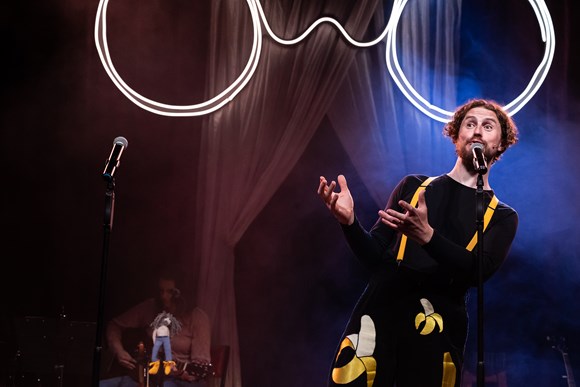
Gary McNair – writer and performer of Dear Billy said: “I’m delighted we are launching the Big Map for the Big Yin where people can pin their own stories and connections to Billy. As we learned when interviewing people to make this show- everyone has something to say about Billy, whether that’s a memorable meeting or a connection to his work.
“The great thing about the Big Map is that there is a space where people can continue to share and hopefully build an interactive document about what he means to us all.
“I’m beyond giddy to be bringing the show Dear Billy back so soon after it’s tour last year. It is a genuine honour to have been trusted to make this show, Billy is so important to so many people that it was so well received was a dream come true.
“I can’t wait to get back on the road with the band and meet new amazing audience.”
ABOUT THE SHOW
National Theatre of Scotland presents
DEAR BILLY
A Love Letter to the Big Yin From the People of Scotland
Written and performed by Gary McNair, Directed by Joe Douglas
Music performed and composed by Simon Liddell and Jill O’Sullivan, Set and Costume designed by Claire Halleran, Lighting design by Kate Bonney and Simon Hayes, dramaturgy by Joe Douglas.
Touring Scotland and England in May followed by a run at Edinburgh Festival Fringe in August 2024
Opening at His Majesty’s Theatre, Aberdeen then touring to Pavilion Theatre, Glasgow; and Eden Court, Inverness.
Followed by a two-week run at the Assembly Rooms as part of the Assembly Festival programme for the Edinburgh Festival Fringe 2024.
“Vivid, funny and poignant.” ★★★★★ The Guardian
“A gloriously masterful 90 minutes of theatre.” ★★★★★ The Telegraph
In 2023 National Theatre of Scotland’s production of Dear Billy undertook a 17 venue Scotland-wide tour, reaching over 8000 people.
Originally announced to mark Billy Connolly’s 80th birthday year, the production was enthusiastically received by audiences, selling-out at venues across Scotland, garnering a wealth of positive reviews and due to popular demand is now back on tour again in 2024.
“If you want to know about Billy Connolly, ask the people of Scotland. If you want to know about the people of Scotland, ask them about Billy Connolly.”
Billy Connolly needs no introduction. He is a national treasure. From the shipyards of the Clydeside to his trailblazing and extraordinary stage and movie exploits, he is woven into Scottish culture.
Everyone has a Billy story. An expert team of story gatherers has created a collection of these moving and hilarious tales. Gary McNair, one of Scotland’s most renowned theatre-makers, has turned these stories into a special show celebrating the Big Yin and what he means to the people of Scotland.
The production will tour in May 2024, opening at His Majesty’s Theatre, Aberdeen before touring to Pavilion Theatre, Glasgow and Eden Court in Inverness with a two-week run at the Edinburgh Festival Fringe in August 2024.
Dear Billy is a unique touring production that evolved on the road. It travelled the length and breadth of Scotland in 2023, visiting local theatres, arts and community centres gathering stories along the way which were woven into the show as the tour progressed.
Gary McNair is hitting the road once more with two musicians. Audience members are welcomed to share their own Billy stories, with the possibility of those stories making it into the performance. Each show offers a unique chance for audiences to laugh, sing, and celebrate the man and the legend.
“The perfect tribute to a man who has left his gloriously indelible mark, not only on the art of stand-up comedy, but on the culture of Scotland.” The National
“What emerges is a brilliant portrait not only of the Big Yin as others see him, but of his importance as a cultural touchstone to many Scots” ★★★★, The Times
Dear Billy is written and performed by leading Scottish theatre-maker Gary McNair whose recent work includes the acclaimed Nae Expectations, a fresh take on the Dickens classic for the Tron Theatre; Ugly! A Cinderella Story for Cumbernauld Theatre Company and a new adaptation of Robert Louis Stevenson’s Jekyll and Hyde featuring a solo performance from Forbes Masson which opened at the Royal Lyceum Theatre, Edinburgh in January 2024 before touring.
The production is directed by Joe Douglas whose work for National Theatre of Scotland includes The Cheviot, The Stag and the Black, Black Oil, Dear Scotland and Associate Director for Black Watch. Joe previously collaborated with Gary on McGonagall’s Chronicles (Which Will Be Remembered for a Very Long Time).
Musicians re-joining Gary on the road are Simon Liddell whose work for theatre includes The Domestic (Scenes for Survival/National Theatre of Scotland) and McGonagall’s Chronicles (Which Will Be Remembered for a Very Long Time) and Jill O’Sullivan who writes and performs across the worlds of popular music, theatre and dance.
“A vivid, charismatic piece of theatre.” ★★★★★ The Skinny
Billy Connolly, or, the Big Yin, whom this show is dedicated to, is Scotland’s most beloved comedian, with an impressive career as a stand-up, actor, writer and musician spanning more than 50 years. In 2022, Connolly was awarded the BAFTA Fellowship for lifetime achievement.
Gary McNair is a Glasgow based writer and performer. He is a three-time Fringe First winner and has produced work for and with many of Scotland’s major theatre companies.
His plays have been translated and performed all over the world, from Germany to Japan, from New York to New Zealand. Gary’s work includes A Gambler’s Guide to Dying, Square Go (co-written with Kieran Hurley); McGonagall’s Chronicles Which Will Be Remembered for a Very Long Time, Donald Robertson Is Not a Stand-Up Comedian, After The Cuts, Letters to Morrissey and Locker Room Talk. These plays are published by Methuen.
Joe Douglas is a theatre director, playwright and performer.
Joe’s career began as Trainee Director at the National Theatre of Scotland from 2007 to 2008. He was the Artistic Director of Live Theatre from 2018 to 2020, and before that, Asspcoate Artistic Director of Dundee Rep and Co-Artistic Director of the Utter touring company. His work includes Clear White Light, Death of a Salesman, Spoiling, The BFG, George’s Marvellous Medicine, The Resistible Rise of Arturo Ui, Educating Ronnie, Letters Home, The Red Shed, Stand By and The Cheviot, the Stag and the Black, Black Oil.
Touring to His Majesty’s Theatre, Aberdeen (Thu 16-Sat 18 May); Pavilion Theatre, Glasgow (Wed 22-Sat 25 May); Eden Court, Inverness (Tue 28-Wed 29 May); Quays Theatre, The Lowry, Salford (Sat 1 June); Assembly Rooms,Edinburgh Festival Fringe (Tues 13 – Sun 25 August, no shows on Wednesdays)
On social: #DearBilly
Access: Theatre for a Fiver tickets available for under 26’s and those on Universal Credit
BSL interpreted, audio described and captioned performances full information here.
MSPs have backed Stage 3 of the Children (Care and Justice) Bill, enshrining in law age-appropriate care and justice for vulnerable young people across the country.
As part of wider work to embed the United Nations Convention on the Rights of the Child (UNCRC) in law and to Keep the Promise, the Bill contains a series of measures to improve children’s experiences of the care and justice systems, whether victims, witnesses or children who have caused harm.
It ensures children are kept out of prison, ending the placement of under 18s in Young Offenders Institutions, with secure accommodation being the normal place of detention instead.
The Bill also provides new reforms to support victims, including providing a clearer understanding of their right to request information from the Children’s Reporter and a new single point service for victims in the hearings system.
Further measures include:
strengthened referral arrangements between courts and children’s hearings
enhancements around secure and residential care, including secure transport
improved regulation for cross-border placements, to ensure that these happen only in exceptional cases where a move is in the child’s best interests
enabling secure care to support a young person past their 18th birthday, in appropriate circumstances
Minister for Children, Young People and Keeping the Promise Natalie Don said: “Scotland is taking a big step forward in embedding UNCRC principles and Keeping the Promise by passing this Bill.
“It contains wide ranging measures to ensure age-appropriate justice is delivered, ensuring children in Scotland are kept out of prison and supporting safe, proven care-based alternatives.
“The integrated, welfare-based, Kilbrandon ethos of our children’s hearings system is something Scotland can rightly take pride in and all children – whether in need, at risk or in trouble – deserve our concern and support. This Bill will help ensure they get it. It equally provides a robust package of support for victims and their families, strengthened during Stage 2 and Stage 3 of the Bill.
“This landmark Bill is proof of the progress Scotland is making to Keep the Promise by 2030 and will be transformational for the most vulnerable children and young people in the country.”
The Promise Scotland Chief Executive Fraser McKinlay said: “The Promise Scotland is pleased that the Children (Care and Justice) (Scotland) Bill has passed the final stage of parliamentary scrutiny. Effective implementation of the Bill will be critical. It must be accompanied by significant support for the workforce, along with adequate investment and resourcing.
“These important changes represent a significant step forward in Scotland’s efforts to Keep the Promise by 2030. It is clear that Scotland’s approach to care and protection must be based on early help and support alongside a more progressive, rights-based approach to youth justice that builds on the Kilbrandon principles, upholding children’s rights and increasing access to Scotland’s unique, welfare-based Children’s Hearings System.”
Children and Young People’s Centre for Justice Director Fiona Dyer said: “This is a momentous day for children in conflict with the law in Scotland.
“It marks the culmination of years of hard work and campaigning from many across the sector, including from children and young people themselves, to rightly recognise all children under 18 in the care and justice systems as children, in need of care and support.
“Nearly all children who harm have also been the victim of significant harm themselves and this Bill guarantees a compassionate, trauma-informed, and rights-respecting approach to ensure they are given the support needed to prevent future offending.”
· Childline has seen a five percent increase in counselling sessions on emotional abuse.
· Being shouted at or verbally abused accounted for more than half of the sessions (52%)
· NSPCC believeseveryone can play their part in protecting children from abuse and neglect, and calls for the public to get involved in Childhood Day on the 7th of June.
· Lidl GB has been named as retail sponsor for the third year in a row and is encouraging customers and colleagues to get involved in activities across the country.
Today, the NSPCC is releasing new data which reveals over the last year its Childline service has seen a 5 per cent increase in the number of counselling sessions it has delivered to children across the UK experiencing emotional abuse.
From April 2023 to March 2024 the service’s trained counsellors delivered 2,879 sessions on this issue.
In 52% of sessions, where the main concern was emotional abuse, being shouted at or verbally abused was the top sub concern.
Being criticised, humiliated and called names was the second most common sub concern.
The children’s charity is releasing these figures as it rallies communities to come together to play their part in helping to keep children safe by supporting the charity’s annual Childhood Day on the 7th of June.
Lidl GB has been named as retail sponsor for the event for the third year in a row and is encouraging customers and colleagues to get involved in activities across the country to help raise money.
People can get involved by donating, volunteering at a collection point or taking on the charity’s Childhood Day Mile.
All the funds raised will go towards helping the NSPCC deliver vital services, like Childline which supports children at risk.
Being isolated or ignored, not being allowed to have friends and receiving blame for things they had not done were amongst the main things that children mentioned to the service’s trained counsellors. On average, eight children a day are contacting the service about emotional abuse.
Fundraising activities already planned in Scotland include a beach clean at Broughty Ferry on the 28th of May and bucket collections in Edinburgh Waverley on 30th of May, St Nicholas Street, Aberdeen, on the 31st of May, and Glasgow Central on the 6th of June.
NSPCC fundraisers also hope to capture the generosity of music fans with collections outside Murrayfield on the 8th of June just before Taylor Swift’s concert in Edinburgh and also before a Foo Fighters concert at Hampden Park in Glasgow on the 17th of June.
Fiona Milne, Fundraiser for NSPCC Scotland, said: “The Childhood Mile is a fantastic way to raise money for the NSPCC and help us support children and keep them safe.
“Across Scotland, we will be out in force with our collection buckets, so if you have any spare change please give generously, or if you can give a couple of hours of your time, we would love you to join us.
“Fundraising drives like this are vital in allowing us to continue our work keeping children safe from abuse and neglect.”
A 17-year old from Scotland* told a Childline counsellor: “I live with my dad and most days it’s like treading on eggshells, I don’t know what mood he’ll be in.
“Like, the other day, he shouted at me for no reason, and called me stupid and hopeless. It hurts even more cos none my siblings get treated like this, it’s just me! Physically, I’m safe but mentally I feel like I’m dying inside. I don’t know what to do.”
Another young person that called Childline said: “I love my dad, he does not shout or swear or call me horrible names like mum. I feel way safer at his house, I don’t at mum’s – she’s really scary.
“Just yesterday, she screamed at my sister to ‘shut the F up!’ I honestly want to leave my house and run and run and never look back – but I can’t. What do I do?”
At the NSPCC, we know that emotional abuse can sometimes be difficult to spot as there are not always obvious signs.
Despite this, it is an issue that is impacting many children and young people.
Last year, 99,630 children were identified through Child in Need assessments as experiencing emotional abuse and this was the highest number of assessments for all types of abuse and neglect.
At the NSPCC, we know that over time and without the right support, emotional abuse can have long lasting effects on a child’s social, emotional, and physical health.
That is why it is essential that services like Childline are here for those children who need help and do not know where to turn.
Sir Peter Wanless, NSPCC CEO, said: “Half a million children a year suffer abuse in the UK. That means 7 children in a classroom experience abuse before they turn 18. This can’t go on and it doesn’t have to.
“It’s devastating to hear that contacts to Childline on emotional abuse are on the increase. We must remember that these are not children who are being overly sensitive or dislike being disciplined, they are being psychologically abused by the people who are there to protect them.
“For the past 140 years, the NSPCC has been working tirelessly to prevent abuse, change the law and support children at risk, but the charity knows that strong communities are at the heart of keeping children safe.
“That is why the charity is encouraging everyone to play their part and support Childhood Day. £4 raised could help a Childline counsellor answer a call to a child in need of help.”
Lidl GB is sponsoring the NSPCC’s Childhood Day for a third year as retail sponsor. Lidl GB has been partnered with the NSPCC for 7 years and is currently supporting young people with their mental health by raising money for Childline. Lidl GB will be helping to raise awareness of Childhood Day, as well as holding their own activities with their colleagues and customers across Great Britain to help raise vital funds.
Mark Newbold, Lidl GB Senior CSR Manager, said:“We’re proud to be backing Childhood Day for the third year in a row, rallying our colleagues and customers in support of such a vital cause – protecting young people.
“No child facing abuse or feelings of isolation should ever have to struggle alone. Childline is a lifeline for so many young people, and we hope that through our partnership with the NSPCC and continued support with raising funds, children who need somewhere to turn can get help quickly.”
To find out more on how to get involved in Childhood Day this year including taking part Childhood Day Mile or volunteering at a collection point visit:
Public servants in Edinburgh can now enjoy free unlimited access to more than 100 National Trust for Scotland places and more, thanks to a new membership package from Boundless – opening the door to £599* in total annual savings.
The new Boundless Plus membership package offers four new benefits for public sector and civil service workers and retirees, including days out at some of the UK’s top historic sites and attractions.
Among these benefits, Boundless Plus members get access to more than 100 National Trust for Scotland locations. This includes complimentary entry for up to two adults and up to six children at museums, gardens, historic houses and more, from the dramatic natural beauty of Glencoe National Nature Reserve in the Highlands to the fairytale Fyvie Castle near Aberdeen.
For those looking to immerse themselves in history, entry is included to sites cared for by the independent charity Historic Royal Palaces, with admission for one additional adult and up to two children per visit. This includes one of the UK’s most popular tourist attractions, the Tower of London – plus Hampton Court Palace, Kensington Palace, Kew Palace and Hillsborough Castle and Gardens near Belfast.
Adventurers will find no shortage of activities either, as Boundless Plus members can join the Ramblers community, with unlimited access to more than 50,000 guided group walks and a wealth of walking routes available to try out, including in Scotland.
Basic breakdown cover worth £33 with Roadside Assist by LV= Britannia Rescue tops off the offer, which includes free roadside assistance and local breakdown recovery.
Darren Milton at Boundless said: “We’re excited to expand our benefits package with a range of new opportunities for our members to enjoy some fantastic free days out in Scotland and across the UK.
“We hope Boundless Plus members will love exploring these top attractions with friends and family, whilst making great savings along the way.”
Ali MacLeod, head of fundraising at National Trust for Scotland, said: “We’re delighted to be working with Boundless and look forward to welcoming their members to experience and enjoy nature, beauty and heritage at National Trust for Scotland places.”
Boundless Plus members can access all the new benefits for an annual fee of £68, which builds upon the club’s impressive roster of deals already available with its £40 membership.
These perks include unlimited complimentary access to Kew Gardens in London, Wakehurst in West Sussex and all nine Wildfowl and Wetlands Trust (WWT) centres across the UK, as well as discounts for days out through Kids Pass, featuring kids-go-free deals and savings at nationwide attractions, such as Edinburgh Zoo and Go Ape forest adventure park.
Members get free access to tastecard including Coffee Club – the UK’s biggest dining club, which provides discounts every day of the week at thousands of restaurants nationwide. Boundless members also save up to 37 per cent on cinema tickets through the Cinema Society, including at Vue, Odeon, Cineworld and Showcase cinemas across the UK.
In addition, the Boundless community can enjoy a range of exclusive events throughout the year – from discounted member days out at some of the UK’s top attractions to online talks and masterclasses, plus a variety of local events organised by Boundless members, including lunches, quizzes, museum visits and more.
Boundless membership is available to all civil service and public sector workers, working or retired, along with relatives of existing members. This includes teachers, civil servants, local-government workers and members of the armed forces, fire service, NHS, police and more.
For more information on Boundless membership and to join, please visit: www.boundless.co.uk/plus.
* The value of Boundless Plus instant benefits is calculated by combining comparable membership deals at RBG Kew, National Trust for Scotland, Kids Pass, tastecard including Coffee Club and the Ramblers, as well as equivalent admission offers at WWT Slimbridge and the Tower of London (HRP). Additionally, it includes annual Roadside Assist by LV= Britannia Rescue. Terms and conditions apply.
Inception Art Show is thrilled to announce the dates for its return to Dalkeith Palace from Friday, May 3rd to Sunday, May 12th, 2024.
The art sales exhibition will feature an exciting programme alongside an impressive collection of sculptors, artists, photographers, and painters exhibiting within the historic cultural venue, Dalkeith Palace.
The 2024 edition of Inception Art Show will showcase a carefully curated collection of over 30 artists, with 10 talented NEW artists joining for the first time.
Building on the success of previous years, the exhibition will open its doors to the public on Friday, May 3rd at 10am, running for 10 consecutive days, including a NEW Family Day.
‘I am delighted to see Inception return to Dakeith Palace again this year’ says Charlotte Rostek who directs the development of the Palace. ‘It has really become our flagship show signalling a whole new chapter in the story of this remarkable building and one we are excited to see unfold over the coming years.’
With a focus on contemporary art and sales, Inception Art Show promises an enriching experience for art enthusiasts.
This year, 35 modern and contemporary artists will ‘take over’ the Palace, offering visitors the opportunity to engage with the artists and their creations over the course of 10 days.
“Working alongside the artists, we hope to create an immersive cultural experience that showcases the art at its best and engages directly with visitors” said Walter Dalkeith, who along with Taisir Gibreel and Charlotte Rostek curate the show each year.
“We are proud to create this platform for visitors to purchase artwork and support the incredible creativity and talent on show”.
In addition to the exhibition, Inception Art Show will feature an exciting programme of events, including Family Day, Palace tours, and an online charity auction in support of our charity partner, My Name’5 Doddie Foundation.
This thrilling addition to the Inception programme, gives visitors the opportunity to bid for works by many of the Inception artists, painters & photographers, all for a worthy cause, in partnership with the charity auction company Impulse Decisions.
Paul Thompson Director of Fundraising and Communications, My Name’5 Doddie Foundation, said: “The support we receive from the public makes an important difference to our ability to invest in vital MND research and we are thrilled that Dalkeith Country Park is supporting us through their Inception Art Show.
“Finding effective treatments for MND is a team effort and we’re sure that this fantastic partnership will be a popular one!”
Moreover, families are invited to enjoy a special NEW Inception Family Day sponsored by Savills, which will include family-friendly workshops and demonstrations on 11th May 2024.
Dalkeith Palace and Country Park is delighted to welcome Anderson Strathern supporting Inception Art Show as the exhibition’s catalogue sponsor and welcomes Savills as the sponsor of the new Family Day on Saturday 11th May 2024.
Entrance tickets to the Inception Art Show cost £3 and are now on sale.
The exhibition is open daily from Friday 3rd May to Sunday 12th May, from 10.00 to 16.00. We also run daily, pre-bookable guided tours of the Palace.
Meet the contestants of Dùbhlain DIY (Instructions Not Included)
Get ready for an electrifying DIY showdown this spring as amateur Scottish duos go head-to-head in a brand new TV challenge series,Dùbhlain DIY (Instructions Not Included).
Airing each Monday at 8.30pm from 6 May, the five-part BBC ALBA original series will follow six pairs – made up of married couples, family members and friends – as they compete for a £2,000 cash prize and the ‘Dùbhlain DIY champions’ title.
Inspiring the nation to ‘do it yourself’ in the name of sustainability, the innovative format will see rookie pairs battle it out in a series of home renovation tasks – with a twist. Without any instructions, demonstrations or even guidelines to follow, the couples will need to bring their differing strengths and creative talents to the competition to see who measures up.
Some may shine while others fall flat as they face a variety of themed challenges, but everything is to play for with one couple being eliminated each week, putting their skills – and relationships – to the test.
Hailing from across Scotland, the Dùbhlain DIY (Instructions Not Included) contestants include:
Isle of Lewis and BBC Radio Nan Gàidheal pals, actor Marisa MacDonald and An Lot crofter Donald “Sweeny” MacSween;
Hebridean siblings, solicitor Isabel Macleod (from Carloway, now based in Stornoway) and Royal National Mòd ‘Traditional’ gold medallist, Tormod Macleod (from Carloway);
Lewis-based spouses, wife and mum-of-four Marie Duke (originally from Skye) and her film editor husband Paul (originally from Newtonmore);
Glasgow-based friends, singer Josie Duncan (from Laxdale) and artist and content creator Choirstaidh Iona McArthur (from Greenock);
Retired twin sisters from the Isle of Lewis, Donna Barden and Mina Nicolson; and
South Uist cousins studying in Glasgow, Alasdair Campbell and Calum MacMillan (raised in Bornais)
From basic flat pack furniture to their own creations made out of recycled materials, their imagination will be allowed to run riot, before being tempered by materials, time constraints and often, their own abilities.
Dùbhlain DIY competitor, Tormod Macleod said: “I do occasionally try my hand at DIY. I have built flatpacks like everyone else and have built a couple of basic raised beds for my garden.
“I do try to fix things when needed as well but I’m certainly not a professional.”
Hoping to learn a few things along the way, his solicitor sister Isabel Macleod added: “I learnt a lot from my dad – he was a fisherman, joiner and builder and could turn his hand to anything.
“I would often spend time helping him make and repair things but wish I’d learnt more! I always attempt to fix things around the house as I don’t like how wasteful society is. Not sure if I’m very good at some tasks but it’s always worth a try!”
Hosted by TV and radio presenter Derek “Pluto” Murray, alongside main judge musician Iain “Spanish” MacKay – a skilled joiner by trade – the Gaelic duo ensure there will be plenty of laughs along the way.
Enlisting the help of an expert guest judge each week, viewers can join in with the excitement and exasperation as the couples vie for the title, with a display of improvisation at its best.
Presenter Derek “Pluto” Murray said: “Get ready for the ultimate test of creativity, ingenuity, and skill with our new DIY competition, pitching challenges with the twist of “instructions not included” – as if flat pack furniture building wasn’t stressful enough!
“Although the competitors lack in instructions, they excel in enthusiasm and craic!”
Judge Iain “Spanish” MacKay added: “It’s a celebration of the country’s DIY culture – whether an amateur enthusiast or someone who has had to pick up a hammer out of necessity, Dùbhlain DIY will give the viewers something they can relate to, even if it’s just seeing the sheer frustration of attempting even the most basic of DIY tasks.
“While offering feel-good escapism, we hope it’ll inspire those at home to get out there and start a new project of their own.”
But which couple can prove to the nation that they have what it takes to be the first ever ‘Dùbhlain DIY champions’ and still remain friends?
A joint project between Demus and Seaglass Productions, Dùbhlain DIY (Instructions Not Included) premieres on BBC ALBA and BBC iPlayeron Monday 6 Mayat 8.30pm (in Gaelic with English subtitles), with weekly episodes available every Monday evening. Watch live or on demand.
The first of its kind, Women in Revolt! is a major survey of feminist art, celebrating the women whose radical ideas and rebellious methods changed the face of British culture.
Come and discover the powerful and often provocative work of over 100 women artists and collectives, forged against the backdrop of seismic social and economic change over two decades.
Tickets are on sale now from the National Galleries of Scotland website.
Curated by Linsey Young, Curator of British Contemporary Art at Tate Britain, in collaboration with the National Galleries of Scotland and The Whitworth, The University of Manchester, Women in Revolt! will take over the entire Modern Two gallery in Edinburgh from 25 May 2024 until 26 January 2025.
Following its debut at Tate Britain in November 2023, the exhibition will bring to Edinburgh a select range of works from the London show, drawing from public and private collections across the country in what will be the only chance to see this landmark exhibition in Scotland.
Women in Revolt! spans two decades of art and activism, charting a range of themes and social issues that influenced and impacted on women artists.
Topics such as the Women’s Liberation Movement, maternal and domestic experiences, Punk and independent music, Greenham Common and the peace movement, the visibility of Black and South Asian women artists, and Section 28 and the AIDS epidemic will be explored in six thematic galleries platforming the creative contributions, ideas and activism of a diverse set of communities living and working in the UK throughout this period.
Women in Revolt! will highlight the ways in which women challenged societal norms through their creativity, both collectively and in isolation, using their lived experiences to create art and fight injustice.
Paintings, drawings, sculptures, textiles, films, photography, and documentation of performances will be shown alongside a range of archival materials, with many artworks on display for the first time since the 1970s.
Work by well-known artists including Sonia Boyce, Helen Chadwick and Linder will be displayed side by side with an array of artists who, despite their long careers, have been left out of the mainstream art historical narratives.
Featuring artists from across the UK, the powerful work and pioneering techniques of Scottish-based women artists will also be showcased. Visitors will encounter works such as Cool Bitch and Hot Dog (1978) by Edinburgh-based artist and weaverElizabeth Radcliffe. Her sculptural three-dimensional tapestry reflectsthe artist’s desire to be a modern woman, defying the passive stereotypes of mother, caregiver, cleaner or sexual object.
Glasgow-born artist Rita McGurn utilised a range of found and domestic materials to create work, using techniques such as crochet, a long-undervalued artistic medium due to its domestic associations. Several of McGurn’s characterful life-sized soft sculptures will go on display at Modern Two.
Maud Sulter
Select works from Scotland’s national collection will also go on display, including Uraniafrom the seriesZabat (1989) by the Scots-Ghanaian artist and writer Maud Sulter.
A significant figure in the Black Arts Movement, Sulter used her practice to challenge white supremacy and reconsider history through a personal lens as a Black woman.
The monumental Warrior Woman V: The Artist (1986), by Glasgow-based Sam Ainsley will be shown in Scotland for the first time in nearly four decades as part of this tour. Standing at over 11 feet tall and brimming with the spirit of protest, Ainsley’s work presents a striking figure, embodying the artist’s expression of feminist concerns, challenging the patriarchy and asserting female power.
GMA 3026
The dramatic evolution of women’s relationships with work, domesticity and motherhood created an extensive source of inspiration for artists throughout this period. Frustrations fuelled by the expectations of domestic labour are palpable in a range of impactful works on display by artists such as Bobby Baker, Alexis Hunter and the See Red Women’s Workshop whose bold poster works challenge sexist stereotypes and directly reflect the demands and concerns of the Women’s Liberation Movement.
The social and political implications of women raising a family also comes into play in works such as The Hackney Flashers’ Who’s Holding the Baby (1978). The installation critiques the lack of government supported childcare and sheds light on the impossible position of being both a mother and a worker in 1970s Britain.
The riotous and expressive era of Punk and Post-Punk movements will be examined through collage, film and photography by artists and musicians including Marianne Elliott-Said (A.K.A Poly Styrene), Caroline Coon, and The Neo Naturists, whose ritualistic performance art of the 1980s used bold body paint to challenge the objectification of the female form.
Gina Birch, a founding member of the experimental Punk band The Raincoats, also presents her 1977 film 3 Minute Scream, where the artist can be heard screaming for the duration of a Super 8 cartridge. The film communicates a powerful statement of defiance, conveying what many young women felt but were not given the opportunity to articulate.
The art of protest and women’s role in activism will form a key element of the show, with a range of banners, posters and journals, as well as documentary photography by Format Photography Agency, Mumtaz Karimjee, and Bhajan Hunjan telling the story of rousing, women-led protests throughout this time.
Women in Revolt! focuses on causes such as the Greenham Common Women’s Peace Camp, established in 1981 to protest the placement of nuclear weapons, and the Section 28 protests, fighting against laws prohibiting the promotion of homosexuality.
Materials exploring the 1984 Miners’ Strike and anti-racism campaigns are also represented, highlighting the central role women have played in activism.
Women in Revolt!will also platform the crucial contribution of Black and South Asian women artists and activists. The exhibition will explore the impact of women involved in movements including the BLK Art Group and the advocacy group and archive Panchayat, as well as their role in the first National Black Art Convention in 1982.
Key works by artists including Sutapa Biswas, Lubaina Himid, Claudette Johnson, Joy Gregory, Pratibha Parmar and Rita Keegan will feature alongside recently conserved works such as Nina Edge’s Snakes and Ladders (1985), an installation made of batik on paper and ceramicsandexhibited as part of Women in Revolt! for the first time in three decades.
The final room brings together work created in the context of the AIDS epidemic and Section 28 in the late 1980s, with a focus on lesbian communities. Discover the powerful work of artists including Jill Posener, Del LaGrace Volcano, Poulomi Desai and Tessa Boffin. Women in Revolt! concludes with works that reflect on the changing economic landscape and women’s place within it by Franki Raffles and Roshini Kempadoo.
Women in Revolt!is a timely and urgent exhibition celebrating the women who paved the way for future generations through their creativity and activism. The power of their work continues to resonate with audiences today.
Anne Lyden, Director-General at the National Galleries of Scotlandsaid: “We are proud to platform the work of women artists who have been under-represented throughout their careers and are grateful to Tate for bringing this important exhibition to the forefront.
“Women in Revolt! also presents a fantastic opportunity to consider the Scottish women artists who have contributed significantly not only to the world of art, but the world around us. We hope visitors to Modern Two will be inspired by the tenacity, creativity and strength of the remarkable women they will encounter throughout this exhibition.”
Linsey Young, Curator of British Contemporary Art at Tate Britainsaid: “Being from Edinburgh, I’m thrilled that Women in Revolt! is touring to the National Galleries of Scotland.
“I’m particularly excited to see it take over Modern Two where the gallery’s unique space will allow it to a develop a new character and encourage different readings of the work.
“It’s a real joy to be able to present works by local artists such as Maud Sulter, Sam Ainsley, Rita McGurn, Erica Rutherford and Elizabeth Radcliffe in the exhibition along with so many of their celebrated peers, demonstrating the importance of Scottish women’s artistic practice in the broader context of feminist art history across the UK.”