New safety measures introduced to protect the public
Extra funding, improved signs and lesson plans for pupils are all part of a new Water Safety Action Plan.The plan has been drawn up by the Scottish Government and a range of key organisations following a number of tragic water deaths.
Partners on the Water Safety Stakeholder Group have committed to further develop partnership working to help prevent drownings and agreed a range of key actions including:
new water safety promotions targeted at areas with a higher risk of drowning, improved signage at popular locations including lochs and reservoirs and a risk assessment of beaches
additional funding of £60,000 for Water Safety Scotland to develop its co-ordination role for all organisations with an interest in water safety
roll-out of a drowning incident review scheme to ensure lessons are learned from all fatal and non-fatal incidents
lesson plans on water safety for pupils
continued development of the National Learn to Swim Framework delivered with local authorities
Scotland’s Water Safety Code developed to ensure consistency of public messages on key issues including hidden hazards and cold water shock
training for businesses and the public on how to use rescue equipment and review of 999 procedures
Community Safety Minister Ash Regan – who chaired the stakeholder group – said: “The Scottish Government takes water safety very seriously and this Action Plan includes a range of key steps agreed with our partners to further mitigate the risks from Scotland’s coastal and inland waters.
“Scotland’s beaches, rivers, reservoirs and lochs are amongst our finest natural resources, but beautiful as they are they can be a source of lethal danger and we continue to see the tragic consequences of that.
“The actions in the plan are targeted at creating a safer environment in Scotland. But whether it’s sailing, swimming, diving or fishing, anyone undertaking recreational activities in and around water must be fully aware of the risks and take every possible precaution.”
Chair of Water Safety Scotland Michael Avril said: “We would like to thank the Minister for taking a proactive approach to the prevention of drownings in Scotland. The release of this Action Plan – created in partnership with member organisations – compliments Scotland’s Drowning Prevention Strategy.
“Today, we have published the Interim Review of the strategy and we are hopeful this, combined with the Action Plan and increased collaboration from partners, will help Scotland meet its key targets to reduce accidental drowning fatalities by 50 per cent by 2026 and contribute to reduction of water-related suicide.”
People who ordinarily live in Ukraine will be able to access NHS services at no charge on the same basis as people living in Scotland.
An amendment to current legislation will ensure that people who have fled Ukraine can access services such as maternity care, mental health services and treatment for specific conditions at no charge while they remain here.
This will also apply to people from Ukraine who were in Scotland on short-term visas when the conflict began and who apply to extend or switch visas because they cannot return home.
Anyone in Scotland, regardless of their nationality, residence status or length of time they will be in the country, is already entitled to receive emergency treatment at an A&E or casualty department, and can register with a GP Practice to receive general medical services, at no charge.
In addition, emergency legislation which came into force on Tuesday 22 March will allow people coming to Scotland from Ukraine to meet residency conditions for Scottish social security benefits.
This means that those fleeing war in Ukraine, and who are eligible, will have immediate access to benefits such as Scottish Child Payment and Child Disability Payment.
Health Secretary Humza Yousaf said: “We are determined to do everything in our power to give displaced people from Ukraine the warmest welcome possible when they arrive and this includes offering healthcare to those who need it.
“We fully recognise that they may have been through very traumatic experiences and could require specialist treatment and care. Removing charges for healthcare and providing access to benefits is a practical step in ensuring those who have been forced to flee their homes and country can live safely and comfortably in Scotland for as long as they need to.”
Improving staff skills and working conditions are key parts of a newly published strategy to support retailers.
Getting the Right Change: A Retail Strategy for Scotland outlines how the Scottish Government, business leaders and trade unions can work together to unlock opportunities to grow businesses and the economy, improve wellbeing and address inequality, and support progress towards our ambitious climate change targets.
Actions outlined include:
developing and promoting a Fair Work Agreement that retailers can voluntarily sign up to, to improve fair work conditions across the sector and contribute to reduction of in-work poverty
working with Skills Development Scotland and other partners on a Skills Audit and Action Plan, to support retail reskilling or upskilling as jobs change, for example due to technology like self-scan checkouts and online ordering systems
developing a Just Transition Plan for Retail to protect jobs and contribute to net zero emissions by 2045 through developing local supply chains, reuse of materials and sustainable travel choices by staff and customers
promoting town and city centres and local businesses while supporting ways to repurpose vacant retail units
harnessing opportunities in the National Strategy for Economic Transformation that will directly support the retail sector, like actions to grow businesses, boost productivity and support entrepreneurship
A new Industry Leadership Group will be established to drive delivery of the retail strategy, co-chaired by Public Finance Minister Tom Arthur.
Mr Arthur said: “As we have seen during the pandemic, our retailers have played and continue to play a vital role in creatively supporting our communities.
“Our retail strategy sets out actions to support the sector to rebuild from the effects of the pandemic, address longer-term challenges and maximise opportunities to fulfil its potential. It has been developed in collaboration with business, trade unions, academia and the public sector.
“It builds on the National Strategy for Economic Transformation and Covid Recovery Strategy – setting out a shared vision for retail to achieve inclusive economic growth and play its part in creating a fairer, greener Scotland.
“The retail strategy builds on the strengths of the sector – so that it is successful, resilient, sustainable and profitable to the benefit of all of Scotland.
“We want to support innovation and entrepreneurship, and seize opportunities from new technology and markets, to boost productivity and grow businesses.
“In this way, our retailers can benefit from and contribute to the bold programme of actions that will transform our economy over the next decade.”
Chairman of the Scottish Retail Consortium John Brodie MBE said: “Scotland’s retailers have shown tremendous fortitude and resilience to come through the tribulations of the past few years, a period of profound transformation for the industry which was accelerated by the Covid pandemic.
“The Scottish Retail Consortium is delighted to have partnered with government to develop this strategy which recognises the enormous economic and social contribution that retailers make and outlines a shared approach to sustainably grow the industry.
“Retail is Scotland’s largest private sector employer and this more strategic and collaborative approach to supporting and nurturing the growth of the industry should help it flourish and fulfil its potential over the decade ahead.
“This will benefit retailers and the millions of customers they serve in Scotland, as well as the supply chain and broader economic ecosystem that retail touches, and help drive forward Scotland’s economy.”
Child poverty in Scotland is projected to fall to its lowest level in nearly 30 years as a result of the actions taken to date and commitments in the second Tackling Child Poverty Delivery Plan.
More than 60,000 fewer children could be living in relative poverty in 2023 compared to 2017, according to updated modelling.
Social Justice Secretary Shona Robison said a focus on long-term parental employment opportunities, strengthened social security and support to reduce household costs are at the heart of the new four year delivery plan, Best Start, Bright Futures.
In 2022-23 this work will be supported by investment of almost £113 million on top of funding already allocated to ongoing programmes.
Actions include:
Significantly increasing employment services with the aim of supporting up to 12,000 parents to enter and progress in sustainable and fair work through actions taken over the life of the Plan, with initial investment of up to £81 million in 2022-23 in employability support for parents
Increasing Scottish Child Payment from £20 to £25 when the benefit is extended to under 16s by the end of 2022. This means £1,300 of support per eligible child per year. It is five times more than originally asked for by campaigners and an investment of £671 million over the next two years
Delivering a new Parental Transition Fund to tackle the financial barriers parents face in entering the labour market, particularly over the initial period of employment, with an investment of up to £15 million each year
Taking immediate steps to mitigate the UK Government’s Benefit Cap as fully as possible within devolved powers, through Discretionary Housing Payments. This will support our priority families, in particular, who are disproportionately impacted by this policy
Ms Robison said: “I am proud that our actions of the past four years, together with those set out in this plan, are projected to deliver the lowest level of child poverty in Scotland in 30 years.
“We are taking immediate steps to put cash in the pockets of families – tackling the cost of living crisis and helping to lift thousands of children out of poverty in Scotland.
“Our package of five family benefits for low income families, including the increased Scottish Child Payment, will be worth over £10,000 by the time a family’s first child turns 6, and £9,700 for second and subsequent children.
“That is a difference of more than £8,200 for every eligible child born in Scotland in comparison to England and Wales – highlighting the unparalleled support offered by this government to children across the early years.
“We will also build on our investment in employment support for parents, through new skills and training opportunities and key worker support to help reduce household costs and drive longer term change.
“Our national mission to tackle child poverty is already giving more children the best start and a bright future. We are determined to meet our ambitious targets set for 2023-24 and 2030 and beyond, so that no children in Scotland are living in poverty. We know there is not a silver bullet and this cannot be done overnight.”
Scottish Government Minister and Scottish Green Party Co-Leader Patrick Harvie said: “This plan delivers on key commitments to tackle child poverty and inequality in the cooperation agreement between the Scottish Government and the Scottish Green Party.
“We welcome the actions being taken, particularly in mitigating the UK Government benefit cap and increasing the Scottish Child Payment which will provide major support to thousands of low income households.”
Reacting to the Scottish Government’s publication of its Child Poverty Delivery Plan, Peter Kelly, director of the Poverty Alliance said: “Child poverty is unjust and unnecessary. It’s a sign of Scotland’s commitment to compassion and justice that there are stretching targets to end it.
“A clear message from Poverty Alliance members ahead of the new plan was to ‘put money in people’s pockets’. Commitments to increase the Scottish Child Payment to £25 by the end of this year and to mitigate the unjust benefit cap are therefore welcome. With one in four children in Scotland still growing up in the grip of poverty, and the rising cost of living meaning that many more families are being swept into hardship every day, this new plan needed to set out how we can do more to protect people from harm.
“On the back of the Chancellor’s failure of a Spring Statement yesterday, we needed to see real commitments that will make a positive impact on the lives of people on low incomes. Alongside the mitigation of the benefit cap, the expansion of employability support that provides tailored support to families can help to make that impact.
“However, there is significant scope to go much further to ensure that cash makes it to those who most need it. There is clear evidence that increasing the Scottish Child Payment to £40 would have an even greater impact in unlocking families from poverty and take us closer to the target of eradicating child poverty by 2030.
“The rising tide of poverty sweeping across the country demands that the actions contained in this Plan are not the peak of our ambitions, but merely a start. Our efforts cannot and must not cease.”
Regulations have been passed to put in place a safe, fast and free vetting system for those who open their homes to displaced Ukrainians.
Under the scheme, volunteer hosts will be able to apply for expedited disclosure checks. These enhanced checks will offer the same level of scrutiny as the initial checks carried out for those working with children and vulnerable adults.
Sponsors will be contacted as part of the matching service and guided through the disclosure check application process.
Children’s Minister Clare Haughey said: “The generosity of people who want to open their homes for Ukrainians fleeing the illegal invasion of their country is heart-warming.
“We want Scotland to be a welcoming and safe haven and so ensuring the wellbeing and safety of those arriving from Ukraine, who are overwhelmingly women and children, is critical. That is why we have taken action to put in place appropriate checks for sponsors and to make sure the checks are free for those who are offering a place to stay.
“Under this scheme, Disclosure Scotland will prioritise checks for volunteer hosts when they are matched so the homes are ready for any new arrivals as quickly as possible.”
The regulations will come into effect today – 24 March. It will mean that potential hosts who are matched with Ukrainians – whether they have offered to host adults only or families with children – will be subject to enhanced disclosure checks.
Anyone aged over 16 in the same household as the sponsor will also be required to undergo the same checks.
These higher level disclosures contain information about spent criminal convictions, other relevant information provided by police, details of prescribed court orders and sex offender notification requirements, and information about whether the applicant is barred under the Protection of Vulnerable Groups (PVG) Act from working with children or protected adults or whether the applicant is under consideration for barring.
Potential hosts should wait to be contacted about disclosure checks.
The regulations will not apply to unaccompanied children and protected adults arriving from Ukraine. Separate arrangements for their care are being urgently considered.
‘A failure of courage, a failure of compassion and a failure of justice‘ – Peter Kelly, The Poverty Alliance
Chancellor announces Spring Statement tax cut for 2.4 million Scottish workers through rise in National Insurance thresholds – saving the typical employee over £330 a year.
Unveiling plans to give families further help with the cost of living, Rishi Sunak also slashes fuel duty on petrol and diesel by 5p per litre for the next 12 months.
Spring Statement also sets out measures to help businesses boost investment, innovation, and growth – including a £1,000 increase to Employment Allowance to benefit around half a million SMEs across the UK
The UK Government is providing an additional £45 million to the Scottish Government next year as a result of measures announced by the Chancellor today.
The Chancellor delivered a Spring Statement today that ‘puts billions of pounds back into the pockets of hard-working people in Scotland’– unveiling a series of tax cuts to ease the cost of living.
Rishi Sunak announced that National Insurance starting thresholds will rise to £12,570 from July, meaning hard-working people across the UK will keep more of what they earn before they start paying personal taxes.
The cut, worth over £6 billion, will benefit 2.4 million working people in Scotland with a typical employee saving over £330 a year, whilst the typical self-employed person will save over £250. This means the UK now has some of the most generous tax thresholds in the world.
Mr Sunak also announced that fuel duty for petrol and diesel will be cut by 5p per litre from 6pm tonight (23 March) to help drivers across the UK with rising costs. Worth £2.4 billion, this is the biggest cut ever on all fuel duty rates and means a one-car family will now save on average £100.
As a result of a cut to the basic rate of income tax for savings income, taxpayers in Scotland will see benefits worth £3 million. As other income tax rates are devolved in Scotland, the Scottish Government’s funding is automatically increased as a result of this tax cut as set out in the agreed Fiscal Framework. This is initially worth £350 million in 2024-25.
The Chancellor also set out a series of measures to help businesses boost investment, innovation, and growth – including a £1,000 increase to Employment Allowance to benefit around half a million businesses.
As a result of measures in this Spring Statement the UK Government is providing the Scottish Government with an additional £45 million through the Barnett formula next year.
Chancellor Rishi Sunak said:“We’re slashing taxes for millions of hard-working people in Scotland, getting pounds in people’s pockets and helping pay cheques to stretch further – from July more than 2.4 million in Scotland will get a tax cut with the typical employee keeping £330 more each year.
“By cutting fuel duty, we’re making it cheaper for people in Scotland every time they go to the pump, which together with the freeze means people save £100 per car on average a year.
“We’re boosting small business growth by increasing the Employment Allowance – a tax cut worth up to £1,000 for thousands of businesses.”
To grow the world’s very best talent in AI, the UK Government will partner with industry and academia to create 1,000 new AI PhDs. The Government will invest £117m to create PHDs across the UK at Centres for Doctoral Training, building on the existing three sites in Scotland. This will train a new generation of AI researchers who will develop and use AI in areas such as healthcare, climate change and creating new commercial opportunities.
Delivering the statement, the Chancellor made clear that our sanctions against Russia will not be cost-free for people at home, and that Putin’s invasion presents a risk to our economic recovery – as it does to countries all around the world.
However, announcing the further measures to help people deal with rising costs, he said the extra support could only be provided because of the UK’s strong economy and the tough but responsible decisions taken to rebuild our fiscal resilience.
The immediate financial support for people and businesses comes as part of a wider tax plan announced by the Chancellor that will create better conditions for growth and will share proceeds from growth more fairly – ensuring people can keep more of what they earn.
Mr Sunak also announced that the Scottish Government will receive £41 million more funding as there will be an extra £500 million for the Household Support Fund, which doubles it’s total amount to £1 billion to support the most vulnerable families with their essentials over the coming months.
The Chancellor also reduced the VAT on energy saving materials such as solar panels, heating pumps and roof insulation from 5% to zero, helping families become more energy-efficient.
This cost of living support comes on top of the measures that the Chancellor has already announced over the recent months to support families. This includes an over £9 billion energy bill rebate package, worth up to £350 each for around 28 million households, an increase to the National Living Wage, worth £1,000 for full time workers, and a cut to the Universal Credit taper, worth £1,000 for 2 million families.
The Spring Statement also confirms that:
A new Efficiency and Value for Money Committee will be set up to cut £5.5 billion worth of cross-Whitehall waste – with savings to be used to fund public services.
£50 million new funding to create a Public Sector Fraud Authority to hold departments to account for their counter-fraud performance and to help them identify, seize and recover fraudsters money.
Local residents across the UK will benefit from a fresh set of infrastructure projects as we open the second round of the £4.8 billion Levelling Up Fund. It will continue to focus on regeneration, transport and cultural investments.
Chancellor’s statement ‘a failure of courage and compassion’, says Poverty Alliance
Reacting to today’s Spring Statement, Peter Kelly, director of the Poverty Alliance, said: “Government should be about compassion and justice, and making sure people are able to live as full a life as they can.
“The Chancellor said his Spring Statement today was all about security. Yet his plans show a failure to comprehend the situations being faced by households across the country, leaving them with insecure and falling incomes in the face of rising costs.
“Amid a rising tide of poverty, the Chancellor could have thrown a lifeline by increasing benefits in line with inflation and by scrapping the unjust benefit cap. Instead he has provided additional funding of only £500m to the Household Support Fund which, although welcome, will quickly be consumed by the rising cost of living for families on the lowest incomes.
“The increase in the National Insurance threshold has also been presented as a support to people living on low incomes. In reality two thirds of this effective tax cut will go to middle and higher income households.
“By ignoring the tidal wave of rising living costs that is pulling so many people into poverty, the Chancellor has made clear his priorities. His tax cutting agenda will generate positive headlines, but could see another 400,000 people across the UK swept into poverty.
“Ultimately, the Chancellor’s statement is a failure of courage, a failure of compassion, and a failure of justice.”
The UK Government has not delivered the support and help that families and businesses need today, according to Finance Secretary Kate Forbes.
Responding to the Spring Statement, Ms Forbes said the Chancellor failed to help thousands of worried households facing poverty as a result of soaring energy bills and a cost of living crisis.
In 2018/19, the Scottish Government introduced a more progressive approach to tax, including a 19% starter rate band below the basic rate, ensuring those who can afford to pay a little more do so.
Ms Forbes said: “The Spring Statement has failed to address the biggest challenges facing households today. With soaring energy bills and a cost of living crisis, the Chancellor has not used his Spring Statement sufficiently to provide lifeline support that could prevent households facing fuel poverty.
“The Scottish Government is providing a further £10 million to continue our Fuel Insecurity Fund into 2022-23, which supports people struggling with their energy bills. Most powers relating to the energy markets remain reserved and Scottish Ministers have repeatedly called for the UK Government to urgently take further action to support households – including a reduction in VAT on household energy bills and support for those on low incomes.
“We are doing all we can to tackle the cost of living crisis – including doubling the Scottish Child Payment from £10 per week per eligible child to £20 next month. The UK Government should have followed our lead and matched the 6% uprate on social security benefits which the Scottish Government is adding to eight of the benefits we deliver. The Chancellor failed to match that commitment which could have provided lifeline support to thousands of households.
“On taxation, we have already acted to introduce a 19% starter rate of income tax below the basic rate, in line with our commitment to progressive taxation, which makes Scotland the fairest taxed part of the UK. We will continue to take that approach when we set taxation policy in future budgets.”
In the midst of the biggest wages and bills crisis in living memory, Rishi Sunak’s Spring Statement has failed families who need help NOW, says the TUC.
He didn’t stand up for families. He didn’t take the opportunity to stand up to the bosses who’ve sacked hundreds of workers at P&O. And he didn’t set out a plan to get wages rising – leaving the average workers facing a wage cut of over £500 this year.
Fund efforts towards a peaceful solution to the conflict in Ukraine
Take additional measures to support families in the UK with rising energy prices
Deliver the long-term changes needed for a high-wage, high skill, high productivity economy
Below we set out how the spring statement matched up to our tests and assess what it means for working people.
The Chancellor didn’t deliver an immediate boost to pay
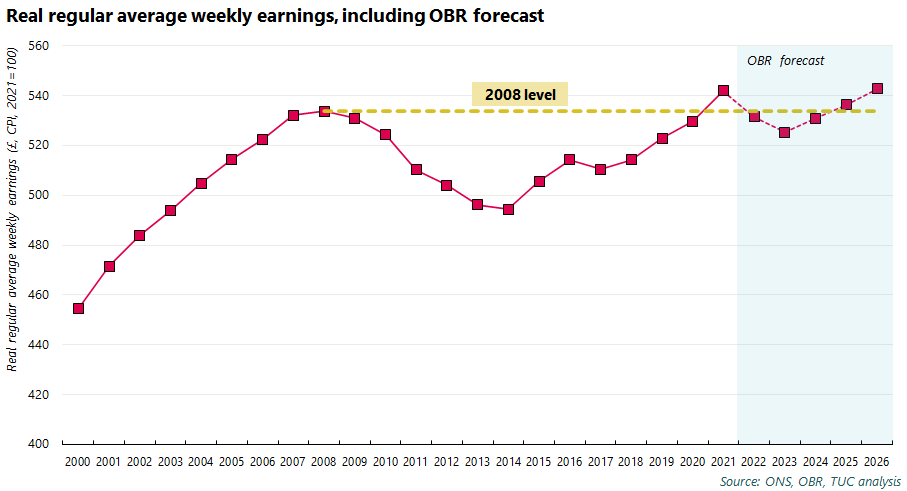
Workers’ pay prospects from the statement don’t look good. The OBR forecasts real weekly wages to fall by £11p/w (2.0 per cent) in 2022, and fall again in 2023. This will put wages back below their 2008 levels (after a brief recovery in 2021), where they’ll stay until 2025. And even this contains some optimistic wage forecasts, with the OBR forecasting pay before inflation to rise by as much as 5.9 per in Q3 2022.
The OBR forecasts that the 2022-23 financial year will see the biggest fall in living standards since records began in 1956-57, explaining that the “failure of nominal earnings growth to keep pace with rising inflation” is a “key factor” in this.
It adds that the policy measures announced since October only “offset a third of the overall fall in living standards that would otherwise have occurred in the coming 12 months”.
But there was no action to tackle falling pay in the Chancellor’s statement: nothing on raising the minimum wage, or funding public sector pay rises, and no recognition that collective bargaining (and union presence) is the most sustainable way to get wages rising.
Measures to support families in the UK with rising energy prices and the cost of living were totally inadequate
The spring statement offers little good news for struggling families, especially those in receipt of benefits.
Benefits uprating
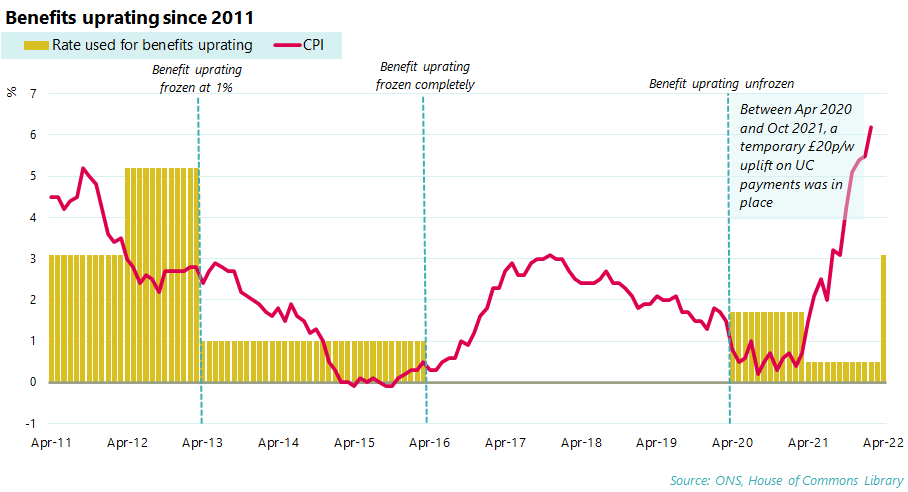
Worst of all there was no increase in the basic rate of benefits. As it stands, the standard allowance for Universal Credit and legacy benefits is set to rise by 3.1 per cent in April 2022. But this is far below the latest inflation figure (CPI is 6.2% in Feb 2022 and RPI is 8.2%), with inflation forecast to rise higher in the coming months.
This will leave those on benefits facing a real terms cut at a time when energy bills are rising by 54 per cent. The families who need the most help have been left totally out in the cold by the Chancellor today.
The decision not to cut benefits in real terms will particularly impact those who are unable to work. This reflects a wider ignorance of the equalities impact of the cost of living crisis.
We also didn’t see a reversal of the decision to suspend the state pension triple lock. The decision to abandon the pensions triple lock will cost pensioners almost £500 a year. Pensioners are particularly vulnerable to price hikes as they spend a higher percentage of their income on food and fuel.
Targeted support
The big new announcement for targeted support for low-income households was £500 million in additional funding for the Household Support Fund – a temporary discretionary fund run by local authorities. This scheme was set to end this month, and the initial funding was £500 million.
This extra money is worth less than £10 each to the six million families claiming Universal Credit – in the unlikely event they hear about it and are able to jump through the hoops needed to claim it. And contrast this £500 million to the £10 billion cut to benefit spending in 2022-23 as a result of not uprating benefits in line with inflation.
Income tax and national insurance threshold
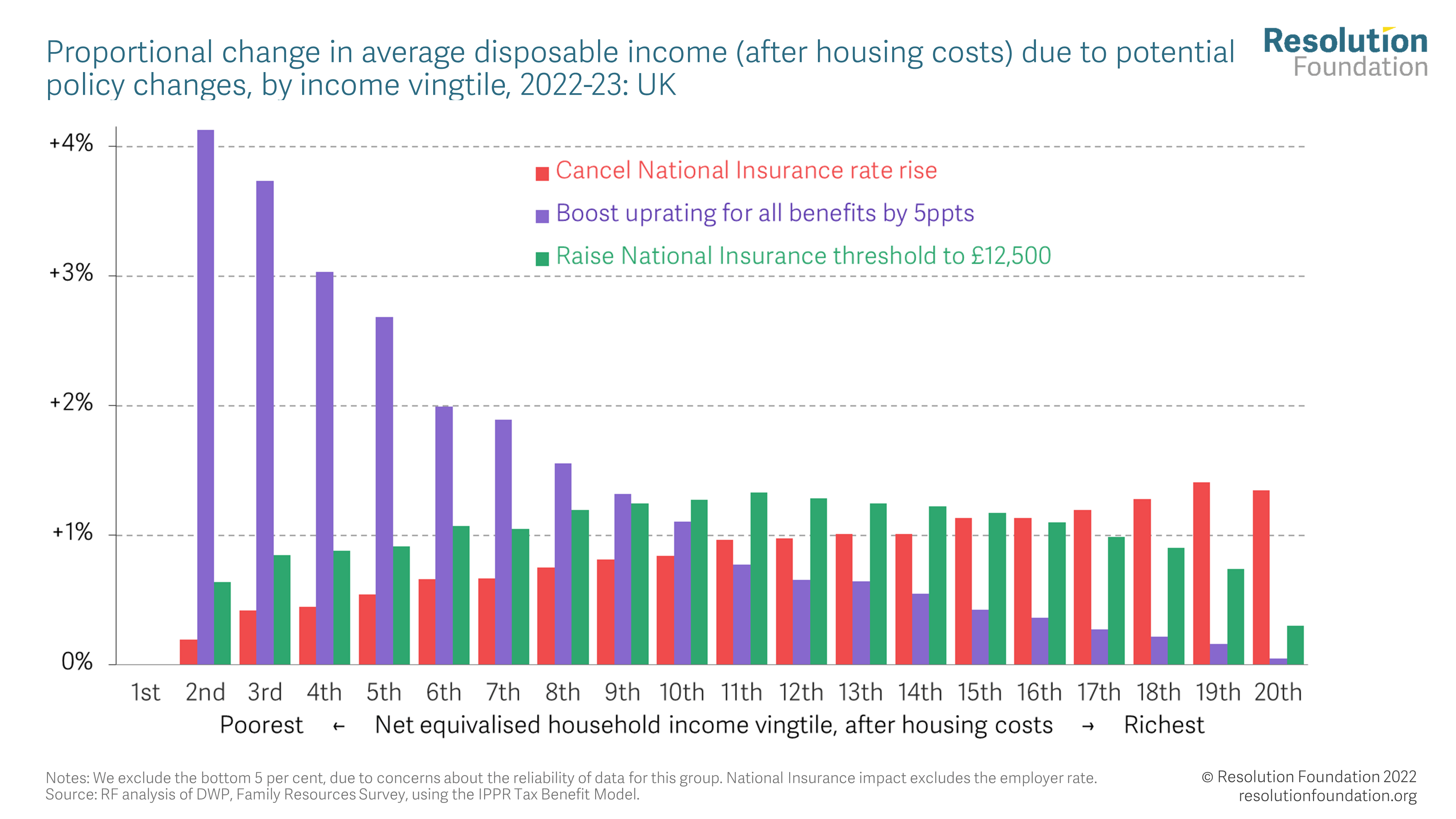
Changes to tax cuts won’t help the families who need it most now. Raising the National Insurance threshold mostly benefits middle earners and, compared to increasing benefits payments, does little to help those with low income. This can be seen in the chart below, from the Resolution Foundation.
And promises of income tax cuts tomorrow do nothing for families facing cuts to their living standards now.
And the Chancellor has missed another opportunity to raise sick pay and make it available to all. Living with Covid requires decent sick pay for all, yet we’re still waiting for government to take action on this.
VAT-free insulation and solar panels
Alongside this was the removal of the 5% Value Added Tax currently applied to building materials, like home insulation and solar panels. But this only benefits families who own a home and can afford to renovate it anyway.
The Chancellor should’ve taken the opportunity to invest in home retrofits at scale. Improving the average UK home’s energy efficiency to band C would reduce the country’s gas demand by 15% and cut hundreds of pounds off fuel poor homes’ energy bills. A massive social homes retrofits programme, delivered by local authorities, could also create over a quarter million good jobs over two years. But here again the Chancellor failed to act.
Transport
The 5p cut on fuel duty does next to nothing to support those at the sharp end of the wages and bills crisis. Analysis by NEF estimates that a third of this tax cut will go directly to the richest 20% of households, while the poorest 20% will on average only receive £5 per month. To make transport truly affordable for everyone, Government should be expanding bus and rail services in the public sector.
The Chancellor didn’t talk about the long-term changes needed for a high-wage, high skill, high productivity economy
We heard nothing on reforms to corporate governance, industrial strategy or expanding the public sector workforce to deliver the decent public services we need to level up.
The Chancellor did announce a review of the apprenticeship levy. We believe that any changes to the levy should focus on significantly increasing the number of high-quality apprenticeships and widening access to groups facing long-standing barriers. A review must not be an exercise in allowing employers to duck their responsibilities on apprenticeships.
And much more than this is urgently needed to tackle the shortfall in training, including increased government skills funding and new workplace training rights to expand opportunities for everyone to upskill and retrain.
The Chancellor didn’t stand up to the scandalous behaviour by bosses P&O
The Chancellor talked about security but did nothing to take on the bosses who take every measure to undermine their workers’ job security. He could’ve made it clear that no employer who treats workers with the contempt shown by P&O Ferries would receive a penny of public money until they reinstate their workforce, including by taking freeports contracts off DP World, the parent company of P&O.
Yet once again the Chancellor failed to mention the issues that matter to working people.
The government’s response to those fleeing conflict and war is inadequate
The Spring statement document outlines the £400m in humanitarian support the government has given to Ukraine, and says it has committed “to provide local authorities with £10,500 per person for support services, and between £3,000 and £8,755 per pupil for education services depending on phase of education, as well as £350 per month for sponsors for up to 12 months”.
But it’s clear that the government’s support for the people fleeing war and conflict is worse than inadequate. The Ukraine for Homes scheme is no substitute for a properly funded system that provides universal refugee protection. And yesterday, the Government’s nationality and borders bill, passed a vital stage in the House of Commons, meaning that those fleeing conflict may find themselves treated as criminals and deported, instead of finding sanctuary.
The Chancellor let families down today.
Families are facing soaring bills at a time when their incomes have been squeezed by years of wage cuts and attacks on the social security system. The wages and bills crisis is a consequence of decisions taken by successive governments. Today the Chancellor chose to make the pain last for longer.
THERE WAS SOME PRAISE FOR SUNAK’S MINI-BUDGET, HOWEVER:
Simon Roberts, Chief Executive Officer, Sainsbury’s said:“We know our customers and colleagues are concerned about increases to the cost of living and at Sainsbury’s we are doing everything we can to support them.
“We really welcome today’s changes to fuel duty and national insurance. We are passing a 6 pence per litre cut in fuel across our forecourts from 6pm tonight as we know fuel costs are one of the biggest pressures everyone is facing right now.
“We were pleased to welcome the Chancellor to one of our stores today to discuss what we are doing to offer customers great value and to invest over £100 million in increasing pay for our colleagues with a new hourly rate of £10 per hour nationally and £11.05 in inner London.”
Michelle Ovens CBE, Founder, Small Business Saturday said:“Moves in today’s Spring Statement to increase the employment allowance, reduce fuel duty and raise the National Insurance threshold are welcome, and will go some way to help businesses deal with rising costs.
“In particular, It is good to see the immediacy of this rise in employment allowance.”
Martin McTague, Chair, Federation of Small Businesses, said:“We are very pleased to see the Chancellor adopting our top ask for this Spring Statement: uprating the Employment Allowance to help small employers with national insurance costs.
“We originally put forward the Employment Allowance as a targeted measure to help small firms, and it has now been expanded three times since its creation.
“Together with a cut to fuel duty, these measures will provide crucial breathing space for our embattled small employers.
“This Spring Statement marks a good starting point, with welcome measures on business rates, net zero and energy investment taking effect next month.
“With steep inflation, energy bills increasing fast, without the same support in place as enjoyed by consumers, and hiring pressures landing hard on small firms, more of the right stuff will be needed in the autumn given this challenging backdrop.
“We’ve seen a VAT cut on net zero investments for households today, which is good for small firms involved in their installation.
“However, a high street shop or local bar cannot access the same support that consumers do when dealing with the same energy supplier, and they should have access to the same assistance to reduce energy use and support the move to net zero.
“We look forward to working with the Chancellor on his new tax plan. Achieving the new culture of enterprise vision he rightly aspires to, alongside levelling up aspirations, will mean putting community small firms and sole traders front and centre of reforms.
“That means taking more of them out of the business rates system, protecting SME R&D investment incentives and delivering on commitments to end an endemic late payment culture that destroys thousands of firms a year.”
Alex Towers, Director of Policy and Public Affairs, BT Group said:“We welcome the Chancellor’s focus on tax reforms for business investment, given how central this is to UK infrastructure and growth.
“This is particularly important for BT Group as we make once in a generation investments to build the UK’s full fibre broadband and 5G networks. The existing super-deduction has already helped us to significantly increase and accelerate that investment.
“We agree that longer-term incentives are now needed, to support this country’s growth and competitiveness, and we will be keen to contribute evidence to aid the Government’s decision-making.”
Dr Clive Hickman OBE, Chief Executive, the Manufacturing Technology Centre said: “We welcome the Spring Statement, which outlines concrete steps to ensure that the manufacturing sector remains competitive, sustainable, and resilient.
“The Government’s commitment to cut tax rates on business investment is important if the UK is to boost manufacturing productivity and create high-quality jobs. In addition, the reform to R&D tax credits is a very positive step that will enable the scheme to be more effective, better value for money, and more generous.
“These measures will be crucial to spur innovation and encourage investment across the country.”
Julian David, Chief Executive, TechUK said: “Rightly the majority of the Spring Statement focused on addressing the cost of living concerns resulting from the war in Ukraine and rising inflation. Along with this vital action, the Chancellor also outlined a welcome package of consultations and policy programmes aimed at boosting businesses investment.
“In our recent Digital Economy Monitor Survey UK tech companies said increasing support to invest in R&D would be their top ask of Government, with 76% saying R&D is important to their business operations in the UK.
“The proposals unveiled today to further expand R&D tax credits and consult on ways to maintain the tax deduction for capital expenditure have the potential to unlock more investment into UK innovation.
“However, to get this right the Government must ensure that the software and intangible assets that power modern business investment are kept in scope. Otherwise, the Government risks missing an opportunity to unleash the potential of tech led growth.”
Dom Hallas, Executive Director, COADEC said:“Better R&D tax credits would mean more innovation from startups and innovative companies.
“We’re delighted the Chancellor recommitted to expanding it to cover cloud and data costs – and look forward to discussing the many ways to improve the credit further.”
Irene Graham OBE, Chief Executive, ScaleUp Institute said: “In the face of increasing pressures of inflation and wider international uncertainties, it is very good to see the Spring Statement continues to recognise the importance of business growth and innovation.
“It reaffirms policies targeted towards R&D, people and skills, investment, and innovation including the new Innovation Challenge across central government departments. We will continue to work closely with the Government on the evolution and development of these policies which are so vital to our scaleup economy.”
Michael Moore, BVCA Director General, said:“Increased business investment is key to the future of the UK economy and we welcome the measures announced by the Chancellor today which support this objective.
“Private capital’s focus on sectors like AI, robotics and fintech has helped the UK to become a world leader in these areas – further reform of R&D tax credits will help businesses to drive further innovation and strengthen the UK’s position in this new economy.”
Fuel Duty
Edmund King, President, the AA said: “The AA welcomes the cut in fuel duty. However, we are concerned that the benefit will be lost unless retailers pass it on and reflect a fair price at the pumps. Average pump prices yesterday hit new records- despite the fall in wholesale costs.
“The Chancellor has ridden to the rescue of UK families and businesses who use their vehicles, not for pleasure, but to function in their daily lives. Since the start of the year, the 20p-a-litre surge in pump prices has been the shock that rocked the finances of families, and particularly young drivers, pensioners and lower-income workers who need to commute each day.
“AA research showed that even in November, when petrol pump prices set new records at around 148p a litre, 43% of drivers were cutting back on car use, other spending to compensate or both. That rose to 59% among young drivers and 53% among the lower-paid. Petrol started this week averaging 167p a litre.
“On top of the duty cut, there has been a substantial reduction in wholesale road fuel costs feeding through to the forecourts since 9 March. That needs to drive lower pump prices also. The road fuel trade shouldn’t leave the Treasury to do the heavy lifting when cutting motoring costs.”
Elizabeth de Jong, Director of Policy, Logistics UK said:“With average fuel prices reaching the highest level on record and rising inflation, there has been an unstainable burden on logistics businesses which operate on very narrow margins of around 1%; the Chancellor’s decision today will help to ensure operators can continue to afford supplying the nation with all the goods it needs, including food, medicine and other essential items.
“Fuel is the single biggest expense incurred by logistics operators, accounting for a third of the annual operating cost of an HGV. The cut in fuel duty of 5ppl will result in an average saving of £2,356 per year per 44-tonne truck; this move will help to strengthen the UK’s supply chain during a time of ongoing financial and operational challenges.”
Zero rating VAT in energy efficiency measures
David Cowdrey, Director of External Affairs, MCS said:“The Chancellor has used the Spring Statement as an opportunity to kick-start the home heating revolution by zero rating VAT on home energy efficiency and renewable technologies for five years.
“This announcement allows people to insulate their homes and save on our fuel bills, making houses cheaper to run, especially when gas prices are at a record high.
“The government’s bold move to zero rate VAT can help the UK meet its net zero targets by using proven, off the shelf, zero carbon domestic energy solutions, such as solar and heat pumps, which are ready to be upscaled now.“
Professor Robert Gross, Director, U.K. Energy Research Centre, Professor of Energy Policy, Imperial College said:“The VAT cut on energy efficiency products is a great first step in helping households adopt simple measures to help cut fuel bills for the coming winter.
“Better insulated houses need less energy to keep warm and this is good for our bills, energy security and the environment.”
Amy MacConnachie, Director of External Affairs, Association for Renewable Energy and Clean Technology (REA), said:“The REA warmly welcomes today’s announcement to remove VAT on domestic renewables for five years. We have long campaigned for this change because we know these installations will help protect people from volatile gas prices and reduce their energy bills, while also supporting the transition to Net Zero and providing a catalyst for new jobs and investment across the country.
“The move to bring forward business rate exemptions for green technologies from April 2022, including solar panels and heat pumps, will help to further drive down costs and support the decarbonisation of buildings.
“We now want to see the Government clarify and go further on the range of technologies included as Energy Saving Materials, particularly energy storage, but this is a positive package of measures for our sector.
“We stand ready to deliver an energy future which is independent, secure, and stable.”
Chancellor expected to unveil Spring Statement that builds a stronger, more secure economy for the United Kingdom.
Rishi Sunak will set out further plans to support people with the rising cost of living and pledge to continue to “stand by” hard-working families during the challenging times ahead.
He will say that freedom and democracy remain the best route to peace, prosperity, and happiness and that a strong economy is fundamental in enabling us to counter the threat Russia poses to our values.
The Chancellor will today deliver a Spring Statement that ‘builds a stronger, more secure economy for the United Kingdom’.
With people across the UK facing growing pressures exacerbated by the war in Ukraine, Rishi Sunak will pledge to continue to “stand by” hard-working families and outline further plans to help with the rising cost of living.
Alongside Britain continuing its “unwavering” support to Ukraine, he will add that a stronger economy is vital in responding to the threat of President Putin and that freedom and democracy remain the best route to peace, prosperity, and happiness.
Delivering the Spring Statement, Chancellor Rishi Sunak is expected to say:“We will confront this challenge to our values not just in the arms and resources we send to Ukraine but in strengthening our economy here at home.
“So when I talk about security, yes – I mean responding to the war in Ukraine. But I also mean the security of a faster growing economy.
“The security of more resilient public finances. And security for working families as we help with the cost of living.”
The Chancellor’s statement is also expected to set out how the government plans to create a new culture of enterprise, with the private sector training more, investing more, and innovating more.
The Spring Statement will build on UK government support worth around £21 billion this year and next to help families with the cost of living.
That includes the £9.1 billion Energy Bills Rebate, putting an average of £1,000 more per year into the pockets of working families via changes to Universal Credit and freezing fuel and alcohol duties to keep costs down.
The Government is also raising the National Living Wage to £9.50 per hour from April, meaning people working full time on the National Living Wage will see a £1,000 increase in their annual earnings.
And the Government’s Plan for Jobs is also helping people into work and giving them the skills they need to progress – the best approach to managing the cost of living in the long term.
Bold action needed to tackle cost of living
The UK Government must take bold and decisive action to help protect people from soaring living costs, according to Holyrood Finance Secretary Kate Forbes.
Speaking ahead of the Spring Statement, Ms Forbes said the Chancellor of the Exchequer must use every tool available to provide support through what is expected to be a turbulent period of economic uncertainty.
Finance Secretary Kate Forbes said: “This is not a time to be ducking the considerable challenges we face, and I expect the Chancellor to use the Spring Statement to outline significant actions to support households and businesses, considering that most of the relevant powers are reserved to the UK Government.
“The Scottish Government is doing all it can to help those most in need. We are uprating eight Scottish benefits by 6% from 1 April as well as doubling our Scottish Child Payment to £20 per week per eligible child. I call again on the UK Government to follow our lead and uprate social security benefits by 6%.”
The Scottish Government has called on the Chancellor to:
increase benefits at a higher rate, closer to inflation
implement business relief on National Insurance contributions
provide immediate funding to sectors directly impacted by the Russia/Ukraine conflict
remove/reduce VAT on household energy bills
take VAT off energy efficient and zero emissions heat equipment and products
provide powers to implement flexible working, to get more people into jobs
deliver two extra Cold Weather Payments – one immediately and another in winter 2022-23 when energy bills will have risen again.
Commenting on today’s (Wednesday) inflation figures, which show CPI inflation rising to a 30-year high of 6.2% in February, TUC General Secretary Frances O’Grady said: “The Chancellor must respond to high inflation today with much greater help for families with soaring bills and a plan to get wages rising.
“Families need grants, not loans to help with soaring energy bills. These should be funded by a windfall tax on excess profits from gas and oil. Universal credit should get a boost to help families keep up with the rising cost of living.
“And we need a comprehensive plan to get wages rising, including new pay bargaining rights for workers and their unions.”
Almost £6 billion has been invested to support low income households across Scotland over the last three years.
More than a third of that total, around £2.18 billion, has directly benefitted children as the Scottish Government prepares to publish its Tackling Child Poverty Delivery Plan for 2022-2026.
On Thursday (24 March) Social Justice Secretary Shona Robison will update Parliament on the national mission to break the cycle of poverty for thousands of families.
The Delivery Plan for 2022-26 builds on the work of ‘Every Child, Every Chance’, published in 2018. It introduced a range of new supports through Social Security Scotland, including the Scottish Child Payment and Best Start Grants, and employability services such as Fair Start Scotland.
Ms Robison said: “In the face of UK government austerity, combined with the deeply damaging £20 cut to Universal Credit, our investment over the last four years to support low income families has had a significant impact. But there is still more we must do to deliver the transformational changes we all want to see.
“Our second Tackling Child Poverty Delivery Plan will be a plan for all of Scotland. All parts of society have a role to play in our national mission to end child poverty. This is a collective effort across society to deliver for our future generations and break the cycle of poverty once and for all.
“Our ambitious measures are already delivering considerable support to children and families compared with other parts of the UK – for example, through free childcare and employment support, maximising incomes and affordable housing and, of course, social security.
“We remain the only part of the UK to have five family benefits, including the Scottish Child Payment, which was designed to tackle child poverty head on. Combined with our three Best Start Grants and Best Start Foods, low income families receive up to £8,400 of financial support by the time their first child turns six.
“Our budgets may be fixed, powers limited, and the scale of the challenge as we emerge from the pandemic has increased. However, we are determined to do everything within our powers to give the children of Scotland the opportunities they deserve to succeed.”
The Scottish Environment Protection Agency (SEPA) is working with businesses across Scotland to help them prepare for a potential lack of water this summer.
Today on World Water Day, it’s emerging parts of the country could struggle in the coming months with insufficient resources due to a particularly dry winter. New data reveals January this year was the seventh driest on record for the East coast. Groundwater levels are also still low despite a series of storms in February, and without average rainfall through spring and summer, there is a risk of water scarcity particularly in Angus.
Water scarcity is just one indicator of Scotland’s changing climate. With more extreme weather and a projected decrease in summer rainfall, many places could face pressure on water resources even if they have not experienced this before. As well as the ecological impacts – food and drink production, hydropower generation and other business activity reliant on a consistent water supply could also be affected.
Environment Minister Mairi McAllan said: “In recent times Scotland has experienced some of the driest conditions we have seen for many years, bringing water scarcity impacts for many businesses and households across the country.
“With climate change at the forefront of all our minds, the need to conserve water as one of our most precious natural resources is more crucial than ever.
“Indeed, the most recent report from the Climate Change Committee confirmed that drought will become more prevalent in years to come as summers in Scotland get drier and hotter. That’s why I urge everyone to use water wisely and to take advantage of the advice and guidance offered by SEPA and Scottish Water – it benefits all of us, is good for our economy and our planet.”
SEPA is responsible for the forecasting, monitoring, and reporting of the situation facing Scotland’s water resources and produces regular water scarcity reports between May and September.
However, due to the severity of impacts last year, reports were also published outside of this period. This work, along with wet weather research, will better equip Scottish communities and organisations to innovate, adapt and prepare for future increased impacts.
Businesses also have a role to play in managing our water environment, and efficient use of resources can lead to economic and environmental benefits. SEPA helps organisations do this in sectors such as agriculture, aquaculture, hydropower, golf, and whisky production.
Girvan Early Growers, a co-operative of local farmers in Ayrshire, has already felt the pressures of water scarcity in previous years and works with SEPA in becoming more resilient.
Chairman of Girvan Early Growers, Andrew Young, said: “I have been a farmer for more than 40 years and last year was the driest I have seen in my lifetime. We simply can’t grow high quality potatoes and carrots here without access to water.
“By working closely with SEPA, we can plan where the best locations are to grow our crops. We can also be flexible and abstract water from different sources depending on where the pressures are.
“Simply having that awareness and a clear back-up plan for drier months, allows us to operate our business as effectively as possible.”
SEPA’s Head of Water and Planning, Nathan Critchlow-Watton, said: “It is vitally important that Scotland is prepared to deal with water scarcity now and in the future. Businesses should use the information available to them to make informed decisions about reducing their reliance on water and to plan for and manage water scarcity events.
“Water abstractors licenced by SEPA should have a plan to deal with the range of conditions they may experience. They should monitor their water usage and equipment to ensure they are operating at maximum efficiency and avoiding any unnecessary leakage. Businesses are also being encouraged to work together and plan abstractions accordingly to minimise any potential impacts.
“SEPA can provide advice and guidance on a series of straightforward steps that can be taken to reduce pressure on Scotland’s water environment. However, if businesses deliberately fail to follow the abstraction guidelines set out by SEPA this may result in enforcement action.”
Business can find out more information about water scarcity and how to prepare on SEPA’s website.
Scotland’s Finance Secretary writes to Treasury ahead of Spring Statement
People and businesses need urgent UK Government support to mitigate the rising cost of living, says Finance Secretary Kate Forbes.
In a letter to the Chancellor of the Exchequer Rishi Sunak ahead of the Spring Statement, Ms Forbes called on UK Ministers to match the 6% uprate on social security benefits which the Scottish Government is delivering on eight of the benefits it delivers, and for further payments to be made to low income households through the Cold Weather Payment
The letter to the UK Government also calls for:
more targeted funding to business sectors directly affected by the conflict in Ukraine
relief to business on National Insurance Contributions
the removal of VAT from energy efficient and zero emission heat equipment and products
greater powers for the Scottish Government to work with employers to implement flexible working
full replacement of EU funding lost to Scotland as a result of Brexit, as promised by the UK Government
The Scottish Government ‘stands ready’ to work with the UK Government, which holds the powers to tackle the most pressing issues, to put a package of support in place.
Ms Forbes said: “In Scotland we are doing all we can to ensure people, communities and businesses are given as much support as possible to deal with the rising cost of living and the potential economic implications of Russia’s illegal invasion of Ukraine.
“However, many of the powers required to really tackle these issues are reserved to the UK Government, which is why I am calling on the Chancellor to take much needed action in his Spring Statement.
“The Scottish Government is uprating eight Scottish benefits by 6% from 1 April as well as doubling our Scottish Child Payment from £10 per week per eligible child to £20. We are using our powers to help those who need us most in these difficult times and it is time for the UK Government to follow our lead and uprate social security benefits by 6%.
“I would also ask for further immediate support to be delivered through the Cold Weather Payment, with an additional payment now and another next winter when we know energy bills will have risen again.”