Budgets reflect the choices and priorities of our Governments. Our political leaders have a responsibility to use them to build an economy and society in which all people the income necessary to live in decency and dignity.
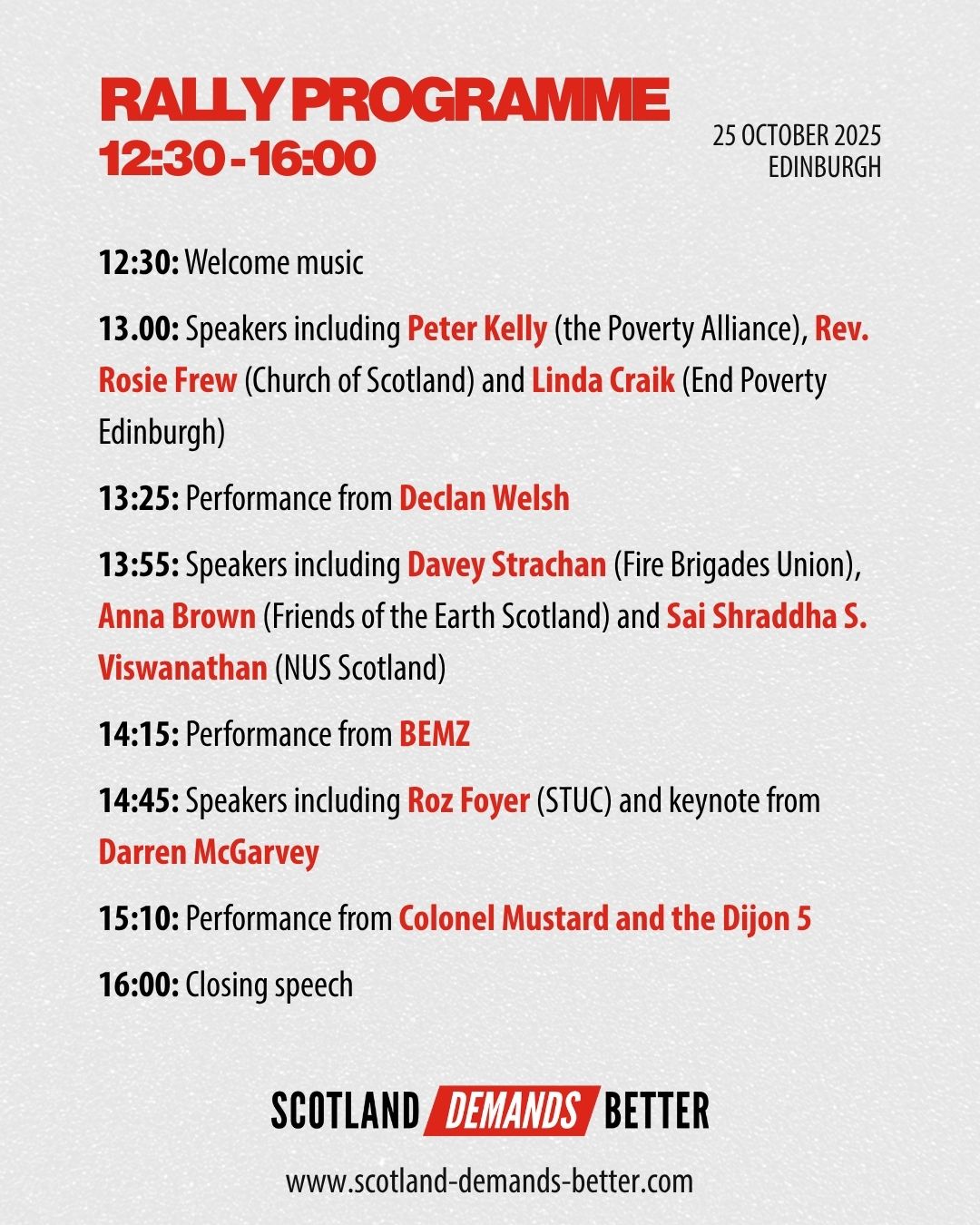
In October 2025, thousands of people from across Scotland took to the streets of Edinburgh in the Scotland Demands Better campaign march and rally, the largest anti-poverty demonstration our country has seen in decades.
They stood together to demand that politicians build a Scotland free from poverty, creating the conditions for better jobs, better investment in life’s essentials and vitally, better social security.
In this briefing, we set out how MSPs can build a better future for Scotland’s children:
Change for the better happens when people stand together and demand it. That is why thousands of people took to the streets of Edinburgh yesterday to say with one voice that we demand better – better than poverty, better than inequality and better than divisive, hateful narratives that seek to pit our communities against one another.
Trade unions, faith groups, community organisations and charities stood shoulder to shoulder with people from across Scotland to demand fair work, strong public services and dignified social security.
It was a showcase to our political decision makers at all levels that we are tired of waiting for change on the injustice of poverty, and we are standing together to demand action.
This isn’t the end. It is the start of a movement, together in hope and solidarity, for a better Scotland for all of us.
TOMORROW, Saturday 25th October, Child Poverty Action Group – alongside other members of the End Child Poverty Coalition – will be joining charities, community organisations, faith groups, trade unions and many more in a march from Holyrood to the Meadows in Edinburgh (writes CPAG Scotland’s MARIA MARSHALL).
#ScotlandDemandsBetter has been organised to give organisations and individuals in Scotland an opportunity to make their voices heard and demand that politicians make the change needed so that every household in Scotland can thrive.
Signs we are on the right track…
In a lot of ways, we have seen progress to tackle child poverty in the past several years, at least here in Scotland.
The passing of the Child Poverty (Scotland) Act in 2017 was a watershed moment. Following the abandoning of child poverty targets by the UK Government in 2015, the Child Poverty (Scotland) Act ( unanimously backed by all of Holyrood’s parties) set targets for child poverty reduction and requirements such as a tackling child poverty delivery plan to be published by the Scottish Government every four years.
The result of this cross-government, cross-party effort in Scotland has been to sharpen the minds of those who hold the power and drive real and tangible progress for families.
Since then, we have seen the introduction and expansion of the Scottish child payment (SCP), first introduced in February 2021 and now worth £27.15 a week for every eligible child under 16.
Along with other members of End Child Poverty and the Scotland Demands Better movement we are now calling for immediate and sustained increases in its value so that it reaches £55 per week by the end of the next parliament. Investing further in the Scottish child payment is the most direct and cost-effective tool available to the Scottish government to further reduce child poverty.
SCP is one of a suite of policy interventions in the first two delivery plans including; Best Start Foods and Best Start grant (replacing Healthy Start and Sure Start in the UK), an expanded offer of 1,140 hours of funded early learning and childcare, increased focus on parental employability support and the expansion of universal free school meals in primary schools (despite subsequent backtracking on promises for universal provision for P6-7 pupils too…)
Of all the interventions taken, it is the increased investment in social security in Scotland that is behind the diverging trend confirmed in the latest child poverty statistics which saw child poverty in Scotland fall by four percentage points, while rising (once again) UK-wide. Steps in the right direction for sure.
We’ve come some way, but not far enough
So on the one hand, we have seen some real success. In December last year, research commissioned by CPAG on the costs of raising a child, found that the gap between costs and incomes for families in Scotland was narrower than the rest of the UK. However, this same research found that Scotland’s lowest-income families are still left with less than half the income they need for a minimum socially acceptable standard of living.
Despite showing that progress had been made, this year’s child poverty statistics also confirmed that over one in five children in Scotland are still growing up in poverty. For those children, for all children, we are demanding better.
We can shout about the progress made, but for families living on the sharp end of the cost of living crisis, this will ring hollow. Summer holidays this year too often brought more stress and anxiety for Scottish parents than opportunities to learn and play. Like Hope, parent and participant in the Changing Realities project, who wrote in July:
“Already it has been a bit stressful. The kids are constantly hungry and “bored” then hungry again. Which means more food shopping. I can’t afford summer clubs/camps (tennis, football, multi sports, water sports etc) as they are coming in at around £40 a day and some of them state you have to bring your own packed lunches … I also am embarrassed to take the kids to a food bank this year. So if my oldest boy is in I’ll get him to watch my youngest and tell them “I’m going shopping.”
Too many families are being denied the security and opportunity to thrive that we all deserve. But looking to the future, there should be reason to feel hope.
Standing at the crossroads
We now have two governments, UK and Scotland, who have made a commitment to tackling child poverty. Campaigners are anxiously awaiting the UK child poverty strategy due to be published this Autumn.
Next year’s elections in Scotland also provide an opportunity for all parties, MSPs and candidates to commit to building on the progress made and delivering a better future for all of Scotland’s children.
In theory, we are at the cusp of a real opportunity for making progress on tackling child poverty. But we can also risk losing our way…
Will we build on the progress made in Scotland to meet the 2030 targets? Will the UK Government pull the levers in their power such as scrapping the two-child limit and benefit cap to move us in the right direction together?
Or will we see a stalling in Scotland, resting on existing progress and unable to keep up with the rising costs squeezing low-income families? Will the UK strategy fail to tackle the true drivers of rising child poverty such as the slashing of social security support in the past 15 years?
Walking with hope
In May last year, parents from the Changing Realities project launched their own campaign ‘Hope Starts Here’ with the aim to change the narrative on the progress we need to see by shifting the focus on the potential that all children have.
One parent, Faith, expressed that: “I hope that my children will be able to have endless possibilities of what and who they want to become in the future when they grow up. There is a big world waiting out there for them.”
Faith’s words encapsulate why members of the End Child Poverty coalition will be marching together to demand better for our children. All children should have endless possibilities of what and who they want to be when they grow up.
Better is possible. There is already ambition across the political spectrum to tackle child poverty. We now need to see the two-child limit and benefit cap scrapped at UK level, and in Scotland we need all parties to set out a clear path that will deliver year on year progress towards the 2030 targets, so that every child in Scotland can have the best possible start in life.
If you’re in Edinburgh on Saturday, please join us.
The Council Leader and campaigners have come together to call for action to challenge the injustice of poverty in Scotland’s capital.
Staging an anti-poverty event this week (Wednesday 8 October), the End Poverty Edinburgh citizen group highlighted how around 80,000 people are living in relative poverty in Edinburgh.
The conference, held at the Grassmarket Community Project with people with lived experience of poverty, is part of Challenge Poverty Week 2025. Highlighting the need for poverty prevention and the injustice of poverty on marginalised communities, the event followed previous conferences held in 2023 and 2024.
In Edinburgh, a citywide commitment has been made to tackle poverty, which affects one in five children in the city. This includes accelerating the work of the End Poverty Edinburgh Action Plan – also tackling the city’s Housing Emergency and reviewing the way the council supports the third sector in Edinburgh.
A new preventative approach has been adopted with the aim of making it easier for people at risk of poverty to access support, while funding has been provided to Edinburgh’s new Regenerative Futures Fund, which will help local communities to lead poverty prevention and deliver change.
Caroline Cawley, a member of End Poverty Edinburgh, said: “This is our third annual conference, and we wanted to use this day as an opportunity to highlight the injustices facing marginalised groups, who are more likely to experience poverty in Scotland.
“Poverty and uncertainty for these groups is not getting better and many people are starting to lose hope. This is the worst thing to lose as hope is the last thing to go. As a group of Edinburgh residents with lived experience of poverty, we’ll continue to use Challenge Poverty Week to call for change and solutions, including greater poverty prevention in the city.”
Speaking at the event, Council Leader Jane Meagher said: “In Edinburgh around 80,000 residents are struggling to make ends meet, with one in five children living in relative poverty. We must continue to do everything in our power to end poverty in Edinburgh.
“I’m proud of the positive work which is already being done to combat the causes of inequality in the city, and this annual conference highlights the incredible efforts of our third sector, council officers, and city partners to make life better for thousands of people across the city. Without this progress, these statistics would be even more stark.
“We can’t address poverty alone and this Challenge Poverty Week, we’re uniting for change, highlighting the injustice of poverty in our communities.”
Peter Kelly of The Poverty Alliance said: “We’re very pleased that Edinburgh is marking this year’s Challenge Poverty Week. In a rich country like ours, poverty is an injustice that weakens us all as a society.
“But we can solve it. We can redesign our economy to make sure people have incomes that are adequate enough to live a life with freedom and dignity.”
The End Poverty Edinburgh Conference is the first of three major poverty events happening in Edinburgh this month. On 25 October, the Scotland Demands Better rally led by the Scottish Poverty Alliance will take place in Edinburgh.
Then, on 31 October, the Edinburgh Poverty Commission will host a public event to launch the publication of their most recent findings on the actions needed to end poverty in Edinburgh.
Meanwhile, during Challenge Poverty week, poverty stigma training is being rolled out to Council employees to increase awareness of poverty and to help people access the support they need.
A Council pop-up in Gilmerton Library is also offering information on benefits, building skills, money advice and links to the community food pantry in Gilmerton community centre.
Information for residents experiencing or at risk of poverty can also be found on the Council’s cost of living webpages
Change for the better happens when people stand together and demand it. Scotland Demands Better is the march and rally for all of us.
On Saturday 25 October thousands will come together in Edinburgh to demand that politicians make the changes we need for a society where every household can thrive and prosper.
We’re holding a series of public meetings across the country, and we’ve just got dates for the first three – in Glasgow on 4 Sep, Edinburgh on 9 Sep, and Dundee on 11 Sep. We’ll be sharing further details on the Scotland Demands Better website in the coming days.
On the updated Scotland Demands Better website, you can also download our new toolkit, with lots of inspiration and ideas about how you can get involved and mobilise people in your communites. You can also order a Promo Pack, with posters, leaflets, badges, and stickers.
On Thursday 14 August at 1pm and then again at 7pm we’re hosting free online events where activists can join to talk about how the campaign is going so far, and how we can best organise transport to get people to Edinburgh on the day.
Change for the better happens when we stand together and demand it!
Join this free online meeting to talk about how we can mobilise people in your community for the Scotland Demands Better march.
Are you an activist? Do you want to campaign for a better Scotland?
Change for the better happens when people stand together and demand it.
Help us rally Scotland behind Scotland Demands Better—let’s fill the streets of Edinburgh on October 25th!
Scotland needs that change. Too many of us are being cut off from life’s essentials. Too many are frightened of what the future will bring. Too many of us are feeling tired, angry, isolated, and disillusioned.
Scotland Demands Better is a march and festival for all of us. It’s our chance to come together and demand that politicians make the changes we need for a decent society.
We demand better jobs for everyone who needs one, with fair conditions and wages that pay the bills.
We demand better investment for life’s essentials – like affordable homes, good public transport, a safe environment, and strong public services.
We demand better social security so that all of us have a foundation for the future.
We are hosting a series of ‘Get Organised’ meetings to support you to mobilise your communities to stand up and demand change.
This first meeting will be an opportunity to network with others who are supportive of the campaign. We will give an update on the campaign so far, discuss strategies to spread the word about Scotland Demands better and chat about what support we can offer you.
We are looking forward to seeing you there.
This meeting is for people interested in the campaign and activists, rather than organisations.
The EIS, the country’s largest teaching union, has welcomed the publication of the report Scotland Demands Better: Fairer taxes for a fairer future by the Scottish Trade Unions Congress (STUC).
The report highlights how progressive tax reform could raise an additional £3.3Billion by 2026, including £1.3Billion of tax reforms by April 2023 to help fund public services and public sector pay.
Commenting following the publication of the report, EIS General Secretary Andrea Bradley said, “The EIS welcomes the publication of the STUC report Scotland Demands Better, which represents an important contribution to debates around tax reform and the funding of quality public services.
“The report demonstrates ways in which the Scottish Government could, if it so chooses, engage in progressive reforms to ensure that public services can be properly funded.”
Ms Bradley added, “Scotland’s teachers are currently in dispute over the succession of real-terms pay cuts that have been offered to them this year.
“Since teaching unions submitted their pay claim at the start of the year, a succession of sub-inflationary offers – at 2%, 3.5%, 5% and then 5% again – have been made by the Scottish Government and COSLA, and rejected by Scotland’s teachers.
“With inflation currently sitting at between 11% (CPI) and 14% (RPI), the latest rejected offer would have meant a real-terms pay cut of between 6% and 9% for classroom teachers, and even greater cuts for promoted staff such as headteachers and deputes.”
Ms Bradley added, “Fundamentally, the funding of quality public services and fair pay for public sector workers are a matter of political priorities. Just last week, we saw an Audit Commission report highlighting that the Scottish Government had underspent on last year’s budget by two billion pounds.
“That was a political choice by the Scottish Government, and one that has profound implications for our public services. If the Scottish Government is serious about protecting our public services and valuing public sector workers, they must commit to funding our public services properly and paying our public sector workers fairly.”