Weekend storm warning for motorists

As weather forecasters say we could be in for a weekend of thunderstorms, motorists are being warned to check their insurance policies before venturing out into the elements.

The Met Office says a ‘hotter than normal’ weekend will bring outbreaks of torrential downpours and thunderstorms as temperatures cool after the heatwave.

Quotezone.co.uk, a leading car insurance comparison website, says any damage to cars caused by driving through flash floods might not be covered by insurance policies. It warns motorists to carefully check their policy exclusions, and even if routes are partially blocked, drivers should think twice before using waterlogged roads.

If drivers find themselves stuck in the car during a thunderstorm, official advice from the Met Office is to wind up the window and stay inside the vehicle – the metal frame of the car should act as a conductive Faraday cage, passing the current around the passengers and into the ground, should it be struck by lightning.* 

If motorists have an open or soft top vehicle, they are best to avoid driving if they know thunderstorms are coming.

Greg Wilson, Founder of Quotezone.co.uk, comments: “Motorists who have taken out third party only or third-party, fire and theft insurance wouldn’t be covered for any storm damage to their vehicles – only fully-comprehensive policyholders are likely to be protected in those cases.

“If a storm is predicted look at official flood warnings, avoid roads that are likely to flood and allow more time for your journey, note you may have to pull over and wait it out if the downpour starts to affect your visibility – not forgetting to put on the hazard lights.

“Unfortunately, if motorists do decide to drive through waterlogged roads, there’s a very real risk that they won’t be covered for any resulting water damage to the car – even fully-comprehensive drivers.”

Greg also warns motorists that have to go out, to make sure their cars are roadworthy before setting off, which includes checking tyre tread and windscreen wipers.

Quotezone.co.uk compares prices across all types of car insurance, including breakdown cover,  and niche products such as motor trade insurance – helping around 3 million users every year find better deals on their insurance. 

Government urged to take action on the UK’s worsening pothole problem

Drivers are being warned about the worsening condition of roads across the UK as recent data reveals that 90% of insurance claims come from potholes.

Experts from leading price comparison website Quotezone.co.uk are calling on the government and local councils to not let the pothole problem get even worse. 

With a long winter of bad weather ahead motorists will run an increased risk of damaging vehicles by driving over potholes if UK roads are not properly maintained.  

Spending on road maintenance has almost halved since the financial crisis just over a decade ago, and the recent cost-of-living crisis has further reduced potholes on the priority list.  

Even temporary pothole fixtures – which involves filling the hole with a form of asphalt treatment – have also decreased by almost half in some counties.  

There are also claims from members of the public that councils are not properly inspecting potholes that have been reported online.  

Several county councils have admitted that filling in potholes is no longer a priority as a result of the rising cost of living, with less funding for UK highways.  

And with an expected bad weather spell to last well into the New Year with rising levels of snow, ice and rain – it will no doubt make potholes even worse.  

With a combination of bad weather and lack of funding, the UK is likely sitting on a disaster waiting to happen and the pothole problem may soon get out of hand.  

With nine in 10 insurance claims coming from pothole incidents, Quotezone.co.uk are calling for councils and the government to urgently act on what is a UK-wide problem. 

Data shows that the worst pothole affected area in the UK by far is Northumberland, with over 180,000 potholes reported over four years, followed by Cornwall and Kirklees in West Yorkshire.  

Newcastle, Liverpool and Suffolk also have some of the worst potholed roads in the UK as well as Fife and Glasgow in Scotland, and Newry, Mourne & Down joined by Armagh City, Banbridge & Craigavon in Northern Ireland.  

Greg Wilson, Founder and CEO of Quotezone.co.uk said: “We all know how bad it can be to drive down roads which are full of potholes, and unfortunately the problem does not seem to be going away. 

“With a massive 90% of insurance claims coming from pothole related incidents, most of us have had damage caused by a pothole, or know someone that has. 

“We are expecting a winter of extreme weather and with spending on road maintenance on the decline, we could expect to see a significant increase in pothole related claims. 

“This will make UK roads more dangerous for all road users, so we’d encourage local authorities and the government to act now ahead of the worsening weather and make a start on fixing the UK’s pothole problem.” 

Quotezone.co.uk helps thousands of road users each year find savings on everyday household bills and essentials such as car insurance, van insurance and motorbike insurance

Don’t let car thieves steal Christmas

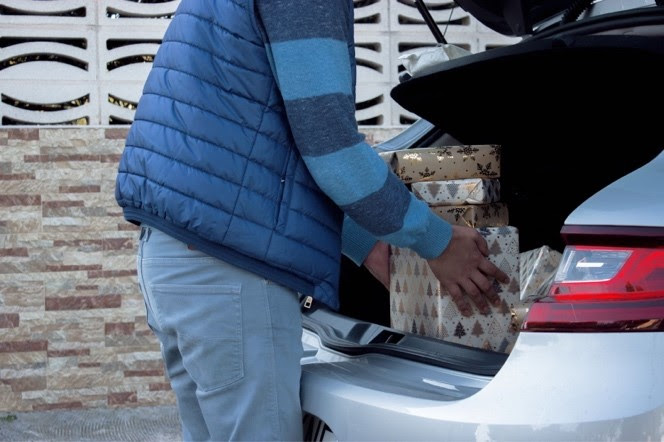
Motorists have been warned not to leave Christmas presents on display in parked vehicles after almost a third admitted to being a victim of car crime.    

Experts at  Quotezone.co.uk have revealed that more than one in ten Brits leave their precious presents in the car during the festive season, presenting an ideal opportunity for heartless thieves to ruin Christmas.    

New data from Quotezone.co.uk reveals that 11% of us admit to leaving gifts we have purchased for loved ones in our cars while we continue our Christmas shopping or enjoy a night out.  

A person standing next to a carDescription automatically generated with low confidence
A picture containing control panelDescription automatically generated

The car insurance comparison experts also asked 1,000 drivers if they had experienced a vehicle break-in, with almost `a third, 31%, confirming they had.    

Now they are warning car owners to be more careful this year and ensure presents are kept in the safety of the home, or at least well hidden from view in vehicles. 

Better still, take presents straight home from the shops and get them wrapped and placed under the tree.    

Greg Wilson, Founder of Quotezone.co.uk said: “It must be a terrible feeling to have carefully chosen or sentimental Christmas presents stolen from a car just before the big day.    

“Our data shows that almost one third of drivers have experienced a car break in, yet 11% of us still leave presents in a parked car.  Christmas is a time of goodwill but sadly for some thieves it’s a time of opportunity.   

“It’s also an incredibly busy time of year, drivers need to remember to be careful and always keep presents hidden out of sight under the boot cover or in the glove box, ideally parked next to a streetlight on a busy street.  If the car is left unlocked or the stolen items are in full view, it may invalidate an insurance claim.    

“Fully comprehensive car insurance usually includes cover for some possessions damaged or stolen from a car but there’s usually a cap on this amount.  If drivers know they’ll be travelling to see family this Christmas and have a large sack of expensive gifts in the car, it would be worth informing their insurer to double check they’re covered and potentially increase the price cap temporarily.  Also don’t forget to keep all receipts, they may be needed if they have to make a claim.”    

To further prevent car break ins, drivers should park in a well-lit, populated area, ensure that all windows are rolled up, and consider installing a steering-wheel lock, car tracker and immobiliser – if the car doesn’t have one as standard.    

Car security is really important any time of the year, but especially during the festive period with expensive and sentimental presents in danger of being stolen and ruining Christmas.   

If cars are broken into, drivers should take photos, identify the damage and inform the police – obtaining a crime reference number, also inform the car insurance company as soon as possible.   

Quotezone.co.uk helps around 3 million users every year find savings on everyday household bills and essentials, such as fully comprehensive car insurance. 

Differences in Car Insurance Premiums Mapped Out Across the UK

The amount drivers pay to insure their cars varies widely depending on where in the country they live, new data has revealed.

The average car insurance premiums paid by drivers, show massive regional differences according to newly released data from insurance comparison platform Quotezone.co.uk.

DiagramDescription automatically generated

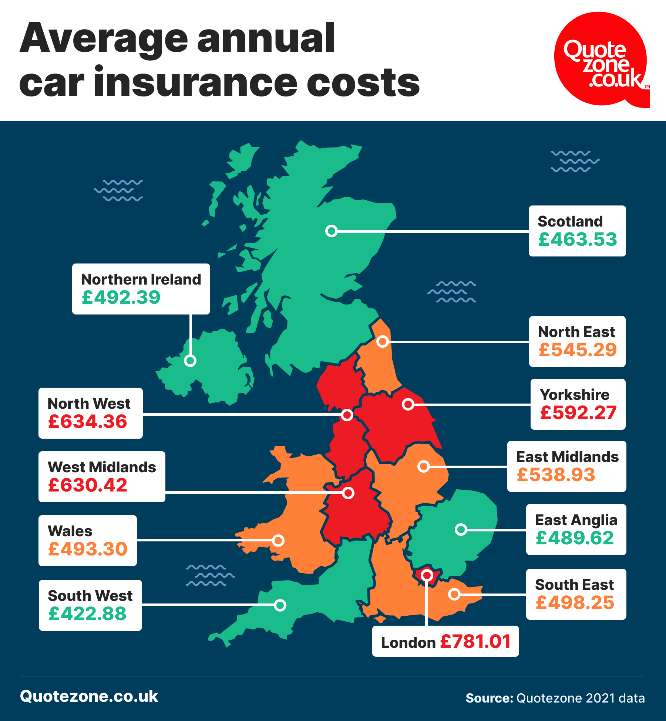
Motorists in London are forking out considerably more than drivers in other parts of the UK, with average premiums in the capital nudging close to £800.

Some motorists may be tempted to move to the South West of England where average premiums are little more than half those in London at just over £400 a year.

Across the UK as a whole drivers paid an average of £548.52 for their annual motor insurance policy. 

But regions comprising large rural spaces generally enjoy lower premiums than those that include large cities and urban areas where road accidents and car thefts are statistically more likely to occur.

Drivers in Scotland, Wales and Northern Ireland all paid less than the UK average at just £500 a year for their car insurance.

Conversely, motorists in regions such as the North West and West Midlands, which are largely made up of highly populated urban areas, both paid more than £630 a year on average.

As well as the likelihood of accidents and thefts, cities and densely populated urban areas generally have a younger population which is also a factor contributing to higher average car insurance premiums.

The average vehicle value can also be higher in big cities, pushing average premiums up even more, this is particularly true in the capital.

Quotezone.co.uk crunched the numbers on a sample of over 1,000,000 policies, naming London as the most expensive place in the UK to insure a vehicle, with drivers paying £781.01 on average.

The North West of England was the second most expensive place to insure a car with an average premium of £634.36.

The West Midlands region was revealed to be the third most expensive part of the UK for car insurance with an average premium of £630.42, just slightly less than that of the North West.

Drivers in Yorkshire, with its mix of urban and rural landscapes, paid an average premium of £592.27, while those in the North East paid £545.29.

The East Midlands region commanded insurance premiums considerably cheaper than those down the road in the West Midlands with an average premium in the East Midlands being just £538.93.

Perhaps surprisingly, the South East of England region offers motorists good value once those living in London have been factored out, with the average premiums here being just £498.25.

Welsh drivers paid only £493.30 on average while motorists in Northern Ireland enjoyed even better value, paying just £492.39.

Drivers in East Anglia also enjoyed cheaper premiums at just £489.62 on average, while north of the border motorists in Scotland paid even less, at £463.53 on average.

Finally, those car owners in the South West of England, including the rural counties of Devon and Cornwall, enjoyed the best value car insurance in the UK with average premiums of only £422.88.

Quotezone.co.uk founder Greg Wilson said: “When it comes to paying for car insurance there are huge variations depending on where in the country drivers live.

“Insurance companies are very specific and can vary the cost of a policy depending on which postcode the driver lives in but by zooming out a little we can see there are some interesting regional differences as a whole.

“Motorists in big cities tend to pay more and this is particularly true in London. With a greater population density, there are more cars on the road and the likelihood of a prang does increase.

“But there are also other factors at play including the local crime rate, the average age of drivers and the value of the vehicles they are insuring.

“So while the data may tempt some drivers to up sticks and move down to Cornwall, they should be warned that the cost of their premium won’t necessarily decline. There are several other factors insurance providers must consider and each premium is calculated on an individual basis for the person in question.

“It is essential for all motorists to accurately inform their insurance company of their home address as well as any other location where their vehicle is likely to spend more than 30 days. Failing to do so may cause their policy to be invalid if they were to make a claim.”

The data is available at Quotezone.co.uk and our comparison site can help keep insurance quotes competitive.  

‘Thunder fever’ could cost motorists up to £5000

The unusual weather this summer is causing issues for drivers that could result in fines or penalty points – adding to the mounting cost of living expenses.

This week alone has seen warnings from medical experts about ‘thunder fever’ – a rare weather phenomenon that makes hay fever (and asthma) much worse with a combination of thunderstorms and elevated pollen counts across the country. It happens when moisture and lightning brought by the storm, shatter pollen normally too large to enter the lungs into tiny pieces.

Whilst drivers need to be careful that sneezing, a runny nose and watery eyes brought on by hay fever doesn’t impair their driving ability, there is a serious risk for those suffering with the pollen.  The government legislation that bans driving while under the influence does not distinguish between illicit drugs, prescription medication and over-the-counter medications. 

This means any type of drug that affects a motorist’s driving abilities could potentially result in a drug-driving conviction, even if it’s something as simple as hay fever medication that causes drowsiness. One in four people in the UK has hay fever, which equates to approximately 16 million people.

Other  distractions that could be classed as careless driving include  ‘rubber necking’ at the storm itself or failure to see through the windscreen properly, if caught in heavy rain.

Quotezone.co.uk, a leading car insurance comparison website, says if drivers find themselves stuck in the car during a thunderstorm, official advice from the Met Office is to wind up the window and stay inside the vehicle – the metal frame of the car should act as a conductive Faraday cage, passing the current around the passengers and into the ground, should it be struck by lightning.

However, any damage to cars caused by driving through flash floods that accompany thunder storms might not be covered by insurance policies. Quotezone.co.uk warns motorists to carefully check their policy exclusions, and even if routes are partially blocked, drivers should think twice before using waterlogged roads.

Greg Wilson, Founder of Quotezone.co.uk, comments: “The weather has been extreme this summer and driving in the heat alone has been challenging but there are things drivers need to know to avoid risking penalty points or fines and keep themselves safe on the roads.

“If a storm is predicted look at official flood warnings, avoid roads that are likely to flood and allow more travel time, note drivers may have to pull over and wait it out if the downpour starts to affect your visibility – drivers can be fined if they can’t see clearly out of all windows.

“Hay fever symptoms can come on unexpectedly and some types of medication do cause drowsiness, or carry a ‘do not operate heavy machinery’ warning. If a driver fails to obey this warning and gets behind the wheel, they could risk a hefty fine of up to £5,000, points on their licence and endanger themselves and other road users.”

It’s always sensible to check the weather before setting off on long journeys and err on the side of caution, Met Office pollen count forecasts available here.

Quotezone.co.uk compares prices across all types of car insurance, including  breakdown cover,  and niche products such as motor trade insurance – helping around 3 million users every year find better deals on their insurance, with over 400 insurance brands across 60 different products.

Recommended by 97% of reviewers on Reviews.co.uk.

Two out of three drivers won’t go electric unless ‘absolutely necessary’

As the cost-of-living rockets, price comparison experts Quotezone.co.uk asked consumers how they really feel about electric versus fossil fuel cars (petrol/diesel) and which they found most cost effective. 

The new survey reveals that 59.3% of petrol/diesel drivers will only consider buying an electric or hybrid vehicle ‘when I absolutely have to’.  26.2% said they would buy ‘within the next 5 years’, 10.3% said they would ‘buy now / as soon as is feasibly possible’ and only 4.3% said they’d buy ‘just before the deadline’ – 2030, when the government plan on banning the sale of new petrol and diesel cars.  

The research also found that the main barrier that is stopping people from buying an electric car is the price, with 35.7% of drivers saying they are too expensive, followed by 20% of people who said range anxiety was a major concern, while worries about the availability of public charging points were cited as an issue by 19.3% of respondents. 

Interestingly though, 57.8% of those with electric cars said they were saving over £100 per month compared to their previous fossil fuel vehicle – with 36.6% saving under £100 per month.  Only 5.6% didn’t believe they were making savings.  

When electric vehicle owners were asked what they didn’t like about their cars, 24.8% said there weren’t enough readily available charging points, followed by range anxiety (20%), broken charging points (19%) and rising energy costs (18%).  

The data, compiled by Quotezone.co.uk, was taken from a survey of 500 electric and petrol / diesel car insurance policyholders, completed in August 2022.  

Quotezone.co.uk’s Founder, Greg Wilson, comments: “It’s really interesting to see what’s holding people back from going electric and again, lack of infrastructure and car price, appear to be the top offenders that are making it impractical for many to make the switch.   

“The hike in car prices is most likely due to the new car shortage, brought about by lack of materials and logistical issues across Europe, causing a spike in shoppers choosing ‘nearly new’ second-hand petrol cars.  

“One positive point to bear in mind for those worried about costs is that electric car insurance is now more readily available as the majority of insurance providers have added electric cars to their offering – making it easier for consumers to shop around and get a competitive premium.”   

Currently only 2% of cars are hybrid and 3% are electric in the UK.  Data from Quotezone.co.uk shows a small increase in customers with electric or hybrid cars of 0.2% from June 2021 compared to June 2022 – with the average cost of those electric vehicles increasing by £5k from £34,000 to £39,000. 

The government has been increasing investment in charging points, including grants for motorists, as well as tax relief to help make electric vehicles more affordable.   

Quotezone.co.uk helps around 3 million users every year, with over 400 insurance brands across 60 different products including electric car insurance, Tesla car insurance and standard car insurance.

Quotezone.co.uk is recommended by 97% of reviewers on Reviews.co.uk. 

Hay fever: high pollen warning for Scotland’s motorists

The Met Office is issuing a ‘high’ pollen forecast for Scotland, south of Grampian and The Highlands, which could give hay fever sufferers more than watery eyes from today.

Scottish hay fever sufferers who are vulnerable to grass and nettle pollen and Cladosporium spores, which will increase in intensity during bright warm weather should take note, especially if they take medication to lessen symptoms.

The Met Office forecast has led to a warning from one of the country’s leading car insurance comparison websites, that many motorists are unaware of the fact that ‘driving under the influence’ could result in hefty fines and points on their licence.  Some hay fever medications could see drivers committing this type of motoring offence without even realising it.

Insurance comparison website Quotezone.co.uk says the government legislation that bans driving while under the influence, does not distinguish between illicit drugs, prescription medication and over-the-counter medications.  This means any type of drug that affects a motorist’s driving abilities could potentially result in a drug-driving conviction, even if it’s something as simple as hay fever medication that causes drowsiness.

One in four people in the UK has hay fever, that’s approximately 16 million people, according to the Natasha Allergy Research Foundation.  Grass pollen is arguably the biggest cause of seasonal allergies, affecting approximately 90% of hay fever sufferers – with peak season from mid-May until July.                                                           

Scotland’s hay fever sufferers could consider the following advice before getting behind the wheel:

Five driving tips for hay fever sufferers

Check medication – antihistamines and hay fever medications can differ in strength, check with the doctor if in any doubt about possible side effects and always read the label – the warning, ‘do not operate heavy machinery’ is commonly found and applies to cars, forklifts and any other heavy machinery.

Plan journeys – check the Met Office Pollen warnings or download the weather app, which gives a 5-day forecast for high pollen counts. 

Keep the car as pollen-free as possible – clean the car regularly to get rid of dust that could trigger symptoms before setting out, regularly change pollen filters in the car’s ventilation system and keep car windows closed during journeys.  

Get stocked up – keep the car stocked with fresh tissues, hay fever medicine, a bottle of water, eye drops, anything used to ease the symptoms, should they strike unexpectedly. 

Drive safely – better to err on the side of caution, giving lots of space to fellow road users and taking breaks if hay fever symptoms start.  If drivers don’t feel well or the pollen count is high, play it safe and don’t make non-urgent journeys.

Greg Wilson, Founder of Quotezone.co.uk, comments:  “A lot of people aren’t sure exactly when the hay fever season starts, it actually runs for seven months of the year – March to September – depending on the type of pollen people are allergic to, so it can catch drivers off guard.

“Most people assume that the term ‘drug-driving’ refers to driving while under the influence of illicit narcotics, but the truth is that driving after taking any type of drug, could result in a motoring conviction if the motorist’s driving abilities are impaired.

“While some hay fever medications are non-drowsy, some types do cause drowsiness, and some prescription hay fever tablets in particular carry a ‘do not operate heavy machinery’ warning. If a driver fails to obey this warning and gets behind the wheel, they could risk a hefty fine of up to £5,000, points on their licence and endanger themselves and other road users.”

Quotezone.co.uk compares quotes from over 110 UK car insurance providers, helping over 3 million users find a more competitive deal each year on everything from car insurance to electric car insurance to convicted driver insurance

Oh man! Penalty points hit male motorists where it hurts

Male motorists are clocking-up more than twice as many penalty points as their female counterparts, according to new data from the Department for Transport (DfT).

Male drivers racking up three penalty points on their licences currently total 1,343,700, compared to 606,700 for female drivers, as of the 5 February this year.

The number of male drivers with six points is 395,000, whereas with female motorists the figure is 120,600.

Greg Wilson, Founder of Quotezone.co.uk, a leading insurance comparison website, comments: “The data suggests that women are the more cautious drivers – racking up less penalty points. However, the differences are stark to say the least and concerning.”

Greg Wilson warns that law breaking motorists will feel the effect: “At a time when all of us are looking to tighten our belts, penalty points can really hit motorists in the pocket. In addition to legal fines that accompany the points, offending motorists’ insurance companies will reassess how they see their risk and in turn premium.

“Three points can raise insurance premiums by 5%, but can rachet up fees by as much as 25% if a motorist has six points on a licence. Remember, penalty points stay on a licence for four years and the corresponding rise in insurance fees may do so as well.”

The data further shows that 1,120 women and 6,100 men have 12 points on their licences, which leads to an automatic ban – called a TT99. If a driver is disqualified from driving under this ‘totting up’ system, they will have had a TT99 conviction code added to their driving record, which means they’ll likely have to pay considerably more for their ‘TT99 insurance’ after the period of disqualification ends. 

Greg Wilson continues: “Motorists who can prove exceptional circumstances in court may be allowed to continue driving, but the courts are far from pushovers and the judge has the power to award the maximum fine and determine the length of the ban – over 56 days means the driver has to reapply for the license and maybe even retest.”  

Insurance providers are prohibited from using gender as part of their risk analysis calculation, as per The Equality Act established in 2010.  They use other factors such as the level of no claims bonus secured, age, postcode, vehicle specifications and of course, number of penalty points incurred, to help determine the most appropriate premium price per customer.

Motorists who want to reduce the effect of penalty points might try the following to keep their premiums as low as possible:

  • Sign-up to a telematics product recognised by their insurance firm, which allows them to showcase their new safer driving behaviour
  • There are specialist insurance policies for drivers with penalty points that can help – shop around on comparison websites for specialist driver policies
  • Parking in a more secure location overnight can really reduce fees, if they have a garage or a private driveway use it and let the insurer know
  • Choosing a car without branding or modifications and even a smaller engine can also help reduce premiums
  • Installing a dashcam can help too – insurance providers may offer discounts if drivers have one fitted

Quotezone.co.uk compares prices across all types of car insurance, including TT99 insurance and  convicted driver insurance, helping around 3 million users every year find better deals on their insurance, with over 400 insurance brands across 60 different products. Recommended by 97% of reviewers on Reviews.co.uk

Cycling and mobiles don’t mix: Peer calls for law change

Mobile use while cycling should be banned, says peer

A new call from Baroness McIntosh of Pickering has highlighted a loophole where cyclists can still legally use mobiles while in the saddle – even though motorists cannot.

The former MP wants a law change so cyclists are prosecuted for the offence of using a phone – the same as car drivers.  Presently there is no specific offence for a cyclist using a phone, but a minister pointed out cyclists can be prosecuted for careless or dangerous cycling with fines of up to £2,500.

The peer says she has recent personal experience of being in danger from a cyclist using a mobile.  She claims a cyclist was on the wrong side of the road using their mobile phone with one hand, while she was attempting to cross over to the Houses of Parliament.

The Baroness’ plea follows Highway Code changes in January that introduced a ‘hierarchy of road users’ ranking the most vulnerable to harm, such as cyclists and pedestrians, and placing the greatest responsibility on car drivers for the safety of other road users – giving cyclists greater priority over vehicles at zebra crossings and junctions.

Lady McIntosh also asks why the code’s Rule 149 to ‘exercise proper control of your vehicle at all times’ bans mobile phone use yet does not apply to cyclists and e-scooter users. A further law banning handheld mobile use for car drivers came into effect on 25 March.

A leading cycling and motoring insurance comparison website, Quotezone.co.uk, hopes the new law on using mobile phones will come into effect equally across all road users.

Greg Wilson, Founder of Quotezone.co.uk comments: “It makes sense to review mobile phone use for all road users given the zero tolerance approach to motorists brought into effect at the end of March.  We should embrace any and all efforts to make our roads safer and using a phone while cycling can be particularly dangerous. 

“If the phone is there to act as a bike computer it should be attached safely with a hands-free product such as a quad lock or bike-specific phone case but even then, with the rise in the volume of potholes over the course of the pandemic, cyclists need their full attention to cope with the unexpected

“Cyclist and bicycle insurance can help protect the bike riders and other road users by safeguarding their finances from claims, covering medical expenses, personal liability, theft and damage to property but it can’t keep people out of harm’s way.  We need to respect the new changes to the highway code and look out for more vulnerable road users, this new law should help take that further.

“Bicycle insurance isn’t a legal requirement at present like car insurance is, but it should be something every cyclist has before hitting the saddle and it isn’t expensive, especially when using a comparison site to compare providers. For those with a bicycle under £1,000 it can even be added to their home insurance as a specified item.”

Quotezone.co.uk launched the UK’s first bicycle insurance comparison website with bespoke bicycle and cyclist insurance providers covering a wide range of products such as road bike insuranceelectric bike insurance and courier bike insurance

Roaring Twenties makes a return as consumer spending rockets

As the UK finally begins to emerge from the pandemic’s profound disruption to normal life, new patterns in consumer behaviour are taking shape. 

Increases in consumer spending at the start of this year, coupled with the acceleration of GDP throughout 2021 to levels not seen since the second World War, suggests that Brits are set to re-live aspects of the post-war Roaring Twenties, characterised by a surging economy and mass consumerism.*  

New data from Quotezone.co.uk highlights that business is booming in line with consumer spending as demand for commercial property insurance increased by 45% in the last six months of 2021. And just as the 1920s welcomed a new era of entrepreneurship and creativity, this boom has been largely led by smaller high street shops, businesses, salons, and pubs.  

As highlighted by the British Retail Consortium (BRC), consumer demand in January has been concentrated on the high street as the public flock back to homeware shops, restaurants, and clothing stores.

Quotezone.co.uk’s data supports this, showing that the driving force is demand for retail outlets rather than office space, with demand for offices falling even lower over the last six months compared to 2020, falling by 83%. 

Greg Wilson, Founder of Quotezone.co.uk, a leading financial comparison platform, comments: “As retail sales surge and the UK’s GDP finally gets back on track, we’re beginning to see positive trends emerge for post-pandemic Britain.

“It’s encouraging to see such strong retail sales even in light of rising living costs. The spike in consumer demand is hopefully a sign that we’re entering our century’s very own Roaring Twenties.  

“It’s interesting that demand for office space has continued to drop dramatically, even though restrictions have been easing for several months, reflecting the continued popularity of working from home – showing that, like the 1920s, a major change in lifestyle is here to stay with a focus on the work-life balance. 

“However, as the majority of covid restrictions are now lifted, we may start to see demand for office space increase for the first time in two years – with many firms keen to explore the hybrid work model. 

“We champion increased consumer confidence and economic recovery, but consumers must remain vigilant. Many will face challenges in the coming months, particularly with rising energy and transport prices, so it is important to get value for money and find savings where possible. 

“A good place to start is checking how competitive suppliers are by not auto-renewing, reviewing direct debits, ordering in bulk and looking to sell or repurpose existing household items that are no longer needed.  Shopping around is key, comparison websites can help you compare policy details and prices all in one place so it’s easier to see what’s a fair price.” 

Quotezone.co.uk is one of the UK’s leading financial comparison platforms, helping millions of consumers find better deals on everything from personal loans to credit cards, and from car insurance to commercial property insurance.