The British Dental Association has applauded a video message from Nick Whelan, the student who nearly died of sepsis for want of a dental appointment.
Nick was forced to undergo life-saving surgery after he was admitted to Ninewells Hospital with septicaemia in 2021. Nick, 22, said he had been struggling to get a dentist appointment after his toothache began at the tail-end of the first lockdown in September 2020.
In a video message marking World Oral Health Day, Nick says: “I have a simple message for everyone out there across the UK and beyond.
“To every patient waiting in pain, to every politician and policymaker, and to every dentist worried about what might come through that door next.
Dental health matters. It is not an optional extra. It is a vital part of our lives.
“Dental care is healthcare.
“Nobody should have to go through what I did, but I know until dentistry is taken seriously they will.”
Across the UK the BDA has been pressing for urgent reform to give NHS dentistry a sustainable future.
BDA Chair Eddie Crouch said:“Nick has offered a message that every Health Minister in every part of the UK needs to hear.
“The tone is very much ‘Horrible Histories’. The real scandal is this is the reality facing patients in a wealthy 21st century nation.”
As FND National Awareness Day (March 25th) approaches, Edinburgh Leisure highlights its commitment to creating accessible and inclusive facilities for those living with Functional Neurological Disorder (FND), a complex neurological condition that affects brain functioning.
Edinburgh Leisure’s dedication is exemplified through the story of Ruth Desire, a 56-year-old care assistant whose life was transformed when she found her “happy place” in Edinburgh Leisure’s swimming pools after being diagnosed with FND following a fall in 2008.
“Learning to expect the unexpected has become my mantra,” says Ruth, who experiences a range of challenging symptoms including drop attacks, mobility issues, dissociative seizures, and visual disturbances.
“Before my diagnosis, I enjoyed cycling and swimming. While cycling is no longer possible for me, Edinburgh Leisure has helped me stay active in other ways.”
Tailored Support Making a Difference
Edinburgh Leisure’s approach to supporting customers with complex needs like FND demonstrates how small accommodations can make significant impacts. For Ruth, these include:
Dimming lights around pool areas to prevent seizure triggers
Access to disabled facilities with emergency alarms for safety
Adaptive class environments with modified lighting
Staff trained to recognise and respond to FND episodes
Ruth attends aquafit classes 4-5 times weekly across multiple Edinburgh Leisure venues including Dalry, Ainslie Park, Leith Victoria, Portobello Baths, and Meadowbank Sports Centre, describing how “aquafit helps loosen my joints, which is beneficial for the muscle aches caused by FND-related spasms.”
Staff Going Above and Beyond
The organisation’s commitment extends beyond facility adaptations to include compassionate staff who understand the variable nature of FND.
Kate Cramb, Operations Manager at Portobello Swim Centre said: “We’re proud of our team members who have taken the time to understand Ruth’s condition and provide personalised support. Our goal is for everyone to feel welcome and safe while enjoying the physical and mental benefits of staying active.”
Ruth particularly acknowledges several staff members who have been instrumental in her journey, including Maggie (LA), Robbie (Supervisor), and Val (Coach) at Portobello; Emma, who coaches both Aquafit at Portobello and Active Life classes at Meadowbank and is particularly vigilant, having witnessed Ruth’s FND in various forms; and Susan McIntosh (Leisure Attendant), Stuart Cavers (Supervisor) and all the staff at Leith Victoria Swim Centre who have assisted Ruth with various FND episodes.
FND Awareness Day – March 25th
Functional Neurological Disorder is a brain network disorder that can affect anyone of any age. Despite its prevalence, with neurologists seeing cases frequently in their clinics, there remains limited awareness and knowledge about the condition.
FND National Awareness Day on March 25th provides an opportunity for communities to unite as #Voices4FND to influence positive change. The day highlights the urgent need for accessible specialist care for those diagnosed with FND, many of whom are currently left to navigate their condition without adequate support.
Edinburgh Leisure’s Healthy Active Minds programme, which provided Ruth with a specialised membership following her GP referral for stress, anxiety, and depression, exemplifies how targeted health initiatives can significantly improve quality of life for those with complex conditions.
About Edinburgh Leisure
Edinburgh Leisure is a charity dedicated to creating opportunities for everyone to get active, stay active, and achieve more. With facilities across the city, the organisation is committed to inclusive programming that benefits the physical and mental wellbeing of all Edinburgh residents.
There are moments that will stay with you for the rest of your life. For millions of people across our country, that was five years ago today, Sunday 23 March (writes TUC’s Natahn Oswin).
‘From this evening, I must give the British people a very simple instruction – you must stay at home’ – Prime Minister Boris Johnson
The essential workers who kept the country running
‘From this evening, I must give the British people a very simple instruction – you must stay at home’ – Prime Minister Boris Johnson.
But for many this simply wasn’t possible – due to their jobs being so essential to the country they were declared key workers and kept going into work, risking their lives and livelihoods to keep our society running.
They were the people we stood outside our doorsteps for every Thursday, clapping, banging pots and generally attempting to show our appreciation for what they kept on facing.
Honoring the NHS and social care heroes
It wasn’t just nurses and doctors, it was physios and cleaners in our hospitals, porters and midwives. So many NHS staff faced unimaginable scenarios and kept going, as best they could, to save as many lives as possible.
Meanwhile, social care – a workforce often underappreciated, grappling with zero hour contracts and minimum wages – battled to stem the tide and protect vulnerable residents from the virus, now labelled Covid-19.
The hidden struggles of key workers during Covid-19
Transport workers continued to make our national infrastructure run and many lost their lives ensuring NHS workers and social care staff could make it into their workplace.
Education staff tried their utmost to look after children and protect them whilst facing off against a government who simply did not care about their welfare, with Gavin Williamson and Boris Johnson rejecting calls for masks in schools because they were in “no surrender mode” towards trade unions.
Food manufacturing workers, textiles workers, retail staff, refuse collectors, fire staff, police staff, civil servants and many, many more played a vital role.
Many watched as colleagues lost their lives to the pandemic.
The emotional and mental health impact of the Pandemic
The consequences for many have been severe.
I vividly remember a friend who served in our NHS during the pandemic breaking down in tears during a remembrance service, “I hadn’t realised how little I had processed it all” she said.
For many the emotional scars of the trauma they experienced as key workers will last a lifetime, the mental health impact is hard to calculate and the continuing effects of Long Covid are devastating for millions of people.
They knowingly marched into danger, often terrified, but with heads held high to tackle the biggest crisis our country, and the world, has faced since World War II.
It is a debt we can never truly repay, but that does not mean we should not try.
Why we must improve workers’ rights and protections
A decent level of statutory sick pay from day one, banning exploitative zero hour contracts and tackling the scourge of poverty pay would ensure that a future pandemic could not thrive when people are faced with the impossible choice of going into work ill or being able to feed their families, boosting our national resilience.
The dangers of underfunding public services
The pandemic was a stark reminder of how crucial public services are, revealing the dangers of underinvestment – the UK went into the pandemic unprepared and our public services were under-resourced.
Lessons from the pandemic: the need for insourcing
Recognising the risks of outsourcing is another key lesson which this government is already getting to grips with. A fragmented social care system failed thousands of care recipients and care workers.
Insourcing public services like social care will rebuild the state and allow resources to be redirected to frontline delivery, rather than corporate profits.
Join the fight for justice: share your Covid-19 experience
Long Covid should be recognised as an industrial disease.
We want to hear about your experiences of the pandemic to make sure the Inquiry knows the challenges working people faced and hope you will fill in our survey to make sure the Inquiry hears your voice.
East Craigspractice benefits from £100,000 investment
ONE of the capital’s biggest dental practices has unveiled a significant refurbishment following an extensive investment programme to enhance services for its 11,000 registered patients.
Since acquiring East Craigs Dental Clinic just over two years ago, Scottish Dental Care has committed £100,000 towards a series of infrastructure and technology improvements.
Crucially, the practice has remained fully operational throughout the phased works, ensuring patients continued to receive care with minimal disruption.
Now, with the latest phase of investment completed, patients and staff alike are benefitting from a transformed clinic.
Co-Founder and Director of Dentistry at Scottish Dental Care Philip Friel, said: “We are committed to continually investing in our clinics to ensure we provide the highest standard of dental care for our patients.
“This latest investment has enhanced both our facilities and treatment options. Alongside modernised patient areas and a new clinical room, we have introduced state-of-the-art digital scanning technology and upgraded essential equipment, ensuring our team can deliver the very best in dental care.
“Expanding our capacity by adding a new surgery and welcoming a sixth dentist strengthens our ability to provide accessible, high-quality treatment.
“By embracing the latest innovations and growing our team, we are further improving the patient experience at every stage of their journey.”
As part of the improvements, a brand-new fifth surgery room has been introduced, increasing capacity and enabling greater access to high-quality dental care. This follows the build out of a new sanitisation suite and a refreshed waiting area.
Additionally, state-of-the-art dental chairs have replaced ageing models, offering an upgraded experience for both clinicians and patients.
A move to digital radiography enhances patient care and the latest digital intraoral scanning technology has also been implemented, significantly reducing the need for traditional dental impressions in most restorative treatments.
Alongside these facility improvements, the East Craigs team has also welcomed a new dentist.
Dr Amna Sajad BDS, a University of Aberdeen graduate, brings valuable experience in treating patients of all ages, including those with anxiety, disabilities, and learning needs. She has a particular interest in paediatrics and restorative dentistry, further strengthening the clinic’s expertise.
East Craigs Dental Clinic has been a vital part of the north-west Edinburgh community for more than 40 years. Originally opened in 1983 as a purpose-built clinic, it offers a comprehensive range of high-quality NHS treatment as well as an array of cosmetic procedures.
Dr. Roddy Little, Lead Clinician at East Craigs Dental Clinic said: “Our commitment to delivering excellent care has always been our priority. Ongoing investment allows us to enhance our facilities, upgrade essential equipment, and introduce cutting-edge digital scanning technology.
“With these improvements, we are proud to offer an even better experience to our patients, ensuring they receive the highest standard of care.”
Glasgow-headquartered Scottish Dental Care has established itself as a major player in Scotland’s dental sector, growing to 21 locations based throughout the country, from Inverness to Dumfries.
Founded by brothers Philip and Christopher Friel, Scottish Dental Care consists of more than 125 clinicians and 200 dental nurses and practice staff serving 250,000 patients.
Philip continues to practice, ensuring that patient care and clinician wellbeing remain a top priority across all clinics. He is regarded as one of the country’s leading dentists.
Addressing Men’s Mental Health and Rising Suicide Rates
As we come into the peak of spring, we as a community must come together to battle suicide and the disparate impact of mental health challenges on men that lingers beneath the surface of our society (writes FOYSOL CHOUDHURY MSP).
Mental health remains one of the biggest challenges facing public health in Edinburgh. Despite breaking away from the jaws of the isolating pandemic, suicide is becoming a sadly ever-present part of our lives. With over 792 probable suicides registered by the National Records of Scotland in 2023, an increase of 4% from previous years, the people of Edinburgh are ready for change.
Recent observations by NHS Lothian and local community groups in Edinburgh, such as the Health and Social Care Partnership, point to an alarming trend; men are disproportionately affected by the ongoing mental health crisis that is contributing to rising suicide rates.
Although mental health disorders are less prevalent in men compared to women, the impact on men is typically more severe. Men with mental health conditions are less likely to seek help, leading to greater risks. They face a significantly higher rate of suicide, with men being three times more likely to die by suicide than women.
Societal norms and traditional gender roles contribute to why men are often less inclined to talk about or seek help for their mental health issues. While it is widely recognised that gender stereotypes about women can have harmful effects, it is equally crucial to acknowledge that these stereotypes and societal pressures can also negatively impact men.
Alongside national and local organisations such as Andy’s Man Club and Lothians Speak Their Name, Lothian is working to focus efforts on addressing the challenges surrounding suicide and men’s mental health.
For instance, the local community group Lothians Speak Their Name is creating a mixed-media quilt in memory of people that have died by suicide. Here, we see Lothians residents raising awareness behind the struggles of mental health and remembering those that have sadly lost their lives to suicide.
We also see other groups like Andy’s Man Club, whose mission it is to prevent other families from going through the heartache and grief caused by suicide by encouraging men to speak openly about their issues through Monday night talking groups. And with the Great Scottish Run taking place this October, there is plenty of time to support this great initiative.
Other organisations in Edinburgh, such as iThrive, Change Mental Health, and Samaritans Scotland are also striving towards facilitating change in the Lothian region concerning men’s mental health. Furthered by the non-stop work of health care providers in NHS Lothian, we are determined to bring men together to share their stories.
While these initiatives are essential in order to tackle the challenges posed by suicide and mental health challenges, it is crucial that we follow in the footsteps of those seeking change. We must keep raising awareness of suicide in our region, emphasising more kindness and open conversation.
In Scotland, men should not feel anxious when it comes to discussing mental health issues, yet many still do. This shows we have not fully addressed the problem. This situation mirrors the past, when men were reluctant to talk about prostate health until it was too late, but attitudes have changed. We have been part of that shift and are proud of it. Now, we need to drive similar change for mental health.
We must ask, why do men struggle to open up? The answer lies in the burden of traditional masculinity, just as it did with prostate health. Our goal is a Scotland where men feel comfortable seeking help for any health concern.
We must remember that suicide and mental health can impact anyone, at any time throughout the year. As a community and for our loved ones, let’s begin to transform the agenda that mental health is not unmanly; it is a prevalent virus that can affect us all.
If you are experiencing suicidal thoughts or mental health issues at any time, remember that support is available – you do not have to face it alone.
Older autistic people must be involved in decisions about their health and social care services, a new research project from Heriot-Watt University in Edinburgh and charity Scottish Autism suggests.
The project, titled “Autism, Ageing and Social Care”, used creative methods to begin a wider conversation about the support that autistic people will need when they get older.
The research team worked with autistic film-makers to create a documentary about the hopes, concerns and needs of autistic people as they get older.
Workshops with autistic adults, whose ages range from 45 to 80, and care professionals, led to a series of artworks reflecting on what good support looks like for this population in older age.
Professor Mary Stewart, Director of Social Interaction, Mental Health and Wellbeing at Heriot-Watt University, and member of the University’s Global Research Institute in Health and Care Technologies, is the academic lead for the project.
Professor Stewart said: “Using filmmaking and art helped us to ask autistic people who communicate in diverse ways to express what’s important to them and how to plan for ageing and change.
“Everybody finds ageing difficult, but it can be particularly challenging for autistic people to access appropriate health and social care provision.”
Dr Joe Long, Director of Practice and Innovation at Scottish Autism, was a co-researcher on the project. He said: “The children Scottish Autism first supported in the 1960s are now reaching retirement age, so we know there’s a real need plan properly for the support that older autistic people will need.
“It’s really important that those future services are shaped by the people who use them, so this project is about starting those conversations and amplifying the voices of older autistic people.”
In the documentary film, autistic adults are interviewed by Iceberg Productions, a group of autistic filmmakers who are supported by Scottish Autism, and The Untold Motion Picture Company, which specialises in filmmaking for the voluntary and community sectors.
In the artworks, older autistic people’s visions of ageing and support are captured in hand-drawn scenes and diagrams by artist Clare Mills of Listen, Think, Draw.
Emma Stanley, a co-researcher on the initiative and a member of the Iceberg Productions team, sadly passed away during the project. Speaking in the films, in which she acted as interviewer, Emma said: “It’s an important project, because no matter what walk of life you’re in, you get old.
“My mum died a couple of years ago and there’s still not enough help out there for autistic people suffering bereavement.
“It will get more important when you get older.”
The researchers say the project provides insights into how to start conversations around what a good life will look like in older age and the need to support understanding of change and loss.
The project also shows the need for creating safer spaces for those dialogues, and for working together to develop a shared understanding of a person’s need – as well as the need for effective care pathways for older autistic people.
The NHS estimates that at least one in 100 people in Scotland is autistic, with some research showing more than double that number. Many older autistic people will not have a diagnosis. Scottish Autism says these figures underline the need to plan properly for inclusive and person-centred services in older age.
The findings of the research will be presented at an event in the Scottish Parliament at Holyrood today (Wednesday 19 March).
The event will be chaired by Daniel Johnson MSP and attended by Minister for Social Care, Mental Wellbeing and Sport, Maree Todd. The event will include a screening of the documentary and display of the artworks created from the project.
As a result of this research, project partners are calling for:
Timely, multi-agency planning for transitions across the lifespan of autistic people, including the transition to older age
Tools and resources to support autistic people to understand the changes they may face and to co-design their care as they age
Holistic care pathways in older age, incorporating multi-disciplinary collaboration and bringing healthcare into familiar and safe environments for autistic people
Data, transparency and accountability relating to the support provided for older autistic people and to the resulting outcomes. This will help maximise the lessons learned, in order to establish best practice.
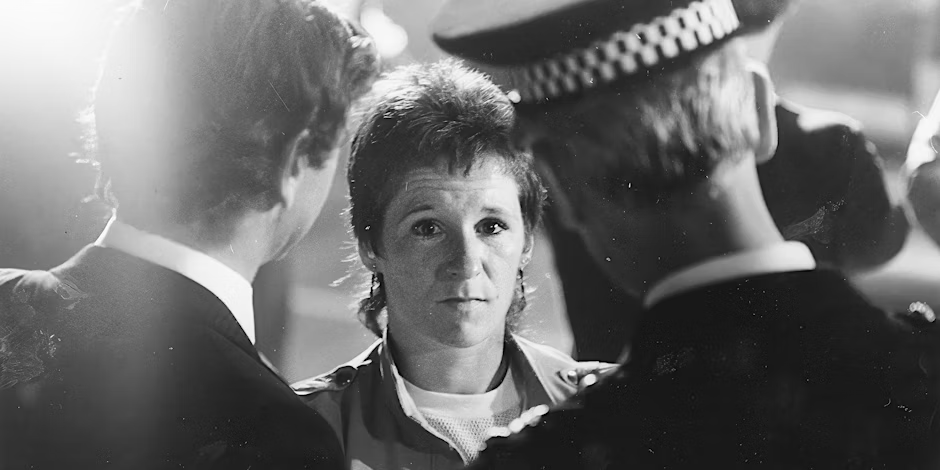
North Edinburgh Arts presents the first screening for more than 40 years of Heroin, a series of three films by Peter Carr made in North Edinburgh in 1983.
Originally shown over successive nights on prime time national UK television, Heroin is an unflinching fly on the wall glimpse at an often forgotten part of Edinburgh’s social history.
As poverty, crime and drug use in Scotland’s capital was ripping forgotten communities apart, Peter Carr was introduced to Edinburgh’s hidden underbelly by co-founder of the Gateway Exchange, Jimmy Boyle.
Boyle also introduced Carr to SHADA – Support Help and Advice for Drug Addiction – the grassroots organisation set up by what Carr calls “two remarkable women” – Heather Black and Morag McLean – as a lifeline and support network for drug users.
This became the basis of Heroin, which over its three episodes reveals a powerful and moving portrait of a community surviving in the face of institutional neglect and contempt from local authorities who would rather keep it out of view.
After four decades, Peter Carr revisits North Edinburgh for the screenings of his films to take part in a unique event by, for and about North Edinburgh.
Each screening will be followed by a conversation between key figures around the making of Heroin and those around North Edinburgh then and now.
Heroin ‘Uncut’ – The Films of Peter Carr and the Edinburgh Community Stories Behind Them
North Edinburgh Arts
MacMillan Hub
12c MacMillan Square
Edinburgh EH4 4AB
Heroin 1 followed by Irvine Welsh in conversation with ZoëBlack – April 23 – 6.30-8.30pm.
Heroin 2 followed by Dr Roy Robertson in conversation with Victoria Burns – April 24 – 6.30-8.30pm.
Heroin 3 followed by Peter Carr in conversation with Sarah Drummond – April 25 – 6.30-8.30pm.
Running time of each film is 50 minutes, followed by a short break and discussion.
An exhibition of production images from Heroin by Granada TV stills photographer Stewart Darby runs at North Edinburgh Arts alongside Heroin ‘Uncut’, from April 23 to May 17 2025.
A programme for Heroin ‘Uncut’ features a new essay by Peter Carr reflecting on the making of his films alongside Stewart Darby’s images from Heroin.
Heroin ‘Uncut’ is coordinated and produced by Zoë Black, Victoria Burns, Neil Cooper, Sarah Drummond, Graham Fitzpatrick and Kate Wimpress in collaboration with North Edinburgh Arts and Screen Education Edinburgh.
With thanks to Laura Alderman, Alice Betts and Genevieve Kay-Gourlay at North Edinburgh Film Festival, Willie Black, Jimmy Boyle, Morvern Cunningham, Freda Darby and the Darby family, Malcolm Dickson at Street Level Photoworks, Laura Hoffman, Judith Jones and Stephen Kelly at granadaland.org, Jordan at ITV plc, Alan McCredie, Dr. Roy Robertson, Emma Welsh, Irvine Welsh, Bob Winton.
Special thanks to all staff, volunteers and board members of North Edinburgh Arts and Screen Education Edinburgh who made this event happen.
Extra special thanks to Peter Carr.
Heroin was originally produced by Granada Television and screened on the ITV network on November 7th, 8thand 9th1983. All films and photographs are sole copyright of ITV plc, and are shown under licence.
Heroin ‘Uncut’ is dedicated to the memory of Heather Black, Morag McLean and all those friends, neighbours and loved ones who took part in the Heroin films. Though they may no longer be with us, their stories live on.
Largest welfare reforms for a generation to help sick and disabled people who can and have the potential to work into jobs – backed by a £1 billion investment, unveiled by the Work & Pensions Secretary today
Work Capability Assessment to be scrapped and “right to try” work guarantee to be introduced in drive to tear down barriers to work
Changes will unlock work, boost employment, and tackle the broken benefits system to unlock growth as part of the government’s Plan for Change
Record £1 billion employment support measures have been announced ‘to help disabled and long-term sick people back into work’.
The new measures are designed to ensure a welfare system that is fit for purpose and available for future generations – opening up employment opportunities, boosting economic growth and tackling the spiralling benefits bill, while also ensuring those who cannot work get the support they need as part of the government’s Plan for Change.
This will end years of inaction, which has led to one in eight young people not currently in work, education or training and 2.8 million people economically inactive due to long term sickness – one of the highest rates in the G7.
The number of people receiving one of the main types of health and disability benefit, Personal Independence Payments (PIP), has also risen rapidly and is becoming unsustainable.
Since the pandemic, the number of working-age people receiving PIP has more than doubled from 15,300 to 35,100 a month. The number of young people (16-24) receiving PIP per month has also skyrocketed from 2,967 to 7,857 a month. Over the next five years, if no action is taken, the number of working age people claiming PIP is expected to increase from 2 million in 2021 to 4.3 million, costing £34.1 billion annually.
All this has driven the spiralling health and disability benefits bill, forecast to reach £70 billion a year by the end of the decade, or more than £1 billion a week. This is equivalent to more than a third of the NHS budget, and more than three times as much as is spent on policing and keeping communities safe.
Speaking in Parliament today, Liz Kendall announced a sweeping package of reforms to overhaul the system, so it better supports those who need it while tearing down barriers to work including:
Ending reassessments for disabled people who will never be able to work and people with lifelong conditions to ensure they can live with dignity and security
Scrapping the controversial Work Capability Assessment to end the dysfunctional process that drives people into dependency – delivering on the government’s manifesto commitment to reform or replace it
Providing improved employment support backed by £1 billion – one of the biggest packages of employment support for sick and disabled people ever – including new tailored support conversations for people on health and disability benefits to break down barriers and unlock work
Legislating to protect those on health and disability benefits from reassessment or losing their payments if they take a chance on work.
To ensure the welfare system is available for those with the greatest needs now and long into the future, the government has made bold decisions to improve its sustainability and protect those who need it most, including:
Reintroducing reassessments for people on incapacity benefits who have the capability to work to ensure they have the right support and aren’t indefinitely written off.
Targeting Personal Independence Payments for those with higher needs by changing the eligibility requirement to a minimum score of four on at least one of the daily living activities to receive the daily living element of the benefit, in addition to the existing eligibility criteria.
Rebalancing payment levels in Universal Credit to improve the Standard Allowance. Raising it above inflation by 2029/30, adding £775 annually in cash terms.
Consulting on delaying access to the health element of Universal Credit until someone is aged 22 and reinvesting savings into work support and training opportunities through the Youth Guarantee.
Prime Minister Keir Starmer said: “We inherited a fundamentally broken welfare system from the previous government. It does not work for the people it is supposed to support, businesses who need workers or taxpayers who foot the bill.
“This government will always protect the most severely disabled people to live with dignity. But we’re not prepared to stand back and do nothing while millions of people – especially young people – who have potential to work and live independent lives, instead become trapped out of work and abandoned by the system. It would be morally bankrupt to let their life chances waste away.
“When I talk about opportunity for all, I mean it. That’s why we are bringing forward the biggest changes to the welfare system in a generation and improving support for those who need it. Ensuring those who can work do work is not only right, but it will also improve living standards and drive growth, the number one priority in our Plan for Change.”
Work and Pensions Secretary Liz Kendall said: “Our social security system must be there for all of us when we need it, now and into the future. That means helping people who can work to do so, protecting those most in need, and delivering respect and dignity for all.
“Millions of people have been locked out of work, and we can do better for them. Disabled people and those with health conditions who can work deserve the same choices and chances as everyone else.
“That’s why we’re introducing the most far-reaching reforms in a generation, with £1 billion a year being invested in tailored support that can be adapted to meet their changing circumstances – including their changing health – while also scrapping the failed Work Capability Assessment.
“This will mean fairness for disabled people and those with long term health conditions, but also for the taxpayers who fund it as these measures bring down the benefits bill.
“At the same time, we will ensure that our welfare system protects people. There will always be some people who cannot work because of their disability or health condition. Protecting people in need is a principle we will never compromise on.”
In her statement to Parliament, the Work and Pensions Secretary outlined the clear case for change to the welfare system and set out her commitment to ensuring that disabled people and those with a health condition have the same opportunities to work as anyone else.
In particular, she highlighted that the UK has one of the highest reported rates of working-age people out of work due to ill health in Western Europe and the UK is the only major economy whose employment rate hasn’t recovered since the pandemic – exacerbated by a broken NHS with millions of people on waiting lists.
The government has already made huge progress to fix the NHS, including by hitting the manifesto commitment to deliver over two million extra elective care appointments seven months early, and bringing forward a wider programme for NHS reform through the rollout of community diagnostic centres and 10-year plan. The Health Secretary has also sent crack teams spearheaded by top clinicians into areas of high economic inactivity, and the latest data shows waiting lists in these areas have reduced at almost double the rate of the rest of the country.
The reformed system will be built on a straightforward guarantee: any disabled person or person with a long-term health condition who is claiming out of work benefits will be able to access high quality, tailored help into a job. It will also mean that those who cannot work will always get the support they need. In Scotland and Wales, we will work closely with the devolved governments as we develop this package of support.
The reforms are based on five key principles:
Protecting disabled people who can’t and won’t ever be able to work and supporting them to live with dignity by:
Income Protection: Those currently in receipt of UC health will benefit from the increased standard allowance and will not be affected by plans to reduce UC health in future.
Extra Financial Support: For people who receive the new rate of UC health in the future system, we are proposing a new premium for individuals with severe, life-long health conditions who will never be able to work. The details, eligibility criteria and rate of this premium will be set out in due course.
Ending Reassessments: Reassessments for disabled people and people with life-long conditions who will never be able to work will be scrapped.
Improving Safeguarding Practices: The government will look at how safeguarding practices for the most vulnerable can be improved and improve experiences with the system, working with stakeholders to identify areas for improvement.
Delivering better and more tailored employment support to get more people off welfare and into work. This includes:
£1 Billion employment package to deliver tailored support for disabled people and those with long-term conditions.
New Support Conversations to provide earlier opportunities for people with health conditions to discuss work goals and available help.
Investing in the Youth Guarantee by delaying access to UC health element until age 22 and reinvesting savings into work support and training for young people.
Stopping people from falling into long-term economic inactivity through early intervention and support by:
Access to Work Scheme: We will consult on improvements to help people start and stay in work with reasonable adjustments including aids, appliances and assistive technology. These would be the first substantive changes to Access to Work since its introduction in 1994
Unemployment Insurance: We will reform contributory benefits (ESA and JSA) into a single, non-means tested, time-limited benefit for those who have paid into the system to ensure people get the support they need to find a new job that makes the most of their skills, contributing to a dynamic and productive economy.
Restoring trust and fairness in the system by fixing the broken assessment process that drives people into dependency on welfare by:
Scrapping the WCA to end the labelling of people as either ‘can or can’t work’ and consulting on a new single assessment. Under the new system, any extra financial support for health conditions (including PIP, ESA or UC health) will be assessed via a new single assessment which will be based on the PIP assessment – considering on the impact of disability on daily living, not on capacity to work.
Increasing Face-to-Face Assessments for PIP and the WCA to improve the quality of assessment decision while ensuring we continue to meet the needs of those with who may require a different method of assessment.
Longer term reform of the PIP Assessment – In the long term we will set out broader reforms to the PIP assessment, and intend first to carry out a review involving experts and stakeholders to adapt and improve it.
Right to Try Guarantee: which will ensure someone trying work or on a pathway towards employment will never lead to an immediate reassessment or award review.
Restarting Mandatory Reassessments: We will reintroduce reassessments for incapacity benefits, with exceptions for those who will never work and those under special rules for end-of-life care. Reassessments have largely been switched off since 2021, leaving people stuck on benefits when they could be helped into work and to improve their quality of life.
Ensuring the system is financially sustainable to keep providing for those who need it most by:
Changing PIP Eligibility: PIP will be targeted more on those with higher needs by requiring a minimum of four points on one daily living activity, in addition to the existing eligibility criteria.. DWP will work with DHSC to ensure that existing people who claim PIP who may no longer be entitled to the benefit following an award review under new eligibility rules have their health and eligible care needs met. The government is consulting on how best to achieve this.
Rebalancing Universal Credit: by improving the Standard Allowance to provide more adequate support. The government plans to raise the Standard Allowance above inflation by 2029/30, adding £775 in cash terms annually. This aims to avoid people having to choose between employment or adequate financial support. This change addresses the current issue where the health element rate is double that of the standard allowance, creating an incentive for people to prove they are unfit to work to claim the health element and access greater financial support.
Helen Barnard, director of policy at Trussell, said: “We’re deeply concerned by the cuts announced to disability payments today.
People at food banks have told us they are terrified of how they might survive. We welcome the positive proposals from the Department for Work and Pensions to boost the basic rate to Universal Credit and invest in employment support. However, we fear these steps will be undermined by a Treasury drive to make short-term savings.
“Huge cuts risk pushing more disabled people to the doors of food banks, and will have devastating consequences for us all. The UK government was elected on manifesto pledges to end the need for emergency food parcels. This isn’t what people voted for.
“Disabled people are already three times more likely to face hunger, and three quarters of people at food banks are disabled or live with someone who is. Our social security system should be rooted in justice and compassion, able to be there for us all, especially when we need it most.
“This isn’t a done deal. With at least a year before any cuts come into force, there’s still time for the Prime Minister and Chancellor to rethink and make good on today’s promise to restore trust and fairness in the social security system.”
The TUC said: ’11 General Secretaries of our trade union affiliates have written to the government to raise “profound concerns” about today’s welfare cuts targeted at disabled people. The labour movement must stand together with campaigners, charities & carers to resist”
Responding to today’s statement by Liz Kendall MP, Poverty Alliance policy & campaigns manager Ruth Boyle said: “People in the UK are desperate for a government that delivers a just and compassionate country.
“They want to see an end to deepening poverty, debt, destitution, and hunger in their communities. Many will be distressed, disappointed, scared, and angry at today’s announcements.
“The plans to cut the health element of Universal Credit are wrong and unjust. Cutting vital financial support to disabled people won’t help them into paid work – but it is likely to move them towards poverty.
“Equally unjust is the idea of making it virtually impossible for under-23s to get Universal Credit health support. The Government is punishing young people who aren’t fit for work simply because of their age.
“These changes are driven by a desire for financial cost savings, rather than helping people access the support they need. Positive proposals like personalised support to help people into work and a Right-to-Try will be undermined by cuts which force people into further and deeper poverty.
"The plans to cut the health element of Universal Credit are wrong and unjust. Cutting vital financial support to disabled people won't help them into paid work – but it is likely to move them towards poverty." https://t.co/gLnkE8FNAkpic.twitter.com/CZAIn0O6kL
— The Poverty Alliance (@PovertyAlliance) March 18, 2025
“Personal Independence Payments are a vital part of the social security system, and even though we have a replacement Adult Disability Payment in Scotland, there are still many people here who are on PIP.
“These social security benefits support people’s basic freedom – whether they are in work or not. They help cover some of the extra living costs that are forced on disabled people. The Government now plans to make it harder for them to get that vital support, denying them a full place in society, and undoubtedly pushing many towards debt and destitution.
“We urge the Scottish Government to maintain its commitment to justice and compassion, and to make sure the Adult Disability Payment still supports the freedom and rights of disabled people.
“It is shameful to try to balance the books on the backs of disabled people and households that are already struggling to keep their heads above water. Instead, the Government should do the responsible thing and use their tax powers to unlock our country’s wealth for investment in a strong social foundation.
“And they can scrap their self-imposed fiscal rules with a plan to help everyone build a better life for their households, and a better future for our country.”
Commenting on the Green Paper’s plans for social security reform announced by the government today (Tuesday), TUC General Secretary Paul Nowak said: “During 14 years of Tory failure, too many people were written off. Millions of workers have been left without proper support to move into work or progress in good jobs, and too many people with disabilities or ill health have not had access to the support they need.
“But change must be done in the right way. While we welcome the decision not to freeze PIP, this package will still lead to significant cuts in entitlements for some disabled people.
“As well as ensuring that those with the most severe disabilities are protected, we urge ministers to reconsider the scale of proposed cuts in disabled people’s incomes.
“Disabled people who are unable to work must not be pushed further into hardship.”
Commenting on the Green Paper’s wider proposals, Paul added: “Action to boost access to quality employment programmes and ensure that Jobcentre work coaches can provide quality and meaningful support is welcome. As too are proposals to strengthen contributory benefits.
“This needs to be accompanied by ongoing investment in the NHS, including mental health services. Better healthcare can transform lives.
“The government’s plan to Make Work Pay is also crucial to driving up the quality of jobs in Britain and ensuring more people have access to decent work.”
Transport union, RMT has criticised Labour’s decision to cut welfare spending by up to £5bn by 2030.
Eddie Dempsey RMT general secretary said: “Welfare cuts target people who rely on support to survive, including disabled people, carers, the unemployed, and those in insecure work.
“For the past 40 years our economy has been marked by low investment, wage suppression and super-high profits.
“Our economy needs to be fundamentally restructured so we can invest in housing, infrastructure and services to create well paid jobs and provide an adequate safety net for those who fall on hard times.
“There is an enormous amount of wealth in this country and the Labour government should be using the economic levers at their disposal to capture it from the rich.
“Billions could be recouped by the treasury through levies on wealth, the closure of tax loopholes, and extracting excess corporate profits.
“RMT stands with all in our working-class communities, including the disabled and unemployed.”
OXFAM Scotland tweeted: ‘Just a reminder there’s no shortage of money in the UK, just a shortage of political will to go out & tax it.
‘While more people risk being locked into hardship/deeper poverty, the ballooning bank balances of the UK’s richest millionaires/billionaires get off virtually scot-free’
The Disability Policy Centre’s Interim Director of Research, Arun Veerappan, response to the Government’s release of the Green Paper this afternoon.
Green MSP slams Labour betrayal of disabled people and calls on MPs to fight back
Scottish Green’s co-leader and MSP for Lothian region Lorna Slater is calling on Labour MPs to fight back on the inhumane cuts that the UK government are proposing to hit their fiscal targets.
In the Westminster government’s latest controversial move, it has announced a package of changes expected to affect some of the UK’s most severely disabled people. The measures will deny benefits for thousands of people across the country.
Lorna Slater MSP for Lothian region said: “These cuts will make a cruel and dehumanising system even more brutal than it already is. They will spread pain and misery across every community.
“ This decision is immoral. You can’t cut £5 billion of support without causing real harm to disabled people.
“ None of this is inevitable. Labour could choose to bring in a wealth tax that collects a fair and justified share from the richest people to invest in the services we all rely on.
“Labour are doubling down on the Tory idea that you can work your way out of disability. They are sending a cruel and dangerous message that only people who can boost our economy are worth supporting. They promised an end to austerity, but this goes even further than anything that the Tories ever dared.”
“The fact that they are choosing to punish the people with the least tells us everything we need to know about Labour’s values. The millions of people who waited 14 long years to get rid of the Tories deserve so much better than this.”
‘Cuts to benefits announced today have clearly been motivated by a desire to make short-term savings to meet arbitrary fiscal rules, says New Economics Foundation’s Head of Social Polict Tom Pollard.
‘They’re not going to help ill and disabled people, they’re only going to create more problems.’
Former Labour Party leader and now Independent MP Jeremy Corbyn said: “This is a seminal moment: a Labour government cutting disability benefits. Not just continuing Tory levels. Cutting.
“This comes after a week of speculation, itself an act of cruelty by a government toying with people’s dignity. These cuts are disgraceful – and will cost lives.”
Scope charity commented: “These plans will be catastrophic for disabled people’s living standards. Nearly half of families living in poverty already include someone who is disabled. Now the government is choosing to penalise some of the poorest people in our society.
“We welcome the investment in tailored, non-compulsory employment support. But ripping £5 billion out of the benefits system by 2030 will completely undermine this positive step.
“Countless disabled people, charities, MPs, and experts are urging the government to think again. And we’re not backing down. The consultation is likely to receive an overwhelming response. We urge the government to listen to disabled people and think again.
“Over the coming days, we’ll analyse all the details in the government’s plans. We’ll then share more information about what these changes mean and who could be affected as soon as we can. We’ll also share ways you can have your say in the consultation.
‘This is an especially worrying time for many disabled people. If you’re concerned about these changes, you can contact our helpline for advice and support.
Call us free on 0808 800 3333, or visit our website for more ways to get in touch:
‘If you need to talk to someone about how you’re feeling, day or night, Samaritans are here to help. Call 116 123 for free, or visit their website https://samaritans.org “
Money and Mental Health response to government welfare green paper
Today the government has published its welfare green paper, which outlines its proposals to reform the welfare system.
In particular, the green paper sets out plans to make it harder for people to qualify for Personal Independence Payments (PIP) — a benefit which people with disabilities and long-term ill-health can claim to help cover the extra costs associated with their disability, and which is not connected to work. In addition, people aged under 22 will not be able to qualify for the health top-up element of Universal Credit.
The government has also announced £1bn additional funding for personalised employment support to help people with disabilities move into work, and that people receiving benefits will be given a “right to try” work without losing their benefits entitlement.
Commenting on the proposals, Helen Undy, Chief Executive of the Money and Mental Health Policy Institute, said:“PIP is an absolute lifeline for thousands of people with mental health problems.
“It can be the difference between being able to afford basic things like a phone to call your crisis team or help to clean your home, or living in disarray and increasing isolation. Making it harder to access will jeopardise people’s financial security and cause serious distress, which won’t set up people to go back into work and to thrive.
“These changes will mean that needing help to wash or get dressed because of your mental health wouldn’t be enough to qualify for PIP. The government says it will ensure people with ‘genuine need’ aren’t affected, but we’re really concerned that these new reforms will take us further back to the days when people with mental health problems were treated as less worthy of help than those with physical health issues.
“The new ‘right to try’ a job without losing the benefits is welcome, as is the funding for personalised employment support for people with disabilities or health conditions. But introducing these measures alongside cuts to PIP and stopping young people from getting incapacity benefits will do more harm than good.
“It is a short sighted approach that will have a devastating impact on many people’s finances and mental health, and we urge the government to rethink these plans.”
Mikey Erhardt, Policy Officer at Disability Rights UK, said: “The minister stood up today and made clear that, after months of rumours, media speculation and spin, these reforms are not about supporting Disabled people into work, but making brutal and reckless cuts of £5 billion. That is up from £3 billion just a few weeks ago.
“The rise in claims is driven by the increase in the retirement age, record NHS waiting lists, inadequate education and mental health support for young Disabled people and a complete failure to tackle the disability employment and pay gaps. Yet the government has decided to create a rhetorical smokescreen around the depth of cuts it’s going to make.
“The government intends to bar young Disabled people from receiving the Universal Credit health component until they are 22. That is alongside their promise to significantly increase assessments at scale without making the assessment process safer for those going through the system right now.
“These measures mark dangerous cuts for all Disabled people. Furthermore, altering the PIP award criteria will make it harder for those who need support to qualify.
“The minister’s assertion that 1000s more face-to-face assessments will be more accurate is laughable; we know that in-person assessment causes more stress and worry and often leads to inaccurate findings from assessors.
“Let’s be clear: there is nothing ambitious about cutting support from those who need it and that’s what today’s announcements were really about. Rising claims for personal independence payment reflect not a problem with Disabled people but rather reflect successive government’s failure to do even the bare minimum to create a more equitable society.”
Mental Health Foundation responded:
Responding to the Government’s proposed changes to welfare and work announced today, Carers Trust’s CEO, Kirsty McHugh, said:“In the midst of today’s announcements on welfare reform, we cannot lose sight of the nation’s carers. Two-thirds of carers have been forced to give up work or cut back on hours because of their caring role.
“Many would like to work if they were able to access flexible jobs and the right employment support – sadly this is rarely on offer. But for many carers, work isn’t an option – either because of the toll of their caring role or their own ill health.
“Proposals to tighten eligibility criteria for benefits will strike fear into the heart of many carers. Around half a million carers look after someone receiving Personal Independence Payments (PIP), and nearly 150,000 people rely on both PIP and Carer’s Allowance.
“Disabled people and their carers are already among the most vulnerable in our society and more likely to live in poverty. Reducing their access to a financial safety net could push them over the edge.
“Carers already prop up our ailing health and social care system and we cannot introduce welfare changes that leave carers again picking up the pieces. We therefore welcome the commitment in the Green Paper to consider the impact of these changes on carers.”
State of Caring in Scotland 2024: Health and social care support for unpaid carers
36% of unpaid carers reported their mental health as ‘bad or very bad’– a 29% increase in 12 months.
65% stated they need more support with their health and wellbeing.
56% often or always feel overwhelmed by their caring role.
59% said that support services were not there when they needed them.
80% have been unable to take a break because of a lack of support from social services.
There is a growing mental health crisis in Scotland’s unpaid carer population – this is the message from Carers Scotland in ‘State of Caring in Scotland 2024: Health and social care support for unpaid carers’.
This new research, based on a survey of over 1,700 unpaid carers in Scotland, saw a 29% increase in the last 12 months of the number of unpaid carers who reported their mental health as “bad or very bad” – 36% of respondents in 2024, compared to 28% in 2023.
This statistic was even more severe when a carer reported struggling financially, with 59% of carers who are struggling to make ends meet saying they had “bad or very bad” mental health. 28% of respondents also rated their physical health as “bad or very bad”, with this number rising to 49% among carers struggling to make ends meet.
80% of unpaid carers from the research stated that the main challenge they will face over the next year is the impact of caring on their physical and/or mental health.
These new findings show that unpaid carers are not receiving the support they need to maintain their health and wellbeing whilst managing their caring responsibilities. More support with health and wellbeing was the number one need cited by unpaid carers in the research, with long waiting times for appointments, inflexible GP appointment systems, and insufficient replacement care all highlighted as barriers to support.
Another challenge is the inability of many unpaid carers to take a physical and mental break from their caring role. Taking a break from caring is essential for carers to recharge, spend time with family and friends, and engage with their own hobbies and interests to improve their wellbeing. However, 63% of carers who stated in the research that they felt overwhelmed in their caring role said that this was due to them not having a break from caring.
Richard Meade from Carers Scotland said: “Unpaid carers in Scotland are in a mental and physical health crisis, which only threatens to get worse without immediate action.
“Unpaid carers continue to bear the weight of an overstretched health and social care system as they are increasingly expected to fill the growing gaps in service provision without increased support for themselves.
“Whilst the Scottish Government has focused on reducing NHS waiting lists, improving hospital discharge delays and access to essential health services there still remains an urgent need for investment in social care and support for unpaid carers.
“Unpaid carers provide the equivalent of £15.9bn in health and social care support and without them the system would collapse, yet they receive a fraction of the support they need.
“The stalled National Care Service provided hope for many unpaid carers that things could change. However, many feel their needs have been lost to a wider political debate and little has changed to improve their lives.
“The Scottish Government, the NHS, and local councils must act now to ensure that carers can access the support they need to continue to care without such devastating consequences to their physical and mental health.”
The monetary value of the contribution of unpaid carers in Scotland estimated at £15.9 billion(1) a year. Despite this, unpaid carers face deteriorating physical and mental health, loneliness and isolation, with too many driven to despair and unable to access to the supports they need to maintain a healthy life.
Carers Scotland has included a range of recommendations alongside this research for the Scottish Government, NHS Boards and Health and Social Care Partnerships to ensure all unpaid carers get the support they need to look after their health and wellbeing and receive the right help for caring.
Download and read the report in full at the link below:
How one participant found motivation through movement
A NATIONAL walking challenge is returning this spring, inspiring people across Scotland to improve their wellbeing by increasing their daily step count.
The spring Step Count Challenge, led by walking charity Paths for All, runs from Monday, 5th May to Sunday, 29th June, offering a fun and social way for teams to stay active during the working day.
Past participants have reported benefits including improved mental health, stronger social connections, and increased daily movement – many return year after year to take on the challenge.
For Fiona, from team Strideclyders For Life, the Step Count Challenge has become a workplace tradition. Having taken part in five challenges, she was recognised as a runner-up in the 2024 autumn Step Count Champion competition by Paths for All, with colleagues nominating her for her commitment and motivation.
“My job is mostly desk-based, so I have to motivate myself to get outside—whether it’s a pre-work walk, a lunchtime stroll, or even just climbing the leaderboard. Having teammates makes all the difference, especially in the winter months,” said Fiona, who works in the Alumni and Development Department at the University of Strathclyde.
“My favourite type of walk is a brisk one along the beach. I’m from Kinross-shire, so some of my top spots are St Andrews, Aberdour, and the East Neuk of Fife, though I’ve also enjoyed some stunning beach walks on the west coast.”
Fiona has encouraged dozens of colleagues to get involved, particularly new team members, helping them connect while staying active. A highlight for her was creating a video for the team’s Instagram (@unistrathclydealumni), featuring their favourite walking routes.
The Step Count Challenge invites teams of five—including workplaces, friends, and families—to log their steps and engage in friendly competition while working towards personal and team goals.
The challenge offers more than just physical activity—it supports workplace wellness by reducing stress, improving productivity, and promoting safer, cleaner, and greener work environments through reduced carbon emissions and decreased car use.
Kevin Lafferty, Chief Executive Officer at Paths for All, highlights the benefits of taking part: “Walking is one of the most accessible ways to improve both physical and mental health. Fiona’s story is a perfect example of how small, daily changes can have a big impact.
“The challenge is a fantastic way to build healthy habits, reduce stress, and support Scotland’s journey towards a greener, healthier future.”
To encourage participation, an early bird discount is available until Monday, 31st March. Teams can sign up for £48 instead of £60 by using the voucher code SPRING25 at checkout.
Paths for All, which works with the Scottish Government and partner organisations , is committed to promoting walking as the default choice for short journeys and supporting local authorities in creating inclusive, active environments.
More information and registration details for the Spring Step Count Challenge can be found at www.stepcount.org.uk.