Free event to offer legal and property advice for families navigating dementia

Supportive evening session to help families plan with confidence

WHEN a loved one is diagnosed with dementia, the emotional impact is often compounded by urgent and unfamiliar decisions about care, legal authority and financial planning.

As part of Dementia Awareness Month, a free public information evening in central Edinburgh will offer families the chance to hear from a panel of experienced professionals, offering expert insights into Powers of Attorney, property, guardianship and the wider support available.

The event, titled Supporting Loved Ones with Dementia: A Practical Guide to Power of Attorney & Property, will take place on Tuesday 17 February 2026 at the ESPC Property Lounge on George Street, Edinburgh.

Hosted by legal and property specialists Ralph Sayer, the event is being delivered in partnership with The Dementia Trust and supported by ESPC, which is providing the venue as part of its commitment to supporting public education and community wellbeing.

The free session will run from 5.30pm until 8pm, with short presentations from guest speakers between 6:00pm and 6:45pm, followed by an informal Q&A and the opportunity for one-to-one discussions with experts.

Attendees will hear from Kimberley Mackay, Partner and Head of Private Client at Ralph Sayer, who will speak about the importance of putting a Power of Attorney in place.

Kimberley explains: “We encourage everyone to consider making a power of attorney whilst they are fit and able. However, a diagnosis of dementia does not automatically mean that is no longer possible to do so. Taking legal advice at the earliest opportunity is a good idea to understand the options.”

“We want people to leave this session feeling better informed and more in control when supporting someone through a dementia diagnosis.”

The panel will also feature Tzana Webster, Head of Estate Agency at Ralph Sayer, who will explain the role of property in funding care and how to navigate property transactions when acting under a Power of Attorney or guardianship

Tzana added: “Property is often a person’s most significant asset but selling it on their behalf can bring both legal complexities and emotional strain. We’ll be sharing practical advice for families facing those decisions and advise what steps they can take to prepare in advance.”

The event will also include perspectives from The Dementia Trust, which works directly with families, carers and individuals living with dementia to offer guidance and emotional support.

Professor June Andrews, a leading dementia expert, and Sandra McDonald, former Public Guardian for Scotland and respected authority on capacity and decision-making, are expected to join the panel to bring vital insight from their combined decades of frontline experience.

Sonia Mangan, Interim Lead Officer from the Dementia Trust said: “This event reflects the kind of practical, empathetic support that makes a real difference to people navigating life after a diagnosis. Dementia can feel overwhelming, but families are not alone.

“We know how uncertain and isolating a diagnosis can feel, especially when it comes to legal and financial decisions. That’s why we’ve launched our Planning Ahead campaign and why we’re calling February 2026 Power of Attorney Month. Our message is simple: put Power of Attorney in place early.

“The average age of people in Scotland making a Power of Attorney is 79 – and too often we see people waiting until it’s too late.”

In addition, Dianne Millen, Director of specialist incapacity law firm Datrys Legal, and an accredited specialist in incapacity and mental disability law, will demystify the guardianship process, helping attendees understand how the court procedure works when a Powers of Attorney is not already in place.

Dianne said “Going to court is an intimidating prospect for most people and can feel overwhelming when you are also caring for a loved one with dementia.

“Understanding the process can make you feel more in control.”

Paul Hilton, CEO of ESPC, added: “As an organisation made up of Solicitor Estate Agents with huge amount of legal and property expertise, ESPC has long supported opportunities for our firms to help the public make informed decisions.

“Our Property Lounge isn’t just a shopfront, but also a space for education, connection and community. We’re proud to host events like this that support people through difficult times with clear, trusted advice. Many families don’t realise the vital role property can play in funding care or planning for later life, so this kind of event offers an important way to begin those conversations.”

Spaces at the event are free but strictly limited to 30 attendees, with advance registration required. Tea, coffee and light refreshments will be provided.

Attendees are invited to submit questions in advance when registering, helping to tailor the session to the most pressing concerns.

The event is open to anyone supporting a loved one with dementia, considering legal planning for later life or simply seeking clarity on where to begin.

To register, please visit: https://www.eventbrite.com/e/supporting-loved-ones-with-dementia-power-of-attorney-and-property-tickets-1982000361435?aff=oddtdtcreator&msockid=1d1fe889bdee66af33defe9fbcc9671e

Parents facing separation urged to avoid courtroom conflict as Family Mediation Week kicks off in Scotland

Parents facing separation urged to avoid courtroom conflict as Family Mediation Week kicks off in Scotland

Parents living in Scotland who are considering separation or divorce in 2024 are being urged to seek an alternative to a courtroom confrontation to settle parenting arrangements, with the launch of Family Mediation Week, 22 – 26 January. 

January usually sees a dramatic rise in the number of parents deciding to live apart as the various pressures that go hand-in-hand with the Christmas period act as a final straw for relationships.

Stuart Valentine, Chief Executive of Relationships Scotland said: “Family Mediation Week is designed to raise awareness of the benefits of family mediation, a process that can help ex-partners agree what works for them, whilst avoiding the court process with all the stress, delay and cost it can bring.

“Many parents emerge from the festive period feeling defeated by the pressures on relationships and finances that have been highlighted during the holiday period.

“Here in Scotland we find parents in this position simply don’t know which way to turn. Their life-changing decision to separate brings with it so many tough questions: Who lives where? Where will the children live, and how will we make sure we each spend time with them? How will we sort money? What about debts and pensions? And even the family dog?

Family Mediation Week shines a helpful spotlight on these tricky issues, offering separating parents information about their options as they look to make arrangements for parenting, property and finance.

“Family mediation is a process where an independent, professionally-trained mediator helps you work these things out, enabling you to avoid courtroom confrontation. Professional mediators help empower you to create long-term solutions for your particular circumstances, rather than leaving it to a court to make decisions for your family.”

The Scottish Government fund Relationships Scotland to provide family mediation at low cost where children are involved, and Legal Aid may also be available.

Anyone wanting to know more about the benefits of family mediation can visit:

 www.relationships-scotland.org.uk or call 0345 119 2020.

NHS Greater Greater Glasgow & Clyde launches Home for Lunch initiative

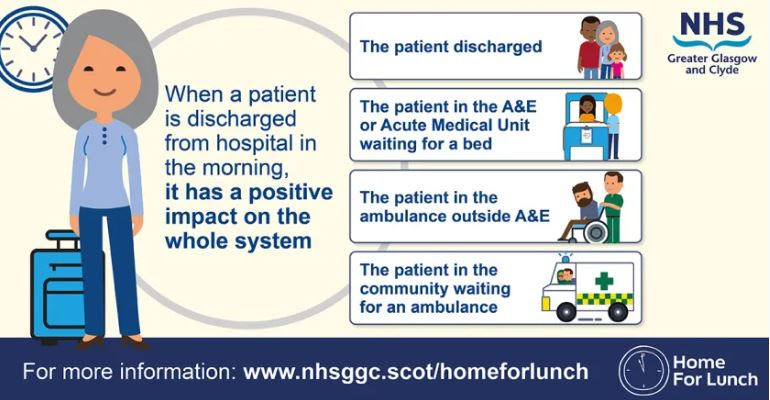
As winter poses increasing demand on our healthcare system, NHSGGC is encouraging family members to help get their loved ones ‘Home for Lunch’. 
 
Almost all patients that are ready to go home are discharged on the same day, but a number remain in hospital causing flow issues throughout the health care system. 
 
Doctors are reminding families of patients who are ready to be discharged to help make the required arrangements to get them back to their own home or care setting, at the earliest opportunity. 
NHS Greater Glasgow and Clyde ward staff and discharge teams work in parallel to create pathways for families to ensure that, when their loved ones are healthy enough to return home, they are supported in doing so.
 
As part of NHSGGC’s ABC winter campaign, the health board are attempting to ease pressure on our services and staff from the emergency department, through to patients being discharged. 
 
Dr Scott Davidson, Deputy Medical Director for Acute Services, said: “Winter places increasing demands on our health care services and families play an important role in helping to ease those pressures. 
 
“Our staff are working extremely hard to ensure we provide the best possible care for our patients and we are looking for your help to get loved ones home at the earliest opportunity. 
 
“We do not want patients spending any longer than they need to within our hospitals and want people to be in the comfort of their own home, without the risks associated with lengthy hospital stays. 
 
“I would like to thank families and members of the public who are doing their best to support our patients and staff as we continue to tackle winter pressures.” 

‘Grief is the price we pay for love’

Remembering 9/11 at London ceremony

On September 11th, 2001 families who lost loved ones in the 9/11 attacks in the USA will mark the 20th anniversary of that fateful day.

This will include a private gathering organized by the September 11 UK families support group (S11UKFSG) at the September 11th memorial garden in Grosvenor Square, London.

The September 11th UK families support group represents relatives of both the 67 British victims and other nationals with strong links to the UK.

The memorial garden (above) is the only UK memorial specially designed in consultation with the bereaved families.

It was created in memory of all those who lost their lives in the atrocity and houses a pergola with the inscription: “Grief is the price we pay for love.”

Service of Remembrance

On Saturday September 11th 2021 families who lost loved ones in the 9/11 attacks in the USA will mark the 20th anniversary of that fateful day with a special Service of Remembrance for bereaved families.

This private gathering organised by the September 11 UK Families Support Group (S11UKFSG) will take place at the September 11 Memorial Garden in Grosvenor Square, London.

The focus of our commemoration will be the reading of the names by family members and  the laying of white roses on the inscription stone within the Garden. We shall observe a one minutes silence during the service.

Candlelight Memorial

After sunset on September 11th 2021, an installation of 67 LED candles will be lit within the September 11 Memorial Garden in memory of the 67 British victims who perished that day. 

We shall remember the lives of those taken, mourn the beautiful souls no longer with us and celebrate the love they brought into our lives.

The Square will remain open until 8pm.

The memorial garden will be closed to members of the public from 1pm – 5pm on September 11th . Outside these hours the garden is open to the public as usual.

A Nostalgic Nation?

Brits’ favourite ways to spend time with their Grandparents

  • –    Nostalgic conversations are the nation’s favourite way to spend time with their grandparents 
  • –    Research reveals top 10 activities include baking, gardening, and playing board games  
  • –    Psychotherapist, Andre Radmall, explains why it’s so important for grandchildren to spend time with their grandparents.

Reminiscing about the past (32%) is the nation’s favourite activity to do with their grandparents, new research has revealed. 

The study was conducted by Gala Bingo, the nation’s favourite bingo site, to launch its new Paddle Pals TV advert, which celebrates the bond we have with our grandparents. 

Playing card games (31%), looking through old photographs (30%) and baking (30%) were some of the other ways in which we cherish time with Grandma and Grandad.  

Men and women tend to have different favourites, however, as while talking about history is the favourite grandparent pastime for men, baking takes the top spot for women. Almost two in five (38%) women say baking is their favourite thing to do with their grandparents, compared to just 21% of men. Yet men and women equally enjoy spending time planting and pruning in the garden (26%) with their elders. 

Interestingly, age plays a part in which activities are most enjoyed. Cooking alongside their grandparents is a popular activity for both the 25-34 (41%) and the 35-44 (33%) age groups. For the younger generation (18-24), taking the dog for a walk with their grandparents topped the list at 31%. 

Overall, the nation’s top 10 favourite activities to do with their grandparents are:  

  1. Talking about the past – 32% 
  2. Playing cards – 31% 
  3. Going through old photos – 30% 
  4. Baking – 30% 
  5. Cooking – 28%  
  6. Playing board games – 28% 
  7. Gardening – 26% 
  8. Walking – 23% 
  9. Going to the park – 23% 
  10. Doing puzzles, crosswords, word games –20% 

Dog walking (15%), taking a trip to the beach (15%) and puzzling over jigsaws (19%) were among the other wholesome activities that were mentioned but didn’t quite make the top 10. 

Sporty activities such as swimming (4%) and bowling (3%) were some of the least popular endeavours. 

There is also variation across the UK. Playing board games with the grandparents is the preferred activity for people in Bristol and Edinburgh (both 37%) whereas taking a stroll around a park is the favourite thing to do for those in Liverpool (31%) and Sheffield (33%).  

Psychotherapist and author Andre Radmall said: “The relationship between grandparents and their grandchildren is immensely important. Spending time with each other provides innumerable benefits for both. 

“Grandchildren can learn from the experience of grandparents, passing on their wisdom through to adulthood which can be a rewarding and meaningful experience for grandchildren.”  

Karina Adrian, head of brand marketing at Gala Bingo, said: “It’s really great to see the nations appreciation and love we share for our grandparents.

“There are so many shared experiences between a grandparent and their grandchild, with this research reflecting just how much of a positive impact the bonds with our grandparents can have on us as adults. 

“We hope this research has inspired people to spend some quality time with their grandparents this week and reminisce on good times spent with them.” 

Christmas without family tops concerns for Samaritans callers

Being separated from family and loved ones over the Christmas period is one of the biggest concerns facing callers to Samaritans, the charity has revealed.

Volunteers on the 24-hour helpline say almost a third of callers are feeling concerned about their wellbeing over Christmas, with the majority of those worried about being separated from family and loved ones, and coping with being lonely during Christmas or having to spend Christmas alone.

Samaritans surveyed 1,400 of its own volunteers in Ireland and the UK to see how callers to the helpline have been feeling about the festive season.

Niall Mulligan, Executive Director for Samaritans Ireland, wants to remind the public that Samaritans are there 24 hours a day, including Christmas Day, for anyone who is distressed, lonely or suffering.

Samaritans volunteers in the Republic of Ireland answered almost 40,000 calls in December 2019. More than 50 volunteers answered over 1,150 calls and written contacts on Christmas Day alone.

“It has been an unprecedented year with the pandemic affecting so many people’s health and wellbeing and this will be a very different Christmas for many people,” Mr Mulligan said.

“Some may not be able to visit family or friends, others may have family oversees who cannot travel home, and for others missing normal events, like Christmas Mass or socialising in the local pub, can be devastating.”

“We know that people struggle more at Christmas, as it’s a time when loneliness can really hit home. We want people to know that we are available 24/7 for everyone on freephone 116 123 or email jo@samaritans.ie.”

Among the volunteers on duty this Christmas Day will be Bernie Keane and her brother Thomas Carbery, who will be on duty together in Samaritans Waterford branch.

Bernie said it’s “no sacrifice” to volunteer on Christmas night as she loves being there for others when they need someone to talk to.

“I find it very rewarding to volunteer on Christmas Day,” said Bernie, who joined Samaritans 12 years ago.

“A lot of places close for Christmas, like care and day centres, and there are very lonely people, some with mental health issues, who may not see anyone for the whole of Christmas. Giving them 15 minutes just to talk to someone can make a difference.

“They may not be suicidal, but they’re so lonely. Other callers may have had a fall out with family members or other issues may surface like bereavement.”

Thomas joined Samaritans five years ago when he retired as a sergeant in the Irish Defence Forces.

“It can be hard sometimes on a particular call, but at the end of that call when someone says thank you for being there it feels good. You can’t get that feeling anywhere else,” he said.

“It’s nice to be there at Christmas when people need you and when they do not have anyone else to chat to. You could be the only person they talk to all day. It’s a good feeling to know you have been there for that person. It’s definitely been hard for people this year.”

Tonight, Samaritans in Ireland will also mark the Longest Night of the year – the Winter Solstice on Monday December 21st – by asking landmarks across the country to illuminate in green to remind people we’re there for them in their darkest hours.

Dublin’s Convention Centre, The Rock of Cashel, Kilkenny Castle, Millmount in Drogheda and Limerick County Council offices are among those taking part to raise awareness of our service.

Images will be shared across social media channels with the hashtags #LongestNight #AlwaysThere.

Lockdown has sparked positive changes in family behaviour

Food bringing the nation closer together

·         New research reveals the nation ate more meals together as a family during lockdown which has brought them closer together

·         Two in five said they talked more to their family or partner as a result and over a third said they laughed more at the dinner table

·         Brits also became more mindful with 40 per cent saying they made a conscious effort to be more sustainable and food waste aware

·         Hotpoint #FreshThinking campaign aims to help people maintain their new positive changes and mindful habits in ‘the new normal’

A new study has revealed that lockdown has sparked positive changes in family behaviour and habits in the kitchen, with mealtimes bringing UK families closer as they have bonded by spending more time together cooking and eating. 

Proving that the kitchen really is the heart of the home, the research by Hotpoint as part of its Fresh Thinking For Forgotten Food campaign, reveals that over a third of Brits (38 per cent) have sat down to eat together more as a family during the pandemic than before lockdown.

Two in five (40 per cent) said this led them to talking more with their family or partner at mealtimes than they did previously, with 35 percent saying they felt they have laughed more together at the dinner table than before.

During lockdown, over a third (38 per cent) of those surveyed said the amount they looked forward to mealtimes as a family increased, with two in five (41 per cent) Brits cooking more meals together as a family. Over a third (36 per cent) said they rediscovered their love of cooking during the pandemic. 

Almost three-quarters (74 per cent) said they felt pleased with their new habits and 90 per cent said they intended to continue.

Commenting on the research, behavioural psychologist, Jo Hemmings says: “In a time where our day-to-day lives have been turned upside down and fear and anxiety have never been far from our thoughts, it has been important to find an alternative routine that provides us with some distraction and reassurance.

“For many, both preparing family meals and sitting down and eating together as a family has provided that emotional support and been a comforting anchor in our new way of living.” 

The study by appliance manufacturer Hotpoint, revealed that Brits have become more adventurous in the kitchen, with 45 per cent trying out new dishes, and almost half (49 per cent) cooking more meals from scratch.

Almost two in five (39 per cent) said they cooked more healthy meals during lockdown than before. Following the banana bread craze that swept social media, over a quarter of men (27 per cent) and two in five (40 per cent) of women said they rediscovered their love of baking. 

Jo Hemmings agrees: “It’s not just the forgotten joy of sitting together, eating a home cooked meal as a family, more people have been finding a new love of cooking during the pandemic and preparing the family meal has become less of a burden and much more of a pleasure.”

Commenting on the research, Sophie Ellis-Bextor, who is working on the campaign said: “This research by Hotpoint reflects exactly what happened in our home this year. We always used to eat all together at the weekends but at the beginning of lockdown we started having supper together every night as a family.

“We’ve also become much better at using leftovers and planning ahead – putting more thought into preparing food for the week, how we would turn dinners into lunch for the next day and not wasting anything.”

With fewer trips to the grocery store, almost half of those surveyed (45 per cent) said COVID-19 had made them think more about how to preserve food and organise their fridge, freezer and cupboards in a way that kept certain foods fresh for longer. Two in five (40 per cent) said they used their freezer more often during lockdown.

Nearly half (49 per cent) said they didn’t waste any food as a result of being home more and two in five Brits (40 per cent) said the lockdown has increased their efforts to be more sustainable and food waste conscious. 45 per cent turned their green fingers to growing more of their own food at home. 

In an effort to reduce food waste during the pandemic, 45 per cent of Brits kept cupboards, fridges and freezers more organised than before, with two in five (41 per cent) using meal plans and only shopping for the food they needed, with over a third using leftovers as meals. 

Kimberley Garner, Hotpoint Brand Manager, comments: “It’s been a dynamic and trying time, but we’re seeing that many people have embraced this period as an opportunity to reflect on the choices they make when it comes to sustainable household habits and caring for their loved ones, and as a result want to adapt their behaviour for the better.

“At Hotpoint, we are committed to supporting the public on this journey through the ‘new normal’, providing them with innovative solutions that empower more conscious choices at home, every day. With our #FreshThinking campaign, Hotpoint aims to help people continue their positive changes and conscious lifestyle choices – supporting “the way you care” at home.

Hotpoint is committed to increasing awareness around the global issue of food waste and providing helpful tips and innovative product solutions to tackle this challenge in UK households. Now in its third year, Hotpoint’s Fresh Thinking for Forgotten Food Campaign aims to inspire everyone to enjoy great food whilst cutting back on household waste. As part of its long-term commitment to helping the public move to a zero-waste kitchen, Hotpoint has teamed up with Jamie Oliver to provide recipes, hacks and tips to help people better care for themselves and their families, as well as the environment.

The campaign also showcases the brands innovative, high performance cooking and refrigeration products that can also make a real difference when it comes to cutting back on household food waste.

To find out more visit: www.hotpoint.co.uk/FreshThinking.

Alternative Solutions for Relationship Disputes

Family law experts in Edinburgh are suggesting five alternative solutions to couples wrestling with relationship disputes and unable to go to court to reach a resolution under current guidelines.

Gibson Kerr has seen an influx of requests from concerned parents and separating partners as to what options are available to resolve disputes while the courts remain closed for non-urgent cases.

Head of Family Law Fiona Rasmusen (above) said: “We try to encourage clients to adopt ways of resolving their family disputes and concerns which don’t involve a lengthy or expensive court process.

“With the courts currently closed for non-emergency disputes, now is an even better time to engage in an alternative method to try to resolve issues and concerns.

“The particular route you decide to take will depend on many things including the relationship that you have with your former partner and the nature of the dispute.”

The firm has revealed five common methods of resolving disputes that can take place outside of the courts. The more common disputes Gibson Kerr deal with include dividing assets, support, occupation of the family home, and childcare arrangements.

Fiona, an accredited expert in family law, said: “Former couples can sit down together and negotiate an agreement themselves, with advice from their lawyers to hand – this is what’s referred to as ‘Kitchen Table’ resolution.

“This can save a lot of legal fees, and can even make the relationship more amicable than other methods. Once you have terms decided, you should engage your solicitor to have the arrangements drafted into a formal agreement.”

For couples who can’t easily sit down together to discuss their separation, they might find it easier to work with a neutral mediator to come to an agreement. Gibson Kerr advises that couples have separate legal advice throughout the process, and ask their solicitors to create an agreement once they have reached a resolution.

Collaborative law is another avenue open to couples in conflict, where they work with specially trained solicitors to come together and reach a fair and reasonable settlement. In these situations, both parties agree they will not raise court proceedings, meaning it is less likely to result in a total breakdown of relationships.

Fiona said: “The most common way family law disputes are dealt with is negotiations through solicitors, where each party’s solicitor works to come to an agreement – outside of a court.

“Instead of going to courts, we also encourage clients to look at arbitration, where an independent and qualified arbitrator is appointed to hear a case and make a decision. Arbitration can be very useful if there are one or two important points you want to solve, for example deciding the date you separated, or where your child should go to school.

“As well as being completely confidential, you choose your arbitrator and you can decide the timescales and how the proceedings are managed – including where and when it takes place.”

“When the courts reopen fully, separated partners can look to raise an action. The advantages of going to court are that the process is strict in terms of fairness and timescales, and you will get a definite result at the end of it.

“However, as it’s expensive and lengthy, and can be stressful, we tend to advise clients to look at all of the other options available ahead of making the decision to go to court.”

Anyone interested in alternative methods of dispute resolution should contact one of the family law solicitors at Gibson Kerr on 0131 226 9161.

Ne’er Day campaign escalates as Usdaw makes the case for closing large shops on 1 January

Shopworkers’ trade union Usdaw has published the results of an extensive survey of Scottish retail staff, who overwhelmingly back the closure of large shops on New Year’s Day, and is calling on all MSPs to support the motion tabled by Jackie Baillie MSP in the Scottish Parliament.

Usdaw’s survey of over 1,000 shopworkers in Scotland found that:

  • Three quarters feel they spend too little time with friends and family over New Year.
  • 72% have come under pressure to work on New Year’s Day or 2 January.
  • Four in ten don’t receive any premium pay for working on New Year’s Day.
  • 79% are not happy to work on New Year’s Day or 2 January.

The full survey results can be viewed at: www.usdaw.org.uk/NYDSurvey

Stewart Forrest, Usdaw’s Scottish Divisional Officer says: “This survey clearly demonstrates the strength feeling among our members. We have today written to all MSPs asking them to support Jackie Baillie’s motion calling for a decent break at New Year after the busy Christmas period.

“I have also written to the Scottish Retail Consortium urging them to reconsider their opposition to large stores closing on New Year’s Day. Usdaw does not accept that giving retail workers in large stores just one more day of guaranteed time off would have a negative impact on our high streets. 72% of our members who worked on New Year’s Day 2019 said that their store was either very quiet or fairly quiet.

“Usdaw is fully supportive of efforts to revitalise Scotland’s high streets. The livelihoods of our members depend on a thriving retail sector. That is why we are calling on the Government to implement an industrial strategy for retail and to take action on a whole range of issues, from business rates to parking charges and public transport, in order to breathe life back into the industry. We are seeking to work with the Scottish Retail Consortium, so we can tackle these issues together.”

Jackie Baillie MSP, (Scottish Labour, Dumbarton) said: “Retail staff work incredibly hard all year round, and are often on their feet for long shifts. Christmas and New Year is a time which should be spent with family, and there are few days in the year when families are off at the same time.

“The results of Usdaw’s survey show that the overwhelming majority of respondents want to spend more time with their families during Christmas and New Year.

“I hope that all of my MSP colleagues will recognise that everyone deserves a day off for New Year and will support the motion that I have tabled in the Scottish Parliament.”

Paddy Lillis, Usdaw General Secretary, said: “We are very grateful to Jackie Baillie MSP for the support she is giving to our members and this campaign. New Year is a special holiday in Scotland, but this is not reflected in the experience of many retail workers.

“Under the Christmas Day and New Year’s Day Trading (Scotland) Act 2007, Scottish Ministers may, by statutory instrument, ban large shops from opening on New Year’s Day, subject to consultation.

“On behalf of Scotland’s retail workers, we are urging the Scottish Government to open that consultation and for MSPs to listen to shopworkers concerns about their work/life balance.”

Father’s Day: We’re spending less quality time with loved ones than 5 years ago

Not spending enough quality time with family and friends is having a negative impact on our mental health, according to a new report from smart home service provider, Hive. Continue reading Father’s Day: We’re spending less quality time with loved ones than 5 years ago