The National Flood Forum are joining forces with The Chartered Institution of Water and Environmental Management (CIWEM) to create an exhibition highlighting peoples experience of flooding.
The exhibition will take place as part of the Flood & Coast Conference at Telford International Centre in June 2023.
People who have been flooded are being asked to share artwork, poetry and / or photographs that show their experiences of being impacted by floods. There may also be the opportunity to attend the event and give your personal experience of flooding.
Tracey Garrett, CEO, National Flood Forum, said: “We would like to increase understanding between the industry and those who flood and putting this exhibition of flooded people’s experiences into the Flood and Coast Conference, gives a chance to do just that.’’
Terry Fuller, CEO at CIWEM, said: “We want our conference to place communities at the heart of our thinking and discussions.
“Flood & Coast provides a great opportunity to raise the importance of community engagement amongst the flood risk professionals and decision makers who attend. It is personally important to me that everyone with an interest in flood and coastal risk feels welcome and able to participate”.
For more details and to submit your contribution visit:
Edinburgh’s Gleneagles Townhouse partners with Aya Editions to celebrate IWD
New Exhibit Celebrating Scottish and West African female artist collective to open on International Women’s Day at the Townhouse
Throughout the month of March, West African female artists collective, Aya Editions, will be exhibiting ‘Our City’ at Gleneagles Townhouse’s Lobby 37 as its next exclusive cultural installation. The exhibition is available to view daily between 9am and 7pm for the public, and for members and hotel guests throughout their visit to Townhouse.
Aya Editions – a digital space that encourages and promotes West African female artists to showcase their work, combating inequalities in the creative industries – was co-founded by Carina Tenewaa Kanbi, an Edinburgh native of Scottish Ghanaian heritage, and Victoria Cooke in 2020.
Carina and Victoria recognised that women were underrepresented in West African visual arts so founded the collection to help female artists create, promote and sell their work. They believe women’s contribution to creating and safeguarding cultural heritage is so often obscured because of the social and institutional barriers they face to take part in creative industries. Carina and Victoria wanted to remove these barriers and encourage women to take part and continue to contribute to creative industries.
‘Our City’ captures the movements and moments of urban life across West African and Scottish cities and explores the real and imagined city through the lenses of seven young West African and Diasporan female photographers; Hady Barry, Keren Lasme, Clarissa Rötzel, ASK, Chantal Azari and Azumi. Final artist to be confirmed.
‘Our City’ follows each woman’s journey through their city and challenges the stories often told by men that came before them. In doing so, the images within the exhibit celebrate the female gaze, reminding us that among the chaos, there is calm. Through desperation, there is beauty; in mundanity, there is joy, play and patience.
Whilst firmly rooted in these women’s experiences, ‘Our City’ moves beyond representation to explore the varied and divergent photographic practices that take us through fashion, landscape, photojournalism and street photography, reminding us that cities are neither static nor linear and that they are as much imagined as they are real.
Gleneagles Townhouse is celebrating the exhibition’s opening and International Women’s Day on the 8th of March with a special event exclusive to Townhouse Members.
Aya Editions will host a panel discussion on the role of cultural and creative industries in promoting gender-inclusive cities and what we can do together to make a difference, as well as a DJ set from Emma Korantema to finish the evening.
National Galleries of Scotland announces Decades: The Art of Change 1900-1980, an exploration of 80 years of art at the newly reopened Modern Two
Decades: The Art of Change 1900-1980
29 April 2023
Free
Scottish National Gallery of Modern Art (Modern Two)
The Scottish National Gallery of Modern Art (Modern Two) in Edinburgh will reopen on 29 April 2023 with a spectacular new exhibition, Decades: The Art of Change 1900-1980.
This fascinating, free exhibitionwill take a journey through 80 years of art, from 1900 to the 1970s. Spanning a period of dramatic change, moving from the birth of the motorcar to the dawn of the space race, each work on display will be drawn from the Gallery’s world-class collection of modern art.
Decades: The Art of Change 1900-1980 will take visitors through a series of six chapters across six rooms at Modern Two. Each chapter speaks of a particular moment from across the twentieth century, when artists rebelled against the previous generation, creating works which came to characterise a period.
Beginning with French artists who painted with electrifying colour, the first room includes work by Henri Matisse and André Derain. Their brightly coloured landscape paintings were so radically different that the artists were given the derogatory label ‘Fauves’ – meaning ‘wild beasts’. The term stuck and Fauvism had a major impact on British and particularly Scottish art.
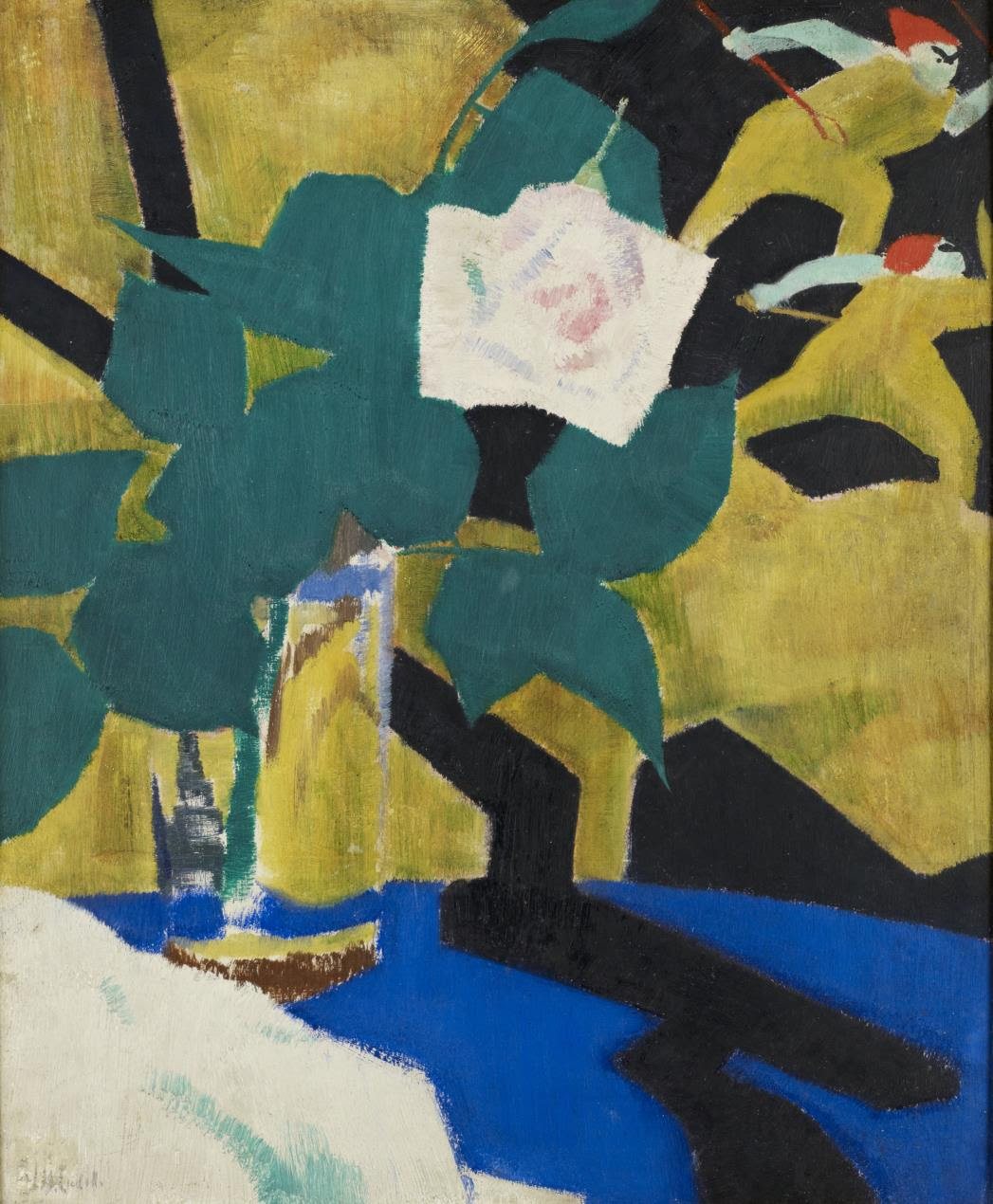
Two fabulous new acquisitions, by Scottish Colourists FCB Cadell and JD Fergusson, feature in this room. Leith-born JD Fergusson, who lived in Paris before the First World War, was one of the key Scottish artists of the twentieth century.
Painted in 1911, Flowers and Pink Box, is vigorous and confident in its brushwork, bright and clashing in colour. The Rose and the Lacquer Screen, by FCB Cadell, combines several of his favourite still-life props: a rose in a transparent vase, a black fan and its trailing ribbon and a detail of the lacquered screen that dominated the drawing room of his house in Edinburgh’s New Town. These new acquisitions have been generously donated by private owners.
Moving into the 1930s, artists such as Piet Mondrian believed that art could change society. This room will feature work by Alexander Calder, Paule Vézelay and Ben Nicholson.
Entering the 1940s, abstraction and idealism were replaced by grim realism. Featuring work by Francis Bacon, Joan Eardley and Bet Low, these paintings and sculptures, created both during and immediately after the Second World War, speak of a new reality.
The 1950s saw a battle between Abstraction and Realism. This is illustrated in Decades: The Art of Change 1900-1980 by two mural projects created for the great Festival of Britain exhibition of 1951, which will be shown together here for the first time. Josef Hermann’s project shows a row of miners – builders of a new socialist order; Victor Pasmore’s mural project is instead a daring essay glimpse of spiralling abstract forms. Exceptional creations by Alan Davie, Louise Nevelson, Fernand Léger, Eduardo Paolozzi and Elisabeth Frink will also be on display, making up the 1950s presentation.
Art became celebratory, playful and experimental in the 1960s. Sculptors abandoned traditional materials such as bronze and marble for ‘soft sculpture’, exemplified in the work of Jann Haworth, Yayoi Kusama and Duane Hanson’s iconic Tourists.
Throughout the 1970s, artists took Abstraction and Minimalism to extremes. Fred Sandback’s Untitled,1971 – two coloured cords which cut across the corner of the room – questions the very notion of art as something with three-dimensional form or narrative meaning.
The Keiller Library will focus on the motif of the hand in Surrealist art and writing. Drawing on works by artists like Man Ray, Edith Rimmington and Salvador Dali, from the national collection’s world-class holding of Surrealist books and archive material.
Radical, questioning and experimental, this selection of one hundred works from the national collection shows ways in which artists have continually pushed the boundaries and created art which defines its time. These pieces still have the power to shock and make us think about our world today.
Director-General of the National Galleries of Scotland, Sir John Leighton, said: ‘National Galleries of Scotland is delighted to reopen Modern Two with an exhibition that celebrates the strength of the national collection.
“Featuring a fascinating range of works by many of Scotland and the world’s greatest artists, Decades: The Art of Change 1900-1980 encourages visitors to think about how art can both reflect and change the way we see the world around us.
“We welcome you to join us on a voyage of discovery through 80 years of bold artistic achievement.’
TURNER IN JANUARY 1 January – 31 January 2023, open daily 10am – 5pm Royal Scottish Academy The Mound, Edinburgh. EH2 2EL 0131 624 6200 | nationalgalleries.org Admission free
Opening on New Year’s Day 2023, the National Galleries of Scotland (NGS) is pleased to welcome back visitors to their yearly tradition:Turner in January.
Scotland’s famous collection of Joseph Mallord William Turner watercolours was left to the nation by the great art collector Henry Vaughan in 1900. Since then, following Vaughan’s strict guidelines, they have only ever been displayed during the month of January, when natural light levels are at their lowest. Because of this, these watercolours still possess a freshness and an intensity of colour, almost 200 years since they were originally created.
Turner in January, the annual exhibition of these watercolours in Edinburgh, is a keenly awaited tradition for many people in Scotland. The 38 watercolours include dramatic landscapes from the Himalayas, the Swiss Alps, and the Isle of Skye, grand visions of Venice, and captivating seascapes. They will take you on a journey through Britain, Europe and beyond, and guide you through the life and career of this iconic artist.
Turner was the most famous British artist of the 19th century. In a career spanning over 50 years, he experimented constantly with technique and colour and created landscapes that still astonish today.
Turner developed new ways of painting in watercolour and revolutionised ideas of what could be achieved in the medium. Through a combination of exceptional talent and incredible hard work, Turner was able to capture in paint the sublime beauty of the natural world.
Taking over two large, spacious rooms within the Royal Scottish Academy, Turner in January contains all 38 watercolours from Henry Vaughan’s gift to the nation, plus the exciting addition of the mesmerising Bell Rock Lighthouse (1819).
In 2023, NGS is delighted that this much-loved annual exhibition is made possible thanks to players of People’s Postcode Lottery.
Charlotte Topsfield, Senior Curator of European & Scottish Art at the National Galleries of Scotland, said: ‘As we enter the New Year, Turner’s watercolours bring light to the dark days of January.
“The brilliantly preserved Vaughan Turners, and their accompanying tradition, hold a special place in the hearts of our visitors. We look forward to welcoming you back’.
The Scottish premiere of the exhibition Doctor Who Worlds of Wonder opens at the National Museum of Scotland in Edinburgh this weekend. In celebration of the television show’s Scottish connections, a suit worn by David Tennant to play the Fourteenth Doctor in special episodes airing next year, will also go on display in the museum.
This ground-breaking new exhibition, which runs from 9 December 2022 to 1 May 2023, explores the science behind the global hit television series Doctor Who and gives fans a chance to experience the Doctor’s adventures from a scientific perspective.
Produced by leading experiential design experts Sarner International under license from BBC Studios, the exhibition invites fans of all ages to explore the role science has played in the world’s longest running action-adventure show. The eight zones set within this educational exhibition cover a diverse selection of exciting scientific topics while drawing in content from across the full canon of Doctor Who.
Doctor Who Worlds of Wonder offers a thrilling exploration of science for both established fans of the TV show and newcomers alike. Actor, director and author Mark Gatiss – writer of several episodes of Doctor Who – narrates the exhibition, guiding this journey through space and time.
Mark Gatiss said: “So many people who have gone on to work in science have had their interest piqued by watching Doctor Who, and one of the amazing things about the show is i2ts ability to make us wonder. I’m thrilled to be part of the exhibition and I do hope as many curiously minded people as possible take the opportunity to visit at the National Museum of Scotland.”
A range of hands-on immersive experiences and interactive features take visitors on a journey through Cosmic Curiosities, a TARDIS Tech room and the science behind time travel asking whether it really is possible. In the Monster Vault, visitors also come face to face with the Doctor’s most famous foes including Cybermen, Weeping Angels and Daleks.
Alison Cromarty, Head of Exhibitions & Design at National Museums Scotland, said: “We are tremendously excited that the premier of this exhibition opens at the National Museum of Scotland this weekend.
“From the wonder of the science fiction of the TV show to our present-day understanding of the big scientific topics it touches on, there is something for everyone.”
Ed Cookson, Projects Director, Sarner International: “For almost 60 years Doctor Who has been exploring mind-bending scientific developments. The iconic characters, monsters, stories, and settings of the television series provide a perfect guide through the wondrous worlds of space, time and science.”
Doctor Who has strong Scottish connections. To date three Scots have played the role of The Doctor, Sylvester McCoy, David Tennant and Peter Capaldi (the Seventh, Tenth and Fourteenth, and Twelfth Doctors respectively) with a fourth, Ncuti Gatwa, recently announced as the new Doctor.
A suit worn by David Tenant in a series of special episodes airing next year will be displayed alongside companion Catherine Tate’s costume by the entrance to the exhibition. Other notable Scottish cast members have included Companions Karen Gillan and Neve McIntosh as well as Michelle Gomez as Missy (The Master), with Alan Cumming having also appeared recently as King James VI & I. Another Scot, Steven Moffat, was showrunner from 2008 to 2017.
The show has featured several other Scottish icons. The Loch Ness Monster appears in 1975’s Terror of the Zygons with Tom Baker, while the Picts featured along with the 9th Legion of the Roman army in 2017’s The Eaters of Light (which starred Peter Capaldi and Michelle Gomez). Other episodes set in Scotland include 2006’s Tooth and Claw, set in the Highlands and Under the Lake/Before the Flood (2015), set in Caithness.
The National Museum of Scotland is supported by players of People’s Postcode Lottery in mounting the exhibition.
The exhibition is proving to be hotly anticipated with tickets for the opening weekend already sold out. Pre-booking is recommended, tickets are available from www.nms.ac.uk/doctorwho
National Museums Scotland Members free.
Book in advance to save, general admission: Adult £12-16.50, Over 60s £11-15.50, Student, Unemployed, Disabled, Young Scot £10-14.50, Child 5–15 £8-12.50, Under 5s Free
10% off family bookings*
Discounts available for groups of 10 or more
*10% off when you buy up to three Child 5–15 ticket alongside up to any two Adult, Over 60s, Student, Unemployed, Disabled, Young Scot tickets, with a maximum of five tickets in total. Cannot be used in conjunction with National Museums Scotland Member tickets or any other discount or promotional offer.
Katherine Ka Yi Liu 廖加怡, absolute truth (from the beginning of Earth – present), yixing clay, plywood, rain water, leaves, sand from Hong Kong and 20 cents Hong Kong dollars. Courtesy of the artist.
HILLSIDE GALLERY
3 December 2022 –26 February 2023
Tuesday – Sunday, 10am—4pm
Collective are delighted to announce a new exhibition by artist-curator Katherine Ka Yi Liu 廖加怡 as part of the Satellites Programme.
neither the West nor the East can be a determinate location is a multisensory installation featuring text, handmade paper, found objects, scent, ceramic sculptures and silver casts.
To create this new series, Katherine has developed an engaged approach to archival research, in which they interrogate and challenge the Western, Eurocentric frameworks that have been imposed on Hong Kong (a British colony from 1841–1997).
This installation will be a space for reflection, encouraging visitors to reclaim strength and charge resilience.
Katherine Ka Yi Liu 廖加怡 is an artist-curator whose practice and research became witness to the political transformation in Hong Kong. Their work contemplates the construction of diasporic identities, and confronts the politics of power, gender(s), and race with a humorous touch.
Saturday 1 July to Sunday 29 October 2023 National Museum of Scotland, Chambers Street, Edinburgh
nms.ac.uk/littleblackdress
#BeyondLBD
A new exhibition at the National Museum of Scotland will deconstruct the little black dress, examining the radical power of the colour black in fashion. From design classics to cutting-edge catwalk creations, Beyond the Little Black Dress (1 July to 29 October 2023) will bring together more than 60 striking looks from collections and designers around the world.
The colour black can be interpreted in many subtle and often contradictory ways. The exhibition will explore how its complexities have made the little black dress simultaneously expressive of piety and perversion, respect and rebellion; from the well-mannered cocktail attire of the early 20th century to the leather and latex worn by members of punk and fetish subcultures.
Beyond the Little BlackDress will open with a simple, short black dress designed by Coco Chanel in 1926. Considered radically modern, it disregarded convention entirely in both the stark design and sombre shade, that had traditionally been associated with mourning.
At the time it was hailed by US Vogue as “the frock that all the world will wear”. The ‘little black dress’ became a wardrobe staple, a symbol of femininity and a byword for chic, with each new silhouette capturing the spirit of its time.
The little black dress remains a blank canvas for broader political and cultural shifts. It can challenge social norms around race, gender and sexuality to reflect evolving ideals of beauty and identity, proving its infinite capacity for reinvention.
Visitors to Beyond the Little Black Dress, which is sponsored by Baillie Gifford Investment Managers, will discover a century of fashion in a series of themed, immersive displays. Iconic early pieces by Yves Saint Laurent, Dior and Jean Muir will be juxtaposed with recent looks by ground-breaking contemporary designers and brands like Gareth Pugh, Simone Rocha and Off-White.
Areas of the exhibition will be dedicated to highlighting Black British designers whose work explores both Blackness in terms of identity, and the role the colour black plays in crafting a futuristic, sci-fi aesthetic. Elsewhere, the exhibition considers how perceptions of the colour black differ in a global context, as well as how the intervention of smart technologies are establishing a blueprint for a more sustainable future.
Georgina Ripley, Principal Curator, Modern and Contemporary Design at National Museums Scotland, said: “Few garments are as iconic as the little black dress, which has often been held up by the fashion industry as the one piece every woman should have in her wardrobe.
“It has evolved dramatically in the century since its creation. From a simple shift dress which helped democratise women’s fashion to a bold political statement, it has moved through various iterations which reflect changing ideals of beauty and body image.
“Displaying classic couture, avant-garde pieces and garments that make a political statement, this exhibition will explore its enduring success, and ask why, in the fickle and fast-paced fashion world, the little black dress has achieved that rare status of being truly above the fray.”
Sam Pattman, Philanthropy Manager at Baillie Gifford Investment Managers said: “We are delighted that our successful relationship with National Museums Scotland continues with our support for Beyond the Little Black Dress.
“This exciting exhibition takes a fresh look at a timeless classic, examining how it has remained in style for nearly a century and displaying a dazzling selection of garments from those worn by royalty to truly avant-garde creations at the cutting edge of the fashion industry.”
National Museums Scotland’s internationally significant fashion and textiles collection comprises around 50,000 objects and is one of the largest in the UK.
The collection includes textiles dating back to the 14th century and clothing and accessories dating from the 16th century to the present day. Beyond the Little Black Dress follows the acclaimed exhibition Body Beautiful: Diversity on the Catwalk.
The exhibition is curated by Georgina Ripley, Principal Curator, Modern and Contemporary Design, National Museums Scotland, Dr Sequoia Barnes, Guest Curator and Carys Wilkins, Assistant Curator Modern and Contemporary Design, National Museums Scotland.
It will be accompanied by a publication and programme of events.
Artists at Work 2: Exhibition celebrating talented colleagues at the National Galleries of Scotland
29 Oct 2022—12 Feb 2023 The Scottish National Portrait Gallery 1 Queen Street, Edinburgh EH2 1JD| 0131 624 6200 |nationalgalleries.org| Admission Free
Artists at Work 2 showcases incredible artwork made by colleagues at the National Galleries of Scotland (NGS) in a group exhibition at the Scottish National Portrait Gallery.
The exhibition celebrates the creative talents of over 100 colleagues working across the entire organisation and runs until February 2023. It is a celebration of the passion and skill of a team charged with caring for and sharing the national art collection for the world.
The exhibition displays a wide range of artistic disciplines; from paintings, drawings, illustration and photography to sculpture and jewellery making; all created by, amongst others, gallery attendants, conservators and retail team workers and follows on from the success of the first Artists at Work exhibition in 2018.
Artist at Work curators ran an open-call submission across the organisation earlier this year and were amazed at the response.
There are 121 artists exhibiting in the show with 157 works on display. Each artwork is supported with information labels that offer insight on the artist, their methods, process, and how their concept came about.
There was no prescriptive theme for the open call which allowed artists to choose art forms and concepts that are personal to their own artistic style and thematic objectives. Themes range from realism to surrealism, the natural world around us and some choose to celebrate topics such as gender and identity with their own personal inflections.
From self-portraits to local landscapes, photographic observations of lockdown life to interpretations of pop culture – Artists at Work 2 is a smorgasbord of artistic talent, colourful reflections, and thoughtful interpretations.
The curatorial team responsible for the exhibition are also exhibitors. The project leads were Darren Duddy and Victoria Gazeley with Aitor Moncho Tudanca (Visitor Assistant) and Silvia Baarlam (Gallery Attendant, Scottish National Portrait Gallery) working alongside them to coordinate the show.
NGS Gallery Shift Attendant, Victoria Gazeley who has co-curated and contributed to the exhibition, said: “We are thrilled to be hosting this exhibition at the Scottish National Portrait Gallery.
“The work on display represents the vast talents of National Galleries of Scotland colleagues and we’re delighted to offer a platform to spotlight this.
“Following on from the popularity of our first Artists at Work exhibition in 2018, we are looking to dazzle our audiences again in a gallery space that matches our growing ambitions. Many talented artists work across our organisation and this exhibition is a wonderful way to celebrate their creativity.”
Darren Duddy, Co-Curator and Conservation Technician at NGS, said: “A gallery is more than just a building and the artworks within. It is also about the people. This exhibition is a great opportunity to see what those of us who work, and volunteer here do in our free time.
“It is a difficult time for artists, and this is a great way for working artists to get their work seen in a national exhibition.”
The first Artists at Work exhibition was held in 2018 and excelled with 300,000 visitors seeing it.
We are delighted to be able to create another exhibition, this time moving from the Scottish National Gallery to the Scottish National Portrait Gallery, Photography Gallery where we have more designated space to display the fantastic works.
The exhibition is open to public from Sat 29 October in Gallery 13 (Robert Mapplethorpe Photography Gallery), Level 1 West, Scottish National Portrait Gallery.
One of Scotland’s most celebrated photographers Stew Bryden is set to host his debut solo showcase at lifestyle aparthotel, Native Edinburgh this November.
This new creative collaboration will see ten striking pieces shot by Bryden and displayed in Counter by Native Edinburgh, for all to enjoy. Running from Thursday, November 3rd, the exhibit is free to attend, and whilst there guests can discover their hidden coffee and cocktail speakeasy – Counter. The perfect backdrop for the stunning exhibition.
Bryden, who is known for his celebrity, fashion and portrait shots, will launch the boutique hotel’s Artist in Residence series that seeks out programming to ignite creative imagination, with an ethos to create great places, with great people, in great areas.
Native Aparthotels are spaces to entertain and be entertained and this new initiative is sure to impress with a ten piece collection that will be on display from Thursday, November 3rd until the end of the year.
At the Edge of Things is in homage to Virginia Woolf’s most experimental work, The Waves: an exploration of the trinity shared between individuality, the self and community.
An iridescent display of eclectic suits, sequin-adorned cocktail dresses and layered outerwear, the visual captures each look within its own habitat — far removed from each other and yet merged into one singular narrative.
As spoken word plucked straight from Woolf’s novel plays over a psychedelic harmony, the images and film flawlessly exudes the themes of its muse: portraying multiple stories merged into one, a unity between the self and other.
Much like fashion itself, the work(s) bear a compelling power that celebrates our limited time on earth.
Stewart Bryden gained his Hons Degree in Glasgow, Scotland before moving to New York City, working within the Chinatown based studio of world-renowned American photographer and artist Ryan Mcginley.
Now based between London, Berlin and Scotland, Stewart has gained commissions and continues to work with some of the world’s most up and coming and leading brands, publications and agencies. He’s shot for the likes of Fendi, Gucci, Max Mara, LV, and editorial clients include Wonderland, Man about town and Clash Magazine.
Olivia Immesi, Managing Director of Native Places, said:“Stewart is a true visual tastemaker and it’s such a pleasure to have him as our first Artist in Residence at Native Edinburgh.
“We’re excited to champion his work and host an exclusive celebration of creative photography here in Edinburgh.”
Stew Bryden, owner of Stewart Bryden said: “As a visual artist it’s always exciting to see your work exhibited, more so with this being my debut solo residency.
“These images and accompanying film were a true passion project and collaboration with some incredibly talented individuals, I’m very proud of the work and for Native places to approach me as their debut artist in residence is very exciting”
Stewart Bryden’s At The Edge of Thingswill be on display in Counter at Native Edinburgh from Thursday, November 3rd until the end of the year. It’s free to attend and Counter is open seven days a week from 8am – 1am.
RESPECT!, an exciting new exhibition, has opened at the Museum of Edinburgh.The exhibition is a celebration of the culture of Caribbean Scottish people through museum objects, poetry and film and has been created in collaboration with the Edinburgh Caribbean Association.
The exhibition explores what it is like to grow up in the Caribbean, what it means to be Caribbean, links with Scotland and how Caribbean food and music has influenced British culture. The items on display have been chosen by members of the Edinburgh Caribbean Association to share their stories with museum visitors. A Spotify playlist has also been created so visitors can enjoy a full range of Caribbean music.
The exhibition is part of a £250,000 community-led collections research project, Exchange, funded by the Arts and Humanities Research Council in partnership with the National Museums Scotland and Royal Museums Greenwich. Exchange | National Museums Scotland (nms.ac.uk)
Cllr Val Walker, Culture and Communities Convener at City of Edinburgh Council said: “Our Museum of Edinburgh celebrates the history of Edinburgh and all the communities who live in the city.
“This wonderful new exhibition has been a community led project, exploring the collections of our Museum of Childhood and the connections between Edinburgh and the Caribbean.
“Visitors to the Museum can enjoy a celebration of the culture of Caribbean Scottish people through museum objects, poetry and film and has been created in collaboration with the Edinburgh Caribbean Association. I would like to thank the association members for their time, creativity and generosity.”
Lisa Williams, Edinburgh Caribbean Association said: “It’s been a wonderful experience collaborating with Museums & Galleries Edinburgh.
“We learned a lot from each other and forged friendship and understanding along the way.”
Curator Lyn Stevens, said: “It has been a tremendous privilege to work with the Edinburgh Caribbean Association.
“The group have shared their knowledge and expertise generously with museum staff and the result is a fascinating insight into the many different Caribbean cultures and what it is like to live in Britain and maintain traditions and a sense of identity.
“I have learnt so much working with them and I am looking forward to our visitors enjoying this wonderful exhibition.”
Dr John Giblin, Keeper of Global Arts, Cultures and Design at National Museums Scotland: “Thanks to a generous grant from the AHRC, the Exchange project has allowed organisations around the UK to work with communities who have historically been marginalised in museum and gallery displays to explore experiences of empire, migration, and life in Britain through their collections.
“Many hundreds of people have come together over the past year to reveal and share a wider range of stories and perspectives, and Respect! Caribbean life in Edinburgh is the culmination of a rich, thoughtful and productive collaboration between a museum and a community group.”
Our Museum of Edinburgh and Museum of Childhood champion local Edinburgh history and Edinburgh communities. The City of Edinburgh council is working to diversify museum collections as part of the Edinburgh Slavery and Colonialism Legacy Review. New acquisitions of dolls, books and magazines have been made as part of this project to add to the Museum of Childhood collections.
The exhibition will be accompanied by a Spotify playlist Respect! Caribbean Life in Edinburgh.
A wide-ranging events programme has been arranged alongside the exhibition.