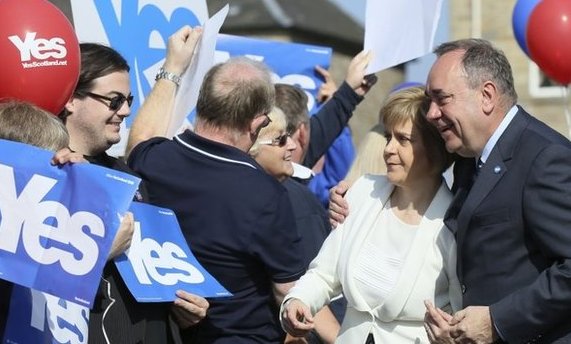
In pictures, the event that reawakened democracy …


Leith Walk will be represented by new SNP and Labour councillors following yesterday’s double by-election.
The councillors were elected using the Single Transferable Vote system – the first time this method has been used to elect two members.
SNP’s John Lewis Ritchie was elected at Stage One of the voting process, while Labour’s Marion Donaldson had to wait considerably longer to learn of her success … she was finally elected at Stage Ten.
The result strengthens the Labour – SNP Capital Coalition’s grip on power at the City Chambers.
The double by-election was brought about by the resignations of Deirdie Brock, who became an MP in May’s general election, and Green councillor Maggie Chapman, who is bidding to become an MSP in North East Scotland at next year’s Holyrood elections.
Returning Officer, Andrew Kerr, said: “I would like to welcome the two newest Councillors to the City of Edinburgh Council and look forward to working with them on matters affecting the Leith Walk Ward and the city as a whole.
“I also want to thank our elections team for all the work they have put into ensuring this by-election ran smoothly.”
The turnout was a disappointing 25.1%
For further details of the results and the Leith Walk By-Election, visit the Elections section of the Council website.
The last few doors have been knocked, the final leaflets have been posted through letterboxes … now it’s up to the voters of Leith Walk:
Leith Walk constituents will go to the polls to elect two councillors for the ward tomorrow (Thursday 10 September).
There are 25,526 Leith Walk residents registered to vote in the election, which takes place in one of the most densely populated areas in Scotland.
Under the Single Transferable Vote (STV) system – a form of Proportional Representation – voters use numbers to rank the 10 candidates in order of preference rather than just using a single cross. Voters can express ‘preferences’ for as many or as few of the candidates as they wish.
This will be the first time in Scotland that an STV by-election has been needed to fill two vacancies in the same ward.
Andrew Kerr, Returning Officer for The City of Edinburgh, said: “This by-election will allow the residents of the Leith Walk ward to play a part in Edinburgh’s democracy, choosing two elected members to represent them and their interests on the City Council. I look forward to working with the electorate to make sure the process runs smoothly.
“Voters should remember that STV allows them to vote for as many candidates they like, numbering choices in order of preference.”
Polling stations will be open from 7am to 10pm on 10 September. There are 11 polling places in the ward, details of which can be found on polling cards and the Council website.
Votes will be taken to the Council HQ where the candidates and their agents will watch them counted electronically as soon as the polls close at 10pm.
Full details of candidates are also available on the Council website.
Find out more about the Single Transferable Vote system.
Leith Walk By-Election: In numbers
11 polling places
19 polling stations
3996 postal votes issued
2 councillors to be elected
10 candidates
25,526 eligible voters – about 7% of the city’s electorate
210 books of ballot papers (100 in each)
40 polling staff, including presiding officers and poll clerks.
ELREC wants your views
ELREC (Edinburgh & Lothians Regional Equality Council) has launched a project, funded by the Scottish government, that aims to increasing representation of Black and Minority Ethnic (BME) communities in public life and the democratic process in Edinburgh and the Lothians.
The first step of the project is to identify the barriers which limit the participation by conducting a survey which will be then used to plan & design the next phase. We would like to request that you to complete the survey online; it will take around 15-20 minutes.
Your view is really important in order to determine further steps to be taken.
Please find the survey link here: www.surveymonkey.com/r/elrec
If you would like a hardcopy of the survey by post please get in touch. For any inquiries, please contact me by email: mrahman@elrec.org.uk or telephone 0131 556 0441. For more information see the project brochure by clicking here.
Thank you in advance for helping us with this project.
Mizan Rahman
Equality Engagement Officer
Edinburgh and Lothian Regional Equality Council (ELREC)
14 Forth Street, Edinburgh EH1 3LH
Tel: 0131 556 0441
Email: mrahman@elrec.org.uk
Edinburgh West SNP MP Michelle Thomson now holds a surgery at Muirhouse Millennium Community Centre (writes JAMES McGINTY)
FRIDAY 4 SEPTEMBER 10.30 – 11.30am
Our newly elected MP in Westminster is back in Scotland after an extensive introduction to Westminster parliamentary procedure, whilst juggling her duties here in Scotland in her constituency.
Many of us have followed Michelle’s exploits via her reports in the Evening News. and Michelle now starts her promised General Surgery here in the Centre (see above).
Come along, no appointment necessary (open door). The surgery will take place in the cafeteria area but will have private space available if required.
In an article marking the 100th day since the General Election, Scottish Secretary DAVID MUNDELL writes that Scotland is in a ‘win-win situation’ as Holyrood becomes one of the most powerful devolved parliaments in the world while we also benefit from remaining part of a strong UK economy:
For the past 100 days our government has acted in the interests of the whole United Kingdom. Every day since the General Election in May we have worked to ensure that every part of Britain benefits from a growing UK economy.
Scotland is enjoying a win-win situation right now. We are winning from the decision we made last year to remain part of a strong UK and keep all the advantages that gives us. We are also winning from the policies this government has delivered in our first hundred days that will provide higher pay and lower taxes for people in Scotland and across the whole of the UK. Scotland’s two governments should be working together at every opportunity to help Scottish workers and Scottish businesses. To protect those who need help most and to provide security in retirement.
This UK Government has made our intentions very clear since May 7th . We will help working people in the UK at every stage of their lives.
The Prime Minister and the Chancellor have set out our stall in the last 100 days. We are moving the UK to a higher wage, lower tax and lower welfare society. The next 100 days will tell us more about whether the Scottish Government shares this ambition.
More powers
One of David Cameron’s first ports of call after the General Election was to come to Edinburgh and meet with Nicola Sturgeon. He promised her we would bring forward legislation to make Holyrood one of the most powerful devolved parliaments in the world. The Scotland Bill was indeed one of the first Bills we published in late May and we are now well on our way to implementing the historic cross party Smith Agreement.
We are entering a new era of devolution in Scotland where the Scottish Parliament is more powerful and more accountable than ever before. Holyrood will have control over billions of pounds worth of tax and welfare powers. They now need to set the Scottish Rate of Income Tax. This money will come out of Scottish paycheques next April. How much will it be? When will they tell us?
If the Scottish Government wants to choose a different path from the UK Government then that is what devolution is all about. If the First Minister wants to increase taxes, create new benefits or top-up existing benefits then that is her choice because these are the new powers Holyrood will have. She should, however, use the next 100 days to explain how Holyrood intends to use these new powers.
Higher pay, lower taxes
The UK Government will keep governing for all parts of the UK. Scotland holds on to the opportunity, security and stability of being part of the UK. This UK Government is committed to driving down borrowing and getting rid of our deficit. We will get our public finances in order and the Chancellor has announced steps to make sure that UK workers hold on to more of their pay and businesses across the UK pay less tax. Britain deserves a pay rise and the Government is establishing a new national living wage which will reach £9.00 an hour by 2020.
New figures this week showed that wages are going up and employment is at near record levels. We are on the right track, providing opportunities for those who work hard and protecting the value of a well-earned UK pension for those in retirement.
Place in the world
In his Summer Budget the Chancellor pledged to increase defence spending. As a Scot, I am proud that this UK Government is meeting both the NATO pledge on defence spending and the UN commitment on international aid spending. This is not an either or decision for us. We will protect ourselves at home and we will continue to help the poorest people in the world.
Scotland will benefit from the security our increased defence spending will provide. Scottish workers and Scottish companies will be at the heart of building the latest UK defence technology for our brave UK Armed Forces.
Conclusion
Last year’s referendum was an historic moment for Scotland. The right decision was made on a once-in-a-lifetime day where a higher percentage of people turned out to vote than ever before in the UK.
We are now building a stronger economy for all parts of the UK and a more powerful devolved parliament for Scotland. It is a win-win situation for Scotland and the rest of the UK.
The first hundred days is just the start. This government will continue to govern for all parts of the UK. We will work with the Scottish Government and others to help those who work hard, create opportunities and support those who need the most help.
The candidates standing in the Leith Walk by-election, which will elect two councillors on Thursday 10 September 2015, have been confirmed.
They are:
Marion Donaldson – Scottish Labour Party
Mo Hussain – Scottish Liberal Democrats
Tom Laird – Scottish Libertarian Party
Alan Gordon Melville – UK Independence Party (UKIP)
Gordon Murdie – Scottish Conservative and Unionist
Susan Jane Rae – Scottish Green Party
Natalie Reid – Scottish Socialist Party
John Lewis Ritchie – Scottish National Party (SNP)
John Ferguson Scott – Independent
Bruce William Whitehead – Left Unity
Voters in this ward have until Tuesday 25 August to register to vote or apply for a postal vote for the by-election. To register to vote or apply for a postal vote people should contact theElectoral Registration Office or phone 0131 344 2500.
Polling stations will be open from 7am to 10pm. Voters should check their polling cards carefully to find out where to vote.
Polling Places:
The by-election will use the Single Transferable Vote (STV) system where voters can rank candidates in order of preference using numbers rather than a single cross. Voters can choose to vote for as many or as few candidates as they like. The result of the by-election will be announced once the votes are counted after polls close at 10pm on Thursday 10 September.
Unusually, TWO councillors will be elected in this by-election. Former SNP councillor Deidre Brock stood down after being elected as the Member of Parliament for Edinburgh North and Leith in May, and Green councillor Maggie Chapman resigned her Leith Walk seat in June to focus on winning a Green seat in the North East of Scotland in the 2016 Scottish Parliament elections.
.
Five more city councillors under latest proposals
The independent Local Government Boundary Commission for Scotland (LGBC) has announced a 12 week period of consultation with the public on proposed electoral wards as part of the Fifth Review of Electoral Arrangements.
Its proposals contain recommendations for councillor numbers in each of Scotland’s 32 council areas and the number, boundaries and names of wards.
Proposed changes in Edinburgh would see an increase in councillor numbers: the city would have 63 elected members instead of the current 58.
Both Forth and Inverleith would retain four councillors under the latest proposals, but neighbouring wards Almond and City Centre would both gain an additional elected member to ‘address forecast disparities’.
Ronnie Hinds, Chair of the Commission, said: “Consultation is a vital part of our work and having completed our consultation with councils, and amended a number of our proposals in the light of these, we now want to hear from local residents, community groups and organisations.
“We have a statutory obligation to conduct reviews and we are required to ensure that the number of electors per councillor in each ward in a council area is as nearly as may be the same – but subject to that we also need to take account of local ties and the public are best placed to tell us about these.
“We look forward to positive engagement with communities across Scotland over the next 12 weeks and have today launched our consultation portal which will allow people to see our proposals and submit their comments to us online including suggested revisions to the maps setting out ward boundaries. Paper copies of our proposals are available at display points across council areas.”
When reviewing electoral arrangements the Commission is required to take account of the following factors:
the interests of effective and convenient local government;
within each council, each councillor should represent the same number of electors as nearly as may be;
local ties which would be broken by making a particular boundary;
the desirability of fixing boundaries that are easily identifiable; and
special geographical considerations.
The proposals for consultation with the public:
provide for 1,219 councillors in 352 wards: a decrease of 4 councillors and 1 ward relative to existing arrangements.
preserve 120 existing wards.
contain 95% of wards that are forecast to be within 10% of parity (only 83% of existing wards are within 10% of parity). contain only 3 wards that are forecast to be 15% or more from parity (19 existing wards are forecast to be 15% or more from parity).
mean that councillors will, on average, represent electorates that are forecast to be 4.6% larger or smaller than the council average – under the existing arrangements councillors would represent electorates that are forecast to be on average 6.0% larger or smaller than the council average.
Proposals for Edinburgh
LGBCS’ proposals for wards in City of Edinburgh council area present an electoral arrangement for 63 councillors representing five 3-member wards and twelve 4-member wards, increasing councillor numbers in the area by 5. The proposals:
A summary of ward boundary proposals is available in this Guidance Booklet part 1, part 2, part 3, part 4, part 5 and part 6.
You can respond to this consultation by using the Consultation portal, or by email or post (details on this webpage). The consultation period ends on 22 October 2015.
The Guidance Booklet for this review contains a summary of the whole process.
LGBC has made material on the proposals available at Display Points agreed with the council across the city. They are:
LGBC expect to submit recommendations to Ministers in 2016. The resulting wards will be available for the local government elections in May 2017.
A meeting taking place in Oban this weekend might just change the way communities engage with politics and politicians. Local democracy needs to change – is it time for a People’s Council?
A grassroots movement created to transform local democracy is to hold an event in Oban this weekend. The People’s Council believes that local democracy in Scotland is broken – and it’s up to people and communities themselves to fix it.
The movement has it’s roots in the west of Scotland, where community activists in Argyll & Bute started the ball rolling. Frustrated by the way their local authority operates, campaigners aim to revolutionise decision-making, taking it back to the local communities themselves. They’ve had enough of the council’s ‘we know what’s good for you’ attitude and believe that decisions made about a community are best made by the people who are affected by them – the people who live there. Sound familiar?
Community campaigners were particularly aggrieved over their local authority’s lack of support for a community buy-out of Castle Toward, their council’s failure to challenge budget cuts and the subsequent cuts to services in their communities that inevitably followed.
Activists began chatting online – and an online community, the People’s Council movement, was formed. It soon became clear that people and communities across the country are also concerned about the state of local democracy, and the decision was made to widen the campaign and make the movement Scotland wide.
The group feels that the structure and ethos of councils, and not just their actions and decisions, must be challenged.
It is calling for fundamental reform of local government in Scotland and have called a People’s Council meeting to look at how this can be achieved.
A People’s Council spokesperson said: “This grassroots event in Argyll is set to challenge the nature of local democracy in Scotland. Scotland may be topping the UK charts in terms of voter turnout at the recent election but there’s still a huge local democratic deficit we need to tackle.
“Join us in Oban on 6 June for this one day event full of speakers, workshops, discussion and action to explore local democracy reform from a grassroots level organised by a collective of community activists from across Argyll.
“Speakers include writer and broadcaster Lesley Riddoch, Common Weal’s Robin McAlpine, Paddy Bort of the University of Edinburgh, campaigner Cat Boyd, local MSP Mike Russell and Councillor Vivien Dance, among others.
“The aim of the event is to plan and organise how people can effect change in our local communities and across Scotland. Everyone knows that local democracy in Scotland is broken. The People’s Council wants to try and fix it.”
Broadcaster Lesley Riddoch has thrown her weight behind the campaign and is one of a number of high profile speakers who will address the People’s Council event on Saturday.
She said: “Scotland has Europe’s largest councils by population and physical size. That means distant decision-making, low levels of participation and constant battles between communities and councils.
“Argyll and Bute Council’s shameful failure to transfer Castle Toward to the local community as agreed was one of the lowest points in the history of Scottish local democracy. But now activists from across Argyll are demonstrating real leadership by deciding to get even – not angry.
“These campaigners have kick-started a process to devise a new workable template of truly local government in Scotland involving folk from all over Scotland – the People’s Councils.
“There’s been support for this novel, grassroots idea at every meeting I’ve spoken at during the election campaign from Assynt in the Highlands to Duns in the Borders. Truly local councils are an idea whose time has come – well done Argyll for getting the ball rolling.”
Independent MSP John Finnie, who will also speak at the Oban event, said: “In far too many local authorities decisions reached indicate just how far, both in terms of geography and mind-set, those charged with representing communities are from what really matters.
“That must and will change as the growing debate around the need to ensure meaningful local democracy, which reflects community aspirations, gathers momentum.”
The event takes place at Oban High School on Saturday 6 June from 9.30am to 4.30pm. Tickets are £10/£7 and can be purchased online from Ticket Tailor, or via www.thepeoplescouncil.org.
A number of free tickets are also available.