Pupils at nine schools in Scotland have been successful in reaching the semi-final stage of the 2021 CyberFirst Girls Competition, run by part of GCHQ.
Girls in Scotland have demonstrated their digital skills and codebreaking prowess by seeing off competition from thousands of rivals in the UK’s flagship cyber security contest.
Pupils at nine schools in Scotland have been successful in reaching the semi-final stage of the 2021 CyberFirst Girls Competition, run by the National Cyber Security Centre (NCSC) – a part of GCHQ.
More than 6,500 girls nationwide entered this year’s qualifying round, with teams from more than 600 schools tackling online cyber security puzzles for a chance to be named local champions and progress to the UK Grand Final.
The highest scoring teams will next take on their rivals in semi-finals in Northern Ireland, Scotland, Wales and English regions. Schools that have already accepted their place in the virtual semi-final include: Hyndland Secondary School in Glasgow and Carluke High School in Carluke.
The NCSC is highlighting the strong nationwide participation in the contest and the success of semi-finalists today on the International Day of Women and Girls in Science.
The CyberFirst Girls Competition is aimed at girls aged 12 to 13 starting to think about what subjects to take for their initial qualifications and its ambition is to inspire them to consider a career in cyber security – an industry where women are still under-represented.
NCSC Deputy Director for Cyber Growth, Chris Ensor said: “On International Day of Women and Girls in Science, we’re pleased to say that thousands of girls came forward to compete in this year’s CyberFirst Girls Competition and we congratulate the top teams which now go forward into the semi-finals.
“These girls have opened the door to what could one day be an exciting and rewarding career, where more female representation is undoubtedly needed.
“We owe a special thanks to teachers who encouraged pupils to take up this fun opportunity to engage with – and hopefully be inspired by – cyber security.”
Digital Infrastructure Minister Matt Warman said: “It is marvellous to see so many girls showing an interest in cyber security and well done to those who made it to the next round.
“The cyber security industry needs talented people and I hope everyone who took part had fun and felt inspired to consider an exciting career cracking codes, disrupting cyber attacks and protecting our online spaces.”
UK Government Minister for Scotland Iain Stewart said: “The UK Government is proud to be working with Scottish schools to support girls into cyber security.
“This competition is a great opportunity for girls right across the UK to learn together and develop digital skills for a 21st century workforce.
“Best of luck to the Scottish pupils who have worked incredibly hard to get this far.”
Since launching in 2017, more than 37,000 girls have taken part in the CyberFirst Girls Competition.
This year’s semi-final rounds will take place simultaneously on Friday 19 March in Northern Ireland, Scotland, Wales, and five English regions: the North of England, Central England, the South West, the South East and London.
Deputy First Minister John Swinney said: “The CyberFirst Girls Competition is a fantastic opportunity for girls to develop new skills and get a taste of just how rewarding a career in cyber security can be.
“Good luck to all those taking part this year.”
The challenges, covering cryptography, logic and networking, will be set by the NCSC with input from cyber security industry partners. The winners of these events will earn their place at the Grand Final in April, where the UK champions will be crowned.
More information about the competition can be found on the NCSC’s website
“… by such means as the Trustees may from time to time select as the best fitted from age to age, remembering that new needs are constantly arising”, or “how to solve a problem like improving wellbeing?”
Along with his substantial endowment, Andrew Carnegie left his UK and Ireland Trustees an obligation to undertake regular reviews of the most effective means of securing his mission to improve wellbeing (writes Carnegie UK Trust Chief Executive SARAH DAVIDSON).
This has translated over time into quinquennial strategy reviews and the subsequent production of 5-year strategy documents. Those of you who follow our work may have spotted that the most recent one (2016-2020) expired at midnight on 31st December. So, what’s next for the Carnegie UK Trust?
For an organisation whose entire purpose is focussed on the improvement of wellbeing, the past decade has been a remarkably fertile one in public policy terms. Across the world, as well as here in the UK, the concept of “societal wellbeing” – everyone having what they need to live well now and in the future – has gathered momentum. The Trust has been at the heart of that debate, bringing accumulated expertise to policy and practice and adding to our own understanding as we went along.
It has been an incredibly busy period, no more so than in the last few years. In our work on digital futures; fulfilling work; enabling wellbeing; and flourishing towns we have ranged widely across the public policy landscape as well as the actual geographies of our 5 jurisdictions. In doing so, we have enjoyed multiple collaborations and partnerships, developed a diverse playbook of approaches, and invested in the thinking and doing which we believed were necessary to stimulate positive change. It has been challenging and exhilarating and – at times – exhausting.
As we entered 2020, we knew that it was almost time to draw breath, to look back and to look forwards and to take stock, as Andrew Carnegie asked us to. And then came the pandemic, and the year that was to have been one of review and reflection became the year when we doubled down on the insights and learning we had gained throughout the strategy period and brought them to bear on the greatest challenge to individual, community and societal wellbeing of our lifetimes.
However, we quickly discovered that 2020’s clarity of focus on questions of wellbeing actually acted as a stimulus to our strategy review, rather than a distraction. We added to our existing evidence base about what influences wellbeing, and we worked alongside partners old and new to understand how Covid-19 was affecting communities across the UK and Ireland.
At the same time, the experience of remote working during a pandemic encouraged us to reflect on ourselves. What is our identity as an organisation when we are not working together in our familiar building in Dunfermline? What does it mean to work across the UK and Ireland when you never leave your home? Faced with immense challenges to public policy and practice, how can a team of 16 FTE reasonably make an impact, and what does “impact” mean anyway, in our business?
In the course of last year, we started to address some of these questions, drawing on the extensive experience and insights of our own team and Board of Trustees, as well as undertaking a thorough stakeholder survey carried out on our behalf by The Diffley Partnership.
We heard some very encouraging and positive things during this process.
People who engaged with our work in 2016-2020 said that they regarded our activities as relevant and influential. We have strong relationships and active networks across all the jurisdictions where we operate, and across sectors, allowing us to fulfil a valuable convening function.
The quality of our work, our approach to partnerships and our varied menu of ways of working are all perceived as strengths, as are my colleagues who are highly valued by all who engage with them. As the Trust’s still-relatively-new CEO I am privileged to enjoy the reflected glory of much of that feedback.
However, a period of reflection and review is most useful when it sharpens your ambition and signals future opportunities. So, while we are proud of the work that we have done over the past decade in order to improve wellbeing, we also recognise that in this rapidly changing world we must evolve our approach to build on the work we have done to date and become even more effective in pursuit of Andrew Carnegie’s mission.
This is what we are working on as we enter 2021.
We are exploring how to strengthen the focus on our USP, which is wellbeing. As part of this, we want to invest more consciously in our ongoing learning as an organisation (both at a governance and an operational level), and we intend to become much more explicit about our values and how they shape us and our work.
We need to revisit the sheer volume of activity that we undertake and reflect on the trade-offs between individual busyness and the overall depth, quality, and impact of our output as a team.
We want to understand more fully how the work we do and the way that we present our evidence connects with those we seek to influence – or doesn’t. Does everyone understand what we mean when we talk about “wellbeing” and if not, how can we communicate that more effectively?
It’s also important for us to keep abreast of and emulate the very best practice in assessing impact in the complex world of social change. We are currently inviting expressions of interest from people interested in working with us on refreshing our brand, and also on a review of best practice on impact. If either of these falls into your area of expertise, we’d be keen to hear from you.
At the same time, we are continuing to assess our own ongoing development as an organisation.
In common with many others in our sector, the events of summer 2020 added further urgency to the challenge we had already set ourselves to examine our policy and practice on Diversity, Equity and Inclusion.
We’ve started some important conversations, but we have much more still to do here. We were already auditing our environmental practice a year ago, but an 11-month period without travel has shown us what is really possible with the aid of technology and the goodwill of partners.
The realities of lockdown created opportunities for team members to step into new spaces, take on additional responsibilities and demonstrate the power of collective leadership. Our Organisational Development strategy will be founded on our strengthened belief in the capacity and desire of individuals, teams, and the organisation as a whole to learn and grow.
So, that’s what we are up to here at the Trust, while at the same time making sure that we bring any remaining work under the 2016-20 strategy to a positive conclusion. The next six months will be the time when we lay down the critical foundations for successful delivery in the years ahead.
We expect to publish our 2021-2026 strategy in the summer, along with the accompanying operating plan. Between then and now, we will go on sharing updates on how our review is going. We are always keen to learn from others, so if you have experience and learning to share, please don’t hesitate to get in touch.
– Edinburgh based Wemyss Malts partners with neighbour The Chocolate and Pastry Bar
– Exclusive coupling in time for Valentine’s Day
Edinburgh’s Wemyss Malts and the Chocolate and Pastry Bar have come together to form the perfect partnership – just in time for Valentine’s Day.
Following the rebrand of the Wemyss Malts Core Range last year, the family-run business is continuing its mission to champion local, by partnering with Edinburgh’s Chocolate and Pastry Bar – debuting a range of delicious handmade Belgian Couverture Chocolate bars, inspired by the Core Range’s three uniquely flavoured whiskies – The Hive’, ‘Spice King’ and ‘Peat Chimney’.
The Wemyss Malts team has worked closely with chocolatier Chef Chiara Scipione to create the trio of chocolate, infused, and influenced by the flavour profile and tasting notes of each whisky.
Handmade with 54% cocoa Belgian dark chocolate – ‘The Hive’ is expertly blended with caramelised orange pieces, ‘Spice King’ is carefully combined with cracked black pepper and smooth caramel and ‘Peat Chimney’ is delicately made with Islay peat-smoked oats and almonds.
The Core Range and inspired Couverture Chocolate bars are available to buy from wemyssmalts.com/shop from Monday the 8th of February – and if ordered by Wednesday 10th of February, can be delivered in time for Valentine’s Day.
The Core Range is available through spirit and whisky specialists worldwide from £39.95. The trio of exclusive chocolates are on offer at £4.95 per bar or free with purchase of one of the Wemyss Malts Core Range.
Steven Shand, Whisky Blender at Wemyss Malts, said:“The past year hasn’t been easy for anyone, so we wanted to do our part to support our neighbours while exploring a new territory for the Wemyss Malts brand.
“It’s been wonderful to collaborate with such a creative business owner like Chiara whose expertise and flair has created the perfect indulgent pairings for our Core Collection.
“Whether you’re celebrating lockdown love or searching for an isolation treat, our new range of handmade Belgian Couverture Chocolates are the perfect pick me up this Valentine’s Day. Now whisky lovers can not only match the hand-crafted whisky blend to their personality, but can now also pair it with one of the delicious, flavoured chocolate bars.”
Chef Chiara Scipione, Owner of the Chocolate and Pastry Bar, said: “I’ve loved exploring the unique tasting notes of the Wemyss Malts Core Range and matching them with the flavour tones of the Belgian Chocolate.
“From the beginning of this process, I’ve been inspired by the brand’s unique take on whisky blending and their selection of flavours to suit every type of personality. It’s been fantastic exploring each of the flavour profiles to find the perfect combination of taste and textures to compliment the whisky with the chocolate.”
Edinburgh’s Electric Cycle Company has been supercharged
The Electric Cycle Company (ECC), Edinburgh, has just opened its new 4000 square foot, state-of-the-art electric bike store and workshop on Crewe Road North, making it the largest specialist e-bike shop in the UK.
Over four times the size of their previous shop, ECC have created a completely safe and welcoming retail environment with enough space to display a much larger selection of both new and established electric bike brands, quality cycle clothing, and e-bike accessories, alongside a bespoke e-bike maintenance workshop.
Following an extensive but challenging renovation project during the Covid-19 pandemic, the new shop is a far cry from the more traditional ‘stack’em high’ model of bike retail. Customers can easily walk around the store while remaining physically distanced.
The hugely knowledgeable and experienced sales team are able to safely deliver interactive and informative e-bike demonstrations and ‘talk throughs’, perfectly matching the best e-bike to a customer’s age, fitness and skill level, and general lifestyle.
With bookable sales appointments, vitally important to an unpressured e-bike purchase experience, there is a welcome reception and sales meeting desks, together with a dedicated, comfortable customer waiting area with a TV, coffee machine, and customer toilets.
Neill Hope, Managing Director of ECC, said: “I am so proud of what our small build team and the staff have achieved during the Covid-19 pandemic. The new shop is even more impressive than my original vision.
“The e-bike knowledge and the expertise in e-bike sales that we have accumulated over more than ten years has enabled us to create the most progressive bike shop in Scotland; a much more welcoming, comfortable, spacious and safe environment for our customers and staff. It just so happened that our long-term future proofing project dovetailed perfectly with the requirement for ‘pandemic proofing’.
“Having started the business in 2006, we quickly established ourselves as Scotland’s leading e-bike specialists, often being frowned upon by the purists within the bike industry who couldn’t see past 100% pedal power. We were just too leftfield. With our new shop we are again disrupting the industry by going against the grain of bike retail.
“Sadly, we can’t have a launch party right now. However, the shop is open, and we look forward to welcoming all of our customers, new and old, who travel from all over Scotland and further afield to buy and service their e-bikes, when they can safely travel again.”
It has been designed to give customers a fantastic first impression of the new store. It is also hoped that once they see the shop’s open and COVID safe environment they will be keen to visit in person when restrictions allow.
The ECC are now offering free extended warranties (+ one year) on all new Bosch and Shimano driven bikes. In order to help combat bike theft all new e-bikes will be fitted with complimentary security tags or trackers and Bikmo Insurance are giving ECC customers 14 days of free rideaway insurance.
Ben Macpherson, MSP for Edinburgh Northern and Leith, said: “I warmly welcome the opening of the Electric Cycle Company showroom and workshop on Crewe Road North.
“It’s great that there’s so much local demand for sustainable transport and I commend the Electric Cycle Company for involving the community in the e-bike revolution, by offering free repairs during the pandemic, bike loans for Key Workers and support for local community groups.
“I look forward to visiting when restrictions allow and it is safe to do so.”
There are plans for the ECC’s old shop on Granton Road.
It is soon to become the base for a new Community Interest Company, Urban Initiatives, focusing on e-bike and e-Cargo bike hire, bike maintenance and training, together with local guided rides on eBikes.
Leith Theatre launches mini-series of digital gigs to showcase breakthrough Scottish artists
A grant from Creative Scotland’s Performing Arts Venue Relief Fund has allowed Leith Theatre to secure a small staff team of expertise, enabling them to produce a mini-series of digital gigs and provide vital incomes for industry professionals and production crew as well as for the musicians and artists themselves.
Shining a light on new music in Scotland has been key to the programme’s conception. Live in Leith aims to nurture fresh talent by providing a harbour – a safe space – for those who are sacrificing their incomes to pursue careers in music at what is always a tender time, no matter what the economic situation or industry climate.
If the funding is the anchor for the whole programme, the theatre itself is certainly the port, a place that has inspired many musicians to return already since the first stage of its revival in 2017: The Snuts for example, played as part of EH6 festival back in November 2018 and Teenage Fanclub featured in EIF’s offering in August 2019. Both bands have since returned to film their latest singles in the theatre’s auditorium in 2020.
Though Leith Theatre’s doors have been closed to the public for almost a full year now, closed sets like these have been able to take place.
In 2020 the theatre was also home to the virtual edition of Scotland’s annual Wide Days music convention, EIF’s My Light ShinesOn recordings featuring Honeyblood and Breabach, and Posable Action Figures’ latest music video for a single in their debut album.
Leith Theatre was once a music machine in the form of legendary gigs of the seventies and eighties and is well on its way to becoming a well-oiled one for today in the new twenties through such productions.
Just as the Port of Leith once fostered connections as a confluence of old and new, production and industry – a stage that was both world-class and local – Live in Leith aims to cultivate all of these elements and bring entertainment home in 2021 (and beyond).
The theatre, where community has always been at the heart of its role as a civic centre, wants to help raise the next generation of musicians, industry professionals and crew right here in Leith, safe in the knowledge that exploring the unfamiliar and investing in what is new and inspiring is always in all of our best interests.
Hosted by Vic Galloway, this programme – Live in Leith – will be streamed over three consecutive Saturdays starting this March via the online platform DICE and will help to showcase and establish up-and-coming young Scottish artists at what is undoubtedly a crucial time in their careers.
All of the artists will be captured playing a 25-minute set in real time, to create a live concert feel and the broadcasts will include introductions and on-stage interviews with host, Vic Galloway.
Each gig will feature two artists, the first duo being Connor Fyfe (youngest musician to sell out at King Tut’s in Glasgow), and Retro Video Club.
Lynn Morrison, Chief Executive of Leith Theatre, said: “It is a dream come true to be producing our very first in-house Live In Leith programme from our grand auditorium!
“This programme has allowed us to see what is possible, brought a greatly missed creative network back into the building and enabled us to showcase incredible live music in a new way.
“Thank you to Creative Scotland and the Performance Arts Venue Relief Fund: the whole production process has been exciting and challenging and we hope that this is just the start of new futures! This launch will mark a new chapter and in doing so the theatre hopes to establish itself as the home for new music in Scotland.”
“I’m delighted to be involved in presenting the ‘Live in Leith’ series for Leith Theatre. As a long-time resident of Leith, it’s so satisfying and inspiring to see this legendary theatre come to life once again”, said presenter Vic Galloway.
“Its history is rich and varied, but ‘Live in Leith’ is also a great opportunity to bring the space into 2021 with three exciting music programmes. We’re not only showcasing some brilliant local talent here, but also shining a spotlight on the building itself as one of Scotland’s best Music and Arts Venues. I hope you enjoy the shows and see the potential of the wonderful Leith Theatre!”
Leith Theatre Programme Co-ordinator Callum Jones added: “Having graduated from my Honours degree in Music Business back in Spring 2020, it was daunting to see that the industry in which I had studied for a career had, in many ways (from a live music perspective) been decimated.
“However, Performance Arts Venue Relief funding via Creative Scotland allowed Leith Theatre to retain me on a full-time basis and in a new role as Programme Coordinator.
“Our intention was then to create a digital programme which would showcase up-and-coming Scottish talent, providing an income stream for artists when there are currently so few alternatives. By doing so, we have been able to provide work for industry professionals across the sector and re-engage with our pre-existing network and supply chain.
“The funding has allowed us to deliver a high quality, digital offering for music fans to enjoy from the safety of their own homes. Our ambition is to establish Leith Theatre as a home for new music in Scotland by supporting the development of artists.
“I hope the broadcasts can provide some much-needed respite until we can welcome visitors back to Leith Theatre.”
Live in Leith:
March 20th: Connor Fyfe and Retro Video Club
March 27th: Ransom FA and Nova Scotia the Truth
April 3rd: The Ninth Wave and Lucia & The Best Boys
Tickets on sale Friday the 12th February at 10am at https://dice.fm (see direct links below) and will cost £11.50
Ediston and Orion Capital Managers are working together to deliver one of the most complex city-centre developments in the UK. New Town Quarter is a £250 million development that has involved extensive local community consultation during the last 18-months.
Planning proposals have involved complex negotiations over major infrastructure matters as well as providing sensitive consideration to environmental concerns given the proximity of the much-loved King George V Park.
Plans include creating 350 new homes as well as office accommodation that will support 700 jobs and add £35 million per annum to the city’s GDP. The construction work alone will generate nearly £27 million of economic development value and support 600 jobs.
The final proposals are expected to go before the City of Edinburgh Council Planning Committee in the near future.
Ross McNulty, Development Director of Ediston, said: “We’ve gone the extra mile to take the local community with us. We’re determined that this major development becomes a positive driver of significant economic activity for Edinburgh city centre.”
Clarification on Trees and Building Heights
We are aware that some of the information currently presented on a Fettes Row and Royal Crescent Association backed-website is inaccurate and we welcome this opportunity to provide clarification.
It is not correct to state that our three planning applications are a threat to many trees being removed, as part of the development. The largest single number of trees being removed is in Eyre Place which is covered by a previous Planning Consent already agreed by the Council.
Some other trees are being removed due to the development, but the information on the website is inaccurate. In Dundas Street, trees are being removed for two important reasons. Firstly, they will not survive the demolition of the existing buildings, and secondly to restore Dundas Street’s original building line.
In King George V Park there will be a small number of trees removed to create a new entrance to link the new route from Dundas Street to the park. The Council has confirmed these trees have a limited lifespan and would need to be removed in due course but we are also providing replacements for these trees within the same area of the park.
Our team has also sought to protect the trees at Fettes Row and Royal Crescent as much as possible to protect the outlook in this location, and the continuous screen of tree cover will be retained.
We have also made a commitment to a 25-year Tree Management Plan throughout our site, as well as helping the Council deliver improved tree management within King George V Park. The number of trees to be removed in the park is entirely a Council matter.
However, along with other investment in the park, we hope to carry out works that will improve both tree cover and the park itself. It should be noted that any additional tree planting and park improvements are not being done to facilitate our development.
In total, 68 new trees are being planted – plus however many are needed for King George V Park. We have stated before that a number of the trees need to be removed on health and safety grounds, and some are internal within the site and have no impact on the local community. We expect the development to either have a neutral impact on tree removal – or potentially a positive one.
The other matter we would like to address is that great efforts have been made to minimise the impact of the development for residents in Fettes Row and Royal Crescent. This includes keeping the buildings at the same height or lower than the adjacent buildings.
With regards to the impact on the park, we have conducted detailed and independent overshadowing studies that show the buildings closest to the park are not only fully compliant with Council guidelines but actually improve some aspects of existing overshadowing.
We appreciate that with any development there is change and we are acutely aware of the difficulties encountered with previous proposals and we respect residents’ right to comment on the proposals. All we are seeking is a fair hearing and a decision taken on the basis of Council and Scottish Government planning policies.
We have extensively consulted with the local community and interest groups and we would like all residents to consider the facts regarding the proposals and view them in the context of the Council and Scottish Government planning policies. The information set out in the Fettes Row and Royal Crescent Association-backed website does not accurately reflect our proposals.
Tree Cover on Fettes Row and Royal Crescent
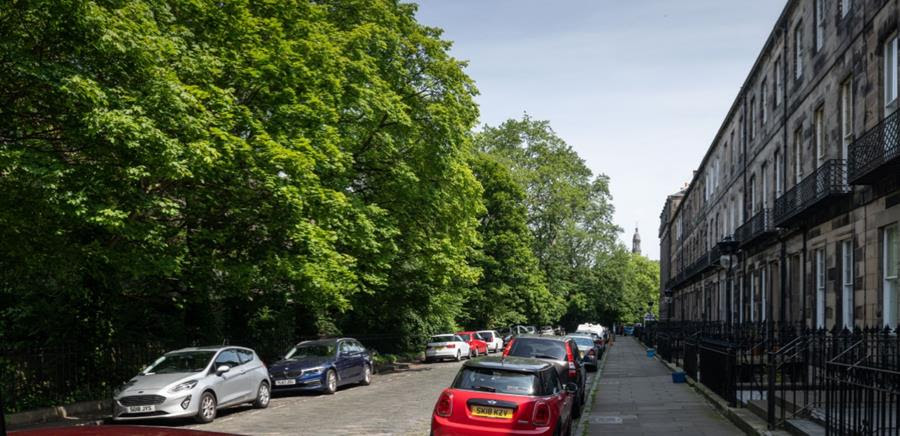
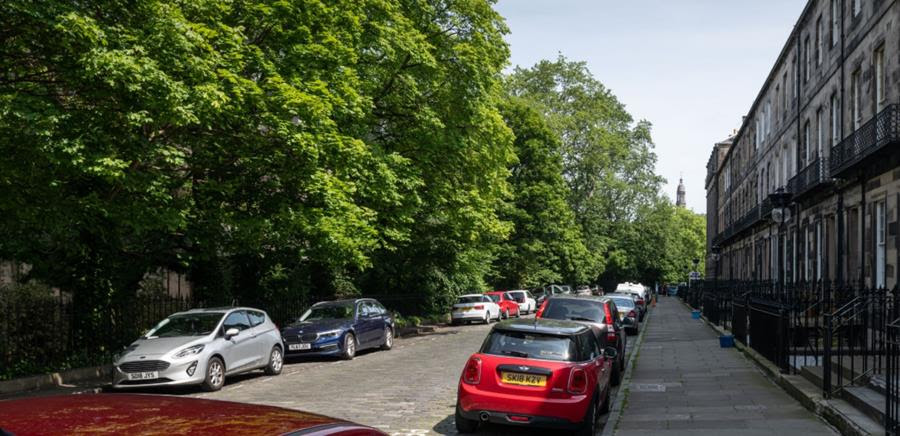
One of the main priorities for the development team was protecting the tree cover in Fettes Row and Royal Crescent. New Town Quarter is well screened by trees to the south of the development and these are much appreciated by residents. The development team has worked hard to ensure that the tree screen is protected and maintained. Existing trees are largely being retained to ensure that views enjoyed by local residents can be enjoyed for a long time to come.
New and replacement trees are being provided on the street and in King George V Park. Wherever possible the development team has sought to ensure that existing trees are protected. Ross McNulty said: “Preserving the character of Fettes Row and Royal Crescent has always been one of the key objectives for the development team and we’re confident that will be achieved with our proposals.”
Current View
Proposed View
King George V Park
King George V Park is a much-loved local park. Since the early stages of the public consultation, elements of the proposals for pathways and cycling have been scaled back following feedback. We have also had further consultation with the Council to highlight the need to manage pedestrians and cyclists at the interface with the park.
The development team is also working closely with the Council to finalise additional investment in the park to help take account of the new development, as well as helping safeguard its future quality and longevity. The proposals for park investment will be finalised through a Section 75 agreement, which is currently being negotiated with the Council. Once signed, this will be a legally binding agreement.
Ross McNulty added: “We would like to thank the Friends of the Park group for engaging with us throughout the consultation process. The discussions have been thorough and complicated at times but hopefully, everyone will see the results – including replacement trees, improved pathways and investment in the park for the long-term benefit of the local community.”
Eyre Place Update
There is a separate planning application to change the site area initially proposed as a hotel to housing. The timing of this application will run behind the main application. Being aware that Eyre Place residents had concerns about overlooking from the proposed new homes, the development team has been looking at ways to address the concerns, and we believe a solution has been agreed.
Even though the current proposals would have been entirely within planning guidelines, the proposed solution has been shared with interested residents.
Ross McNulty said: “We were left in no doubt how concerned residents were regarding this aspect of the proposals and we wanted to help if we could. The housing proposals, as with the hotel, will result in improved daylighting for Eyre Place, which should also help reassure residents that we are sensitive to their interests.”
Business Benefits For the City Centre
If the New Town Quarter development progresses, it will be the first major project in Edinburgh to move forward since the start of the pandemic. As such, it has a critical role to play in boosting the regeneration of the city centre as it recovers from the crippling effects of economic lockdown.
The local area around Dundas Street brings together an interesting mix of mainly independent traders – including cafes, restaurants, bars, hairdressers and guest houses – and a recent survey of 32 local businesses which surround the New Town Quarter area showed overwhelming support for the development plans.
Many of them were hit hard when RBS vacated their premises in 2017 and are now suffering further following the ongoing trading restrictions imposed by the pandemic. The New Town Quarter will bring much-needed investment to the city centre – and most importantly, bring people back to the local area to create a vibrant and exciting new destination.
Here are some of the comments posted by local businesses who support our planning application:
“The RBS site was always a highly visible focal point for visitors and activity and all the businesses in this area benefited from it. Now, more than ever, as we recover from lockdown, we all need the site to once again be an attractive destination for both living and visiting, to both help recovery in the immediate future and over the longer-term.” – Guest House, Eyre Place
“I have gradually built up my business following the RBS relocation, but have also now been hit hard by the coronavirus lockdown. We are all desperate to stay trading in the area but need a commitment that something significant is going to be happening to transform an ugly empty building and gap site right opposite us into a thriving and busy neighbourhood that will bring people back to the area.” – Barber, Dundas Street
Feedback & Contact
For more information on New Town Quarter, contact: Ross McNulty, Development Director, Ediston.
More Scots than ever before are turning to digital health information during the COVID-19 pandemic.
In the first month of 2021 more than 7 million users visited NHSinform.scot. This is the highest ever number of users for the site in a single month – and more than 5 times the number for January last year. Around 4 in every 5 visitors to the site was using a mobile phone or tablet device.
Unsurprisingly, the most popular content in the past year is information on the coronavirus vaccine, who will get it and how, and on how to get coronavirus testing or care for someone with the virus at home.
The other illnesses for which people most often sought digital advice were fever, thrush, food poisoning and chest infections.
Mental Health is a widely shared concern, with anxiety and panic, fears and phobias, stress, anger and low mood, and depression being the most common topics viewed. The NHSinform.scot pages for these topics were viewed over 120,000 times in January alone.
Dr Laura Ryan, Medical Director at NHS 24 said: “The pandemic has meant we have all had to find new ways of going about our daily lives and that includes the way we get essential health information when we need it.
“It’s great to see that our digital resources have become so widely trusted by people across Scotland. The content on NHSinform is governed by the same standards as the advice given by the NHS 24 telephone services.
“I would encourage people to use the self-help guides for immediate support as they are readily available wherever a mobile phone or other device is to hand. In many cases the online advice will allow people to self-care at home, but it is of course very important to contact a healthcare professional if our self-help guides direct you to do that.”
With travel affected by poor weather and the pandemic, it makes sense to turn to NHSinform.scot for support. Where symptoms suggest that a healthcare professional is needed, users are guided to speak to their pharmacist, GP, optometrist, dentist or call 111 or 999 as appropriate. You can also find out where your nearest services are using our Scottish Services Directory by simply entering your postcode.
Users can walk through all this information on our handy self-help guides or, by reading.
NHS 24 wants to offer the public choice about how they access services. Essential information on using our services has been translated into multiple languages with communities across Scotland and is available in easy read and British Sign Language formats.
For those who do not have access to a device or prefer not to use one, we still offer telephony advice and information.
Ahead of this year’s Scottish Parliament elections, we’ve launched our manifesto, Standing Up for Scotland’s Mental Health, calling for radical action in order to combat a growing mental health crisis in Scotland.
Informed by over 2,500 people across Scotland, many of whom have lived experience of mental health problems, our new manifesto sets out 38 actions to make mental health a national priority.
We want to see real change, as part of this we want to see redoubled efforts on suicide prevention, action now to support children and young people and rapid access to psychological wellbeing support for adults.
In the last twelve months, Scotland has seen its population’s mental health and the mental health systems designed to support it challenged like never before. With these pressures likely to continue well into the next parliamentary term, it makes the current picture on mental health even more concerning:
One in five children referred to specialist mental health services are still being turned away
A quarter of those referred for psychological therapies wait at least four months to be seen
Deaths by suicide have risen over the last two years.
It’s clear that mental health must become a real national priority following the May elections.
Billy Watson, Chief Executive at SAMH said: “Scotland’s mental health deserves better. A growing number of people across the country are facing mental health problems and are struggling to access help. There have been too many promises on mental health and not enough action. With the added pressure brought about by the pandemic, we need a radical new plan.
“We must now, more than ever, see political and government commitment to make mental health a priority. That’s why today SAMH is launching our manifesto, urging the next Scottish Government to put the mental health of the nation first. It’s time to listen to the hopes, fears and needs of people with mental health problems.
“The next Scottish Parliament will see many new MSPs, as well as experienced members returning for a further term. We hope we can rely on each and every one of them to Stand up for Scotland’s Mental Health.”
The Standing Up to Scotland’s Mental Health manifesto reflects the real life experiences of people across Scotland. Stephanie, 19, struggled to access the support she needed through CAMHS.
Stephanie said: “After being put on the waiting list for CAMHS, it was many months before I was contacted and learnt that I’d have to go through a whole process to actually be seen.
“Eventually I ended up being rejected as I was on holiday when the letter came in about arranging my first appointment. There was a deadline that you had to get in contact by to arrange this but because I was away I ended up missing it. I got in touch but the only support and advice they could give was for me to go through the full ordeal again.
“I felt helpless and had no idea what I was supposed to do. I was reaching out which is what they said to do, but I was still being shut down. I was terrified and I didn’t know what was going on. I was thinking, ‘What if I don’t get the help, what will happen to me? Will things get worse?’ – It felt like a really big ball of emotions. The whole referral process just felt exhausting. It took a further toll on my mental health and how I dealt with it in the future, and I became closed off once again.”
The research and experiences which lie at the heart of our new manifesto shows that when people are given the support they need quickly, they can flourish.
After a suicide attempt, Robert, 39, reached out for support. This led him to ‘The Changing Room’, a SAMH project which uses the power of football to get men in their middle years talking about mental health.
Robert said: “Early on I remember thinking I’m worth my place in this group, not only is it helping me feel better but I’m going to be part of making other people in this group feel better. I felt like I was worth a lot, and for a long time I didn’t feel like I was worth much.
“Local community support is so important because shared experiences help, having someone you can relate to from a similar background makes it much more organic.”
“Many people feel isolated when they are having suicidal thoughts, I had family all around me, but I still felt isolated, because no one knew what was going on, so then being around people who understand what you’re going through can really make a big difference.”
To find out more about Standing Up for Scotland’s Mental Health, to read our full manifesto and find out how you can help drive real change for mental health, visit samh.org.uk/standup
More than one million people at greatest risk from Coronavirus (COVID-19) in Scotland have had their first dose of the vaccine.
The landmark of one million was reached on Wednesday 10 February. 69 year old John Loch from Bearsden was among those vaccinated on the day the milestone was reached. The retired businessman received his first dose at NHS Louisa Jordan in Glasgow.
The programme has now reached more than a fifth (22%) of the 4.5 million people who will be offered a vaccine.
The biggest vaccination programme ever undertaken is now moving at pace through the 70-79 age group following the opening of new mass vaccination centres at Edinburgh International Conference Centre (EICC) and P&J Live in Aberdeen and other large sites across the country.
The programme remains on track to complete first doses for all those in this age group by the end of this week. Those aged 65 and over are also receiving invitations for their appointment.
Health Secretary Jeane Freeman said: “This is an important milestone in the biggest vaccination programme ever delivered in Scotland and I would like to thank everyone involved and all those who have taken up their offer of a vaccine.
“We have now given first doses to more than a million people in the groups which were prioritised to address 99 per cent of preventable deaths associated with COVID-19. These include elderly care home residents and staff, frontline health and social care workers and those who are at risk of serious harm and death from this virus.
“Scotland’s COVID-19 vaccination programme is delivering ahead of our expectations. Our aim is to vaccinate as many people as possible with both their first and second doses as quickly as possible but the speed at which we can do this depends on supply and we expect a dip in supplies UK wide towards the end of this month.
“We hope to see a significant drop in the disease due to the vaccination programme, however this will take a number of months to evaluate fully. In the shorter term, we are monitoring the uptake rate but we also have a comprehensive surveillance system in place to monitor outcome of vaccine efficacy and disease reduction.
“Each health board is working hard to get the vaccine into people’s arms as quickly as possible, and everyone eligible will be offered the vaccine as we work our way through the priority groups.”
“We continue to urge everyone to take up their appointment when they are offered one. The vaccination programme is one of three key ways we are working to beat this virus, along with our expanded testing programme to identify cases and break chains of transmission and the important lockdown restrictions everyone in Scotland must follow. All these measures work to greatest effect when they work together.”
John Loch said: “I am delighted to have received my vaccine, particularly on the day Scotland reached a million doses. It is exciting to be a part of this milestone moment.
“I would like to thank all the staff at the Louisa Jordan for being so reassuring and making the process so simple and straightforward.”
NHS LOTHIAN VACCINATION FIGURES
Lothian MSP, Miles Briggs, said yesterday: “It is positive that we have seen the number of people vaccinated increase by over 50% since the introduction of mass vaccinations centres last week.
“There are some concerns that NHS Lothian is behind other health boards in the percentage of people vaccinated, but it is important that we keep up the momentum.
“The sooner the people who are most vulnerable to Covid-19 are vaccinated the sooner we can get pupils back to school and reopen the economy with confidence.
“A huge thank you to all NHS Lothian staff working tirelessly in getting the vaccine rolled out and to members of the public for keeping social distanced to suppress the virus, whilst vaccines are rolled out.”
With the country now in its third and hopefully final lockdown there are many businesses unable to operate from their usual premises under current government guidelines, many employees have reverted to working remotely from their homes.
While focus has been on transitioning equipment and employees, many business leaders may not have yet had time to consider their insurance policies and the potential impact of remote working over the longer term.
To support businesses, leading insurance provider,Insurance2go, has shared advice on business insurance cover for those with employees who continue to work remotely.
Check your policy
This may seem like an obvious first step, but it is important to check that you are still covered by your insurance while employees work from home.
The good news is that, generally, your insurance will cover your business when it’s not in its regular location. Where you operate from doesn’t really matter, as long as you’re still in the UK. However, you may need to check your contents insurance and whether it covers use of items such as laptops, for example, beyond your normal premises. If it doesn’t, you may need to extend your cover as you cannot rely on your employee’s home insurance to include business use.
Health and safety checks
Interestingly, The Health and Safety at Work Act 1974 makes no distinction between home and in-office workers. The regulations require employers to carry out a risk assessment of their employees’ workplace, to identify any potential risks so the employer can then seek to remove or mitigate the risk.
It is not necessary to visit the employee’s home to carry out a risk assessment, particularly during the ongoing pandemic. However, HR managers can provide the employee with a detailed self-assessment questionnaire as part of a firm’s legal responsibilities for homeworkers.
If your company does not have one already, there are many free templates available online.
Your business needs to be able to show that is has done everything by the book, just in case a circumstance arises where an employee says you didn’t set them up to work from home properly and suffered as a result of it, or there is a data breach. Keep a record of everything you have done, including reasons and the dates they happened.
It is important to have a home working policy that staff can access and read to ensure it is clear what is expected from both parties.
Home working policies should cover key areas including:
when employees will be available to work
how and how regularly they’ll keep in touch
how their performance will be managed
health and safety expectations
rules around confidentiality, IT security, storing information and data protection
who employees should contact if they’re experiencing any problems.
Get cyber insurance
During 2020, the NCSA (National Cyber Security Centre) reported an increase in cyber-security threats, most likely as a result of employees working from home with serious breach affecting a business’s reputation1.
Firstly, make sure IT teams have undertaken checks on all laptops, desktops, and tablets to make sure they are as protected as possible. Also ensure secure connections are set up from the worker’s home station to the company network.
As cybercrimes become more sophisticated it is important not to rely on checks alone, having cyber insurance in place will help to mitigate further risks.
Keep your insurer informed
Most likely your business has changed due to the pandemic if you’ve seen a period of rapid expansion and growth. Whatever your circumstances then get in touch with your insurer. If you’re unsure, err on the side of caution and provide the updates, rather than running the risk of invalidating your policy.
On the other hand, if your business is now having to operate remotely, you should check with your individual insurance providers as to whether they require you to check and maintain security systems while the premises are vacant.
Richard Gray, Head of Marketing and Digital, at Insurance2go says:“It has been an unforeseen time for businesses and employees alike, and for many business leaders it can be hard to predict what the future looks like for their employees in terms of working remotely.
“It’s more important than ever that businesses protect themselves from any unplanned expenses and we hope this advice helps people understand what is required from an insurance point of view, to continue to operate effectively and safely while working from home.”
For more information on business insurance, please visit: