

Cold Weather Payment in Scotland is changing. Winter Heating Payment will replace @DWPgovuk Cold Weather Payment.
Around 400,000 eligible people will get a reliable annual £50 payment.
Read more: https://mygov.scot/winter-heating-payment
Cold Weather Payment in Scotland is changing. Winter Heating Payment will replace @DWPgovuk Cold Weather Payment.
Around 400,000 eligible people will get a reliable annual £50 payment.
Read more: https://mygov.scot/winter-heating-payment
‘Tis the season to be deaf aware

With less than two weeks to go until Christmas day, there is a lot to get ready – from buying last minute gifts and wrapping presents, to picking up a turkey.
If you will be spending time over Christmas with family or friends who are deaf or have hearing loss, it’s important to consider how to make sure the seasonal celebrations are enjoyable for them too.
RNID, the national charity for deaf people and people with hearing loss, asked their supporters for their top tips of how family and friends can make communication easier at Christmas.
They are:
1. Ask how you can help
Everyone is different, so ask the person who is deaf or has hearing loss what you can do to make communication easier. For example, they might need to see your face when you’re talking, or they might need the subtitles on if you’re watching a film together.
2. Make lipreading easier
Make sure the room you are in for your Christmas get together is well lit – candles and fairy lights alone won’t be much use to people who lipread. Don’t cover your mouth when you’re speaking, and face the person who is lipreading. Try not to speak with your mouth full as this will make it harder for them to lipread you.
3. Take it in turns to speak
Try not to speak over each other – it’s impossible to lipread more than one person at a time and your family member will quickly get lost in the conversation. Speak clearly and not too slowly, and don’t shout as this can be uncomfortable for hearing aid users. If someone doesn’t understand what you said, try repeating or explaining it a different way.
4. Keep background noise low
If you’re playing festive music or if there is background noise, keep the volume low. This will make it much easier for people to hear, and it will help anyone who lipreads to focus on what you are saying.
5. Help people follow the conversation
If the topic of conversation suddenly changes, make sure everyone is aware – maybe ask them a question to check.
And crucially, if someone who is deaf or has hearing loss asks you to repeat something, never say “it doesn’t matter”. If you do that, you’re taking away their opportunity to be part of the conversation, and you might make them feel like they don’t matter.
Harriet Oppenheimer, Deputy Chief Executive at RNID, said: “For lots of us, Christmas is a time of big family get togethers, noisy work Christmas dos and catching up with old friends. But we also know that Christmas can be an isolating time if you are deaf or have hearing loss or tinnitus, and our supporters have told us that they can feel left out of the festive fun going on around them.
“Being deaf aware at Christmas doesn’t have to mean making big changes; there are small things you can do which will make the day a lot more enjoyable for your deaf family member or friend and allow them to be part of the celebrations.”
The 12 Signs of Christmas
RNID have made a video to help everyone learn some festive phrases in British Sign Language (BSL).
From learning how to sign ‘Happy Christmas’ to asking someone to ‘meet me under the mistletoe’ or ‘pass the chocolates’, the charity’s 12 signs of Christmas will help to get everyone in the family signing and having fun together, whilst taking an important step to be more deaf aware.
For more information on how you can be deaf aware at Christmas, visit RNID’s website.

Many people in Scotland are facing a bleak run up to Christmas, as they cut back on essentials like food and heating to ensure they can buy presents for loved ones.
In a national survey of people aged 50 and over by older people’s charity Independent Age, a third (33%) of Scottish respondents said that in order to spend money on loved ones this year, they would reduce spending on essentials for themselves as Christmas approaches.
Of those who said that they will reduce their spending:
The findings come as inflation continues to rise, with the official rate recently soaring to 11.1%.
Scottish Government statistics show that 1 in 7 (150,000) older people in Scotland are living in poverty, with 120,00 pensioners living in persistent poverty (meaning they’ve spent at least three of the past four years in poverty).

Claire Donaghy, Head of Scotland at Independent Age, said: “It’s extremely alarming that those in later life are being forced to cut back on essentials so they can buy presents for loved ones.
“Older people living in one of the world’s richest nations shouldn’t have to risk damaging their health by reducing the food they eat and using less heating during the coldest months.
“For many in Scotland, the festive season is something to look forward to, but increasing numbers of older people are being hit from every angle financially.”

Cost-of-living fears this festive season
The immense financial pressure faced by millions of older people this winter is forcing many of them to cut back on essentials – as well as foregoing presents for others.
In the same survey over two fifths (41%) of people in Scotland said they are planning on spending less money at Christmas this year, compared to last.
When asked how they plan to reduce their spending, worryingly, 49% of people planning to spend less said they would reduce spending on food, and 47% said they would spend less on heating and gas.
When asked about general Christmas spending, 56% who plan to spend less at Christmas said they plan to spend less on presents for their children or grandkids, and this number rises to 78% when asked about other friends and family.
There will be even fewer ornaments and lights to enjoy this festive season, with 39% saying they will reduce spending on decorations that require electricity. These figures paint a bleak picture of how the cost-of-living crisis will stop many from enjoying their usual Christmas.
End the Pension Credit Scandal
With many households struggling to cope financially this December, Independent Age is calling on the government to ensure older people are receiving the support they are entitled to, including Pension Credit.
For people over 66, Pension Credit acts as an income top-up, and is a gateway to additional support, including the Warm Home Discount and Council Tax Reduction. It is also being used as a mechanism by the government to decide who gets some of the vital cost-of-living payments announced in November.
In what the charity is calling a ‘national scandal’, Independent Age estimate that almost 80,000 people who are eligible for Pension Credit in Scotland are currently not claiming, resulting in £160 million being missed out on by older people in Scotland.

Claire Donaghy continues: “The government was right to uprate Pension Credit by inflation in the Autumn Budget, but the hard truth is too many older people are still not receiving this vital income top-up that they are eligible for. Without it, many people in later life are facing a stressful and dire Christmas, forced to cut back on food and heating, which can be detrimental to their health.
“It is scandalous that people are struggling when billions of pounds has been set aside for them and the money is sitting there unused. The government must commit to a Pension Credit strategy to prevent hundreds of thousands of people missing out.”
Independent Age has launched a petition calling on the government to end the Pension Credit scandal and announce a strategy to increase uptake.
You can sign the petition here: End the Pension Credit Scandal

Those eligible for the free COVID-19 and flu vaccinations are being urged to get their jabs as winter sets in and hospitalisations increase.
The reminder comes as Public Health Scotland (PHS) data shows in the week ending 11 December 2022, there were on average 735 patients in hospital with COVID-19, an 18.2% increase from the previous week.
Admissions for flu are also on this rise with the highest hospital admission rate noted in patients aged less than one year old (18.5 per 100,000). Parents and carers are encouraged to get their children vaccinated as soon as possible if they haven’t done so already. The flu vaccine for children is a painless nasal spray which will help protect them and reduce the risk of them spreading the virus to more vulnerable people.
The vaccines are safe, effective and offer the best protection to those most at risk of serious illness from COVID-19 and flu while also helping to protect the NHS at this, the busiest time of year.
Adults over 50 are entitled to get both free vaccines and further information on eligibility for each jab is available on the NHS Inform website.

Health Secretary Humza Yousaf said: “Uptake for the winter vaccine programme is very encouraging with Scotland delivering more jabs per head of the population among over 50’s than any other UK nation. However, the number of hospitalisations from both COVID-19 and flu are on the rise.
“The vaccines help to prevent serious illness and the need for hospital treatment freeing up capacity as we move into what could be the most challenging winter in the history of our health and care service.

“We are concerned that flu-related hospital admissions have been rising, with admission rates highest among very young children, and we urge parents and carers to get their children vaccinated with the painless nasal spray offered to this group.
“As well as protecting the child, the vaccine helps to reduce the risk of children spreading flu to family and friends who are more vulnerable, which is especially important at this time of year when families are getting together more.”

The 2023-24 Scottish Budget will take a distinctive approach to creating a fairer, more equal Scotland, Deputy First Minister John Swinney said.
He stressed the three Budget priorities of eradicating child poverty, strengthening public services and moving towards a net zero economy were strongly linked and would give more people the opportunity to flourish.
Ahead of delivering the Budget to Parliament today, Mr Swinney visited a scheme in Wester Hailes, delivered by City of Edinburgh Council and part-funded by the Scottish Government, installing insulation for households at risk of fuel poverty.

He said: “I was encouraged to see the vital work being carried out to improve energy efficiency and make homes warmer for families facing significantly higher bills this winter. This scheme highlights how tackling the increased cost of living can assist our drive towards net zero, and is an example of the importance of effective public services.
“Our Budget goals are mutually beneficial and represent a distinctive approach to the economic challenges we face. The Scottish Budget will take further steps to address inequality and eradicate child poverty. It will encourage a just transition to net zero, creating wealth and opportunity across the country. And it will be the catalyst for reforms necessary to ensure our first-class public services remain sustainable in the face of the challenges to come.
“I would like to go even further but the cost of living crisis has also laid bare the fiscal constraints of devolution, as we cannot borrow to support day to day expenditure when times are hard to assist us through these difficult days. It is clear that businesses and households are paying a steep price for the economic mismanagement of the UK Government.
“The cost of living crisis requires decisive action. In setting this Budget, the Scottish Government will use its limited powers to the maximum extent that is responsible, to meet the challenges faced by the people of Scotland.”
The Scottish Budget 2023-24 will be presented to the Scottish Parliament TODAY (Thursday 15 December).

The party season is nearly upon us, but before you dust off your decorations and defrost the turkey, it’s important to be aware of potential dangers that could be putting your pet at risk this Christmas.
PDSA Vet Nurse, Nina Downing, shares the toxic treats and decorative dangers to watch out for this festive season:
“Every Christmas we treat poorly pets at our PDSA Pet Hospitals who are suffering from illness and injuries that their owners just didn’t know could be caused by some of their yuletide traditions. I’d urge owners to be aware of the potential dangers that some of our festive favourites present to our furry family members.”
Here are Nina’s top tips for making sure your pet stays safe this Christmas:

Twinkly lights, glittery baubles, and tinsel are what give our homes a touch of festive magic, but they’re also tantalisingly tempting to curious paws. Should your furry family member get hold of a shiny adornment, they may smash it and cut themselves, or even mistake it for a tasty treat – potentially causing life-threatening blockages which require emergency treatment.
Keep fairy lights well away from small furry friends’ enclosures too, to avoid them nibbling through the wires and giving themselves a shock. Many festive plants are also toxic to pets, so make sure they’re well out of paws’ reach.
Whether real or artificial, your cat may see your Christmas tree as the purr-fect climbing challenge. This could result in broken baubles and lots of mess at best, or an injured puss at worst, so always supervise them to avoid any mishaps.
Chocolate baubles are also a festive favourite but, if you own a pet, this is one tradition to leave out of your celebrations. Chocolate is toxic to our furry friends and hanging it on the tree makes it all too easy for them to have a little snack.
The thrill of opening presents may distract you from keeping a close eye on your furry friends, but there are several things to watch out for among the mountains of wrapping paper. Sticky tape, bows, ribbons, and string can be a choking hazard and cause internal blockages if swallowed by our precious pets. Take care to pick up any leftover wrapping or toy batteries and watch out for the beady eyes of soft toys, as these can cause serious problems for our pets if chewed up and swallowed.
Christmas dinner may be a highlight of the day for us but no matter how tempting, don’t give in to any purr-suasion. Not only can a sudden change in diet cause an upset stomach, some parts of our festive feast can also be highly toxic to pets, including onions, garlic, and mince pies.
It’s also important to bear in mind potion sizes – a small dog breed, such as a Border Terrier, eating 4 pigs in blankets is the equivalent of a human eating an entire Christmas dinner with all the trimmings! So, sticking to healthy treats will prevent our pets from piling on the pounds.
The hustle and bustle of Christmas can become particularly overwhelming for furry family members, so it’s important to offer a safe space for them to escape the festivities. This could be a den you have built or even their regular bed in a quieter room. For smaller pets, moving their enclosure to a quiet space will give them some peace during busier periods.

It’s also easy to forget what day it is over the festive period, but remember that four-legged family members benefit from the consistency of a routine – whether that’s sticking to the usual time they go for a walk, or when you feed them.
For more information on how to safely enjoy the festive season with pets, you can visit: www.pdsa.org.uk/xmas-guide

Doric TikTok sensation Aye Tunes will bring My Doric Diary to stages across the country thanks to National Lottery funding through Creative Scotland.
My Doric Diary is among five new and five revived productions receiving £1m from the Touring Fund for Theatre and Dance to tour venues throughout Scotland’s villages, towns and cities, from Autumn 2023 – Spring 2024.
Fraserburgh-born actor and singer Katie Barnett and her actor-musician husband, James Siggens first performed as Aye Tunes during lockdown where they recorded Doric covers of pop songs including ‘Shout Out To My Ex’ by Little Mix, which racked up over 80,000 views overnight.
Far it aa started… If Little Mix wiz fae Aberdeenshire! pic.twitter.com/QSp5l6iYUo
— AyeTunes! (@tunes_aye) April 23, 2021
My Doric Diary follows the story of Daisy – a teenager from Fraserburgh, Aberdeenshire – who is finding her voice amongst the grief of her mother’s death. It’s December 31st in Fraserburgh, and Daisy has disappeared down memory lane again. Obsessed with what could have been, Daisy is suddenly given the opportunity of a lifetime – to go back.
The Doric jukebox musical was a hit on stage during its A Play, A Pie and A Pint run at Òran Mór (Glasgow), Traverse Theatre (Edinburgh) and The Lemon Tree (Aberdeen) in April 2022.
Following the run Katie was nominated for Scots Performer of the Year at the Scots Language Awards for her performance which received fantastic reviews.
On touring the work, Katie Barnett commented: “We are so excited to be bringing My Doric Diary out on tour next year.
“Taking it up to the Northeast will be such a wonderful opportunity to celebrate Scots language with those who speak it and performing it elsewhere in Scotland will hopefully be a fun and original way for folk to hear our amazing dialect. A Doric musical is something I’m so proud to have created.”
Popular music is at the heart of several of the productions being funded. Battery Park by Sleeping Warrior Theatre Company tells the story of a 90s Britpop band from Greenock that never made it. It’s a bittersweet love letter to more positive times that will make audiences laugh, cry and reminisce whilst also providing biting satire about where the UK finds itself now.
Thanks to National Lottery players, many of these productions will offer wrap around engagement to invite local communities and audiences to further consider the important issues raised in these productions such as the climate emergency.
Shō and the Demons of the Deep by Zoë Bullock and Independent Arts Projects is a visual-adventure story for children about overcoming fear, climate crisis, and how the actions of one generation can affect the next.
Burnt Out is a solo dance theatre work by Penny Chivas, centred around our changing climate. Weaving spoken word and movement we are taken on a journey through past Australian bushfires including Penny’s own experiences, through their ignition and devastation, and left with space to ponder how we got here.
After a critically acclaimed and exciting world premiere at the Edinburgh Festival Fringe at Summerhall as part of Made in Scotland, Pain and I by Sarah Hopfinger is a bold exploration into chronic pain experience that returns in its live and digital forms – dance performance, audio piece, and graphic score.
Woman Walking by Sylvia Dow is performed, written and directed by three women all in their 70s. Funded productions also include the next intimate chapter in Rona Munro’s critically acclaimed cycle of plays with James V – Katherine by Raw Material Art, among others.
Laura Mackenzie-Stuart, Head of Theatre, Creative Scotland said: “Ranging across physical performance, musical theatre, dance and theatre this vibrant selection of contemporary productions will not only entertain but educate and inspire children, families and audiences across the country.
“The current selection includes new work inspired by local Scottish landscapes, people and events alongside remounts of dance and theatre which have previously wowed audiences at home and internationally.
“There was exceptional demand for this fund with an ask of £6.6m against an available budget of £1m. We would have liked to have supported many more productions which demonstrates the breadth of talent across the country.”
NEW WORK (x5):
Theatre:
Plinth by Al Seed Productions and co-produced by Vanishing Point’ (£65,909)
James V – Katherine by Raw Material Arts (£215,741)
Battery Park by Sleeping Warrior Theatre Company (£160,776)
Shō and the Demons of the Deep by Zoë Bullock by Independent Arts Projects (£140,277)
Woman Walking by Sylvia Dow (£73,932)
RESTAGINGS (x5):
Dance:
Burnt Out by Penny Chivas (£45,311)
Paper Moon by Shaper/Caper (£82,385)
Theatre:
My Doric Diary by Katie Barnett and James Siggens (£81,928)
Pain and I by Sarah Hopfinger (£75,934)
Ragnarok by Tortoise in a Nutshell (£80,838)
For further information on each production please download the attached Touring Fund for Theatre and Dance Production Descriptions document.

As part of its ongoing Giving Back initiative, AnywhereWorks, the team collaboration and business services provider, has donated a number of Christmas gifts with the fun and happiness charity KidsOut to give gifts to children who would otherwise go without.
The donations form part of AnywhereWork’s Giving Back programme and the company’s commitment to the triple bottom line – people, planet and purpose. Every child deserves a gift under the tree this festive season, but sadly this isn’t the case for everyone.
KidsOut helps children who have fled domestic abuse. Their mission is to give disadvantaged children positive experiences and support them in becoming future members of society. The team at AnywhereWorks has supported the cause by picking up a Giving Tree gift tag with a child’s name and gift request, with all gifts being delivered by KidsOut.
Website
Socials

A new Citywide Culture Strategy to shape the council’s Culture and Wellbeing service through to 2030 has been agreed by councillors.
Four action plans will now be developed that will ensure the city delivers on the strategy’s three main aims, that:
Edinburgh has a long history as a world centre for the culture and creative sector and the draft strategy sets out the overall purpose, vision and aims for the future of the service in the Council. Four individual service area action plans will be developed for:
Culture and Communities Convener Cllr Val Walker said: “The Council has a vital role to play in Edinburgh’s festivals and events sector and our Citywide Cultural Strategy 2023-2030 as well as our existing funding programmes reflect our direct and continued support, contributing to the retention of jobs, creative practices and future development.
“This strategy outlines the priorities and guiding principles of our support for culture in Edinburgh over the next eight years. The pandemic had a massive impact on this sector but also meant creative minds have been hard at work to reappraise long term challenges as well as look for new opportunities.
“It’s exciting that we’re finding new ways of working to reach existing and new audiences and support career development of those in the sector. Following today’s endorsement the strategy will be developed further and we will ensure the future of the sector and maximise on this potential.”
Following the tragic incident that happened at Babbs Mill Lake in Solihull over the weekend, there has been an outcry of support to increase education and knowledge related to water safety.
The team at the Royal Life Saving Society UK (RLSS UK) has picked up a long list of national, regional and local media engagements and there has been a consistent question that has come from journalists – Why are so many school children lacking essential water safety knowledge?
This has been supported with reminiscing about former approaches through public information films and broadcasts. The reality is that the technology and media landscape has changed so much. Whilst at one time posting some content, on TV, at 4pm in the afternoon would reach a large proportion of children there is now so much choice for children and young people, and it has become extremely difficult to guarantee maximum reach.
The question though is not a question for RLSS UK but a question that needs to be posed to government and this blog explains more …

Lee Heard, Charity Director at RLSS UK, praises the work of the emergency services, who the charity works closely with to share crucial messaging around water safety, but asks what more can be done to keep children safe:
“What is guaranteed is that the majority of children can be reached through the education system. The answer on keeping children safe around water is simple. Education. Only with class-based education and removing insurmountable barriers for some schools to travel to pool spaces will we be able to give every child the opportunity to learn crucial knowledge and skills to make informed decisions and be safe around water.
For many years, we at RLSS UK have been working tirelessly to raise awareness of barriers and lobby to try and push forwards with getting class-based water safety education on the national curriculum. It should not take yet another tragedy, and even more innocent young lives lost, to have to put the case forwards once again.
If you speak to Government about this subject they will provide rhetoric and spin. It is positive that in the national curriculum for England that swimming and water safety are included on the PE curriculum but for too many years now this has been used to mask inherent inadequacies and inequalities in their policy position on water safety. Pre-COVID, almost 1 in 4 children (24% of) were not hitting the statutory ‘can self-rescue’ standard. Worryingly there is huge disparity between high and low affluence households, as well as between different ethnic backgrounds, with those from the lowest affluence and those from ethnic minorities most likely to fail to reach the statutory standards.
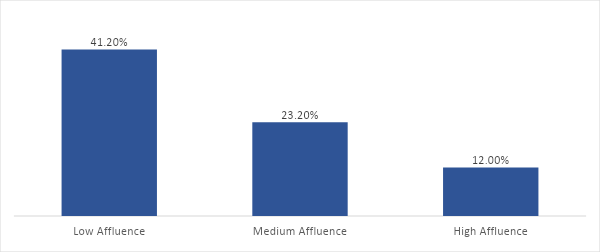
Fig 1: The proportion (%) of UK children (years 3-11) who do not meet statutory ‘self-rescue’ standards by family affluence (2017/18).
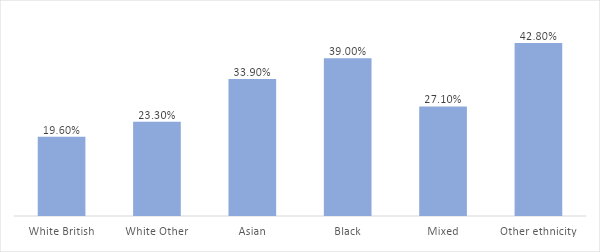
Fig 2: The proportion (%) of UK children (years 3-11) who do not meet statutory ‘self-rescue’ standards by ethnicity (2017/18).
This uneven playing field is well known and RLSS UK has been asking questions of Government since 2017 about reviewing its approach to ensure equal access. This has been followed up by a petition by water safety campaigner and bereaved parent Becky Ramsey who sadly lost her son Dylan Ramsey to drowning in 2011. The petition received over 108,000 signatures. The Government responses indicated no desire to change its approach, instead included a list of approaches and highlighting the hard work of other organisations who have no statutory responsibility. It is worth reiterating that even pre-COVID those from white, affluent families were much more likely to have access to this lifesaving education, proof that the approaches were not working.
The fact is that charities, individuals, organisations and schools who believe in increasing water safety knowledge have been working tirelessly to fill this gap. RLSS UK is not alone, there are incredible organisations doing great work locally and nationally and work is supported by the National Water Safety Forum. We personally have produced resources year after year for our Drowning Prevention Week (DPW) campaigns during the summer months, and these are always widely used by many schools across the UK and Ireland, but this is not enough and we cannot, even across partners, educate everyone alone.
In 2022 during DPW, over 1.2m million children were educated using our free water safety resources but there are over 10.6 million school aged children in the UK. So ,what about those 9.4 million children? Would they know how to stay safe around water? Would they know what to do if they got into difficulty or saw someone in trouble? Or will we see even more sad news in the years that follow? We have the resources, and we have the knowledge to share but only 1 in 5 children have had water safety education in school in the last year. We have to ask why there is resistance to make this small change to include a short class-based water safety lesson on the curriculum?
The current situation is much worse, there has been an obvious decline in attainment since COVID. Of course, a global pandemic has presented it challenges but the worrying fact is that in many cases, this decline was seen in 20/21 and is not showing signs of recovery. The most recent data shared through the 2022 Active Lives Survey shows that only 34.7% of children from low affluence families are able swim 25m unaided. This means that children from low affluence families are half as likely (34.7%) to be able to swim 25m unaided than those from high income families (76.4%).

Fig 3: The proportion (%) of UK children (years 1-11) who can swim 25m unaided standards by family affluence (2021/22).

Fig 4: The proportion (%) of UK children (years 1-11) who can swim 25m unaided standards by ethnicity (2021/22).
The Government seems content that 80% of schools surveyed are currently offering school swimming, the detail shows a very different picture and says a lot about the acceptance of achievements against pre-set outcomes and standards.
The barriers for some schools are simply insurmountable for a number of reasons. The further backdrop is that there are real and perceived barriers for schools to access swimming spaces. The future landscape is due to make this more challenging, we already know that in 2022 there has been a 5.1% decrease in swimming facilities and UK Active has recently reported that 40% of council areas are at risk of losing their leisure centre(s) or seeing reduced services at their leisure centre(s) before 31 March 2023.
We know that swimming and water safety is already on the national curriculum, but we also know that unfortunately this isn’t a successful policy to meet the Government’s own stated outcomes. Water safety goes hand-in-hand with swimming. We will always advocate for swimming as a life and water skill but our research shows that swimming is quite simply not enough. In our analysis of 83 accidental drownings of 8–18-year-olds in the UK, 3 in 5 (61%) were described as swimmers by their friends and family. This data suggests that being able to swim alone isn’t a guarantee of staying safe in, on and around water.
We have lesson plans which can be incorporated into existing lessons such as English, Maths, Science and more, for all age groups from early years to primary, to secondary school students. We want to be proactive when educating children on water safety, not reactive when we hear of a tragedy like we saw in Solihull at the weekend.
For this to change we need support from the very top. We need the Government to accept and acknowledge that:
We are calling on the government to make a change; to finally put water safety education on the class-based curriculum, to give every single child the chance to know how to stay safe in and around water, to ensure that families don’t have to go through the heartache that so many have already endured and to simply care for our children and their futures.
Education will save lives.”