New data shows 2.4 million rise in patient-GP surgery contact
Health Secretary Neil Gray underlined the Scottish Government’s commitment to shift the balance of care to community settings, as new data shows an increase in the number of times people have accessed care at their GP surgery.
Statistics released by Public Health Scotland yesterday show patients in Scotland had 33.98 million direct encounters with staff in General Practice between October 2024 and September 2025 – an increase of 2.4 million on the same 12-month period in 2023-24.
GP numbers have increased in Scotland and to make it easier for people to access GP services and support recruitment, the Scottish Government is investing an additional £531 million of newly agreed funding in General Practice over the next three years, subject to Parliament agreeing future budgets.
Health Secretary Neil Gray said: “We are determined to improve access to primary care, and I welcome these figures which show more people are accessing care at their GP surgery. I am grateful to our hard-working GPs and all practice staff for the care they provide.
“And while GP numbers have risen in Scotland over the last year, we have put a plan in place to go further.
“We have confirmed that we will invest £531 million over the next three years to significantly boost recruitment and help deliver the capacity needed to improve services for patients. This is the largest-ever investment in core GP services in Scotland.
“This will be supported by our commitment to open 15 new GP walk-in centres providing care from 12pm-8pm seven days per week, making it easier for people to get the care they need in a way that works for them.”
Twelve public libraries across Scotland are set to transform their services thanks to a £200,000 injection from the Public Library Improvement Fund (PLIF). The funding will support a range of pioneering projects, from gaming and e-sports hubs to AI workshops and sustainability initiatives, designed to create lasting impact for their local communities.
Administered by the Scottish Library & Information Council (SLIC) on behalf of the Scottish Government, the annual PLIF helps libraries deliver cutting-edge services that inspire engagement, promote digital upskilling and foster inclusivity across the country.
This year’s successful projects showcase the evolving role of libraries as hubs for trusted information, civic participation and innovative learning and upskilling experiences.
Priority was given to initiatives that address pressing societal challenges including combating mis/dis information, promoting democratic participation, tackling child poverty through educational support, enhancing family wellbeing, and fostering economic growth through community co-production.
Highlights include a gaming and e-sports hub for young people in Elgin, a digital inclusion initiative in North Ayrshire tackling scams and providing information on pension credit, energy advice and staying safe online, community-led initiatives in Inverclyde promoting democratic engagement, and workshops on AI, media and digital wellbeing in South Lanarkshire.
Culture Secretary Angus Robertson said: “The Scottish Government deeply values the role libraries play in our society, local communities, and neighbourhoods. Across the country, libraries continue to deliver a wide range of support and resources, standing proudly at the heart of our communities as trusted and vibrant hubs.
“Through our support, twelve projects have been successful in receiving funding from SLIC’s Public Library Improvement Fund (PLIF), for 2025-26. The fund will yet again support pioneering and innovative projects across library services. I am keen that we make the best use possible of all avenues and platforms to ensure that libraries can continue delivering the multitude of services they offer.”
The projects awarded 2025/26 PLIF funding are:
‘ReadMore 2026’, an Aberdeen City Library scheme to deliver library services to schools
‘How Fiction Becomes Fact’, helping communities in Aberdeenshire tackle misinformation and the growing influence of AI-generated content
‘Empowering Teens through the World of Graphic Novels’, an initiative aimed at increasing the engagement of 13–18-year-olds with library services in Campbeltown
‘Greenwave’, supporting citizen science projects in Dundee
‘East Lothian Reads’, taking on child poverty and supporting attainment in East Lothian
‘Cultivating Climate Champions’, a Highland project to expand its green libraries programme to include Ullapool, Gairloch, Fort William, Thurso and Fortrose
‘Libraries Give Us Power’, promoting active citizenship in the Inverclyde area
‘Game Explorers’, creating a gaming and e-sports hub in Elgin Library
‘Savvy about Scams’, a North Ayrshire initiative tackling scams and providing information on pension credit, energy advice and staying safe online
‘Learning and Discover Zone Development’, creating a dedicated zone for children aged 0-12 in Peebles Library
‘DigiAye’, providing workshops on topics such as AI and digital wellbeing across South Lanarkshire
‘Secret History Squad’, encouraging children’s library membership in Stirling
Alison Nolan, chief executive of SLIC, added: “Public libraries play a vital and multifaceted role as one of the last truly open-access community spaces.
“They offer access to essential services and resources and serve as vibrant spaces for creativity and self-expression. Continued investment is crucial to sustaining and evolving these services to meet the community needs, and the PLIF remains a key mechanism for strengthening our network.
“Our strategy for Scotland’s public libraries is built on three pillars: people, place and partnership, and this year’s twelve winning projects exemplify that vision, reimagining libraries not just as centres of literacy, but as catalysts for civic engagement, skill development and the sources of trusted information for people of all ages.”
The PLIF is part of a £450,000 annual programme administered by SLIC on behalf of the Scottish Government, supporting creative, sustainable, and innovative public library projects throughout Scotland.
Conservators from Historic Environment Scotland (HES) have been carrying out painstaking conservation work of a portrait of James VI of Scotland, the only monarch to be born at Edinburgh Castle.
The painting of James VI, which is on loan from a private collection, normally hangs in the Mary Room at Edinburgh Castle. However, at the end of last year the painting was brought to HES’s conservation studio to undertake a full assessment and essential conservation treatment.
James VI and I, who ruled Scotland from 1567 as James VI and England and Ireland from 1603 as James I, is the only monarch to have been born at Edinburgh Castle. The only son of Mary, Queen of Scots, he is the longest-reigning monarch in Scotland’s history.
He was also the target of the Gunpowder Plot of 1605, the attempted regicide plot to blow up the House of Lords during the State Opening of Parliament. The thwarted conspiracy is commemorated by Bonfire Night (Guy Fawkes Night) on 5 November each year.
Over the many centuries of the portrait’s life, it naturally accumulates surface dirt and changes in the protective varnish coatings. The painting underwent conservation work to stabilise the paint layer.
The old, discoloured varnish was carefully removed and replaced with a new protective varnish. King James VI and I’s silvery blue sash and his gold regalia, which had dulled in the centuries since they were first painted, now shine once more.
During the consolidation and conservation work, various strands of investigation also became apparent for Ailsa Murray, Senior Paintings Conservator. Several areas of the painting were retouched during previous conservation treatment, visible as dark purple areas under U.V. light.
Through scientific analysis of the fill material, it was found that there had been at least two campaigns of conservation previously. The original painting had at some point been lined with a second canvas, and the original stretcher, the wooden structure that holds the canvas in place, had also been replaced.
The other strand of investigation explored the identity of the portrait’s painter. The inscription on the bottom right reads ‘Painted by Jameson’ superimposed by a second inscription ‘School of Vandyck’. It is possible that this relates to the 17th century Scottish portrait painter George Jamesone (b. 1587 – d. 1644), though it may have been added later.
The original portrait by Van Dyck of James VI and I forms part of the Royal Collection at Windsor Castle. The portrait was posthumously painted for Charles I and dates from 1632. If the portrait at Edinburgh Castle was indeed painted by Jamesone, this narrows the window from 1632 to 1644, when Jamesone passed away.
Restoration and inspection of portrait of James VI from the Edinburgh Castle collection. Painting on loan. Pictured – Ailsa Murray.
Ailsa Murray, Senior Painting Conservator at HES, said: “This painting has a lot of history to tell, and some of it may yet be uncovered. We hope that through this conservation treatment, the painting will be able to see another 400 years and continue to be enjoyed by visitors from all over the world.
“It’s a real privilege to be able to work so closely with such historically important works and to be just a small part of helping to preserve such collections for future generations.”
Newhailes visitors get the chance to win tickets and vouchers for upcoming Christmas shopping fair
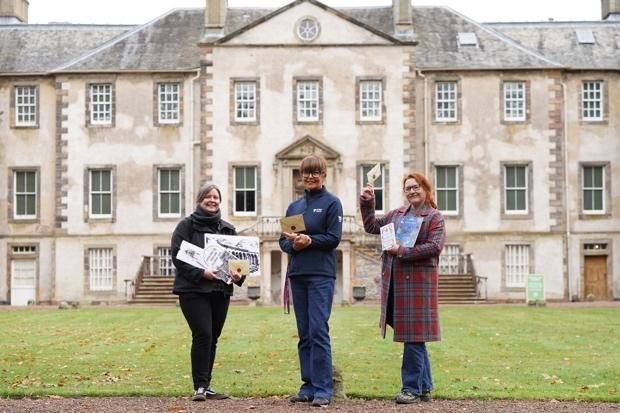
Deck the Halls, a brand new Christmas gift fair coming to the SEC from 28-30 November, is teaming up with partner, National Trust for Scotland to host a giant festive gift hunt at Newhailes House and Gardens
Newhailes House & Gardens in Musselburgh will host the gift hunt from Friday 7 – Sunday 9 November, giving visitors the chance to seek out hidden golden envelopes containing tickets to Deck the Halls and up to £150 worth of vouchers to spend at the upcoming event.
Coming to Glasgow for the first time in partnership with National Trust for Scotland, Deck the Halls promises to be an upmarket Christmas shopping experience like no other. Featuring up to 125 handpicked exhibitors, ranging from unique gifts to food and drink and interactive festive workshops, Deck the Halls will help visitors tick off their Christmas list and get into the festive spirit in luxury and style.
Gift hunt winners will get the chance to browse artisan food and drink brands like BeeHype Honey and Craobh Gin; explore handcrafted gifts from Lin-Pin Crafts, Marc Peters Glass and Edinburgh Illustrations; shop unique accessories from Maccessori, Lindsay McDowall and Gist Jewellery; as well as discover thoughtful gifts for everyone from the likes of Birlinn Publishing and National Trust for Scotland.
Speaking about the gift hunt, event organiser Springboard Events’ Managing Director, Mark Saunders said: “We wanted the lead up to Deck the Halls to feel every bit as magical as the event itself.
“Our gift hunt with National Trust for Scotland gives visitors the chance to soak up the Christmas spirit and enjoy some festive fun in the properties’ picturesque surroundings before stepping into Scotland’s newest festive shopping experience. It’s a taste of what’s to come as we get ready for our Glasgow debut later this month.”
National Trust for Scotland Director of Commercial Enterprises, Caroline Reid said: “We’re excited to be part of the celebrations leading up to Deck the Halls. Newhailes House & Gardens will provide the perfect setting for a festive adventure, and the gift hunt is a fantastic way for visitors to celebrate Scotland’s heritage and Christmas spirit while enjoying some of our most loved properties.”
Visitors to Newhailes House & Gardens this weekend will be invited to participate in the Deck the Halls gift hunt and find the limited number of hidden golden envelopes at each property containing tickets and vouchers for the event*.
Tickets for Deck the Halls are available to book now and save £2. General admission is £16 but with advanced booking, tickets can be purchased now for just £14 (children under 15 go free).
Hundreds of young people across Scotland have benefitted from a record £3.5 million investment from the Essentia Foundation across 2025.
This total includes their largest funding commitment to date, with £2 million recently awarded to eight leading charities across the country.
Funding will support these organisations to deliver programmes tackling youth unemployment, poverty, poor mental health and barriers to education.
Each of the eight charities, including Edinburgh-based Children First and Bethany Christian Trust, has received £250,000, enabling ambitious projects that are helping young people build resilience, develop new skills, and take steps towards brighter futures.
This major investment comes at a critical time. Young people have been disproportionately affected by recent crises, from the long-term effects of the pandemic to the pressures of the continuing cost of living crisis.
Many continue to face the lasting consequences of disrupted education and social development, alongside limited opportunities in training and employment.
Combined with ongoing mental health challenges and persistent inequality, these barriers mean that support for Scotland’s young people is more urgently needed than ever.
Brian Davidson, Trustee and Chairperson of the Essentia Foundation, said: “Scotland’s young people are facing some of the toughest challenges in generations, and the need for support has never been greater.
“These eight charities are already making a real difference in communities across the country. This funding will help create opportunities, build resilience, and give young people the skills and confidence to thrive.
“The impact of these projects will last well beyond the life of the programmes themselves, and we hope it also sparks further support from others who want to see Scotland’s young people flourish.”
Other grant recipients of £250,000 each from the Essentia Foundation include:
Aberlour Childcare Trust
Cyrenians
Sistema Scotland
The Outward Bound Trust
The King’s Trust
The Venture Trust
These awards, alongside the additional £1.5 million that has been distributed this year by the Essentia Foundation, underpin its commitment to support young people across Scotland through initiatives focused on wellbeing, education, skills development, and opportunities for employment.
The awards also mark a milestone moment for the Essentia Foundation itself. The Foundation has confirmed it will now wind up its activities, leaving a £1.5 million legacy fund to be administered by long term partner Foundation Scotland, who have been supporting the Essentia Foundation since 2017.
Helen Wray, Head of Philanthropy & Quality, Foundation Scotland said: “We are honoured to continue Essentia Foundation’s legacy through the new fund. For the last eight years, our team has had the privilege of working alongside Essentia to ensure its resources reach young people who need them most.
“This next chapter will see us build on that partnership by supporting grassroots organisations across Scotland.
“We look forward to helping smaller charities deliver vital opportunities that improve wellbeing, education and future prospects for children and young people, ensuring Essentia’s legacy and impact endures for years to come.”
This future programme will provide small grants to grassroots charities, ensuring Essentia’s mission of supporting children and young people continues well into the future.
Festival’s biggest-ever on-demand release features Ta-Nehisi Coates, Ben Okri, Judy Murray, Philippe Sands, Linder, Belle and Sebastian’s Stuart Murdoch, and dozens more – all on a donate what you can basis
Edinburgh International Book Festival is releasing 60 more events from its August 2025 programme for global audiences this week on a Donate What You Can basis. Already watched by viewers from 63 countries, ranging from Japan to a potentially very well-connected viewer in Vatican City, the festival has also been building its digital strategy around inclusion throughout the year, with over 100 events streamed into libraries across twelve Scottish local authorities in August alone, all entirely free. Together, these initiatives represent the festival’s most ambitious digital accessibility efforts to date.
The collection, launched at 10am today, brings conversations with some of the world’s leading literary voices to audiences unable to attend in person, from Pulitzer Prize-winner Ta-Nehisi Coates in dialogue with historian David Olusoga, to novelist Ben Okri‘s exploration of heartbreak and renewal, local crime writing duo Ambrose Parry, and culinary icons José Pizarro and Sami Tamimi, among many more.
The Donate What You Can basis ensures financial barriers don’t prevent access to these conversations, while allowing the festival to continue delivering both its August events and year-round community projects, including the recently launched Paper Trails library project.
The release marks a significant expansion of the festival’s digital offering, with these 60 new events bringing the total of on demand events available to view to almost 150, which more accurately reflect the diversity of the Festival’s in-person programme.
Spanning urgent political debates, intimate author conversations, and family programming, highlights include climate justice discussions with Tony Juniper and Friederike Otto, disability rights activism with Rachel Charlton-Dailey, and renowned Belle and Sebastian frontman Stuart Murdoch unveiling his stunning debut novel, Nobody’s Empire.
With the support of Event Scotland, a number of international territories will benefit from dedicated marketing materials to encourage increased global engagement with the Festival’s digital offering.
Jenny Niven, Director of Edinburgh International Book Festival, said: “As an international festival, streaming our events around the world during August is a key part of what we do. It’s brilliant to now be able to make that content available all year round, both for international audiences and audiences in other parts of Scotland.
“This is the largest on demand collection we’ve ever released. The depth and range of our programme means even if you did come in August and attended lots of sessions, there will still be an enormous number of insightful and inspiring discussions you might have missed, so it’s a gift that will keep on giving.
“Every donation made to watch these events helps us develop our work as a charity, delivering programmes in communities throughout the year and creating our August festival. We’re very grateful for your support.”
The initiative forms part of the festival’s year-round accessibility strategy, building on its Communities Programme and the Paper Trails library project launched earlier this year.
Rebecca Edser, Head of EventScotland said: “The Edinburgh International Book Festival is a vibrant celebration of literature, and the streaming of selected shows from this year’s programme offers an exciting opportunity for audiences to continue enjoying the festival beyond its August run.
“This online programme not only creates new opportunities for international audiences to engage with Scotland’s vibrant literary scene, but it helps build a sense of connection and curiosity that inspires future travel.
“As part of our diverse portfolio of events and festivals, the Edinburgh International Book Festival plays a key role in helping to drive Scotland’s visitor economy and reinforces our reputation as a world-leading tourism and events destination.”
Among the must-watch events now available:
Literature meets politics: Tariq Ali on empire and resistance; Booker-shortlisted Madeleine Thien with translator Deepa Bhasthi on the sanctity of language, Ash Sarkar on identity politics
Genre favourites: Romance authors Bolu Babalola and Beth O’Leary; crime duo Ambrose Parry; bestseller Jenny Colgan (above)
Poetry and performance: Award-winning poets Raymond Antrobus and Najwan Darwish
Family programming: “Brilliant Bugs” and mystery-solving with Robin Stevens
Food and culture: Culinary conversations with José Pizarro and Sami Tamimi; music history with Dylan Jones and Miranda Sawyer
History: TV historian Dan Jones, Edinburgh writer Kate Foster sheds the city’s women and their stories, and Paul French on Wallis Simpson’s formative period in China
All events are available with captions. You can find the full list HERE.
Emergency Departments record worst-ever September performance
Accident and Emergency
As Scotland’s Emergency Departments experienced the worst September on record for performance, the Royal College of Emergency Medicine has asked the government: ‘where is the tangible plan for winter?’
The figures, released yesterday (4 November 2025) by Public Health Scotland, come as Health Secretary, Neil Gray, is reported to have said waiting times in A&E are ‘below the levels we all wish to see’.
The PHS data, for the month of September, reveals 6,427 patients waited 12 hours or longer in an Emergency Department before being admitted, discharged, or transferred.
That’s around one in every 19 people and the highest number who experienced this wait for the month of September since records began in 2007.
The data, for major EDs in Scotland, also showed that in September 2025:
12-hour waits were almost 34 times worse than in September 2018 – that’s despite the number of people attending EDs only increasing by 4.5% in the same period
One in eight people (15,348) waited eight hours or more to be discharged or transferred – the worst September on record
63.7% of patients were seen within four hours – again, the worst September on record and is far below the government’s target of 95%
There was an average of 1,955 beds occupied by people healthy enough to be discharged – a decrease of only nine compared to the previous month
The new data comes shortly after RCEM published its political manifesto for Scotland, urging all political parties to end overcrowding in EDs, and provide enough Emergency Medicine staff to deliver safe and sustainable care, along with adequate resources to ensure equitable care throughout the emergency care system.
Meanwhile, recently published analysis from the College revealed there were more than 800 deaths associated with long A&E waits before admission last year.
Dr Fiona Hunter, RCEM Vice President for Scotland, said: “These figures prove what I and many other EM clinicians already know – that we are in crisis and the depths of winter, when the inevitable seasonal pressure hits, is yet to arrive.
“Our members and their Emergency Medicine colleagues tell me about the relentless pressure their hospitals are under and the impact this has on patient care – people are being treated in ambulances, in corridors, and other inappropriate spaces.
“Our EDs don’t have elastic walls. These are visual signs our hospitals are full to bursting– we can’t move patients from our departments into wards because of a lack of available inpatient beds.
“On top of dealing with system pressures, our clinicians are facing violence and aggression from those we are trying our best to care for – that can be caused by frustration over long waits. It’s beyond unacceptable.
“We know that Scottish Health Secretary understands the scale of the issue, and just today acknowledged that ‘ED performance is below where it should be’.
“But we are yet to see any tangible plan from the government about how it intends to tackle the season ahead – which will be nothing short of challenging.”
The countdown to 2026 has begun, as Edinburgh’s Hogmanay organisers today announce the first events at this year’s First Footin’ programme on New Year’s Day, presenting another packed line-up of free and ticketed events in venues across the city.
Michael Pedersen, Edinburgh’s Makar, will host an evening of music and discussion to kickstart 2026 with guests including: Shirley Manson, Nicola Sturgeon and Norman Blake, whilst the First Footin’ music line-up welcomes the likes of Tinderbox Orchestra, James Emmanuel, Kathryn Joseph, Rachel Sermanni and more.
Supported by the Scottish Government’s Festivals EXPO Fund through Creative Scotland, First Footin’ transform some of Edinburgh’s much-loved venues and attractions with a showcase of artists from across Scotland and beyond, inviting audiences to discover new music and experiences on 1 January.
The New Year’s Day events programme is a spectacular finale to the four-days of Edinburgh’s Hogmanay, which is created and produced by Edinburgh’s Unique Assembly on behalf of the City of Edinburgh Council, welcoming local residents and visitors from across the globe to come together and celebrate the arrival of 2026 with a showcase of Scottish music and tradition.
Culture Secretary Angus Robertson said:“The First Footin’ and Sprogmanay programmes look like they’re shaping up to be a great way for people of all ages and interests to ring in the New Year.
“Edinburgh’s Hogmanay and New Year’s Day festivities are much-loved at home and abroad, and are a wonderful showcase for the extraordinary range of artistic talent we have in this country.
“The Scottish Government is therefore proud to continue our support with £180,000 for this year’s Edinburgh Hogmanay from our Festival Expo Fund, which aims to support festival innovation and maximise national and international opportunities for the artists who contribute to them.”
An annual highlight, First Footin’ in St.Giles’ Cathedral will this year become a carnival of sound and colour, with Edinburgh’s Tinderbox Orchestra bringing together rappers and singers with soaring strings and thundering bass and drums. Tinderbox Orchestra will host a selection of Scotland’s finest musicians throughout New Year’s Day as they are joined by award-winning special guests James Emmanual, Kathryn Joseph and Rachel Sermanni.
The sessions will run from 2pm – 6pm, inviting audiences to welcome in the New Year with magnificent performances from some of the country’s most talented musicians in the atmospheric setting of St.Giles’.
Tinderbox Orchestra said: “We are over the moon to be part of the First Footin’ programme this year alongside so many other wonderful acts.
“The opportunity to take over St Giles’ and share our music and showcase brand new arrangements with some of Scotland’s best loved artists is incredibly exciting for us and we cannot wait!”
The First Footin’ music trail also welcomes a collaboration from Edinburgh’s Grammy-nominated guitarist Sean Shibe and award-winning fiddle-player and composer Aidan O’Rourke uniting in New College’s Rainy Hall, for a spellbinding meeting of classical music and Scottish folk. Award-winning Dundee singer-songwriter Theo Bleak will be performing in Virgin Hotel’s Eve, along with other special guests to be announced.
In the evening, the music continues with the First Footin’ Sessions with Cold Town Beer, as live events come to life throughout the Grassmarket and New Town bars, featuring a feast of music from foot-stomping trad artists from across Scotland to be announced.
Edinburgh’s Hogmanay draws to a close with Scottish literary and cultural icons in Portobello Town Hall as Muckle Be The Light: Manson, The Makar & Dreamers Beyond welcomes one of Scotland’s most iconic musicians Shirley Manson and Edinburgh’s Makar Michael Pedersen at their cultural salon.
Together, the duo will look back on their favourite moments of 2025, in art and friendship, joined by very special guests – former First Minister and author Nicola Sturgeon, plus live music from Teenage Fanclub frontman Norman Blake.
Audiences can expect lively discussion, live music, reading and more at this one-off event reminiscing on cultural highlights of 2025 whilst kickstarting 2026 with some of Scotland’s most iconic voices, as well as a special pop-up bookshop from local store The Portobello Bookshop.
Michael Pedersen said:“’I can think of no more glorious a way to start the year than in the presence of Edinburgh’s primo cultural icon / all round extraordinary human / cherished friend, Shirley Manson.
“And what an epic year Shirley and Garbage have had – they delivered my album of 2025, and she’s my person of the year. Shirley also happens to be one of my favourite people to talk about books and art and life with – we’ll be brimming over with vocal zest.
“To be joined by one of the world’s finest songwriters, Norman Blake, and Scotland’s boldest new bestselling author, Nicola Sturgeon, is a level of dreamy beyond. Did I mention I went to high school ceilidhs in this town hall?
“What a quest to get here and return with reflections on my debut novel and first year as Edinburgh’s Makar. How’s about that for a first footing firework! Be warned: I’ll be swooning at them aw’!”
Council Leader Jane Meagher said: “Edinburgh has always been a city that knows how to celebrate, and there’s no time of year that shows it better than Hogmanay.
“We’re welcoming 2026 with the return of our much-loved First Footin’ – a fantastic showcase of Scotland’s talent with performances taking place in some of our most renowned venues and public spaces.
“I’m delighted to welcome this year’s programme and encourage everyone, whether you’re a first-time visitor or a lifelong resident, to come along and start the year on a high.”
With even more First Footin’ performances set to be announced, music fans can spend New Year’s Day discovering Scotland’s most exciting rising stars and familiar faces in some of the city’s most atmospheric settings – a celebration of music and friendship as audiences cross the threshold into a New Year.
Tickets for all events including Concert in the Gardens with Wet Leg, Torchlight Procession and Night Afore Concert with Peat & Diesel are on-sale now via www.edinburghshogmanay.com
Follow Edinburgh’s Hogmanay on social media – Facebook and Instagram.
A seasoned firefighter has spoken of the terrifying moment her crew came under attack with fireworks.
Watch Commander Debbie McCafferty serves communities at both Glasgow’s Clydesmill Community Fire Station and at Carluke Community Fire Station.
Debbie has protected communities since 2002 and balances her wholetime role with family life and responding to emergencies via a pager.
Last year, she and her on call crewmates came under attack during a callout to an unofficial bonfire in Carluke.
After engaging with the crowd in attendance, Debbie and her colleagues began to extinguish the bonfire. It was then a firework was fired in their direction.
Debbie recalled: “There were loads of people around the bonfire. As we began to extinguish it and the crowd began to disperse, we heard a whistling noise.
“I looked around to my left and an unexploded firework had hit a trainee firefighter on his leg. We both instinctively kicked it away and then it went off.
“It was horrible, really horrible. Thankfully everyone was okay, but all it would have taken was for the firework to get stuck in his tunic or for it to have landed in front of us and it would have caused severe injuries.
“We’re there trying to do a job and keep people safe. We’re not targets and we don’t deserve to be treated like that.”
Firefighter Scott Stevenson attended the same incident and was struck by the firework. He recalled: “It was quite dark, and I was stood making sure the fire was out when I heard a whistle.
“I felt something strike my leg and my colleague pulled me to the side as the firework exploded.
“It was a scary situation and could have been a lot worse.
“My family were very upset and angry when they found out.”
Debbie is keen to point out that attending an organised firework event or bonfire display is the safest way to enjoy the bonfire season – but she is realistic enough to know many people will host firework displays or have bonfires at home.
She said: “Have a good time and enjoy yourself but do it in a safe manner. Don’t put yourself at risk and don’t ruin anyone else’s fun. Respect other people and consider the impact of fireworks on animals.
“We’re not there to ruin anyone’s fun, we just want to keep people safe – and that includes ourselves.”
You can find out key safety information, including the Bonfire Code, on the SFRS website.
On there, you will also see a full and updated list of all public firework events taking place across Scotland.