Governments across the world are raising wages, cutting tax and announcing hefty financial aid packages for people and workplaces affected by the energy crisis (writes TUC’s NINA REECE):
War in Ukraine is exposing the cracks in a global energy system that privileges profit over people and the climate and is too reliant on international trade in fossil fuels. The result is a massive increase in energy costs that is hurling people into poverty while energy companies announce another year of eye-watering profit.
But the Conservative government’s decision not to help the people or sectors most affected by the energy crisis is the exception, not the rule. Here is how other governments across Europe are providing support.
Germany
In Germany, €16billion (£13.4billion) has been made available to ease the burden of rising costs. The support package includes a €9 pass for commuters, giving them a month’s unlimited use of public transport. Making public transport more accessible in the UK is key to reaching our emissions targets.
There is a one-off €300 tax cut for individuals, extra discounts for low-income families and fuel taxes will be cut for three months, with the price per litre cut by €0.30 for petrol and €0.14 for diesel.
Importantly, this package includes a commitment to reducing German reliance on gas, oil and fossil fuels long term.
Germany is also set to raise the national minimum wage by 15 per cent, benefitting nearly 6.2 million low-paid workers – two thirds of them women – giving Germany the second-highest minimum wage in Europe. The rise, agreed as part of the coalition deal, will also cover self-employed and flexible workers.
Nordic countries
A six million Swedish kronor (£473m) pot was set aside by the Swedish government to soften the impact of soaring bills. This may not sound like a lot, but with population that is fraction of that of the UK – it is significant. The government has also issued winter bill subsidies of up to 6000 kronor (£488) for 1.8m households from winter into 2022.
The Norwegian government’s package of measures to help households totals more than eight billion kronor (£664m). In January, Norway even committed to covering 80 per cent of electricity costs for a short period whenever the rate for electricity is above 70 Norwegian øre (6p) per kilowatt-hour.
France
President Macron is targeting energy companies.
EDF, the state energy provider, will charge electricity at below market rate and will take an €8.4bn financial hit. It has also been ordered to sell nuclear power to rivals at below current market rate as its reactors generate 70% of the country’s electricity.
This month, the CEO of Total Energie has also announced a freeze on dividends. In the UK, despite massive profits, no caps or restrictions have been placed on the Big Six energy providers.
The French government has also cut electricity taxes in a bid to slow the increase to bills. While here in the UK, gaps in the Chancellor’s support package means the energy crisis will hit the poorest families the hardest, in France 5.8million low-income households were given a €100 payment for energy bills in January this year.
Spain
The Spanish government’s €16billion response to the energy crisis is the most comprehensive. The focus is on curbing profits and protecting jobs.
Some €2billion will be raised from a windfall tax on energy providers. €500million in subsidies will be provided for electricity-intensive industries and companies that receive this aid won’t be able to dismiss staff to balance out their rising energy costs.
€10billion of state loans will also be given to companies in other industries who are forced to spend more on energy. There is protection for truckers and professional drivers with €450million in direct aid for transport professionals.
And for families and individuals, a fuel sales subsidy of €1.4billion will reduce prices by €0.20 a litre, making a full tank about €9 cheaper, far better than Rishi Sunak’s 5p cut to fuel duty which would take just £2.25 off the cost of a full tank.
These responses from other countries show that our government can do more to help families and industries survive what the Governor of the Bank of England calls a ‘historic shock’ to our living standards. Households currently face an annual energy bill of £2000 and prices are to rise again in October.
Sign petition to demand action from Rishi SunakRishi Sunak must come back to parliament and present an Emergency Budget. We need a proper package of economic support for families.
Materials barred from high-risk buildings over 11 metres
Legislation to improve fire safety and boost Scotland’s Net Zero ambitions has been laid before the Scottish Parliament.
Under the legislation, developers will be banned from using combustible cladding on high-rise buildings. Since 2005, new cladding systems on high rise blocks of flats have either had to use non-combustible materials or pass a large-scale fire test.
The building standards legislation removes the option of a fire test, completely prohibiting such materials from use on domestic and other high-risk buildings, such as care homes and hospitals, above 11m.
The highest risk metal composite cladding material will be banned from any new building of any height, with replacement cladding also required to meet the new standards.
The legislation also includes improvements to energy performance standards, aiming to make buildings easier to heat while ensuring they are well ventilated and comfortable to live in.
Building Standards Minister Patrick Harvie said: “This is the third set of changes made to fire safety standards for cladding in Scotland since the tragic Grenfell Tower Fire, requiring any cladding on domestic or other high risk buildings above 11m to be strictly non-combustible.
“Taken together with our new fire alarms regulations, covering all homes in Scotland regardless of ownership, this is yet another step on the Scottish Government’s mission to minimise the risk of deaths and injuries from fire.
“The energy improvements will deliver another important step toward improved energy and emission performance of our buildings, and we’ll be going further on this in 2024 with regulations requiring new buildings to use zero-emissions heating systems.”
Changes to requirements on fire safety of cladding systems will be introduced on 1 June 2022, while improvements to energy and environmental standards will apply from 1 October 2022.
The changes have been brought in following public consultations in 2021 on the fire safety of cladding systems and on energy and environmental standards.
Supporting Technical Handbooks, which set out the full detail of changes, will be published from the start of May.
The combustible cladding ban will apply to all buildings with a storey 11m or more above the ground, and which contain:
a dwelling
a building used as a place of assembly
or as a place of entertainment or recreation
a hospital
a residential care building or sheltered housing complex or a shared multi-occupancy residential building.
MPs back TUC’s calls for asbestos removal from public buildings
On Thursday, MPs backed calls from the TUC for all asbestos to be removed from public and commercial buildings.
Westminster’s Work and Pensions Select Committee published a report from its inquiry into asbestos management in which it cites TUC calls for stronger asbestos removal.
Asbestos remains the biggest cause of work-related deaths in the UK according to the Health and Safety Executive (HSE), with 5,000 deaths recorded in 2019. And Britain has the highest rates of mesothelioma cases in the world.
Asbestos is classed as carcinogenic, which means it can cause cancer and other serious lung conditions when fibres are inhaled.
According to figures from the HSE asbestos is still found in around 300,000 non-domestic buildings despite a ban on the use of the substance in new buildings in 1999.
Committee report
The new report by MPs cites concerns that the likely dramatic increase in retrofitting of buildings in response to net zero ambitions means that more asbestos-containing material will be disturbed in the coming decades.
The TUC says current asbestos management is not fit for purpose and has long called for new legislation requiring removal of all asbestos from public buildings.
Today MPs have called for a 40-year deadline to remove all asbestos from public and commercial buildings. The TUC welcomes the news but says a 40-year deadline is not ambitious enough.
The report also calls for more funding for the HSE to support this increased programme of work.
Asbestos dangers
There is no safe threshold of exposure to asbestos fibres – inhalation even of small quantities can lead to mesothelioma decades after exposure.
This means that where asbestos is still present, it is not safe to assume there will be no disturbances that put working people in danger.
The only way we will eradicate mesothelioma in Britain is with a legal duty to safely remove asbestos, and a clear timetable for its eradication. Only then can we ensure that future generations will not have to experience the same deadly epidemic from asbestos-related diseases that we suffer today.
TUC General Secretary Frances O’Grady said: “Everyone should be safe at work. Asbestos exposure at work continues to cause thousands of deaths every year. Asbestos is still with us in workplaces and public buildings across the country. As a result, more than 22 years after the use of asbestos was banned, hundreds of thousands of workers are still put at risk of exposure every day.
“The only way to protect today’s workers and future generations is through the safe removal of asbestos from all workplaces and public buildings.
“Today’s report by MPs is welcome, but a 40-year deadline isn’t ambitious enough: hundreds of thousands of workers risk dangerous exposure in that time. Ministers must commit to removing all asbestos to keep future generations safe.”
Taking a few practical steps to support Muslim workers during Ramadan will help to create a workplace where everyone is respected and valued, writes TUC’s Riz Hussain.
For the next four weeks, thousands of Muslims across the UK will be fasting during the daytime to mark Ramadan or Ramazan.
Ramadan falls at a different time each year because Islam uses the lunar calendar.
This year, Ramadan will start at the beginning of April and continue for 29 or 30 days from when you begin your fast.
What happens during Ramadan?
It is a time for deep spiritual reflection and collective rituals for Muslims across the UK. It’s a time for Muslims to share food with their families and friends, and celebrate their cultures, heritage and faith.
The fasting day is long. The morning meal will be before dawn and people won’t break their fast until dusk. That’s 13 hours without food or drink (yes that’s right, not even water!). This can be challenging for many Muslims especially whilst at work.
That’s why it’s important to support your Muslim workmates, to stand in solidarity with them and create a team culture where everyone is respected and valued, no matter where they’re from or who they worship.
Practical steps colleagues and employers can take to support their Muslim workmates and friends:
Ask colleagues if they’re observing Ramadan
Don’t be shy about asking Muslim colleagues if they will be observing Ramadan.
Some people may choose not to take part – perhaps for medical reasons – as fasting is a personal choice.
Be considerate
Ramadan should not interfere with everyday tasks at work, but fasting co-workers may be tired or lacking energy during the day.
Usually the first ten days are the hardest. If you have colleagues who will be fasting, ask them if changing some aspects of work can make it easier for them.
Be flexible
Ramadan isn’t only about not eating or drinking during daylight hours.
It usually means rising early and eating late, and may mean taking part in late night prayers at the mosque or their homes. Ramadan is usually a time for deep spiritual reflection, congregational prayers and lots of social dinners with family and friends.
Some workers may ask to change their working day or shift times, to take a shorter lunch break, or to make sure they finish on time so they can break their fast at home.
Being flexible may help people work when they are most productive.
Some workers might have additional religious commitments during Ramadan. It may be especially important to perform prayers on time through the week. Employers can help by ensuring there’s a quiet space in the workplace for prayers and by allowing short breaks.
The last ten days of Ramadan are considered to be especially holy. Some Muslim workers might decide to take time off, or ask to change their working patterns to perform all-night prayers.
The end of the fasting period
Eid ul Fitr marks the end of the fasting period. It’s like Christmas for Muslims – the biggest celebration of the year.
There is often some uncertainty about which day Eid will fall because it depends on moon sightings, so be prepared for your Muslim colleagues not to know the exact date.
This may also impact on when they can work and how much notice they can give you, as Eid can last up to three days.
Supporting colleagues during Ramadan is part of building a culture where everyone is respected and valued.
This Ramadan, the TUC would like to wish all Muslim trade union members and everyone who is fasting in the UK: Ramadan Mubarak.
This Mother’s Day mums across the country will wake up to breakfast in bed and bouquets of flowers from their little ones. But although the recognition from family members is appreciated, the fact is many working mums are being pushed to the brink.
Juggling work with family life is not easy. And working mums are buckling under the strain of a combination of caring responsibilities and the added pressures of wages and bills crisis.
Last week the Chancellor delivered his spring statement – setting out spending commitments for the next six months. But there was nothing in the Chancellor’s mini-budget to support working mums, despite the fact that recent TUC research found that one in three parents of pre-school age children spend more than a third of their pay on childcare – a staggering amount when households across the country are struggling to cover soaring energy bills.
And there are other challenges facing women in the labour market. Nearly two in five (38%) key workers are paid less than £10 an hour, and most of them are women. Around 2.5 million women key workers earn under £10 an hour.
One in 10 (1.4 million) women workers earn too little to get any sick pay. And TUC research shows that BME women are twice as likely to be on a zero hours contract than their white male counterparts.
Mums took on the lion’s share of caring responsibilities during the pandemic when schools closed. Now they’re more likely to have to take time off work to care for their children when they get Covid-19. Many are being forced to sacrifice hours and pay to do so.
And too many women are stuck in low-paid, insecure jobs with few rights and no sick pay. They deserve so much more.
5 ways the government can help mums this Mothers Day
This Mother’s Day, the TUC wants the government to introduce five key measures to help mums stay in work and support their families:
Increase the minimum wage to £10 an hour
Increase statutory sick pay to at least the level of the real Living Wage, for everyone in work.
Bring in an entitlement to 10 days parental leave per year for each child, on full pay. Currently parents have no legal right to paid leave to look after their children.
Ban zero hours contracts.
Introduce a right to genuine flexible work, from the first day in a job. Flexible working includes having predictable or set hours, working from home, job-sharing, working compressed hours and term-time only working.
Long-term reforms
But ministers cannot stop there. The TUC says the gender pay gap opens when women become mothers, which then feeds into the gender pensions gap later in life.
Government must look at fundamental reforms to equalise care between men and women. A striking omission from the spring statement was the lack of any mention of childcare.
Without access to affordable childcare many families will be forced into further hardship and many mums will be forced out of the labour market.
And the Governments evaluation of shared parental leave is long overdue.
The TUC says ministers must:
Tackle the gender pay and pensions gap. Government should require all employers to publish an action plan alongside their pay gap reporting, setting out the steps they will take to close their gender pay gaps.
Invest in the childcare sector and ensure everyone has access to good quality and affordable childcare and childcare workers are paid a living wage. TUC research found that one in three parents of pre-school age children spend more than a third of their pay on childcare. TUC research also found that over 170,000 childcare workers would benefit from a minimum wage increase to £10 per hour.
Overhaul Shared Parental leave (SPL). Around only 1 per cent of eligible families take up shared parental leave. We need an individual right to SPL for both parents on a use it or lose it basis and paid at real living wage rate.
Women have fought hard for their rights and progression in the world of work, but more than a decade of austerity, compounded by the pandemic and now the wages and bills crisis risks turning the clock back on progress towards women’s equality at work and in wider society.
If the government is serious about women’s equality then it must get serious about its policy interventions.
Sign the petition to call for UK government to stop DP World and P&O Ferries replacing 800 sacked workers with cheaper labour.
What’s the issue?
Last week, 800 workers at P&O Ferries were sacked via Zoom call.
This shameful act is devastating for these workers, their families and communities. Workers must be reinstated immediately – and P&O Ferries must face serious consequences.
This is a national scandal – it can’t ever be allowed to happen again. This must be a turning point for workers’ rights in the UK.
The government can stop this, but they will not act unless thousands of us speak up. If callous acts like this are allowed at P&O, they can happen anywhere.
We need your help!
Please support P&O workers by signing the petition and make sure no worker can be treated like this again.
‘A failure of courage, a failure of compassion and a failure of justice‘ – Peter Kelly, The Poverty Alliance
Chancellor announces Spring Statement tax cut for 2.4 million Scottish workers through rise in National Insurance thresholds – saving the typical employee over £330 a year.
Unveiling plans to give families further help with the cost of living, Rishi Sunak also slashes fuel duty on petrol and diesel by 5p per litre for the next 12 months.
Spring Statement also sets out measures to help businesses boost investment, innovation, and growth – including a £1,000 increase to Employment Allowance to benefit around half a million SMEs across the UK
The UK Government is providing an additional £45 million to the Scottish Government next year as a result of measures announced by the Chancellor today.
The Chancellor delivered a Spring Statement today that ‘puts billions of pounds back into the pockets of hard-working people in Scotland’– unveiling a series of tax cuts to ease the cost of living.
Rishi Sunak announced that National Insurance starting thresholds will rise to £12,570 from July, meaning hard-working people across the UK will keep more of what they earn before they start paying personal taxes.
The cut, worth over £6 billion, will benefit 2.4 million working people in Scotland with a typical employee saving over £330 a year, whilst the typical self-employed person will save over £250. This means the UK now has some of the most generous tax thresholds in the world.
Mr Sunak also announced that fuel duty for petrol and diesel will be cut by 5p per litre from 6pm tonight (23 March) to help drivers across the UK with rising costs. Worth £2.4 billion, this is the biggest cut ever on all fuel duty rates and means a one-car family will now save on average £100.
As a result of a cut to the basic rate of income tax for savings income, taxpayers in Scotland will see benefits worth £3 million. As other income tax rates are devolved in Scotland, the Scottish Government’s funding is automatically increased as a result of this tax cut as set out in the agreed Fiscal Framework. This is initially worth £350 million in 2024-25.
The Chancellor also set out a series of measures to help businesses boost investment, innovation, and growth – including a £1,000 increase to Employment Allowance to benefit around half a million businesses.
As a result of measures in this Spring Statement the UK Government is providing the Scottish Government with an additional £45 million through the Barnett formula next year.
Chancellor Rishi Sunak said:“We’re slashing taxes for millions of hard-working people in Scotland, getting pounds in people’s pockets and helping pay cheques to stretch further – from July more than 2.4 million in Scotland will get a tax cut with the typical employee keeping £330 more each year.
“By cutting fuel duty, we’re making it cheaper for people in Scotland every time they go to the pump, which together with the freeze means people save £100 per car on average a year.
“We’re boosting small business growth by increasing the Employment Allowance – a tax cut worth up to £1,000 for thousands of businesses.”
To grow the world’s very best talent in AI, the UK Government will partner with industry and academia to create 1,000 new AI PhDs. The Government will invest £117m to create PHDs across the UK at Centres for Doctoral Training, building on the existing three sites in Scotland. This will train a new generation of AI researchers who will develop and use AI in areas such as healthcare, climate change and creating new commercial opportunities.
Delivering the statement, the Chancellor made clear that our sanctions against Russia will not be cost-free for people at home, and that Putin’s invasion presents a risk to our economic recovery – as it does to countries all around the world.
However, announcing the further measures to help people deal with rising costs, he said the extra support could only be provided because of the UK’s strong economy and the tough but responsible decisions taken to rebuild our fiscal resilience.
The immediate financial support for people and businesses comes as part of a wider tax plan announced by the Chancellor that will create better conditions for growth and will share proceeds from growth more fairly – ensuring people can keep more of what they earn.
Mr Sunak also announced that the Scottish Government will receive £41 million more funding as there will be an extra £500 million for the Household Support Fund, which doubles it’s total amount to £1 billion to support the most vulnerable families with their essentials over the coming months.
The Chancellor also reduced the VAT on energy saving materials such as solar panels, heating pumps and roof insulation from 5% to zero, helping families become more energy-efficient.
This cost of living support comes on top of the measures that the Chancellor has already announced over the recent months to support families. This includes an over £9 billion energy bill rebate package, worth up to £350 each for around 28 million households, an increase to the National Living Wage, worth £1,000 for full time workers, and a cut to the Universal Credit taper, worth £1,000 for 2 million families.
The Spring Statement also confirms that:
A new Efficiency and Value for Money Committee will be set up to cut £5.5 billion worth of cross-Whitehall waste – with savings to be used to fund public services.
£50 million new funding to create a Public Sector Fraud Authority to hold departments to account for their counter-fraud performance and to help them identify, seize and recover fraudsters money.
Local residents across the UK will benefit from a fresh set of infrastructure projects as we open the second round of the £4.8 billion Levelling Up Fund. It will continue to focus on regeneration, transport and cultural investments.
Chancellor’s statement ‘a failure of courage and compassion’, says Poverty Alliance
Reacting to today’s Spring Statement, Peter Kelly, director of the Poverty Alliance, said: “Government should be about compassion and justice, and making sure people are able to live as full a life as they can.
“The Chancellor said his Spring Statement today was all about security. Yet his plans show a failure to comprehend the situations being faced by households across the country, leaving them with insecure and falling incomes in the face of rising costs.
“Amid a rising tide of poverty, the Chancellor could have thrown a lifeline by increasing benefits in line with inflation and by scrapping the unjust benefit cap. Instead he has provided additional funding of only £500m to the Household Support Fund which, although welcome, will quickly be consumed by the rising cost of living for families on the lowest incomes.
“The increase in the National Insurance threshold has also been presented as a support to people living on low incomes. In reality two thirds of this effective tax cut will go to middle and higher income households.
“By ignoring the tidal wave of rising living costs that is pulling so many people into poverty, the Chancellor has made clear his priorities. His tax cutting agenda will generate positive headlines, but could see another 400,000 people across the UK swept into poverty.
“Ultimately, the Chancellor’s statement is a failure of courage, a failure of compassion, and a failure of justice.”
The UK Government has not delivered the support and help that families and businesses need today, according to Finance Secretary Kate Forbes.
Responding to the Spring Statement, Ms Forbes said the Chancellor failed to help thousands of worried households facing poverty as a result of soaring energy bills and a cost of living crisis.
In 2018/19, the Scottish Government introduced a more progressive approach to tax, including a 19% starter rate band below the basic rate, ensuring those who can afford to pay a little more do so.
Ms Forbes said: “The Spring Statement has failed to address the biggest challenges facing households today. With soaring energy bills and a cost of living crisis, the Chancellor has not used his Spring Statement sufficiently to provide lifeline support that could prevent households facing fuel poverty.
“The Scottish Government is providing a further £10 million to continue our Fuel Insecurity Fund into 2022-23, which supports people struggling with their energy bills. Most powers relating to the energy markets remain reserved and Scottish Ministers have repeatedly called for the UK Government to urgently take further action to support households – including a reduction in VAT on household energy bills and support for those on low incomes.
“We are doing all we can to tackle the cost of living crisis – including doubling the Scottish Child Payment from £10 per week per eligible child to £20 next month. The UK Government should have followed our lead and matched the 6% uprate on social security benefits which the Scottish Government is adding to eight of the benefits we deliver. The Chancellor failed to match that commitment which could have provided lifeline support to thousands of households.
“On taxation, we have already acted to introduce a 19% starter rate of income tax below the basic rate, in line with our commitment to progressive taxation, which makes Scotland the fairest taxed part of the UK. We will continue to take that approach when we set taxation policy in future budgets.”
In the midst of the biggest wages and bills crisis in living memory, Rishi Sunak’s Spring Statement has failed families who need help NOW, says the TUC.
He didn’t stand up for families. He didn’t take the opportunity to stand up to the bosses who’ve sacked hundreds of workers at P&O. And he didn’t set out a plan to get wages rising – leaving the average workers facing a wage cut of over £500 this year.
Fund efforts towards a peaceful solution to the conflict in Ukraine
Take additional measures to support families in the UK with rising energy prices
Deliver the long-term changes needed for a high-wage, high skill, high productivity economy
Below we set out how the spring statement matched up to our tests and assess what it means for working people.
The Chancellor didn’t deliver an immediate boost to pay
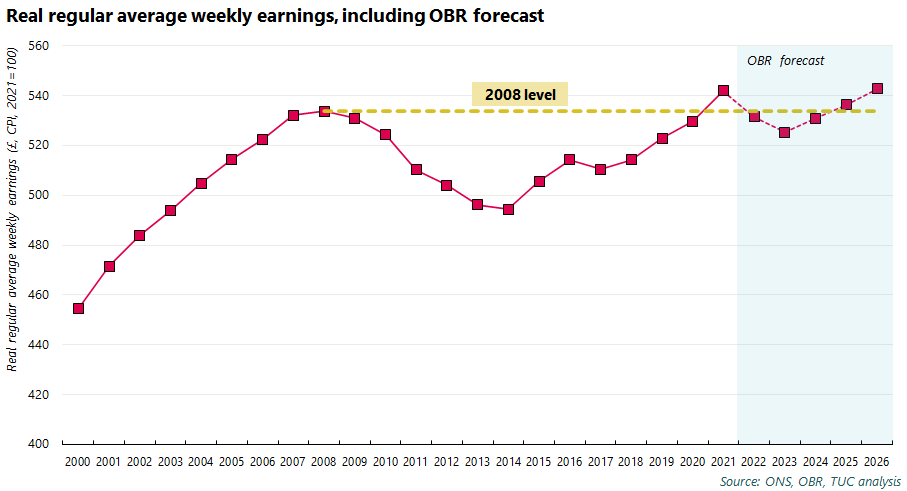
Workers’ pay prospects from the statement don’t look good. The OBR forecasts real weekly wages to fall by £11p/w (2.0 per cent) in 2022, and fall again in 2023. This will put wages back below their 2008 levels (after a brief recovery in 2021), where they’ll stay until 2025. And even this contains some optimistic wage forecasts, with the OBR forecasting pay before inflation to rise by as much as 5.9 per in Q3 2022.
The OBR forecasts that the 2022-23 financial year will see the biggest fall in living standards since records began in 1956-57, explaining that the “failure of nominal earnings growth to keep pace with rising inflation” is a “key factor” in this.
It adds that the policy measures announced since October only “offset a third of the overall fall in living standards that would otherwise have occurred in the coming 12 months”.
But there was no action to tackle falling pay in the Chancellor’s statement: nothing on raising the minimum wage, or funding public sector pay rises, and no recognition that collective bargaining (and union presence) is the most sustainable way to get wages rising.
Measures to support families in the UK with rising energy prices and the cost of living were totally inadequate
The spring statement offers little good news for struggling families, especially those in receipt of benefits.
Benefits uprating
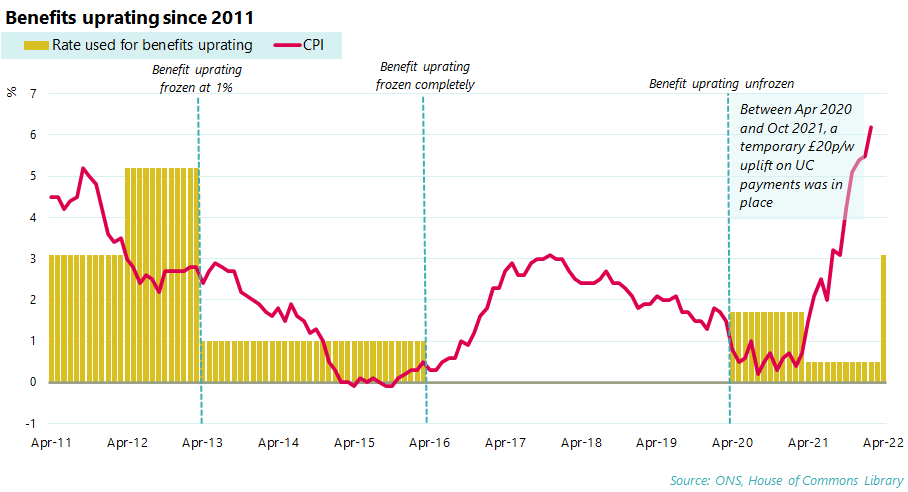
Worst of all there was no increase in the basic rate of benefits. As it stands, the standard allowance for Universal Credit and legacy benefits is set to rise by 3.1 per cent in April 2022. But this is far below the latest inflation figure (CPI is 6.2% in Feb 2022 and RPI is 8.2%), with inflation forecast to rise higher in the coming months.
This will leave those on benefits facing a real terms cut at a time when energy bills are rising by 54 per cent. The families who need the most help have been left totally out in the cold by the Chancellor today.
The decision not to cut benefits in real terms will particularly impact those who are unable to work. This reflects a wider ignorance of the equalities impact of the cost of living crisis.
We also didn’t see a reversal of the decision to suspend the state pension triple lock. The decision to abandon the pensions triple lock will cost pensioners almost £500 a year. Pensioners are particularly vulnerable to price hikes as they spend a higher percentage of their income on food and fuel.
Targeted support
The big new announcement for targeted support for low-income households was £500 million in additional funding for the Household Support Fund – a temporary discretionary fund run by local authorities. This scheme was set to end this month, and the initial funding was £500 million.
This extra money is worth less than £10 each to the six million families claiming Universal Credit – in the unlikely event they hear about it and are able to jump through the hoops needed to claim it. And contrast this £500 million to the £10 billion cut to benefit spending in 2022-23 as a result of not uprating benefits in line with inflation.
Income tax and national insurance threshold
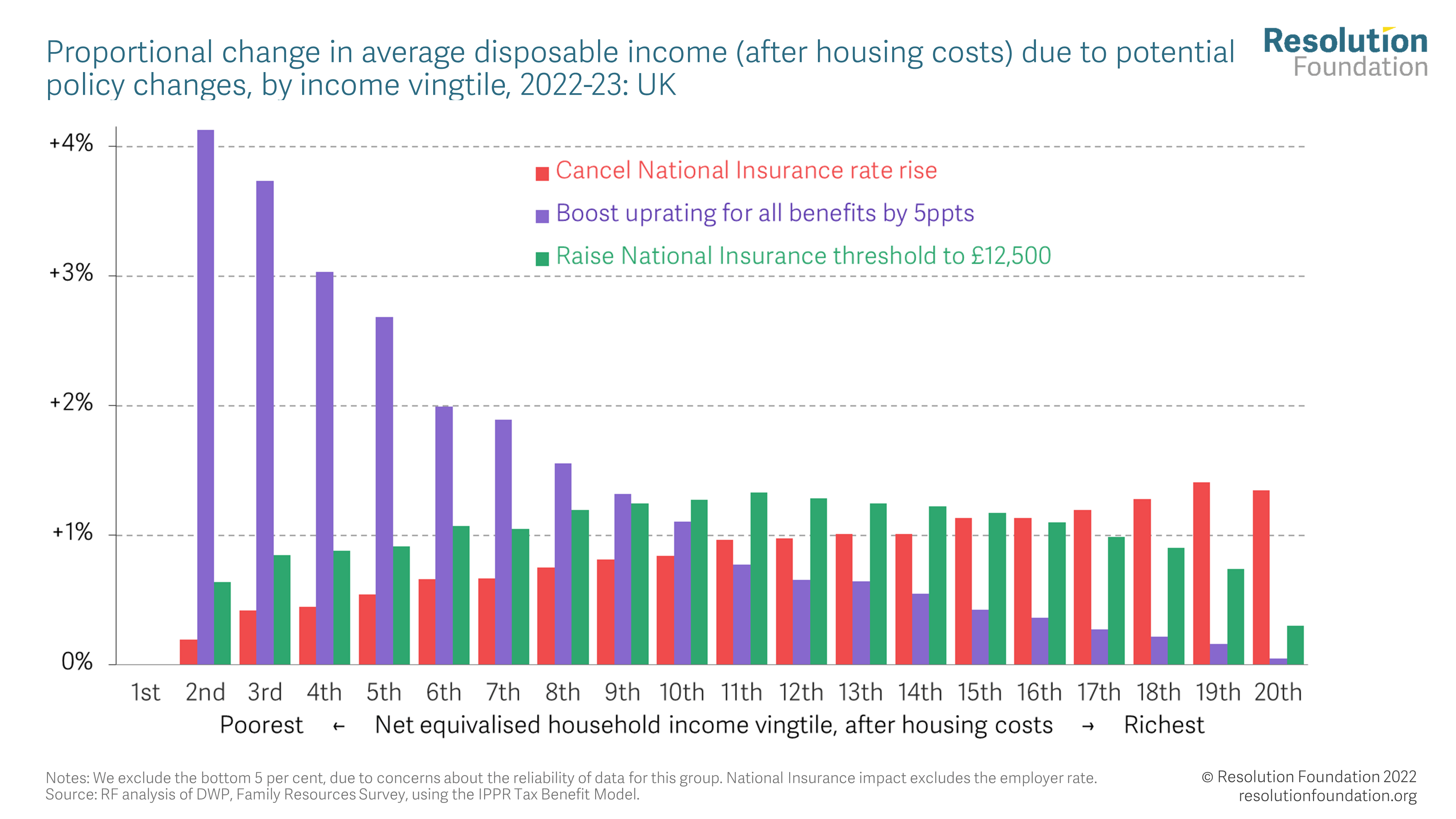
Changes to tax cuts won’t help the families who need it most now. Raising the National Insurance threshold mostly benefits middle earners and, compared to increasing benefits payments, does little to help those with low income. This can be seen in the chart below, from the Resolution Foundation.
And promises of income tax cuts tomorrow do nothing for families facing cuts to their living standards now.
And the Chancellor has missed another opportunity to raise sick pay and make it available to all. Living with Covid requires decent sick pay for all, yet we’re still waiting for government to take action on this.
VAT-free insulation and solar panels
Alongside this was the removal of the 5% Value Added Tax currently applied to building materials, like home insulation and solar panels. But this only benefits families who own a home and can afford to renovate it anyway.
The Chancellor should’ve taken the opportunity to invest in home retrofits at scale. Improving the average UK home’s energy efficiency to band C would reduce the country’s gas demand by 15% and cut hundreds of pounds off fuel poor homes’ energy bills. A massive social homes retrofits programme, delivered by local authorities, could also create over a quarter million good jobs over two years. But here again the Chancellor failed to act.
Transport
The 5p cut on fuel duty does next to nothing to support those at the sharp end of the wages and bills crisis. Analysis by NEF estimates that a third of this tax cut will go directly to the richest 20% of households, while the poorest 20% will on average only receive £5 per month. To make transport truly affordable for everyone, Government should be expanding bus and rail services in the public sector.
The Chancellor didn’t talk about the long-term changes needed for a high-wage, high skill, high productivity economy
We heard nothing on reforms to corporate governance, industrial strategy or expanding the public sector workforce to deliver the decent public services we need to level up.
The Chancellor did announce a review of the apprenticeship levy. We believe that any changes to the levy should focus on significantly increasing the number of high-quality apprenticeships and widening access to groups facing long-standing barriers. A review must not be an exercise in allowing employers to duck their responsibilities on apprenticeships.
And much more than this is urgently needed to tackle the shortfall in training, including increased government skills funding and new workplace training rights to expand opportunities for everyone to upskill and retrain.
The Chancellor didn’t stand up to the scandalous behaviour by bosses P&O
The Chancellor talked about security but did nothing to take on the bosses who take every measure to undermine their workers’ job security. He could’ve made it clear that no employer who treats workers with the contempt shown by P&O Ferries would receive a penny of public money until they reinstate their workforce, including by taking freeports contracts off DP World, the parent company of P&O.
Yet once again the Chancellor failed to mention the issues that matter to working people.
The government’s response to those fleeing conflict and war is inadequate
The Spring statement document outlines the £400m in humanitarian support the government has given to Ukraine, and says it has committed “to provide local authorities with £10,500 per person for support services, and between £3,000 and £8,755 per pupil for education services depending on phase of education, as well as £350 per month for sponsors for up to 12 months”.
But it’s clear that the government’s support for the people fleeing war and conflict is worse than inadequate. The Ukraine for Homes scheme is no substitute for a properly funded system that provides universal refugee protection. And yesterday, the Government’s nationality and borders bill, passed a vital stage in the House of Commons, meaning that those fleeing conflict may find themselves treated as criminals and deported, instead of finding sanctuary.
The Chancellor let families down today.
Families are facing soaring bills at a time when their incomes have been squeezed by years of wage cuts and attacks on the social security system. The wages and bills crisis is a consequence of decisions taken by successive governments. Today the Chancellor chose to make the pain last for longer.
THERE WAS SOME PRAISE FOR SUNAK’S MINI-BUDGET, HOWEVER:
Simon Roberts, Chief Executive Officer, Sainsbury’s said:“We know our customers and colleagues are concerned about increases to the cost of living and at Sainsbury’s we are doing everything we can to support them.
“We really welcome today’s changes to fuel duty and national insurance. We are passing a 6 pence per litre cut in fuel across our forecourts from 6pm tonight as we know fuel costs are one of the biggest pressures everyone is facing right now.
“We were pleased to welcome the Chancellor to one of our stores today to discuss what we are doing to offer customers great value and to invest over £100 million in increasing pay for our colleagues with a new hourly rate of £10 per hour nationally and £11.05 in inner London.”
Michelle Ovens CBE, Founder, Small Business Saturday said:“Moves in today’s Spring Statement to increase the employment allowance, reduce fuel duty and raise the National Insurance threshold are welcome, and will go some way to help businesses deal with rising costs.
“In particular, It is good to see the immediacy of this rise in employment allowance.”
Martin McTague, Chair, Federation of Small Businesses, said:“We are very pleased to see the Chancellor adopting our top ask for this Spring Statement: uprating the Employment Allowance to help small employers with national insurance costs.
“We originally put forward the Employment Allowance as a targeted measure to help small firms, and it has now been expanded three times since its creation.
“Together with a cut to fuel duty, these measures will provide crucial breathing space for our embattled small employers.
“This Spring Statement marks a good starting point, with welcome measures on business rates, net zero and energy investment taking effect next month.
“With steep inflation, energy bills increasing fast, without the same support in place as enjoyed by consumers, and hiring pressures landing hard on small firms, more of the right stuff will be needed in the autumn given this challenging backdrop.
“We’ve seen a VAT cut on net zero investments for households today, which is good for small firms involved in their installation.
“However, a high street shop or local bar cannot access the same support that consumers do when dealing with the same energy supplier, and they should have access to the same assistance to reduce energy use and support the move to net zero.
“We look forward to working with the Chancellor on his new tax plan. Achieving the new culture of enterprise vision he rightly aspires to, alongside levelling up aspirations, will mean putting community small firms and sole traders front and centre of reforms.
“That means taking more of them out of the business rates system, protecting SME R&D investment incentives and delivering on commitments to end an endemic late payment culture that destroys thousands of firms a year.”
Alex Towers, Director of Policy and Public Affairs, BT Group said:“We welcome the Chancellor’s focus on tax reforms for business investment, given how central this is to UK infrastructure and growth.
“This is particularly important for BT Group as we make once in a generation investments to build the UK’s full fibre broadband and 5G networks. The existing super-deduction has already helped us to significantly increase and accelerate that investment.
“We agree that longer-term incentives are now needed, to support this country’s growth and competitiveness, and we will be keen to contribute evidence to aid the Government’s decision-making.”
Dr Clive Hickman OBE, Chief Executive, the Manufacturing Technology Centre said: “We welcome the Spring Statement, which outlines concrete steps to ensure that the manufacturing sector remains competitive, sustainable, and resilient.
“The Government’s commitment to cut tax rates on business investment is important if the UK is to boost manufacturing productivity and create high-quality jobs. In addition, the reform to R&D tax credits is a very positive step that will enable the scheme to be more effective, better value for money, and more generous.
“These measures will be crucial to spur innovation and encourage investment across the country.”
Julian David, Chief Executive, TechUK said: “Rightly the majority of the Spring Statement focused on addressing the cost of living concerns resulting from the war in Ukraine and rising inflation. Along with this vital action, the Chancellor also outlined a welcome package of consultations and policy programmes aimed at boosting businesses investment.
“In our recent Digital Economy Monitor Survey UK tech companies said increasing support to invest in R&D would be their top ask of Government, with 76% saying R&D is important to their business operations in the UK.
“The proposals unveiled today to further expand R&D tax credits and consult on ways to maintain the tax deduction for capital expenditure have the potential to unlock more investment into UK innovation.
“However, to get this right the Government must ensure that the software and intangible assets that power modern business investment are kept in scope. Otherwise, the Government risks missing an opportunity to unleash the potential of tech led growth.”
Dom Hallas, Executive Director, COADEC said:“Better R&D tax credits would mean more innovation from startups and innovative companies.
“We’re delighted the Chancellor recommitted to expanding it to cover cloud and data costs – and look forward to discussing the many ways to improve the credit further.”
Irene Graham OBE, Chief Executive, ScaleUp Institute said: “In the face of increasing pressures of inflation and wider international uncertainties, it is very good to see the Spring Statement continues to recognise the importance of business growth and innovation.
“It reaffirms policies targeted towards R&D, people and skills, investment, and innovation including the new Innovation Challenge across central government departments. We will continue to work closely with the Government on the evolution and development of these policies which are so vital to our scaleup economy.”
Michael Moore, BVCA Director General, said:“Increased business investment is key to the future of the UK economy and we welcome the measures announced by the Chancellor today which support this objective.
“Private capital’s focus on sectors like AI, robotics and fintech has helped the UK to become a world leader in these areas – further reform of R&D tax credits will help businesses to drive further innovation and strengthen the UK’s position in this new economy.”
Fuel Duty
Edmund King, President, the AA said: “The AA welcomes the cut in fuel duty. However, we are concerned that the benefit will be lost unless retailers pass it on and reflect a fair price at the pumps. Average pump prices yesterday hit new records- despite the fall in wholesale costs.
“The Chancellor has ridden to the rescue of UK families and businesses who use their vehicles, not for pleasure, but to function in their daily lives. Since the start of the year, the 20p-a-litre surge in pump prices has been the shock that rocked the finances of families, and particularly young drivers, pensioners and lower-income workers who need to commute each day.
“AA research showed that even in November, when petrol pump prices set new records at around 148p a litre, 43% of drivers were cutting back on car use, other spending to compensate or both. That rose to 59% among young drivers and 53% among the lower-paid. Petrol started this week averaging 167p a litre.
“On top of the duty cut, there has been a substantial reduction in wholesale road fuel costs feeding through to the forecourts since 9 March. That needs to drive lower pump prices also. The road fuel trade shouldn’t leave the Treasury to do the heavy lifting when cutting motoring costs.”
Elizabeth de Jong, Director of Policy, Logistics UK said:“With average fuel prices reaching the highest level on record and rising inflation, there has been an unstainable burden on logistics businesses which operate on very narrow margins of around 1%; the Chancellor’s decision today will help to ensure operators can continue to afford supplying the nation with all the goods it needs, including food, medicine and other essential items.
“Fuel is the single biggest expense incurred by logistics operators, accounting for a third of the annual operating cost of an HGV. The cut in fuel duty of 5ppl will result in an average saving of £2,356 per year per 44-tonne truck; this move will help to strengthen the UK’s supply chain during a time of ongoing financial and operational challenges.”
Zero rating VAT in energy efficiency measures
David Cowdrey, Director of External Affairs, MCS said:“The Chancellor has used the Spring Statement as an opportunity to kick-start the home heating revolution by zero rating VAT on home energy efficiency and renewable technologies for five years.
“This announcement allows people to insulate their homes and save on our fuel bills, making houses cheaper to run, especially when gas prices are at a record high.
“The government’s bold move to zero rate VAT can help the UK meet its net zero targets by using proven, off the shelf, zero carbon domestic energy solutions, such as solar and heat pumps, which are ready to be upscaled now.“
Professor Robert Gross, Director, U.K. Energy Research Centre, Professor of Energy Policy, Imperial College said:“The VAT cut on energy efficiency products is a great first step in helping households adopt simple measures to help cut fuel bills for the coming winter.
“Better insulated houses need less energy to keep warm and this is good for our bills, energy security and the environment.”
Amy MacConnachie, Director of External Affairs, Association for Renewable Energy and Clean Technology (REA), said:“The REA warmly welcomes today’s announcement to remove VAT on domestic renewables for five years. We have long campaigned for this change because we know these installations will help protect people from volatile gas prices and reduce their energy bills, while also supporting the transition to Net Zero and providing a catalyst for new jobs and investment across the country.
“The move to bring forward business rate exemptions for green technologies from April 2022, including solar panels and heat pumps, will help to further drive down costs and support the decarbonisation of buildings.
“We now want to see the Government clarify and go further on the range of technologies included as Energy Saving Materials, particularly energy storage, but this is a positive package of measures for our sector.
“We stand ready to deliver an energy future which is independent, secure, and stable.”
P&O staff and other trades unionists will join demonstrations in Dover, Liverpool, and Hull today, condemning P&O for sacking 800 staff.
The company, which is funded by the Dubai Royal Family, stunned workers in a pre-recorded Zoom call, when they informed staff that they were being dismissed and would be replaced by cheap agency labour from abroad.
When workers rightly refused to simply accept this despotic decision, private security staff with handcuffs, believed to have been hired by the company, began to drag workers off the ships.
RMT general secretary Mick Lynch said: “It is vital workers from every industry mobilise for the demonstrations on Friday.
“We need to send a message to ruthless employers and the government alike, that when working people are treated so abysmally, there is a militant response from the trade union movement.
“This example of gangster capitalism which our members in P&O have been subjected, is what lies ahead for other workers up and down the country if we do not all take a stand.”
Liverpool: 1.00pm Main Liverpool Port entrance Liverpool L21 1LA
Hull: 12. 00 midday– King George Dock, Hull HU9 5PR
Labour’s Shadow Transport Secretary Louise Haigh said: “This scandalous action is a betrayal of the workers that kept this country stocked throughout the pandemic. Unscrupulous employers cannot be given free rein to sack their workforce in secure jobs and replace with agency staff.
“The Conservative government must not give the green light to this appalling practice and must act to secure the livelihoods of these workers.”
First Minister Nicola Sturgeon tweeted: “I’m deeply concerned at P&O announcement – due to the importance to Scotland of the Cairnryan/Larne route obviously, but also the impact on 100s of workers.
“Fire & rehire is an appalling practice & offends the basic principle of fair work. @scotgov will be seeking urgent talks”.
While the UK Government has made no official comment, Defence Minister James Heapey told BBC’s Breakfast that P&O Ferries have ‘behaved disgracefully’ but admitted that the company’s ‘despicable’ fire and rehire action is not something the government could have stopped. He said the government will focus on supporting the workers who have lost their jobs .
Union body calls on ministers to urgently bring forward an employment bill to end fire and rehire style practices
Workers must be reinstated immediately – and P&O Ferries must face serious consequences if they fail to do this, says TUC
What happened to P&O workers “can’t ever be allowed to happen again”, says TUC
The TUC has called for the “scandalous” treatment of P&O workers to be a “turning point” for workers’ rights in the UK.
The union body says ministers must bring forward an employment bill now to stop workers from “being treated like disposable labour”.
The call comes after 800 P&O crew were sacked without notice on Thursday and threatened with handcuffs if they refused to leave their ships.
P&O Ferries’ actions appear to be unlawful. But the TUC says these events show that UK employment law urgently needs strengthening to penalise bad employers.
The union body says ministers must use an employment bill to:
End fire and rehire style practices and stop companies firing at will: P&O has exploited many of the same weaknesses in the law as companies using the punitive fire and rehire tactics. TUC research published during the pandemic revealed that 1 in 11 (9%) of workers have been forced to re-apply for their jobs on inferior terms and conditions. The law should state that no notices of dismissal can be given until consultation has been completed. Employees should be given protection from unfair dismissal from day one in the job.
Increase penalties on companies that break employment law: P&O’s failure to consult staff on their redundancies was unlawful. But companies who flout employment law in this way currently face very low fines and can get away with offering staff measly compensation.
Ban other forms of exploitative practices: More than 1 million workers in the UK are employed on zero-hours contracts and thousands of others are employed in bogus self- employment. The TUC says zero-hours contracts and umbrella companies should be banned.
In addition, the TUC is calling on the government to:
Remove DP World (P&O ferries owner) from any government advisory groups: DP World currently sits on the influential UK Government’s Transport Advisory Group.
Get around the table with unions representing members in the sector to urgently review government contracts with P&O and ensure livelihoods are protected
Reinstate sacked staff
All sacked staff must be reinstated immediately without loss of pay, the TUC is demanding – adding that P&O should face serious consequences.
The union body has warned the government that a “slap on the wrist” from ministers would not be good enough.
And the government must put in place measures to ensure that all future procurement comes with a commitment from companies receiving public money to respect workers’ rights.
TUC General Secretary Frances O’Grady said: “Everyone deserves to be treated with dignity and respect at work. But bad bosses can still get away with treating staff like disposable labour.
“What happened at P&O is a national scandal – it can’t ever be allowed to happen again. Enough is enough. This must be turning point for workers’ rights in the UK.
“The government must urgently bring forward an employment bill that strengthens workplace protections and that imposes strong penalties on employers who break the law.
“The prime minister vowed to make Britain the best country in the world to work. He has run out of excuses for failing to deliver on that promise.”
On the need for the government to penalise P&O, Frances added: “P&O has acted appallingly. It must be made an example of.
“A slap on the wrist is not going to cut it.
“If the company refuses to reinstate all of its sacked staff it should face serious consequences.”
International Women’s Day celebrates the social, economic, political, and cultural achievements of women around the world; but women still face significant discrimination in the workplace and wider society, writesTUC’s NIKKI POUND.
It is critical to raise awareness today on the continued inequality faced by women and to rally calls for action to accelerate equality.
We have seen women at the sharp end of the pandemic, on the frontline as key workers, and taking on an even more disproportionate burden of care and domestic work in the home.
We know that many women face multiple forms of discrimination with racial and gender inequalities intersecting, highlighted by evidence that BME women have had both the highest rate of unemployment (8.8 per cent) and the lowest rate of employment (62.5 per cent) throughout the pandemic.
Disabled women continue to be excluded from the labour market, demonstrated by the 52 per cent employment rate for disabled women workers compared to 85 per cent for white, non-disabled men.
The gender pay gap persists at 15.4 per cent, and the gender pensions gap is more than twice that, at 37.8 per cent.
We know that 54,000 women are forced out of the labour market every year due to pregnancy and maternity discrimination. And 1 million women have been forced to leave their jobs due to the lack of support for them while experiencing menopause.
Globally, increasingly authoritarian governments promote anti-feminist, racist, anti-migrant, and homophobic narratives. This has led to a global crackdown on reproductive, sexual and human rights that disproportionately effect women, girls and LGBT+ communities.
This year alone, we have seen attacks on same sex marriage and LGBT+ freedoms across Europe, legislation restricting abortion and contraception in the US, a new crisis of education in North Africa and the Middle East and yet more violence and harassment of trade unionists across Latin America.
As conflicts continue in Syria, Palestine and Afghanistan and new ones unfold in the Ukraine, we see women and girls have their freedom shattered and safety removed. But we also see our international sisters fighting back.
In Honduras, a female progressive president has been elected, ending the 12 years of right-wing rule which followed the 2009 coup. Today in Pakistan, for the fifth year running, thousands of women will take to the streets for the Aurat March.
This year, they will be protesting this year for increased wages, security and peace for women– incredibly powerful, given it was here that Malala Yousafzai was shot by the Taliban in 2012 for attempting to attend school.
In the U.S, after years of legal battles, the women’s national soccer team have settled a dispute on unequal pay compared to the men’s team to the tune of $24m. And, in February this year, the International Labour Organization (ILO) and the International Women’s Coffee Alliance (IWCA) have signed a Memorandum of Understanding that establishes a collaborative partnership to improve occupational safety and health training and knowledge for women who depend on coffee production for their livelihoods across the globe.
Here in the UK, trade unions led calls for and won the commitment from government to introduce a preventative duty on employers, forcing employers to take all reasonable steps to prevent sexual harassment in their workplaces.
And we finally got the government to commit to ratifying ILO C190, which recognises the right of everyone to a world of work free from violence and harassment, including gender-based violence.
We also have seen landmark wins on equal pay for work of equal value. We lobbied for guidance on risk assessments make clear that employers must carry out individual risk assessments for pregnant and new mothers in the workplace. And our campaign saw over 7000 responses submitted to the government consultation on flexible working.
So yes, there is always more work to do and some days – when progress feels slow – it is tough. But 57 per cent of trade union members are women, and we continue to lead collective action for women’s equality in the workplace, in our society and across the world.
Here are just a few actions you can take this International Women’s Day
The war in Ukraine is forcing many to flee their homes, putting women and children at heightened risk of violence. Donate to the ITUC emergency fundraising appeal today to help local and neighbouring trade unions provide essential provisions.
This International Women’s Day, we must remember and celebrate our hard fought for wins and continue to organise and agitate. And from our brothers and allies we need not just their solidarity, but their action.
Trade unions and the TUC have written to the Chancellor calling on him to use his spring statement to introduce ‘emergency support’ in response to the conflict in Ukraine.
This includes measures to support Ukrainian refugees, ensure that sanctions are effective, and protect UK families from the impact of rising energy prices.
The TUC has condemned the invasion of Ukraine, expressed its solidarity with the Ukrainian people, and called on governments to pursue all diplomatic efforts towards peace.
The letter from the TUC and unions says that the Chancellor must now step up with new financial measures to both support the Ukrainian people, and respond to the impact of the conflict on the cost-of-living crisis in the UK.
The letter calls on the Chancellor to:
Ensure that sanctions are effective by increasing enforcement funding for measures in the economic crime bill that would crack down on money-laundering in the UK; and consider a 100 per cent windfall tax on the profits of companies still invested in Russian state enterprises.
Provide safe routes to the UK for those fleeing the conflict, and scrap legislation plans that would close the door on all people fleeing war and threats to their lives.
Fund wider humanitarian assistance for displaced people, including essential medical supplies.
Protect working families against further energy price rises as a result of the crisis, by giving grants rather than loans to recued energy bill, increasing the warm homes discount, increasing universal credit, and accelerating a home energy efficiency retrofit programme.
The letter also calls on the government to ensure that those working in supply chains are protected from disruption, including by considering the use of a short-time working scheme.
TUC General Secretary Frances O’Grady said: “Trade unions condemn the illegal invasion of Ukraine. We know that working people in Ukraine, Russia and across Europe want peace. The UK government must pursue all diplomatic efforts to achieve that goal.
“The Chancellor must use his spring statement to act too. That means ensuring that sanctions are more effective, with funding to crack down on money-laundering in the UK. And he should fund greater humanitarian assistance for Ukrainians, including safe passage for those fleeing the war.
“Working people in the UK will need protection from even steeper hikes in gas bills from the conflict. The Chancellor should introduce grants to help with energy prices, roll out an emergency programme of home insulation, and fund it with a windfall tax on excess energy profits.”
“The government must provide safe routes to the UK for those escaping conflict. And ministers should scrap their Nationality and Borders Bill, which will close the door to people fleeing war and threats to their lives.”
Full text of the letter to the Chancellor:
Dear Chancellor
Protecting working people from the impact of the invasion of Ukraine
The trade union movement is united in its condemnation of Russia’s illegal invasion of a sovereign nation. Our solidarity is with the working people of Ukraine. Working people always suffer in conflict and the pursuit of peace is a fundamental trade union value, an essential condition to secure safety, social justice and workers’ and human rights.
The UK government must now take further action to support and strengthen international efforts to impose significant and effective sanctions on Russia and to support all diplomatic efforts towards peace. And it must play its part in supporting humanitarian assistance for forcibly displaced people and welcoming refugees seeking to come to the UK.
The government must also ensure that it takes every step possible to protect working people here at home from the impact of the conflict and measures taken in response to this. We urge you to use your forthcoming budget to act. We call on you to:
Target sanctions on wealthy elites linked to the Russian government – and ensure they are effective. We welcome the proposed register of overseas owners of UK property through the Economic Crime (Transparency and Enforcement) Bill, but this needs to be backed up by sufficient powers and funding for Companies House to enforce.
Fund humanitarian assistance for displaced people, and welcome refugees to the UK. The new Ukrainian visa proposals are inadequate and fall well short of what is needed. Limiting asylum to Ukrainian immediate family members of those already settled in the UK will not reassure Ukrainians fleeing war and bloodshed that they will be able to seek sanctuary in our country. The government must establish a safe route, so all Ukrainian families, who through no fault of their own have been forced from their homes, can easily apply for a humanitarian visa to travel to the UK. The Nationality and Borders Bill must be scrapped. Thousands of Ukrainians fleeing war may try to find sanctuary in the UK. If the Bill is passed many of these Ukrainians, along with others around the world fleeing conflict, threats to their lives and seeking safety may find themselves treated as criminals and deported, instead of being offered sanctuary.
Protect working families against rising gas prices, by raising funds through a windfall tax on energy profits and a new tax on profits made by UK companies invested in Russian state businesses. The current energy price crisis is hitting workers hard, and prices are likely to rise further. Government should implement existing TUC calls for:
Support for households in the form of a grant, not a loan (replacing the energy price rebate proposed by the government).
An increase in the warm homes discount, and a permanent increase in Universal Credit.
Rapid implementation of an accelerated and expanded domestic home retrofit programme, delivered by local councils who are best placed to deliver fast
Funding for these measures by the implementation of a windfall tax on north sea oil and gas companies.
An immediate increase in the national minimum wage to at least £10 an hour and a strategy to protect pay across the economy, including public services.
In addition, the government should consider implementing a new 100 per cent tax on additional profits made by UK based companies from their shareholdings in Russian state-backed enterprises that have profited from the gas price crisis. For example, this includes profits made by oil companies Shell and Vitol from their shareholdings in oil and gas fields in Russia in joint ventures with state-controlled companies Rosneft and Gazprom.
Protect jobs in supply chains now and build future supply chain resilience. Forcompanies sourcing parts and supplies from Russia, sanctions could have a significant impact. To protect jobs, the UK government should:
Re-introduce the furlough scheme or a permanent short-time working scheme in order to allow companies to protect jobs while they seek to shift their supply chains.
Begin an urgent programme to provide investment support to help companies to invest in UK supply chains and jobs.
Trade union leaders would be happy to meet you to discuss these issues, and the steps we must take now to support working people in Ukraine and in the UK,
Yours sincerely
Frances O’Grady, General Secretary, TUC
Sue Ferns, President, TUC
Christina McAnea, General Secretary, UNISON
Sharon Graham, General Secretary, Unite
Gary Smith, General Secretary GMB
Kevin Courtney and Mary Bousted, Joint General Secretaries, NEU
Paddy Lilis, General Secretary, Usdaw
Patrick Roach, General Secretary, NASUWT
Dave Ward, General Secretary, CWU
Mark Serwotka, General Secretary, PCS
Mike Clancy, General Secretary, Prospect
Ged Nichols, General Secretary, Accord
Ukraine: what you can do to help
Everyone wants to do their bit to support those who have been forced to flee their homes because of the invasion. Here is how you can help.
Financial donations
If you want to donate money, there are a number of charities providing humanitarian relief in Ukraine.
The UK Government will match public donations to this appeal pound-for-pound up to £25 million.
Make your donation safely
There are lots of organisations across the UK and internationally who have launched appeals, and you may wish to donate through these organisations instead. There are some simple steps you can take to ensure your money is safe and being used effectively:
Most charities with an income of £5,000 or more must be registered, which means they are regulated by The Charity Commission
Make sure the charity is genuine before giving any financial information
If in doubt, ask the charity or organisation for more information
Donating essential supplies
One of the best ways to help is by donating cash through trusted charities and aid organisations, rather than donating goods. Cash can be transferred quickly to areas where it is needed and individuals and aid organisations can use it to buy what is most needed. Unsolicited donations of goods, although well-meant, can obstruct supply chains and delay more urgent life-saving assistance from getting through.
Organisations across the UK are gathering essential supplies, such as clothes, first aid and sanitary products. Many charities and community groups will have lists of items they need.
Charities with experience of responding to disasters are best placed to reach victims on the ground.
Apply to be a sponsor
The government will be launching a new sponsorship scheme to make sure that Ukrainians who have been forced to flee their homes have a route to safety.
The scheme will match people, charities, businesses and community groups to Ukrainians who do not have family ties to the UK.
The UK Government, Ukrainian Government and others have been sharing messages of support on social media using the hashtag #StandForUkraine
Take care what you share! There is a lot of false information about the conflict circulating online – this is often called misinformation and disinformation. You can do your part to stop the spread:
Ask yourself – does this look right? Does this sound right? Does this information come from a source I recognise?
The SHARE checklist can help you decide if information can be trusted, before you interact with or share it on your social media channels
Cyber security
The National Cyber Security Centre is not aware of any specific cyber threats to the UK in relation to the Russian invasion of Ukraine. However we strongly encourage organisations and citizens to follow NCSC guidance on steps to take when the cyber threat is heightened.
Visit the Cyber Aware website where you find practical steps and tools to help keep you, your family or business more secure online.
New TUC polling reveals majority of workers say they have experienced surveillance in the past year
Overwhelming support for stronger regulation to protect workers from punitive use of AI and surveillance tech
Post Office scandal must be a turning point on uncritical use of worker monitoring tech, says TUC
Intrusive worker surveillance tech and AI risks “spiralling out of control” without stronger regulation to protect workers, the TUC has warned.Left unchecked, the union body says that these technologies could lead to widespread discrimination, work intensification and unfair treatment.
The warning comes as the TUC publishes new polling, conducted by Britain Thinks, which reveals an overwhelming majority of workers (60 per cent) believe they have been subject to some form of surveillance and monitoring at their current or most recent job.
The TUC says workplace surveillance tech took off during the pandemic as employers transferred to more remote forms of work.
Surveillance can include monitoring of emails and files, webcams on work computers, tracking of when and how much a worker is typing, calls made and movements made by the worker (using CCTV and trackable devices).
Three in 10 (28 per cent) agree monitoring and surveillance at work has increased since Covid – and young workers are particularly likely to agree (36 per cent of 18-34 year olds).
There has been a notable increase in workers reporting surveillance and monitoring in the past year alone (60 per cent in 2021 compared to 53 per cent 2020).
In particular, more workers are reporting monitoring of staff devices (24 per cent to 20 per cent) and monitoring of phone calls (14 per cent to 11 per cent) compared to 2020.
In calling for stronger regulation, the TUC highlights the recent Post Office scandal which saw hundreds wrongly prosecuted for theft and false accounting after a software error – and says it must be a turning point on uncritical use of worker monitoring tech and AI.
Creeping role of surveillance
The creeping role of AI and tech-driven workplace surveillance is now spreading far beyond the gig economy into the rest of the labour market, according to the TUC.
The following sectors have the greatest proportion of workers reporting surveillance:
financial services (74 per cent)
wholesale and retail (73 per cent)
utilities (73 per cent)
The union body warns of a huge lack of transparency over the use of AI at work, with many staff left in the dark over how surveillance tech is being used to make decisions that directly affect them.
The use of automated decision making via AI includes selecting candidates for interview, day-to-day line management, performance ratings, shift allocation and deciding who is disciplined or made redundant.
The TUC adds that AI-powered technologies are currently being used to analyse facial expressions, tone of voice and accents to assess candidates’ suitability for roles.
To combat the rise of workplace surveillance tech and “management by algorithm”, the TUC is calling for:
A statutory duty to consult trade unions before an employer introduces the use of artificial intelligence and automated decision-making systems.
An employment bill which includes the right to disconnect, alongside digital rights to improve transparency around use of surveillance tech
A universal right to human review of high-risk decisions made by technology
The TUC points out that the government recently consulted on diluting General Data Protection Regulation (GDPR) as part of its post-Brexit divergence agenda, despite it providing some key protections for workers against surveillance tech.
The EU is currently putting in place laws dealing specifically with the use of AI, whereas the UK does not have anything like this. The TUC says this is yet another example of the UK falling behind its EU counterparts on workers’ rights.
There is significant and growing support among workers for stronger regulation of AI and tech-driven workplace surveillance:
Eight in ten (82 per cent) now support a legal requirement to consult before introducing monitoring (compared to 75 per cent in 2020)
Eight in 10 (77 per cent) support no monitoring outside working hours, suggesting strong support for a right to disconnect (compared to 72 per cent in 2020)
Seven in 10 (72 per cent) say that without careful regulation, using technology to make decisions about workers could increase unfair treatment (compared to 61 per cent 2020).
TUC General Secretary Frances O’Grady said: “Worker surveillance tech has taken off during this pandemic – and now risks spiralling out of control.
“Employers are delegating serious decisions to algorithms – such as recruitment, promotions and sometimes even sackings.
“The Post Office scandal must be a turning point. Nobody should have their livelihood taken away by technology.
“Workers and unions must be properly consulted on the use of AI, and be protected from its punitive ways of working.
“And it’s time for ministers to bring forward the long-awaited employment bill to give workers a right to disconnect and properly switch off outside of working hours.”