The UK government is attempting to rush through Parliament new laws that could undermine workers’ ability to take strike action to defend their pay and conditions.
It allows Ministers to write regulations in any services within six sectors (health, education, fire and rescue, border force, nuclear decommissioning and transport) that will force workers to work during strike action.
Employers will then issue work notices naming who has to work and what they must do.
Workers could be sacked and unions face huge damages if they fail to comply.
First in the firing line will be ambulance, fire and rail workers, with the government seeking to ram through new rules by the summer.
The TUC believes this new law is undemocratic by forcing workers to cross picket lines even if they have voted to strike in a legal ballot.
It is counter-productive: the government’s own analysis has warned that it could lead to more strikes.
And it ignores the steps that workers already take to ensure that life-and-limb cover is in place during industrial action.
Workers could be sacked
Workers could now be sacked for taking strike action that has been agreed in a democratic ballot.
If a person specified in their employer’s work notice continues to take strike action despite being required to work during the strike, they will lose their protection from automatic unfair dismissal.
This currently applies for first 12 weeks of a strike.
This is a gross infringement of individuals’ freedom.
It is also a U-turn on ministers’ initial pledge was to protect individuals from penalties.
The significant risk of dismissal for workers who speak up about their pay and conditions will do nothing to resolve staffing shortages in public services.
Unions might have to pay large damages
The Bill says a union must take “reasonable steps” to ensure that all its members identified in the work notice do not take part in the strike action.
If it doesn’t it could union could face an injunction to stop the strike or have to pay huge damages. These costs come out of members’ subs.
The cap for damages was last year raised to £1 million.
The legislation doesn’t say what a “reasonable step” constitutes leaving trade unions uncertain of their responsibilities.
The TUC also believes that forcing unions to send their members across picket lines is a significant infringement of their freedoms
Probably against international law
Ministers claim they are following similar systems in France, Spain and Italy.
But European unions disagree.
The European Trades Union Congress says: “The UK already has among the most draconian restrictions on the right to strike in Europe, and the UK government’s plans would push it even further away from normal, democratic practice across Europe.”
You can’t legislate away dissatisfaction
Workers taking industrial action today have endured the longest wage squeeze since Napoleonic times.
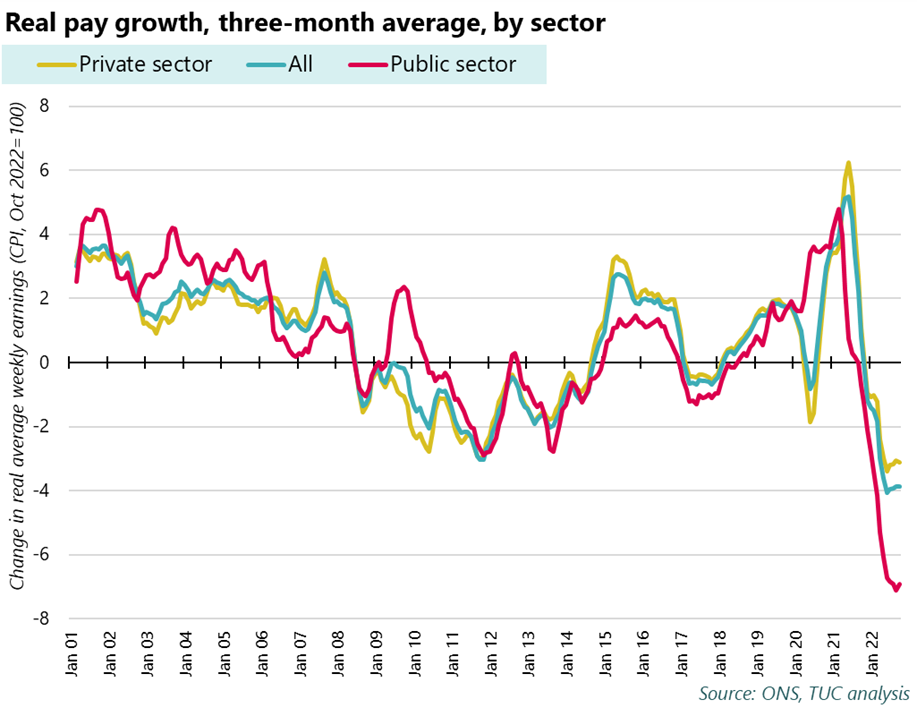
Workers in the public sector have seen their wages fall much further behind those of other workers: public sector pay rises are currently running at less than half the rate of those in the private sector.
For example, in the NHS nurses are earning £5,000 a year less in real terms than they were in 2010. For midwives and paramedics this rises to over £6,000.
This Bill will do nothing to help those workers, or to resolve current industrial disputes.
And it will do nothing to support those using public services, who are seeing the consequences of a decade of austerity.
New laws will allow government to set minimum levels of service which must be met during strikes ‘to ensure the safety of the public and their access to public services’
New laws will allow government to set minimum levels of service which must be met during strikes to ensure the safety of the public and their access to public services
the Strikes (Minimum Service Levels) Bill will ensure crucial public services such as rail, ambulances, and fire services maintain a minimum service during industrial action, reducing risk to life and ensuring the public can still get to work
Business Secretary Grant Shapps said in Parliament today: “We do not want to have to use this legislation unless we have to, but we must ensure the safety of the British public.”
Millions of ‘hard-working’ people across the UK will be protected from disruptive strikes thanks to new laws introduced yesterday, which will allow employers in critical public sectors to maintain minimum levels of service during strikes.
The government is introducing this legislation to ensure that striking workers don’t put the public’s lives at risk and prevent people getting to work, accessing healthcare, and safely going about their daily lives.
The government will first consult on minimum service levels for fire, ambulance, and rail services, recognising the severe disruption that the public faces when these services are impacted by strikes, especially the immediate risk to public safety when blue light services are disrupted.
The government hopes to not have to use these powers for other sectors included in the Bill, such as education, other transport services, border security, other health services and nuclear decommissioning.
The government expects parties in these sectors to reach a sensible and voluntary agreement between each other on delivering a reasonable level of service when there is strike action. This will, however, be kept under review and the Bill gives the government the power to step in and set minimum service levels should that become necessary.
Business Secretary Grant Shapps said: “The first job of any government is to keep the public safe. Because whilst we absolutely believe in the ability to strike, we are duty-bound to protect the lives and livelihoods of the British people.
“I am introducing a bill that will give government the power to ensure that vital public services will have to maintain a basic function, by delivering minimum safety levels ensuring that lives and livelihoods are not lost.
“We do not want to have to use this legislation unless we have to, but we must ensure the safety of the British public.”
The sectors the legislation includes are:
health services
education services
fire and rescue services
transport services
decommissioning of nuclear installations and management of radioactive waste and spent fuel
border security
This principle is already recognised in many countries across the world, such as Italy and Spain, where systems for applying minimum levels during strikes are in place for services the public depend on.
As is the case currently a union will lose its legal protection from damages if it does not comply with the obligations set for them within the legislation.
Yesterday’s reforms come as government ministers are meeting trade unions to discuss fair and affordable public sector pay settlements for 2023 to 2024.
TUC to hold national ‘protect the right to strike’ day on February 1
Union body says it will fight new anti-strike legislation “every step of the way”
The TUC will hold a national ‘protect the right to strike’ day on Wednesday 1 February.
The announcement comes following a meeting of trade union leaders yesterday.
Events will take place in different parts of the country against the Conservative’s new anti-strike legislation.
Members of the public will be invited to show their support for workers taking action to defend their pay and conditions.
More information will be provided in the coming weeks about planned activities.
The TUC has vowed to fight the new strike curbs “every step of the way” – including through parliament and the courts.The union body says the government’s new anti-strike plans are unworkable and almost certainly in breach of international law.
TUC General Secretary Paul Nowak said: “The right to strike is a fundamental British liberty – but the government is attacking it in broad daylight.
“These draconian new curbs will tilt the balance of power even more in favour of bad bosses and make it harder for people to win better pay and conditions.
“Nobody should lose their job if they take lawful action to win a better deal. But ministers have gone from clapping our key workers to threatening them with the sack.
“Unions will fights these plans every step of the way – including through parliament and through the courts.
“On February the 1st will we hold events across the country against this spiteful new bill – which is unworkable and almost certainly illegal.
“We will call on the general public to show support for workers taking action to defend their pay and conditions, to defend our public services and to protect the fundamental right to strike.”
On the need for the government to follow the example of the private sector, Paul Nowak added: “The government should be following the example of many employers in the private sector who have sat down with unions and agreed fair pay deals.
“But instead ministers are drawing up plans that will succeed only in escalating disputes and driving workers away from wanting to work in our public services.”
TUC polling published in last year revealed that 1 in 3 public servants were taking active steps to leave their professions.
Analysis published by the union body shows:
Nurses have lost £42,000 in real earnings since 2008 – the equivalent of £3,000 a year
Midwives have lost £56,000 in real earnings since 2008 – the equivalent of £4,000 a year
Paramedics have lost £56,000 in real earnings since 2008 – the equivalent of £4,000 a year
And if the government does not improve its pay offer for public servants, public sector pay will fall, on average, by over £100 a month in real terms in 2023.
Responding to yesterday’s attack on the right to strike to defend workers’ pay and conditions, the TUC has said that the Prime Minister should concentrate on fixing our public services, not attacking public sector staff.
The union body says that the proposed legislation would make it harder for disputes to be resolved.
TUC General Secretary Paul Nowak said: “This is an attack on the right to strike. It’s an attack on working people. And it’s an attack on one of our longstanding British liberties.
“It means that when workers democratically vote to strike, they can be forced to work and sacked if they don’t. That’s wrong, unworkable, and almost certainly illegal.
“The announcement offers nothing more to help with this year’s pay and the cost of living crisis.
“The only offer of talks is for next year. But we need to resolve the current disputes and boost the pay of public sector workers now.
“The Prime Minister said yesterday his door is always open – if he’s serious, he should prove it. He should take up my offer to get around the table to improve this year’s pay and end the current disputes.
“There is a world of difference between promises of jam tomorrow with technical discussions about pay review bodies, and proper negotiations on pay in the here and now.
“Our public services are already deep in a staffing crisis. But this government has gone from clapping key workers to threatening them with the sack if they take lawful action for a pay rise. It will only push more people away from essential jobs in public services, harming the whole nation.”
On the trade union campaigning to defend the right to strike, Paul added: “Trade unions will fight this every step of the way. We’re inviting every worker – public and private sector, and everyone who wants to protect British liberties -to be a part of our campaign to defend the right to strike.”
‘I want my time leading the TUC to focus on one thing: making the trade union movement bigger, stronger and more diverse. That’s how we win for more workers.‘
I started my working career stacking the warehouse shelves in Asda. Later on, I worked as a hotel porter, and in a call centre. I know the difference being in a union can make – and that’s why, as the TUC’s new General Secretary, my focus will always be on making sure the UK’s trade unions are growing (writes PAUL NOWAK).
The current wave of strike action has one cause: the Tories’ failure to get wages growing across the economy. Workers are on course for two decades of lost pay – the longest squeeze on earnings in modern history.
Working people have had enough. They are tired of their standard of living falling year after year.
Nurses, paramedics, rail staff, posties and other key workers have been forced into taking action to defend their livelihoods and the services they provide.
Nobody takes the decision to go on strike lightly. But this is a problem of the government’s own making. Twelve years of pay cuts have left workers with no choice. And that’s why they are out on strike – with massive public support.
And rather than sitting down with unions to negotiate a resolution, ministers seem more interested in escalating disputes.
The UK already has the most restrictive trade union laws in western Europe – but ministers are set to undermine the right to strike even more. That will tilt the balance of power even further towards bad bosses and make it harder for working people to win better pay and conditions.
Have no doubt: I will lead the union movement in opposing further restrictions on the right to strike – just as we will oppose further attacks on any rights at work, including those rights that came from the EU.
But I don’t want us to spend our time just fighting bad laws – I want the trade union movement to set out a positive vision for Britain. Because we know it doesn’t have to be like this. For too long the UK has been trapped in a vicious cycle of stagnant growth, stagnant investment and stagnant wages. Now it’s time for a proper long-term economic plan that rewards work not wealth.
Unions have the answers. We should target low-pay industries, raising pay and standards and driving out rogue operators with sector-wide fair pay agreements. And ministers, unions and employers should work together on a proper industrial strategy, delivering good green jobs, training and skills across the country.
Working people deserve a seat at the tables of power – and it’s the job of unions to get them there. That’s why, when I’m asked, I always say that my first priority is building a stronger, bigger and more diverse trade union movement.
Unions must reflect the modern multiethnic working class of the UK in 2023, promoting women and Black leaders and fighting racism and discrimination.
Unions have to grow, to represent more workers and get more workplaces covered by collective bargaining. That’s how we raise wages, improve conditions and cut inequality. It’s how we stop outrages like P&O sacking hundreds of workers on the spot, with impunity.
And unions have to be stronger and more confident. That’s how we win the argument for a growing, redistributive economy, a £15 per hour minimum wage, and a ban on zero hours contracts.
The solidarity and power of a stronger, growing and more diverse trade union movement is how we will win. It is how we turn the tide on cuts, casualisation and two decades of standstill wages. And it is how we deliver what working people are asking for – a fair day’s work for a fair day’s wage.
The whole trade union movement stands ready to defend workers’ fundamental right to strike, writes TUC’s KATIE STILL.
The right to strike is a fundamental British liberty
Exercising the right to strike when negotiations break down is a fundamental British liberty. It’s not one that workers ever use lightly.
Going on strike in the UK today means getting past tough legal restrictions, including winning a ballot conducted by post. It also means losing pay for the days you’re on strike.
But when employers won’t negotiate, exercising the right to strike can be the only way to bring them back to the table.
But it’s under attack from a Tory government that’s run out of ideas
The strikes this winter are the symptom of a broken economy. We’ve experienced the longest pay squeeze since Napoleonic times, with workers losing out on £20,000 worth of wages due to pay not keeping up with prices since 2008. And exploitative bosses like those at P&O Ferries are getting away with treating their workers like disposable labour.
But rather than getting round the table to negotiate a fair resolution of disputes, and setting out a plan to get pay rising, ministers are making vague threats to the right to strike.
In October government attacked transport workers through a proposed law mandating minimum service levels – but it’s not clear whether this has now been dumped. And ministers keep telling the media that they are proposing “tough” new laws – but they haven’t published any proposals.
The UK already has some of the most restrictive trade union laws in the world – but workers have been pushed into action by a government and employers that won’t listen. You can’t legislate away the depth of anger workers feel about how they’ve been treated.
The trade union movement stands ready to defend the right to strike
Working people and their trade unions want to negotiate a fair resolution to the current disputes. Ministers and employers should talk to unions about our demands for better pay and fairer working conditions. That’s our priority.
But if ministers want to use workers as a political football, the whole trade union movement will be united in defending the right to strike.
And make no mistake: we will fight hard. Any new restrictions are likely to be in breach of the UK’s commitments under international law. Ministers don’t have a mandate for new curbs on the right to strike from the manifesto they were elected on.
Working people across the country just want a fair day’s pay for a fair day’s work. It’s time for a government that puts them first.
Last week the High Court granted permission for a legal challenge – brought by eleven trade unions, coordinated by the TUC and represented by Thompsons Solicitors LLP – to protect the right to strike.
The unions – ASLEF, BFAWU, FDA, GMB, NEU, NUJ, POA, PCS, RMT, Unite and Usdaw – have taken the case against the government’s new regulations which allow agency workers to fill in for striking workers.
The challenge will be heard along with separate legal cases launched by TUC-affiliated unions UNISON and NASUWT against the government’s agency worker regulations, which have also been given the green light by the High Court. A hearing will be held from late March onwards.
The unions come from a wide range of sectors and represent millions of workers in the UK.
The TUC says the move is a “major blow” to government attempts to undermine workers’ right to strike for better pay and conditions.
With industrial action taking place across the economy after years of declining real pay and attacks on working conditions, reports suggest the government is considering new ways to restrict workers’ right to strike.
In addition to the agency worker regulations brought in last summer, ministers are already pushing through legislation on minimum service levels in transport – with the bill due for its second reading in the new year.
In threatening the right to strike, the TUC has accused the government of attacking a fundamental British liberty and making it harder for working people to bargain for better pay and conditions in the middle of a cost of living crisis.
Unlawful agency worker regulations
The unions argue that the regulations are unlawful because:
The then Secretary of State for business failed to consult unions, as required by the Employment Agencies Act 1973.
They violate fundamental trade union rights protected by Article 11 of the European Convention on Human Rights.
The change has been heavily criticised by unions, agency employers, and parliamentarians.
The TUC has warned these new laws will worsen industrial disputes, undermine the fundamental right to strike and could endanger public safety if inexperienced agency staff are required to fill safety critical roles.
The Recruitment and Employment Confederation (REC), which represents suppliers of agency workers, described the proposals as “unworkable”.
The Lords Committee charged with scrutinising the legislation said “the lack of robust evidence and the expected limited net benefit raise questions as to the practical effectiveness and benefit” of the new laws.
The TUC recently reported the UK government to the UN workers’ rights watchdog, the International Labour Organization (ILO), over the recent spate of anti-union and anti-worker legislation and proposals, including the government’s agency worker regulations, which it says are in breach of international law.
TUC General Secretary Frances O’Gradysaid: “The right to strike is a fundamental British liberty. But this government seems hellbent on attacking it at every opportunity.
“Threatening this right tilts the balance of power too far towards employers. It means workers can’t stand up for decent services and safety at work – or defend their jobs and pay.
“With inflation above an eyewatering 11%, ministers are shamelessly falling over themselves to find new ways to make it harder for working people to bargain for better pay and conditions.
“And these attacks on the right to strike are likely illegal. Ministers failed to consult with unions, as the law requires. And restricting the freedom to strike is a breach of international law.
“That’s why unions are coming together to challenge this change in the courts.
“Working people are suffering the longest and harshest wage squeeze in modern history. They need stronger legal protections and more power in the workplace to defend their living standards – not less.”
Richard Arthur, Head of Trade Union Law at Thompsons Solicitors, which represents the TUC-coordinated unions, said: “This is a timely reminder that the government is not above the law when it tries to restrict the rights of working people to take industrial action.
“The Court has agreed with the trade unions that the government’s decision-making should be scrutinised against UK and international legal standards at a hearing to take place from late March onwards.”
This winter we’ve seen hundreds of thousands of workers taking industrial action – or striking – to defend their pay and conditions (writes TUC’s Alex Collinson).
These are individual disputes, and it’s important to understand the details in different workplaces. But there is a common cause: a pay disaster that means workers are being paid less in real terms now than they were 14 years ago.
First things first – what’s a strike?
Trade unions exist to defend their members’ jobs, pay and conditions. Normally they try to do that through negotiations with employers, through a process called collective bargaining. But when those negotiations break down, workers have the right to collectively withdraw their labour to help bring the employer back to the bargaining table.
In Britain, the right to strike is governed by complex and restrictive industrial action laws. In summary, to count as ‘protected industrial action’, a strike must:
relate to a work dispute with your own employer
be supported by a valid secret postal ballot with independent scrutiny, in which at least of half the balloted workers have voted (in other words, “not voting” counts as a vote against the strike)
be carried out with notice
In addition, since the Tories’ 2016 Trade Union Act strikes involving workers who provide what the government calls an “important public service” can only be lawful if at least 40% of the workers balloted over the action vote in favour of it.
How much has strike activity increased?
The number of strikes has been on the rise in recent months. The latest data shows that the 417,000 days were lost due to strike action in October 2022, the highest it’s been in 11 years. Some are estimating that this December will see over a million days lost to strike action for the first time since 1989.
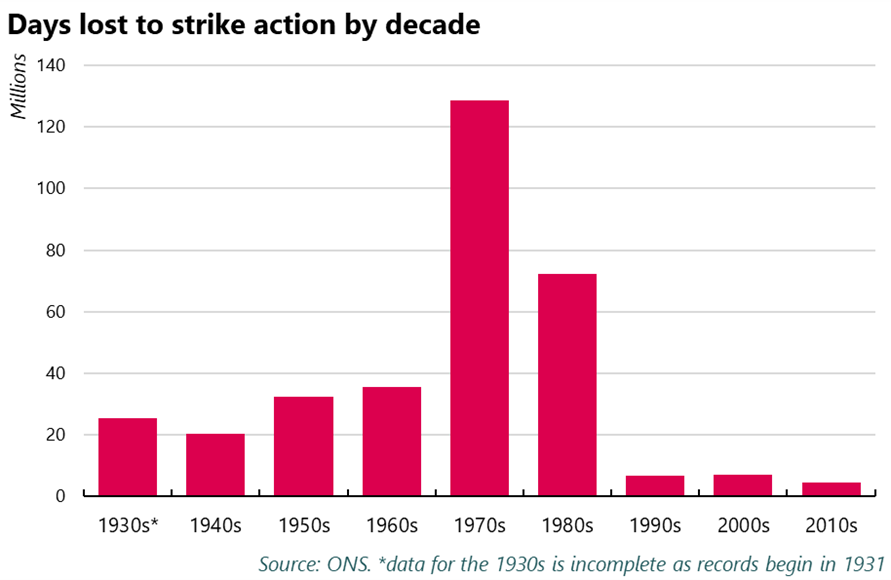
But it’s important to put the recent rise in strike action into context. While the number of days lost due to strike action is relatively high compared to the past couple of decades, they’d be fairly standard in any decade before the 1990s.
If more than one million working days are lost due to strikes in December, it’ll be the first time it’s happened since July 1989. But between 1970 and 1989, there were 47 months when this happened. And the 417,000 days lost due to strike action in October 2022 may be the fifth highest on record since 1990, but we regularly saw far higher figures pre-1990.
So what’s behind the rise?
Each individual strike will have different reasons behind it, but there’s some common factors behind the recent rise.
Work has been getting worse for many – lower paid, worse conditions, increasingly insecure. At the same time as workers have seen pay and conditions get worse, businesses have been giving more and more money to shareholders, with dividends paid out to shareholders growing three times faster than wages over the past decade.
And the government has been refusing to properly fund pay rises for public sector workers, failing to introduce a proper minimum wage, and attacking trade union rights, and failing to introduce a proper minimum wage.
The government’s minimum wage remains below the Real Living Wage set by the Living Wage Foundation, and, even with next year’s rise, will be £4.58 below a £15 per hour minimum wage.
Pay
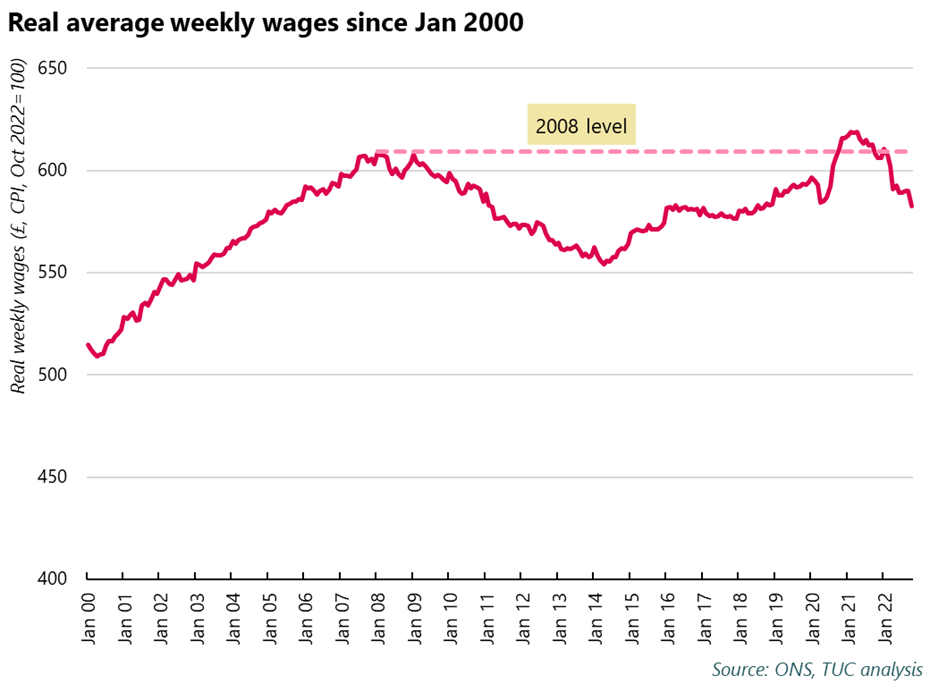
We’ll start with pay. Average real pay (that’s wages once you take inflation into account) is lower now than it was in 2008. It’s not expected to go back above 2008 levels until 2027. This 19-year pay squeeze is longer than any pay squeeze we have official records for, and likely the longest since Napoleonic times.
If wages had grown in line with pre-2008 trends over the past fourteen years, they’d now be £291 per week higher than they currently are.
Over a decade of stagnant pay has directly contributed to the current crisis, leaving many people unable to cope with a sudden rise in prices. While the cost of living crisis is often presented as a recent problem, it’s been building for years.
The situation was already dire before energy bills began to rise. As we went into the pandemic, the number of people in poverty was at a record high, with the majority of those in poverty living in a working household.
The recent rise in prices has made the situation even worse. After years of stagnant pay, workers are now facing double-digit inflation while being offered single-digit pay rises. The latest data shows that, in October, nominal pay rose by 6.4 per cent, while inflation hit 11.1 per cent. Real pay has fallen by £111 per month in the past year alone.
This is particularly bad in the public sector, where pay is rising by just 3.8 per cent, and average real pay has fallen by £185 per month in the past year.
Weak pay growth in the public sector is down to the government refusing to give proper pay rises to workers that kept the country running during the pandemic. Look at health workers, for example. TUC analysis of NHS pay scales shows that:
Nurses’ real pay fell by £1,800 over the last year
Paramedics’ real pay fell by £2,400 over the last year
Midwives’ real pay fell by £2,400 over the last year
This is after a decade of pay suppression by government that has led to nurses earning £5,000 a year less in real terms than they were in 2010. For midwives and paramedics this rises to over £6,000.
Working conditions and job losses
But it’s not just about pay. Many of the current strikes happening aren’t just about getting pay rising, but also protecting jobs, fighting against worsening working conditions, and putting an end to insecure contracts and outsourcing.
Fighting for pay itself is often a fight to improve working conditions. Better pay helps with recruitment and retention of staff.
It’s a political choice
The government spent months clapping for key workers, but now refuses to give them a fair pay rise. This is a political choice. The government could avoid, for example, rail workers, nurses, teachers, paramedics striking by getting around the negotiating table and offering a decent, fair pay rise.
Instead, it continues to offer real pay cuts to public sector workers, often hiding behind pay review bodies while it does. And when it comes to rail workers, the government is actively blocking deals being made. This is all part of wider cuts to public services that have left them understaffed and underfunded.
The government doesn’t agree pay deals in the private sector, but it can set a positive example to employers by offering decent pay rises. It also has the power to deliver increases to the minimum wage that get it to £15 an hour.
But instead, the government has repeatedly attacked trade union rights, making it harder to strike and therefore harder to negotiate for better pay.
Workers are winning
There’s another reason behind the rise in the number of people gaining confidence to take action: workers are winning. People are winning better pay deals and working conditions by joining together and standing up for themselves. Striking workers have won themselves double-digit pay rises across a range of different jobs, from bus drivers to BT engineers, as well as better conditions and an end to outsourcing.
If you aren’t in a union yet, there’s never been a better time to join – talk to your mates and talk to a union. And to learn more on how the TUC is supporting union disputes, see our solidarity hub here.
Responding to new figures published on Long Covid by the Office for National Statistics (ONS) yesterday, TUC General Secretary Frances O’Grady said: “Around two million people in the UK are living with Long Covid – more than the populations of Manchester and Birmingham combined.
“Economic inactivity is rising almost 10 times as fast for people with Long Covid than for those without the condition. And older workers are being hit the hardest.
“Ministers must ensure everyone with Long Covid is recognised as disabled under the Equality Act. This will give them the support they need to continue to do their jobs and formal protection under employment law.
“And Long Covid must also be recognised as an occupational disease. That would entitle employees to protection and compensation if they contracted the virus while working.
“It’s a scandal that more than two and a half years after the first lockdown, the workers who kept our country going through the pandemic have still been offered no support.”
The ONS figures show that:
Between July 2021 and July 2022, the inactivity rate among working-age people with self-reported Long Covid grew by 3.8 percentage points, compared with 0.4 percentage points among working-age people without self-reported Long Covid.
The relationship between self-reported Long Covid and inactivity (excluding retirement) was strongest for people aged 50 to 64 years, where the higher odds of inactivity compared with pre-infection peaked at a 71.2% increase among people reporting Long Covid 30 to 39 weeks post-infection.
The full ONS figures on Long Covid are available at:
THIS week the government replaced one catastrophic plan with another (writes TUC’s GEOFF TILY). A new course to placate financial markets is traded off against likely massive hits to household budgets and fears about the future.
Support for energy bills was cut, public services already stretched beyond breaking point will be hit again, little was offered on soaring borrowing and mortgage costs, and nothing about already deeply inadequate benefits and universal credit falling further behind inflation.
There is another way to deliver an economy that works for working people, but the government couldn’t be further from it,
Dealing with failure
The Truss government were right about one thing, the economic policies of the past decade and more have been a disastrous failure. As Kwasi Kwarteng admitted, growth has been ‘anaemic’. In the ONS words: the UK is the only G7 economy yet to recover above its pre-coronavirus pandemic level in Quarter 4 2019. The UK has the lowest investment as a share of GDP (see our ‘companies for the people report’, Figure 7) In Spring OECD figures showed UK real wages would fall furthest of all G7 economies.
Mini budget catastrophe
But the mini budget was catastrophically wrongheaded. Truss and Kwarteng took the fundamental problem of an economy serving wealth not work and turned it into the solution. The flip side of support for energy bills, was lavish tax breaks for those least in need – under the spurious and long discredited fallacy of ‘trickle down’.
On top of this their intention was to borrow to fund this extreme project. They did so the day after the Bank of England had confirmed that they would be reducing support for government borrowing, and implementing a £80billon programme of ‘quantitative tightening’ [i.e. selling back government bonds to financial markets] from the start of October. (Regardless of anything else this revealed staggering lack of coordination on the part of both institutions – the excellent Daniella Gabor called this ‘uncoordinated class war on the British public’.)
Financial markets took fright and instead of buying started to dump government debt, but this was also intimately connected to a third factor. The complex financial strategies – so-called liability driven investments (LDI) – that pension funds have been deploying (unnoticed by most) for the past 20 years began to unravel in the face of these rate rises.
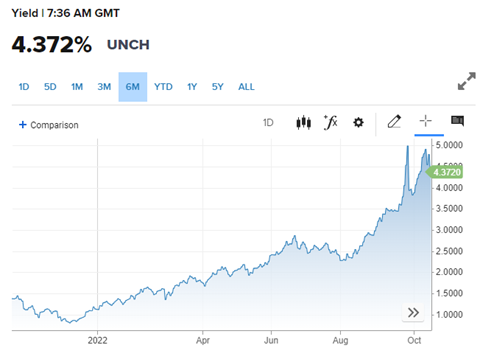
The Bank of England was obliged to step in to halt a vicious cycle – or doom loop – of bond sales leading to higher interest rates and so more bond sales. The spike in the chart below of interest rates on UK 30-year bonds shows how the episode was at least momentarily brought under control.
And in the meantime the government came under sustained assault for ‘fiscal irresponsibility’.
U-turn to a worse economy
After two U-turns (on the 45p top rate and corporation tax reductions), yesterday they U- turned on pretty much the whole thing.
But reversing a wrong doesn’t make a right, far from it.
We are now on the brink of a deep and damaging recession that threatens millions of jobs. But the latest Conservative chancellor has now announced the same basic approach that got us into this mess.
He warned of “more difficult decisions” on tax and spending to come. And immediately that “Some areas of spending will need to be cut”.
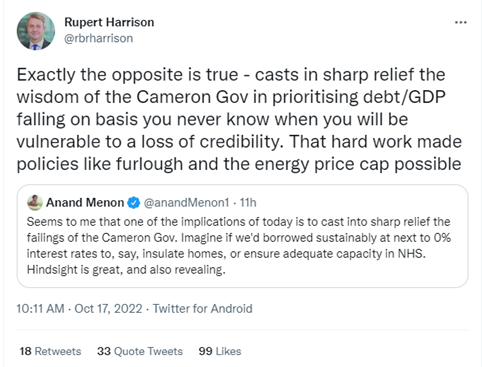
The Chancellor not only announced austerity. He not only sought once more – as did his George Osborne – to make a political virtue about imposing misery. He even invited George Osborne’s favourite adviser Rupert Harrison (now at Blackrock, one of three key institutions in LDI strategies) back to the Treasury to head a new panel of ‘economic advisers’ to deliver this reborn monstrosity.
Yesterday morning Rupert gave his City-oriented perspective on austerity
But this is a seriously misleading statement. The Osborne government did not repair the public finances. Over 2010-2019 the public debt ratio increased by 22 percentage point of GDP – the worse performance over a decade of economic recovery for a century (here).
For workers, this meant the worst pay crisis for 200 years. As Frances O’Grady spells out today, now expected (and this was before yesterday) to last at least two decades.
But the context for policy today is even more worrying than in 2010. Central banks, led by the Federal Reserve in the United States, are engaged in a forceful (their word) tightening of monetary policy.
This amounts to ending a strategy that has been in place since the start of the global financial crisis. In the wake of the last increase to 3.0 to 3.25 per cent, a Fed committee member has pointed to rates at up to 4.5 to 5 per cent. Fear of the impact of these rate rises on mortgage rates is likely common to all countries – for example in the US rates on a 30-year mortgage are up from 2.7 per cent at the start of 2021 to 6.9 per cent now.
And while in the UK the spike was brought under control, government interest rates are still seriously elevated and will carry on feeding through to mortgages.
In the UK money expert Martin Lewis has offered a grim rule of thumb: “For each 1 percentage point your mortgage rate increases, expect to pay roughly £50 more a month (£600/year) per £100,000 of mortgage debt.” The Resolution Foundation reckoned five million families would see annual payments rising by an average of £5,000 between now and the end of 2024.
Standing further back, the Financial Stability Board (Dietrich Domanski on the Today programme, 6 Oct.) have warned of the challenges of raising interest rates to deal with inflation under the conditions of the high global indebtedness that prevail today.
Likewise the IMF last week warned of “hidden leverage”, “waves of deleveraging”, and in particular the risk to ‘non-bank financial institutions’ – the latter including pension funds.
In terms of countries, first in the firing line are emerging market economies – with 20 countries “in default or trading at distressed levels”.
While the immediate trigger for central bank policies is the inflation set in motion by the end of lockdowns and Putin’s brutal invasion of Ukraine, the scale of the dislocation reflects a wider failure to set the economy right since the global financial crisis of 2008-09 exposed deep underlying failings. Summing up, the IMF offered the chilling: “the level of risk we are flagging at the moment is the highest outside acute crisis”
As the Biden administration has argued, for 40 years the interests of wealth have been prioritised over those of workers. The economy crashed in the first place because these financial interests proved wildly at odds with the interests of the population as a whole. An economy of speculation and debt crowded out production and decent pay and work.
The chancellor’s new advisory panel puts these interests back front and centre of policymaking at the Treasury. The other members so far announced are also from the City of London, not least securing J.P. Morgan a seat at the table.
Yesterday the Financial Times reported that the Bank of England’s programme of quantitative tighten has been put on hold, likely to protect the casino capitalism around pension funds.
Ahead of the mini budget the TUC issued a plan for a budget ‘on the side of working people’. We desperately need a government that will put first our interests not those of wealth. But instead once more the interests of the city of London are put ahead of those of workers and the country.
The central responsibility of any government is to do what is necessary for economic stability.
Behind the decisions we take and the issues on which we vote are jobs families depend on, mortgages that have to be paid, savings for pensioners, and businesses investing for the future.
We are a country that funds our promises and pays our debts.
And when that is questioned, as it has been, this government will take the difficult decisions necessary to ensure there is trust and confidence in our national finances.
That means decisions of eye-watering difficulty.
But I give the House and the public this assurance: every single one of those decisions…
…whether reductions in spending or increases in tax, will prioritise the needs of the most vulnerable.
That is why I pay tribute to my predecessors for the Energy Price Guarantee, for the furlough scheme…
…and indeed for even earlier decisions to protect the NHS budget in a period when other budgets were being cut.
Mr Speaker, I want to be completely frank about the scale of the economic challenges we face.
We have had short term difficulties caused by the lack of an OBR forecast alongside the mini-budget…
…but there are also inflationary and interest pressures around the world.
Russia’s unforgivable invasion of Ukraine has caused energy and food prices to spike.
We cannot control what is happening in the rest of the world, but when the interests of economic stability mean the government needs to change course, we will do so – and that is what I have come to the House to announce today.
In my first few days in this job, I’ve held extensive discussions with the Prime Minister, Cabinet colleagues, the Governor of the Bank of England, the OBR, the head of the Debt Management Office, Treasury officials, and many others.
The conclusion I have drawn from those conversations is that we need to do more, more quickly, to give certainty to the markets about our fiscal plans.
And show through action, not just words, that the United Kingdom can and always will pay our way in the world.
We have therefore decided to make further changes to the mini budget immediately, rather than waiting until the Medium-Term Fiscal Plan in two weeks’ time, in order to reduce unhelpful speculation about those plans.
Mr Speaker I am very grateful for your agreement on the need to give the markets an early, brief summary this morning, but I welcome the opportunity to give the House details of the decisions now.
We have decided on the following changes to support confidence and stability.
Firstly, the Prime Minister and I agreed yesterday to reverse almost all the tax measures announced in the Growth Plan three weeks ago that have not been legislated for in Parliament.
So we will continue with the abolition of the Health and Social Care Levy, changes to Stamp Duty, the increase in the Annual Investment Allowance to £1 million, and the wider reforms to investment taxes.
But we will no longer be proceeding with:
The cut to dividend tax rates, saving around £1 billion a year.
The reversal of the off-payroll working reforms introduced in 2017 and 2021, saving around £2 billion a year.
The new VAT-free shopping scheme for non-UK visitors, saving a further £2 billion a year.
Or the freeze to alcohol duty rates, saving around £600 million a year.
I will provide further details on how those rates will be uprated, shortly.
Second, the Government is currently committed to cutting the basic rate of income tax to 19% in April of 2023.
This government believes that people should keep more of the money they earn, which is why we have continued with the abolition of the Health and Social Care Levy.
But at a time when markets are asking serious questions about our commitment to sound public finances, we cannot afford a permanent, discretionary increase in borrowing worth £6 billion a year.
So I have decided that the basic rate of income tax will remain at 20% – and it will do so indefinitely, until economic circumstances allow for it to be cut.
Taken together with the decision not to cut Corporation Tax, and restoring the top rate of income tax, the measures I’ve announced today will raise around £32 billion every year.
The third step I’m taking today, Mr Speaker, is to review the Energy Price Guarantee.
This was the biggest single expense in the Growth Plan and one of the most generous schemes in the world.
It is a landmark policy for which I pay tribute to my predecessor.
It will support millions of people through a difficult winter and will reduce inflation by up to 5%.
So I confirm today that the support we are providing between now and April next year will not change.
But beyond next April, the Prime Minister and I have agreed it would not be responsible to continue exposing the public finances to unlimited volatility in international gas prices.
So I am announcing today a Treasury-led review into how we support energy bills beyond April next year.
The review’s objective is to design a new approach that will cost the taxpayer significantly less than planned whilst ensuring enough support for those in need.
Any support for businesses will be targeted to those most affected. And the new approach will better incentivise energy efficiency.
There remain many difficult decisions to be announced in the Medium-Term Fiscal Plan on October 31st …
…when I confirm that we will publish a credible, transparent, fully costed plan to get debt falling as a share of the economy over the medium term…
…based on the judgement and economic forecasts of the independent Office for Budget Responsibility.
I would like to thank the OBR, whose director Richard Hughes I met this morning, and the Bank of England whose Governor Andrew Bailey I have now met twice.
I fully support the vital, independent roles both institutions play, which give markets, the public, and the world confidence that our economic plans are credible, and rightly hold us to account for delivering them.
But I want some more independent, expert advice as I start my journey as Chancellor.
So I am announcing today the formation of a new Economic Advisory Council to do just that.
The Council will advise the government on economic policy with the first four names announced today:
Rupert Harrison, former Chief of Staff to the Chancellor of the Exchequer,
Gertjan Vlieghe, Element Capital
Sushil Wadhwani, Wadhwani Asset Management
Karen Ward, J. P. Morgan
Mr Speaker,
We remain completely committed to our mission to go for growth, but growth requires confidence and stability – which is why we are taking many difficult decisions, starting today.
But while we do need realism about the challenges ahead, we must never fall into the trap of pessimism.
Despite all the adversity and challenge we face, there is enormous potential in this country.
We have some of the most talented people in the world.
Three of the world’s top ten best universities.
The most tech unicorns in Europe.
One of the world’s great financial centres.
Incredible strengths in the creative industries…
…in science, research, engineering, manufacturing, and innovation.
All that gives me genuine optimism about our long-term prospects for growth.
But to achieve that, it’s vital that we act now to create the stability on which future generations can build.
The reason the United Kingdom has always succeeded is because at big and difficult moments we have taken tough and difficult decisions in the long-term interests of the country. That is what will we now do.
And I commend this statement to the House.
Hunt statement fails to undo damage to families and businesses and leaves more uncertainty, says TUC
Commenting on the Chancellor Jeremy Hunt’s fiscal statement), TUC General Secretary Frances O’Grady said: “The Conservatives drove the UK economy over a cliff. Hunt slamming the gears into reverse now won’t help families and businesses already hit by soaring borrowing costs.
“People needed reassurances today. Instead, they got more uncertainty – about energy bills, about our public services, and about whether universal credit and benefits will rise with inflation.
“We are now on the brink of a deep and damaging recession that threatens millions of jobs. But the latest Conservative Chancellor still has the same basic approach that got us into this mess.
“The Chancellor should have announced a boost to universal credit and pensions, and a comprehensive plan to get wages rising faster for everyone. And he should have announced a much higher windfall tax on oil and gas giants.”
On the announcement of a review of support for families and businesses with energy costs beyond April 2023, she added:
“Families and businesses now face months of worry. There is going to be less help with bills – but no-one knows who will lose out, by how much, or whether there will finally be a programme to fix Britain’s cold and draughty homes. This is not the reassurance working families need.”
The Chancellor will make a statement at 11am, bringing forward measures from the Medium-Term Fiscal Plan that will support fiscal sustainability.
He will also make a statement in the House of Commons this afternoon.
This follows the Prime Minister’s statement on Friday, and further conversations between the Prime Minister and the Chancellor over the weekend, to ensure sustainable public finances underpin economic growth.
The Chancellor will then deliver the full Medium-Term Fiscal Plan to be published alongside a forecast from the independent Office for Budget Responsibility on 31 October.
The Chancellor met with the Governor of the Bank of England and the Head of the Debt Management Office last night to brief them on these plans.
That racket you hear is those infamous Mini-Budget economic plans being put through the shredder – Ed. …
UPDATE: The Chancellor of The Exchequer Jeremy Hunt has today, Monday 17 October, brought forward a number of measures from 31 October’s Medium-Term Fiscal Plan:
Changes designed to ensure the UK’s economic stability and provide confidence in the government’s commitment to fiscal discipline
Basic rate of income tax to remain at 20% until economic conditions allow for it to be cut, IR35 and dividend tax rate reforms no longer going ahead
Treasury-led review of energy support after April 2023 launched
Following conversations with the Prime Minister, the Chancellor has taken these decisions to ensure the UK’s economic stability and to provide confidence in the government’s commitment to fiscal discipline.
The Chancellor made clear in his statement that the UK’s public finances must be on a sustainable path into the medium term.
Today’s announcement represents another down payment following the reversal of the corporation tax cut announced on Friday 14 October by the Prime Minister. The Chancellor will publish the government’s fiscal rules alongside an OBR forecast, and further measures, on 31 October.
In his statement the Chancellor announced a reversal of almost all of the tax measures set out in the Growth Plan that have not been legislated for in parliament.
The following tax policies will no longer be taken forward:
Cutting the basic rate of income tax to 19% from April 2023. While the government aims to proceed with the cut in due course, this will only take place when economic conditions allow for it and a change is affordable. The basic rate of income tax will therefore remain at 20% indefinitely. This is worth around £6 billion a year.
Cutting dividends tax by 1.25 percentage points from April 2023. The 1.25 percentage points increase, which took effect in April 2022, will now remain in place. This is valued at around £1 billion a year.
Repealing the 2017 and 2021 reforms to the off-payroll working rules (also known as IR35) from April 2023. The reforms will now remain in place. This will cut the cost of the government’s Growth Plan by around £2 billion a year.
Introducing a new VAT-free shopping scheme for non-UK visitors to Great Britain. Not proceeding with this scheme is worth around £2 billion a year.
Freezing alcohol duty rates from 1 February 2023 for a year. Not proceeding with the freeze is worth approximately £600 million a year. The next steps of the Alcohol Duty Review announced in Growth Plan 2022 will continue as planned. The alcohol duty uprating decision and interactions with the wider reforms to alcohol duties under the Alcohol Duty Review will be considered in due course.
This follows on from the previously announced decisions not to proceed with the Growth Plan proposals to remove the additional rate of income tax and to cancel the planned increase in the corporation tax rate.
Taken together, these changes are estimated to be worth around £32 billion a year.
The government’s reversal of the National Insurance increase and the Health and Social Care Levy, and the cuts to Stamp Duty Land Tax, will remain benefitting millions of people and businesses. The £1 million Annual Investment Allowance, the Seed Enterprise Investment Scheme and the Company Share Options Plan will also continue to further support business investment.
Energy bills support review
The government has announced unprecedented support within its Growth Plan to protect households and businesses from high energy prices. The Energy Price Guarantee and the Energy Bill Relief Scheme are supporting millions of households and businesses with rising energy costs, and the Chancellor made clear they will continue to do so from now until April next year.
However, looking beyond April, the Prime Minister and the Chancellor have agreed that it would be irresponsible for the government to continue exposing the public finances to unlimited volatility in international gas prices.
A Treasury-led review will therefore be launched to consider how to support households and businesses with energy bills after April 2023. The objective of the review is to design a new approach that will cost the taxpayer significantly less than planned whilst ensuring enough support for those in need. The Chancellor also said in his statement that any support for businesses will be targeted to those most affected, and that the new approach will better incentivise energy efficiency.
The government is prepared to act decisively and at scale to regain the country’s confidence and trust. The Chancellor stated in his speech that there will be more difficult decisions to take on both tax and spending. This means doing what is needed to lower debt in the medium term and to ensure that taxpayers’ money is well spent, putting public finances on a sustainable footing.
In light of this, government departments will be asked to find efficiencies within their budgets. The Chancellor is expected to announce further changes to fiscal policy on 31 October to put the public finances on a sustainable footing.
Further information
Table of total benefit of tax policy reversals:
Policy (£bn)
2022-23
2023-24
2024-25
2025-26
2026-27
Re-instate plans to raise Corporation Tax to 25% from April 2023
+2.3
+12.4
+16.6
+17.6
+18.7
Suspend 1p reduction in the basic rate of income tax
0
+5.3
+5.9
+5.8
+5.9
Maintain additional rate of income tax
+2.4
-0.6
+0.8
+2.2
+2.1
Maintain 1.25 percentage point increase in dividends tax rates
0
+1.4
-1.0
+1.1
+0.9
Maintain 2017 and 2021 reforms to off-payroll working rules (also known as IR35)
0
+1.1
+1.4
+1.7
+2.0
Cancel VAT-free shopping scheme for non-UK visitors to Great Britain
0
0
+1.3
+2.0
+2.1
Cancel one year freeze to alcohol duty rates
+0.1
+0.5
+0.6
+0.6
+0.6
Total
+4.7
+20.1
+25.4
+30.9
+32.3
Costings in the table are as set out in the Growth Plan 2022 – except for the 1p reduction in the basic rate of income tax, which is the costing from Spring Statement 2022 as adjusted in the Growth Plan 2022. Final costings will be set out as part of the Medium-Term Fiscal Plan on 31 October. Totals may not sum due to rounding.
THE CHANCELLOR’s STATEMENT:
A central responsibility for any Government is to do what is necessary for economic stability.
This is vital for businesses making long-term investment decisions and for families concerned about their jobs, their mortgages, and the cost of living.
No government can control markets, but every government can give certainty about the sustainability of public finances and that is one of the many factors influencing how markets behave.
And for that reason, although the Prime Minister and I are both committed to cutting corporation tax on Friday she listened to concerns about the mini budget and confirmed we will not proceed with the cut to Corporation Tax announced.
The government has today decided to make further changes to the mini budget.
And to reduce unhelpful speculation about what they are, we have decided to announce these ahead of the Medium-Term Fiscal Plan, which happens in two weeks.
I will give a detailed statement to Parliament and answer questions from Members of Parliament.
But because these decisions are market sensitive, I have agreed with the Speaker the need to give an early, brief summary of the changes which are all designed to provide confidence and stability.
Firstly, we will reverse almost all the tax measures announced in the Growth Plan three weeks ago that have not started Parliamentary legislation.
So whilst we will continue with the abolition of the Health and Social Care Levy and Stamp Duty changes we will no longer be proceeding with:
The cut to dividend tax rates.
The reversal of off-payroll working reforms introduced in 2017 and 2021.
The new VAT-free shopping scheme for non-UK visitors.
Or the freeze on alcohol duty rates.
Secondly, the government’s current plan is to cut the basic rate of income tax to 19% from April 2023.
But at a time when markets are rightly demanding commitment to sustainable public finances, it is not right to borrow to fund this tax cut.So I have decided that the basic rate of income tax will remain at 20% and it will do so indefinitely, until economic circumstances allow for it to be cut.
Taken together with the decision not to cut Corporation Tax, and restoring the top rate of income tax the measures I’ve announced today will raise, every year, around £32bn.
Finally, the biggest single expense in the Growth Plan was the Energy Price Guarantee.
This is a landmark policy supporting millions of people through a difficult winter and today I want to confirm that the support we are providing between now and April next year will not change.
But beyond that, the Prime Minister and I have agreed it would not be responsible to continue exposing public finances to unlimited volatility in international gas prices.So I am announcing today a Treasury-led review into how we support energy bills beyond April next year.
The objective is to design a new approach that will cost the taxpayer significantly less than planned whilst ensuring enough support for those in need.
Any support for businesses will be targeted to those most affected.
And the new approach will better incentivise energy efficiency.
The most important objective for our country right now is stability.
Governments cannot eliminate volatility in markets, but they can play their part, and we will do so because instability affects the prices of things in shops, the cost of mortgages, and the value of pensions.
There will be more difficult decisions to take on both tax and spending as we deliver our commitment to get debt falling as a share of the economy over the medium term.
All departments will need to redouble their efforts to find savings, and some areas of spending will need to be cut.
But, as I promised at the weekend our priority in making the difficult decisions that lie ahead will always be the most vulnerable.
And I remain extremely confident about the UK’s long term economic prospects as we deliver our mission to go for growth.
But growth requires confidence and stability, and the United Kingdom will always pay its way.
This Government will therefore make whatever tough decisions are necessary to do so.
REACTION:
Commenting on the Chancellor Jeremy Hunt’s fiscal statement today (Monday), TUC General Secretary Frances O’Grady said: “The Conservatives drove the UK economy over a cliff. Hunt slamming the gears into reverse now won’t help families and businesses already hit by soaring borrowing costs.
“People needed reassurances today. Instead, they got more uncertainty – about energy bills, about our public services, and about whether universal credit and benefits will rise with inflation.
“We are now on the brink of a deep and damaging recession that threatens millions of jobs. But the latest Conservative Chancellor still has the same basic approach that got us into this mess.
“The Chancellor should have announced a boost to universal credit and pensions, and a comprehensive plan to get wages rising faster for everyone. And he should have announced a much higher windfall tax on oil and gas giants.”
On the announcement of a review of support for families and businesses with energy costs beyond April 2023, she added: “Families and businesses now face months of worry. There is going to be less help with bills – but no-one knows who will lose out, by how much, or whether there will finally be a programme to fix Britain’s cold and draughty homes. This is not the reassurance working families need.”
Director of Policy & Communications at Independent Age, John Palmer, said: “Older people living on low and modest incomes were hoping to be reassured today, but frustratingly the Chancellor’s statement posed more questions than answers.
“Instead of ensuring stability, today only provided uncertainty. The review of the Energy Price Guarantee is extremely concerning. It’s no longer clear who will receive support beyond April 2023. Now millions of older people are wondering if they will be abandoned by the government and left with unaffordable energy bills and freezing homes next year.
“We know that many people in later life are already making dangerous cutbacks on heating and food. Our own polling revealed that 65% of older people plan to use less heating this winter.
“The government must ensure that its new targeted approach from next year helps older people in financial hardship, including the 850,000 older people who are currently entitled to Pension Credit but do not receive it.
“A fundamental, non-negotiable way to help older people’s incomes keep up with the price of essentials is for the government to uprate benefits and the State Pension with inflation. Today was another missed opportunity to offer this reassurance. Instead, millions of people over 65 will continue to live in fear that they will be made even poorer, when their budgets have been broken by the cost-of-living crisis.”
Will Hodson, consumer champion and founder of How To Save It commented:‘The Chancellor’s announcement that the Government will review the energy price cap in April is welcome. Supporting millionaires in paying their energy bills for two years was both morally and economically wrong.
“However, many households will be concerned about what this change means for them. The Government needs to make sure that their support is both good value to the taxpayer and provides sufficient, targeted support to those who really need it.’