RNID, the charity supporting people who are deaf, have hearing loss or tinnitus is looking for volunteers to support our vital work across the UK.
Volunteers Week (1-7 June) is a fantastic opportunity to celebrate the amazing impact our volunteers have. Last year, they gave more than 7,740 hours of their time to support people in their communities with practical information and support with hearing aids. This year, we need you to help us reach our goals and ensure that everyone in the UK can benefit from support.
Volunteering for RNID could involve providing information to local organisations and community groups, helping people get the most out of their hearing aids, or giving a friendly welcome to everyone who passes through the door at one of our support sessions.
Many of our volunteers have hearing loss themselves or in their family, and volunteering with us is a great way to meet new people, gain new skills and experience, try something new and help people in your community.
What are you waiting for?
For more information, visit www.rnid.org.uk/volunteering or contact us at 0808 808 0123. You can also text us at 07360 268 988.
Join our guest organist Oli Kelly and the church choir tonight Friday 19 May at 7pm for a charity recital and concert in aid of Drake Music Scotland.
The event is free but we would ask for donations to the work of Drake Music Scotland who provide music making opportunities for children and adults with disabilities and special needs.
The concert will last approximately 1 hour 20 mins and will be followed by refreshments. The concert will feature Oli Kelly on the organ and after a short interval Oli will conduct the church choir in a selection of pieces ranging from Palestrina to Howard Goodall.
You can learn more about the work of Drake Music Scotland at:
The Financial Conduct Authority (FCA) has reminded borrowers they can get help from their lenders if they are struggling to keep up with payments, as it found the number of people struggling to meet bills and credit repayments has risen by 3.1m since May 2022 (10.9m, compared to 7.8m in May 2022).
The number of adults who missed bills or loan payments in at least three of the last six months has also gone up by 1.4 million, from 4.2 million to 5.6 million over the same period.
The FCA has repeatedly reminded firms of the importance of supporting their customers and working with them to solve problems with payment, including by writing to industry bosses to make sure they are aware of the regulator’s expectations.
Where firms haven’t supported their customers properly, the FCA has told them to make changes. It reminded 3,500 lenders of how they should be supporting borrowers in financial difficulty and told 32 lenders to make changes to the way they treat customers. This work has led to £29 million in compensation being secured for over 80,000 customers.
As part of its Financial Lives survey, the FCA found that the cost of living is having an impact on people’s mental wellbeing. Around half of UK adults, or 28.4 million people, in January 2023 felt more anxious or stressed due to the rising cost of living than six months earlier.
Sheldon Mills, Executive Director of Consumers and Competition said: ‘Our research highlights the real impact the rising cost of living is having on people’s ability to keep up with their bills, although we are pleased to see that people have been accessing help and advice.
‘If you’re concerned about your finances, you do not need to worry alone. We’ve told lenders that they should provide support tailored to your needs. And, if you find yourself in debt or want to know more about how to manage your finances, free expert advice is available.
‘We will continue to act quickly to make sure financial firms help their customers who are facing financial difficulty or are worried they might be soon.’
The support needed to deal with the rising cost of living goes beyond what is provided by the financial services sector. As a result, the FCA continues to work with other regulators and debt organisations to drive better coordination and help make sure customers are treated fairly and supported if they get into financial difficulty.
The FCA will also be introducing the Consumer Duty in the summer. The Duty will be the driving force behind its consumer protection work, as it will require firms to act to deliver good outcomes for consumers and make sure that they are properly supported while using a financial product or service.
An estimated 20,000 additional people will become eligible for additional help to buy healthy foods when income thresholds are removed for Best Start Foods payments.
The Scottish Government benefit provides help to pregnant women or their partners as well as families with children aged up to three years old, so they can buy healthy food, milk or baby formula.
It is currently paid to people who receive qualifying benefits, so long as their incomes are not above set thresholds. The Scottish Government will introduce regulations that remove those thresholds increasing eligibility for Best Start Foods to around an additional 20,000 people from February 2024.
Social Justice Secretary Shirley-Anne Somerville said: “Tackling poverty and protecting people from harm is one of the Scottish Government’s three critical missions.
“Rising food prices disproportionately hurt those on the lowest incomes, so removing the threshold for qualifying benefits means around 20,000 people will now get vital help to buy healthy foods.
“Best Start Foods is one of our five family payments, including the Scottish Child Payment, which together could be worth more than £10,000 by the time a first child turns six and more than £20,000 by the time an eligible child is 16.
“As set out in our tackling child poverty plan, we will use all the resources available to provide immediate support to families, while seeking more powers to enable us to truly tackle poverty.”
Learners are now paying 215% more for driving lessons than they did thirty years ago, with more young people being excluded from getting behind the wheel due to financial pressures.*
Now car insurance experts at Quotezone.co.uk are calling for more regulation for the cost of learning to drive.
This comes after many simply cannot afford the expense as young people are estimated to pay over £2500 to get their licence.
Credit – Shutterstock
Quotezone.co.uk has researched the average amount of money a learner today will end up paying from start to finish.
Before even getting behind the wheel, learners in the UK must apply for a provisional driving licence, costing them £34 to apply online or £43 by post.
Next, the biggest expense, is finding a driving instructor suitable and getting enough practice in to take the test.
The Government’s ‘Ready to Pass’ campaign claims that the average learner will take 45 hours of lessons with their instructor plus 22 hours of private practice.**
Taking into account that the average 1 hour lesson costs £30, learners are expected to fork out £1,350 to pay instructors.***
Paying to actually take the driving test is another expense learners cannot avoid – pupils must pass both the theory test (£23) and the practical test (£62 for weekday tests rising to £75 on the weekend).****
Additional fees at the test-taking stage include paid-for apps to practise theory test questions, and many driving instructors will also require payment for learners to use the car when taking their test.
Overall, learners are now paying £2707 to learn to drive, not including the cost of more driving lessons and more tests if they are unsuccessful after the first try.
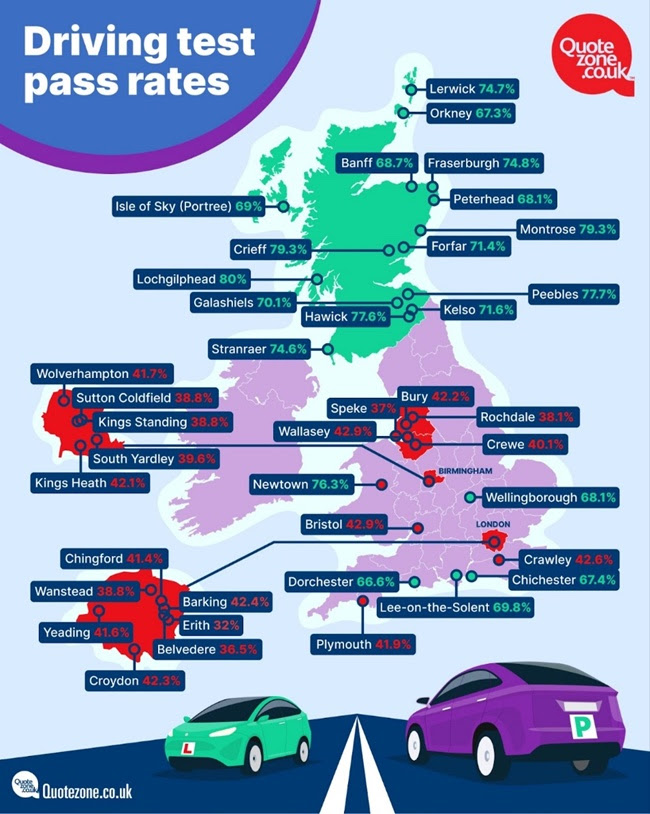
Every year around 1.6 million nervous Brits buckle up to sit their practical driving test, and the pass rate as a whole falls just shy of 50% – dropping to 46% on average for female drivers.
Comparatively, reports show that learners in the 1980s and 90s paid an average of just £10 an hour – meaning lessons alone are costing pupils today £900 more.
Greg Wilson, Founder and CEO of Quotezone.co.uk said: “Learning to drive is a rite of passage and the worry is young people aren’t getting the option to learn, as the rising costs are making it unaffordable.
“More regulation on the cost of driving lessons and other mandatory fees would help young people get out on the roads and also help ensure they don’t cut corners.
“Having a more affordable pathway to learn to drive will also encourage pupils to take their time before booking a test and in turn help reduce the growing driving test backlog seen across the country.”
Learners also have to tax and insure the vehicle and indeed the vehicle cost itself if they don’t have access to a family car, it’s beginning to make driving unattainable for young drivers.
As a price comparison site, Quotezone.co.uk is designed to help young drivers find competitive costs by comparing products and exploring alternative options such as black box or telematics products.
“Following my recent visit to Edinburgh Dog and Cat Home (EDCH) in Seafield, I attended their parliamentary drop-in session yesterday supported by animal campaigner and TV Presenter Kirsty Gallacher at the Scottish Parliament (writes FOYSOL CHOUDHURY MSP).
“CEO Lindsay Fyffe-Jardine and her Team at EDCH have been doing tremendous work to alleviate pet poverty across the Lothian region and beyond, ensuring pet owners are not separated from their families.
“Many pet owners across Scotland have been struggling to keep their much beloved pets at home as they can no longer pay for food, heat and vet bills particularly with the cost of living crisis which has exasperating the situation post-Covid.
“This has been very traumatic for cat and dog owners whose pets are part of the family, providing them with joy, comfort and security.
“Edinburgh Dog and Cat home Pet Food Bank launched in 2019, provides pet food, jackets, blankets, leads, collars, bowls and bedding to those who can no longer afford their pets’ needs or care for them properly due to financial difficulties, an illness, homelessness or other social issues.
“It is important that we raise awareness that these Pet Food banks do exist and are there to support pet owners when needed. To guarantee pet supplies are available, EDCH has partnered up with 88 human food banks and has been supporting over 3,800 pets each month across the Lothians, Fife, Falkirk and The Borders.
“However, The Edinburgh Dog and Cat Home has been struggling with the rising costs-of-living. CEO Lindsay Fyffe-Jardine reached out to me at the end of last year to make me aware of the significant challenges the Pet Home has been going through due the rising costs.
“In November last year, the Home was hit with a huge increase in annual electricity and gas costs– equating to £130K of unanticipated funding that Lindsay has been desperate to find. This is an addition to £200K needed to cover increased supplier costs.
“These increases are just unsustainable in addition to coping with the increase of pet owners having to give up their cats and dogs. Lindsay informed me that the phone calls are increasing 7 days a week, with calls up 55% from December to January.
“The energy and cost increases are just exasperating an already struggling pet home, and animal charities like EDCH do not have the option to turn the lights and heating off. They have pets who need their care and rehabilitation as well as staff who need them to care for them while they carry out their mission both on the Home’s site and right across East and Central Scotland.
“EDCH has been working to exhaustion point to avoid a major pet crisis, keeping our communities together, making sure our pets are cared for and assuring owners can keep their pets to avoid the trauma of losing their beloved pet. We all know how our pets play a central part within our family lives, they give many who would find themselves completely lonely and isolated company and a reason to live for.
“In the past months, I have raised questions to the Scottish Government regarding the impacts of the cost crisis on pet ownership and I will continue to put pressure on them to ensure our pet homes avoid the prospect of closing.
“Our local animal shelters like EDCH need our support and we need to see practical action beyond donations to ensure the survival of this 140-year old animal shelter to keep our animals safe and sheltered, and avoid painful separation from their owners.”
Victims and witnesses are set to use virtual reality headsets to familiarise themselves with giving evidence in court as part of a pioneering Scottish Government initiative to allay fears or discomfort around the process.
Ahead of giving evidence in court, the world-leading £500,000 virtual court project will allow victims to ‘walk through’ a 3-dimensional world, comprising actual videos of the court building where their case will be held. The system uses cutting-edge software to allow victims and witnesses to interact in a virtual environment that includes depictions of the people and objects they can expect to encounter when they go to court.
The project will enable victims and witnesses to be supported at all times by Victim Support Scotland (VSS) volunteers as they experience the virtual court environment. This will remove the need to travel to court prior to their hearing date, while allowing people to familiarise themselves with what can be an unfamiliar, daunting and often retraumatising environment.
The project – a partnership between VSS, tech provider Immersonal and CivTech, the world’s first successful public-sector-focused innovation accelerator – has delivered a working prototype for Glasgow Sheriff Court and the High Court in Glasgow with wider development and roll out over the next year.
Cabinet Secretary for Justice and Home Affairs Angela Constance said: “We continue to put victims at the heart of the criminal justice system, their needs are an absolute priority.
“However victims and witnesses can naturally find giving evidence a daunting prospect. This unique project, using innovative technology to support and prepare victims for attending court, could prove transformative.
“It has the potential to reduce anxiety and additional trauma, and also reduces the need to travel often long distances for victims to familiarise themselves with a new environment before experiencing it ‘in real life’.
“We hope that this will reduce retraumatisation and anxiety, supporting victims to give the highest quality evidence.
“This project is part of the Scottish Government‘s wider work that has seen more than £93 million invested through the justice budget over the past five years to prioritise victims’ rights and needs. Our Victim Centred Approach Fund continues this important commitment, making £48 million available to victims’ organisations.”
Chief Executive of Victim Support Scotland Kate Wallace said: “Victims and witnesses often tell us of the retraumatising effects caused by giving evidence in court and that it can cause as much anxiety as the crime itself.
“Victim Support Scotland strongly advocates for victims being able to give evidence remotely and in trauma-informed environments.
“This virtual reality experience will provide just that and can be accessed through a headset available with the help of volunteers from Victim Support Scotland, as well as through laptops, smart phones and tablets thereby offering more choice and access about how to prepare for court at a time and place that suits the victim.”
Disabled people are being urged to find out if they are eligible for Scottish Government disability benefits as part of a new campaign to increase benefit take-up.
The nationwide campaign aims to raise awareness about financial support available to help with the extra costs that disabled children and adults may face.
Child Disability Payment provides financial support to help families and carers with the extra costs of caring for a disabled child or young person or a child or young person with a long-term health condition. Adult Disability Payment is available to people aged between 16 and state pension age who are disabled, have a long-term health condition or a terminal illness.
These benefits are administered by Social Security Scotland and replace the Department for Work and Pensions’ Disability Living Allowance (DLA) for Children, DLA and Personal Independence Payment.
People already getting disability benefits from DWP will see their award transfer automatically and they do not need to apply separately.
Social Justice Secretary Shirley-Anne Somerville said: “Being disabled or having a long-term health condition can come with a variety of extra costs, such as paying more for accessible transport. We want to make sure that disabled children and adults get all the extra financial support they are entitled to, to ease the impact of those costs.
“This campaign is not just about raising awareness but also has an important role to play in helping to remove any stigma that people may be worried about when applying for social security. We believe social security is a human right. It is here for any of us should we need it and we want to make sure people are accessing what they are due.
“This is the first time that we are proactively promoting disability benefits as part of a national advertising campaign, including adverts on TV. We are not aware of the UK Government running a campaign on the equivalent UK benefits for over 30-years. I want to actively encourage people to check if they are eligible for Child and Adult Disability Payments and make sure they get extra financial support to help them live full and independent lives.”
The campaign features Piper, 9, who has Down’s Syndrome. Her mum Caroline Milburn, says disability benefits have helped cover extra costs as well as give Piper opportunities she’d never have had without them.
Caroline, from Edinburgh, said: “Piper is such a unique character. When she was born we were told she wouldn’t walk until she was around six, but she was walking at two. She’s so determined and knows her own mind. If she wants to do something she’ll do it.
“Disability benefit allowed me to buy her a sensory swing and a tablet that gives her access to games that help her learn. She just thinks she’s having fun but the games have taught her so much. She plays them with her five-year-old brother sitting beside her and he learns with her.
“Child Disability Payment helps cover the costs of buying Piper new clothes and duvets as she is always chewing holes in them It also allows me to send her to holiday clubs. She loves them and they’re really good for her, but they cost about £40 a week.
“Piper is such an amazing girl and she makes everyone’s lives better. Without disability benefits we’d not have been able to give her all the experiences and opportunities she’s had to learn and connect with the world.”




 New Term Programme


