A 45-year-old man has been sentenced to life imprisonment following the death of a man in Edinburgh.
Paul Menzies was found guilty of the murder of a 53-year-old man, Brian Ramsay, today (Wednesday, 14 January, 2026), following a trial at Edinburgh High Court.
He was sentenced to life imprisonment, with a minimum term of 18 years.
Officers were called to Westfield Road in the city centre around 12.55pm on Friday, 7 June, 2024, following concern for a man within a property. Mr Ramsay was pronounced dead at the scene.
Detective Chief Inspector David McAlinden said: “This was a violent attack that cost Brian Ramsay his life, and Menzies will now face the consequences of his despicable actions.
“While this conviction cannot change what has happened, I hope it gives Brian’s family and friends some closure.
“I want to reassure the public that violent incidents such as this will not be tolerated in our communities, and our officers will continue to work tirelessly to bring those responsible to justice.”
A gunman who murdered a gangland rival outside a Granton pub on Hogmanay 2023 has been jailed for life.
Grant Hunter, 34, shot Marc Webley outside the Anchor Inn just before midnight on New Year’s Eve two years ago.
Hunter pleaded guilty to murdering Webley and attempting to murder a second man, Stuart Pearson, who was also shot but survived his injuries. Hunter will serve a minimum of 26 years for the crime but was told he may never be released.
Hunter approached Marc Webley and Stuart Pearson outside the pub, where he produced a gun and fired four shots at the men. Stuart Pearson was injured but Marc Webley died from his injuries in the early hours of New Year’s Day.
Jailing Hunter for a minimum of 26 years, Judge Lord Mulholland said: “You fired four shots which showed beyond any doubt that you wanted him dead.
“You shot another man who could have came to his aid which shows further intent.
“It is blatantly sinister that you wanted your victim to see your face which is an aggravating factor. In doing so you removed your mask and this was your undoing as the police knew you and people knew you which led to your swift arrest.
“The public are grateful to the police and forensic scientists for bringing you to justice.
“Gangsterism is not acceptable in a civilised society – this is a civilised society. The public will not put up with this gangsterism and the courts will not put up with it.
“Anyone going to court for carrying out this type of criminality can expect a lengthy prison sentence.
“As I said to you previously, this is not Chicago of the 1930s. Scotland is a civilised place without tolerance for gangsterism.
“You have left a mother without a son and two boys without a father. Your cowardly actions will haunt you for the rest of your life.”
Head of Kenova Sir Iain Livingstone has called for the UK Government to publicly name Stakeknife after publishing its final report which detailed how the agent had committed “grotesque serious crime” including torture and murder.
Sir Iain also urged Government to use the principles of the Kenova model for legacy investigations as he presented the 164-page document to his predecessor, and current Chief Constable of Police Service of Northern Ireland, Jon Boutcher marking an end to the nine-year investigation into Stakeknife’s offending and state handling. The Kenova final report also outlined the other separate enquiries carried out by the Kenova team, namely Operations Mizzenmast, Turma and Denton.
The report contains updates on the 10 recommendations made in the Interim Report published in 2024 and urged Government to depart from the Neither Confirm Nor Deny policy (NCND) in regard to Stakeknife on grounds of public interest.
Sir Iain said: “Having spent my life in policing and justice, I support NCND and know its value. Although the policy’s definition and use require review, Kenova has no intention to undermine NCND.
“However, NCND must be exercised in a proportionate and necessary manner and should not be an absolute bar to providing truth and justice. It cannot be used to protect agents who commit grotesque serious crime, leaving victims and families ignored and their demands for information and answers dismissed.
“As this Final Report makes clear, we in Kenova believe there is a compelling ethical case for the UK government to derogate from the NCND policy regarding the agent Stakeknife’s identity. It is in the public interest that Stakeknife is named.”
Stakeknife findings
Operation Kenova was initially set up to investigate the activities of the alleged army agent ‘Stakeknife’ within the Provisional Irish Republican Army’s Internal Security Unit.
The Final Report provides an overview of Stakeknife’s time as an informant, from his recruitment in the late 1970s through to the early 1990s. Investigators discovered a military unit known as the ‘Rat Hole’ was set up solely to assist the management of Stakeknife, and he was given a dedicated phone line which he could call at any time.
In total Kenova discovered 3,517 intelligence reports from Stakeknife including 377 in an 18-month period.
However, it found that ‘time and again’ the reports were not acted upon, with the protection of the agent apparently more important than protecting those who could and should have been saved.
The investigation revealed evidence of Stakeknife’s involvement in serious and unjustifiable criminality, including kidnap, interrogation and murder.
Prosecution files submitted to the Public Prosecution Service for Northern Ireland implicated Stakeknife in 14 murders and the abduction of a further 15 individuals.
MI5 further material recovered
The report outlines state failures around the handling of Stakeknife and describes the late discovery of further material by MI5 after publication of the Kenova Interim Report in 2024. The further material revealed MI5 had earlier and greater knowledge of the agent than previously stated.
Sir Iain said: “While the information in the additional files would not have altered prosecutorial decisions, further investigative opportunities were undoubtedly lost.
“The very fact that material owned and held by MI5 was not timeously disclosed understandably undermined the confidence of communities that state authorities had cooperated fully with Kenova. It was a significant failure on the part of MI5.”
Recovered evidence
The report details how Kenova investigators were able to use new techniques to re-examine exhibits seized during initial investigations such as tapings which had been used to bind or blindfold victims.
These tapings, along with bullet casings, confession tapes and letters and a firearm allowed detectives to identify suspects and even a victim of a non-fatal punishment shooting who was subsequently located as a key witness.
Scientific examination of these exhibits recovered DNA profiles and linked offences or suspects.
Future of legacy investigations
The report refers to the Northern Ireland Troubles Bill, which will repeal the 2023 Legacy Act and establish a reformed Legacy Commission and a joint Independent Commission for Information Retrieval.
In welcoming the new Bill, Sir Iain suggested there was an opportunity to build upon the experience of Kenova to ensure comprehensive, independent investigations and a focus on victims.
Sir Iain said: “Kenova has shown that the truth can be uncovered, but it requires determination, independence, and a commitment to those victims and families. Our work demonstrates the need for rigorous, transparent investigations and for the interests of those most affected to be placed at the centre of legacy processes.
“It is also crucial that sufficient investigative powers and resources are allocated to a reformed Legacy Commission to ensure every piece of available information is accessed and that families are given the whole truth of what happened to their loved ones.
“The lessons from Kenova should inform the new legacy legislation.”
Mizzenmast and Turma
The Kenova Final Report outlines the additional investigations and reviews that PSNI asked Kenova to conduct beyond its initial commission regarding the conduct of the agent Stakeknife.
It summarises Operation Mizzenmast, the investigation into the murder of Jean Smyth-Campbell in 1972, and gives an overview of the background to Operation Turma, the murders of Sergeant Sean Quinn and Constables Paul Hamilton and Allan McCloy in an explosion at Kinnego Embankment in 1982.
Denton
Operation Denton was a thematic review of sectarian attacks by loyalist paramilitaries, referred to as the Glenanne series, between 1972 and 1978. The review examined over 98 incidents resulting in 127 deaths, assessing allegations of collusion between security forces and loyalist terrorists.
It found clear evidence of collusion by some security force members who committed or facilitated horrific acts of sectarian violence including murder. The review also addressed previous investigations and the impact on victims and families, emphasising the importance of transparency and engagement.
The review concluded that no discrete ‘Glenanne gang’ existed but rather there was a broader network involving loyalist paramilitaries and some corrupt security force members. While collusion at the individual level was evident, some of it long established before Denton was initiated, there was no evidence of collusion at a political or strategic level. Denton’s findings included that the Belfast UVF was responsible for the Dublin and Monaghan bombings.
With regard to the entirety of Kenova’s work, Sir Iain said: “The Kenova team has worked intensely to seek answers, provide explanations and pursue justice. At times some of our findings did not align with what victims and families expected. However, our duty was to seek the truth relentlessly and then share as fully as we could with those who deserved to hear it and who had endured the traumatic attacks.
“Victims and families from the Troubles consistently demonstrate dignity and grace in the face of appalling suffering from brutal terrorism, at times compounded by state failures to act legitimately or with empathy and care.
“Kenova has from the outset put the interests of victims and families at the heart of its approach. We learned that an outcome through the criminal justice process may in fact not always be achievable or even what is desired. Kenova detectives prioritised listening and being responsive to questions unanswered for decades.
“This authentic engagement with victims and families is a key factor which distinguishes Kenova and must be adopted if the reformed legacy arrangements are to succeed.”
The Secretary of State for Northern Ireland, Hilary Benn MP, has responded to the Operation Kenova Final Report into the activities of an alleged agent known as ‘STEAK KNIFE’, which has been published by the Police Service of Northern Ireland (PSNI).
The Secretary of State said: “I want to begin by commending the Kenova team, led by Sir Iain Livingstone and Jon Boutcher, for the exemplary way they carried out their work, built trust with families, put victims first and provided many answers about what happened to their loved ones.
“Operation Turma, which was part of Kenova, resulted in the prosecution of an individual, now extradited from Ireland and awaiting trial, for the murder of three RUC officers in 1982.
‘Kenova has set a standard for future legacy investigations, and we have drawn on a number of those lessons in drafting the Troubles Bill.
“I wish to express my heartfelt condolences to all the families who lost loved ones in the appalling circumstances described in this sobering report.
“Operation Kenova was asked to establish whether there was evidence of criminal offences by the alleged agent known as STEAK KNIFE, or their alleged handlers.
“The behaviour described of the alleged agent, and their role in the Provisional IRA, is deeply disturbing. It should not have happened, and in recent decades, there have been significant reforms to agent handling practice, including through legislation. The use of agents is nowadays subject to strict regulation, overseen by the Investigatory Powers Commissioner and the Investigatory Powers Tribunal.
“On Operation Kenova’s request to the Government to name STEAK KNIFE, I told Sir Iain Livingstone in August that: “Due to ongoing litigation relevant to the Neither Confirm Nor Deny [NCND] policy, namely the Thompson Supreme Court appeal, a substantive and final response to your request will be provided after judgment has issued in that case.”
“The Government’s first duty is of course to protect national security, and identifying agents risks jeopardising this.
“Today’s Report also makes public the high-level findings of Operation Denton, which looked at killings carried out by the UVF Glennane Gang. The behaviour reported on, including collusion by individual members of the security forces, is shocking.
“The Government will respond to the full Denton Report when it is published, bearing in mind that there are related legal proceedings ongoing in this case and in the case of STEAK KNIFE.”
Stakeknife has been identified by the press as FREDDIE SCAPPATICCI, a leading member of the Provisional IRA’s notorious Internal Security Unit known as The Nutting Squad. He was involved in 14 murders and the abduction of a further 15 people during The Troubles. Scappaticci died in 2023.
A 34-year-old man has been convicted of murder following the death of Marc Webley in Edinburgh on New Year’s Eve, 2023.
Grant Hunter (pictured below) pleaded guilty to murdering the 38-year-old and the attempted murder of a second man, aged 39, subsequently named as Stuart Pearson, at the High Court in Edinburgh today, (Thursday, 13 November, 2025).
Two other people, Emma McVie, 35, and Gary Robertson, 22, both also pleaded guilty to attempting to pervert the course of justice in relation to the incident.
Robertson admitted supplying cash in the build-up to the murder, as well as helping to dispose of a firearm afterwards, while McVie (pictured below) admitted attempting to destroy evidence.
Emergency services were called around 11.50pm on Hogmanay (Sunday, 31 December, 2023), after a firearm was discharged outside the Anchor Inn on West Granton Road.
Mr Webley and the 39-year-old man were taken to hospital, where Marc Webley was pronounced dead a short time later.
Detective Superintendent Graham Grant, senior investigating officer, said: “The violence involved in this case, which resulted in the death of a young man, is absolutely senseless.
“Our thoughts are with the family of Marc Webley today following these convictions.
“Although this was a targeted attack, there was absolutely no regard for the safety of the local community by discharging a firearm outside a busy pub on New Year’s Eve.
“One man lost his life and another was seriously injured but this incident could also have left other people seriously injured – or worse – and I want to make it clear this behaviour will not be tolerated.
“Violence and the carrying of firearms is completely unacceptable.
“I believe these convictions sends a message to those involved in serious criminality that we remain determined to bring you to justice.
“This was a complex investigation involving a range of specialist officers working closely with our partners.
“I would also like to thank the public for their support throughout the investigation.”
Hunter, McVie, and Robertson are all due to be sentenced at a later date.
A 21-year-old man has been convicted of the murder of Lewis McCartney in Edinburgh.
The 18-year-old was found with serious injuries on Viewcraig Street around 3.45am on Sunday, 12 February, 2023. Lewis was taken to the Royal Infirmary of Edinburgh where he died a short time later.
Bailey Dowling was found guilty of murder at the High Court in Edinburgh today (Thursday, 17 April, 2025). He will be sentenced at a later date.
A 25-year-old man has been convicted of murder and an attempted murder in Edinburgh in 2023.
On Friday, 2 June 2023, police were called to attend a report of a disturbance on Leith Street near to the junction with Greenside Row. Peter Mullen, aged 30, was found with serious injuries and was taken to the Royal Infirmary of Edinburgh where he died a short time later.
Officers subsequently arrested and charged Dylan Curran in connection with the death, and on Friday (14 March, 2025), he was convicted of murder following a trial at the High Court in Edinburgh.
Curran was also convicted of the attempted murder of a 43-year-old man during the same incident. He will be sentenced at a later date.
Detective Chief Inspector Bob Williamson said: “Our thoughts remain with Peter’s family and friends as they come to terms with what happened to him. I hope this verdict will bring some sense of justice for them.
“Dylan Curran will now face the consequences of his deplorable actions.
“Thankfully violent crimes like these in public places are rare in our communities. When such incidents take place, we will use all resources necessary to carry out thorough, rigorous inquiries to ensure we track down those responsible to bring them to justice.
“I would like to thank those members of the public who assisted with our enquiries.”
A 36-year-old man has been arrested and charged in connection with the death of a 78-year-old woman in Edinburgh on Tuesday (21 May).
Around 8.25am, police were called to a disturbance within a house in Fernieside Crescent. Police and Ambulance attended however 78-year-old Margaret Parker was pronounced dead at the scene.
The 36-year-old man is due to appear at Edinburgh Sheriff Court today (Thursday, 23 May),
The 36-year-old man has also been charged in relation to the attempted murder of a 55-year-old woman and a 42-year-old woman during this incident. They did not require medical treatment.
Detective Inspector Dougal Begg said: “Our thoughts are with the family and friends of Margaret Parker and everyone affected by this tragic incident.
“A continued police presence can be seen in the area as officers continue their enquiries into this isolated incident.”
A report will be submitted to the Procurator Fiscal.
A blog by the Youth Justice Board’s (YJB) Business Intelligence and Insights Directorate that highlights racial disparity in the youth justice system and the ongoing work to tackle it.
Today, people across the UK remember Stephen Lawrence, who at just 18 was murdered in an unprovoked racist attack. Every year, on 22 April, Stephen Lawrence Day is an opportunity for people to come together and honour Stephen’s life and legacy and stand up against discrimination.
At the YJB, we have been highlighting the issues of over-representation and disproportionality of Black children and those with Mixed ethnicity within the youth justice system for more than a decade. And so, it seems timely to highlight the information on disparity that we have captured in our Annual Statistics.
What do our Annual Youth Justice Statistics show?
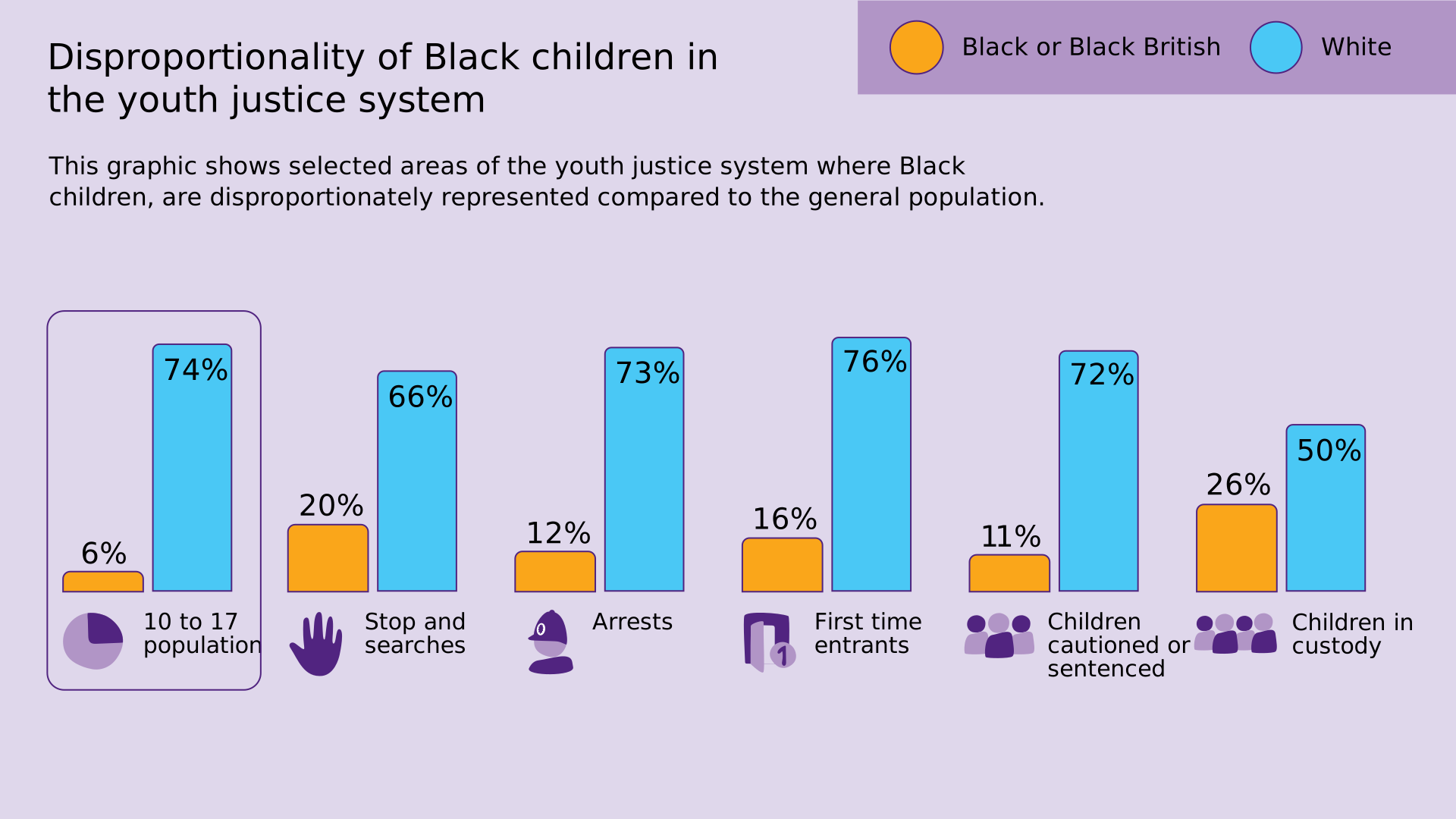
While there have been promising reductions across different stages of the youth justice system, Black children and those with Mixed ethnicity continued to be over-represented.
Compared with the proportion of Black children in the 10-17 population, Black children are disproportionately represented across most stages of the youth justice system.
Disproportionality of Black children in the youth justice system
There have been some encouraging reductions across several areas in recent years, including stop and search, arrests, youth cautions, first time entrants, sentencing and children in custody.
What does the wider evidence tell us?
Addressing ethnic disparities in the youth justice system is one of the YJB’s strategic priorities and will require close partnership working to achieve. We now know more about the existence and extent of ethnic disparities, and potential drivers, but less about potential solutions.
Intersectionality is also apparent when analysing the data from other government departments – for example custodial sentences have been found to be twice as common among care-experienced children with a Black or Mixed ethnicity compared with care-experienced children who were White.
YJB research identifies that the key drivers of ethnic disparity in child reoffending include:
Marginalisation of individuals and communities.
Individual, institutional and systematic bias.
Weaknesses in prevention and intervention.
Negative experiences of the wider youth justice system.
This is consistent with findings from wider research and data which finds that Black and Mixed ethnicity children are:
With the structure and safety of the school system removed (including access to heat, food, and a community of peers) it may increase the chances a child may become involved in crime.
The HM Inspectorate of Probation thematic review also reports that Black and Mixed ethnicity boys in the justice system are more likely than others to have an Education, Health and Care plan and unaddressed special educational needs and disabilities.
This creates additional vulnerability for these children for which they may be currently receiving insufficient support both before and after entry to the youth justice system.
Promising interventions to address ethnic disparity include racially sensitive interventions and training for staff to be more culturally competent, with a contextual understanding of the child/families’ personal experiences, as well as constant investment/interest in improving and understanding structural inequalities.
Ongoing and upcoming work to further explore and address disparity for children from ethnic minority backgrounds includes:
research into the usage of Pre-Sentence Reports being conducted by Ipsos Mori and Manchester Metropolitan University will be published in spring 2024
Revolving Doors have been commissioned to produce a Disparity Good Practice report which will include case studies of good practice in tackling inequalities in youth justice which will be published in 2024
bids for the Addressing Disproportionality Pathfinder have now closed and the commercial process is ongoing
the upcoming release of the Case Level Ethnic Disparity Tool which will be made available to youth justice services and enable them to investigate disproportionality within their service
A range of research activity is being delivered by the sector around ethnic disparity, many of which we will keep track of through our strategic relationships, including:
The Youth Endowment Fund have commissioned The University of Greenwich to review evidence of what works in tackling racial disparity
The Nuffield Foundation have funded a project on Racial Disparity in Diversion which The University of Bedfordshire will undertake
Stephen Lawrence Day serves as a poignant reminder of the need to confront racial injustice and systemic discrimination.
But there is no one-solution to a systemic problem. Of course, we want fewer Black and Mixed ethnicity children entering the justice system, but to achieve this, we need to recognise the drivers for disparity and work collaboratively to achieve whole system change.
A 47-year-old man has been jailed for life in connection with the death of Paul Smith, who died following a serious assault in the Craigmillar Court area in January 2021.
Paul Smith was conveyed to the Royal Infirmary of Edinburgh, around 2.20am on Wednesday, 6 January, 2021, where he subsequently died on Sunday, 10 January, 2021.
John Blyth was found guilty of murder at the High Court in Edinburgh on Friday, 15 March, 2024. At the High Court in Stirling today (Friday, 12 April, 2024), he was sentenced to life imprisonment, with a minimum term of 13 years.
Detective Inspector Keith Taylor said: “This was a brutal, senseless attack and John Blyth will now face the consequences of his actions.
“Whilst this sentencing cannot change what John Blyth did to Paul, I hope that it brings some kind of closure for Paul’s family and friends.
“I would also like to thank Paul’s family for their support throughout the investigation, as well as commend them for their strength and dignity throughout this ordeal.”
A father and son have pleaded guilty to the murder of 37-year-old Derek Johnston and 66-year-old Desmond Rowlings.
Mr Johnston and Mr Rowlings were subjected to horrific crimes before their deaths at the hands of Ian MacLeod and Dean McLeod in November 2022 in Greendykes Road, Edinburgh.
The pair admitted murdering their victims when they appeared at the High Court in Edinburgh today, Monday, 8 April, 2024.
Detective Superintendent Susan Balfour said: “My thoughts remain with Derek and Desmond’s families. They have had to endure unimaginable pain and trauma.
“These crimes were some of the most violent I have seen, and everyone involved was affected. There is no doubt in my mind that people are safer now that these two men are in prison.”