Jellyfish sting led to breast cancer diagnosis—and inspired 58km charity sea swim for NHS Lothian breast Cancer Institute Fund

An Edinburgh woman whose breast cancer was discovered after a jellyfish sting has completed a gruelling 58km (36 miles)  non-stop sea swim around Jersey to raise money for the NHS team that treated her.

Nicky Mather signed up for this 58km non-stop, non-wetsuited sea swim around Jersey challenge in 2021.

On a training swim in 2022 Nicky swam over a lion’s mane jelly fish at her local Portobello beach in Edinburgh and was stung all over the chest.

In the process of inspecting the sting she discovered a lump that was not the work of a jelly fish. Three weeks later she  had been diagnosed with breast cancer, booked in for surgery and started on hormone therapy. After two rounds of surgery, 16 weeks of chemotherapy, intensive radiotherapy and further preventative treatment and medication she has gradually re-built her life.

It was important to Nicky to return to things that were not possible during treatment – including this swimming challenge. It has taken two years to carefully build back her  swim fitness and cold-water acclimatisation to be ready whilst also balancing her recovery needs. 

The swim

This swim requires a large helping hand from the formidable Jersey tides and currents and very little wind.

Nicky had been allocated a 5-day slot in which she could complete the swim, so really needed some luck for the right conditions to align! It didn’t look like she would get the low-wind forecast needed at all.

On Thursday morning just as she had resigned herself to not swimming and was preparing to go to work, she received a message from the pilot saying ‘Come to Jersey now – we’re swimming Saturday, meet at the boat 7.30am‘!  So then a scramble to get herself and crew from Edinburgh to Jersey, supplies organised and to prepare herself mentally for swimming again. 

 When Nicky finally stepped off the boat and swam to the wall at Elizabeth Castle signalling the swim start, she felt so grateful to be able to do the swim at last.  

The first two hours of the swim involved  navigating around jaggy rocks so Nicky had to be separated from the main support boat and escorted by a very small boat until they reached deeper waters. She was very glad to be reunited with her support boat and ready for her first feed!  

During the swim it is forbidden to be helped in any way: use of buoyancy or thermal aids and sports watches are banned, no one can touch the swimmer and the swimmer cannot touch the boat.

Fuelling has to happen whilst treading water. Nicky’s husband fed her liquid carbohydrate drink from the boat every 45 mins via a rope and bottle. Nicky also likes peaches in syrup as a treat to soothe the mouth and throat from ingesting too much salt water! It’s important to feed fast and keep swimming to avoid losing the tidal advantage so each pit-stop was no more than 15 seconds. 

During the first 6 hours of the swim conditions were smooth and Nicky enjoyed swimming past the different places where she had trained for this swim over the past few years. 

Jersey is a bit like a rectangle and every time she turned a “corner” she noticed the water became suddenly confused and could feel the currents pulling her in different ways.  The second half of the swim the wind picked up and it became much more ‘wavey and choppy’. It was hard to see much other than the very large barrel jellyfish wizzing past underneath Nicky on the currents. 

Nicky did however notice the large ferry gliding past at one point and a speeding RIB that came a bit too close to the boat for the pilot’s liking!!!  Nicky was very grateful to have a very experienced, alert pilot and crew to keep her safe in very busy waters.

The final 45 mins were really tough, swimming very tired into a headwind.  Nicky was very relieved and delighted to touch the walls of Elizabeth Castle again 11 hours 41 mins after starting! 
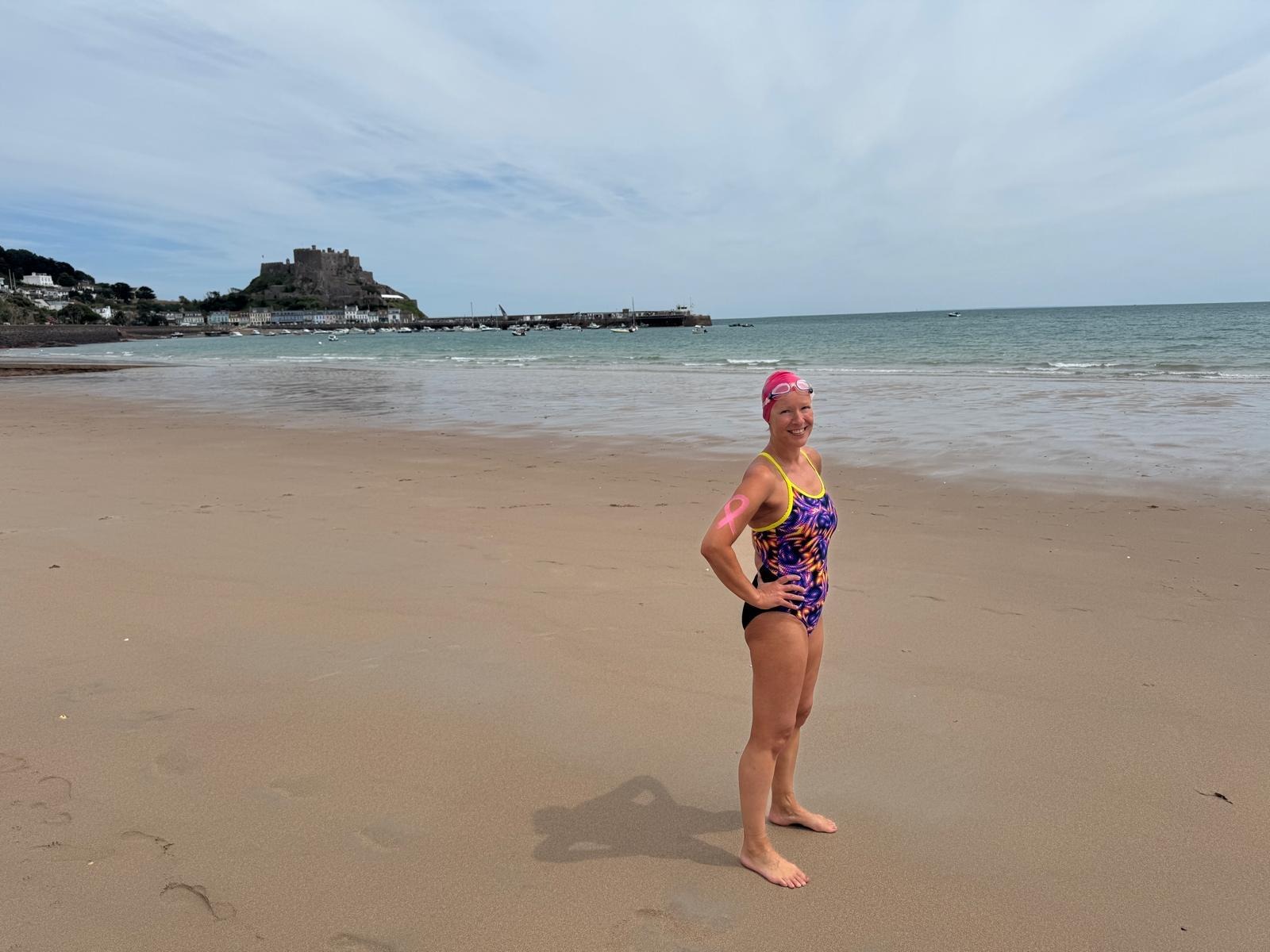
Nicky says: “Overall it was a beautiful and special swim. Touching the finishing wall was not just about completing the swim – it was about celebrating what is possible and making the most of each day.

“This swim is dedicated to the amazing NHS staff at the Western General Hospital and my local Colinton GP surgery. Their swift interventions, expertise and support are the reason I am here and was able to finally complete this swim.”

Nicky is hoping to raise £4000 for the Breast Cancer Institute of Edinburgh at the Western General Hospital Fund S03181.

This Fund is held within and managed by NHS Lothian Charity and is locally administered by stewards with strong links to the Edinburgh Breast Unit.

Every pound raised will support breast cancer research, specialist equipment, education  and enhancements to the patient experience:

https://www.justgiving.com/page/nicola-mather-4?utm_medium=FR&utm_source=CL

Hilariously brave stand-up show raises awareness for The House of Hope

Manogram – a man with breast cancer

Alan Wake, who poignantly tells his personal story of breast cancer in a stand-up comedy show, Manogram – a man with breast cancer, put on an exclusive performance in The Caves, for Edinburgh-based The House of Hope, Scotland’s first bespoke wellbeing centre for people impacted by breast cancer.

Alan’s incredible story is taking the Edinburgh Fringe by storm and explores a man’s experience of mammograms, mastectomies and hormone therapy, in a light hearted one-man show, which celebrates laughter and love through adversity, while raising awareness and funds for breast cancer.

When Alan was diagnosed with breast cancer in 2025, his wife had already been treated for the disease twice, and having to tell their two boys of a third breast cancer diagnosis in the family was unthinkable and according to Alan; ‘somewhat ridiculous.’

The special show received a standing ovation from the House of Hope community and supporters in the audience, when Alan asked the question; ‘Has anyone here been impacted by breast cancer?’ 

Alan said: “I was blown away by the support shown for the show and the audience unexpectedly taking to their feet was incredible. It was really moving and very powerful to see the whole room unite against breast cancer.”

House of Hope Manager, Hazel McLinden said: “Alan’s show adds a lot of love and light to people going through a breast cancer journey, which is so important. 

“We are thrilled that Alan selected The House of Hope as a charity partner and all donations will go towards improving and enhancing the wellbeing services for people impacted by breast cancer in Scotland and their families.”

Alan continues: “The impact breast cancer had on my wife Julie was totally devastating. While I have lost a breast and have a scar, most people wouldn’t realise I’ve been through breast cancer and that’s just not the same for women, who often lose a part of their identity through treatment and surgery.

“While breast cancer is no laughing matter, I wanted to raise awareness through humour, because that’s what I know best and my show gives a totally different perspective by exploring the weird and often humorous ways men support each other through banter and comradery.”

Manogram – a man with breast cancer – will continue to raise funds for breast cancer charities throughout its run at the Edinburgh Fringe, with shows running until 30th August.

For more information about Alan’s story and the important wellbeing services provided by the House of Hope visit houseofhope.org.uk.

Jane’s simple breast check gave her more time with the people she loves

If Jane McNiven (63), a GP Practice Manager from Alexandria, hadn’t checked her breasts in front of a mirror at home, she may never have known she had breast cancer and might have missed out on a year filled with precious family moments, and many more still to come.

Just over a year ago, Jane was lying in bed when she noticed something didn’t feel quite right when she lay on her side. It felt like a small lump, but when she stood up, it disappeared. Trusting her instincts, Jane decided to check her breasts properly in the mirror.

Standing face on and placing her hands around her neck, she could clearly see that something looked different in her right breast.

“It would have been completely undetectable if I hadn’t checked in front of the mirror,” said Jane. “I am so glad I did, because otherwise I would have just carried on as normal, completely unaware that anything was wrong.”

Jane contacted her GP and was quickly referred to the Breast Clinic at the Royal Alexandra Hospital for scans and a biopsy.

“It all happened very quickly. I was told I would need surgery followed by chemotherapy. It was a huge rollercoaster of emotions, but I felt grateful that I had found the lump early and that treatment could start straight away.”

Following surgery, Jane felt well enough to continue working between treatments.

“I was very fortunate to feel relatively well physically, but cancer also brings a mental and emotional load. I decided to focus on looking after my health and getting on with life as much as I could.”

Jane and her family are passionate dog lovers and, just before her diagnosis, she had taken on two new puppies bringing her total to four Scottish Highland Terriers (Scotties): Edward, Ebony, Tromie and Dugald.

“My family and the dogs kept me going. I walked them every day, which really helped keep my fitness levels up. I then decided to start walking to raise money for cancer charities.”

Jane’s granddaughters, Daphne (11) and Evie (9), also wanted to help. They organised a school fundraiser through the charity event Scotties in the City, raising money for Maggie’s, the cancer support charity. Earlier this year, the girls attended Crufts, where they were awarded the Young Person’s Award in recognition of their fundraising efforts.

“Going to Crufts is really special for our family, and seeing the girls recognised for their fundraising was one of my proudest moments,” said Jane.

“It’s something I might never have experienced if I hadn’t checked my breasts, been diagnosed early and received treatment.”

Now recovering and looking to the future, Jane is determined to share her message with others.

“I urge everyone to check their breasts regularly. Look, feel, and know what’s normal for you. Even if you attend regular screening or have recently been given an all-clear, changes can still happen in between.

“Checking my breasts, especially looking in the mirror, saved my life. Please make it something you do for yourself.”

Rosemary Stevens, Consultant Clinical Oncologist at NHS Greater Glasgow and Clyde, said: “Jane’s story is a reminder of why being breast aware is so important. Breast screening can save lives, but it is also vital that people know how their breasts normally look and feel and check for changes in between screening appointments.

“Also, this is important for women who may not yet have reached the routine screening age of 50.

“Checking your breasts doesn’t need to take long and there’s no right or wrong way to do it. NHS Inform advises looking at your breasts in the mirror with your arms by your sides and then raised, and feeling all areas of the breast, up to the collarbone and into the armpit, using both light and firmer pressure. What matters most is getting to know what’s normal for you.

“If you notice any change, whether it’s a lump, a change in shape, skin texture, nipple position or discharge, please contact your GP practice without delay. Finding cancer early often means treatment is more straightforward and outcomes are better.”

Changes in breasts to be aware of are:

  • a lump or bump, or an area of thickened tissue on one or both breasts
  • a change in the size or shape of one or both breasts
  • a lump or swelling in either armpit
  • skin on either breast that looks like orange peel
  • crusting on or around either nipple
  • a leaking nipple, that may or may not include blood
  • dimples on your breast, or skin that’s become drawn in
  • a nipple that’s become turned in

For more information on checking your breasts visit:

https://www.nhsinform.scot/healthy-living/screening/breast-screening

For more information on NHSGGC cancer screening visit: 

https://www.nhsggc.scot/your-health/public-health/public-health-screening/adult-screening-programmes/

New discovery could halt secondary breast cancer growth

Finding could prevent disease spreading

Scientists at the Cancer Research UK Scotland Institute have made a discovery which could help stop the spread of breast cancer – one of the leading causes of death from the disease.

The research, published in the journal Embo Reports, found there are key metabolic changes which occur in the body before the cancer spreads, offering a vital window to intervene.

Detecting these changes early could allow therapies to stop cancer cells being able to move around the body and grow tumours elsewhere. 

The study was conducted in the labs of Professor Jim Norman and Professor Karen Blyth at the Cancer Research UK Scotland Institute and the University of Glasgow.

Study lead Dr Cassie Clarke, of the Cancer Research UK Scotland Institute and University of Glasgow, said: “This study represents a major shift in how we think about preventing the spread of breast cancer.

“By targeting these metabolic changes as early as possible we could stop the cancer progressing and save lives.”

With around 56,800 people diagnosed with breast cancer in United Kingdom each year * and around 11,300 people sadly losing their lives to the disease each year, finding new ways to tackle it is vital.**

Thanks to research, breast cancer has become a far more treatable disease, but once it spreads to other areas within the body it becomes harder to control effectively.

Understanding how and why breast cancer spreads is key to preventing the disease becoming unmanageable with current therapies.

Cancer Research UK’s Director of Research, Dr Catherine Elliott, said: “Discoveries in cancer research have made huge strides in making breast cancer a far more treatable disease than ever before.

“However, metastasis – when cancer spreads – is a major factor in breast cancer becoming harder to treat especially if the cancer returns months or even many years later.

“This discovery gives us new hope for detecting and stopping metastasis early and ensuring people have many more years with their families and loved ones.”

This new study focused on how breast cancer changes the immune system so it can’t tackle cancer cells as they begin their spread.

The researchers found that cancer changes the metabolism (the way cells make and use energy) of specific immune cells, resulting in them releasing a prominent metabolite called uracil.

Uracil is a molecule key to essential processes in the body which was found to help distant organs build a “scaffold” to grow secondary tumours elsewhere in the body.

By blocking an enzyme called uridine phosphorylase-1 (UPP1), which produces uracil, the scientists were able to stop this scaffold forming in mice and restore the ability of the immune system to kill secondary cancer cells to prevent metastasis.

This opens the door to new potentially powerful new tools to tackle cancer – detecting uracil in the blood could help spot early signs of cancer spread then blocking UPP1 with drugs could stop the spread before it starts.

The research was funded by Cancer Research UK, the Wellcome Trust, the Medical Research Council, Breast Cancer Now and Pancreatic Cancer UK.

Simon Vincent, chief scientific officer at Breast Cancer Now, said: “This is an exciting piece of joint research that expands our understanding of how secondary breast cancer develops.

“The researchers discovered that high levels of a protein called UPP1 may make some cancers, including breast cancer, more likely to spread to other parts of the body, where the disease becomes incurable.

“In mice, targeting the UPP1 protein before secondary breast cancer developed led to fewer secondary breast tumours and a boosted immune response in the lungs.

“Now we need more research to see if this new insight can be turned into new drugs that stop secondary breast cancer, and potentially other secondary cancers, in their tracks. With around 61,000 people living with secondary breast cancer in the UK, research like this is vital.”

The team are now further investigating exactly how UPP1 changes the behaviour of immune cells, exploring the role of immune cell metabolism in early breast cancer initiation, and testing the ability of drugs that block immune cell metabolism to prevent cancer occurring.

Last chance to take part in an Edinburgh Moonwalk

ANNOUNCEMENT!📢

This year the MoonWalk Scotland is going to be super special as 2025 will be the final time in Edinburgh! We are SO excited to break the news that the MoonWalk will be going on tour to a new city🌃

With just a few more weeks to go, there is still time to enter and stride through beautiful Edinburgh by night, all whilst fundraising for an amazing cause!

Sign up now and get ready for a weekend of fun, inspiration and smiles:

ttps://walkthewalk.org/challenges/the-moonwalk-scotland/

The MoonWalk Scotland brings sparkle to the streets of Edinburgh!

Scotland’s iconic night time fundraising event, The MoonWalk Scotland, lit up the streets of Edinburgh last night (Saturday 7th September)

Hundreds of women, men and young people wearing brightly decorated bras or colourful “bra t-shirts” set off from Holyrood Park at 11pm, to walk a half or full marathon through the capital, to raise money for breast and other cancers.

Glittering light installations showed MoonWalkers the way, with iconic buildings across the Edinburgh skyline also lit up pink in their honour, including:  Camera Obscura, Lloyds on the Mound, the Royal Society of Edinburgh, Edinburgh International Conference Centre, Radisson Blu Hotel and the Stamp Office.

Dozens of walkers also took on a walking challenge virtually, in their own areas.

Organised by breast cancer charity Walk the Walk, Scotland’s MoonWalk has raised an incredible £22 million since the event was first staged in 2006.

Funds awarded by Walk the Walk make a huge difference to people across Scotland living with cancer – recent grants have been made to the Beatson Cancer Charity, Ayrshire Cancer Support and Make 2nds Count. 

To register your interest for The MoonWalk Scotland 2025 go to:

 www.walkthewalk.org

Make 2nds Count announces Monumental Milestone

The innovative service celebrates a pivotal achievement in advancing patient access to clinical trials

Make 2nds Count, a pioneering charity dedicated to raising awareness and funding research for secondary breast cancer, is proud to announce that – championed by a generous grant from Breast Cancer charity Walk the Walk – their Patient Trials Advocate (PTA) service has so far supported 500 secondary breast cancer patients across the UK, marking a significant milestone and pivotal achievement in advancing patient access to clinical trials.

In a noteworthy collaboration, the Walk the Walk charity – organiser of the iconic MoonWalk London and MoonWalk Scotland fundraising events – has donated £79,434 to the PTA service, which was originally launched in 2021. These funds will be used to finance the full initiative for the next 9 months to a year, demonstrating the collective effort to make a meaningful impact in the lives of secondary breast cancer patients.

Nina Barough CBE, Founder and Chief Executive of Walk the Walk said: “I am really delighted to share the news of the recent grant which Walk the Walk has awarded to Make 2nds Count.

“This funding will specifically contribute towards the charity’s ground-breaking Patient Trials Advocate Service. This much-needed service is designed to bring together women with breast cancer, who might not otherwise have had access to clinical trials, and for many of whom this is the last resort of treatment.  

“By collaborating, charities can make such a huge difference to so many people, and we are incredibly proud to be supporting Make 2nds Count and what they achieve in raising awareness and funding research for secondary breast cancer.

“Whilst Walk the Walk supports its own campaigns, grants like this one are very exciting and wonderful to share with Walk the Walk’s fundraisers – I cannot thank these generous and wonderful people enough!”

Make 2nds Count’s PTA service is the first of its kind in the UK, offering fresh hope to patients by connecting them with clinical trials that have the potential to improve outcomes and extend life.

Since its pilot launch in 2021, the PTA service has provided support to over 500 patients, with a remarkable 100% endorsement from those who have experienced the initiative. Furthermore, 95% of patients expressed their willingness to engage in discussions with their clinicians about the possibility of accessing clinical trials.

Patient Trial Advocate, Senior Research Nurse Vivienne Wilson, expressed her enthusiasm for the service, stating, “I’ve been working with Make 2nds Count for over two years now, and I think this service really is one of a kind.

“I enjoy the opportunity to talk to many secondary breast cancer patients, sharing my knowledge with regards to available trials and guiding them to explore their options.”

One such patient is Margaret Irvine, who was diagnosed 8 years ago with secondary (metastatic) breast cancer after an original diagnosis of primary breast cancer 9 years before that.

A person standing on a path

Description automatically generated

Margaret – who is a trained District Nurse and has worked in the community throughout her career -says: “The worst part of being diagnosed was telling my close family – any negative changes are always hard to deal with.

“Finding information is never easy as most of it is very negative or outdated when beginning to research, but I tried my best and the unit I originally attended for treatment was very supportive. As my treatment progressed, I became aware of Make 2nds Count and I started talking to people about the PTA Service.

“Access to the service has given me new hope and support, as well as a new way of opening discussions with my treatment team and allowing myself and others as patients to have more control of the journey we are on. This is the main reason I decided to share my experience with others too.”

Secondary breast cancer, also known as metastatic, advanced, or stage IV breast cancer, claims the lives of 1000 women in the UK each month and is currently affecting 61,000 people, yet it remains a relatively unknown and underrepresented area of research.

The PTA service, which covers the UK with dedicated nurses based in Edinburgh, the Borders, and the Highlands, provides patients with personalised support and information. Patients undergo an initial one-to-one, hour-long phone consultation with specialist nurses who offer guidance on clinical trials, address queries, and assist in searching for suitable trials.

The ultimate goal is to empower patients to discuss clinical trials as a viable part of their treatment pathway.

Nina Barough CBE, Founder and Chief Executive of Walk the Walk adds: “We could not do any of the special work we do without everyone’s help, so sign up now at www.walkthewalk.org for The MoonWalk London on Saturday 18 May and join this incredible fun-filled ‘Fiesta’ of a night. 

“A night which brings people together all putting one foot in front of another to reach their own personal goal of walking a Half or Full Marathon through the night, whilst helping others. Come and see for yourself, it really is breath-taking!”

Make 2nds Count is dedicated to continuing its mission, ensuring that every patient with secondary breast cancer has the knowledge and opportunity to explore clinical trials as an integral part of their treatment journey.

If you are a secondary breast cancer patient who may be interested in clinical trials and the PTA service, please visit our website:

 – https://make2ndscount.co.uk/support/pta

MoonWalk Scotland lights up the night-time streets of Edinburgh

The MoonWalk Scotland returned to the streets of Edinburgh in a blaze of colour last night (Sat 9th Sept).

Women, men and young people wearing brightly decorated bras or colourful “bra t-shirts” set off from Holyrood Park in balmy, late summer temperatures at 11pm, to walk a half or full marathon through the capital. 

Organised by breast cancer charity Walk the Walk, the first MoonWalk Scotland was staged in 2006. Since then, walkers have raised almost £22 million, which is granted across Scotland to help support those living with cancer. 

Walk the Walk recently awarded £50,000 to the charity Cancer Support Scotland, to help reduce the waiting list for Scottish cancer patients and their families, who are in desperate need of emotional and wellbeing support.

Many buildings and landmarks across Edinburgh lit up pink throughout the night in honour of Walk the Walk’s amazing walkers and volunteers.

These included Edinburgh Castle; Camera Obscura, Lloyds on the Mound; Royal Society; Edinburgh; Victoria Quay, Leith, Radisson Blu Hotel, St. Andrew’s House, Prestonfield House Hotel; Edinburgh International Conference Centre.

Rachel Groves (59) from Edinburgh completed the 26.2 miles Full Moon. Rachel was diagnosed with breast cancer in January 2023, having battled for almost a year to be examined in person by her GP.

Rachel said; “I’m chuffed to bits to have completed The MoonWalk with my daughter, sister, nieces and closest friend.

“It was quite an incredible experience: amazing volunteers, very non-traditional Edinburgh weather and a cause we all truly believe in.

“For me, personally, it was particularly humbling to be fundraising knowing that MoonWalk organisers breast cancer charity Walk the Walk funded the unit which treated me at the Western General Hospital in Edinburgh.

“And here I am, less than five months after a mastectomy, walking the walk!“

Fiona Watson, (56) from Elgin, took part in her first Moonwalk, completing the 13.1 miles Half Moon. Fiona has been on constant treatment for secondary breast cancer since 2014.

She said: “Our team thoroughly enjoyed completing the Half Moon. It was uplifting and challenging, amongst many other emotions, and there was a tremendous feeling of unity throughout the night – the organisers and the volunteers were first class from start to finish.

“The warmth we experienced from the city of Edinburgh was immeasurable and we are also quite overwhelmed and humbled by the generosity of all our sponsors.

“By taking part in The MoonWalk, I hope I’ve raised awareness that it is possible for anyone newly diagnosed with breast cancer (or indeed secondary breast cancer) to still lead a relatively normal life.”

Nina Barough CBE, Founder and Chief Executive of Walk the Walk, said: “What an incredible night! It was wonderful to see so many people taking part, including a large number who were totally new to MoonWalking.

“Together, everyone was uniting not only to raise awareness of breast cancer, but also valuable funds which will help improve the lives of people across Scotland living with the disease.

“The collective pink hug from so many iconic buildings across Edinburgh which had lit up pink for the occasion was such a huge boost for our Walkers and Volunteers, as was the unseasonably warm weather!

“Keep helping us make a difference by signing up for The MoonWalk Scotland 2024!” 

Entries are already open for The MoonWalk Scotland on Saturday 7th September 2024. Sign up now www.walkthewalk.org

Breast cancer charity Walk the Walk funds vital support for people across Scotland affected by cancer

Breast cancer charity Walk the Walk has granted £50,000 to help reduce the waiting list for Scottish cancer patients, and their families, who are in desperate need of emotional and wellbeing support.

The funds will allow Cancer Support Scotland, based in the grounds of Glasgow’s Gartnavel Hospital, to provide 174 people with wellbeing support at the time when they need it most. The charity has seen a dramatic increase in referrals recently and is being contacted by up to a dozen new patients from across Scotland every single day.

The current waiting list for appointments is up to 12 weeks. Walk the Walk’s grant will allow people to get vital assistance much sooner, either online or at Cancer Support Scotland’s centre.

·         Counselling – providing patients with the tools to deal with their diagnosis

·         Complimentary therapy – in person sessions, designed with relaxation in mind 

·         Befriending – informal wellbeing calls to help reduce isolation, fear and anxiety

Walk The Walk – Moon Walk – Edinburgh. Picture Shows; Walkers set off from the start line of this years Moon Walk through the street of Edinburgh. Saturday 11 June 2022. ©Stuart Nicol Photography 2022


Entries are now open for The MoonWalk Scotland 2023, organised by breast cancer charity Walk the Walk.

On Saturday 9th September, thousands of women and men wearing decorated bras will set off from Holyrood Park in Edinburgh to walk an overnight half or full marathon through the streets of the capital.

Sign up now at www.walkthewalk.org

Michael MacLennan, Interim CEO of Cancer Support Scotland, said: “We are absolutely delighted to receive a £50,000 grant from Walk the Walk.

“We understand these are challenging times for everyone and these incredible funds will allow us to continue supporting those that need us, when they need us most.

“Each year we continue to see a rapid rise in demand for our services, and thanks to the generosity of Walk the Walk we’ll be able to provide 174 people with 6 vital wellbeing appointments.”

Susan (52) from Glasgow received counselling from Cancer Support Scotland, following her cancer diagnosis. She said: “My mood was very low and I was often feeling anxious. I was also spending a lot of time in my flat, not going out much and felt as if sometimes people didn’t understand why I wasn’t feeling great, as my treatment had ended.

“I didn’t understand that myself if I’m honest. I still struggle at times but I’ve received so much non-judgemental support, motivation, encouragement, and laughter (which is so important) through these sessions.”

Nina Barough CBE, Founder and Chief Executive of breast cancer charity Walk the Walk said: “I was deeply upset to hear about the unacceptable length of time people are having to wait for wellbeing support, following their cancer diagnosis.

“Whilst 12 weeks might not seem very long in some people’s worlds, if you’ve just found out you have cancer, it’s a lifetime!

“In 2023, Walk the Walk is releasing £1 million to help fund innovative support like that provided by Cancer Support Scotland. It’s a tough time for cancer patients across Scotland, so I’m delighted that Walk the Walk has been able help so many people.”

Secondary breast cancer highlighted at Scottish Parliament

A charity supporting secondary breast cancer patients took its campaign to be heard to the Scottish Parliament from the 29th November to the 2nd December.

Edinburgh-based Make 2nds Count is highlighting the shocking toll of the disease which claims 1000 lives each month in the UK – an average of 31 deaths every day – and its pioneering Patient Trials Advocate service (PTA).

Make 2nds Count raises awareness of secondary breast cancer, a form of the disease which has spread beyond the breast to other parts of the body. Also known as metastatic, advanced or stage IV breast cancer, it currently affects around 35,000 people in the UK. 

It is incurable but can be treated and the charity has developed the PTA service to introduce patients to clinical trials which can help to improve outcomes and extend life.

The initiative, the first of its kind in the UK, started in Scotland through nurses based in Edinburgh, the Borders, and the Highlands, and has recently been extended across England, Wales, and Northern Ireland.

The Make 2nds Count team is in the parliament building for the next week staging an exhibition highlighting its work and the signs of secondary breast cancer.

Emma Hall, Head of Operations for Make 2nds Count says: “Secondary breast cancer is a little-known form of the disease and we are delighted to have this opportunity to raise awareness of it and our work, particularly the Patient Trials Advocate service.

“We would like to thank the Scottish Parliament for the chance to get our message across to such an influential audience.”

To find out more about Make 2nds Count and the Patient Trials Advocate service visit: 

https://www.make2ndscount.co.uk/funding-research/patient-trials-advocate/ 

Photo Caption: MSPs pictured in the Scottish Parliament buildings on Wednesday 30th November supporting Make 2nds Count and their work campaigning for more research, support and education for the Secondary Breast Cancer community across the UK