CCTV appeal following Leith assault

Police are continuing to investigate an assault in Leith. Officers have released CCTV images of a man that they believe may have information that can assist them with their enquiries.

The incident happened at a pharmacy on Duke Street around 1pm on Wednesday, 25 March, 2020.

A female victim was spat at following a disturbance and the door of the pharmacy was also damaged.

The man shown in the images is described as white, 18 to 25-years-old and of slim build.

He is shown in the images wearing a navy blue jacket, grey hoodie with the hood up, dark jogging bottoms and blue reflective trainers with black soles. He is also shown carrying a black backpack.

Constable Henderson of Leith Police Station said: “The victim was left extremely shaken by this assault.

“We would urge anyone who may be able to help our enquiries or who recognises the man seen in the CCTV images to come forward.

“Information can be passed to Police Scotland by calling 101, quoting incident 1406 of 25 March, 2020, or call Crimestoppers anonymously on 0800 555 111.”


Coronavirus: England attempts to get housing market moving

UK Housing Secretary Robert Jenrick led yesterday’s daily press briefing and outlined the measures announced to restart, reopen and renew the housing market in England.

Scotland’s First Minister updated MSPs at Holyrood and repeated the ‘Stay At Home’ message.

Good afternoon,

As Housing Secretary, I’m going to set out our comprehensive plan to safely restart, reopen and renew the housing market.

But first, I want to update you on the latest data on the coronavirus response.

  • 2,094,209 tests for coronavirus have now been carried out in the UK, including 87,063 tests carried out yesterday;
  • 229,705 people have tested positive, that’s an increase of 3,242 cases since yesterday;
  • 11,327 people are in hospital with COVID-19, down 15 per cent from 13,273 last week;
  • And sadly, of those tested positive for coronavirus, across all settings, 33,186 have now died. That’s an increase of 494 fatalities since yesterday.

These figures includes deaths in all settings not just in hospitals.

Before turning to the housing market I want to remind people of how we will address this phase of our fight against Covid-19. Firstly, in order to monitor our progress, we are establishing a new COVID Alert Level System, with five levels, each relating to the level of threat posed by the virus.

The alert level will be based primarily on the R value and the number of coronavirus cases.

And in turn that alert level will determine the level of social distancing measures in place.

The lower the level the fewer the measures; the higher the level the stricter the measures.

The social distancing measures remain critical in our efforts to control the virus.

Throughout the period of lockdown which started on March 23rd we have been at Level 4 – meaning a Covid19 epidemic is in general circulation, and transmission is high or rising exponentially.

Thanks to the hard work and the sacrifices of the British people in this lockdown, we have helped to bring the R level down, now that we are in a position to begin moving to Level 3, we will do so in time, in careful steps.

We have set out the first of three steps we will take to carefully modify the measures and gradually ease the lockdown, and begin to allow people to return to their way of life – but crucially doing so while avoiding what would be a disastrous second peak that could overwhelms the NHS.

After each step we will closely monitor the impact of that on the R and the number of infections, and all the available data will be used, and we will only take the next step when we are satisfied that it is completely safe to do so.

The first step – from this week:

  • Those who cannot work from home should now speak to their employer about going back to work.
  • You can now spend time outdoors and exercise as often as you like.
  • You can meet one person outside of your household in an outdoor, public place provided you stay two metres apart.

The second step – from 1 June , at the earliest, as long as the data allows, we will aim to do the following:

  • Primary schools to reopen for some pupils, in smaller class sizes;
  • Non-essential retail to start to reopen, when and where it is safe to do so;
  • Cultural and sporting events to take place behind closed doors, without crowds.

And then Step 3 – no earlier than 4 July, and again, only if the data says it safe to do so, we aim to allow:

More businesses and premises to open, including potentially those offering personal care such as leisure facilities, public places, and places of worship. And on that last point, I have been speaking to faith leaders and will convene later this week a taskforce to establish when and how places of worship can openly safely for some of the practices where social distancing can take place, such as private prayer, potentially private prayer being able to be carried out earlier than 4 July.

(NOTE: These plans are for ENGLAND ONLY. Scotland, Wales and Northern Ireland are currently sticking with the STAY AT HOME message – Ed.)

Many of these businesses and organisations will need to operate in new ways to ensure they are safe, and we will work with those sectors and individuals on how to do this.

Having taken the first step in carefully adjusting some of the measures and our advice to people on what to do, we have also updated what we are asking people to do, which is to Stay Alert, to Control the Virus and Save Lives.

For many people the appropriate course still means staying at home as much as possible. But there are a range of other actions we’re advising people to take when they do go out to work or for other activities.

Limiting contact with other people;

Keeping distance if you go out – two metres apart where possible;

Washing your hands regularly;

Wearing a face covering when you are in enclosed spaces where it’s difficult to be socially distant – for example in some shops or on public transport;

and if you or anyone in your household has symptoms, you all need to self-isolate.

If everyone stays alert and follows these rules, we can control coronavirus by keeping the R down and reducing the number of infections. This is how we can continue to save lives, and livelihoods, as we begin as a nation to recover from coronavirus.

And as we begin to recover from coronavirus, it’s essential that we cautiously open essential parts of our economy, where it is safe to do so.

Earlier today in Parliament, I made a statement setting out our clear, coherent and comprehensive plan to restart, reopen and renew the housing market and our construction industry.

I’m sure that this will be of interest to many people at home who are hoping to move house, and I’d like to set out what this means in more detail.

From today anyone in England can move house if they follow new guidance we have published on gov.uk.

When the lockdown was announced in March, we changed the rules so that people could only move home if they thought it was “reasonably necessary”.

That meant that more than 450,000 buyers had to put their plans on hold.

And each month 300,000 tenancies come up for renewal as well.

A significant proportion of these will result in people needing to or wanting to move home. The pressure to move for some was becoming acute, with serious legal, financial and health implications.

During an already very difficult time, these people have been stuck in limbo. Now they can carry on with their house moves and add some certainty to their lives.

So, from today:

  • Estate agents’ offices can re-open;
  • Viewings – whether virtual or in person – are permitted;
  • Show homes can open;
  • And removal companies and the other essential parts of the sales and letting process are re-started with immediate effect.

For most people moving home is not a luxury. People decide to move home because their personal circumstances change.

The changes that I have announced today are happening safely in order to control the virus and to protect the public.

We have published very detailed guidance, informed by public health advice, to explain how this can be achieved, with all parties observing hygiene measures and social distancing guidelines.

People have asked why they would be able to look around a stranger’s house, but not visit their parents or loved ones at home.

Now I understand why that might seem confusing at first glance – especially when people have been separated from their loved ones for so long.

But our guidlines makes clear that in the first instance that viewings should happen virtually. When viewings do happen in person, we’ve set out a clear plan to ensure the safety of those already in the property intself, those considering moving in and the estate agents and lettings agents.

These requirements include:

Visits being by appointment only, open house viewings not taking place, and speculative viewings where buyers or tenants are not serious yet, are highly discouraged.

All parties following strict social distancing guidelines

All internal doors should be opened where possible

The current occupier vacating the property for the duration of the visit, going out for their daily exercise, going out to the shops or standing in the garden, if that is possible.

All involved in the process washing their hands upon entering the property. And, once the viewing has taken place, all surfaces in the property including the door handles, should be thoroughly cleaned.

There are of course exceptions. For those who are self-isolating or have coronavirus, they should not be moving or going back to work or allowing trades people or professionals into their home.

Where this is the case, all parties involved in house buying or selling should prioritise agreeing amicable sensible arrangements to change move dates for the individuals concerned. That has been happening across the country in recent weeks and it will need to continue.

We would also ask those who are clinically vulnerable and those who are shielding to consider very carefully their personal situation and to seek personal and specific medical advice before deciding whether to commit to or proceed with moving home.

If you are in this situation, and you decide that you must go ahead, all professionals involved must be made aware so that they can put in place any additional precautionary measures to provide further protection for your health and further legal protection to make sure the transaction goes as smoothly as can be expected.

A vibrant housing market means more than buying and selling homes. We need to get back to building again and Britain needs that.

It is something that this Government has always been committed to. Something that our ambitious First Homes programme will do later this year, with a 30% discount on new homes for key workers including nurses and teachers and police officers as well as local first time buyers.

We want them to be ready as soon as possible and that’s just one of the reasons I am keen to get construction up and running.

To help with this today I am announcing further steps to support safe house building by allowing more flexible working hours on construction sites, where it’s appropriate and with local consent.

I am allowing sites to apply to extend their working hours, again with immediate effect, to 9pm Monday to Saturday in residential areas and beyond that in on-residential areas and setting out a very clear Government position that these applications should be approved by local councils unless there are very compelling reasons why this is not appropriate.

Varied start and finish times will make it easier for sites to observe social distancing, take the pressure off public transport like the tube in London, and keep Britain building.

There are countless examples of the industry behaving responsibly and proactively during this pandemic.

I’d like to thank today Taylor Wimpey, who now have now got construction safely underway on the majority of their sites and have started removing staff from the furlough scheme and getting back to work on full pay.

They are offering a discount of 5% for NHS staff and care workers on new homes – a great way to recognise the contribution that our front line heroes are making to the country.

So thank you to them.

It’s also time that the planning system makes more use of digital technology to operate remotely and efficiently during this pandemic.

I am determined that the planning inspectorate be at the forefront of this work – I welcome the inspectorate now undertaking its first ever virtual hearings.

I am asking them to make all hearings virtual within weeks so that the planning system can resume and be made more permanently more accessible and user-friendly.

This is the most comprehensive restarting of an industry in the first phase of our roadmap with few if any transactions there is no visibility and no precedent with which to accurately judge the state of the housing market, but history tells us that in each economic recovery in modern British economic life the housing market has been key to recovery and revival.

As Housing Secretary, I will do everything I can to support the millions of people employed in the construction and the housing industries, to help their sector bounce back, while always prioritising their safety and wellbeing.

Almost 100 separate organisations have already signed up to the Charter for Safe Working Practice, pledging that they will share the responsibility to ensure that their sites operate safely and in accordance with Government advice.

I’d like to thank all of all of those who have signed and encourage the whole industry to join them.

Today we reopen, we restart and renew the housing market and construction industry to protect lives, to save jobs and to begin rebuilding our economy.

Thank you.

The UK Government’s plans to get England back to work have come in for scathing criticism. Teaching unions yesterday published a joint statement on the safe reopening of schools in England.

The statement follows a longer statement to the Secretary of State on Friday (8 May), which set out in full detail the principles and tests necessary for the safe reopening of schools. It is signed by AEP, GMB, NAHT, NASUWT, NEU, NSEAD, Prospect, UNISON and Unite.

Full text of the education union’s statement:

“We all want schools to re-open, but that should only happen when it is safe to do so. The government is showing a lack of understanding about the dangers of the spread of coronavirus within schools, and outwards from schools to parents, sibling and relatives, and to the wider community.

“Uniquely, it appears, school staff will not be protected by social distancing rules. 15 children in a class, combined with their very young age, means that classrooms of 4 and 5-year olds could become sources of Covid-19 transmission and spread.  While we know that children generally have mild symptoms, we do not know enough about whether they can transmit the disease to adults. We do not think that the government should be posing this level of risk to our society.

“We call on the government to step back from the 1st June and work with us to create the conditions for a safe return to schools based on the principles and tests we have set out.”

The principles and tests include (see full statement from Friday 8 May, linked to below):

  • Safety and welfare of pupils and staff as the paramount principle
  • No increase in pupil numbers until full rollout of a national test and trace scheme
  • A national Covid-19 education taskforce with government, unions and education stakeholders to agree statutory guidance for safe reopening of schools
  • Consideration of the specific needs of vulnerable students and families facing economic disadvantage
  • Additional resources for enhanced school cleaning, PPE and risk assessments
  • Local autonomy to close schools where testing indicates clusters of new covid-19 cases

Statement to the Secretary of State for Education on 8 May: The full statement setting out the principles and tests can be found here:

https://www.tuc.org.uk/news/unions-set-out-needs-safe-reopening-schools-letter-education-secretary

Man jailed for Grassmarket attacks

A man who attacked three people in the city centre in November 2018 has been jailed.

At the High Court in Edinburgh yesterday, Peter Cameron was sentenced to a minimum of 6 years imprisonment and subject to an order for lifelong restriction following the attempted murder of two women and the serious assault of one man outside a hotel in the Grassmarket.

The judge further informed Mr Cameron that under the terms of his indeterminate sentence he must not assume he will be released at the end of the 6 year period.

Cameron, 39, approached the 59 and 62-year-old female victims as they stood within a vennel area and spoke briefly with the pair before walking off. He returned a short time later in possession of a knife and assaulted the pair, leaving them with serious injuries.

A 39-year-old male employee from the hotel then came to the women’s aid and sustained a hand injury during a struggle with Cameron, who then ran off from the area.

Gayfield CID launched a thorough investigation into the attacks and Cameron was arrested later the same evening.

He pled guilty to the attempted murder of one woman and the serious assault of the man, while he was found guilty of the second attempted murder, in court on Tuesday 18th June.

Detective Sergeant Gavin Howat from Gayfield CID said: “Peter Cameron subjected two women to a horrifically violent and unprovoked attack, and also injured another men who stepped in to help them.

“There is absolutely no doubt in my mind that, had it not been for the courageous intervention of the hotel employee, Cameron would be commencing a custodial sentence for murder.

“I want to take this opportunity to thank this individual for his selflessness and bravery, and for his assistance with our investigation, which resulted in Cameron’s arrest.

“This sentence should send a clear message that violent crime will not be tolerated in Edinburgh.”

Price-gougers selling Covid-19 essentials for up to TEN TIMES the typical price

A Which? investigation has uncovered hundreds of listings for essential products at inflated prices sold via online marketplaces, and has found evidence that thousands of items have been sold at these rip-off rates. 

The first page of search results for some popular brands on online marketplaces such as Amazon Marketplace and eBay were rife with household essentials being sold for at least double the typical supermarket price, as some third-party sellers seek to profiteer amid the coronavirus crisis – and Which? has heard similar reports from consumers who are vulnerable or in desperate need of these in-demand items.

The consumer champion has also uncovered evidence on eBay that thousands of these essential products such as hand sanitiser, cleaning products, toilet roll and tissues are being purchased at these high prices by consumers.

Unknown to the brands, the unscrupulous traders often exploit popular household names such as Andrex, Carex, Dettol and Kleenex in order to profit.

Which? recognises that action is being taken against price-gouging by both Amazon and eBay through blocking and removing large quantities of listings or offers and suspending accounts, but its investigations continue to find large numbers of essential products being listed for sale at inflated prices, suggesting measures from marketplaces alone are not enough and government intervention is needed.

Based on the first page of search results for Carex on Amazon Marketplace, more than half (56%) of Carex products, including hand wash and hand sanitiser, were being sold for five times the typical supermarket price or more and one in 10 (9%) were on sale for 10 times the price.

In fact, 98 per cent of those items on the first page of search results were on offer for double the typical price or more.

For Dettol products listed by Amazon sellers on the first page of search results, which included antibacterial soap, wipes and spray, around six in 10 (63%) of listings were double the price or more.

On the first page of listings for Dettol on eBay, Which? researchers found that not only were nearly nine in 10 (85%) of Dettol items being sold for double the typical supermarket cost, but two in 10 (22%) were five times the typical price, and 8 per cent were 10 times the price.

Eight in 10 (81%) Carex products on the first page of search results  – including hand wash and antibacterial gels – were being sold on eBay for double the typical supermarket cost, while 60 per cent of Andrex and 50 per cent of Kleenex first page listings were double the typical price.

Which?’s new price-gouging reporting tool has also received hundreds of reports of inflated prices so far, six in 10 (58%) of which were about products sold on online marketplaces. Given that Amazon and eBay are by far the most popular online marketplaces in the UK, it’s no surprise that a large proportion of reports are about them.

Consumers are also encouraged to report any issues they see to Amazon and eBay directly.

Of the other 42 per cent, the majority were about supermarkets or large chain stores. One reason Which? set up the tool was due to the difficulty in investigating bricks and mortar cases during lockdown. A third of tool users also reported they are buying products even when they believe them to be at unfair prices.

Which? has heard from housebound vulnerable people who rely on essential items such as cleaning products to protect themselves from Covid-19 – and have reported the sky-high prices they have seen on online marketplaces.

Kathryn Taylor, 59, has a chronic lung condition and has to stay at home due to serious issues with her immune system. She saw a seller on Amazon Marketplace selling 1 litre of Dettol spray for £29.99.

She said: “It’s disgusting. I have had to use these products for years now for hygiene reasons for managing serious health conditions and the current shortages mean

“I have to try to look elsewhere if not available for my Tesco delivery, but I cannot afford to pay the prices.”

On eBay, a 500ml bottle of Dettol surface cleanser, usually sold for £1.75 or less, was listed for more than £9 by one seller. In the reviews, a buyer said that they had been forced to buy it at an ‘exorbitant price’ for their elderly mother who suffers from Parkinson’s disease.

Which? also saw issues on OnBuy, which claims to be one of the world’s fastest growing online marketplaces and was reported to Which? by people trying to find Dettol products.

One person who used Which?’s price gouging reporting tool said that they had found Dettol antibacterial washing machine cleaner on sale for £19.59 via OnBuy, instead of the typical £3.50. Another told Which? that they had been trying to buy Dettol anti-bacterial spray, and had found a bundle of three 750ml bottles on OnBuy for £45.94, rather than the usual £2.50 a bottle.

Which? found multiple examples of products listed by sellers for inflated prices via OnBuy. A bundle of six 750ml Dettol Power and Pure kitchen sprays, usually £3 each, was being sold for more than £40 including postage. A pack of Dettol wipes was for sale for £15.81, more than three times the usual £5.

Which? will be sharing its price-gouging tool data with the CMA, which has set up a special Covid-19 task force to look at issues faced by consumers.

Which? is calling for emergency legislation to give regulators the tools to swiftly crack down on price-gouging on certain essential products during this crisis, and any future ones.

Sue Davies, Head of Consumer Protection at Which?, said: “It cannot be right that potentially thousands of people have paid unjustifiably high prices to buy essential items during this Covid-19 crisis.

“While welcome, it’s clear that measures being put in place by online marketplaces are not enough to stop coronavirus profiteering by those seeking to exploit the current situation.

“The government, working with the CMA, needs to step in with emergency legislation to enable swift action to crack down on price-gouging and keep the price of essential items reasonable during crises both now and in the future.”

On Thursday 14 May at 9.30am, Which?’s Sue Davies will be giving evidence to the BEIS Select Committee about the impact of coronavirus on consumers: https://committees.parliament.uk/event/965/formal-meeting-oral-evidence-session/

Link for consumers to submit reports to Which?’s price-gouging tool: https://www.which.co.uk/pricegouging

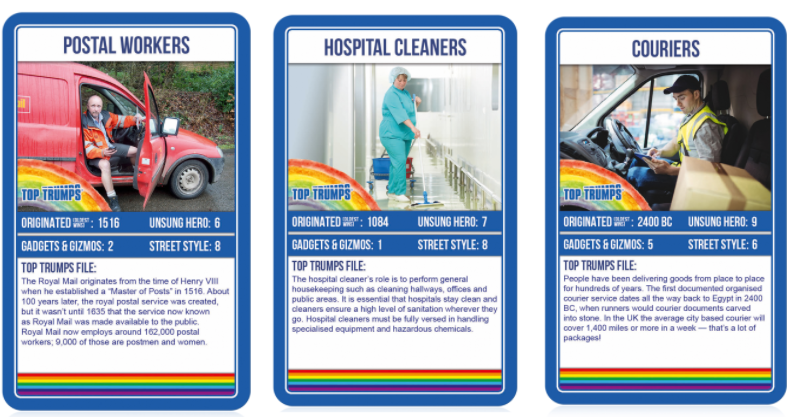
Binmen are tops in new key workers game

The unsung heroes and heroines of the Covid-19 pandemic are bin men and women, alongside couriers, shop workers, journalists and of course, doctors and nurses.

A brand new edition of Top Trumps, honouring Covid 19 key and essential workers, has hit shops … with profits being donated to the NHS.

The game lauds and applauds those key and essential workers who have saved Britain during the Pandemic : from doctors and nurses to less high-profile professions such as pest controllers, midwives and sea merchants.

Politicians, who are depicted on the Top Trumps card by Boris Johnson, and journalists are included too.

One of the four scoring sections in the new game is ‘Unsung Heroes’, and in that category it is the partners of key workers who come out top – they get a maximum 10 out of 10. Binmen and binwomen scored a point lower at nine out of ten. Less unsung heroes like doctors (8), nurses (8) and police (7) fare lower.

In its card citation Top Trumps point out that being a partner of a key worker is “stressful and worrying”.

Claire Simon, from Top Trumps, says: “Every single front-line key worker is, of course, a heroine and hero and would each score 10 (or even 11) out of 10 by any reckoning if we had devised a Hero category.

“By creating an Unsung Heroes category we have ensured varying marks, in keeping with the game’s core classic and its unique and much-loved branding.

“From our research, which has been intensively conducted over the six weeks, partners of key workers came out top in this section. There are an estimated one and a half million partners of key workers in Britain so that’s a lot of Unsung Heroes and Heroines.

“Many of the public we spoke to pointed out that partners too are putting their lives on the line, albeit less directly. As well as being there physically they are providing emotional support. For that reason we listed partners as key workers.”

Other features of the pack include: 

  • Binmen and binwomen being named as the most stylish of all the key and essential workers.  That’s because of their fluorescent and neon clothing, which is all the fashion rage at the moment. They score 10 /10 on ‘Street Style and as they are also runners-up in the ‘Unsung Heroes’ section then they are very much the card not to bin during the game!  In its card citation Top Trumps point out that refuse collectors first began their profession during the 14th Century Black Death that swept across Europe and add: “In terms of facing a pandemic, refuse collectors can rightly joke that ‘we’ve bin here before’ ”.
  • Stuffy politicians score just 1/10 in the style section – with teachers not doing much better and obviously in need of extra fashion homework. They get just 2/10.  Journalists only manage 5/10.
  • Religious and spiritual workers are listed by Top Trumps as the very oldest profession of all the workers in the pack in an ‘Originated’ section. They are named as first appearing in 50,000 BC, which easily wins this category.
  • Gadgets and gizmos winner is the journalist, which isn’t surprising bearing in mind the lightening media advances with Zoom and the like – since the start of the Pandemic. The profession with the least formal gadgets and gizmos includes mental health workers.
  • One of the very best cards to hold in Top Trumps terms is the courier. That’s because it features very well in the Originated section: at 2400 BC. It also scores very highly in the Unsung Heroes category – notching up a nine out of ten. And in terms of gadgets and gizmos it is only shaded by journalists.

Claire Simon, who is Global Marketing Manager at Top Trumps, added: “We are sure that this new edition of Top Trumps can lift spirits in this very challenging and unprecedented period of time, as well as raising money for the NHS, with all net proceeds going direct to the NHS.”

In this version of the celebrated card game 30 different professions are listed, each marked in typical Top Trumps style across four separate scoring categories:

  1. Unsung Heroes: In the pack Top Trumps explains: “All our key workers are heroes, but some jobs are often less praised. We want to make sure key workers are given the praise they deserve”.
  1. Street Style:  Top Trumps explains: “Neon is in! This section assesses the gear and garb a key and essential worker wears”.
  1. Gadgets & Gizmos:  “What equipment the worker uses and carries to do their job.”
  1. Originated:  “The year in which profession was established (or in the case of religious and spiritual workers the estimated year: 50,000 BC!).

Top Trumps Britain at its Best: Key Workers is available priced £5 exclusively at: winningmoves.co.uk and comes in a twin deck (the other pack being Britain at its Best: Hospitals.

CALA launches activity pack to keep kids busy at home

Housebuilder CALA Homes has created a free activity pack to help parents keep children entertained at home.  Downloadable from the CALA website, it includes a whole host of fun activities and creative projects to help kids uncover some hidden secrets about where they live.

Tasks include researching the history of their home, looking at the different property styles on their road, identifying the materials their home is made up of and discovering the variety of wildlife that share their outdoor space.

There are also some creative project ideas, from designing a bedroom of the future to writing a poem or short story on what home means to them.  There’s even a quick quiz to see if children can name the residents of some famous addresses from Buckingham Palace to Bikini Bottom.

Philip Hogg, regional sales and marketing director for CALA Homes East, said: “Many of us are facing the same challenge of keeping our children entertained and stimulated as we all stay at home.  The Your Home Activity Pack is full of ideas to keep them occupied and help them discover more about the place they call home.”

“We’ve designed the pack to cover a variety of different activities so there should be something to suit a range of interests and age groups. We’re asking people to share their completed projects with us and we can’t wait to see their creative ideas!”

CALA’s Your Home Activity Pack can be downloaded by visiting www.cala.co.uk/activitypack

It’s time to address gender inequality and racism in Edinburgh

The First Minister’s National Advisory Council on Women and Girls (NACWG) is urging Edinburgh residents to get behind the #GenerationEqual movement by sharing their experiences in its latest discussion surrounding racism and inequality and the need to eradicate racism to achieve equality in Scotland. 

Women and girls continue to face inequalities that negatively affect their daily life and the NACWG wants to find out more about these intersectional issues, including employment and career progression. The Advisory Council would like to hear from individuals of any gender and those who don’t identify within Edinburgh to understand any/all challenges of racism and inequality. 

The NACWG was established as a catalyst for change, playing a leading role in raising the issue of gender inequality on Scotland’s agenda by providing a challenging voice to the First Minister.

Focusing on different spotlight themes, the Advisory Council encourages people to share ideas and opinions on different gender equality issues. The NACWG’s spotlight is on ‘Racism and Inequality’ until June as part of its efforts to better understand racism in Scotland and help create a society where we are all equal. 

To participate in the national conversation and show support, individuals are encouraged to form a ‘Wee Circle’ with family, friends or colleagues to discuss the issues surrounding racism and inequality for women and girls.

Feedback from Circle discussions can be submitted online at onescotland.org/NACWG. Alternatively, people can share their thoughts on social media using the hashtag #GenerationEqual. 

Dr Ima Jackson, joining Louise Macdonald OBE as Co-Chair of The NACWG in 2020, said: “Racism and inequality is still a problem within Scotland, particularly for women. Women and girls are too often discouraged within society to reach their full potential because of both their gender and the colour of their skin. 

“We invite people across Edinburgh to share their views and experiences, whether they themselves or someone they know is affected by these issues. We will use this feedback to help advise the First Minister what is needed to tackle gender inequality and racism through our recommendations. This is an opportunity for the people of Edinburgh to play a part in real and lasting change for everyone in Scotland.”  

Read The NACWG’s 2019 report and recommendations at onescotland.org/NACWG.

Call to restart cancer services in Scotland

Scottish Conservatives Lothian MSP, Miles Briggs, has called for the Scottish Government to publish an NHS Scotland Recovery Plan to restart services disrupted by Covid-19, particularly cancer services.

In preparation for the Covid crisis NHS Scotland went to great lengths to free up capacity and many services were paused.

Elective surgeries were postponed for three months to free up beds and cancer screening programmes for breast, cervical and bowel cancer as well as some cancer operations were also indefinitely halted.

Now cancer charities have issued a plea to the Scottish government to get cancer services up and running again and the Scottish Conservatives have asked for a plan to deal with the backlog in treatment and operations.

In NHS England cancer treatments restarted over two weeks ago.

In addition, this morning ISD Scotland published figures showing that attendances at A&E services have dropped dramatically since the end of march, due to the measures put in place to respond to COVID-19.

The statistics highlight that during the week of the 3 May only 16,107 people were seen at A&E, compared to 27,845 for the same week in 2019, the previous year, a staggering drop of over 40%. 

Miles Briggs, Scottish Conservative shadow health secretary said: “It is vital that the Scottish Government brings forward an NHS Recovery Plan – a plan to restart our health service, particularly cancer services and operations, in Scotland.

“Over the last two months, in so many ways, people have selflessly put their own needs on hold.

“The A&E figures show that people have been staying away from the NHS meaning many people may be suffering in silence.

“But further delays will mean more patients could have poorer outcomes.

“It is now over two weeks since NHS England restarted cancer treatments, we could too.

“Thanks to the incredible work from everyone who works in our NHS, our health service has not been overwhelmed during this crisis.

“The Scottish Government must publish a plan to deal with the current backlog of operations and treatments and give everyone access to the healthcare they need before it’s too late.”

Police urge motorists to drive safely

Police are urging motorists to drive safely after a number of people were charged in connection with high level speeding offences over the bank holiday weekend.

Between Friday 8 May and Sunday 10 May, 12 men were detected driving at speeds between 93mph and 111mph on the M876 J2 near Larbert. The men, aged between 19 and 66, will be reported to the Procurator Fiscal.

Other notable incidents across Scotland between Friday 8 May and Monday 11 May include:

• On 8 May a 47-year-old man was detected driving at 57mph in a 30mph limit on the A803 Bonnybridge.

• On 9 May, a 46-year-old man was detected driving at 55mph in the 30mph limit also on the A803 Bonnybridge.

• Also on 9 May, a 27-year-old man was detected driving at 119mph in a 70mph limit on the A90 near Blackdog, Aberdeenshire.

• On 10 May, a 21-year-old man was detected driving at 103mph in a 70mph limit on the M8 near Euro Central.

• On 11 May, a 29-year-old man was detected driving at 101mph in a 60mph limit on the A90 near Ellon, Aberdeenshire.

Chief Superintendent Louise Blakelock, Head of Road Policing said: “The dangers of speeding are well known and have been shown time and again as being a significant factor in fatal and serious injury collisions.

“Speeding increases your risk of being involved in a collision. With the current challenges facing us just now, we need to protect the NHS and save lives, therefore, drivers need to be more cautious and consider other road users.

“The high speeds detected over the weekend show that despite the clear risks involved a minority of drivers are still willing to take their chance. Officers will continue to patrol the road network to deter and detect illegal driving behaviour in an effort to keep the public safe.

“Additionally, the stay at home message from the Scottish Government is still in place, therefore, we would ask people to consider if their journey really is essential. If it is, drive safely.”

Student nurses share their experience of life on the frontline

Two student nurses have documented their experiences of life on the frontline at Glasgow’s Royal Alexandra Hospital in Paisley.

It has been just over one month since Stephanie Clark and Rebecca Mason, third year adult nursing students from the University of the West of Scotland (UWS) joined the fight against COVID-19.

Both nurses currently work alongside teams at the RAH to help care for COVID-19 patients and filmed their experience over the course of two weeks.

You can view the videos here: 

Rebecca, who was on placement in the orthopaedics department at the beginning of the out break, said: “The way the staff at the RAH initially responded to the outbreak really inspired me to want to opt in and help in any way I could.

“I was in Spain on placement when I heard about coronavirus,” Stephanie added. “But I knew the first thing I wanted to do upon travelling back was opt in to help.”

Stephanie and Rebecca are two of the 1,200 nursing, midwifery and biomedical science students from UWS supporting teams at hospitals and care settings across Scotland during the pandemic.

Both pre-registration student nurses in their final year of study, Stephanie and Rebecca have been based in elderly medicine and COVID-19 wards at the hospital since opting in.

“I’m helping by taking observations, supporting patients who can’t have any visitors just now, and helping clinical practitioners, whilst also learning as much as I possibly can,” Stephanie explained.

Rebecca added: “It can be tough at times, of course. One of my patients deteriorated really quickly and my role was to ensure I was providing comfort to the patient, who didn’t have any relatives with them.

“It can be hard when you’re wearing full PPE – the patients can only see your eyes, but it is so important to show empathy and compassion.”

“The patients are ill and vulnerable, but providing the best support I can to my team and my patients is my number one priority,” Stephanie said.

“The staff have been so supportive and I really feel like I’m starting to find my feet and my role within the team,” Rebecca said. “While it is challenging at times, I feel privileged to be involved and grateful for this opportunity.”

“It’s really important to me to follow the correct infection control policies that have been put in place for all staff at the hospital. While I am a third year student and I do work in the hospital, I’m also a mum and I need to make sure I’m doing what I can to protect my husband and two kids.”

Stephanie added: “We are hugely grateful to the public too, who are staying at home to keep safe and protect the NHS.”

Paul Hendry, NHSGGC’s Lead Nurse for the Emergency Care Medical Specialty Team at the Royal Alexandra Hospital in Paisley, said: “The contribution made from the student nurse cohort has been a tremendous boost in supporting in the care of patients.

“Joining the frontline at the best of times can be daunting, and to see the skill, professionalism and enthusiasm brought by the students is a testament to their training.

“They work closely with the staff across services, who help support them in the delivery of everything from day-to-day tasks to planning and delivering care in both the COVID-19 and non-COVID-19 wards.

These are unprecedented times and everyone is working together, adapting to changing circumstances and experiencing new kinds of pressures. Despite this, by working jointly, we’re able to continue delivering effective person centred care throughout and I’m extremely proud of the way the whole team has responded to the pandemic.

“This has been a career defining moment for everyone within healthcare.”

UWS is Scotland’s largest provider of nursing and midwifery education, with all four of its Scottish campuses equipped with state-of-the-art clinical skills simulation facilities, replicating hospital, primary care and domestic environments.

Julie Edgar, Dean of the School of Health and Life Sciences at UWS, said: “It is hard to put into words how proud we are of all of our students who have risen to the challenge and opted in to help our NHS at this vital time.

“It has been fantastic to watch Rebecca and Stephanie’s video diaries of their time based at the Royal Alexandra Hospital.

“Hands-on experience is a key component of all of our programmes, with a large proportion of our pre-registration nursing and midwifery programmes delivered in practice. It is with this in mind that we had absolute confidence our students would be well-prepared to lend an important hand in supporting the NHS and others on the frontline at this time.

“Each and every one of our students should feel incredibly proud of themselves and know that UWS is here to support them every step of the way.”