Since the outbreak of Covid-19 the scale of digital exclusion in the UK has been exposed and exacerbated beyond previous understanding. While new initiatives have been rapidly and successfully delivered, substantially accelerating progress and ensuring thousands of individuals now have appropriate digital access, there is still much more to be done to ensure no one in the UK is left digitally excluded.
In our new report, we set out a series of 12 recommendations calling for ambitious action from policy makers, practitioners, academia and industry.
The recommendations build on our work on digital inclusion over the past decade, and particularly draw on learning and reflections from the coronavirus outbreak and lockdown period. We look forward to discussing and pursuing these recommendations with interested individuals and organisations.
You can read the report hereand follow the hashtag #12stepsfordigital on Twitter to join the conversation.
consultation launched to update law on using a hand-held device while driving
changes will help bolster enforcement and improve safe driving behaviour
further measures – including a review into roads policing – to tackle phone use at the wheel and improve road safety
People using a hand-held mobile phone in all circumstances while driving will be breaking the law, under new government plans unveiled by Roads Minister Baroness Vere today (17 October 2020) to close a legislation loophole and improve road safety.
It’s already a criminal offence to use a hand-held mobile phone to call or text while driving, but not for other actions such as taking photos. While still distracting, drivers have escaped punishment due to a legal loophole where such actions aren’t seen as ‘interactive communication’, and therefore do not fit the current definition of the offence.
Recognising that mobile phones are commonly used as a method of payment – such as at drive-thrus – an exemption will apply under the new proposals set out by government today to contactless payments, if a vehicle is stationary, and if goods or services – such as a takeaway meal – are delivered immediately.
Roads Minister Baroness Vere said: “Our roads are some of the safest in the world, but we want to make sure they’re safer still by bringing the law into the 21st century.
“That’s why we’re looking to strengthen the law to make using a hand-held phone while driving illegal in a wider range of circumstances – it’s distracting and dangerous and for too long risky drivers have been able to escape punishment but this update will mean those doing the wrong thing will face the full force of the law.”
Ministers have rejected calls to go further by banning the use of hands-free functions – drivers will still be able to continue safely using devices ‘hands-free’ while driving, such as a sat-nav secured in a cradle.
The project, commissioned by the Department for Transport and carried out by the University of Leeds, looked at footage of 51 drivers and found over 765 trips, 662 mobile phone interactions were observed with only 38 completely hands-free. At 30mph, a car travels 100 feet in 2.3 seconds – meaning even a split-second lapse from changing a song on a playlist or checking an app could result in a crash.
By updating the law, police powers will be bolstered to tackle this behaviour even further – ensuring they can take immediate action if they see a driver holding and using their phone at the wheel. The penalties in place for using a hand-held mobile phone while driving are 6 penalty points and a £200 fine.
National Police Chiefs’ Council Lead for Roads Policing, Chief Constable Anthony Bangham, said: “Using a mobile phone while driving is incredibly dangerous and being distracted at the wheel can change lives forever.
“Police will take robust action against those using a hand-held mobile phone illegally and proposals to make the law clearer are welcome.”
AA president Edmund King OBE said: “There’s no excuse for picking up a mobile phone when driving so we’re pleased this loophole will be closed. Phones do so much more than calls and texts, so it’s only right that the law is changed to keep pace with technology. Tweets, TikTok and Instagram snaps can all wait until you park up.
“These new rules will clarify the law and help drivers realise that this dangerous act can have the same consequences and be as socially unacceptable as drink driving. If you cannot resist the temptation to pick up your phone, then you should convert your glovebox into a phone box.”
As well as this, the department runs dedicated THINK! campaigns to show drivers the risk they’re taking and the potentially devastating impact of using a hand-held mobile phone while driving.
In addition, the road safety action plan sets out over 70 measures to reduce the number of people killed or injured on roads around the country.
This weekend marks international Anti-Slavery Day, on Sunday 18 October 2020.
Assistant Chief Constable Judi Heaton is reminding everyone that slavery is not a thing of the past but continues to blight Scotland’s communities:
It is up to all of us to Spot the Signs, to help those being exploited, to stand against traffickers and protect our communities.
Human Trafficking is the illegal trade in human beings, both adults and children, for the purpose of commercial exploitation.
Victims of human trafficking are often the most vulnerable members of a community however, there is no such thing as a typical victim.
Victims are known to come from numerous continents such as Asia, Africa and (Eastern) Europe. They may arrive in your community after being kidnapped, smuggled or tricked by a friend offering a job and the opportunity of a new life, however soon discover that their lives are not their own and are forced into a life of exploitation with no way of escaping.
Trafficking victims are often forced into prostitution, exploitative labour, the illegal drugs trade, stealing or domestic slavery to pay back the debt that traffickers claim they owe them for travel. Victims are trapped in this life with limited freedom or options. They regularly have their identity documents removed and are often subjected to physical and mental abuse, torture and rape.
Human Trafficking exists in communities across Scotland and also can involve people who are resident legally in the country. The industry of trafficking people has become so sophisticated that it often goes unnoticed and assistance from the public is crucial to identify potential signs of Human Trafficking within your community and reporting any concerns to the police.
You do not have to report concerns to the police – you can pass on information anonymously to the independent charity Crimestoppers on 0800 555 111.
Potential Signs of Human Trafficking
Human Trafficking can happen anywhere, victims could be living next to you. Look for the signs:
Sexual Exploitation
Multiple female foreign nationals living at the same address.
Occupants are rarely seen outside.
Occupants of premises change regularly.
Male callers day and night staying for only a short time.
Sexual debris such as condoms, call cards, advertisements.
Forced Labour/Domestic Servitude
Migrant workers who have the right to free movement in and around the United Kingdom, but have limitations placed on their employment may be exploited through Industries such as agriculture, factories, hotels and restaurants.
Large number of foreign nationals living in the same address.
Occupants change regularly.
Van transported at unusual times of the day and/or night.
Workers movements are monitored and/or controlled by others.
Workers may seem fearful of employers, police or any other external agency and poorly integrate with the wider community.
Employers, or someone else, is holding their passport and/or legal documents.
Workers have no days off or holiday time.
Workers display signs of physical abuse i.e. bruises, cuts and signs of untreated medical problems.
Workers display signs of malnutrition, dehydration, exhaustion and poor personal hygiene.
Domestic Servitude is where an adult or child is forced into the role of a servant. This often occurs within a residential address. Signs to look out for include:
The person is rarely allowed out of the house, unless their employer or guardian is with them.
They have no private space or a proper place to sleep i.e. on the floor or sofa.
They have a poor diet or are given the family’s leftover food to eat.
They are subject to mental, physical, sexual abuse, threats or other cruelty.
A child, may have poor attendance at school, no access to education and no time to play with its peers.
There is no interaction with the family, friends or other authorities.
If you suspect there are people who have been trafficked into your community or you have concerns about an adult or child whom you think may be being exploited, please report this to Police Scotland on 101 or alternatively to Crimestoppers on 0800 555 111, where your call will be treated in confidence.
A new £1 million ‘Scotland Loves Local’ fund will provide grants of between £500 and £5,000 to hundreds of projects to promote town centre and online businesses.
The funding aims to support small scale improvements that will help motivate people to shop, eat and relax within their community whilst ensuring public health safety.
Grants can be put towards providing safe shopping information for residents and tourists, the installation of public health infrastructure such as protective screens, physical distancing markers, hand sanitising equipment and PPE.
Communities Secretary Aileen Campbell said: “We know money spent locally is more likely to stay in the local economy and support local jobs. The Scotland Loves Local campaign encourages people to think how they can safely support this.
“This fund will help initiatives supporting businesses, such as projects to encourage safe shopping, business and leisure opportunities, promoting and advertising local providers of online shopping or enhancing visitor appeal.
“We all have a part to play in Scotland’s economic recovery and can do so, whilst we look out for one another and follow the FACTS guidance.”
Chief Officer of Scotland’s Towns Partnership Phil Prentice said: “This is an exceptional opportunity for local communities – a chance to get the funding that will unlock some brilliant creativity.
“We’ve seen throughout the Scotland Loves Local campaign that people all over the country want to back their local towns and places – we’re looking forward to seeing some brilliant ideas take shape. Our campaign is highlighting that money spent locally stays local for longer. This new fund will be a real boost for communities across the country.”
The funding is being provided by the Scottish Government, and administered by Scotland’s Towns Partnership.
On 4 October, posters appeared on the front window of Tesco on Leith Walk, exposing how Tesco sells industrial meat linked to forest destruction.
The same posters were placed on more than 30 Tesco stores across the UK earlier this month, from Falmouth to Aberdeen.
The posters were accompanied by a letter from Greenpeace UK Executive Director John Sauven, to make sure that the new Global CEO Ken Murphy gets the message that customers want Tesco to drop forest destroyers from their supply chains and reduce the amount of meat they sell by at least half – starting from phasing out industrial meat.
Anke Bremer from Tollcross said: “I found it impossible to simply walk past this heartbreaking image of the Amazon burning to clear land for the production of industrial meat. The message to Tesco’s new CEO Ken Murphy couldn’t be clearer. Tesco must drop forest destroyers altogether and stop selling industrial meat.”
This year, the fire season in the Amazon has kicked off with worrying intensity, with the highest number recorded in August since 2007. Many fires which are destroying the Amazon and other forests are started deliberately to clear land to graze cattle or grow soya.
Protecting the Amazon is essential in order to avoid catastrophic climate change, protect the homes of indigenous people and wildlife, and reduce the risk of future pandemics.
Tesco promised to end its part in deforestation for commodities such as soya by 2020, but in 2018 it quietly changed that goal to 2025 and still has not published a credible plan to show how this will be achieved.
Much of the chicken and pork on its shelves is fed on Brazilian soya, and produced by companies owned by JBS, the world’s biggest meat packing company, which has been repeatedly linked to deforestation in the Amazon, as well as human rights violations.
Tesco has recently made an announcement that it will increase its sales of plant-based food, which shows it is feeling the pressure – but this doesn’t go far enough.
In order to truly tackle its impact on forests, Tesco must reduce its overall meat and dairy footprint and stop doing business with companies owned by Amazon destroyers.
Natalie Louw continued: “The Amazon may be 5000 miles away, but the products in my local Tesco – the very meat we eat with friends and family – are fuelling rainforest destruction.
“This summer, I started cutting my meat consumption because I can’t in good conscience keep eating food that contributes to forest destruction and to the climate crisis.
“Please join me in eating less meat, and sign our petition to supermarket chains and fast food companies on cutting forest destroyers from their supply chains.’’
– Initial April discount for NHS Heroes has been extended indefinitely –
– The move is to thank hard working NHS staff as they continue to battle against the coronavirus during the winter months –
Morrisons is to extend the 10% discount that NHS heroes receive on their grocery shop.
The discount was first introduced in April and aims to support the 1.5 million NHS staff through the winter. It is a thank you from Morrisons.
With hospitals again dealing with an increased number of coronavirus cases, NHS staff are supporting the country through the next stage of the pandemic. Morrisons is therefore to extend the discount.
As well as receiving a discount in Morrisons stores, NHS workers are also able to make use of it while ordering a home delivery through Morrisons.com. They simply have to sign up for the Morrisons NHS Club to receive the discount.
David Potts, Morrisons Chief Executive said:“We want to continue to support all those in the National Health Service and show our appreciation for the fearless work they undertake daily. We hope alongside our other measures, shopping can be a little bit easier for our vital NHS staff.”
To benefit from the 10% discount staff need to present their NHS ID card in all Morrisons stores.
To make sure NHS staff can get hold of the groceries they need, Morrisons also offer an NHS hour at the beginning of every day from 6am-7am.
On Sundays, the majority of stores open at 9am for hard working NHS workers to shop.
A transformation has been afoot at the Royal Hospital for Sick Children this week.
Capital Theatres’ Learning and Participation Coordinator Cat Sheridan has been working with Edinburgh Children’s Hospital Charity’s (ECHC) arts team at the hospital to tempt those who can climb out of their beds to transform their space into one filled with their own stories and imagination.
A continuation of a brilliant established relationship between Capital Theatres and ECHC throughout 2020, Curtains Up is a brand-new project which brings a bit of old school overhead projector fun to bedsides, creating unique and playful scenes on the inside of hospital curtains.
The children created original drawings which have been projected and traced onto their hospital bed curtains, proudly displaying their art to their families and the rest of the ward. Curtains Up gives children autonomy over their environment while staying in hospital, creates a child centric environment and fosters creativity between families and staff.
Mackenzie and Cat Sheridan working together on Curtains Up
Cat Sheridan, Learning and Participation Coordinator at Capital Theatres, said: “We are hugely excited to be back working in partnership with Edinburgh Children’s Hospital Charity on this project.
“It has been a real treat for me to deliver on the wards, working with fantastic staff and being greeted by so many smiles. The joy is in seeing children and their families grow in confidence, take charge and have so much fun! Our aim is to encourage creativity and boost their sense of well-being. All through transforming something as simple as curtain with a bit of imagination.”
Fiona O’Sullivan, Deputy Director of Children’s Wellbeing, said: “The visits from Capital Theatres always prove hugely popular with children and young people in the hospital so we are very excited to welcome them back for the Curtains Up project.
“Decorating their hospital space is a fantastic and fun way for children to get creative and make their bedside environment feel a little less scary and more like their own home.
“We would like to say a huge thank you to Capital Theatres for getting involved with our vital arts programme as it’s projects like this one that enable ECHC to continue to transform the lives of children and young people in hospital.”
Lesley-Ann, play specialist, said: “It was such engaging activity for the older age groups to do. It’s something thing different and was so nice to see them engage with it so much. Nancy went away with big a smile on her face, she was totally loving it!”
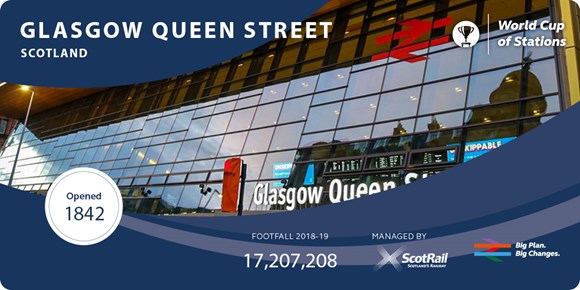
Glasgow Queen Street has been named the nation’s favourite railway station in a public poll which recorded over 95,000 votes
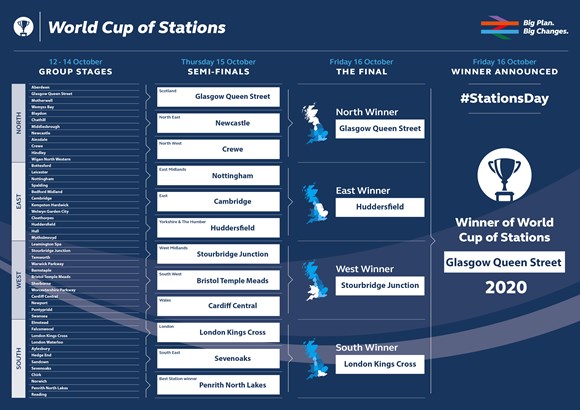
48 stations from across the country competed head to head in the World Cup of Stations with the Scottish terminal receiving most votes
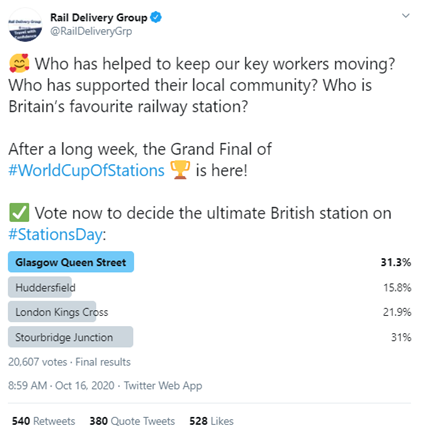
Queen Street beat Scottish rivals in the group stages before triumphing in the final over three English stations in a nail biting conclusion, pulling ahead in the final 15 minutes of voting
Rail staff at Glasgow Queen Street and at stations across the country have been playing a key role supporting Britain’s recovery from COVID-19
Glasgow Queen Street has been named Britain’s favourite station after winning the World Cup of Stations 2020.
Out of 2,579 stations across the country, Queen Street was shortlisted as one of 48 stations participating in the week-long online poll which recorded over 95,000 votes in total.
They saw off the competition in each day of public voting ,beating Scottish rivals Motherwell, Aberdeen and Wemyss Bay in the group stages and heavyweights Newcastle and Crewe in the semi-final.
Edinburgh Waverley was eliminated at the group stage.
Two of this year’s finalists once again thought the path to victory was courting the internet’s substantial cat vote with both Huddersfield and Stourbridge Junction putting their moggy mascots front and centre.
But in the end Glasgow Queen Street, coming fresh off a £120m redevelopment, proved too much for them and for London Kings Cross.
The 2020 final was a nail-biter coming right down to the wire with Queen Street eventually winning by 0.3% pulling ahead in the last 15 minutes of voting.
Maggie Hoey, Queen Street Station General Manager, said: “We’re absolutely delighted that Glasgow Queen Street has been crowned champion in this year’s World Cup of Stations.
“The recent redevelopment work has revitalised the station, delivering a contemporary building both internally and externally. It’s created a spacious and accessible transport facility that will be a positive and prominent addition to Glasgow’s historic George square for years to come.
“We owe a huge thanks to everyone who voted for us, and to our social media colleagues who really got behind the Rail Delivery Group’s campaign to drum up support.”
The competition highlighted the important role that the railway, stations and staff are playing keeping people connected and supporting communities and local businesses during the pandemic.
Robert Nisbet, Director of Nations and Regions for the Rail Delivery Group said: “For a while it looked like nothing was going to stop Stourbridge Junction and their mascot George the cat, but Glasgow Queen Street played the full 90 minutes and have come away with the silverware.
“It’s a fitting tribute to the newly redeveloped station and the friendly staff there who have kept key workers moving through the pandemic and continue to support the local community.”
Rail Minister Chris Heaton-Harris said:“I am immensely proud of the whole railway family, who have worked tirelessly throughout this pandemic to keep our railways running and passengers safe.
“My congratulations go to all the staff at Glasgow Queen Street for winning this year’s competition. They have played a key role supporting Britain’s recovery from Covid-19, ensuring that key workers and NHS staff can get to work, saving lives.”
October has been an incredibly tough month for the hospitality industry, facing another forced closure and further uncertainty surrounding jobs and moving forward.
Leith hirdresser Simon Hill of SESH Hairdressing wanted to do something to show support and gather momentum. The ‘Stick to the Shore’ initiative Simon has rolled out is designed to rally the locals of the shore in Leith and remind them to support one another during this time.
Simon and the team at SESH Hairdressing are offering local hospitality workers basedin the Shore, 25% off all hair services. This applies to appointments made with selected members of the SESH team. This initiative is in place until 20th November whilst the hospitality industry returns to work and finds their feet again.
SESH are running a social media initiative to encourage their followers to ‘Stick to the Shore’ too. When any SESH client supports a local shore bar or restaurant by purchasing a voucher or using their takeaway services, they will receive a complimentary hair treatment at SESH Hairdressing.
Small acts of kindness are crucial during this difficult time.
SESH Hairdressing and Simon Hill have always been passionate about their local area at the shore and this small gesture is their way of supporting the community.
Simon Hill commented: “It was important to us that we not only offer local hospitality workers some money off but also do our bit to ensure our audience supports them too.
“By sticking together and showing each other support we can all come out of this stronger. We hope everyone sticks to the shore and supports those who really need us just now.”
Defying gravity isn’t for everyone but six supporters of VOCAL have persevered through bad weather and COVID restrictions to complete their 10,000ft skydives.
The ‘Super Six’ all took on the challenge last year to raise funds and awareness of VOCAL – Voice of Carers Across Lothian: the charity supporting ununpaid carers looking after partners or family members with health and disability issues that require care in the home.
“I think when I signed up I was keen to raise some cash for VOCAL, but since COVID I have been doubly determined to ensure that the carers looking after the most vulnerable in our communities are recognised for their vital role during this crucial time,” said Julie Forster, who did her jump at the end of September describing it as “the craziest thing ever”.
Wendy Brooks, who works directly with carers at VOCAL said: “We had to postpone the jump throughout lockdown but rather than giving up we persevered.
“We knew the cause was so important and really wanted to complete this huge personal challenge. It was scary – but I am so glad to have done this!”
Emma Rogers also completed her jump as part of a suite of challenges in support of VOCAL: “It was so good to complete this challenge.
“I have abseiled from the Forth Bridge and climbed Ben Nevis, but this was the scariest but most amazing challenge yet. I am so thankful that my parents and grandad got to see me complete the jump.”
Also jumping were three members of the Pattinson family: sisters Emma and Katie with their father Jon.
“It was amazing to have this family skydive adventure” said Emma. “We were so supportive of each other and really kept each other going during lockdown until we got news that we could get together and make that leap. And we did it!”
The Super Six send thanks to the hundreds of sponsors who came on board to raise about £4,500 for VOCAL.
Julie added: “It was just hard that we couldn’t give each other huge hugs and get a great team photo together because of the coronavirus. But maybe the next Super Six will!”
VOCAL are now recruiting for the next set of adventurous supporters to show their recognition of the invaluable work done by the thousands of people who take on intensive and complex caring roles across Edinburgh and Midlothian.