Corra Foundation in partnership with Comic Relief are welcoming applications from community groups, organisations and charities for the latest round of #ShiftThePower Scotland Comic Relief Fund.
#ShiftThePower supports organisations with passionate people to make meaningful change in their communities.
Up to £20,000 is available to grassroots organisations and charities with an income of £250,000 or less, whose work fits one of two strategic themes:
Children Survive and Thrive
Supporting children to survive and thrive during the first years of life (0-5 years old) through targeted work and opportunities for children and families facing disadvantage.
Mental Health Matters
Supporting people with mental health issues or challenges to share their stories, live free from stigma and discrimination, and build positive relationships and experiences.
The Children Survive and Thrive strand will fund organisations supporting children at risk of, or experiencing, disadvantage.
Examples of this could include supporting parents, carers and communities, ideas that test new ways of supporting pre-school children or support for staff/volunteer training in early years settings.
The Mental Health Matters strand will prioritise organisations that have a focus on mental health issues alongside preventative approaches that support people before mental health issues escalate.
For example, the funding could be used to improve support networks or accessibility or relevance of services for people experiencing, or at risk of, poor mental health, especially those from marginalised groups.
The fund is seeking applications that demonstrate how the money will support people and increase the reach, capacity or quality of an organisation’s work or how it will support new ideas or approaches.
It is open to applications from today (17th January) and will close at midday on 8th March 2022.
The team at Corra is encouraging groups to get in touch to discuss their ideas before sending an application.
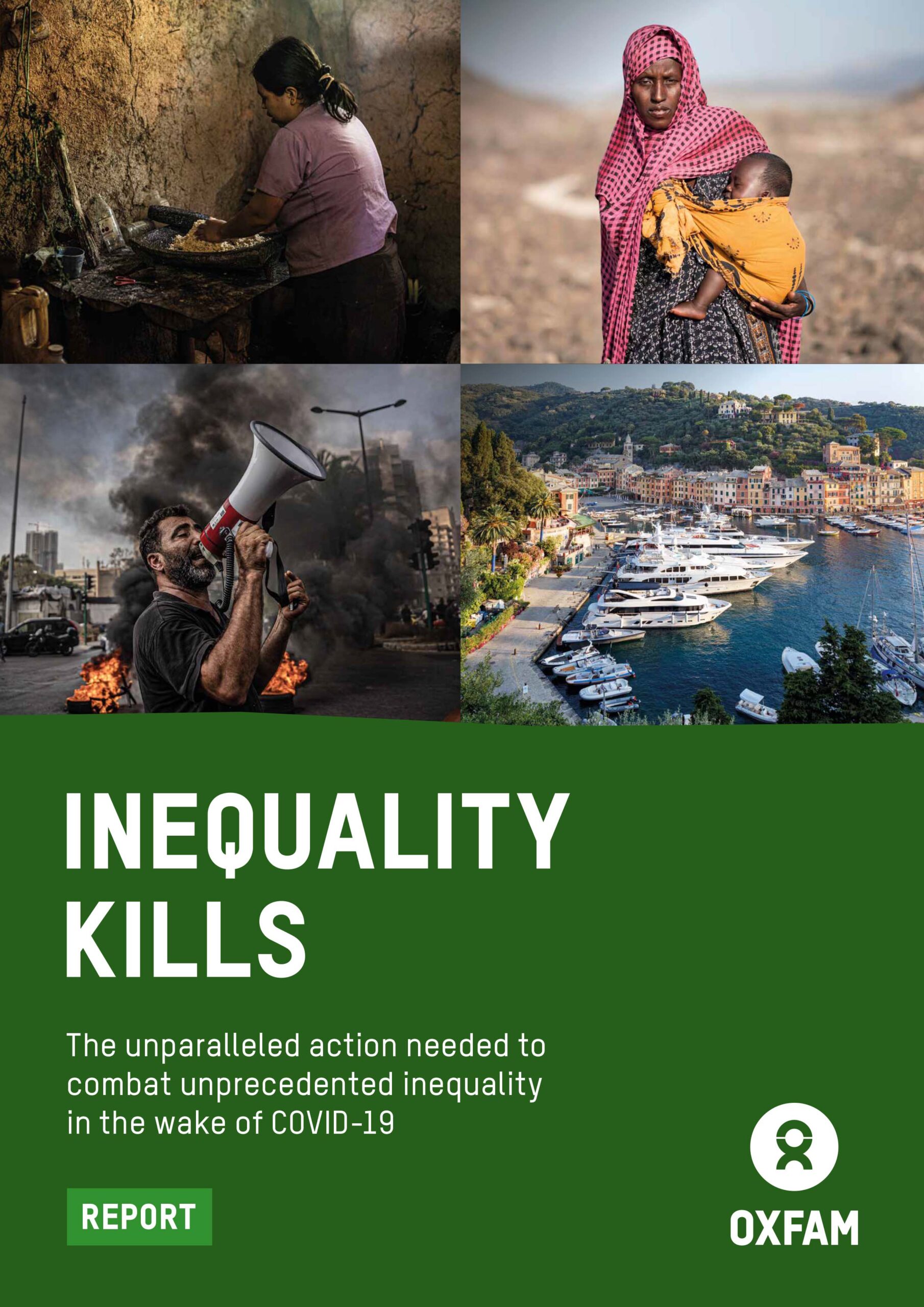
New billionaire created every 26 hours, as inequality contributes to the death of one person every four seconds
The world’s ten richest men more than doubled their fortunes from $700 billion to $1.5 trillion – at a rate of $1.3 billion a day – during the pandemic while the incomes of 99 per cent of humanity have fallen with over 160 million people forced into poverty and inequality contributing to the death of one person every four seconds, an Oxfam report reveals today.
The report Inequality Kills, published on the opening day of the World Economic Forum’s Davos Agenda, finds that a new billionaire has been created every 26 hours since the start of the pandemic while the collective wealth of all 2,755 billionaires surged more than in the last 14 years put together. At $5 trillion dollars, this is the biggest increase in billionaire wealth since Forbes records began in 1987.
If the ten richest men were to lose 99.999 per cent of their combined wealth tomorrow, they would still be richer than 99 per cent of people on the planet and their wealth is six times more than that of the poorest 3.1 billion people.
The enormous rise in wealth is juxtaposed by a sharp increase in poverty around the world. Over 160 million more people are living on less than $5.50 a day than when the pandemic began. Inequality is now contributing to the death of at least 21,000 people each day, or one person every four seconds. This conservative finding is based on deaths globally from lack of access to healthcare, hunger, gender-based violence and climate breakdown.
Danny Sriskandarajah, Oxfam GB Chief Executive said: “The explosion in billionaire’s fortunes at a time when poverty is increasing lays bare the fundamental flaws in our economies.
“Even during a global crisis our unfair economic systems manage to deliver eye-watering windfalls for the wealthiest but fail to protect the poorest – it is an avoidable tragedy that every day people die because they lack essentials such as food and healthcare.
“Today’s generation of leaders can start to right these wrongs by implementing progressive taxes on capital and wealth and deploying that revenue to save lives and invest in our future. They should make sure that Covid-19’s long-term legacy is quality universal healthcare and social protection for all. Governments have an historic opportunity to back bold economic plans based on greater equality that change the deadly course we are on.”
The report also details how:
Developing countries, denied access to sufficient vaccines because of rich governments’ protection of pharmaceutical corporations’ monopolies, have been forced to slash social spending as their debt levels spiral and now face the prospect of austerity measures.
The pandemic has set gender parity back from 99 years to 135 years. Women collectively lost $800 billion in earnings in 2020, with 13 million fewer women in work now than there were in 2019. Over 20 million girls are at risk of never returning to school.
The pandemic has hit racialized groups hardest. During the second wave of the pandemic in England, people of Bangladeshi origin were five times more likely to die of Covid-19 than the White British population. In the US, 3.4 million Black Americans would be alive today if their life expectancy was the same as White people – a fact that is directly linked to historical racism and slavery.
Analysis of emissions by income group shows that over-consumption by the world’s richest people is one of the main drivers of today’s climate crisis. 20 of the richest billionaires are estimated, on average, to be emitting as much as 8,000 times more carbon than the billion poorest people.
Oxfam’s analysis showed that a one-off 99 per cent tax on the ten richest men’s pandemic windfalls alone would raise $812 billion and could fund:
Enough vaccines for the world
Universal healthcare and social protection, climate adaptation and gender-based violence reduction in over 80 countries
While still leaving these men $8 billion better off than they were before the pandemic.
Oxfam recommends that governments:
Urgently tax the pandemic gains made by billionaires and introduce permanent wealth and capital taxes, investing the trillions that could be raised on universal healthcare and social protection, climate change adaptation, and gender-based violence prevention and programming.
Immediately waive intellectual property rules over Covid-19 vaccine technologies to allow more countries to produce safe and effective vaccines to usher in the end of the pandemic.
Tackle sexist laws that discriminate against women and create new gender-equal laws.
End laws that undermine the rights of workers to unionize and strike and set up stronger legal standards to protect them.
The number of households suffering from ‘fuel stress’ – spending at least 10 per cent of their family budgets on energy bills – is set to treble overnight to 6.3 million households when the new energy price cap comes into effect on April 1, according to new research published today by the Resolution Foundation.
The research shows that the proportion of English households in ‘fuel stress’ – a general indicator of finding energy bills unaffordable and also the definition of fuel poverty in Wales, Scotland and Northern Ireland – is currently 9 per cent.
It is expected to leap to 27 per cent as a result of the energy price cap rising by more than 50 per cent this April to around £2,000 per year. Ofgem will announce the new price cap level on February 7.
Levels of fuel stress are set to be highest in the North East and the West Midlands (33 and 32 per cent), among pensioner households (38 per cent), among those in local authority housing (35 per cent) and among those in poorly insulated homes (69 per cent of families in homes with an EPC F-rating).
The sheer scale of energy bill increases mean that fuel stress will no longer be confined to the poorest households, says the Foundation, but low- and middle-income families will find it hardest to cope as they spend a far greater share of their family budgets on these essentials.
The report notes that the Government is rightly considering ways to mitigate rising energy bills, and should target support at lower income households.
The Foundation says that the most effective way to support lower-income families is through the benefits system, with a faster-than-currently-planned uprating of benefits in April (benefits are set to rise by 3.1 per cent).
Alternatively, an additional payment based on the Warm Homes Discount (WHD) could be pursued. However, the policy will require major surgery in order to make it for purpose. The reforms should include making the WHD:
Bigger, by increasing the £140 payment by at least £300;
Broader, by widening eligibility to all families in receipt of pension credit or working age benefits (8.5 million families in total) and making payments automatic;
Timelier, the extra support should be delivered via an additional bill discount this spring, following the normal winter round; and,
Taxpayer funded, by funding the payments through general taxation (at a cost of £2.5 billion) rather than through further increases in everyone else’s energy bills.
A new vastly improved WHD would cut the number of households living in fuel stress by around five percentage points – equivalent to over one million families.
The report adds that the Government may also want to take action to cut everyone else’s energy bills too.
This could be achieved by spreading the costs of energy firm failure over a number of years (reducing bills by up to £65) and temporarily transferring the social and environmental levies needed to future-proof Britain’s energy supply from bills to general taxation.
This would cut everyone’s energy bills by around £245 and would cut the number of families in ‘fuel stress’ by over seven percentage points – or 1.7 million families – but at a cost of £4.8 billion.
In combination, this dual approach of providing support to all energy bill payers, alongside targeted support for those most at risk of falling into ‘fuel stress’ would reduce energy bills by up to £545 a year – at a cost of around £7.3 billion – and help to avert a cost of living catastrophe this year. The rise in fuel stress would be reduced by two thirds, with 2.7 million fewer families in fuel stress.
Finally, while short term measures are clearly needed, the medium- and long-term solution to energy price shocks is reform of our energy market, better insulating our homes, and reducing our dependence on natural gas via an accelerated move to heat pumps, and the rollout of renewable and nuclear electricity.
Jonny Marshall, Senior Economist at the Resolution Foundation, said:“Rising gas prices are causing energy bills to soar, and will see the number of families suffering from ‘fuel stress’ to treble to more than six million households this summer.
“Fuel stress levels are particularly high among pensioner households, and those in poorly insulated homes – a stark reminder of the need to modernise Britain’s leaky housing stock and curb national dependency on gas for power and heating.
“The Government can take action by targeting support at lower income households via benefits or a bigger and broader version of the Warm Homes Discount. They should also temporarily transfer the cost of environmental levies onto general taxation, as well as spreading the cost of supplier failure over three years.
“While not cheap at £7.3 billion, this plan is affordable, and by cutting bills by up to £545 would help prevent the upcoming rise in energy bills turning into a cost of living catastrophe for millions of families.”
The next meeting of the EDINBURGH ASSOCIATION of COMMUNITY COUNCILS will be an Extraordinary General Meeting (EGM) on Thursday 20 January at 7pm to update the EACC Constitution.
Other items include on the agenda include best practice for community council treasurers and police reports at CC meetings.
Police Scotland has released an image of a male they believe may hold information which might assist in relation to an incident that occurred at Giles Street at around 4.30am on Saturday, 9 October, 2021.
The male is described as being in his late 30s, of average build with short dark hair.
Detective Constable Greg Manley said: “I would urge the male, or anyone who has information relating to him, depicted in the image to make contact with the Police.
“Members of the public can contact Police Scotland via the 101 non-emergency telephone number quoting incident number 0758 of Saturday, 9 October, 2021.
“Alternatively, calls can be made anonymously to Crimestoppers on 0800 555 111.”
From today (Monday 17 January), people with COVID-19 in England can end their self-isolation after 5 full days, as long as they test negative on day 5 and day 6.
People self-isolating with COVID-19 will have the option to reduce their isolation period after 5 full days if they test negative on both day 5 and day 6 and do not have a temperature, from Monday, 17 January
Individuals who are still positive on their rapid lateral flow tests must stay in isolation until they have had 2 consecutive negative tests taken on separate days
This will support essential public services and keep supply chains running over the winter
From Monday 17 January, people with COVID-19 in England can end their self-isolation after 5 full days, as long as they test negative on day 5 and day 6.
The decision has been made after careful consideration of modelling from the UK Health Security Agency and to support essential public services and workforces over the winter.
It is crucial that people isolating with COVID-19 wait until they have received 2 negative rapid lateral flow tests on 2 consecutive days to reduce the chance of still being infectious.
The first test must be taken no earlier than day 5 of the self-isolation period, and the second must be taken the following day. If an individual is positive on day 5, then a negative test is required on day 6 and day 7 to release from isolation.
It is essential that 2 negative rapid lateral flow tests are taken on consecutive days and reported before individuals return to their job or education, if leaving self-isolation earlier than the full 10-day period.
For instance, if an individual is positive on day 5, then a negative test is required on both day 6 and day 7 to release from self-isolation, or positive on day 6, then a negative test is required on days 7 and 8, and so on until the end of day 10.
Those who leave self-isolation on or after day 6 are strongly advised to wear face coverings and limit close contact with other people in crowded or poorly ventilated spaces, work from home if they can do so and minimise contact with anyone who is at higher risk of severe illness if infected with COVID-19.
The default self-isolation period continues to be 10 days, and you may only leave self-isolation early if you have taken 2 rapid lateral flow tests and do not have a temperature in line with guidance.
Health and Social Care Secretary Sajid Javid said: “After reviewing all of the evidence, we’ve made the decision to reduce the minimum self-isolation period to 5 full days in England.
“These 2 tests are critical to these balanced and proportionate plans and I’d urge everyone to take advantage of the capacity we’ve built up in tests so we can restore more freedom to this country, whilst we are keeping everyone safe.”
Existing public health measures remain in place, including:
staying at home if you feel unwell
getting a test if you experience any COVID-19 symptoms
wearing a face covering in crowded, enclosed spaces
working from home if possible
maintaining social distancing and regular hand washing
taking up the offer of the free COVID-19 vaccine
Self-isolation may continue in certain circumstances, such as for those who work with vulnerable people. A full list will be published in guidance in due course.
Vaccinations remain our best defence against COVID-19, offering substantial protection against infection and hospitalisation – and the government continues to urge the public to get boosted as soon as you’re eligible.
In line with this announcement, the government will also consider the guidance for close contacts of people with COVID-19, including around the advice for fully vaccinated contacts to take daily rapid lateral flow tests for 7 days.
NHS England has also announced that the first 16 and 17-year-olds will be able to book their booster jabs or attend a walk-in vaccination centre from today.
ENABLE Scotland launches campaign to address the ‘human rights emergency’ of hundreds of Scots who have learning disabilities being forced to live far away from their families or stuck in hospital.
#MyOwnFrontDoor calls for urgent change to uphold the human rights of all adults with learning disabilities in Scotland to live in the community of their choice by 2023.
A new campaign launches today to unlock the door for hundreds of adults with learning disabilities to have the right to a home they choose and to live in the community of their choice, as Scotland’s largest member-led charity calls on society to address the “human rights scandal” facing people with learning disabilities in Scotland.
ENABLE Scotland’s latest campaign – #MyOwnFrontDoor – is being led by the charity’s 12,000 strong membership and supporter network to address what it describes as a “level of discrimination that we do not expect and would not expect other people in our society to bear“.
Due to lack of support to live in their own communities close to their loved ones, official data reveals that over 1,000 adults have been sent by Scottish local authorities to live ‘out of area’, meaning not in their home local authority area. Beyond this, a further 67 people are living in hospital. 22% of these people have been there for more than 10 years.
Despite a Scottish Government report highlighting this issue in 2018, which recommended that better specialist social care support should be available across Scotland to support these individuals to live in the community of their choice, there has been no monitoring of progress, and ENABLE Scotland fear that the situation has deteriorated further.
The campaign is calling for urgent action to end hospital living for people with learning disabilities; and to put immediate plans in place to ensure that all people in delayed discharge or who have been displaced ‘out of area’ are supported to return to live in the home they choose and the community they choose, close to the people they love by 2023.
Already the charity supports 6,000 people to live independently across Scotland, including some people who were previously living in hospital or other institutional settings for many years, or who have been fighting for their rights to live closer to their families.
People, like Nova, who ENABLE Scotland helped to support to move back to Scotland from England and live in her own house, close to her family. Before ENABLE Scotland got involved, Nova, who is in her early forties, was offered a placement in a care home for the elderly and it took more than a year to support her to get her own keys to her own front door.
Launching the campaign, John Feehan, an adult who has a learning disability and who is an active member of ENABLE Scotland, said: “It can be so hard to speak up for yourself when you have a learning disability. It is even harder to make people listen.
“That is why I am speaking out. It makes me so angry that other people who have a learning disability are stuck in hospital, or being forced to live far away from their families. This has been going on for too long now.
“Some people think that people who have a learning disability are not able to live in local communities like everyone else. They think that that it is easier for them to be locked away in hospital, or to live with lots of other people who have a learning disability.
“That isn’t true. It is only because the right support is not there – it’s not the person’s fault. Anyone can live anywhere with the right support. If they don’t want to be where they are, people need help to get back to live close to their families or to get out of hospital – right now.”
Jan Savage, Director of ENABLE Scotland, said: “This is a human rights emergency. It is a national scandal – hidden in plain sight. People who have a learning disability – brothers, sisters, sons and daughters – are being forced to live far from home, to “live” in hospital, or to live in care settings where they are uncomfortable and unhappy.
“I am sure that people will be shocked to learn about the situation our fellow citizens find themselves in. But they should be reassured that better is possible.
“Clear and decisive action is now required to adopt a ‘Community First’ principle to end the practice of people being sent out of area; to nationally invest in high quality, consistent, specialist social care support to be available in every community; and to stop building new multi bed units for people who have a learning disability. These are not the solution – they perpetuate the problem.
“We cannot wait any longer. People who have learning disabilities are being subjected to a level of discrimination that we would not, and do not, expect other groups in our society to bear.
“We are determined that this campaign will start a movement for change as each and every one of us stand up for the human rights of all people with learning disabilities in 2022. The keys to unlocking their own front door are in our hands.”
John Dalrymple, Director of Radical Visions, said: “Everything we know about the disastrous effects of segregation and exclusion and all the evidence we have about good social care practice argues for an immediate halt to the placement of people in institutions.
“Everything we say we believe about basic humanity, independent living and universal human rights compels us to support campaigns like #myownfrontdoor and ensure that in future no-one is denied a home of their own.”
A new campaign report from the charity – My Own Front Door– proposes five key steps that public bodies must take now to unlock the right to an own front door for people who have a learning disability.
The five keys are:
Close all Assessment and Treatment Unit (ATU) beds and end the practice of Scottish citizens being sent out of the country.
Immediately implement a Community First principle for the commissioning of support for all adults and children who have a learning disability in Scotland – ending the commissioning of multi bed units.
Invest nationally in a Specialist Provider Network to improve local support in every area in Scotland.
Maintain a national at-risk register and ensure that everyone identified on this has a plan by 2023 to come home to the community of their choice.
Create a national Community Living Panel to ensure oversight and accountability of decision making about individual placements.
As part of this campaign, the charity is offering support and advice to any individual or family who is affected by this issue, and is asking members of the public to raise the issue directly with their local MSPs.
To join the movement, act, share, speak up and get informed, please visit:
Over 30 public and school libraries across Scotland have been awarded Scottish Government funding to deliver a range of innovative projects including initiatives to tackle climate change and promote sustainable development – but none of them are in Edinburgh.
The Public Library Improvement Fund and the School Library Improvement Fund are annual awards set up by the Scottish Government and administered by the Scottish Library and Information Council. This year nearly £400,000 has been awarded through the two funds.
Sustainable projects backed by the Public Library Improvement Fund include East Renfrewshire Culture and Leisure’s The Root Cause Project, which received £14,240 to transform an outdoor space at Thornliebank library into a sustainable community allotment and multi-functional space.
Funds for school libraries were awarded to projects championing anti-racism and anti-discrimination.
These included Prestwick Academy Library and Ayr Academy Library’s project Read Woke Primaries to curate a wider range of contemporary fiction written by, and about, people from minority groups.
Culture Minister Jenny Gilruth said: “Libraries play a key role in our communities and our schools and projects funded through these awards will help to improve the services they can offer.
“Promoting sustainability is integral to our Net Zero ambitions to tackle climate change and our public libraries are an important focal point for conversations and taking action.
“And as part of our wider approach to creating anti-racist environments in school, it is great to see school libraries engaging our young people on the importance of belonging, inclusion and social justice.”
Pamela Tulloch, Chief Executive at the Scottish Library and Information Council, said: “As we begin to rebuild our society following the pandemic, school and public libraries are an essential part of the recovery process to ensure our future social and economic well-being.
“We’re particularly proud to provide funding awards to projects that promote sustainable development in public libraries and champion anti-racism and anti-discrimination across school libraries as examples of how libraries can make a valuable contribution to Scotland’s social fabric.”
The total amount for projects from the two funds comes to £398,142.
South Ayrshire Libraries Jock Tamson’s BairnsAmount Awarded: £9,200
South Ayrshire LibrariesClimate for ChangeAmount Awarded: £26,610
Stirling Libraries in partnership with Stirling University Making a Difference – Amount Awarded: £46,568
West Dunbartonshire Libraries Towards a Sustainable Future – Amount Awarded: £21,435
West Lothian Libraries in partnership with Heriot Watt University Eco-Ableism – Amount Awarded: £6,000 Total: £198,657
School Library Improvement Fund awards
Aberdeen School: Dyce AcademyProject: Hear a Story / Tell a Story – Award: £4,000
School(s): Aberdeen City Libraries / Harlaw Academy with Holocaust Educational Trust Erika’s suitcase – Award: £8,000
Angus School: Arbroath Academy plus othersProject: OPEN – a book, your eyes, your world – Award: £1,630
Borders School: Arbroath Academy plus othersProject: OPEN – a book, your eyes, your world – Award: £1,630
School: Eyemouth High Project: Get Woke – Award: £8,150
Dumfries and Galloway School: North-West Community Campus NWCC Project: Bringing Diversity, Racial Equality to the NWCC Young adult Book Group – Award: £8,150
East Lothian School: Musselburgh Grammar Project Award: Digital Storybag – Award: £4,900
School: Lethams Mains Primary with EL Council – Project Award: The Borrowers Bus – Award: £9,000
Falkirk School: Bonnybridge Primary – Project: Bonnybooks: For a’ Jock Tamson’s Bairns – Award: £24,940
Fife School: Bell Baxter ClusterProject: Racial Equality Transition ProjectAward: £9,000
School: Carleton PrimaryProject: The Same Page – connecting families to promote diversity and equality. – Award: £5,500
Glasgow S -Award: £11,120School: Barmulloch Primary & ALNProject: Digital and Family Learning HubAward: £13,000School: Lourdes SecondaryProject: Inclusive Storytelling for Healthy Minds – Award: £15,870
Moray School: Forres Academy Project: Equality, Inclusion, Diversity, and a Mentally Healthy School – Award: £3,750
North Ayrshire School: Auchenharvie cluster and Strathclyde UniProject: Keep the Heid’n’Read Even Mair! – Award: £16,400
Perth and Kinross School: Breadalbane Community Library/Breadalbane AcademyProject: Read It Racism – Award: £4,220
South Ayrshire School(s): Prestwick Academy Library and Ayr Academy Library (in collaboration with 9 primary school libraries)Project: Read Woke Primaries – Award: £44,000
South Lanarkshire Schools: St Andrew’s and St Bride’s HighProject: Equal Voices using anti-racist and diverse texts in extra-curricular group discussion – Award: £5,125 Total: £199,485