NHS Lothian has published the findings of a research project, funded by NHS Lothian Charity, to learn about the Royal Infirmary of Edinburgh’s historical ties with the enslavement of African people and people of African descent.
The main findings include:
From 1729 to 1850, the Royal Infirmary of Edinburgh (RIE) received at least £28,080 from 43 individuals with ties to Atlantic slavery. These donors included physicians, surgeons, politicians, colonial officials, bankers, and a range of merchants, both in Britain and its colonies, who were connected to the enslavement of African people in the British West Indies and America.
From 1749 to 1892, the RIE owned and leased an estate in Jamaica called Red Hill pen, bequeathed in the will of the Scottish surgeon and enslaver Dr Archibald Kerr. Until the abolition of slavery in Britain’s colonies in 1834, the RIE owned and leased the enslaved people, drawing substantial rents from the property. After Abolition, the estate employed ‘apprentice’ Black labourers.
Between 1773 and 1801, the RIE was involved in requests for the manumission (the granting of freedom) of an enslaved Black woman (Juliet) and later her two enslaved children (John and William Moodie) on Red Hill at the request of their father, Dr John Moodie, a White man.
Through a complex series of events, the RIE eventually received approximately £832 from the British Government after the abolition of slavery (1834) as ‘compensation’ for the loss of the labour of the enslaved people at Red Hill.
NHS Lothian is committed to eliminating unlawful discrimination and harassment, advancing equality of opportunity, and fostering good relations between the different groups of people working for the organisation and using its services.
Throughout January, a series of public engagement events, led in partnership between the project’s independent Advisory Group and researcher, will be held in Edinburgh and online.
The purpose of these events is to start a conversation about what we have learned, the lasting impact, and the changes NHS Lothian can make today.
We are particularly interested in hearing from those groups who are most adversely affected by this history of slavery, including NHS Lothian BME staff and the wider ethnically diverse communities across Lothian. The Advisory Group will then make recommendations to the NHS Lothian Board to suggest how the organisation might correctly and appropriately learn from its past and act to tackle the modern-day racism and racial inequalities experienced by the people who work for NHS Lothian and use our services.
Two open sessions will also take place at the Centre for Research Collections, University of Edinburgh. During these sessions, relevant eighteenth and nineteenth century records used in the historical report will be available for people to view with the guidance of staff at Lothian Health Services Archive.
Talking about the importance of this charity-funded project, NHS Lothian Chief Executive, Calum Campbell said: “It is essential that our health and care system is truly inclusive so that everyone in Lothian lives longer, healthier lives, with better outcomes from the care and treatment we provide.
“We also strive to be an inclusive employer where everyone who works with and for us has better experiences. This work to acknowledge and tackle racism and racial inequality is vital to delivering this ambition.
“This project was fully funded by NHS Lothian’s official charity, NHS Lothian Charity. An independent researcher was contracted by NHS Lothian Charity to undertake the research and will lead the subsequent public engagement work.
“We hope that the public will get involved in conversations about this important work, helping us to understand and consider different reflections and viewpoints that will inform the independent Advisory Group’s final recommendations.”
Director of NHS Lothian Charity, Jane Ferguson said: “This is an important piece of work that we are serious about working in partnership on with NHS Lothian and we are providing charitable funding to take it forward.
“Reducing health inequality is one of the Charity’s priority objectives and this research helps both us and NHS Lothian understand what more we can do to help improve the health outcomes of our ethnically diverse communities.”
A list of FAQs has been provided to help with any questions that you might have about this project.
Industrial action in schools next week: all primaries closed on Tuesday 10 January, all secondaries closed on Wednesday 11 January, special schools are also affected.
Full details incl. nurseries and free school meal payments here:
The EIS has said that the New Year’s resolution for both the Scottish Government and COSLA must be to pay Scotland’s teachers fairly by coming back with a greatly improved pay offer.
Scotland’s teachers have not received a pay rise for the year 2022, despite being due for a pay increase in April.
Commenting as schools broke up for the Christmas holidays, EIS General Secretary Andrea Bradley said, “As 2022 comes to a close, Scotland’s teachers are still waiting for a pay settlement that should have been paid to them in April. What Scotland’s teachers have been offered by the Scottish Government and COSLA amounts to a record real-terms pay cut of up to 11% in a single year.
“This is in the context of the value of teachers’ pay dropping by a massive 20% since 2008. It is little wonder that teachers voted so overwhelmingly for strike action, and remain determined to stand firm against the unprecedented pay cuts that have been offered.”
Ms Bradley continued, “Having taken one day of strike action in November, EIS members will resume a programme of strike action in the New Year. We have offered every opportunity to the Scottish Government and COSLA to settle this dispute, but they have stubbornly failed to take advantage of those opportunities.
“Reheating old offers and repeating tired spin is not going to fool Scotland’s teachers, and it is not going to resolve this dispute or end the ongoing programme of strike action. Neither teachers nor the public believe the claims that Scottish teachers are better paid than their counterparts elsewhere in the UK and internationally – in England the top of the pay scale is higher than in Scotland, and 14 OECD countries sit above Scotland on the league table of teachers’ pay.
“The only OECD league table on teachers’ conditions that Scotland has climbed is the one which quite shockingly shows that Scotland has the third worst record in the world when it comes to excessive class contact hours.
“Rather than Scottish Government spin, only a substantially improved, fair and credible offer can end this dispute and let teachers focus fully on teaching young people rather than having to fight for a fair wage.”
Ms Bradley added, “The Scottish Government and COSLA must do better. They owe it to Scotland’s teachers – the majority of them women – and Scotland’s pupils to end this dispute by committing to pay Scotland’s teachers a fair pay increase. This is about pay justice and gender pay justice.
“Teachers worked tirelessly as key workers throughout the pandemic, often putting their own health at risk to ensure the best possible education for Scotland’s young people amidst very difficult circumstances. Now, in the early stages of education recovery, teachers want to be in the classroom supporting pupils. But, as the cost-of-living soars, teachers deserve and expect an appropriate increase in their pay – not a deep real-terms pay cut, as they have consistently been offered.
“Education must be a top priority for government and for local authorities, and that means investing in Education, including investing in teachers, to ensure the best possible educational experience for all of Scotland’s young people.
“Scotland has a stated commitment to reducing the gender pay gap and to being a Fair Work nation by 2025. Having made these commitments and as the new year dawns, it has to be time for the Scottish Government and COSLA to resolve to offer a fair pay settlement to all of Scotland’s teachers.”
A new annual report explores how the significant disruption of last year is setting the market mood of the construction sector in 2023.
Today, Glenigan, one of the construction industry’s leading insight and intelligence experts, releases its 2022 Construction Performance Review.
Providing a topline overview of UK construction sector activity over the past 12 months, this report evaluates overall output whilst offering insight into how this will influence the market in 2023.
Figures presented are drawn from Glenigan’s own data, combining both major (> £100m) and underlying (<£100m) projects, complemented with information from other official sources, including ONS figures.
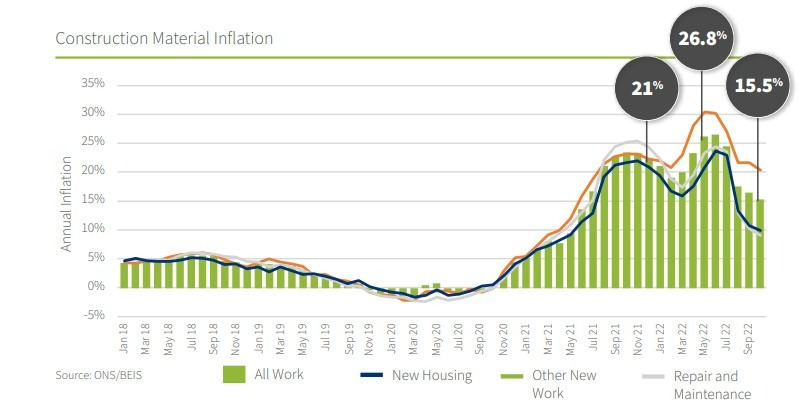
The key takeaway from the Review is the staggering inflation in construction materials costs, which had been gathering momentum since January 2021 to peak at a massive 26.8% in Q.2 2022. Whilst currently figures have settled at around 15%, ongoing international geopolitical events and domestic socioeconomic disruption indicates market volatility and, possibly, another inflation spike in the first half of 2023.
Looking at specific materials categories, energy intensive products were hit hardest, with the price of aggregates and insulation rising an eye-watering 53% and 32% respectively. More barriers to imports post-Brexit and rocketing power prices can be seen as the key reasons for these dramatic rises, and will put considerable pressure on contractors already working to extremely tight margins.
Labour and Wait
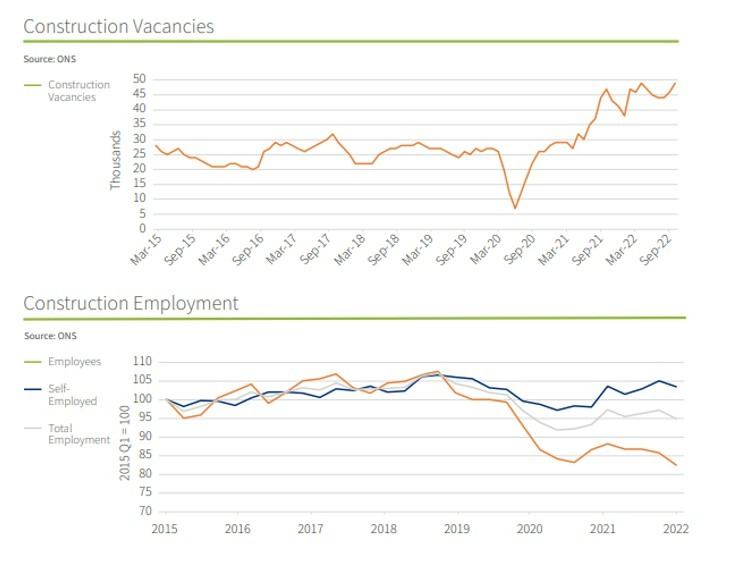
The construction sector also felt the pinch in terms of labour supply, which intensified over the course of 2022. Alongside legacy issues, such as a shallow recruitment pool and a greying workforce, Brexit and the Pandemic has resulted in less ready access to EU workers.
Looking at the figures as they stand at the start of the year, whilst there are currently 2.14 million employed in the sector, this number still languishes almost 7% below pre-Pandemic levels and 2.4% on a year ago. Couple this with 49,000 construction vacancies and there’s a shortfall with the very-real potential to stifle 2023 activity. This might put a serious dent in the current Government’s ambitious infrastructure and levelling-up plans in the short-term.
Projected Performance
Despite material and labour pressures, output actually rose in 2022 by 6% compared to the previous year. Most significant was a 52% leap in industrial new build and 11% registered for private residential new build activity.
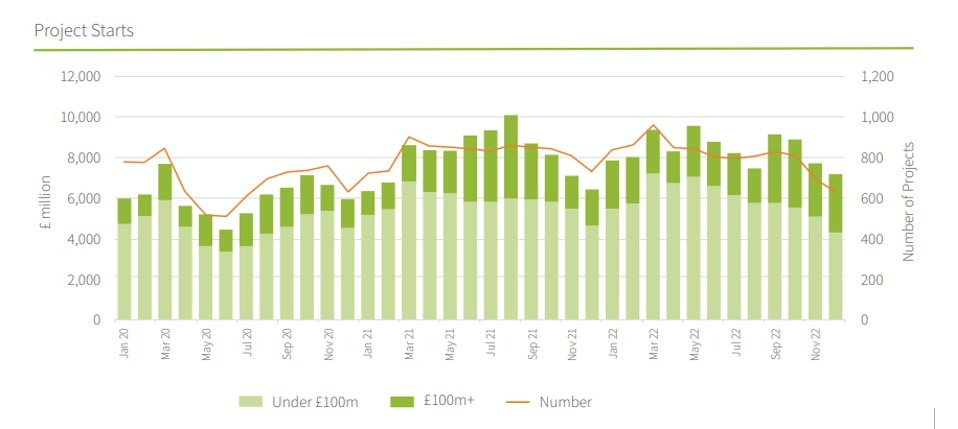
However, tempering any optimism for a speedy recovery, a drop in the number of projects starting on site last year points to a weakening in construction output in 2023.
2022 saw a significant slowdown in projects progressing to work on site, as contractors and clients have reappraised the design and cost of build, largely prompted by price inflation and regulatory changes.
For example, many housing developers pushed back start dates in Q.3 2022, following the introduction of Part L of the Building Code. Overall this has led to a 50% increase in the time it takes from planning approval to commencing on site.
Furthermore, the value of underlying project starts also declined by 5% in the second half of 2022, compared with the same period a year ago. This was reflected in a 5% dip in the value of underlying planning consents during the same period and a concerning 14% drop in the number of projects securing planning consent.
Looking Ahead
Commenting on 2022 performance, and how it relates to the year ahead, Glenigan’s Economic Director, Allan Wilen, says: “The construction sector has already been buffeted by strong headwinds in the second half of 2022, and these look to become more forceful in 2023.
“The cautious optimism and tentative performance increase this time last year has been washed away by events out of the sector’s control, and many businesses will be battening down the hatches and hedging their bets for a potential, if modest, uplift in the latter half of the year.
“Whilst supply side pressures may ease, the skills shortage is a persistent problem which the industry will urgently need to tackle if it wants to return to pre-Pandemic output levels. However, there are a few bright spots in the gloom, with major projects including HS2 driving activity, as well as an increased focus on other critical infrastructure in energy, healthcare and data centre developments.
“Whilst next year will remain depressed, with a 2% decrease in the overall value of underlying project starts, Glenigan predicts a 6% increase in 2024, setting construction back on the road to recovery.”
To read the full 2022 Construction Performance Review Report, containing deeper analysis of the above, click here.
2023 sees Glenigan celebrate its 50th anniversary, commemorating half a century of delivering the highest-quality construction market intelligence.
To find out more about its services and expertise click here.
1 million meals to UK charity The Bread and Butter Thing to benefit low income families
wagamama has launched an iconic veganuary dish with a special partnership allowing one million meals to be donated to low income families.
Guests at wagamama know that every veganuary they can expect new and exciting plant-based flavours to nourish them.
And this year is no exception as it launches a new vegan take on its much missed iconic kare lomen dish adding a veganuary flourish to the regular menu which is already more than 50 percent plant based. This will be launched alongside the new charity partnership with The Bread and Butter Thing.
The vegan ‘chicken’ kare lomen is udon noodles served in a nourishing bowl of coconut broth with a chilli kick, and topped with vegan teriyaki ‘chicken’, coriander, beansprouts and cucumber. It is a fresh, fragrant and warming bowl available in all wagamama restaurants and on Deliveroo for this veganuary only.
This year the delicious veganuary dish will be served up alongside a campaign of support initiatives to help nourish local communities across the country through a partnership with food charity The Bread and Butter Thing which supports thousands of families in over eighty locations.
Set up in 2016, The Bread and Butter Thing brings low-cost food to low-income communities. Those in need of support pay a fraction of the cost for food, which is sourced direct from manufacturers and retailers. It has over 40,000 members and redistributes to over 5,000 families a week who typically pay £7.50 for £35 worth of groceries.
The partnership with wagamama will involve projects in its restaurants and out in the community. Overall, it will see the restaurant chain provide support for The Bread and Butter Thing to deliver 1 million meals worth of food to low income families who use the charity to receive a more affordable weekly shop, at a time when the nation needs it more than ever.
wagamama has already supplied food and bespoke recipes cards to The Bread And Butter Thing and the £25,000 wagamama donation will pay for forty one truck journeys with each able to carry 426 tonnes of food with each tonne equating to 2380 meals. A grand total of just over a million meals.
Teaming up to champion The Bread and Butter Thing’s Warm Hub initiative, wagamama will also be providing warm and inclusive community spaces in selected restaurants – offering free sides to families facing difficult choices between heating and eating. While its team members will be volunteering to support local projects and its chefs will provide ‘wok it don’t waste it’ demos and advise on how to cook nourishing and affordable meals.
wagamama CEO, Thomas Heier, said: “At wagamama we believe in the Japanese philosophy of seijaku; finding calm and tranquillity in the midst of activity. In these challenging times it is important that we all continue to nourish ourselves and our communities.
“Typically, every veganuary we like to surprise and delight our guests with a plant-based showstopper, but we know this veganuary is a little bit different for families across the UK, so it is a privilege this year to support local communities through our newly launched partnership with The Bread and Butter Thing.”
Mark Game, CEO of The Bread and Butter Thing said: “We’re delighted to be entering this new partnership with wagamama. Its philosophy of nourishment chimes exactly with The Bread and Butter Thing’s work to ensure that people in low income communities can access healthy, nutritious food for their families.
“By providing both food and funding to support the unseen but vital logistics that go into making The Bread and Butter Thing possible, wagamama will help us deliver over 1 million meals worth of food to our members who are making really difficult decisions between heating and eating, or even keeping a roof over their heads, in the toughest financial crisis of a generation.”
wagamama has always led the way in making delicious plant-based food accessible and full of flavour, being the first multi-site UK restaurant business to offer a vegan menu on the high street.
In the six years following the launch of its vegan menu in October 2017, the proportion of vegan sales has doubled at wagamama. During veganuary 2022 there was a 12% increase in the proportion of vegan sales from the previous month thanks in part to its limited edition exclusive dish the vegan f-ish and chips.
This dish was one of the highest selling vegan mains during January 2022 and compared to the previous veganuary exclusive they saw an 144% increase in guest participation.
In October 2021 wagamama made half its menu plant-based with a mission to continue inspiring and empowering Brits to give plants a go, one bowl at a time.
wagamama has made vegan versions of all their most popular dishes, collaborated with vegan chef Gaz Oakley to bring guests the world’s first vegan ‘egg’, turned watermelon into ‘tuna’ and eliminated red meat from their test kitchen menu in Old Street, London.
The lingering stress of the cost-of-living crisis weighs heavily on the shoulders of many, and with temperatures dropping, food prices skyrocketing, and Christmas credit card bills arriving, it is bound to have an added impact on the stresses of everyday life.
Therefore, people up and down the country are looking for tips and tricks to ease and eliminate as much stress as possible.
CBD experts Simply CBD have revealed some tips that will help encourage stress relaxation and a stress-free routine that you can implement into your weekly routine.
New analysis reveals that searches in the UK for ‘reduce stress’ increased by 216% over the past month, proving just how desperate we are to find solutions for feelings of overwhelming stress.
In fact, searches for ‘is stress normal’ has seen a huge 635% increase over the past month in the UK, showing just how concerned people are about stress levels and how they can impact their health.
Self-care
Being mindful of your own needs is essential and focusing on self-care will help reduce stress and anxiety tremendously. Some forms of self-care include maintaining a balanced diet and sustaining a healthy sleep schedule but indulging in pampering is often overlooked.
Pampering doesn’t have to break the bank. Forget spa days or trips away; you can easily indulge in pampering at home:
Take a hot bath or shower.
Pop on a face mask and read your favourite book – time away from blue light from your phone also helps relax the mind.
Light some candles and listen to a meditation podcast.
Treat yourself to your favourite home-cooked meal (or take away if you prefer!).
Exercise
Although the thought of exercise can sometimes be exhausting, with long workdays feeling tiring enough, finding the time to get a good workout in can often be the release from a lot of pent-up stress.
Sometimes getting past the mental barrier of doing physical activity is the only thing holding you back from releasing tension and endorphins, aka the body’s natural painkillers.
The exercise doesn’t necessarily need to be intense, and there are many options when it comes to fitting in an hour of increased heart rate:
Go on a walk – Whether with friends, family or just by yourself, getting out for some fresh air and moving your body will work wonders.
Take part in a local exercise class – there are many different options, such as low intensity Yoga and Pilates, which are great options if you don’t want to do an intense workout.
Take part in an online exercise class! – if physically leaving the house to exercise fills you with dread, you will be pleased to know there are thousands of online classes and pre-recorded free videos of workouts that you can do in the comfort of your own home.
Listen to music
Listening to music gives the brain a total workout, and we all know how vital brain health is. By listening to music, you can:
Reduce blood pressure.
Improve memory.
Reduce anxiety.
Improve sleep quality.
Not only can it reduce stress, but it can elevate moods and clear the way for emotional expression; this is why it is great that there are so many genres of music to choose from; just pick whatever gets you out of a funk and makes you feel good!
Experiment with hobbies
By experimenting with hobbies that you might have put on the back burner, you are allowing your body to remind itself of something you enjoy and take pride in. Hobbies are a great distraction and can be the perfect way to relax and forget about the stresses of everyday life.
If you’re struggling to think of a hobby, it’s never too late to find one! By making a list of all the hobbies you would love to try, you are already one step closer to expanding your knowledge, widening your range of skills, keeping your brain working and mind off all things stressful.
Turn the phone off and stay off social media
In a world dominated by technology, we have everything at the push of a button, making it hard to imagine life without it, but keeping so up-to-date and caught up on social media can sometimes be exhausting and lead to unhealthy comparisons.
By turning off your phone or limiting the time spent on social media, you can shut off the constant updates and remain solely focused on other things that might bring you joy. Instead of getting distracted by technology, you could be reading your favourite books, spending time with family and friends, giving yourself a well-deserved pamper or just taking a nap, whatever relieves stress from your day!
6 new recordings launched between January and April
The Royal Ballet: The Cellist, Romeo and Juliet and Sylvia
The Royal Opera: La traviata, Fidelio and Madama Butterfly
This New Year, the Royal Opera House will add six new performances to Royal Opera House Stream for audiences around the world to enjoy: The Cellist, Romeo and Juliet and Sylvia from The Royal Ballet; and La traviata, Fidelio and Madama Butterfly from The Royal Opera.
The new titles join a library of over 50 beloved productions and over 100 behind-the-scenes videos, giving audiences an opportunity to discover more by the artists they love, and watch world-class art wherever they are.
The year kicks off with a recording of Cathy Marston’s extraordinary one-act ballet The Cellist (2020).
The production – the choreographer’s first work for the Royal Opera House’s Main Stage – is a lyrical memoir of the momentous life of the cellist Jacqueline du Pré, whose brilliant career was cut short by the onset of multiple sclerosis at the age of 28.
Composer Philip Feeney incorporates music by Elgar, Beethoven, Fauré, Mendelssohn, Piatti, Rachmaninoff and Schubert into an exquisite score that is itself an homage to the cello. This multi award-winning production stars Royal Ballet Principals Lauren Cuthbertson, Marcelino Sambé and Matthew Ball.
On Thursday 19 January 2023, our latest revival of Verdi’s ever popular La traviata arrives on Royal Opera House Stream.
Richard Eyre’s production, with sumptuous belle époque-inspired designs by Bob Crowley, has long been a Royal Opera favourite, winning critical acclaim for its exquisite sets, lavish costumes, and unforgettably dramatic staging.
The performance (recorded in 2022) is sung by a truly international cast that includes Pretty Yende as Violetta Valéry, Stephen Costello as Alfredo Germont and Dimitri Platanias as Giorgio Germont.
February begins with the release of Tobias Kratzer’s production of Beethoven’s only opera, Fidelio (2020), with Music Director of The Royal Opera Antonio Pappano conducting a spectacular cast led by Lise Davidsen and David Butt Philip.
Then, on Valentine’s Day 2023, Romeo and Juliet will be made available. Kenneth MacMillan’s classic adaptation of Shakespeare’s play – set to Prokofiev’s iconic score and featuring evocative designs by Nicholas Georgiadis – has remained a firm favourite of The Royal Ballet’s repertory since its premiere in 1965, which was danced by Rudolf Nureyev and Margot Fonteyn.
The production offers dancers in the lead roles a wealth of opportunity for differing interpretations of the star-crossed lovers.
Two further new productions will be available from March: Frederick Ashon’s ballet Sylvia (2005), starring former Royal Ballet Principal Darcey Bussell and Guest Artist Roberto Bolle; and Puccini’s devastating opera Madama Butterfly (2022), conducted by Nicola Luisotti and sung by a stunning cast that includes acclaimed Italian soprano Maria Agresta as Cio-Cio-San, American tenor Joshua Guerrero as Lieutenant B.F Pinkerton, Spanish Baritone Carlos Álvarez as Sharpless, and English mezzo-soprano Christine Rice as Suzuki.
All Royal Opera House Stream productions come complete with extra wraparound material – interviews, masterclasses, rehearsal footage and more – giving audiences a unique behind the scenes insight into one of the world’s leading theatres.
Royal Opera House Stream currently hosts over 50 stunning works from The Royal Ballet and The Royal Opera, with highlights including Wayne McGregor’s The Dante Project, Katie Mitchell’s production of Handel’s Theodora, Frederick Ashton’s La fille mal gardée, Christopher Wheeldon’s The Winter’s Tale and Puccini’s Tosca.
In addition to the 100+ pieces of behind-the-scenes content already online, further features – ranging from rehearsal footage to interviews and masterclasses – will be made available across 2023 for subscribers to enjoy.
Join today to watch the world’s greatest performers, emerging talent, leading choreographers and trailblazing creative teams from the comfort of your own home. From family favourites and modern masterpieces to heartbreaking arias and passionate pas-de-deux, Royal Opera House Stream offers it all: truly transformative experiences for only £9.99 a month or £99 annually.
Whatever your interest – whether classical or contemporary – there’s a breadth of content for you.
New productions from March 2023 will be announced over the coming months.
In partnership with North Edinburgh Festival, North Edinburgh Arts, and West Pilton Neighbourhood Centre, the first event of North Edinburgh Film Festival takes place Saturday 28th January with an afternoon focused on documentary, experimental film, and Pilton Video archive films
The Scottish Fire and Rescue Service is urging people to stay safe around frozen water as temperatures look set to remain below freezing in Scotland.
Whether it’s a river, pond, canal or reservoir – frozen water should be avoided.
While the ice may look solid, it can suddenly crack and cause a person to fall through and potentially become trapped under the ice. The consequences can be fatal as the low temperature of the water can bring on cold-water shock which can lead to a heart attack.
If someone does get into difficulty on the ice, the advice is to dial 999, ask for the fire and rescue service and wait for help to arrive. Do not attempt to rescue them as you could be putting yourself in danger.
Parents, carers and guardians are also asked to ensure children are made aware of the dangers of playing on ice.
Dog owners should also ensure they keep pets on a lead and should avoid throwing objects onto the ice for them to retrieve.
Scottish Fire and Rescue Service Area Commander for Prevention and Protection, David Dourley, said: “We strongly urge everyone to please be aware of the dangers of frozen water. We know the ice can look inviting but do not be tempted to walk on ice. It can easily crack and cause a person to fall through.
“Don’t wander too near to the edge, icy conditions could cause you to slip and fall in and don’t be tempted to test how solid the water is.
“Adults should set a good example by staying off the ice and we also ask that parents, carers and guardians ensure children are aware of the dangers of frozen water.
“We don’t want your winter walk to end in tragedy so please avoid going near frozen water when you are out with loved ones and pets.”
Advice for anyone who gets into trouble in frozen water is to try to conserve their energy by keeping as still as possible while waiting for help.
And be aware of the dangers of cold-water shock which can be brought about by low temperatures, which can cause breathing difficulties, blood vessels to close, the heart-rate to increase and lead to a heart attack.
For more information on Cold Water Shock please visit:
First-time buyers and others on low to medium incomes are being encouraged to take advantage of the Open Market Shared Equity Scheme to help buy a home in 2023.
The scheme allows people to buy a home without having to fund its entire cost and is available across Scotland to these people who face particular barriers to the housing market:
people aged 60 and over
first time buyers
social renters (people who rent from the council or a housing association)
disabled people
members of the armed forces
veterans who have left the armed forces within the past two years
widows, widowers and other bereaved partners of service personnel for up to two years after their partner has lost their life while serving
Housing Secretary Shona Robison said: “We recognise the challenges people are facing in this cost of living crisis and we want to help as many people as possible to buy an affordable home this new year.
“This scheme puts applicants on a more level playing field with other buyers when purchasing an affordable home. Buyers can purchase a share of a property while holding the full title, with the Scottish Government funding the remaining share under a shared equity agreement.
“Scotland continues to be a great place to buy a first home and has led the way in the delivery of affordable housing across the UK. We have now delivered almost 113,000 affordable homes since 2007, over 79,000 of which were for social rent.
“If you’re from one of the priority groups and would like to own a home, I’d encourage you to consider the Open Market Shared Equity scheme.”