Do you get tax credits and no other means-tested benefits? Your second #CostofLiving Payment of £324 will be paid between 23 – 30 November.
 No need to contact us
 If you’re eligible you’ll be paid automatically into your bank account
Do you get tax credits and no other means-tested benefits? Your second #CostofLiving Payment of £324 will be paid between 23 – 30 November.
No need to contact us
If you’re eligible you’ll be paid automatically into your bank account

Prime Minister Rishi Sunak has said it is “deeply humbling” to be in Kyiv and pledged that the UK will continue to stand by Ukrainians in their fight, on his first visit to the country yesterday [Saturday 19th November].
Meeting President Zelenskyy, he confirmed that the UK will provide a major new package of air defence to help protect Ukrainian civilians and critical national infrastructure from an intense barrage of Russian strikes.
The £50 million package of defence aid comprises 125 anti-aircraft guns and technology to counter deadly Iranian-supplied drones, including dozens of radars and anti-drone electronic warfare capability. It follows more than 1,000 new anti-air missiles announced by the Defence Secretary earlier this month.

In the last week, Ukrainian forces say Russia has rained down more than 148 missile strikes on critical infrastructure, leaving approximately 10 million people without power. The UK is also bolstering our training offer to Ukrainian’s armed forces, sending expert army medics and engineers to the region to offer specialised support.
In Kyiv, the Prime Minister laid flowers at a memorial for the war dead and lit a candle at a memorial for victims of the Holodomor famine, before meeting first responders at a fire station.
The team of emergency responders described their harrowing work rescuing survivors from the rubble and fighting fires in the aftermath of Russian airstrikes and mortar attacks.
He also saw captured Iranian-made drones which have been used to target and bomb civilians in recent months.

Prime Minister Rishi Sunak said: “I am proud of how the UK stood with Ukraine from the very beginning. And I am here today to say the UK and our allies will continue to stand with Ukraine, as it fights to end this barbarous war and deliver a just peace.
“While Ukraine’s armed forces succeed in pushing back Russian forces on the ground, civilians are being brutally bombarded from the air. We are today providing new air defence, including anti-aircraft guns, radar and anti-drone equipment, and stepping up humanitarian support for the cold, hard winter ahead.
“It is deeply humbling to be in Kyiv today and to have the opportunity to meet those who are doing so much, and paying so high a price, to defend the principles of sovereignty and democracy.”

Recognising that Ukrainians face a very difficult winter, with widespread blackouts of destruction of homes, schools and hospitals, the Prime Minister has also confirmed £12 million for the World Food Programme’s response, as well as £4 million for the International Organisation for Migration.
The funding will help provide generators, shelter, water repairs and mobile health clinics. The UK is also sending tens of thousands of extreme cold winter kits for Ukrainian troops.
Working with the Government of Ukraine, the UK has identified an initial eight construction projects to be supported by UK Export Finance, helping to repair Ukraine’s critical infrastructure and lay the foundations for economic recovery. The projects include six bridges and two housing projects, including a development in Bucha for some 2,250 residents.

Scottish Secretary Alister Jack has responded to the Chancellor’s Autumn Statement where the UK Government pledged to restore stability to the economy, protect high-quality public services and build long-term prosperity for the United Kingdom.
Jeremy Hunt outlined a targeted package of support for the most vulnerable, alongside measures to get debt and government borrowing down.
The plan he set out is designed to fight against inflation in the face of unprecedented global pressures brought about by the pandemic and the war in Ukraine.

Scottish Secretary Alister Jack said: “We are facing complex global challenges, and the Chancellor has had to take some difficult decisions. By reducing our borrowing, tackling the root causes of inflation and putting our public finances on a stable footing, we will create the economic stability we need for our long-term prosperity.
“As we promised, we have put in place extra support for those who need it most, with support on energy bills and increases in pensions, benefits and the National Living Wage.
“The Scottish Government will receive an additional £1.5 billion, to help support public services in Scotland. We are also putting extra money into two key projects in Scotland. Catapult will help grow our offshore energy capability, and a feasibility study to upgrade the A75 will pave the way for much improved connectivity between Scotland, Northern Ireland and England.”

As a result of Thursday’s tax and spending decisions, the Scottish Government will receive around an additional £1.5 billion over 2023-24 and 2024-25.
Delivering for the people of Scotland, the Chancellor has reconfirmed the UK Government’s commitment to work with the Scottish Government on options to improve the A75, in line with the findings from the Union Connectivity Review.
He also confirmed that funding for the UK’s 9 Catapult innovation centres will increase by 35% compared to the last funding cycle, this includes the offshore renewable catapult in Glasgow.
To protect the most vulnerable from the worst of cost-of-living pressures, the Chancellor announced a package of targeted support worth [£26bn], which includes continued support for rising energy bills. More than eight million households on means-tested benefits will receive a one-off payment of £900 in instalments, with £300 to pensioners and £150 for people on disability benefits.
The Energy Price Guarantee, which is protecting households throughout this winter by capping typical energy bills at £2,500, will continue to provide support from April 2023 with the cap rising to £3,000. With prices forecast to remain elevated throughout next year, this equates to an average of £500 support for households in 2023-24.
Working age benefits will rise by 10.1%, boosting the finances of millions of the poorest people in the UK, and the Triple Lock will be protected, meaning pensioners will also get an inflation-matching rise in the State Pension and the Pension Credit.
The National Living Wage will be increased by 9.7% to £10.42 an hour, giving a full-time worker in Scotland a pay rise of over £1,600 a year, benefitting 160,000 of the lowest paid workers.
The Scottish Government is receiving additional funding at the Autumn Statement for the current Spending Review period to 2024-25, but will be expected to live within these new budgets and support our mission of fiscal discipline.
To improve public finances, from 2025-26 onwards day to day spending will increase by 1% with capital spending held flat in cash terms. This means overall departmental and devolved administration budgets will continue to rise in real terms, although more slowly, increasing by 0.5% each year to 2027-28.
To raise further funds, the Chancellor has introduced tax rises of £25 billion by 2027-28. Based around the principle of fairness, all taxpayers will be asked to contribute but those with the broadest shoulders will be asked to contribute a greater share.
The threshold at which higher earners start to pay the 45p rate will be reduced from £150,000 to £125,140, while Income Tax, Inheritance Tax and National Insurance thresholds will be frozen for a further two years until April 2028.
The Dividend Allowance will be reduced from £2,000 to £1,000 next year, and £500 from April 2024 and the Annual Exempt Amount in capital gains tax will be reduce from £12,300 to £6,000 next year and then to £3,000 from April 2024.
The most profitable with the broadest shoulders will also be asked to bear more of the burden. The threshold for employer National Insurance contributions will be fixed until April 2028, but the Employment Allowance will continue protect 40% of businesses from paying any NICS at all.
In addition, the government is implementing the reforms developed by the OECD and agreed internationally to ensure multinational corporations pay their fair share of tax. And as confirmed last month, the main rate of Corporation Tax will increase to 25% from April 2023.
To ensure businesses making extraordinary profits as a result of high energy prices also pay their fair share, from 1 January 2023 the Energy Profits Levy on oil and gas companies will increase from 25% to 35%, with the levy remaining in place until the end of March 2028, and a new, temporary 45% levy will be introduced for electricity generators. Together these measures will raise over £55 billion from this year until 2027-28.
To ensure fiscal discipline while providing support for the most vulnerable, the Chancellor has introduced two new fiscal rules, that the UK’s national debt must fall as a share of GDP by the fifth year of a rolling five-year period, and that public sector borrowing in the same year must be below 3% of GDP.
Overall, the Autumn Statement improves public finances by [£55 billion] by 2027-28, and the OBR forecasts both of these rules to be met a year early in 2026-27.
As spending cuts worsen, on Budget Day, Greenpeace volunteers hosted a screening of the new short film ‘The Cost of Living’.
This documentary, made by Greenpeace in partnership with the New Economics Foundation, tells the story of volunteers in food banks and community centres in the Rother Valley, Yorkshire. The film depicts how communities hard hit by the cost of living crisis are pulling together to support each other at this difficult time and how properly insulating homes can help tackle the cost of living and climate crises.
On the eve of the autumn statement, the trailer for the film was projected onto Prime Minister Rishi Sunak’s house in his Yorkshire constituency to encourage him to address the issues shown in the film.

Greenpeace Edinburgh Local Group, as part of the Warm This Winter Coalition, is campaigning for the cost of living and climate crises to be solved by investing in renewable energy, properly insulating homes and providing people with the skills and training needed to deliver this green energy revolution.
Greenpeace is calling for at least £6 billion to be spent on implementing a national insulation and energy efficiency programme during this parliament. People living in poorly insulated homes will have to pay almost £1,000 more than others on their energy bills this winter.
Data from the End Fuel Poverty Coalition shows that almost a quarter (24.5%) of UK households are currently experiencing fuel poverty.
Around 20 people watched the documentary at the Grassmarket Community Project, one of more than 40 screenings taking place across the UK this winter. The screening was followed by a talk from Greenpeace speaker Issy, and a panel discussion with representatives from local organizations.

The panel was made up of Aditi Jehangir, chair of the Gorgie and Dalry branch of Living Rent, Stuart Bretherton, Energy for All Campaigner at Fuel Poverty Action and Louis Keal, an activist from Just Stop Oil.
After the panel discussion, members of the public were given advice on contacting their local MPs in Edinburgh, Ian Murray, Tommy Sheppard, Deirdre Brock, Joanna Cherry and Christine Jardine, to share how they are being affected by the sharp rise in energy and food prices.
Louis argued that the solution to the crises lies in connecting with one another and ‘finding our people power in a way we never have before,’ while Stuart reiterated the words of one of the film’s interviewees, referring to the government’s understanding of how the crisis is affecting ordinary people: ‘they haven’t got a clue’.

Zoë, a volunteer from Newington, said: ‘The Cost of Living depicts towns in the Rother Valley, but the experience of people living in Edinburgh is very similar. We are facing enormous energy bills, and more and more people are relying on the community to help put food on their table and provide a warm refuge.
“Food banks and community centres are being stretched to the limit as winter approaches. It’s vital that our MPs know how much people are struggling at the moment, but that there are solutions to this problem.
“In this week’s Budget the Government seems to have finally realised that home insulation needs to be done, but not quite how urgently we need to do it. Home insulation will make our homes permanently warmer, and our bills permanently lower, as well as reducing our carbon emissions.
“Almost a quarter of the country is in fuel poverty right now and we need an urgent insulation programme now to fix this. Ministers shouldn’t be waiting another three years to do what should have happened years ago.“
Recent polling conducted by Survation on behalf of Greenpeace shows that 68.8% of people in Scotland have had to make cuts to other spending due to rising energy bills, and 61.8% feel that their standard of living has got worse since the last general election. 83.6% of people in Scotland would support a government programme to install home insulation in their area.
A recent report by Cambridge Econometrics on behalf of Greenpeace UK, highlights how a government backed programme to insulate homes and install heat pumps could inject £6.8 billion into the economy every year and create almost 140,000 new jobs by 2030.
These green home upgrades could provide huge economic and social benefits – including to those on low incomes, older people and People of Colour, who tend to be most exposed to fuel poverty – while slashing bills and carbon emissions.


The Chancellor has today (Thursday 17th November) announced his Autumn Statement, aiming to restore stability to the economy, protect high-quality public services and build long-term prosperity for the United Kingdom.
Jeremy Hunt outlined a targeted package of support for the most vulnerable, alongside measures to get debt and government borrowing down. The plan he set out is designed to fight inflation in the face of unprecedented global pressures brought about by the pandemic and the war in Ukraine.

The Chancellor of the Exchequer Jeremy Hunt said: “There is a global energy crisis, a global inflation crisis and a global economic crisis. But today with this plan for stability, growth and public services, we will face into the storm. We do so today with British resilience and British compassion.
“Because of the difficult decisions we take in our plan, we strengthen our public finances, bring down inflation and protect jobs.”
To protect the most vulnerable from the worst of cost-of-living pressures, the Chancellor announced a package of targeted support worth £26 billion, which includes continued support for rising energy bills. More than eight million households on means-tested benefits will receive a cost-of-living payment of £900 in instalments, with £300 to pensioners and £150 for people on disability benefits.

The Energy Price Guarantee, which is protecting households throughout this winter by capping typical energy bills at £2,500, will continue to provide support from April 2023 with the cap rising to £3,000. With prices forecast to remain elevated throughout next year, this equates to an average of £500 support for households in 2023-24.
Working age benefits will rise by 10.1%, boosting the finances of millions of the poorest people in the UK, and the Triple Lock will be protected, meaning pensioners will also get a rise in the State Pension and the Pension Credit in line with inflation.
The National Living Wage will be increased by 9.7% to £10.42 an hour, giving a full-time worker a pay rise of over £1,600 a year, benefitting 2 million of the lowest paid workers.
The Chancellor also announced a £13.6 billion package of support for business rates payers in England. To protect businesses from rising inflation the multiplier will be frozen in 2023-24 while relief for 230,000 businesses in retail, hospitality and leisure sectors was also increased from 50% to 75% next year.
To help businesses adjust to the revaluation of their properties, which takes effect from April 2023, the Chancellor announced a £1.6 billion Transitional Relief scheme to cap bill increases for those who will see higher bills.
This limits bill increases for the smallest properties to 5%. Businesses seeing lower bills as a result of the revaluation will benefit from that decrease in full straight away, as the Chancellor abolished downwards transitional reliefs caps. Small businesses who lose eligibility for either Small Business or Rural Rate Relief as a result of the new property revaluations will see their bill increases capped at £50 a month through a new separate scheme worth over £500 million.
To protect high-quality front-line public services, access to funding for the NHS and social care is being increased by up to £8 billion in 2024-25.
This will enable the NHS to take action to improve access to urgent and emergency care, get waiting times down, and will mean double the number of people can be released from hospital into care every day from 2024.
The schools budget will receive £2.3 billion of additional funding in each of 2023-24 and 2024-25, enabling continued investment in high-quality teaching and tutoring and restoring 2010 levels of per pupil funding in real terms.
All other departments will have their Spending Review settlements to 2024-25 honoured in full, with no cash cuts, but will be expected to work more efficiently to live within these and support the government’s mission of fiscal discipline.
To improve public finances, from 2025-26 onwards day to day spending will increase more slowly by 1% above inflation, with capital spending maintained at current levels in cash terms. This means departmental spending will still be £90 billion higher in real terms by 2027-28, compared with 2019-20 while £30 billion of public spending will be saved.
To raise further funds, the Chancellor has introduced tax rises of £25 billion by 2027-28. Based around the principle of fairness, all taxpayers will be asked to contribute but those with the broadest shoulders will be asked to contribute a greater share.
The threshold at which higher earners start to pay the 45p rate will be reduced from £150,000 to £125,140, while Income Tax, Inheritance Tax and National Insurance thresholds will be frozen for a further two years until April 2028. The Dividend Allowance will be reduced from £2,000 to £1,000 next year, and £500 from April 2024 and the Annual Exempt Amount in capital gains tax will be reduced from £12,300 to £6,000 next year and then to £3,000 from April 2024.
The most profitable businesses with the broadest shoulders will also be asked to bear more of the burden. The threshold for employer National Insurance contributions will be fixed until April 2028, but the Employment Allowance will continue to protect 40% of businesses from paying any NICS at all.
In addition, the government is implementing the reforms developed by the OECD and agreed internationally to ensure multinational corporations pay their fair share of tax. And as confirmed last month, the main rate of Corporation Tax will increase to 25% from April 2023.
To ensure businesses making extraordinary profits as a result of high energy prices also pay their fair share, from 1 January 2023 the Energy Profits Levy on oil and gas companies will increase from 25% to 35%, with the levy remaining in place until the end of March 2028, and a new, temporary 45% levy will be introduced for electricity generators. Together these measures will raise over £55 billion from this year until 2027-28.
To ensure fiscal discipline while providing support for the most vulnerable, the Chancellor has introduced two new fiscal rules, that the UK’s national debt must fall as a share of GDP by the fifth year of a rolling five-year period, and that public sector borrowing in the same year must be below 3% of GDP. Overall, the Autumn Statement improves public finances by £55 billion by 2027-28, and the OBR forecasts both of these rules to be met a year early in 2026-27.
To ensure prosperity in the future, the Chancellor recommitted to the £20 billion R&D budget and made numerous infrastructure commitments. Sizewell C nuclear plant will go ahead, with the EDF contract to be signed at the end of the month, providing reliable, low-carbon power to the equivalent of 6 million homes for over 50 years.
The Chancellor also confirmed commitments to transformative growth plans for our railways including High Speed 2 to Manchester, the Northern Powerhouse Rail core network and East West Rail, along with gigabit broadband rollout.
Plans for the second round of the Levelling Up Fund were confirmed, with at least £1.7 billion to be allocated to priority local infrastructure projects around the UK before the end of the year.
In further efforts to level up the UK, a new Mayor will be elected in Suffolk as part of a devolution deal agreed with Suffolk County Council, and the government is in advanced discussions on mayoral devolution deals with local authorities in Cornwall, Norfolk and the North East of England.

Many of today’s tax and spending decisions apply in Scotland, Wales and Northern Ireland.
As a result of decisions that do not apply UK-wide, the Scottish Government will receive around an additional £1.5 billion over 2023-24 and 2024-25, the Welsh Government will receive £1.2 billion and the Northern Ireland Executive will receive £650 million.
As a result of today’s tax and spending decisions, the Scottish Government will receive around an additional £1.5 billion over 2023-24 and 2024-25.
The Chancellor has reconfirmed the UK Government’s commitment to work with the Scottish Government on options to improve the A75, in line with the findings from the Union Connectivity Review.
He also confirmed that funding for the UK’s 9 Catapult innovation centres will increase by 35% compared to the last funding cycle, this includes the offshore renewable catapult in Glasgow.
The Chancellor of the Exchequer Jeremy Hunt said: “This Autumn Statement will help deliver economic stability across the UK. We’ve made tough decisions to tackle inflation, but we’re committed to protecting the most vulnerable against the rising cost of living.
“Scottish families will receive billions of pounds of UK Government support, such as inflation-matching increases in benefits and the state pension, and the Scottish Government is receiving an additional £1.5 billion over the next two years to help protect vital public services and drive prosperity through the challenging times ahead.”

Scottish Secretary Alister Jack said: “We are facing complex global challenges, and the Chancellor has had to take some difficult decisions. By reducing our borrowing, tackling the root causes of inflation and putting our public finances on a stable footing, we will create the economic stability we need for our long-term prosperity.
“As we promised, we have put in place extra support for those who need it most, with support on energy bills and increases in pensions, benefits and the National Living Wage.
“The Scottish Government will receive an additional £1.5 billion, to help support public services in Scotland. We are also putting extra money into two key projects in Scotland. Catapult will help grow our offshore energy capability, and a feasibility study to upgrade the A75 will pave the way for much improved connectivity between Scotland, Northern Ireland and England.”
COMMENT and REACTION
The UK Government’s Autumn Statement fails to address the pressure on devolved budgets to help people with the cost of living crisis, support public services, and finance fair pay offers, according to Deputy First Minister John Swinney.
Reacting to Chancellor of the Exchequer Jeremy Hunt’s fiscal announcement, Mr Swinney expressed dismay at his failure to address the impact of inflation on the Scottish Government’s budget, when businesses and households continue to face financial uncertainty and £1 billion in savings have had to be found to help those who need it most.
The Deputy First Minister said: “Today’s statement shows that households across Scotland are paying a steep price for the economic mismanagement of the UK Government, with average household disposable incomes forecast to fall by 7% in real terms according to the Office for Budget Responsibility.
“This would erode just under 10 years of growth in living standards, taking them back to levels not seen since 2013-14, meaning they would not recover to pre-pandemic levels until after 2027-28 – a devastating indictment of the UK Government’s management of the economy.
“Inflation is eating away at the Scottish budget, and due to the lack of additional funding in 2022-23 and the financial restrictions of devolution, we have had no choice but to make savings of more than £1 billion.
“I welcome the Chancellor’s decision to increase benefits in line with inflation from next financial year and retain the triple lock on pensions – both measures we have consistently called for. However, the higher energy price cap from April is still unsustainable for many households.
“The proposals may limit the impact for some consumers, but the UK Government needs to carefully consider the affect a £500 rise in energy bills will have on those who are in or at risk of fuel poverty. And there’s still no certainty on how businesses struggling to stay afloat will be supported from April after the Energy Bill Relief Scheme ends.
“The constant U-turns on tax by the UK Government have made planning for the Scottish Budget more challenging this year. We will take time to consider the implications for Scotland before setting out our own plans as part of the normal budget process.
“I am pleased the Chancellor has finally listened to our calls to tax more of the windfall gains in the energy sector, but he should have gone further to remove the poorly targeted investment allowance, which only serves to encourage short-term investment in fossil fuels rather than promoting long-term, sustainable energy solutions.
“This leaves me with the difficult task of setting Scotland’s Budget for 2023-24 with no hope of financial flexibility to make a real difference in the lives of those who need it most.”
HEALTH

Amanda Pritchard, NHS Chief Executive, said: “When the government – and the country – face such a daunting set of challenges, we welcome the chancellor’s decision to prioritise the NHS with funding to address rising cost pressures and help staff deliver the best possible care for patients. This shows the government has been serious about its commitment to prioritise the NHS.
“The NHS is already one of the most efficient health services in the world and we are committed to delivering further efficiencies, with over £5 billion already freed up for reinvestment in patient care this year.
“NHS staff are delivering a huge amount in the face of record demand with 10% more GP appointments than before Covid, an extra 35 million in a year, more support than ever for peoples’ mental health and the highest level of cancer checks while transforming peoples’ lives with innovative treatments such as laser therapy for epilepsy and genetic testing for sick babies and children.
“While I am under no illusions that NHS staff face very testing times ahead, particularly over winter, this settlement should provide sufficient funding for the NHS to fulfil its key priorities. As ever, we will act with determination to ensure every penny of investment delivers for patients.”
SCHOOLS
Leora Cruddas CBE, Chief Executive, Confederation of School Trusts said: “We are delighted that the Government has prioritised schools in the Autumn statement.
“We know economic times are tough. But investment in the education of our children is an investment in our future.
“Schools and school trusts have the talent and expertise to find innovative and cost-effective ways to keep improving education and supporting their local communities, and the announcement today will help them to plan ahead.”
INFLATION
Helen Dickinson, Chief Executive, the British Retail Consortium, said: “High inflation remains a major threat to the UK economy and we support the government’s objective of bringing this down.
“Inflation is making people poorer, damaging consumer confidence and holding back demand. It pushes up the costs to businesses which further increases prices for consumers. As the retail industry enters the crucial Christmas period, it is vital that inflation is brought to heel.”
NATIONAL LIVING WAGE
Bryan Sanderson, Chair, Low Pay Commission, said: “The rates announced today include the largest increase to the NLW since its introduction in 2016 and will provide a much-needed pay increase to millions of low-paid workers across the UK, all of whom will be feeling the effects of a sharply rising cost of living.
“For a full-time worker, today’s increase means nearly £150 more per month. The tightness of the labour market and historically high vacancy rates give us confidence that the economy will be able to absorb these increases.
“Businesses also have to navigate these economically uncertain times and by ensuring we remain on the path to achieve our 2024 target, employers will have greater certainty over the forward path. These recommendations have the full support of the business, trade union and academic representatives who make up the Commission.”
BUSINESS RATES – ONLINE SALES TAX
Baldock, CEO, Currys plc, said: “We’re happy that the Treasury listened to our concerns on business rates, and acted quickly.
“I’m also delighted at the ditching of the Online Sales Tax, which would have added costs for consumers and depressed business investment. We will continue to support customers and colleagues through this cost-of-living crisis, keeping prices low, jobs well-paid, and helping everyone enjoy amazing technology.”
James Lowman, Chief Executive, Association of Convenience Stores (ACS) said: “We welcome the freeze of the business rates multiplier for another year. The extension and increase in the retail, hospitality and leisure relief scheme will be warmly welcomed by small business in particular.
“Scrapping downward transition will help the businesses most adversely impacted by the pandemic and other market factors, and the Supporting Small Business Scheme will help those who have grown their business to the point where they lose some business rates relief they previously claimed.
“This package of business rates measures meets our asks to the Chancellor and we are delighted that he has listened. We will continue to work with the Treasury and other departments on modernising the whole business rates system.”
A spokesperson for ASOS said: “We welcome the Chancellor’s decision to rule out an Online Sales Tax after considering the evidence and arguments.
“Like other online retailers and major High Street names, we opposed this new sales tax which would have added significant business costs against the backdrop of the current challenging economic environment and risked higher prices, so this decision is good news for consumers and businesses alike.”
Reserch & Development
A spokesperson for GSK said: “We welcome the Government’s continued commitment to increase investment in R&D and boost incentives for businesses to invest in innovation.
“Given the challenging economic circumstances we face, it’s even more important that the Government continues to take steps to secure the UK’s leadership in science and technology, including life sciences which are a key source of jobs and growth, and we look forward to working with the Government to deliver this ambition.”
Richard Torbett, Chief Executive, The Association of the British Pharmaceutical Industry (ABPI), said: “The Chancellor has delivered a pragmatic Autumn Statement, taking some tough decisions while recognising the vital role innovation must play in setting the economy back on the path to recovery.
“The decision to protect spending on research and development, as well as increasing the R&D expenditure credit from 13 to 20 percent are both essential to boosting the UK’s share of global pharmaceutical R&D spending and investment.
“The life sciences industry is uniquely well-placed to deliver the innovation-led growth the UK needs. To realise this opportunity, the government must continue striving to make the UK a more competitive and attractive place to invest. This journey is already well underway, but we need to raise our ambitions even further if we are to truly make the UK a life science superpower.”
SOLVENCY II
Hannah Gurga, Director General, The Association of British Insurers (ABI), said: “We strongly welcome these changes to the Solvency II regime which will allow the UK insurance and long-term savings sector to play an even greater role in supporting the levelling up agenda and the transition to Net Zero.
“Meaningful reform of the rules creates the potential for the industry to invest over £100bn in the next ten years in productive finance, such as UK social infrastructure and green energy supply, whilst ensuring very high levels of protection for policyholders remain in place.
“More broadly, it will encourage a thriving and competitive industry which will ultimately benefit the UK economy, the environment and customers. This meets the objectives that HM Treasury set out to achieve and which the industry has supported throughout.”

In his Autumn Statement today, Jeremy Hunt, the fourth Conservative Chancellor this year, announced that the UK economy is in recession. The documents that accompanied his statement warned of half a million job losses. Staggeringly workers face in 2022 and 2023 the worse years of a pay crisis that is now reckoned to be lasting basically for two decades.
Rightly protections were announced against further energy price rises, and social security protection was uprated in line with inflation. The government took the advice of the low pay commission to increase the minimum wage to £10.42 an hour.
But this support is paid for by steep cuts to departmental budgets from 2024-25 onwards. And immediately there was no extra money to support public servants in the face of double-digit inflation.
As Frances O’Grady said: ““This is a recession made in 10 Downing Street, which will put jobs at risk and hit workers’ wages. We are all paying the price for the last decade of Tory governments, which decimated growth and living standards.
“Today’s statement shows it will be two decades until real wages recover. Millions of key workers across the public sector – who got us through the pandemic – face years of pay misery as departmental budgets are brutally squeezed.”
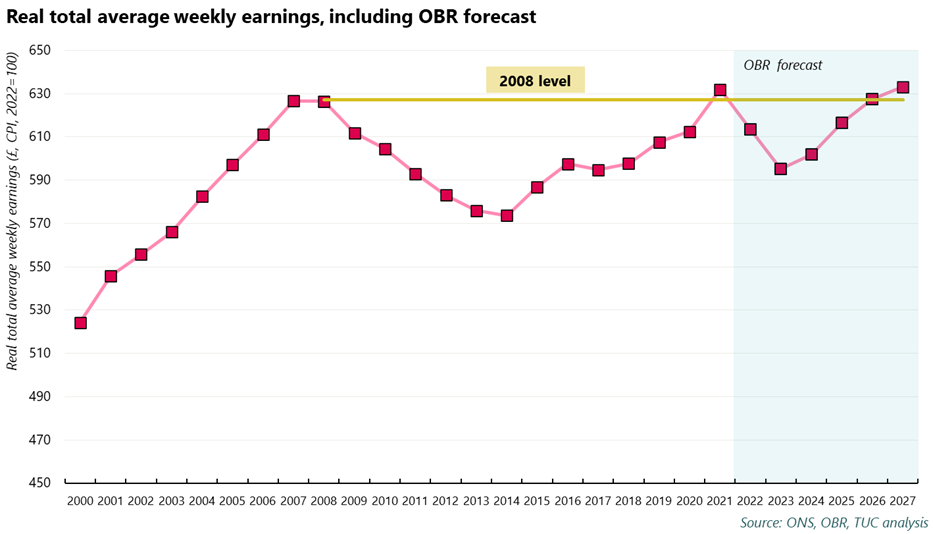
The OBR forecast expects that the real pay squeeze that’s already in its fourteenth year is set to last another five. Real average weekly earnings aren’t expected to go back above 2008 levels until 2027 – a 19-year pay squeeze that’s hit workers hard and is longer than any other since the Napoleonic times. The statement itself did little to help. The minimum wage has increased, but by less than inflation and still below the level of a real living wage. There was nothing to suggest public sector workers will get pay rises to help face the rising cost of living, after a decade in which their pay has been squeezed time and time again.


In terms of the labour market, the OBR has forecast a sustained fall in employment, still flatlining economic participation, and a rise in unemployment, which is not expected to return to the pre-crisis level until beyond the end of the forecast period in 2027. In terms of headcount the rise in unemployment is half a million – though the Bank of England is forecasting that it will rise by double this.
Ahead of the disastrous mini budget we called for protection against rising bills, with any costs shared fairly. And we called for a plan to grow the economy. The most prominent feature of the Chancellor’s plan was also the most worrying – to celebrate Nigel Lawson’s big bang that scrapped regulation on the city and set the trajectory to the global financial crisis.
Protection against inflation
A universal protection against rising energy bills was replaced with a more targeted approach, with bills now allowed to rise to an average of £3,000 p.a. (up from £2,500), but extra support for those on means tested benefits, pensioners, and disabled people. But energy are not the only bills that are soaring – CPI inflation is now at a forty year high of 11.1 per cent. Food inflation is at a record level, fuel prices are very high and prices are up across the board. The ONS reported this week that inflation rates hitting the lowest earners are three percentage points higher than those for the highest earners.
Benefits
Chancellor said, ‘I am proud to live in a country with one of the most comprehensive safety nets anywhere in the world.’ This comment is beyond belief, as since 2010 this Government have implemented cuts which have decimated the social security system.
The benefit uprating by the Chancellor today has been the bare minimum. The standard out of work benefit is now worth just 13% of average weekly earnings. And the basic amount of universal credit will be worth £43 a month less than in 2010 even after this uprating is in place.
The state pension has fared better than working age benefits thanks to the triple lock, but ours remains one of the least generous in Europe. So the decision to return to the triple lock formula and increase pensions by CPI inflation after this year’s real terms cut, and to increase pension credit in line with prices too, was the bare minimum.
The autumn statement also contained a strong hint that the government was preparing to axe its formula linking state pension age rises to improvements in life expectancy and bring forward its planned increase. The savings to government – and cost to the public people – of this move would dwarf the impact of pension increases resulting from the triple lock in any given year.
The minimum wage will be raised to £10.42 in 2022/23. Significant increases are needed especially after real terms declines over the last couple of years. But the announced increase will still leave the real value of the minimum wage 1.1 per cent below where it was two years before. The government must, instead, put the minimum wage on a growth path to £15 as soon as possible.
Infrastructure investment
The Chancellor warned that capital investment was too soft a soft target for austerity (like under George Osborne), then proceeded to cut planned spending by £5bn in 25-26, £9bn in 26-27 and £15bn in 27-28.
This will have major impacts on delivering the infrastructure needed to keep people moving, the UK economy competitive, and to hit climate targets.
Taxing wealth and windfalls
The Chancellor was duty bound to hit the better off. But these were not big changes in the great scheme of things. The biggest hits came on the energy profits levy and the electricity generator levy, raising £14bn in 23-24 and £11bn in 24-25. The wider hit from the 20% income tax thresholds will earn the Treasury a cool £6bn a year, compared to less than £1bn raised from lowering the threshold for paying the top rate of tax. All these changes are however dwarfed by the reversal of Rishi Sunak’s health and social care levy which costs £16-£17bn a year.
A strong economy relies on strong public services. Welcome words from the Chancellor as he set out his fiscal statement. Yet, warm words failed to match spending plans.
The Chancellor confirmed government would stick to cash spending plans set out in the Comprehensive Spending Review 2021. Meaning departmental budgets would not be adjusted to account for soaring inflation, placing unsustainable pressure on public services and creating more years of pay misery for the millions of key workers across the public sector who got us through the pandemic.
Analysis carried out by NEF for the TUC ahead of the budget showed, departmental budgets needed an additional £43 billion just to remain at the level set out in the Comprehensive Spending Review 2021 and keep public sector pay in line with the cost-of-living. This did not materialise.
Some relief was provided for key government departments such as the NHS, social care and schools. Nothing for public sector pay rises or cash starved areas like the court system, prisons, HMRC and local government.
Schools will receive an additional £2.3 billion in funding for 2023-24 and 2024-25, representing an overall spending increase of 4 per cent, returning per pupil spending to 2010 levels.
But no additional funding was provided for adult education, where spending fell by 49 per cent between 2009 and 2019 – surprising given the Chancellor’s emphasis on the importance of skills to economic stability and growth.
Nor for the cash-strapped early years sector, where the number of providers fell by 4,000 between 1 April 2021 and 31 March 2022, in large part due to a toxic combination of unsustainable funding levels and soaring costs for essential expenditure such as energy and food.
Health and social care will receive additional funding of around £7.5 billion. An estimated £1.6 billion of the money identified for social care requires local authorities generating additional revenue through rises to council tax.
At a time when millions of households are struggling with the cost-of-living, it is hard to see how councils will do this without putting even more financial strain on families.
Councils in areas of high socio-economic deprivation, often the most cash strapped when it comes to social care, will have the hardest time raising additional revenue.
The additional £3.3 billion for the NHS represents less than 1% of it’s overall budget. A drop in the ocean. Only a fraction of what our NHS and its workforce needs this winter. With NHS vacancies at a record-high, one in ten posts unfilled, what the health system desperately needed was investment in its workforce.
Indeed, across the public sector, what was needed and missing from today’s fiscal statement was a recognition that after twelve years of government imposed pay restraint and real terms pay cuts, our public sector workforce are on their knees. To deliver world class, high-quality public services, we need to treat the people that deliver them, with respect and dignity. That starts with spending plans that deliver cost-of-living proof pay rises in 2022 and beyond.
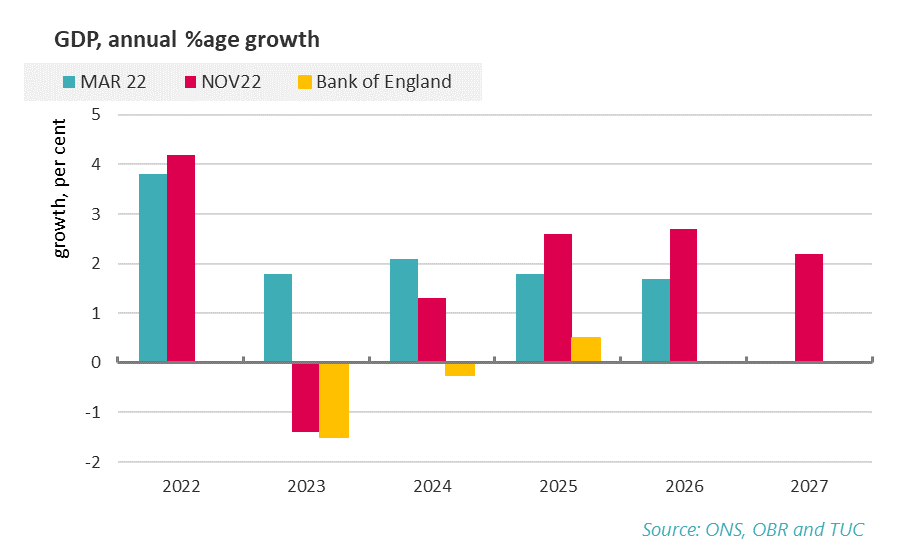
In spite of all this pain, the biggest risk is still the economy. Here the OBR have let the government off lightly. While the recession means a decline in GDP next year of 1.4 per cent, activity recovers quickly into 2024 and then continues at rates that would be exceptional given the experience since 2008. When asked at their press conference why the forecasts were so much stronger than those of the Bank of England, the OBR offered – ‘ask the Bank’.

This vigour comes in spite of much higher than anticipated central bank interest rates, virtually unchanged government support on the immediate horizon, and heavy austerity into the future (at the press conference the OBR equivocated whether it was comparable to Osborne’s).
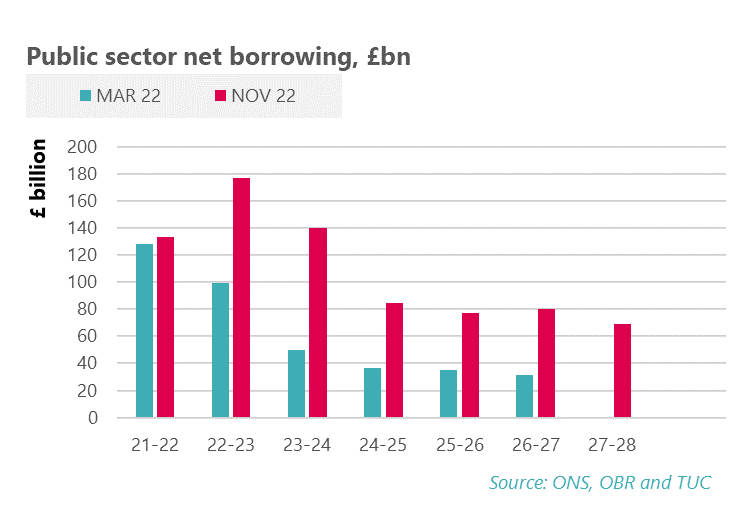
In a way we are lucky. Better projected GDP outcomes protect against the need for even tougher austerity, given the vogue for fiscal rules. Nonetheless the government have also accepted a fairly substantial increase in borrowing over coming years, with public sector debt is expected to peak at 97.6 per cent of GDP in 2025-26.

There are no game changers here, and there is very little protection against a steeper deterioration. In the meantime workers face yet another severe reduction in the standard of life. But sadly nothing here is new. Until we have a government that has a serious plan to put work before wealth, we look set to remain trapped in the doom loop of austerity politics.
We know that today’s choices weren’t inevitable. There is a better plan to grow the economy, protect our public services, and get wages rising. Now we need a government prepared to deliver it.

The UK Government has been urged to increase the amount of funding available for NHS pay.
Ahead of the Autumn statement, Scottish Health Secretary Humza Yousaf and Welsh Health Minister Eluned Morgan have written to UK Health Secretary Steve Barclay to ask for additional funding to help avert strike action this winter in the NHS.
The letter reads:
“We wanted to write to you in advance of the Chancellor’s Autumn Statement on 17th November to once again make the case for additional funding for our hardworking NHS staff.
“In recent weeks the Deputy First Minister of Scotland and the Welsh Government Minister for Finance and Local Government have written to His Majesty’s Treasury to make clear the need for additional funding for public services.
“The Royal College of Nursing have announced a sweeping legal mandate for industrial action across the UK. In Scotland, they have joined several other unions representing NHS staff in gaining a legal mandate for industrial action with ballots expected to confirm a mandate in the rest of the UK.

“The risk to the NHS of industrial action this winter is profound, and we all need to do all we can to avert industrial action in any form. The NHS across the UK continues to feel the effects of the pandemic as it recovers and remobilises, and any action is likely to have catastrophic effects in all parts of the UK.
“We are experiencing a cost of living crisis and the anger of NHS staff is entirely understandable. Sky rocketing inflation combined with high interest rates, a direct result of the havoc caused by the UK Government’s mini-budget, means that we are simply unable to come close to matching the expectations of NHS staff across the country. While the support provided by the UK Government on areas such as support for energy bills is welcome, it has not gone nearly far enough.
“Media reports suggest that the Chancellor is considering reimposing austerity on the people of the UK again, for which there is no mandate, through extensive spending cuts. That would be a disaster for our public services, including the NHS, at a time when they need more investment, not less.
“We would therefore implore you to work with us to make the case to the Chancellor in advance of his Autumn Statement for increased funding for the NHS and the devolved governments as a whole, primarily to pay our hard working NHS staff a fair pay rise in the face of the cost of living crisis this winter, and avoid what could be catastrophic industrial action in the NHS.”

Responding to the latest Emergency Department performance figures published by NHS England for October 2022, Dr Adrian Boyle, President of the Royal College of Emergency Medicine, said: “The crisis in Emergency Care is dire. October saw nearly 44,000 patients face a 12-hour DTA wait – we know 12-hour waits measured from decision-to-admit are just the tip of the iceberg and hides the reality.
“We know far more patients wait for 12-hours measured from their time of arrival. NHS England and the Department of Health and Social Care will still not commit to publishing this data, despite it being collected by all Trusts. We believe this is a barrier to tackling the root of the crisis.
“We know excessively long waits and dangerous crowding are associated with patient harm and increased risk of mortality. Scientific studies have shown that there is one death for every 67 patients waiting between eight and 12-hours from their time of arrival in the Emergency Department.
“The ONS continue to report worryingly high excess mortality figures and we believe that dangerous crowding, long delays, and the crisis in urgent and emergency care are contributing to a significant proportion of these excess deaths.
“We are increasingly concerned about the winter and the health system’s ability to cope. We are already at 94.3% bed occupancy for all general and acute beds and each month patients face the longest waits on record. The system is failing in its core function – the quick and effective delivery of emergency care.
“We need meaningful action now – sticking plasters like setting up tents or handover units will do nothing to resolve these long-waits and may actually cause more harm to patients. We know we need to be able to admit patients, we know ambulances need to handover patients quickly, we agree that it is vital that ambulances must return to Urgent and Emergency calls in the community – but to achieve this we must tackle the issue of poor flow in our hospitals.
“Many patients in hospital no longer meet the criteria to reside, they are occupying beds to which we could be admitting patients. Around 13,000 people are in hospital unable to be discharged. We urgently need an effective social care workforce to help with the discharge of these patients, so we can admit patients, receive patient handovers promptly, and get ambulances back out to the community.
“It is crucial that those in power understand that this is not a demand issue, attendances are not causing crowding and long waits. Crowding and long waits are a consequence of the inability to move patients through the hospital, a consequence of patients who are unable to be discharged because of severe cuts to social care.
“If you can’t discharge patients, beds are indefinitely occupied and the whole system is blocked. The government must get a grip of the social care crisis to fix flow.”

Commenting on the news that the RCN have voted in favour of strike action, Dr Adrian Boyle said: “In Emergency Medicine there is a retention crisis, particularly amongst our nursing colleagues.
“Emergency Medicine nurses are a critical part of the workforce – EM is a team sport. We know and understand that many EM staff, including nurses, are burned out, exhausted and overwhelmed.
“They are skilled, competent professionals who deliver excellent care for our patients. It is vital that our nursing colleagues feel valued and appreciated.”

The latest Emergency Department performance figures published by NHS England for October 2022 for show:
The latest beds data for October 2022 show:
The latest Hospital Episodic Statistics published by NHS Digital for September 2022 show:

New data released today (10th) reveals the full effect of UK sanctions on Russia – with £18.39 billion of Russian assets frozen and reported to the Office of Financial Sanctions Implementation (OFSI).
The figure, released for the first time in OFSI’s Annual Review, demonstrates the key role the UK has played in standing up to Russia following their illegal invasion of Ukraine. It is nearly £6 billion pounds more than reported across all other UK sanctions regimes.
In conjunction with its allies, the UK has imposed the most severe sanctions Russia has ever faced, designating more than 1,200 individuals, over 120 entities and freezing the assets of 19 Russian banks with global assets of £940 billion since they began their illegal invasion.
Economic Secretary to the Treasury, Andrew Griffith said: “As staunch defenders of democracy, the UK is united with its allies in opposition to Russia’s barbaric and unprovoked invasion of Ukraine. We have imposed the most severe sanctions ever on Russia and it is crippling their war machine.
To make sure we are doing all we can to keep the pressure on Putin’s corrupt cronies we are more than doubling OFSI’s headcount. Our message is clear: we will not allow Putin to succeed in this brutal war.
FCDO Minister of State, Anne-Marie Trevelyan said: “When Putin invaded Ukraine he assumed we would sit idly by. He was wrong. Instead, the UK and our international partners have stood shoulder to shoulder with Ukraine in their fight for territorial integrity and political independence.
“Today’s report shows the scale of UK sanctions – freezing over £18 billion of Russian assets to stop Putin funding his war machine. We will continue to ramp up our sanctions to exert maximum economic pressure on the Russian regime until Ukraine prevail.”
By implementing these sanctions alongside our international partners, the UK is degrading Russia’s military machine. Despite the Russian regime’s attempts to firefight, GDP is predicted to decline by up to 6.2% in 2022 when compared to pre–invasion forecasts, and decline a further 2.3% in 2023. 60% of Russia’s foreign reserves have been immobilised, Russia’s exports have plummeted, and imports of critical goods have dropped by 68% from sanctioning countries.
The £18.39 billion figure is a significant contribution to the $30 billion of frozen Russian assets reported by the Russian elites, proxies, and oligarchs (REPO) taskforce in June. All this is having a major impact on the Russian military complex – vital semiconductors are now being scavenged from fridges and soviet-era equipment is being sent to the front line.
In order to ensure that the most stringent financial sanctions in history on Russia have not adversely affected the UK’s private and voluntary sectors, where appropriate OFSI has worked with businesses and granted general and specific licences allowing UK businesses to move away from Russian facing positions without an increased risk.
These licences have been granted where sufficient evidence has been provided and are often for basic needs and legal fees. The careful granting of these licences by OFSI in line with legislation, has helped UK individuals and businesses to function throughout a challenging period and helped maintain the UK’s place as a centre for financial stability.
The Russia sanctions regime will continue to play a major part of the OFSI’s work for as long as Putin’s illegal war against Ukraine continues. The government has committed to ensuring that OFSI is fully resourced, more than doubling its headcount.

Over 8 million households in England, Wales, Scotland and Northern Ireland who claimed qualifying means-tested benefits during the eligibility period will be automatically paid £324 this month, as part of £1,200 worth of direct help for households.
The payments, starting today from the Department for Work and Pensions, are made directly into eligible recipients’ bank accounts, with no need for people to apply or do anything to receive it.
The payment reference on DWP recipients’ bank accounts will be their national insurance number, followed by “DWP COL”. For HMRC recipients the payment reference will be “HMRC COLS”.

Work and Pensions Secretary, Mel Stride said: “We understand that people are struggling and that is why we’ve consistently acted to ensure millions of low-income families are supported. We will continue to act with compassion as we navigate challenging global economic circumstances.
“As part of a wider £37 billion package of support, this latest £324 payment will help the most vulnerable people in our society who are worrying about their finances through the winter months.”
The UK government’s £1,200 support package contains £400 for energy bills that is being paid in monthly instalments to all domestic energy customers between now and March 2023. It also includes a £150 Council Tax rebate for 85% of all UK households and the previous £326 Cost of Living Payment made by DWP in July and by HMRC in September.
On top of this, nearly one in ten people received the £150 disability payment in September, and a £300 addition to Winter Fuel Payments will go to over eight million pensioner households over the winter.

Chancellor of the Exchequer, Jeremy Hunt added: “Prices are rising across the world as we manage the aftershock of COVID-19 and Putin’s invasion of Ukraine. We recognise that families back home are struggling, which is why we’ve taken decisive action to hold down energy bills this winter, and provided hundreds of pounds of cash support for each vulnerable household.
“As part of that support, over 8 million vulnerable households – almost a quarter of families in the UK – will automatically receive a second cost of living payment worth £324 in their bank account from today.
“And while we can’t completely protect people from rising prices, my priority at the upcoming Autumn Statement will be to protect the poorest in society as we take the tough decisions necessary to fix our public finances.”
Those eligible to receive the second cost of living payment from today include people on:
To be eligible, claimants must have been claiming and entitled to a payment between 26 August and 25 September 2022, with the exception of pensioner households, who may be able to have a new Pension Credit claim backdated.
They have until 18 December 2022 to submit a valid claim for Pension Credit, which could entitle them to the £324 Cost of Living payment. Anyone can check their eligibility for Pension Credit using the online calculator or by calling the freephone claim line, on: 0800 99 1234.
Even if you are not on a qualifying DWP benefit you may still be eligible for the £324 payment, as HMRC are also making payments to over a million people who receive Working Tax Credit or Child Tax Credit and no other eligible benefits. These will be paid between 23 and 30 November 2022 and customers do not need to contact the government or apply for the payment at any stage

The £324 payment and the overall £1,200 package come on top of wide-ranging government support with the cost of living this winter, including an extension to the Household Support Fund, which is providing an extra £421 million between October and March to help vulnerable people with the essentials.
As well as this, the Energy Price Guarantee is ensuring people across the country pay significantly less for their energy bills, with a typical household saving around £700 this winter.
+ UN warns world on track for catastrophic 2.8C of heating
+ Call for Scotland to finally join global Beyond Oil & Gas Alliance
+ UK Gov’t urged to ‘Free Alaa’ from Egyptian prison
+ Scottish Climate March planned for Edinburgh

Ahead of the UN climate talks in Egypt, campaigners have issued a warning to the UK and Scottish Governments that they must ‘set an end date’ for oil and gas if the world is to stay within agreed climate limits.
The UN recently warned that the world was on course for a catastrophic 2.8C of climate warming by the end of this century, saying that emissions must fall significantly by 2030 if we are to stay within agreed climate limits. However the UK Government is opening new oil and gas fields, encouraging companies to explore for more fossil fuels and briefly tried to bring back fracking.
First Minister Nicola Sturgeon, who will join the talks in Egypt, said at COP26 that Scotland would work towards becoming part of the Beyond Oil and Gas Alliance – a group of nations who have committed to a managed phase out of oil and gas in line with the goals of the Paris Agreement.

One year on this commitment has not been made. The forthcoming Scottish Energy Strategy must establish a phase out of oil and gas for any chance of meeting our climate targets.
Demonstrations are all but banned in Egypt, which has a dire track record on human rights. Consequently there will not be any mass protests during the talks but instead Egyptian activists along with allies across African countries and the Arab world, have called for a global mobilisation to draw attention to demands for climate justice and human rights.
Edinburgh will host a Climate Justice March on Saturday 12 November as part of this Global Day of Action during COP27.

Friends of the Earth Scotland’s head of campaigns Mary Church said: “In the 12 months since COP26 ended we’ve seen yet again the devastating impacts of global heating at only 1.1C of warming – 30 million people flooded in Pakistan, famine across east Africa, wildfire and drought in the UK during the summer heatwave, and thousands of premature deaths from that same heatwave.
“Politicians did a lot of backslapping at COP26 with the UK presidency claiming to have kept the goal of 1.5C alive but these are empty words without the action to deliver on them. Over the last year the UK Government has actively made the climate crisis worse as it opened up new oil fields, tried to bring back fracking and is still considering opening a new coal mine.
“The UK and the Scottish Governments need to set an end date for fossil fuels well within the decade and redouble efforts for a fair transition away to a renewable powered economy, with affordable heat and transport for all.
“For COP27 to have any chance of success the talks need to see rich historical polluters like the UK come to the table willing to deliver their fair share of climate action, which means deep and rapid cuts to climate emissions in line with our responsibility for causing the crisis. A fair outcome would also include paying our climate debt to those nations who have done the least to cause the crisis and yet find themselves on the sharpest ends of its extreme impacts.
“Yet none of the big historical polluters including the UK is committing to anything near what is needed or owed. Instead, governments and corporations are greenwashing business as usual and relying on fantasy techno-fixes like carbon capture and storage and hydrogen to save the day.”
Commenting on the human rights situation in Egypt, and the ongoing hunger strike of British-Egyptian blogger and activist Alaa Abd El Fattah, one of Egypt’s highest profile prisoners of conscience who has been in prison for most of the last 8 years, Church continued: “The human rights situation in Egypt is atrocious, and we stand in solidarity with Egyptians and call for the release of all political prisoners and the opening up of civic space.
“There can be no climate justice without human rights and without public participation in shaping the transition to a world freed from fossil fuels.
“The UK Government must not return from Egypt without British citizen and human rights defender Abdel Abd El Fattah who is currently on hunger strike in an Egyptian jail for the so-called crime of sharing a Facebook post.”
FoES Head of Campaigns Mary Church will be attending the second week of COP27.

The First Minister will today call on world leaders to deliver on the commitments they made in the Glasgow Climate Pact, as she attends the first full day of the COP27 climate conference in Egypt.
The First Minister will take part in an all-female panel discussion on financing decarbonisation with government leaders, including the Prime Minister of Barbados.
The First Minister will also meet representatives of countries from the Global South to hear their experiences of the climate crisis and what they want to see delivered at the climate talks.
Ahead of the formal opening of COP27 the First Minister met on Sunday with the Executive Secretary of the UNFCCC Simon Stiell, Director General of the International Organization for Migration Antonio Vitorino and Prime Minister Mia Mottley of Barbados.

The First Minister said: “COP26 in Glasgow delivered real progress on tackling the climate crisis, with strengthened commitments to curb emissions, build resilience to climate change, and provide the finance needed to reach net zero. World leaders must use the next two weeks to take meaningful steps to deliver on the promises made in the Glasgow Climate Pact.
“We are gathering against a tense backdrop and the geopolitical landscape has changed significantly in the last year, not least as a result of Russia’s illegal invasion of Ukraine. However the climate crisis has not gone away and the answer to many of the global crises we face, such as energy security and food shortages, lies in going faster.
“For many countries, particularly in the global south, this must be the COP where the global north not only delivers on our promises to finance adaptation and mitigation, but recognises the need to address the loss and damage experienced by countries already impacted by climate change.
“Last year, Scotland became the first developed nation to pledge finance to address loss and damage and others have now followed suit, including Wallonia and Denmark. This shows just how important the action of smaller governments can be, and I know many countries and campaigners hope to see other countries, particularly in the north, step up and make COP in Egypt the loss and damage COP.”

COP26 President Alok Sharma has launched the UK’s COP26 Presidency Outcomes Document. He joined the Prime Minister to host around 80 global business CEOs at an event at Lancaster House on Friday.
The new report, which comes as the UK prepares to hand over to Egypt next week, highlights progress made over the three years since the UK took on the Presidency of the COP. It also acknowledges that more needs to be done at COP27 and beyond to implement the commitments made at COP26.
Under the UK’s stewardship and during a global pandemic, COP26 brought together nearly 200 countries to forge the historic Glasgow Climate Pact. The Glasgow Climate Pact remains the blueprint for accelerating climate action this critical decade to keep 1.5°C in reach.
The report details key achievements across the UK Presidency’s four overarching goals of mitigation, adaptation, loss and damage, and finance and collaboration.
Highlights include:

This progress has been achieved against the backdrop of an incredibly challenging geopolitical context, driven by Putin’s illegal invasion of Ukraine which has demonstrated the integral link between climate change, energy security and the vulnerability caused by our dependence on fossil fuels.
The UK’s Presidency has continued to drive action throughout this, working with countries, civil society organisations, and local communities to ensure that the commitments made in Glasgow are delivered to keep 1.5 alive.

Alok Sharma, COP26 President, said: “The last three years have been a unique privilege and I have been inspired by the urgency and the ambition I have heard around the world.
“The decade ahead can be one where we pull back from the precipice of climate catastrophe and unlock a just and sustainable path to prosperity for billions of people around the world.
“To do this we must fully deliver on the promises made at COP26 and in the Glasgow Climate Pact.”
Mr Sharma hosted members of the UN-backed international campaign Race to Zero at Lancaster House to consider how global business take forward the legacy of the COP26 UK Presidency and deliver on the Glasgow Climate Pact, in his final engagement as COP President before COP27.
Before the reception at Lancaster House, the COP President joined His Majesty The King and the Prime Minister at Buckingham Palace to mark the end of the UK’s COP26 Presidency and the beginning of Egypt’s Presidency of COP27.

The Prime Minister has decided to proclaim an additional bank holiday to mark the Coronation of His Majesty King Charles III next year. The bank holiday will fall on Monday 8 May, following the Coronation on Saturday 6 May.
In line with the bank holiday to mark Her Majesty Queen Elizabeth II’s Coronation in 1953, this will be an opportunity for families and communities across the country to come together to celebrate.
The bank holiday will take place across the United Kingdom.

Prime Minister Rishi Sunak said: “The Coronation of a new monarch is a unique moment for our country. In recognition of this historic occasion, I am pleased to announce an additional bank holiday for the whole United Kingdom next year.
“I look forward to seeing people come together to celebrate and pay tribute to King Charles III by taking part in local and national events across the country in his honour.”
Chancellor of the Duchy of Lancaster Oliver Dowden said: “The Coronation combines the sacred and the solemn but it is also celebratory.”
“This bank holiday will once again give people across the United Kingdom the opportunity to come together as families and communities to welcome His Majesty to the throne as we mark this important day in our nation’s long history.”

First Minister Nicola Sturgeon said: “The Coronation will be an historic moment for Scotland, and the Scottish Government wants to give as many people as possible the opportunity to join the celebrations.
“Scotland will want to send its best wishes to His Majesty, King Charles III, and The Queen Consort.”