A year ago on Friday P&O Ferries made nearly 800 workers redundant with only half an hour’s notice.Experienced sailors with an average of 20 years on the job were replaced with inexperienced and poorly paid agency staff.
But for all the strong words from ministers, 12 months later British workers are more vulnerable than ever.
P&O Ferries was able to get away with its actions because weak UK employment meant any sanctions would be outweighed by the savings they could make on their wage bill.
We know this because the chief executive Peter Hebblethwaite openly admitted P&O Ferries had broken the law when questioned by MPs.
The government promised swift action to prevent a scandal like P&O Ferries occurring again.
But the Insolvency Service declined to pursue criminal charges for P&O Ferries’ failure to inform the authorities of its plans in time. It also hasn’t sought to disqualify P&O Ferries’ directors.
Ministers have done little to close the legal loopholes P&O Ferries exploited
The Seafarer’s Wages Bill is intended to ensure that all vessels that dock at UK ports a minimum of 120 times a year have to pay at least National Minimum Wage equivalent. This gives a lot of scope for employers to avoid it.
On top of that, the surcharges imposed on operators who fail to pay NMWe are determined by port authorities. These might be the same companies that operate the ferries; and if not they will be motivated to set the charges low to secure business from ferry operators.
In either case there is ample potential for charges to be set so low that it is economical for operators to pay well below the NMWe and pay the surcharges as the cost of doing business.
Laws intended to force employers to consult with workers, inform state authorities of their plans and do proper health and safety checks have been left untouched.
The right to strike is under attack
Not only have ministers failed to prevent another P&O Ferries, they have gone out of their way to undermine workers rights and leave them more vulnerable.
The government is rushing through legislation that could impose minimum service levels if workers in transport workers, teachers, nurses, border force, fire and ambulance services and in nuclear decommissioning take industrial action. This is a draconian attack on the right to strike.
It has already been condemned by trade unions across the world and criticised by the International Labour Organization (ILO).
Rest assured if the government succeeds, it wont stop there: more and more workers will find their democratic right drastically undermined.
The government that swept to power promising to enshrine workers rights in law has done little but undermine them.
It’s been a year since the P&O Ferries sackings, but nothing has been done to stop another one.
ONE YEAR ANNIVERSARY – NEW REPORT: Another P&O Ferries style scandal could be on the cards because of ministers’ failure to boost worker protections and close legal loopholes, TUC warns
Ministers borrowing from the P&O Ferries’ playbook by attacking the right to strike and threatening to rip up hard-won workers’ rights, says union body
TUC general secretary Paul Nowak to speak at RMT rally today in Hull to mark the one-year anniversary
The Conservative government has given rogue employers a “free pass to act with impunity” after the P&O Ferries scandal – the TUC has warned, referring to the unlawful mass sacking of 800 seafarers a year ago today (Friday).
The warning comes as the TUC publishes a new report which reveals that of the four ways P&O Ferries broke the law, the government has failed to act on every single breach – both failing to punish the company and to strengthen worker protections.
The TUC says P&O Ferries also exploited loopholes in minimum wage law, which the government has failed to close – despite the introduction of the Seafarers Bill.
The union body warns that without government action, another P&O Ferries-style scandal could be on the cards.
Flagrant law-breaking
The TUC sets out four breaches of law by P&O Ferries which have gone unpunished:
The duty to consult when making collective redundancies: P&O Ferries knowingly broke the law because they could price in the low cost of the financial penalties. Following the P&O Ferries scandal, the TUC called on the government to increase protective awards and sanctions to a level that would ensure employers are deterred from brazenly flouting the law. The government did nothing.
Unfair dismissal of workers: Since the P&O Ferries sackings the government has taken no action to strengthen unfair dismissal protections. Ministers have launched a consultation on a draft statutory code of practice that would apply in similar situations. But even when the statutory code is in place an employer would only face a 25 per cent increase in financial sanctions, if they flouted the law – the TUC says this won’t stop rogue employers from breaking the law.
Failure to notify the relevant government authorities: P&O Ferries failed to notify the correct state authorities. This meant a jobs rescue bid couldn’t be launched. Following the P&O Ferries scandal the government has failed act, meaning that any employer making large scale redundancies can price in the likely sanction for failing to notify the authorities.
Breach of Director duties: P&O Ferries’ directors admitted deliberately breaching the law – and the TUC believes that the directors breached their fiduciary duties. The Insolvency Services is responsible for the initiation of director disqualification proceedings but despite serious acts of misconduct, no action has been taken against the P&O Ferries’ directors. The government has also failed to take action to deter other directors behaving like this in the future.
The TUC adds that the government inadequately acted after P&O Ferries bypassed the law by exploiting loopholes in minimum wage legislation.
The new Seafarers Bill widens the scope of the minimum wage, which currently has very limited application to seafarers.
However, the TUC warns there are gaping loopholes in the Bill, including requiring ships to make a certain number of UK stops to fall within the law, meaning that employers whose ships don’t reach a required threshold of using UK ports a certain number of times could still dodge it.
According to the union body, when the replacement crew were first introduced after the mass sacking, P&O Ferries breached international safety standards by failing to ensure that the replacement crew were properly acquainted with safety procedures.
Maritime inspectors listed an unprecedented 31 separate failings on a P&O Ferries vessel detained last year, ranging from problems with fire safety to lifeboat drills.
Failing working people
The TUC has accused the government of “failing working people” following the P&O Ferries dismissals.
The mass sacking was a national scandal, which provoked serious uproar at the time from politicians across the political spectrum – including government ministers.
Then business secretary Grant Shapps stated that “where new laws are needed, we will create them, that where legal loopholes are cynically exploited, we will close them, and that where employment rights are too weak, we will strengthen them.”
Paul Scully, then business secretary, conceded that unlimited fines would be in stopping another P&O Ferries-style scandal.
The TUC says promised sanctions failed to materialise – adding the government did not rigorously pursue P&O Ferries or change the law to prevent future conduct similar to the company’s actions.
Pete Hebblethwaite, P&O Ferries CEO, faced calls for the sack by senior government ministers – but one year on since the mass sacking, Hebbelthwaite remains in post.
The TUC says ministers are rewarding P&O Ferries for its law breaking with government contracts.
The company has lucrative deals including with the Ministry of Defence, and new freeports have been awarded to DP World and P&O Ferries – despite Grant Shapps pledging to review all their government contracts since March 2022.
Urgent action needed
The TUC says that urgent action is needed to clamp down on fire and rehire style practices and make sure another P&O Ferries-style scandal is never allowed to happen again.
The union body is calling on government to:
Increase sanctions on employers who deliberately breach the law to provide a proper deterrent
Introduce fair pay agreements to help lift wages and prevent a race to the bottom, starting in low-paid industries, including ferries
Give workers protection from unfair dismissal from day one in the job
Ensure employers are required to reinstate workers where employers breach consultative duties
TUC General Secretary Paul Nowak said: “The mass sacking by P&O Ferries was a national scandal. It should have marked a new chapter for employment rights in the UK.
“But this Conservative government has failed working people and given rogue employers a free pass to act with impunity.
“Despite behaving like corporate gangsters, P&O Ferries has been allowed to get away scot-free because of our lax labour laws.
“Instead of boosting worker protections and closing legal loopholes, ministers sat on their hands and did next to nothing.
“And to add insult to injury, ministers are now actively borrowing from the P&O Ferries playbook.
“They are brazenly attacking the right to strike and threatening to rip up hard-won workers’ rights like holiday pay, equal pay for women and men and rest breaks.
“Workers need more power in the workplace, not less. It’s time for the government to put in place proper protections for workers who are at the mercy of bad bosses. That starts with a fair pay agreement for the ferry sector.
“Make no mistake. Without stronger regulation, another P&O Ferries style scandal is on the cards.”
Neil Todd, a senior trade union lawyer at Thompsons Solicitors, who acted on behalf of the RMT union at the time, said: “P&O Ferries took the callous business decision that sacking its staff unlawfully – despite the financial penalties and public backlash it would cause – was more convenient and cheaper than engaging in meaningful consultation and complying with legal obligations.
“What message does it send to unscrupulous employers if P&O Ferries can get away with paying out what are to them small sums and carry on trading? P&O Ferries should have been a pivotal moment in recognising UK employment law does not go far enough to protect working people, but nothing has changed and three Conservative Prime Ministers later it is clear this is not a priority for any Conservative government.
“The financial penalties for sacking staff without notice and without any meaningful consultation need to be strengthened and there needs to be legislation that would more easily allow employees to take pre-emptive legal action before any dismissals take effect. It is only these sorts of changes which will ensure no company is emboldened ‘to do another P&O’.”
A new system that will give the Government and emergency services the capability to send an alert directly to mobiles phones when there is a risk to life has been launched today.
UK-wide Emergency Alerts service launched and in operation from today
System will bolster the UK’s resilience and provides the capability to send alerts direct to mobile phones when there is a risk to life
UK-wide test to take place on Sunday 23 April
Working with mobile broadcasting technology, the Emergency Alerts system will transform the UK’s warning and informing capability; providing a means to get urgent messages quickly to nearly 90 percent of mobile phones in a defined area; providing clear instructions about how best to respond.
The system is now ready to be tested across the country following successful tests in East Suffolk and Reading, as the Government continues to strengthen its resilience capability, making sure it offers the best possible protection against an ever-evolving range of threats.
A UK-wide alerts test will take place in the early evening of Sunday 23 April which will see people receive a test message on their mobile phones.
The alerts will only ever come from the Government or emergency services, and they will issue a warning, always include the details of the area impacted, and provide instructions about how best to respond – linking to gov.uk/alerts where people can receive further information.
Emergency Alerts will be used very rarely – only being sent where there is an immediate risk to people’s lives – so people may not receive an alert for months, or even years.
The service has already been used successfully in a number of other countries, including the US, Canada, the Netherlands and Japan, where it has been widely credited with saving lives, for example, during severe weather events. In the UK, alerts could be used to tell residents of villages being encroached by wildfires, or of severe flooding.
Announcing the launch of the new alerts system, Chancellor of the Duchy of Lancaster, Oliver Dowden MP, said: “We are strengthening our national resilience with a new emergency alerts system, to deal with a wide range of threats – from flooding to wild fires.
“It will revolutionise our ability to warn and inform people who are in immediate danger, and help us keep people safe. As we’ve seen in the U.S. and elsewhere, the buzz of a phone can save a life.”
Emergency Alerts will be used across England, Scotland, Wales and Northern Ireland, and their initial use will focus on the most serious severe weather-related incidents, including severe flooding in England.
The Government has been working closely with a range of stakeholders and partners across the UK on developing the system, including colleagues from the emergency services, transport groups and the Environment Agency.
Scotland’s Justice Secretary and lead Minister for resilience Keith Brown said: “This new service builds on the arrangements we already have in place with responders and other key organisations in Scotland to keep people safe during emergencies and save lives.
“The system has already been used successfully overseas in other countries including New Zealand, the Netherlands, Japan and the USA where it has been credited with saving lives during severe weather events and earthquakes.
“During rare events where there is an imminent risk to life, alerts can be sent direct to people’s mobile phones with clear instructions explaining what action to take and how to seek help.”
Chair of the National Fire Chiefs Council, Mark Hardingham, said: “Together with every fire and rescue service in the country, I’m looking forward to having Emergency Alerts available to help us to do our jobs and to help communities in the event of emergencies.
“We’ve seen this type of system in action elsewhere across the world and we look forward to having the facility here in the UK – by working together with fire services and partners we want this system to help us to help you be as safe as you can if a crisis does hit.”
Executive Director for Flood and Coastal Erosion Risk Management at the Environment Agency, Caroline Douglass, commented: “Being able to communicate warnings in a timely and accurate manner during incidents is really important to help people take action to protect themselves, their families, and their neighbours.
“This year is the 70th anniversary of the 1953 east coast surge, one of the worst flood events in our recent history which saw over 300 people perish in England – while our ability to warn and inform has come on leaps and bounds since then, Emergency Alerts is a fantastic addition to our toolbox that we can use in emergency situations.”
By broadcasting from cell towers in the vicinity of an emergency, the alerts are secure, free to receive, and one-way. They do not reveal anyone’s location or collect personal data.
Alerts can only be sent by authorised Governmental and Emergency Services users. Successful live tests of the service have already taken place in East Suffolk and Reading.
The Hunting Trophies (Import Prohibition) Bill has been passed by the House of Commons
The UK Government made a manifesto commitment to ban imports of hunting trophies of endangered animals and yesterday supported the passage of Henry Smith MP’s Private Member’s Bill which delivers this.
The Government will continue to support the Bill in the Lords helping to protect animals listed by the internationally agreed Convention on International Trade in Endangered Species (CITES).
After the debate, International Biodiversity Minister Trudy Harrison said: “This is a pivotal moment in delivering one of our key manifesto commitments on international conservation and animal welfare.
“Using an internationally agreed list of species, this will play an important part in helping reverse the decline of wildlife across the world. I look forward to it becoming an Act of Parliament.”
Conservative MP for Crawley Henry Smith said: “At the last General Election we stood on a manifesto commitment to ban imports of hunting trophies of endangered animals. The House of Commons passing this legislation today marks an important moment in ensuring that this pledge to support conservation becomes a reality.
“I’m grateful to the Government for supporting my Hunting Trophies (Import Prohibition) Bill and I look forward to it now progressing through the House of Lords.
“Our country does not want to be part of a trade in the body parts of endangered species. Today the Commons sent this message loud and clear.”
The Bill will ban the import of trophies hunted from around 6,000 species including lions, elephants, rhinos, and polar bears.
It follows the government’s world-leading Ivory Act which came into force last year, introducing a near total ban on the import, export and dealing of items containing elephant ivory in the UK. We will also be setting out measures in due course on whether to extend that ban to other ivory bearing species.
The Government will also support Angela Richardson’s Animals (Low-Welfare Activities Abroad) Bill in the Lords, which will provide the ability for government to ban the sale and advertising of activities abroad which involve low standards of welfare for animals.
Childcare revolution to expand 30 hours free childcare for children over the age of nine months, alongside boosts to subsidised childcare for parents on Universal Credit, including upfront support.
A £27 billion tax cut for business through radical ‘full expensing’ policy and capital allowances reform which will drive investment and growth.
Measures to ease cost-of-living burden will help more than halve inflation, with extension of Energy Price Guarantee and duties on fuel and a pub pint both frozen.
Major set of reforms to support people into work, removing barriers that stop those on benefits, older workers, and those with health conditions who want to work from working.
Inflation falling, debt down and growth up in Chancellor’s Spring Budget for growth that delivers upon the Prime Minister’s economic priorities.
A revolution in childcare, a £27 billion tax cut for business and a trio of freezes to help families with the cost-of-living headlined the Chancellor’s Spring Budget today, Wednesday 15 March.
Aimed at achieving long-term, sustainable economic growth that delivers prosperity for the people of the United Kingdom, the Spring Budget breaks down barriers to work, unshackles business investment and tackles labour shortages head on.
Chancellor of the Exchequer, Jeremy Hunt said:“Our plan is working – inflation falling, debt down and a growing economy. Britain is on a lasting path to growth with a revolution in childcare support, the biggest ever employment package and the best investment incentives in Europe.”
The Chancellor announced 30 hours of free childcare for children over the age of nine months, with support being phased in until every single eligible working parent of under 5s gets this support by September 2025.
The government will also pay the childcare costs of parents on Universal Credit moving into work or increasing their hours upfront, rather than in arrears – removing a major barrier to work for those who are on benefits. The maximum they can claim will also be boosted to £951 for one child and £1,630 for two children – an increase of around 50%.
The Chancellor went on to set out plans to continue to support households with cost-of-living pressures including keeping the Energy Price Guarantee at £2,500 for the next three months and ending the premium that over 4 million households pay on their prepayment meter, bringing their charges into line with comparable customers who pay by direct debit.
Taken together with all the government’s efforts to help households with higher costs, these measures bring the total support to an average of £3,300 per UK household over 2022-23 and 2023-24.
To help household budgets further, the planned 11p rise in fuel duty will be cancelled, maintaining last year’s 5p cut for another twelve months and saving a typical driver another £100 on top of the £100 saved so far.
The generosity of Draught Relief has also been significantly extended from 5% to 9.2%, so that the duty on an average draught pint of beer served in a pub both does not increase from August and will be up to 11 pence lower than the duty in supermarkets. The commitment to duty on a pub pint being lower than the supermarket has been termed the “Brexit Pubs Guarantee” by the Chancellor, and this change will also be enjoyed by every pub in Northern Ireland thanks to the Windsor Framework.
The Chancellor also set out a comprehensive plan to remove the barriers to work facing those on benefits, those with health conditions and older workers. An increase in the pensions Annual Allowance from £40,000 to £60,000 and the abolition of the Lifetime Allowance will remove the disincentives to working for longer.
A new ‘Returnerships’ skills offer for older workers and more stringent Universal Credit job search requirements also feature in the plan that will boost the UK’s workforce, fill vacancies and support economic growth.
In line with the government’s vision for the UK to be the best place in Europe for companies to locate, invest, and grow, a new policy of ‘full expensing’ will be introduced for the next three years to boost business investment in an effective cut to corporation tax of £9 billion per year.
This makes the UK the joint most competitive capital allowances regime in the OECD and the only major European economy to have such a policy. The independent Office for Budget Responsibility (OBR) forecast that this will increase business investment by 3% for every year it is in place.
Mr Hunt signalled an intention to make this scheme – which covers equipment for factories, computers and other machinery – permanent when responsible to do so.
Accompanying forecasts by the OBR confirm that with the package of measures Mr Hunt set out today, the economy is on track to grow with inflation halved this year and debt falling – meeting all of Prime Minister Rishi Sunak’s economic priorities. This comes alongside the confirmation that there are no new tax rises within the Spring Budget.
Childcare
Significant reforms to childcare will remove barriers to work for nearly half a million parents with a child under 3 in England not working due to caring responsibilities, reducing discrimination against women and benefitting the wider economy in the process.
30 hours of free childcare for children over the age of nine months with working parents by September 2025, where eligibility will match the existing 3-4 year-old 30 hours offer.
This will be introduced in phases, with 15 hours of free childcare for working parents of 2-year-olds coming into effect in April 2024 and 15 hours of free childcare for working parents of nine months – 3 years old children in September 2024.
The funding paid to nurseries for the existing free hours offers will also be increased by £204 million from this September rising to £288 million next year.
Schools and local authorities will be funded to increase the supply of wraparound care, so that parents of school age children can drop their children off between 8am and 6pm – tackling the barriers to working caused by limited availability of wraparound care.
Childcare costs of parents moving into work or increasing their hours on Universal Credit paid upfront rather than in arrears, with maximum claim boosted to £951 for one child and £1,630 for two children – an increase of around 50%.
In recognition of both the importance and short supply of childminders, incentive payments of £600 will be piloted from Autumn of this year for those who sign up to the profession (rising to £1,200 for those who join through an agency) to increase the number available and increase choice and affordability for parents.
Employment
The Chancellor set out a comprehensive plan to help people move into work, increase their hours, and extend their working lives, including for those on benefits.
The Lifetime Allowance charge will be removed before being abolished altogether, removing barriers to remaining in work and simplifying the tax system by taking thousands out of the complexity of pension tax.
The Annual Allowance will be increased from £40,000 to £60,000, incentivising highly-skilled workers to remain in the labour market. As a result of the pensions tax measures announced today, an estimated 80% of NHS doctors will not receive a tax charge with respect to accruals under the 2015 NHS career average scheme.
A new ‘Returnerships’ apprenticeship targeted at the over 50s will refine existing skills programmes to make them more accessible to older workers, giving them the skills and support they need to find a recognisable path back into work.
The midlife MOT offer will be expanded and improved to ensure people get the best possible financial, health and career guidance well ahead of retirement. There will be an enhanced digital midlife MOT tool and an expansion of DWP’s in person midlife MOTs for 50+ Universal Credit claimants, aiming to reach 40,000 per year.
A DWP White Paper on disability benefits reform will herald the biggest change to the welfare system in the past ten years, to make sure it better meets the needs of those on disability benefits in Great Britain. This includes removing the Work Capability Assessment, meaning the majority of claimants will now have to do one health assessment rather than two. Reforms will also support claimants to try work without fear of losing their financial support.
A new voluntary employment scheme for disabled people and those with health conditions called Universal Support will be funded in England and Wales. The government will spend up to £4,000 per person to find them a suitable role and cater to their needs, supporting 50,000 places per year once fully rolled out.
Over £400 million plan to tackle the leading health causes keeping people out of work, with investment targeted at services for mental health, musculoskeletal conditions, and cardiovascular disease.
Strengthening work search and work preparation requirements for around 700,000 lead carers of children aged 1-12 claiming Universal Credit in Great Britain.
Increasing the Administrative Earnings Threshold (AET) – which determines how much support and Work Coach time a claimant will receive based on their earnings – for an individual claimant, from the equivalent of 15 to 18 hours at National Living Wage and removing the couples AET in Great Britain. Over 100,000 non-working or low-earning individuals will be asked to meet more regularly with their Work Coach for support to move into work or increase their earnings.
The application and enforcement of the Universal Credit sanctions regime will be strengthened, by providing additional training for Work Coaches to apply sanctions effectively, including for claimants who do not look for or take up employment, and automating administrative elements of the sanctions process to reduce error rates and free up Work Coach time.
Elsewhere, international talent will be attracted through a new migration package that includes adding five construction occupations to the Shortage Occupation List and expanding the range of short-term business activities that are covered under the UK’s six-month business visit visa offer.
Enterprise
The Chancellor put forward a plan to boost innovation, drive business investment and hold down energy costs.
A ‘full expensing’ policy introduced from 1 April 2023 until 31 March 2026 and an extension to the 50% first-year allowance in the same period – a transformation in capital allowances worth £27 billion to businesses over three years.
A £500 million per year package of support for 20,000 research and development (R&D) intensive businesses through changes to R&D tax credits.
Generous reforms to tax reliefs for the creative sectors will ensure theatres, orchestras, museums and galleries are protected against ongoing economic pressures and even more world-class productions are made in the UK.
The Medicines and Healthcare products Regulatory Agency (MHRA) will receive £10 million extra funding over two years to maximise its use of Brexit freedoms and accelerate patient access to treatments. This will allow, from 2024, the MHRA to introduce new, swift approvals systems, speeding up access to treatments already approved by trusted international partners and ground-breaking technologies such as cancer vaccines and AI therapeutics for mental health.
All of the recommendations from Sir Patrick Vallance’s review into pro-innovation regulation of digital technologies, published alongside Spring Budget today, are to be accepted.
£900 million of funding for an AI Research Resource and an exascale computer – making the UK one of only a handful of countries to have one – and a commitment to £2.5 billion ten-year quantum research and innovation programme through the government’s new Quantum Strategy.
Levelling Up
To level up growth across the UK and spread opportunity everywhere, local communities will be empowered to command their economic destiny.
Greater responsibility for local leaders to grow their local economy.
Over £200 million for high quality local regeneration projects in areas of need, from the transformation of Ashington Town Centre to a skills and education campus in Blackburn.
Over £400 million for new Levelling Up Partnerships for twenty areas in England most in need of levelling up, such as Rochdale and Mansfield.
Business rates retention expanded to more areas in the next Parliament.
Delivering trailblazer devolution deals for the West Midlands and Greater Manchester Combined Authorities that include single multi-year settlements for the next Spending Review, alongside a commitment to negotiate further devolution deals in England.
12 Investment Zones across the UK including four across Scotland, Wales and Northern Ireland
£8.8 billion over the next five-year funding period for a second round of the City Region Sustainable Transport Settlements.
Many of today’s decisions on tax and spending apply in Scotland, Wales and Northern Ireland.
As a result of decisions that do not apply UK-wide, the Scottish Government will receive around an additional £320 million over 2023-24 and 2024-25, the Welsh Government will receive an additional £180 million, and the Northern Ireland Executive will receive an additional £130 million.
Scottish Secretary Alister Jack said: “Today the Chancellor has set out a Budget which continues cost of living support and will deliver sustainable, long-term growth, helping us halve inflation and reduce our national debt.
“Maintaining the Energy Price Guarantee until June will save the average family £160 a year and gives certainty over their bills until summer. We’ve also made changes to Universal Credit to help people get back to work.
“Other UK Government direct investment in Scotland includes £8.6 million for Edinburgh’s world-class festivals, more than £1 million for five new vital community ownership projects, and investment in Scotland’s innovative high tech sector. The Chancellor has also confirmed there will be Investment Zones in all parts of the UK, building on Scotland’s two new Freeports.”
STAKEHOLDER REACTION: CHILDCARE
Chris McCandless, European CEO, Busy Bees Nurseries said:“Today’s announcement is a positive step for children, parents and providers of early years education.
“At Busy Bees, we know the difference that a great early education makes to a child’s future and look forward to working with the government on implementing these changes. It’s now critical to ensure this increased funding is used to deliver the most favourable impact on parents and staff, and to generate the desired benefit for the economy.”
Justine Roberts, founder and CEO, Mumsnet said:“This is a hugely significant intervention from the Chancellor. Mumsnet has been campaigning for years for childcare to be recognised as the vital national infrastructure that it is, and to see it at the centre of today’s Budget is testament to the work we have done to drive it up the political agenda.
“We know from our users that the current gap in support between the end of maternity leave and a child’s third birthday means for many women it is simply not financially feasible to return to work.
“This has long term consequences for their careers and pensions, as well as slowing economic growth, so it is welcome that the government has listened to us on this issue and set out a plan to address it.
“We are also pleased that the Chancellor has heeded calls to reform the childcare element of Universal Credit so that it no longer forces parents into debt, and has announced changes to increase the supply of wraparound care to better reflect the needs of working parents.
“That said, there are clearly concerns about whether the funding allocated is actually sufficient to deliver this expanded provision. We would urge the Chancellor to engage with these concerns immediately in order to ensure the offer to families that he has outlined can actually be delivered.”
Joeli Brearley, CEO and Founder, Pregnant Then Screwed said:“The budget announcement on childcare today was the main event in the Spring budget which just shows the power of collective action and we are elated to hear that the childcare sector will now receive a significant investment, and that universal credit will be paid upfront, these schemes will change parents’ lives.
“Parents of young children felt ignored, but this will restore their faith in democracy so we thank Minster’s for hearing our cry and bridging the gap for mothers from the end of maternity leave so that they are supported to be able to work.
“It is imperative that the right investment is made to properly fund the roll out of these free childcare hours. We need to ensure that there is a clear and remunerated strategy to attract more educators into the sector, to retain those workers and to offer progression opportunities.
“Without a workforce plan providers will continue to be forced to close, and increasing ratios will add pressure to an underpaid workforce. The CBI estimates that to do what the government is planning costs £8.9 billion not £4 billion, so we need to see the detail as to how this money is being distributed.
“Free childcare from 9 months is brilliant, but only if there are childcare settings to be able to access this care, without the correct funding and enough childcare staff there won’t be.
“We feel really positive about the future though, and many of the parents we work with feel the same.”
STAKEHOLDER REACTION: CROSS CUTTING
Michael R. Bloomberg, Founder, Bloomberg LP and Bloomberg Philanthropiessaid:“I am a very big believer in the future of the UK’s economy, including for the financial services sector.
“Whatever the daily headlines, the UK has an enormous amount going for it and even more potential. Bloomberg continues to make major investments here and we remain optimistic that the U.K.’s high-tech, high-skilled economy is well-positioned for long-term growth.”
Matthew Fell, Interim Director-General, CBI said:“This Budget is a strong second act in the Chancellor’s plan for stability and growth.
“The CBI called for action on people and productivity and the government has delivered support for both. Measures to help households and businesses will secure the growth we need to boost living standards for all.
“Full capital expensing will keep the UK at the top table for attracting investment and puts us on an essential path to a more productive economy.
“Boosting childcare provision is a big win for businesses struggling to recruit and retain, and parents balancing care and career needs.
“Alongside support for occupational health to help people stay in work, it shows the Chancellor is listening to business on reducing economic inactivity and easing a tight labour market.
“New investment zones focused on economic clusters will drive growth across the country and increased support for quantum is a further step towards making the UK the science and technology superpower it aspires to be.
“Giving the go-ahead to carbon capture and nuclear are important steps that will keep the UK’s green growth story on track. With our closest rivals raising their game on green growth, moving further and faster in the months ahead is key.”
Kate Nicholls, Chief Executive, UKHospitality said:“With hospitality businesses continuing to struggle with vacancies running at 56% higher than pre-pandemic levels, the measures announced today are significant in incentivising people back into work and hopefully alleviating crippling labour shortages. The wider economic forecasts also give us encouragement that consumer confidence and spending are in for an upturn, albeit over time.
“The significant reforms to childcare and the measures to help the over 50s re-enter the workforce are both areas on which UKHospitality has been calling for action and we’re pleased the Chancellor has recognised the help it can offer tackling the enormous vacancies in hospitality.
“Maintaining current levels of energy support to consumers, freezing fuel duty and inflation reducing will help hard-pressed households and increase disposable income, which will be a huge boost for venues in desperate need of trade.
“This will be particularly needed as the sector is still set to see huge energy price increases when current support ends in April, which unfortunately was not addressed. It remains the case that we need to see urgent action on the market failures identified by Ofgem in its non-domestic review update yesterday. The current timeline of further action by the summer is not good enough.
“The reduction in draught duty is positive and we hope this will incentivise more visits to our pubs, restaurants and hotel bars. Addressing draught duty is a good start and I would urge the Government to consider rolling out this type of tax cut across the wider drinks market.
“With duty primarily paid by suppliers, such as breweries, it’s essential that any benefit is passed through to venues to help deliver the Government’s objective of reducing inflation and growing the economy.”
STAKEHOLDER REACTION: EMPLOYMENT
Dr Vishal Sharma, Chair, British Medical Association (BMA) Pensions Committee and Chair of the Consultants Committee said: “Today’s announcement is an incredibly important step forward and the result of year after year of lobbying and campaigning for changes to pension taxation by the BMA.
“The scrapping of the lifetime allowance will be potentially transformative for the NHS as [the majority of] senior doctors will no longer be forced to retire early and can continue to work within the NHS, providing vital patient care.
“The rise in the annual allowance will mean far fewer doctors will receive large punitive pension tax bills and will significantly reduce the perverse incentive to reduce hours due to pension tax. It’s also very welcome the Government has committed to addressing the anomaly of ignoring any negative pension growth and rectifying this will ensure NHS staff can appropriately utilise their full annual allowance.”
STAKEHOLDER REACTION: ENTERPRISE
Steve Bates OBE, CEO, The BioIndustry Association (BIA)said:“This is a huge boost for biotech companies across the UK developing new medicines and improving healthcare for patients.
“Our research-intensive industry is a key growth area for Britain’s economy. The Chancellor is rightly focusing UK taxpayer support to enable life science entrepreneurs to crowd in more private investment, help keep the UK at the cutting-edge of international science, and create new high-value jobs across the UK.”
A GSK spokesperson said:“The UK has a big opportunity in life sciences, to improve patient care and health outcomes, and support economic growth. Today’s Budget recognises this and includes important measures to help realise this opportunity.
“We welcome the new model and funding for the MHRA to accelerate access to innovative treatments and vaccines for patients and improve the attractiveness of the UK for investment in life sciences research. Giving the MHRA the resources and tools to become a leading global regulator is a key part in capitalising on the UK’s potential in life sciences.
“We also welcome the new scheme on R&D tax credits targeted towards the most research intensive SMEs – this should have a positive impact on the wider UK life science ecosystem.”
Tony Hickson, Chief Business Officer, Cancer Research UK and Cancer Research Horizons said:“The government’s decision to revisit the R&D tax credits for SMEs in the Budget is a shot in the arm to oncology start-ups across the UK.
“At a time when they are facing tough economic challenges, early stage companies need this vital support to accelerate discoveries from the lab to the clinic.
“Spin-out companies play a vital role in translating Cancer Research UK-funded research from the lab into life-saving treatments. Today’s decision by the Chancellor is a vote of confidence in the UK’s outstanding life sciences start-up community, creating the opportunities needed to develop new tests, medicines and advances in healthcare for cancer patients.”
Kerry Baldwin, Founder, Managing Partner IQ Capital said: “The Chancellor’s focus on economic growth, science and innovation are the right priorities and venture has a central role to play in building the economy of the future.
“The announcements of the Long term Investment For Technology and Science (‘LIFTS’) and the 10-year extension and further support to British Patient Capital are positive and central to the UK becoming a science and technology superpower.
“The new regime that will allow innovative SMEs to claim greater R&D tax relief is also welcome, especially for R&D intensive companies creating the next wave of scientific breakthroughs in deeptech and life sciences.”
Julian Bellamy, Managing Director, ITV Studios said:“The UK is a world leader in film and TV and the package of measures announced by the government today, particularly the increase in the expenditure credit and the maintenance of the qualifying HETV expenditure threshold at £1m, will help enable the sector to continue to thrive.
“We’re very grateful that the government responded to the concerns of the sector.”
Kate Varah, Executive Director, the National Theatre said: “We are thrilled that the Government has made the vital decision to maintain the higher rate of Theatre Tax Relief.
“In a period where the sector is navigating ongoing financial headwinds, it means the National Theatre and our colleagues in theatres across the UK can continue to make world-class productions of real ambition that delight audiences, provide jobs, stimulate economic growth and cement the UK as a global leader in culture.”
Adrian Wootton OBE, Chief Executive, the British Film Commission said:“Today’s announcement is a real recognition from the Government of the growth and opportunity our UK Film and High-end TV industry presents.
“The UK’s tax reliefs have directly influenced many productions’ decisions to base themselves in the UK, contributing billions of pounds to the economy and hundreds of thousands of jobs across the UK’s nations and regions.
“With increasingly intense international competition, we’re delighted to welcome this package of measures, futureproofing the UK’s film, High-end TV and animation tax credits and our position as a leading global production hub.”
STAKEHOLDER REACTION: COST OF LIVING
Peter Tutton, Head of Policy, StepChange Debt Charity said:“Today’s budget set out vital support targeted at the millions of households facing real financial difficulty following more than a year of this gruelling cost of living squeeze.
“The extension of the Energy Price Guarantee, the end to extra pre-payment meter fees and the extra childcare support announced will make a real difference to struggling households.”
Jack Cousens, Head of Roads Policy, the AA said: “We are pleased the Chancellor has listened to the AA and frozen fuel duty. Not only will this save drivers ‘heavy duty’ pain at the pump, but will help keep the price of goods and services down as they are mainly transported by road.
“Crippling road fuel costs are also a major driver of inflation.”
Maria Booker, Head of Policy, Fair By Design said:“We’re delighted to see the Government ending the prepayment poverty premium. For too long people on prepayment meters have been paying too much for energy.
“Over 4 million people are charged an extra £45 to access energy, an essential service. This is especially shocking in the context of rising energy bills and the cost of living crisis. The extra costs are particularly unfair as many low income consumers use prepayment meters as it helps them budget using cash.”
STAKEHOLDER REACTION: ALCOHOL DUTY
Dr Katherine Severi, Chief Executive, Institute of Alcohol Studies said:“Cuts and freezes to alcohol duty have cost the public purse more than £8 billion over the past 10 years. Today’s announcement by the Chancellor that most alcohol duties will rise by inflation will raise revenue for vital public services.
“We welcome this decision. With alcohol deaths at their highest level on record, now is more important than ever to focus on improving health by tackling cheap alcohol. It’s high time the alcohol industry started paying its way towards the cost of alcohol harm. We urge the Government to continue to prioritise public health by keeping alcohol duty in line with inflation going forward.”
Nik Antona, Chairman, CAMRA said:“The Chancellor has made a welcome move to increase the draught duty rate discount to 11p, which will help pubs compete with the likes of supermarket alcohol.
“However, the lower tax rate is not coming until August, and we must hope that as many pubs as possible will be able to keep their doors open until then. With many parts of the licensed trade struggling to make ends meet, and consumers tightening their belts, hikes in general duty rates are the last thing breweries need, so it’s right that general duty rates have been frozen until the new system is introduced.”
STAKEHOLDER REACTION: LEVELLING UP
Lord Jim O’Neill, Vice-Chair, the Northern Powerhouse Partnership said:“Nearly a decade on from the devolution deal between Greater Manchester and the then Chancellor George Osborne, which helped kickstart the entire Northern Powerhouse project, this feels like a return to the spirit of that period and a new era for metro mayors and local government.
“Single pot settlements and business rate retention will give mayors greater independence and flexibility, allowing them to plan strategically for the long-term. We must open up a clear pathway for other mayoral areas to secure similar powers in the future.
“It will also lay the foundation for us to go further through fiscal devolution and hand more tax powers to accountable local leaders to tackle the productivity gap that has been holding back the North for decades.”
Andy Burnham, Mayor of Greater Manchester said:“This is the seventh devolution deal Greater Manchester has agreed with the government and it is by some way the deepest. This Deal takes devolution in the city-region further and faster than ever before, giving us more ability to improve the lives of people who live and work here.
“I have always been a passionate believer in the power of devolution, and I’ve been in the privileged position of being able to exercise those powers and make a positive difference to people’s lives.
“We’ve worked hard to secure this Deal and have achieved a significant breakthrough by gaining greater control over post-16 technical education, setting us firmly on the path to become the UK’s first technical education city-region; new levers and responsibilities to achieve fully integrated public transport including rail through the Bee Network by 2030; new responsibilities over housing that will allow us to crack down on rogue landlords and control over £150m brownfield funding; and a single block grant that will allow us to go further and faster in growing our economy, reducing inequalities and providing opportunities for all.
“With more power comes the need for great accountability and I welcome the strengthened arrangements announced in the Deal.
“While we didn’t get everything we wanted from the Deal, we will continue to engage with government on those areas in the future. For now, our focus will be on getting ready to take on the new powers and be held to account on the decisions we will be making on behalf of the people of Greater Manchester. Today is a new era for English devolution.”
Andy Street, Mayor of the West Midlands and Chair of the West Midlands Combined Authority (WMCA) said:“This announcement is a major step forward for the West Midlands with significant new powers and funding secured.
“We’re deepening devolution by building on previous deals and further empowering local leadership with the financial autonomy and decision making authority that they are best placed to deploy. No one in Whitehall can understand the West Midlands better than local leaders, and so there is no doubt in my mind that we should be able to shape our own future – which is exactly what this new deal will allow us to do.
“I recently called for an end to the ‘begging bowl culture’ which confined us to regularly submitting bids for various pots of money in competition with other regions. I’m pleased to see that this new devolution deal goes some way to addressing that – giving us guaranteed devolved funding to spend how we choose, akin to what Government departments have currently, and doing away with Whitehall micromanagement.
“Since 2017, we’ve demonstrated a solid track record in building more homes whilst protecting the green belt, improving peoples’ skills to help them find quality work, increasing transport investment sevenfold and tackling the climate emergency. This is why the Government is trusting us and granting us greater responsibility – and accountability – to deliver even more.
“Today is a milestone day for the West Midlands, and I am delighted we have been able to work together as a team to get this Deeper Devolution Deal over the line.”
A ‘missed opportunity’ for meaningful action
Swinney says Spring Budget falls short on vital lifelines
SCOTLAND’s Deputy First Minister John Swinney has described the UK Government’s Spring Budget statement as “another missed opportunity” to help households, businesses and public services through the cost of living crisis.
He said Chancellor of the Exchequer Jeremy Hunt had failed to deploy the full range of powers available to him to mitigate the impact of soaring energy prices and high inflation.
While welcoming a number of individual measures such as the extension of the energy price guarantee – and with a typical household’s monthly energy bills set to rise by almost half from March to April – Mr Swinney said substantive actions such as restoring the Universal Credit uplift were notably absent.
He also called for the UK Government to inflation-proof the Scottish Government’s budget so it can better co-ordinate spending across Scotland.
Mr Swinney said: “This UK Budget is another missed opportunity to take meaningful action to lift families out of poverty, invest in our public services and help businesses so that our economy can grow.
“Instead, the UK Government should have taken more substantive action to increase the Scottish Government’s budget so we can better align spending and deliver for people and organisations right across Scotland.
“While reversal of the planned increase in the energy price guarantee is welcome, with the end of the energy bills support payments, typical household monthly bills will still rise by more than half from March to April, at a time when wholesale energy costs are falling.
“Rising interest rates combined with reduced support means some people are expected to experience a larger fall in living standards this coming year than they have over the last 12 months.
“An uplift on Universal Credit and extending this to legacy benefits would have made a meaningful difference to households struggling to make ends meet.
“The limited additional money for the Scottish Government’s Budget is welcome but will not go far enough and in the long-term our capital funding will fall in real-terms. Without extra funding, we will have to find money from within the Scottish Budget to invest in public services, provide fair pay rises and help people with the cost of living.
“The Scottish Government is doing what it can with its limited powers to ensure people receive the help they need, but the UK Government’s could have done far more to ease the burden affecting so many, demonstrating yet again why Scotland needs the powers of independence.”
TUC: Budget 2023 – was that it?
Today’s budget saw the Chancellor speak about a high-wage and high-skills economy but do nothing to deliver it (writes TUC’s GEOFF TILY). The UK is still in the longest pay squeeze for more than 200 years. And our public services are still run-down and understaffed.
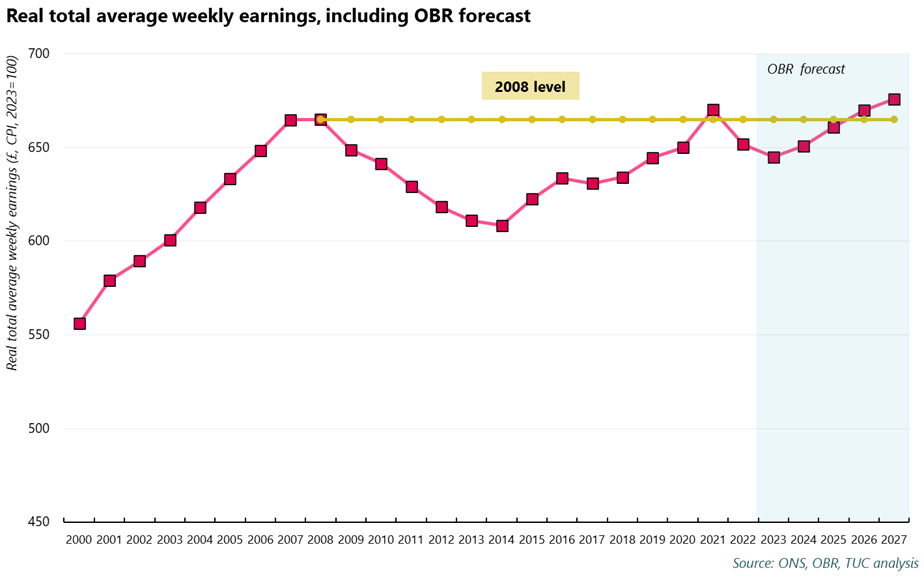
There was no plan to get wages rising across the economy. Real wages will not return to 2008 levels until 2026. And the elephant in the room was the lack of funding for our public services and the pay rises needed to recruit and retain nurses, carers and teachers.
The Chancellor should have announced measures to boost secure jobs, pay and skills. He should have provided a fully-funded workforce plan across our public services to recruit and retain key workers. And he should have set out an investment plan to rebuild our services – from fixing school buildings that are falling apart to restoring public health services. Apart from some long overdue steps forward on childcare, workers across the economy will have looked at this Budget and thought ‘was that it?’
Pay crisis
Appealing to a “high wage high skills economy”, the Conservatives continue to preside over the longest pay crisis in modern history. On current forecasts real pay will fall by 1.0 per cent in 2023, before beginning to grow again in 2024. But even with this growth, real pay will not return to its 2008 level until 2026 – an 18-year pay squeeze that could outlast the government that has spent the past thirteen years taking no action to address it.
This pay squeeze has hit workers’ pockets hard. If real pay had grown by the pre-2008 rate since 2008, workers would’ve been £233 per week better off in 2022 than they were. This gap is set to widen to £304 per week by 2027.
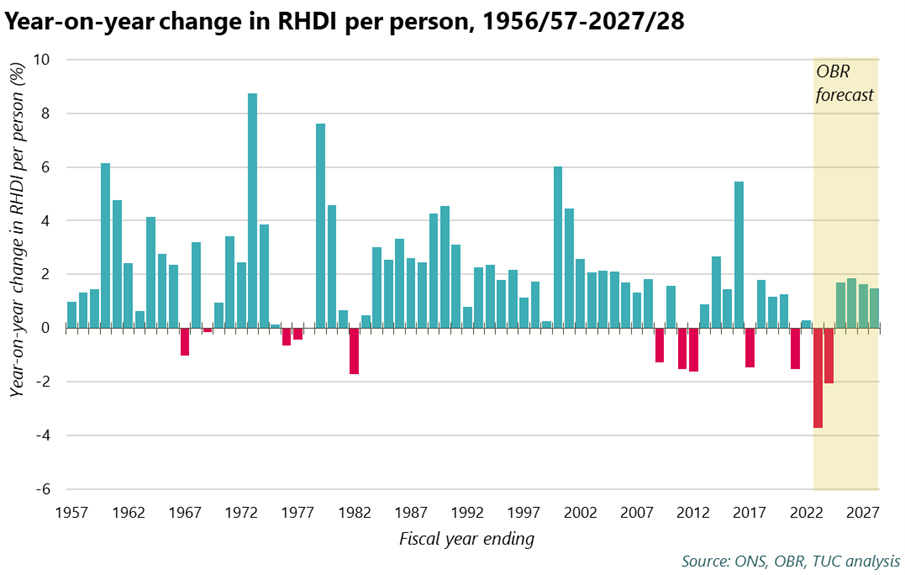
Beyond pay, the OBR forecasts real household disposable income (RHDI) per person, a measure of living standards, to fall by six per cent between 2021/22 and 2023/24. This is the steepest two-year decline since records began in the 1950s.
Before 2010, RHDI per person had only fallen in five of the 54 years since records began. Between 2010 and 2025, it’s set to fall six times.
Unending growth failure
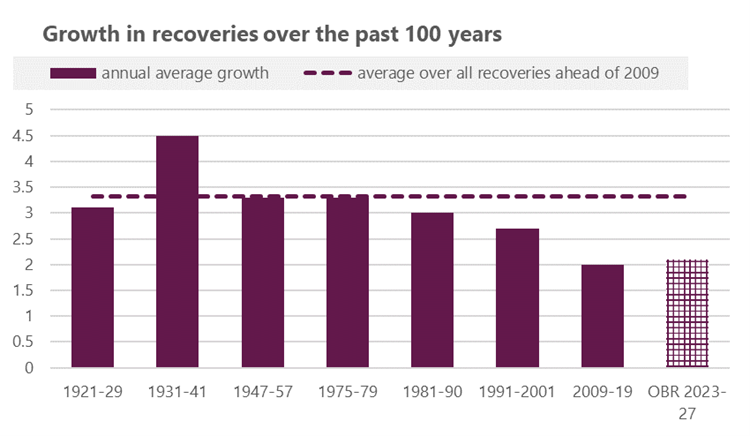
According to today’s OBR forecast, the Chancellor’s ‘plan for growth’ will deliver growth over the next five years that is only only 0.1 percentage point higher than growth between 2009 and 2019 – widely acknowledged as a decade of stagnation. Even if the forecast is delivered, the conservatives will have presided over the two worst recoveries in a century.
The forecast benefits from reduced concerns about recession. But it’s early days on this – the backdrop to his speech is a steep 3.8% decline in the stock exchange today – reacting to newly exposed dysfunction in the financial sector.
And this poor performance will have real consequences for workers. Unemployment will rise from 1.3 million this year to 1.5 million throughout the rest of the forecast.
Failing to deliver
In our Budget statement we asked the Chancellor to invest in public services and the workers that deliver them, and to put workers before wealth.
We asked the chancellor to boost pay across the economy, but astonishingly he did nothing to address the public sector pay crisis.
There was nothing to boost get us on a path to a a £15 minimum wage as soon as possible, or to set up the fair pay agreements we know we need to drive up fair pay across the economy.
We wanted a plan for strong public services and fair taxation:
Battered by inflation and recruitment crises, the chancellor did not mention public services. He offered none of the new funding desperately needed to recruit the nurses, carers and teachers that our public services rely on.
The Chancellor declined to extend the windfall tax on firms profiting from the gas price crisis, even though Big Oil firms fully doubled their profits last year. At the same time, many employers – from small business to big paper mills – have already faced closure due to spiking energy prices. But the Government has declined to extend its energy bills support package for employers.
Long overdue announcements on childcare follow years of union campaigning. But without improved conditions for childcare workers, recruitments and retention challenges could make delivery impossible.
We wanted workers (not the wealthy) protected from hardship
Pressure from unions and broader civil society has worked – the Government agreed to keep the Energy Bills Guarantee at £2,500 for the average household for a further three months, after which energy prices are expected to fall below this level. The Government also finally ended the unfair premium paid on energy by households on pre-payment meters.
But there is nothing in this budget – and in the Government’s existing commitments – to restrict bills sky-rocketing again. No new funding for upgrades to our leaky, draughty homes. And despite announcements to support nuclear energy and carbon capture and storage, there is nothing to expand the supply of clean energy in the next few years.
In spite of the severity of the cost-of-living crisis and the dramatic weakening of provisions over a decade of austerity, the chancellor did nothing on social security protections (beyond the childcare support in universal credit). Instead he further ramped up the already harsh sanction regime for those looking for work and on low earnings.
The work capability assessment will not be missed. But given the government’s track record, we cannot be sure that the new proposals for disabled people will be any better.
Remarkably, however, to fix a quirk in our system of tax relief on pension contributions that pushes some senior doctors into early retirement, the Chancellor scrapped limits on how much individuals can save for retirement tax free over a lifetime.
This indiscriminate measure, together with increases to annual limits, is projected to hand around £4 billion to the wealthiest savers over the next five years. These tax breaks will make it easier for the rich to use pensions as a vehicle for passing on wealth without paying inheritance tax, but do nothing to help most workers save for retirement. With a quarter of over-50s unlikely to achieve even a minimum retirement income, extra incentives should have targeted low earners.
We wanted a plan for sustainable growth that creates decent jobs
The most expensive line in the budget is the announcement of 100% expensing of qualifying capital investment for the next three years. This is predicted by the OBR to cost an average of £9.1 billion per year – over £27 billion in total. The measure means that companies will be able to deduct 100% of qualifying capital investment against their tax bill in the year of investment.
Measure to encourage UK businesses to raise their stubbornly low rates of investment are certainly needed. However, the question with this proposal is whether it will encourage additionality in business investment – or will simply hand public money to companies for investment that would have taken place anyway. Given the huge predicted costs to the scheme, this question is critical to whether it can be judged a success.
The OBR notes that the super-deduction, which this new measure replaces, raised business investment by less than originally expected, saying: “we overestimated its dynamic benefits”. Given the temporary nature of the new measure, the OBR expects it to bring forward investment that is currently planned and to have a smaller peak impact on investment than its predecessor super-deduction.
The measure must be judged by the additionality it creates in terms of levels of business investment and whether this is a sustainable, rather than temporary, effect.
Rather than simply splurging money, the government should reform how business is regulated to encourage long-term, sustainable growth. We need corporate governance reform to encourage companies to prioritise sustainable, long-term investment and decent jobs over short-term shareholder returns.
This means reforming directors’ duties to remove the priority given to shareholder interests and requiring that worker directors comprise one third of the board at large UK companies. These reforms would encourage sustainable business models based on long-term investment and decent work, and would help to ensure that government investment incentives are well used by businesses, with the benefits shared with those who work for them.
And the UK’s manufacturing and process industries were sorely lacking any mention in the Budget. Indeed, when the Chancellor outlined his ambition for the use if Levelling Up investments, the example given as a success was Canary Wharf: hardly hopeful for people who work in real economy jobs in held-back regions now.
The headline commitment to increase defence spending lacked any reference to jobs this spending could generate – meaning any industrial benefit is likely to be offshored once again.
And while the Government did confirm its intention to invest into Carbon Capture, Use, and Storage, this does little to secure the future of the rest of the UK’s heavy industries. Industrial strategy – and a proper strategy to navigate the climate transition, protecting jobs and livelihoods along the way – is still lacking.
‘Was that it?‘ – a Budget with no ambition, more of the same at best, and basically ignoring the most pressing problems facing the UK.
Commenting on the Budget, Jonathan Rolande, spokesman for the National Association of Property Buyers said: “If you were hoping the Budget might make it easier to move home – it hasn’t. Jeremy Hunt has left the UK property market to sort itself out, taking no steps to guide it in any direction whatsoever. The ‘baked-in’ unfairness continues.
“Right now not enough homes are being built, mortgages are up, rents are up and rentals are becoming more scarce. It is almost impossible to rent and save a deposit. There is a growing inequality between those with property (or well-off parents) and those without.
“Many feel they have no hope of ever owning their own home with the benefits and stability that brings
“Mr Hunt has, perhaps for financial reasons or for political expediency taken the much longer-term view. Enabling young parents to return to work will feed through into increased borrowing ability. Increasing pension thresholds will allow the Bank of Mum and Dad to offer higher loans and gifts to their children.
“For the short to medium term, opportunities to level the playing field have been missed. He could have rebalanced Stamp Duty to free up property stock, penalised developers who sit on land waiting for price growth, and offered tax breaks for landlords who insulate their tenant’s homes or offer long-term lets. None are especially expensive and each would have an immediate and positive impact on property buyers and society as a whole.
Mr Rolande added: “The impact of the housing crisis is at the heart of many of the issues that vex the government right now. A lack of homes makes people less tolerant of immigration. Poorly insulated homes are bad for the environment and increase inflation. Disenfranchised younger people feel they have a lesser role to play in society. And many put off having children because they can’t afford the right home, and others cannot pursue dreams of a better job because they can’t afford to live in an area where pay and conditions are better.
That’s why it is all the more surprising that a Conservative has not taken the opportunity to create more homeowners, something generally thought to make people more likely to vote blue.
For me, this Budget will be more about what wasn’t done, than what was. Those who were hoping for good news on housing, will now have to wait another long year to find out what crumbs of comfort might be thrown their way.”
Individuals earning over £300,000 are the secret winners of Chancellor Hunt’s budget
Nimesh Shah, CEO at leading tax and advisory firm Blick Rothenberg said, “The secret winners from Jeremy Hunt’s Budget are individuals earning over £300,000.
“Whilst all the pension headlines are around abolishing the lifetime allowance, hidden away in the detail of Jeremy Hunt’s Budget is an increase to the minimum tapered allowance to £10,000, up from £4,000 – this is the minimum level of tax relievable pension contributions.
“The £6,000 increase will be worth an additional £2,700 of tax relief to someone earning over £360,000. Quite perversely, a minority of very high earners will be some of the biggest winners from today’s Budget announcements.”
The Energy Price Guarantee (EPG) will be kept at £2,500 for an additional three months from April to June, saving a typical household £160.
Energy prices are 50% lower than forecast in October, but remain high, with this support helping bridge the gap to lower prices forecast from the end of June.
Comes as Chancellor set to confirm new cost of living support at Spring Budget, including ending the pre-payment meter premium and help with childcare costs.
MILLIONS of households will get more support with high energy bills to help ease the cost of living, the Chancellor has announced today ahead of the Spring Budget.
The Energy Price Guarantee, which is protecting households by capping typical energy bills at £2,500, will be maintained at the same level for a further three months over April, May, and June, worth £160 in total for a typical household.
The Chancellor is announcing the extension today (15 March) as part of his Spring Budget, which focuses on easing the impact of rising prices, delivering on our promise to halve inflation, and growing the economy by supporting more people into work.
Government support has already cut the typical family energy bill by over £1,300 since October, stopping the average household energy bill hitting £4,279 a year this winter.
The Chancellor’s three-month extension of the Energy Price Guarantee at £2,500 means households won’t feel the full force of Ofgem’s Price Cap between April and June – which stands at £3,280 – helping to bridge consumers into the summer.
Lower wholesale gas prices are expected to feed through to lower household energy bills from July, where Cornwall Insight data suggests the Ofgem Price Cap will reach an estimated £2,100 a year for a typical household.
From April, more support is coming online with 8 million low income and vulnerable households set to receive at least £900 in cash payments over the next year, benefits and pensions set to rise by over 10 per cent, and the National Living Wage increasing to a record £10.42 an hour, so that it always pays to work.
The Spring Budget will go even further, providing hundreds of pounds more in help with childcare costs for parents on Universal Credit and ending the energy premium paid by households who use pre-payment meters, which will save 4 million families £45 a year from July.
Prime Minister Rishi Sunak said: “We know people are worried about their bills rising in April, so to give people some peace of mind, we’re keeping the Energy Price Guarantee at its current level until the summer when gas prices are expected to fall.
“Continuing to hold down energy bills is part of our plan to help hardworking families with the cost of living and halve inflation this year.”
Chancellor Jeremy Hunt said: “High energy bills are one of the biggest worries for families, which is why we’re maintaining the Energy Price Guarantee at its current level.
“With energy bills set to fall from July onwards, this temporary change will bridge the gap and ease the pressure on families, while also helping to lower inflation too.”
Energy Secretary, Grant Shapps said: “Putin’s illegal war has cost British families, which is why we’ve stepped in to pay around half of the typical household energy bill.
“With wholesale prices falling families will start to benefit, but in the meantime we’re stepping back in with the Energy Price Guarantee to prevent the typical electricity and gas bill exceeding £2,500. It’s just part of our plan to help families this winter.”
At Autumn Statement the Chancellor announced that the EPG was due to rise to £3,000 on April 1, with the government then expecting to borrow £12 billion to fund this support. Since then, energy prices have fallen by 50%, cutting the borrowing needed to fund energy support by two- thirds to £4 billion.
The change announced today also follows the latest Ofgem Price cap of £3,280 from April to June which, in large part, sets the cost for this three-month extension. Households would pay the full Ofgem price cap rate if there was no Energy Price Guarantee.
Holding down energy bills is also part of the government’s plan to halve inflation this year, and in November the Office for Budget Responsibility said that the EPG would lower the peak rate of inflation.
The Chancellor set to announce 12 Investment Zones to drive business investment and level up, each backed with £80 million.
Investment for roll out of Levelling up Partnerships, helping to regenerate places across England.
£100 million to be shared across Glasgow, Greater Manchester and the West Midlands supporting them to become globally competitive centres for research and innovation
The Chancellor will supercharge growth at the Spring Budget tomorrow (Wednesday 15 March), as he is expected to announce a plan for 12 high-growth Investment Zones and a pioneering new approach to accelerate research and development in the UK’s most budding industries.
Jeremy Hunt is expected to announce plans to enter discussions with places to host 12 high growth Investment Zones, each backed with £80 million over five years including generous tax incentives, bringing opportunity into areas which have traditionally underperformed economically.
Investment Zones will be clustered around research Institutions such as universities and will be focused on driving growth in one of the UK’s key sectors: Technology, Creative industries, Life Sciences, Advanced Manufacturing and the Green sector.
As well as for tax reliefs, funding can be used to improve skills, provide specialist business support, improve the planning system, or for local infrastructure.
Chancellor of the Exchequer Jeremy Hunt said:“True levelling up must be about local wealth creation and local decision-making to unblock obstacles to regeneration.
“From unleashing opportunity through new Investment Zones, to a new approach to accelerating R&D in city regions, we are delivering on our key priority to supercharge growth across the country”.
Levelling Up Secretary Michael Gove said:“Levelling up means backing local growth across the UK, driving innovation to attract investment and putting power into the hands of local communities so they can reach their full potential.
“Our new investment zones and Levelling Up Partnerships will deliver more jobs, better services and more opportunities for local people.”
Science, Innovation and Technology Secretary Michelle Donelan said: “This government has made clear its aim for the United Kingdom to be transformed into a scientific and technologic superpower, not only pushing our country forward, but the whole world.
“Cutting-edge innovation starts at a local level. That’s why these plans to invest £100 million into 26 groundbreaking projects in Glasgow, Greater Manchester and the West Midlands are so important, supporting them to become the future centres of research and innovation in the United Kingdom.”
Eight places in England have been shortlisted to host Investment Zones, with the intention to agree plans with local partners by the end of the year. This complements and builds on the government’s existing Freeport programme, which deliver investment on specific sites benefitting from tax and customs incentives, key to driving productivity and growth.
The eight places are those covered by:
The proposed East Midlands Mayoral Combined County Authority
Greater Manchester Mayoral Combined Authority
Liverpool City Region Mayoral Combined Authority
The proposed North East Mayoral Combined Authority
South Yorkshire Mayoral Combined Authority
Tees Valley Mayoral Combined Authority
West Midlands Mayoral Combined Authority
West Yorkshire Mayoral Combined Authority
The government is also working closely with the devolved administrations to establish how Investment Zones in Scotland, Wales and Northern Ireland will be delivered, which will account for the four final locations.
These Investment Zones will drive growth in five key sectors: life sciences, creative industries, digital technology, advanced manufacturing, and green industries.
The Chancellor is also expected to provide investment for the roll out of Levelling up Partnerships across England, helping to regenerate places in need of levelling up.
The programme will involve ‘deep dives’ carried out by a partnership of local councils, MPs business and civic leaders to gather a holistic picture of a place and its unique challenges and opportunities, and identify cross-Government interventions to unblock obstacles to regeneration.
It builds on the success of initial trials in Grimsby, which saw cross-government working to help avoid the effective closure of the town’s fish processing sector, and in Blackpool which unlocked a change of use of a central government building that was holding up a £100 million regeneration plan. The Government will work closely with the Devolved Administrations and local government to explore potential options in Scotland, Wales, and Northern Ireland.
The Chancellor is also set to accelerate the growth of high-potential innovation clusters in Glasgow, Greater Manchester and West Midlands with £100 million of investment in 26 transformative R&D projects.
The Innovation Accelerators programme is a new approach to supporting these city regions to become major, globally competitive centres for research and innovation and will support levelling up. The projects will attract private investment to develop the technologies of tomorrow, creating new jobs, and boosting regional economic growth.
Through the programme, local leaders are empowered to harness innovation in support of regional economic growth through a pioneering a new model of R&D decision-making. Working closely with Innovate UK, partnerships between local government, business and R&D institutions in the three city regions have led on selecting the 26 projects. This includes:
A University of Birmingham-led project to accelerate new health and medical technologies,
The Manchester Turing Innovation Hub linking business to cutting edge AI research and technologies to help enhance their productivity
A net zero project led by University of Strathclyde to accelerate the adoption of automated ultrasonic inspection during welding and additive manufacturing.
Tracy Brabin, Mayor of West Yorkshire, said:“West Yorkshire has a strong and thriving economy, and I’m pleased the Government has recognised the strength of our innovation by choosing to work with us to deliver an investment zone.
“It will provide further opportunities for people across the region, as well as our world leading higher educational facilities, building on our expertise in digital, technology, and health and life sciences.
“I look forward to working with government to develop the investment zone policy, unlocking our potential and ensuring our local economy thrives for years to come.”
Ben Houchen, Mayor of Tees Valley, said: “The introduction of an Investment Zone in the Tees Valley would be a huge boost to our plans to level up and redevelop our town centres.
“We have just established two Mayoral Development Corporations which will give us the powers to bring about real change to our town centres. The addition of an Investment Zone would help turbo-charge these plans and accelerate our vison.
“Investment and jobs are the fundamentals of levelling up and this would represent a further delivery on the promise the Government made to rebalance the economy of this country. We have been working for some time on Investment Zones, and I am incredibly supportive of this proposal.”
Andy Street, Mayor of the West Midlands, said:“Our Plan for Growth is central to how we drive forward our regional economic recovery as we bounce back from the temporary setback inflicted by the pandemic. The right mix of devolved powers and investment incentives will help turn that plan into action.
“That’s why this Investment Zones announcement is very welcome news – supporting our efforts to attract new businesses, create high quality jobs and supercharge our economy.
“Investment Zones will make a valuable contribution towards enhancing prosperity for residents right across our region and I look forward to working with local leaders to decide how we best take advantage of this exciting opportunity.”
Oliver Coppard, Mayor of South Yorkshire, said:“South Yorkshire’s steel and energy powered the world into the first industrial revolution, and we know we have the potential to lead the world into the next one.
“We’re home to businesses and institutions working at the forefront of advanced manufacturing, health sciences and green technology. We’re not just imagining a better future, we’re already making it.
“Investment Zones give us the chance to do even more, so I’m pleased South Yorkshire has been recognised as one of the regions able to make the most of that opportunity. I’m looking forward to working with government to design how that works so we can build a bigger, better economy here in South Yorkshire.”
CHANCELLOR’S “reset” to clean up the UK’s domestic energy supply and secure long term energy security, while delivering up to 50,000 highly skilled jobs is expected next week
£20 billion will transform carbon capture in Britain, helping create up to 50,000 highly skilled jobs.
Chancellor to confirm the next steps for Great British Nuclear as competition to deliver small modular nuclear reactors opens this year.
Plan will set the path for the UK’s clean energy supply and secure the UK’s long term energy security and help deliver one of the government’s five promises to grow our economy.
At next Wednesday’s Spring Budget (15th March) the Chancellor, Jeremy Hunt, will set out an unprecedented investment in domestic carbon capture and low carbon energy. Recognising the urgency of the UK’s clean energy revolution, he will commit to spades in the ground on these projects from next year.
No one country has yet captured the carbon capture market. The UK has enough carbon capture capacity to store over a century and half of national annual CO2 emissions, making it one of the most attractive carbon capture markets on earth, creating high-paid jobs of the future across the UK and growing our economy through new cutting-edge industries. Carbon capture will support the UK’s industrial transition to cleaner, greener processes and technology.
An unprecedented £20 billion in investment over the next 20 years will drive forward projects that aim to store 20-30 million tonnes of CO2 a year by 2030, equal to the emissions from 10-15 million cars helping us meet our carbon capture targets as part of our national net zero targets.
The Chancellor will also announce plans to boost nuclear power generation through Great British Nuclear, launching a competition for this country’s first Small Modular Nuclear Reactors, revolutionising how nuclear projects are delivered in the UK.
Chancellor of the Exchequer, Jeremy Hunt said: “Without Government support, the average household energy bill would have hit almost £4,300 this year, which is why we stepped in to save a typical household £1,300 on their energy bills this winter.
“We don’t want to see high bills like this again, it’s time for a clean energy reset. That is why we are fully committing to nuclear power in the UK, backing a new generation of small modular reactors, and investing tens of billions in clean energy through carbon capture.
“This plan will help drive energy bills down for households across the country and improve our energy security whilst delivering on one of our five promises to grow the economy.”
Energy Security Secretary, Grant Shapps said: “Putin’s illegal invasion of Ukraine has demonstrated to the world the vital importance of increasing our energy security and independence – powering more of Britain from Britain and shielding ourselves from the volatile fossil fuels market.
“Already a global leader in offshore wind power, we now want to do the same for the UK’s nuclear and carbon capture industries, which in turn will help cut the wholesale electricity prices to amongst the lowest in Europe.
“Today’s funding will play an integral role in delivering that, helping us further towards our net zero targets and creating green jobs across the country.”
Small Modular Reactors are emerging technology, and no country has yet to deploy one. To ensure the UK steals the march, the Small Nuclear Reactors competition is expected to attract the best designs from both domestic and international manufacturers with winners announced rapidly. The government will also match a proportion of private investment as part of this to ensure designs are ready to be deployed as soon as possible in the UK.
The government is already investing £210 million into the Rolls-Royce SMR project, matched by private sector funding. Rolls’ Royce reactor design is currently being assessed by safety regulator, the Office for Nuclear Regulation.
Great British Nuclear will streamline and coordinate the delivery of new nuclear power plants to meet the country’s ambition of up to 24 Gigawatts of nuclear power by 2050.
The government body will select sites for potential nuclear projects, removing costs, uncertainty, and bureaucratic barriers for manufacturers as they develop their proposals. To support future sites for nuclear development, the Government will also be consulting on a new approach to nuclear site selection later this year.
There will also be a laser focus on how to attract more investment into the sector, with the Chancellor confirming that nuclear power generation will be classed as “environmentally sustainable” under the green taxonomy regime, subject to consultation, encouraging significant private investment. Last year, the Chancellor confirmed reforms to EU-derived Solvency II regulation, which will unlock £100bn of private investment into infrastructure and clean energy over a decade.
We’ve already invested a historic £700 million stake in Sizewell C – our first investment in a nuclear project for 35 years – to provide reliable, low-carbon, power to the equivalent of 6 million homes for over 50 years. This will shore up UK energy security and create 10,000 skilled jobs, while we also continue to bring Hinkley Point C to completion, the first new nuclear power station in a generation.
We have already committed £1 billion to develop four CCUS hubs in the UK by 2030, but with today’s funding, we are providing industry with the certainty required to deploy CCUS at pace and at scale.
This is all part of our plans to transform our homegrown energy supply, investing in renewables and nuclear power, and maximising North Sea oil and gas production as we transition to net zero. All of which crucially brings skilled jobs, prosperity, and growth as we build a cleaner, greener, more secure economy.
Stakeholder reaction:
Andrew Storer, Chief Executive Officer, Nuclear Advanced Manufacturing Research Centre said: “I strongly welcome today’s announcement and the government’s commitment to establish Great British Nuclear to drive delivery of a programme of new nuclear power.
“Business needs the confidence that this will bring to invest in building industrial capability across the UK. The Nuclear AMRC will ensure that companies have access to the innovative manufacturing capability, resilient supply chains and skills needed to ensure the timely and cost-effective delivery of new nuclear power.
“This is an essential part of our future energy system and a great opportunity to drive jobs, skills development and growth across the UK as shown in our leading role in establishing the recently launched Rolls-Royce Nuclear Skills Academy. Our facilities in Rotherham and Warrington and a new technical facility in Derby will enable us to bring advanced manufacturing capability to support the Great British Nuclear mission in the heart of UK industry”.
Tom Greatrex, Chief Executive, the Nuclear Industry Association, said: “This is a huge step forward for UK energy security and UK jobs. Green labelling nuclear will drive crucial investment into projects large and small. Setting up GBN with the powers to select sites for projects will make nuclear deployment more efficient and give the supply chain a clear pipeline to work from.
“The SMR competition should put us back in the global race and create opportunities for UK technology and others to bring jobs and investment to the UK and win export orders in a massive market worldwide.
“We look forward to seeing details of funding for GBN and of the SMR competition in the Budget, as well as confirmation of our ambitions for fleet deployment of large and small scale reactors to make us a clean energy powerhouse of the 21st century.
“More nuclear cuts gas imports, cuts carbon and creates good jobs for communities all across this country.”
Dr Nina Skorupska CBE FEI, Chief Executive of the REA (The Association for Renewable Energy and Clean Technology) said: “Government’s commitment to advancing carbon capture and storage is a long awaited and welcome step forward. It is particularly essential that today’s announcements deliver a route to market for bioenergy with carbon capture and storage, at a range of scales.
“Combining this technology with low carbon bioenergy production, which uses biomass and waste feedstocks, produces real-world carbon removals from the atmosphere that are critical to achieving net zero, after having realised emission reductions.
“This support will help to reaffirm the UK’s global position as leaders in this innovative technology, and see it built at commercial scale. Crucially it will help in attracting new investment, which in turn will lead to thousands of jobs and the growth of the UK’s Green economy.”
Chancellor set to announce new funding package for veterans across the UK at the Spring Budget
£33 million package will increase availability of veteran housing and support veterans with serious injuries as a result of their service
Comes on top of £8.5 million package announced last year to end veteran homelessness
The Chancellor Jeremy Hunt is set to announce in this week’s Budget an additional £33 million over the next 3 years to support veterans, in recognition of the sacrifices they’ve made for the UK.
The majority of the funding package (£20 million) will go towards the Veteran Capital Housing Fund – a new project to provide extra housing for veterans through the development of new builds and refurbishment of veteran social and charitable housing.
The Chancellor will also extend the Veterans Mobility Fund – backed by £3 million – to provide enduring support for veterans with serious physical injury resulting from their service.
The remaining £10 million will go directly to the Office for Veteran’s Affairs to increase the service and engagement provided to veterans over the next two years.
Chancellor of the Exchequer Jeremy Hunt said: “We all owe our veterans a huge amount of gratitude for defending democracy and keeping our country safe – and it’s only right that we provide them with all the support they need when they come home.
“This government is firmly on the side of our veterans, and this week I’ll set out a comprehensive package of policies that will solidify our enduring commitment to our ex-servicemen and women for years to come.”
There are thousands of units in houses, village settlements, care homes and other accommodation specifically for veterans across the country. Many of these could be in need of modernisation, replacement or expansion. Providing sustainable housing is key to helping those who have left service – particularly those who are vulnerable and with complex needs.
The new £20 million Veteran Capital Housing Fund will go towards this alongside action to end veteran rough sleeping within this Parliament – helping the government deliver its pledge in the Veterans’ Strategy Action Plan 2022-24.
The Veterans Mobility Fund has previously been used to provide dedicated equipment for hundreds of eligible veterans, including specialist wheelchairs and orthotics which is not usually available via the NHS or through the Ministry of Defence. The additional £3 million will refresh this fund to ensure veterans continue to get the specialist support they need.
The government has a strong record of supporting veterans. At the end of last year, the government announced more than £8.5 million of funding to deliver services in more than 900 housing units in England, where specialist help for veterans, including with health, education and employment needs are provided.
As part of this, the government established a new referral scheme – Op FORTITUDE – that will enable veterans at risk of homelessness to access supported housing and wrap-around specialist care in health, housing and education from later this year.
The government also introduced Op COURAGE, a bespoke mental health support service for veterans in the NHS in England, backed by over £18 million a year investment plus an additional £2.7 million to be invested over the next two years. The service has already helped tens of thousands of patients since it was established in 2021.
– Chancellor declares “prepayment meter penalty over from July”, cutting energy bills for over four million families. – Families on prepayment meters will no longer pay more compared to people on direct debts. – Follows support this winter which has already cut the typical household bill by almost half.
OVER FOUR MILLION families are set to save £45 a year on their energy bills from July as the Chancellor ends the prepayment premium.
Households on prepayment meters pay more on average compared to direct debit customers due to extra costs firms take on managing meters – such as supplying vouchers and collecting payments – being passed on to users.
The vast majority of households who rely on prepayment meters are typically vulnerable or low income, which means the higher tariff and inability to spread the cost is hitting those who can least afford it.
At his Spring Budget next week, the Chancellor is expected to announce fairness reforms to energy bills, bringing the bills of families on prepayment meters in line with average direct debit energy bill under the Energy Price Guarantee.
Chancellor of the Exchequer, Jeremy Hunt said: “It is clearly unfair that those on prepayment meters pay more than others. We are going to put an end to that.
“From July four million households won’t pay more than those on direct debits. We’ve already cut energy bills by almost half this winter, and this latest reform is proof again that we’re always on the side of families.”
Energy Security Secretary Grant Shapps said: “Charging prepayment meter customers more to receive their energy is a tax on some of our most vulnerable – this change will stop that.
“It’s even more important at a time Brits are faced with high energy costs and when we’ve seen vulnerable households wrongly forced onto them. While actions I’ve pushed for have meant forced installations are on pause, warrants aren’t being waved through and Ofgem is toughening up its reviews, our changes will make sure families aren’t penalised simply for how they heat their home.”
The change is expected to come into effect from July 1 through updates to the Energy Price Guarantee at a cost of £200 million.
From April 2024, when the Energy Price Guarantee ends, the Chancellor has tasked energy regulator Ofgem to report back on additional regulatory options to permanently end the premium and bring fairness to bill payment methods in the long term.
The move is the latest government intervention to help families with their energy costs after the average family bill was cut by £1300 this Winter.
Plan expected to remove barriers to people getting into work and tackle Britain’s economic inactivity problem.
Support will focus on disabled people and those with long-term health conditions, over 50s, and low-earners and parents on Universal Credit.
Changes are expected to encourage benefit claimants to move into work or increase their hours with more Work Coach support, and childcare costs on Universal Credit to be paid up front.
Chancellor Jeremy Hunt is expected to set out the ambition to get hundreds of thousands more people into work in his Budget next week.
Benefit claimants are expected to be encouraged to move into work or increase their hours, through changes to the Universal Credit system and increased job support programmes. As a result of measures set to be announced at Budget, hundreds of thousands of claimants will be asked to attend more regular meetings with work coaches, skills bootcamps will be expanded and the Work Capability Assessment will be scrapped.
The government will also start paying childcare costs on Universal Credit up front, rather than in arrears. Currently many low-income working parents are unable to afford the up-front cost of childcare, making it harder for them to get into work. The maximum amount people can claim for childcare on Universal Credit will also be increased by several hundred pounds, making childcare more affordable for thousands of working parents.
These measures will help people get jobs, increase their hours and extend their working lives – all contributing to the government’s priority to grow the economy.
The Chancellor’s plans are expected to benefit disabled people and those with long-term health conditions, people on benefits and the over 50s. Currently there are more than a million vacancies in the economy, and one fifth of the working population is economically inactive – out of work and not looking for work.
Jeremy Hunt, Chancellor of the Exchequer, said:“Those who can work, should work because independence is always better than dependence.
“Already we’re seeing near record levels of employment in Britain, but we need to go further to build a country that rewards work and gives everyone the chance of a better future.
“But for many people, there are barriers preventing them from moving into work – lack of skills, a disability or health condition, or having been out of the jobs market for an extended period of time. I want this back-to-work Budget to break down these barriers and help people find jobs that are right for them.
“We need to plug the skills gaps and give people the qualifications, support and incentives they need to get into work. Through this plan, we can address labour shortages, bring down inflation, and put Britain back on a path to growth.”
Changes to the Universal Credit system are anticipated to encourage claimants to move into work or increase their hours with additional support from their Work Coaches.
Changes to Universal Credit will include:
Paying parents on Universal Credit childcare support up-front when they are moving into work or increasing their hours, rather than in arrears meaning low-income families will find it easier to afford and it will help remove a barrier that many face when thinking about going back to work.
Increasing the maximum amount parents on Universal Credit can receive in childcare support by several hundred pounds, making childcare more affordable for thousands of parents.
Alongside these changes, strengthened work search requirements are expected to encourage over 700,000 lead carers of children on Universal Credit to look for work or increase their hours and will receive additional Work Coach support to do so. Previously they would have had only limited requirements, or no requirements at all.
The Administrative Earnings Threshold (AET), the minimum amount a person can earn without being asked to meet regularly with their Work Coach, will be increased from the equivalent of 15 to 18 hours of earnings at the National Living Wage for an individual claimant. The couples AET, where a second member of a household may not be asked to look for work if their partner is working, will be removed entirely. This is expected to ask over 100,000 additional claimants to meet more regularly with a Work Coach and take active steps to move into work or increase their earnings.
Strengthening the application of the Universal Credit sanctions regime. This includes additional training for Jobcentre Work Coaches to ensure they are applying sanctions effectively, including for claimants who do not look for or take up employment, and automating administrative elements of the sanctions process, including sending automated messages to claimants who fail to meet with their Work Coach, to reduce error rates and free up Work Coach time.
For disabled people and long-term sick:
A Health and Disability White Paper will be published on the day of the Budget outlining our plans to scrap the Work Capability Assessment. Under the current system disabled people need to have a health assessment and be found incapable of work to receive additional income support through the benefits system. Scrapping the Work Capability Assessment is the biggest reform to the welfare system in a decade, meaning that disabled people can try work without fear of losing their benefits, and reducing the number of assessments needed to qualify for health-related benefits.
For the over 50s:
Returnerships will offer skills training that focuses on flexibility and takes previous experience into account, shortening the length of time they have to be in training.
Skills bootcamps will be expanded by 8,000 places per year in 2024-25, up from 56,000 currently, reskilling people in important sectors such as construction and technology.
Latest figures show that employment is at 75.6% and unemployment is close to a record low of 3.7%.
Charities and business groups react to the Chancellor’s expected Budget announcement of getting hundreds of thousands more people into work.
Plan expected to remove barriers to people getting into work and tackle Britain’s economic inactivity problem.
Support will focus on disabled people and those with long-term health conditions, over 50s, and low-earners and parents on Universal Credit.
Changes are expected to encourage benefit claimants to move into work or increase their hours with more Work Coach support, and childcare costs on Universal Credit to be paid up front.
STAKEHOLDER REACTION: CHARITIES
Victoria Benson, Chief Executive, Gingerbread said:“Single parents are all too often locked out of work because they can’t afford the upfront childcare costs.
“We welcome this change and the increase in childcare support available to low income single parents. We know that single parents want to work and that those who are working want to work more hours and these changes will help many to do just this.”
Dan Paskins, Director of UK Impact, Save the Children said:“The UK Government has made the right decision in deciding to pay childcare fees for those on Universal Credit upfront rather than in arrears. This system was stopping people getting into work and putting people into debt.
“We’re delighted also for Save the Children’s parent campaigners who have spent years trying to get this system changed and given evidence many times in person about how this system has been negatively impacting their lives.
“This is good for families, good for our economy and most of all, good news for children. It is a simple and effective change which will help put money in families’ pockets and make life easier for parents juggling work and childcare.”
Laura Davis, Chief Executive, The British Association for Supported Employment said:“The British Association for Supported Employment (BASE) welcomes the Government’s announcements, which focus on empowering more disabled people to feel confident in entering or re-entering the labour market.
“We’re particularly pleased to hear about the plans to scrap the work capability assessment which will be a great step towards ensuring people can try employment without fear.
“We believe everyone who wants to work, can, with the right job and the right support, and should be provided every opportunity to dream big, without fear of being financially worse off.
“We look forward to hearing the detail in the Back to Work Budget on the 15th March and would welcome the opportunity to work with the government over the upcoming months to ensure that the right support into employment is available to all disabled people across the country.
“BASE is proud to represent the amazing Supported Employment Services and Employer-Partners, who are committed to embedding inclusive recruitment, using the evidenced-based model that works. Our place, train and maintain model supports Disabled, Neurodivergent and disadvantaged people across the UK, into well matched sustainable careers that meets their needs and those of the labour market.”
STAKEHOLDER REACTION: BUSINESS REPRESENTATIVE ORGANISATIONS & TRADE BODIES
Syma Cullasy-Aldridge, Chief Campaigns Director, CBI said:“As firms struggle to fill more than one million job vacancies in the economy, it’s good to see the Government finding ways to support people back into the workplace.
“Childcare costs are a barrier to many parents returning to work, especially those on lower incomes. It’s absolutely right that Government childcare support for those on Universal Credit is now paid upfront. The Government needs to announce the launch of a review into childcare to ensure it works for everyone.
“Helping the over 50s return to work requires flexible skills support from firms, so the Government should be listening to business-wide calls for a reform of the Apprenticeship Levy.
“Business will hope to hear more on how the Government can help support people back into the workplace at next week’s Budget – big gaps in our workforce require big solutions.”
Kate Nicholls, Chief Executive, UKHospitality said:“Despite having record numbers of people working in hospitality, labour shortages continue to hold back our sectors growth potential.
“The 150,000 vacancies in hospitality are forcing venues to reduce trading hours and days, significantly impacting businesses to the tune of £25 billion in lost sales and £7 billion in lost tax to the Treasury, which hamstrings our very real capability to deliver record sales when firing on all cylinders.
“The measures announced by the Government are positive and will help get more people into work. In particular, the introduction of more flexible, shortened skills training and breaking down some of the barriers to work that exists within Universal Credit will be beneficial.
“With hospitality so central to the everyday economy and a proven driver of economic growth, investment and jobs, it’s absolutely right that addressing these shortages are a priority for the Chancellor. Making this work for such a strategically important sector will allow hospitality to help the Government deliver its twin objectives of getting the economy growing and bringing down inflation.
“Through our work with Ministers on the over 50s working group and as a Disability Ambassador for the Cabinet Office, I look forward to continuing to work with the Government on labour, skills and training.”
Neil Carberry, Chief Executive, the Recruitment & Employment Confederation, said:“Our analysis shows that labour & skills shortages could cost the UK economy up to £39billion per year from 2024 – around the same as two Elizabeth lines.
“So it is important that action is taken, particularly in childcare which can be a significant barrier to work for many families. Helping those furthest away from the labour market into work is vital – and has been our focus through the Restart programme. Schemes like Restart prove the job is not one for government alone, businesses and recruitment experts can also play their part to great effect.”
Elizabeth Taylor, Chief Executive, Employment Related Services Association (ERSA) said:“At the Employment Related Services Association, we welcome the announcement that barriers to employment will be removed for some economically inactive groups.
“The employment support sector has the experience and knowledge to deliver this, and we know what works, so we sincerely hope that we will have a part to play. We know the differences between those who are voluntarily and involuntarily not currently seeking work, we recognise that employment support needs to be tailored to the individual, these are not homogenous groups.
“Providers in the sector will be required to work with those who will not engage with Jobcentre Plus. The employment support sector has a proven track record of community-based engagement, of delivering advice and support, and expertise in matching people with the right job that can be sustained. Returning to work must be an attractive proposition – let’s make it one.”