Around 2.5 million UK workers will receive a pay rise, as the National Minimum Wage and National Living Wage increase today
£1,000 a year pay rise for full time workers following the largest ever uplift to the National Living Wage for workers aged 23 and over.
Business Secretary Kwasi Kwarteng: “While no government can control the global factors pushing up the cost of everyday essentials, we will absolutely act wherever we can to mitigate rising costs.”
Millions of UK workers will receive a pay rise from today (Friday 1 April), as the National Minimum Wage and National Living Wage rise comes into effect.
The uplift in wages, which will benefit around 2.5 million people, includes the largest ever increase to the National Living Wage. It will put £1,000 a year more into full-time workers’ pay packets, helping to ease cost of living pressures.
With today’s rise, the yearly earnings of a full-time worker on the National Living Wage will have increased by over £5,000 since the introduction of the National Living Wage by the Government in April 2016.
As a direct result of government action, the current number of employees on the payroll is over 600,000 more than pre-pandemic levels – and unemployment has fallen to 3.9%.
Business Secretary Kwasi Kwarteng said:“We have never been more determined to make work pay, and by providing the biggest cash increase ever to the National Living Wage from today, we are giving a boost to millions of UK workers.
“While no government can control the global factors pushing up the cost of everyday essentials, we will absolutely act wherever we can to mitigate rising costs.
“With more employees on the payroll than ever before, this government will continue to stand up for workers.”
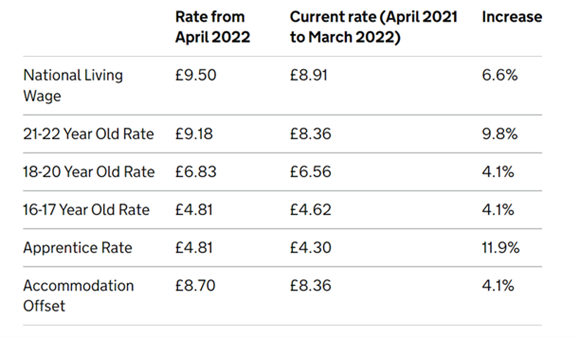
Today’s uplift will particularly benefit workers in sectors such as retail, hospitality and cleaning and maintenance. Apprentices will also get a large 11.9% increase to their minimum hourly pay, with 21-22 year-olds seeing an immediate 9.8% rise. The National Living Wage, the minimum wage for over 23-year-olds, will now move up to £9.50 an hour.
Last year, the age threshold for the rate moved from age 25 to 23, meaning that more young workers are now eligible for a higher wage.
The new National Minimum Wage and National Living Wage rates are both statutory minimums, and businesses are encouraged to pay workers above these whenever they can afford to do so.
Recent studies show significant benefits for employers who pay their staff higher wages, which includes higher job retention and staff productivity.
In full, the increases from 1 April 2022 are:
With the rates going up from today, workers across the UK are being urged to check they are being paid properly. This can be done by visiting the Check Your Pay site, which also offers advice on what to do if you are being underpaid.
The Government also today announced it will be launching a communications campaign in the coming weeks to help increase understanding among minimum and living wage earners around the wages they are legally entitled to, as well as the steps they can take if they are concerned they are being underpaid.
Record increases in global gas prices this year saw the Energy Price Cap, set by the independent regulator Ofgem, rise by 54%. While a worrying time for households, the price cap continues to insulate millions of households from high wholesale gas prices.
Today’s uplift comes alongside further government measures worth over £9.1 billion to support people across the UK with rising energy bills, with the majority of households receiving £350 in total. This will help over 28 million households affected by the large spike in global energy prices, protecting them from half of the average forecast bill rise.
The package includes a £150 rebate in Council Tax bills for all households in Bands A-D in England – 80% of households – with payments being made from today (1 April 2022), and a £200 reduction in energy bills for all households from October 2022 through the Energy Bills Support Scheme.
This contributes to wider government support to ease cost of living pressures worth £22billion next financial year as well as government plans to drive £6 billion into making homes more energy efficient over the next ten years, which is vital to keeping household energy costs down.
The government is also announcing further help for low-income households to meet energy costs with the publication of consultation responses on the extension of the Warm Homes Discount and Energy Company Obligation schemes.
The Warm Homes Discount scheme is being extended until 2025/26 and expanded to reduce the energy costs of around £3 million low-income and vulnerable households every year, while the Energy Company Obligation scheme will see £1 billion annual funding until 2026 to help upgrade energy efficiency measures in 450,000 homes, cutting an average of £300 off energy bills.
Going even further to ease the cost of living, last week as part of the Spring Statement, the Chancellor Rishi Sunak announced a new Tax Plan, including cuts to fuel duty by 5p per litre, and that energy efficiency measures can be installed in homes VAT free for the first time ever.
The Chancellor Rishi Sunak said:“This historic increase will mean a pay rise for millions of hard-working Brits – with an average full-time worker pocketing an extra £1,000 a year.
“We’re doing everything we can to ensure people keep more of what they earn in these challenging times, with a new Tax Plan that delivers tax cuts for nearly 30 million people as well as £22billion to help with the cost of living.”
Bryan Sanderson Chair of the Low Pay Commission (LPC) said:“The Business Secretary’s strong support is especially welcome at this difficult time. Workers on the minimum wage; care for our elderly and sick, harvest and deliver our food, and do a multitude of other tasks which help us all.
“Many public sector workers including for example teaching assistants will also shortly be included. They all deserve to be properly remunerated and respected as key members of our society.
“The Low Pay Commission met with around a hundred representative bodies last year before making its recommendations. We are frequently their main sometimes even their only advocates. With government support we will continue to try to ensure that they do not suffer from the neglect which was so often characteristic of the past.”
New guidance outlines free COVID-19 tests will continue to be available to help protect specific groups once free testing for the general public ends on 1 April
Nicola Sturgeon will given an update on Scotland’s position this afternoon
Free COVID-19 tests will continue to be available to help protect specific groups including eligible patients and NHS and care staff once the universal testing offer ends on 1 April and next steps for adult social care set out
Plans in place to enable rapid testing response should a new health threat emerge, such as a new variant of concern emerge
Vaccines and treatments mean we can transition to managing COVID-19 like other respiratory illnesses, with updated guidance published on 1 April
People at risk of serious illness from COVID-19, and eligible for treatments, will continue to get free tests to use if they develop symptoms, along with NHS and adult social care staff and those in other high-risk settings, Health and Social Care Secretary Sajid Javid announced yesterday (Tuesday 29 March).
Free testing for the general public ends on 1 April as part of the Living with Covid plan which last month set out the government’s strategy to live with and manage the virus.
Although COVID-19 infections and hospitalisations have risen in recent weeks, over 55% of those in hospital that have tested positive are not there with COVID-19 as their primary diagnosis.
Free universal testing has come at a significant cost to the taxpayer, with the testing, tracing and isolation budget costing over £15.7 billion in 2021-22. This was necessary due to the severe risk posed by COVID-19 when the population did not have a high level of protection.
Thanks to the success of the vaccination programme and access to antivirals, alongside natural immunity and increased scientific and public understanding about how to manage risk, the population now has much stronger protection against COVID-19 than at any other point in the pandemic.
This is enabling the country to begin to manage the virus like other respiratory infections.
From 1 April, updated guidance will advise people with symptoms of a respiratory infection, including COVID-19, and a high temperature or who feel unwell, to try stay at home and avoid contact with other people, until they feel well enough to resume normal activities and they no longer have a high temperature. Until 1 April individuals should continue to follow the current guidance.
From 1 April, anyone with a positive COVID-19 test result will be advised to try to stay at home and avoid contact with other people for five days, which is when they are most infectious.
Advice will be provided for individuals who need to leave their home when they have symptoms or have tested positive, including avoiding close contact with people with a weakened immune system, wearing a face-covering and avoiding crowded places.
Secretary of State for Health and Social Care Sajid Javid said: “Thanks to our plan to tackle Covid we are leading the way in learning to live with the virus. We have made enormous progress but will keep the ability to respond to future threats including potential variants.
“Vaccines remain our best defence and we are now offering spring boosters to the elderly, care home residents and the most vulnerable – please come forward to protect yourself, your family, and your community.”
Under the plans set out today free symptomatic testing will be provided for:
Patients in hospital, where a PCR test is required for their care and to provide access to treatments and to support ongoing clinical surveillance for new variants;
People who are eligible for community COVID-19 treatments because they are at higher risk of getting seriously ill from COVID-19. People in this group will be contacted directly and sent lateral flow tests to keep at home for use if they have symptoms as well as being told how to reorder tests; and
People living or working in some high-risk settings. For example, staff in adult social care services such as homecare organisations and care homes, and residents in care homes and extra care and supported living services, NHS workers and those working and living in hospices, and prisons and places of detention (including immigration removal centres), where infection needs to be identified quickly to minimise outbreaks. People will also be tested before being discharged from hospital into care homes, hospices.
Asymptomatic lateral flow testing will continue from April in some high-risk settings where infection can spread rapidly while prevalence is high.
This includes patient-facing staff in the NHS and NHS-commissioned Independent Healthcare Providers, staff in hospices and adult social care services, such as homecare organisations and care homes, a small number of care home visitors who provide personal care, staff in some prisons and places of detention and in high risk domestic abuse refuges and homelessness settings.
In addition, testing will be provided for residential SEND, care home staff and residents during an outbreak and for care home residents upon admission. This also includes some staff in prisons and immigration removal centres.
Children and young people who are unwell and have a high temperature should stay at home and avoid contact with other people, where they can. They can go back to school, college or childcare when they no longer have a high temperature, and they are well enough to attend.
The internationally recognised Community Infection Survey delivered through the Office for National Statistics will continue to provide a detailed national surveillance capability in the coming year so the government can respond appropriately to emerging developments such as a new variant of concern or changing levels of population infection.
Infections in health and care settings will also be monitored through bespoke studies including the Vivaldi study in residential care homes, the SIREN study in the NHS, and RCGP surveillance in primary care.
The government has retained the ability to enable a rapid testing response should it be needed, such as the emergence of a new variant of concern.
This includes a stockpile of lateral flow tests and the ability to ramp up testing laboratories and delivery channels.
The government’s Therapeutics Taskforce and Antiviral Taskforce will also be merged into a single unit which will continue to focus on securing access to the most promising treatments for COVID-19.
Dame Jenny Harries, Chief Executive of the UK Health Security Agency, said: “As we learn to live with Covid, we are focusing our testing provision on those at higher risk of serious outcomes from the virus, while encouraging people to keep following simple steps to help keep themselves and others safe.
“The pandemic is not over and how the virus will develop over time remains uncertain. Covid still poses a real risk to many of us, particularly with case rates and hospitalisations on the rise. That is why it is sensible to wear a mask in enclosed spaces, keep indoor spaces ventilated and stay away from others if you have any symptoms of a respiratory illness, including Covid.
“Vaccination remains the best way to protect us all from severe disease and hospitalisation due to Covid infection. If you have not yet come forward for your primary or booster I would urge you to do so straight away – the NHS vaccine programme is there to help you and the sooner you are vaccinated the sooner you and your family and friends will be protected.”
Most visitors to adult social care settings, and visitors to the NHS, prisons or places of detention will no longer be required to take a test. More guidance on what people should do when visiting adult social care settings will be published by 1 April.
A number of changes and new guidance is also being confirmed today for adult social care including:
From 1 April, those working in adult social care services will also continue to receive free personal protective equipment (PPE). Priority vaccinations and boosters for residents and staff will also continue
Updated hospital discharge guidance will be published setting out how all involved in health and social care will work together to ensure smooth discharges from hospital and people receive the right care at the right time in the right place
Designated settings will be removed. These were initially set up to provide a period of isolation to COVID-19 positive patients before they move into care homes and before routine point of care testing for COVID-19 was available. Restrictions on staff movement will also be removed
Streamlined guidance on infection and prevention control measures will be published to set out long-standing principles on good practice, and support consistency across the adult social care sector. This will include details on future measures for COVID-19 and other respiratory viruses to ensure providers have the latest information on best practice which will include information on admissions, visiting and PPE
Updated guidance for adult social care providers and staff to set out the current testing regime across adult social care
Outbreak management periods in care homes, which can include visiting restrictions, have been reduced from 14 to 10 days
People aged 75 and over, residents in care homes for elderly adults and those who are immunosuppressed are now eligible to receive a Spring booster jab to top up their immunity to COVID-19. Around five million people will be eligible for a Spring booster around six months after their previous dose, and the NHS has contacted over 600,000 people inviting them to book an appointment. Anyone who has not yet had a COVID-19 jab continues to be encouraged to take up the ‘evergreen’ offer.
Through the Health and Social Care Levy, funding will rise by a record £36 billion over the next three years. This is on top of the previous historic long-term settlement for the NHS, which will see NHS funding increase by £33.9 billion by 2023-24, which has been enshrined in law.
The success of the government’s Living with Covid plan, will enable the country to continue to move out of the pandemic while also protecting those at higher risk of serious outcomes from the virus through our testing regime.
First Minister Nicola Sturgeon will announce this afternoon whether Scotland’s last remaining Covid regulations will be lifted next week.
The First Minister will update Holyrood on whether the requirement to wear masks in shops and on public transport will end as planned on 4 April.
Covid cases in Scotland remain at an alarmingly high level.
Westminster government steps up support for England’s social housing tenants
Sub-standard social landlords to be publicly shamed if failing to meet standards
Resident Panel will give tenants a voice to raise their complaints at the heart of government
Social housing reforms will transform the experiences of residents by tightening regulation and holding landlords to account
Measures will help ensure we meet target to half number of non-decent homes by 2030
The UK Government will “name and shame” failing social housing providers as part of major reforms to give residents a stronger voice and drive up standards.
Today’s move means social landlords providing sub-standard housing and services would be publicly called out on the government’s website and across social media channels.
Measures announced today also include a Resident Panel that will allow tenants who live in social housing to be heard directly by government. Around 250 social tenants from across England will be invited to share their experiences and help us ensure our reforms work to drive up standards.
As set out in the Social Housing White Paper, our reforms – due to be delivered through legislation – will transform the experiences of residents, with a major reform of the way in which social landlords are regulated and held to account for the homes and services they deliver.
The Westminster government has already set out a wide range of measures designed to drive up standards and fix a broken complaints system including by strengthening regulation of the sector, improving the Housing Ombudsman Service, and empowering residents to know and exercise their rights.
A package of measures announced today goes even further. It includes:
Publicising on social media where landlords have breached the Regulator’s consumer standards or where the Housing Ombudsman has made its most serious finding – severe maladministration – against them.
The launch of a Resident Panel, inviting residents to have their say on how to improve the quality of social housing. The Panel will allow residents to scrutinise and influence measures to strengthen the Decent Homes Standard, training and qualification for staff, a new Access to Information Scheme and other planned reforms.
Publishing draft clauses to legislation that will reform the regulation of social housing through tougher consumer powers, greater enforcement tools to tackle failing landlords and new responsibilities on social landlords.
A new factsheet explaining the role of the Regulator of Social Housing and Housing Ombudsman Service.
A single gov.uk page, setting out our progress on implementing the measures in the Social Housing White Paper and further measures being introduced to improve quality of social housing.
Minister for Social Housing Eddies Hughes MP said:“Everyone in this country deserves to live in a safe and decent home. It is unacceptable that anyone should have mould covering their walls, risk slipping on a wet floor or have water dripping from the ceiling.
“We have published draft legislation today to toughen up regulation of social housing landlords. This includes naming and shaming those landlords who fail to meet acceptable living standards and giving tenants a direct channel to raise their concerns with government.
“This package will help to deliver on our commitment in the Levelling Up White Paper to halve the number of non-decent rented homes by 2030.”
The UK Government’s ‘Make Things Right’ campaign helps residents raise complaints if they are unhappy with their landlord’s services and struggling to get problems resolved, with clear advice on how to progress issues to the Housing Ombudsman if necessary.
Adverts have run on digital and social media channels, as well as music streaming sites, to raise awareness of the complaints process and barriers to these being progressed.
Foreign Secretary Liz Truss updated the House of Commons on the situation in Ukraine and on the NATO and G7 Leaders meetings in Brussels last week:
With permission, I want to update the House, on behalf of my Rt Hon Friend the Prime Minister, on the NATO and G7 Leaders meetings in Brussels last week.
Together with our allies, we agreed to keep the pressure up on Putin to end his appalling war in Ukraine: through tougher sanctions to debilitate the Russian economy; supplying weapons to Ukraine and boosting NATO’s Eastern Flank; providing humanitarian aid and dealing with the wider consequences of this crisis; and supporting Ukraine in any negotiations they undertake.
Strength is the only thing Putin understands.
Our sanctions are pushing back the Russian economy by years.
We owe it to the brave Ukrainians to keep up our tough approach to get peace. We owe it to ourselves to stand with them for the cause of freedom and democracy in Europe and across the world.
It is vital we step up this pressure.
We cannot wait for more appalling atrocities to be committed in Ukraine. We know that the impact of sanctions degrades over time.
That is why we need to act now.
Next week, NATO Foreign Ministers will meet to follow up on the statements of Leaders, and I will be pressing allies over the next week for all of us to do more.
We must agree a clear timetable with our partners across the G7 to end dependence on Russian oil and gas permanently.
On banks, we’ve already sanctioned 16 major Russian banks. We have hit Gazprombank and we have placed a clearing prohibition on Sberbank, Russia’s largest bank. We want to see others adopt these sanctions and go further.
As refugees come into countries like Poland, we are working with the UNHCR so they are informed about the UK’s Homes for Ukraine scheme.
This scheme has already got over 150,000 applications, thanks to the generosity of the British public.
We know Putin is not serious about talks. He is still wantonly bombing innocent citizens across Ukraine. And that is why we need to do more to ensure he loses and we force him to think again.
We must not just stop Putin in Ukraine, but we must also look to the long-term.
We need to ensure that any future talks don’t end up selling Ukraine out or repeating the mistakes of the past. We remember the uneasy settlement in 2014, which failed to give Ukraine lasting security. Putin just came back for more.
That is why we cannot allow him to win from this appalling aggression and why this Government is determined Putin’s regime should be held to account at the International Criminal Court.
We will work to restore Ukraine’s territorial integrity and sovereignty.
We have set up a negotiations unit to ensure the strongest possible support is available to the Ukrainians, alongside our international partners.
We have played a leading role alongside our G7 allies in driving the response to Putin’s war. And I want to ensure that unity continues.
Sanctions were put on by the G7 in unison and they shouldn’t be removed as long as Putin continues with his war and he still has troops in Ukraine.
That is not all. We need to ensure that Putin can never act in this aggressive way again.
Any long-term settlement needs to include a clear sanctions snapback which would be triggered automatically by any Russian aggression.
In the aftermath of Putin’s war, Ukraine will need our help to build back.
In these exceptional circumstances, we have a duty to step up with a new reconstruction plan for rebuilding Ukraine. And we will work with the international community to do this.
At this defining moment, the free world has shown a united response.
Putin is not making the progress he craves. And he is still not serious about talks.
President Zelenskyy and the Ukrainian people know that everybody in the United Kingdom stands firm with them.
We were the first European country to recognise Ukraine’s independence from the Soviet Union. Thirty years on, we are the first to strengthen their defences against Putin’s invasion, and lead the way in our support.
Over the next week, I will be working to drive forward progress in unison with our allies.
Together, we can secure a lasting peace, which restores Ukraine’s sovereignty. Together, we can ensure Putin fails and Ukraine prevails.
For the first time since the financial crisis, NatWest Group plc (formerly Royal Bank of Scotland Group plc) is no longer under majority public ownership following a £1.2 billion sale of part of the government’s shareholding back to NatWest.
This is the government’s fifth sale of its NatWest shareholding bringing its level of ownership down from 50.6% to 48.1%. This is a landmark in the government’s plan to return to private ownership the institutions brought into public ownership as a result of the 2007-2008 financial crisis.
The Economic Secretary to the Treasury authorised the sale of approximately 550 million shares in NatWest at 220.5p per share raising a total of £1.2 billion. The shares were bought back by NatWest and the process was managed by UK Government Investments.
The Economic Secretary to the Treasury, John Glen said: “This sale means that the government is no longer the majority owner of NatWest Group and is therefore an important landmark in our plan to return the bank to the private sector.
“We will continue to prioritise delivering value for money for the taxpayer as we take forward this plan.”
NatWest chief Alison Rose said the share buyback is an “important milestone” for the bank.
Ms. Rose said: “The deal is a good use of capital for the bank and our shareholders. Reducing government ownership below 50% is an important milestone for NatWest Group and a further demonstration of the progress we are making as we continue to deliver for our customers and shareholders.”
Foreign Secretary Liz Truss confirmed that the UK will provide Ukraine with £2 million in essential food supplies for people trapped by Russian advances
The UK is set to provide £2 million in vital food supplies for areas of Ukraine encircled by Russian forces, Foreign Secretary Liz Truss confirmed today (26 March).
The announcement comes following a direct request from the government of Ukraine, with the UK funding a rapid donation of dried food, tinned goods and water.
Warehouses in Poland and Slovakia are being readied to supply these goods to the government of Ukraine from early next week. Around 25 truckloads will then be transported by road and rail to the local Ukrainian communities in greatest need.
It is estimated over 12 million people are currently in need of humanitarian assistance across Ukraine, with the actual figure likely to be much higher.
This rapid donation is essential, with the window to reach towns and cities already encircled, as well as those at high risk, closing.
Foreign Secretary Liz Truss said: “This vital donation of food and supplies will help support the Ukrainian people in the face of Russia’s barbaric invasion.
“Our teams are working day and night with our Polish and Slovakian friends and the government of Ukraine to ensure those at most risk get the essential supplies they so badly need.”
Alice Hooper, FCDO Humanitarian Adviser said: “The need on the ground in Ukraine is clear, with so many people in encircled areas trapped in basements without access to food or water. Nearly 6 million children remain in Ukraine, many sheltering inside buildings which are coming under attack.
“We are working with partners at the borders to ensure these vital UK supplies reach the places they are needed most as quickly as possible.”
Access to food, water and cooking facilities for those trapped by Russian advances is becoming increasingly difficult, with people taking refuge in basements from shelling.
This latest donation comes as part of the £400 million committed by the UK, with £220 million of this on humanitarian aid.
The Foreign Secretary today announced the allocation of the first tranche of this funding, which will be shared amongst trusted humanitarian delivery partners on the ground, including:
£25 million to the UN Refugee Agency UNHCR to support surrounding countries to receive and care for refugees from the conflict
£20 million to the UN Office for the Coordination of Humanitarian Affairs (OCHA) and the OCHA-managed Ukraine Humanitarian Fund (UHF), to provide coordinated lifesaving humanitarian assistance, protection and basic services to those remaining in Ukraine
£10 million to International Federation of Red Cross and Red Crescent Societies to deliver healthcare and water, sanitation and hygiene provision amongst other support
Grassroots football facilities across Scotland will benefit from an initial £2 million of UK government funding to improve grassroots football facilities, as part of a major commitment to levelling up access to physical activity across the nation.
Beneficiaries of an initial £2 million direct investment in grassroots football facilities across Scotland this year announced
Spartans is one of 18 projects to benefit from first tranche of £230 million investment in football facilities across the UK to level up access to quality sport provision
Improvements to be made in partnership with the Scottish Football Association
SPARTANS Community Football Academy is one of eighteen projects across Scotland to receive funding to create and improve pitches, changing rooms and pavilions, so that more local communities can access high-quality facilities.
Projects have been chosen for their ability to deliver improved facilities in deprived areas, support multi-sport use and increase participation among currently under-represented groups, including women, girls and disabled players.
As well as North Edinburgh social enterprise Spartans Community Football Academy, other examples include:
Drumchapel United in Glasgow – a community club powered by volunteer coaches, which keeps the local community active at all ages from nursery to walking to football, who will use this £150,000 grant to regenerate their pitch;
Kilwinning Community Football Academy in Kilwinning, North Ayrshire – who have just signed the community asset transfer of the pitch and pavilion and are using this funding to regenerate the pitch as part of wider plans to improve the site. The pitch will support everything from school PE to mental health programmes for the local community. The £120,000 grant will be combined with the club’s own funds and funding from North Ayrshire Council.
Buckie Thistle High School where, combined with funding from the council, the renewed 3G pitch will support year round use for the ladies team there.
The funding, combined with contributions from clubs and other local partners, will improve the quality of community facilities, bring people together to enjoy playing sport in their local area, regenerate communities and enhance social cohesion.
It forms part of a £25 million UK-wide investment in grassroots facilities during this financial year, out of a total of £230 million set to be invested to help to build or upgrade up to 8,000 quality pitches across the UK over the next four years. The funding will also support the construction or refurbishment of clubhouses, changing facilities and community buildings.
The Scottish Football Association is delivering the programme on behalf of the UK government in Scotland.
UK Sports Minister Nigel Huddleston said: “We are committed to improving access to high quality sports facilities for the underprivileged and underrepresented in Scotland.
“From Almswall Park in Kilwinning, to pitches in Buckie and Stenhousemuir, this will ensure more people can enjoy the physical and mental health benefits of sport at top class facilities in their local community.”
Secretary of State for Scotland Alister Jack said:From the Borders to Moray and from Inverclyde to Dundee, this £2million UK government funding will breathe new life into grassroots football facilities right across Scotland.
“The investment will help communities all over Scotland become winners on and off the pitch by inspiring people from all walks of life to get active and enjoy the physical and mental health benefits that playing the beautiful game can bring.”
Chief Executive Officer of the Scottish Football Association Ian Maxwell said:“Our goal in Scotland is to harness the power of football, with the positive physical and mental wellbeing benefits that football offers being perfect examples of this.
“This funding will open opportunities for increased participation across many different demographics, including boys’ and girls’ football and para-football disciplines, some of which will be in areas that currently suffer from severe deprivation.
The announcement follows a joint ‘Expression of Interest’ submitted to UEFA by the Football Associations of England, Northern Ireland, Republic of Ireland, Scotland and Wales on Wednesday (23 March).
The governments of the UK, Ireland, Scotland and Wales have confirmed their support for the EOI submission and, given the Northern Ireland Executive is currently not meeting formally, officials there continue to observe the process closely.
Formal discussions on the technical specifications for the tournament are expected to take place with European football’s governing body over the coming weeks, before a final decision is made on submitting a formal bid.
On the prospects of hosting UEFA EURO 2028, Sports Minister Nigel Huddleston added:“This is welcome news from the FAs, and the government remains committed to working closely with them and our partners in the government of Ireland and the Devolved Administrations to bring UEFA’s flagship festival of international football to the UK and Ireland.
“Our unprecedented partnership creates the potential for the best EUROs ever, and we are passionate about bringing another world-leading sporting event here, creating a real celebration of football for people across the UK and Ireland.
“The government continues to demonstrate its commitment to sport and recreation, recently announcing that it is also investing £30 million to refurbish more than 4,500 tennis courts across the UK.”
In his Spring Statement, the Chancellor promised to support families through the cost of living crisis today, and to cut their taxes in the future. But his failure to deliver on both of these means that absolute poverty is expected to rise by 1.3 million people next year, while only one-in-eight workers will see actually see their tax bills fall by the end of the parliament, according to the Resolution Foundation’s overnight analysis of Spring Statement 2022 today.
Inflation Nation shows that faced with an unprecedented squeeze on family’s household finances and a significant boost to the public finances, the Chancellor opted for a big but poorly targeted policy package focused on partially offsetting some of the big tax rises he’d previously announced, rather than on supporting those families hit hardest by the cost of living crisis.
Key findings from the overnight analysis include:
Families face £1,100 income losses. The scale of the cost of living squeeze is such that typical working-age household incomes are to set to fall by 4 per cent in real-terms next year (2022-23), a loss of £1,100, while the largest falls will be among the poorest quarter of households where incomes are set to fall by 6 per cent.
Absolute poverty rises by 1.3 million. The scale and distribution of the cost of living squeeze, coupled with the lack of support for low-income families, means that a further 1.3 million people are set to fall into absolute poverty next year, including 500,000 children – the first time Britain has seen such a rise outside of recessions.
Tax rises for seven-in-eight workers. Considering all income tax changes to thresholds and rates announced by Rishi Sunak, only those earning between £49,100 and £50,300 will actually pay less income tax in 2024-25, and only those earning between £11,000 and £13,500 will pay less tax and National Insurance (NI). Of the 31 million people in work, around 27 million (seven-in-eight workers) will pay more in income tax and NI in 2024-25.
A £11,500 wage loss. With real wages in the midst of a third major fall in a little over a decade, average weekly earnings are on course to rise by just £18 a week between 2008 and 2027, compared to £240 a week had they continued on their pre-financial crisis path. This lost growth is equivalent to a £11,500 annual wage loss for the average worker.
A parliament of pain. Typical household incomes are forecast to fall by 2 per cent across the parliament as a whole (2019-20 to 2024-25), making this parliament the worst on record for living standards, beating the 1 per cent income fall over the course of the 2005-05 to 2010-11 parliament.
Rapid fiscal consolidation. The decision to bank much of the borrowing windfall set out by the OBR sees borrowing set to fall rapidly from 14.8 per cent of GDP in 2020-21 to 1.3 per cent of GDP in 2024-25 – lower than it was expected to reach pre-pandemic. This increases the Chancellor’s fiscal headroom at the end of the parliament from £18 billion to £28 billion, the equivalent of a further 4 to 5p cut in the basic rate of income tax.
Torsten Bell, Chief Executive of the Resolution Foundation, said:“In the face of a cost of living crisis that looks set to make this Parliament the worst on record for household incomes, the Chancellor came to the dispatch box yesterday promising support with the cost of living today, and tax cuts tomorrow. Significant measures were announced on both counts, but the policies do not measure up to the rhetoric.
“The decision not to target support at those hardest hit by rising prices will leave low-and-middle income households painfully exposed, with 1.3 million people, including half a million children, set to fall below the poverty line this coming year.
“And despite the eye-catching 1p cut to income tax, the reality is that the Chancellor’s tax changes mean that seven-in-eight workers will see their tax bills rise. Those tax rises mean the Chancellor is able to point to a swift fiscal consolidation and significant headroom against his fiscal rules.
“The big picture is that Rishi Sunak has prioritised rebuilding his tax-cutting credentials over supporting the low-to-middle income households who will be hardest hit from the surging cost of living, while also leaving himself fiscal flexibility in the years ahead. Whether that will be sustainable in the face of huge income falls to come remains to be seen.”
Prime Minister will urge Allies to ensure Ukrainians have the means to continue to protect themselves at NATO and G7 summits today
UK will provide 6,000 new defensive missiles and £25m for Ukraine’s armed forces
Leaders meeting in Brussels are expected to discuss longer-term military, diplomatic and humanitarian support for Ukraine and strengthening measures against Russia
The Prime Minister will announce a major new package of support for Ukraine today at the NATO and G7 leaders’ meetings, as he calls on the international community to stay the course on Ukraine and stand against tyranny.
The measures announced today include 6,000 missiles, consisting of anti-tank and high explosive weapons, and £25 million in financial backing for the Ukrainian military. This more than doubles the defensive lethal aid provided to date to more than 10,000 missiles, and comes on top of the £400 million the UK has committed in humanitarian and economic aid for the crisis.
The Prime Minister will set out the UK’s intention to work with partners to bolster Ukraine’s defence capabilities, including longer-range targeting and intelligence, as the Ukrainian people face down an unprovoked invasion.
The UK will also provide an additional £4.1 million for the BBC World Service as part of a cross-government effort to tackle disinformation in Russia and Ukraine, as well as new financial and policing support for the International Criminal Court’s investigation into war crimes.
One month into the conflict, the Prime Minister will welcome NATO and the G7’s unified stance on Ukraine and collective action on economic, military and diplomatic measures. He will urge Allies and partners to step up a gear in response to Russia’s use of increasingly brutal tactics, including by providing enhanced defensive support to Ukraine and doubling down on economic sanctions against the Kremlin.
Prime Minister Boris Johnson said: “Vladimir Putin is already failing in Ukraine. The Ukrainian people have shown themselves to be extraordinarily brave and tenacious in defending their homeland, in the face of an unprovoked onslaught.
“But we cannot and will not stand by while Russia grinds Ukraine’s towns and cities into dust. The United Kingdom will work with our allies to step up military and economic support to Ukraine, strengthening their defences as they turn the tide in this fight.
“One month into this crisis, the international community faces a choice. We can keep the flame of freedom alive in Ukraine, or risk it being snuffed out across Europe and the world.”
The UK has already provided over 4,000 anti-tank weapons to Ukraine’s armed forces, including Next-Generation Light Anti-Tank Weapons Systems, or NLAWs, and Javelin missiles.
The Government is also supplying Starstreak high-velocity anti-air missiles to help Ukrainians defend themselves against aerial bombings, as well as body armour, helmets and combat boots.
The £25 million in new non-ODA funding from the Conflict, Stability and Security Fund will help to pay the salaries of Ukrainian soldiers, pilots and police and ensure the armed forces are well equipped with high-quality equipment.
The UK has committed £400 million in humanitarian and economic support to date, complementing the huge generosity of the British public, and donated more than 4 million items of medical equipment and 500 mobile generators.
In further support announced today, the BBC World Service will receive an additional £4.1 million in emergency funding to support its Ukrainian and Russian language services in the region, and to help it create content to counter disinformation about the war in Ukraine. The funding has been provided by the Department for Digital, Culture, Media and Sport and FCDO.
The Justice Secretary, Dominic Raab, will also chair a meeting of justice and foreign ministers in the Hague today to coordinate support for the International Criminal Court’s war crimes investigations.
The Deputy Prime Minister is expected to announce an additional £1 million in funding for the court, as well as new support from UK soldiers with expertise in intelligence gathering and the Met Police’s War Crimes Team.
‘A failure of courage, a failure of compassion and a failure of justice‘ – Peter Kelly, The Poverty Alliance
Chancellor announces Spring Statement tax cut for 2.4 million Scottish workers through rise in National Insurance thresholds – saving the typical employee over £330 a year.
Unveiling plans to give families further help with the cost of living, Rishi Sunak also slashes fuel duty on petrol and diesel by 5p per litre for the next 12 months.
Spring Statement also sets out measures to help businesses boost investment, innovation, and growth – including a £1,000 increase to Employment Allowance to benefit around half a million SMEs across the UK
The UK Government is providing an additional £45 million to the Scottish Government next year as a result of measures announced by the Chancellor today.
The Chancellor delivered a Spring Statement today that ‘puts billions of pounds back into the pockets of hard-working people in Scotland’– unveiling a series of tax cuts to ease the cost of living.
Rishi Sunak announced that National Insurance starting thresholds will rise to £12,570 from July, meaning hard-working people across the UK will keep more of what they earn before they start paying personal taxes.
The cut, worth over £6 billion, will benefit 2.4 million working people in Scotland with a typical employee saving over £330 a year, whilst the typical self-employed person will save over £250. This means the UK now has some of the most generous tax thresholds in the world.
Mr Sunak also announced that fuel duty for petrol and diesel will be cut by 5p per litre from 6pm tonight (23 March) to help drivers across the UK with rising costs. Worth £2.4 billion, this is the biggest cut ever on all fuel duty rates and means a one-car family will now save on average £100.
As a result of a cut to the basic rate of income tax for savings income, taxpayers in Scotland will see benefits worth £3 million. As other income tax rates are devolved in Scotland, the Scottish Government’s funding is automatically increased as a result of this tax cut as set out in the agreed Fiscal Framework. This is initially worth £350 million in 2024-25.
The Chancellor also set out a series of measures to help businesses boost investment, innovation, and growth – including a £1,000 increase to Employment Allowance to benefit around half a million businesses.
As a result of measures in this Spring Statement the UK Government is providing the Scottish Government with an additional £45 million through the Barnett formula next year.
Chancellor Rishi Sunak said:“We’re slashing taxes for millions of hard-working people in Scotland, getting pounds in people’s pockets and helping pay cheques to stretch further – from July more than 2.4 million in Scotland will get a tax cut with the typical employee keeping £330 more each year.
“By cutting fuel duty, we’re making it cheaper for people in Scotland every time they go to the pump, which together with the freeze means people save £100 per car on average a year.
“We’re boosting small business growth by increasing the Employment Allowance – a tax cut worth up to £1,000 for thousands of businesses.”
To grow the world’s very best talent in AI, the UK Government will partner with industry and academia to create 1,000 new AI PhDs. The Government will invest £117m to create PHDs across the UK at Centres for Doctoral Training, building on the existing three sites in Scotland. This will train a new generation of AI researchers who will develop and use AI in areas such as healthcare, climate change and creating new commercial opportunities.
Delivering the statement, the Chancellor made clear that our sanctions against Russia will not be cost-free for people at home, and that Putin’s invasion presents a risk to our economic recovery – as it does to countries all around the world.
However, announcing the further measures to help people deal with rising costs, he said the extra support could only be provided because of the UK’s strong economy and the tough but responsible decisions taken to rebuild our fiscal resilience.
The immediate financial support for people and businesses comes as part of a wider tax plan announced by the Chancellor that will create better conditions for growth and will share proceeds from growth more fairly – ensuring people can keep more of what they earn.
Mr Sunak also announced that the Scottish Government will receive £41 million more funding as there will be an extra £500 million for the Household Support Fund, which doubles it’s total amount to £1 billion to support the most vulnerable families with their essentials over the coming months.
The Chancellor also reduced the VAT on energy saving materials such as solar panels, heating pumps and roof insulation from 5% to zero, helping families become more energy-efficient.
This cost of living support comes on top of the measures that the Chancellor has already announced over the recent months to support families. This includes an over £9 billion energy bill rebate package, worth up to £350 each for around 28 million households, an increase to the National Living Wage, worth £1,000 for full time workers, and a cut to the Universal Credit taper, worth £1,000 for 2 million families.
The Spring Statement also confirms that:
A new Efficiency and Value for Money Committee will be set up to cut £5.5 billion worth of cross-Whitehall waste – with savings to be used to fund public services.
£50 million new funding to create a Public Sector Fraud Authority to hold departments to account for their counter-fraud performance and to help them identify, seize and recover fraudsters money.
Local residents across the UK will benefit from a fresh set of infrastructure projects as we open the second round of the £4.8 billion Levelling Up Fund. It will continue to focus on regeneration, transport and cultural investments.
Chancellor’s statement ‘a failure of courage and compassion’, says Poverty Alliance
Reacting to today’s Spring Statement, Peter Kelly, director of the Poverty Alliance, said: “Government should be about compassion and justice, and making sure people are able to live as full a life as they can.
“The Chancellor said his Spring Statement today was all about security. Yet his plans show a failure to comprehend the situations being faced by households across the country, leaving them with insecure and falling incomes in the face of rising costs.
“Amid a rising tide of poverty, the Chancellor could have thrown a lifeline by increasing benefits in line with inflation and by scrapping the unjust benefit cap. Instead he has provided additional funding of only £500m to the Household Support Fund which, although welcome, will quickly be consumed by the rising cost of living for families on the lowest incomes.
“The increase in the National Insurance threshold has also been presented as a support to people living on low incomes. In reality two thirds of this effective tax cut will go to middle and higher income households.
“By ignoring the tidal wave of rising living costs that is pulling so many people into poverty, the Chancellor has made clear his priorities. His tax cutting agenda will generate positive headlines, but could see another 400,000 people across the UK swept into poverty.
“Ultimately, the Chancellor’s statement is a failure of courage, a failure of compassion, and a failure of justice.”
The UK Government has not delivered the support and help that families and businesses need today, according to Finance Secretary Kate Forbes.
Responding to the Spring Statement, Ms Forbes said the Chancellor failed to help thousands of worried households facing poverty as a result of soaring energy bills and a cost of living crisis.
In 2018/19, the Scottish Government introduced a more progressive approach to tax, including a 19% starter rate band below the basic rate, ensuring those who can afford to pay a little more do so.
Ms Forbes said: “The Spring Statement has failed to address the biggest challenges facing households today. With soaring energy bills and a cost of living crisis, the Chancellor has not used his Spring Statement sufficiently to provide lifeline support that could prevent households facing fuel poverty.
“The Scottish Government is providing a further £10 million to continue our Fuel Insecurity Fund into 2022-23, which supports people struggling with their energy bills. Most powers relating to the energy markets remain reserved and Scottish Ministers have repeatedly called for the UK Government to urgently take further action to support households – including a reduction in VAT on household energy bills and support for those on low incomes.
“We are doing all we can to tackle the cost of living crisis – including doubling the Scottish Child Payment from £10 per week per eligible child to £20 next month. The UK Government should have followed our lead and matched the 6% uprate on social security benefits which the Scottish Government is adding to eight of the benefits we deliver. The Chancellor failed to match that commitment which could have provided lifeline support to thousands of households.
“On taxation, we have already acted to introduce a 19% starter rate of income tax below the basic rate, in line with our commitment to progressive taxation, which makes Scotland the fairest taxed part of the UK. We will continue to take that approach when we set taxation policy in future budgets.”
In the midst of the biggest wages and bills crisis in living memory, Rishi Sunak’s Spring Statement has failed families who need help NOW, says the TUC.
He didn’t stand up for families. He didn’t take the opportunity to stand up to the bosses who’ve sacked hundreds of workers at P&O. And he didn’t set out a plan to get wages rising – leaving the average workers facing a wage cut of over £500 this year.
Fund efforts towards a peaceful solution to the conflict in Ukraine
Take additional measures to support families in the UK with rising energy prices
Deliver the long-term changes needed for a high-wage, high skill, high productivity economy
Below we set out how the spring statement matched up to our tests and assess what it means for working people.
The Chancellor didn’t deliver an immediate boost to pay
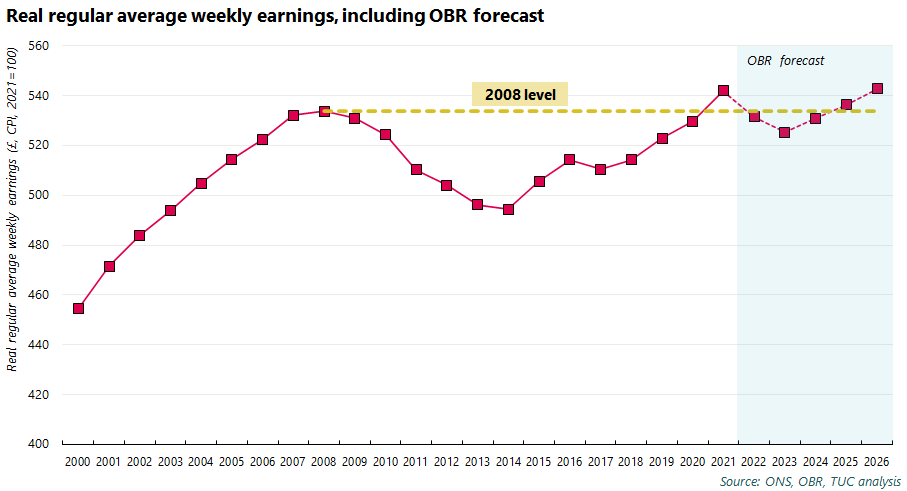
Workers’ pay prospects from the statement don’t look good. The OBR forecasts real weekly wages to fall by £11p/w (2.0 per cent) in 2022, and fall again in 2023. This will put wages back below their 2008 levels (after a brief recovery in 2021), where they’ll stay until 2025. And even this contains some optimistic wage forecasts, with the OBR forecasting pay before inflation to rise by as much as 5.9 per in Q3 2022.
The OBR forecasts that the 2022-23 financial year will see the biggest fall in living standards since records began in 1956-57, explaining that the “failure of nominal earnings growth to keep pace with rising inflation” is a “key factor” in this.
It adds that the policy measures announced since October only “offset a third of the overall fall in living standards that would otherwise have occurred in the coming 12 months”.
But there was no action to tackle falling pay in the Chancellor’s statement: nothing on raising the minimum wage, or funding public sector pay rises, and no recognition that collective bargaining (and union presence) is the most sustainable way to get wages rising.
Measures to support families in the UK with rising energy prices and the cost of living were totally inadequate
The spring statement offers little good news for struggling families, especially those in receipt of benefits.
Benefits uprating
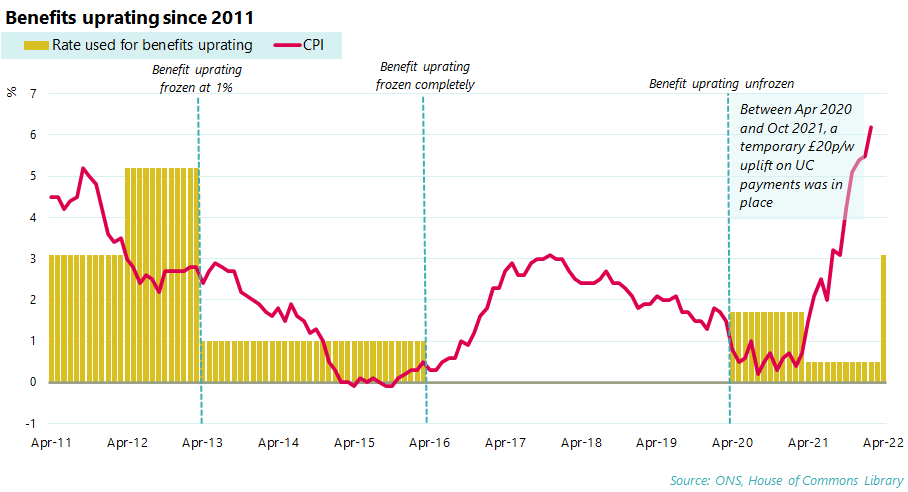
Worst of all there was no increase in the basic rate of benefits. As it stands, the standard allowance for Universal Credit and legacy benefits is set to rise by 3.1 per cent in April 2022. But this is far below the latest inflation figure (CPI is 6.2% in Feb 2022 and RPI is 8.2%), with inflation forecast to rise higher in the coming months.
This will leave those on benefits facing a real terms cut at a time when energy bills are rising by 54 per cent. The families who need the most help have been left totally out in the cold by the Chancellor today.
The decision not to cut benefits in real terms will particularly impact those who are unable to work. This reflects a wider ignorance of the equalities impact of the cost of living crisis.
We also didn’t see a reversal of the decision to suspend the state pension triple lock. The decision to abandon the pensions triple lock will cost pensioners almost £500 a year. Pensioners are particularly vulnerable to price hikes as they spend a higher percentage of their income on food and fuel.
Targeted support
The big new announcement for targeted support for low-income households was £500 million in additional funding for the Household Support Fund – a temporary discretionary fund run by local authorities. This scheme was set to end this month, and the initial funding was £500 million.
This extra money is worth less than £10 each to the six million families claiming Universal Credit – in the unlikely event they hear about it and are able to jump through the hoops needed to claim it. And contrast this £500 million to the £10 billion cut to benefit spending in 2022-23 as a result of not uprating benefits in line with inflation.
Income tax and national insurance threshold
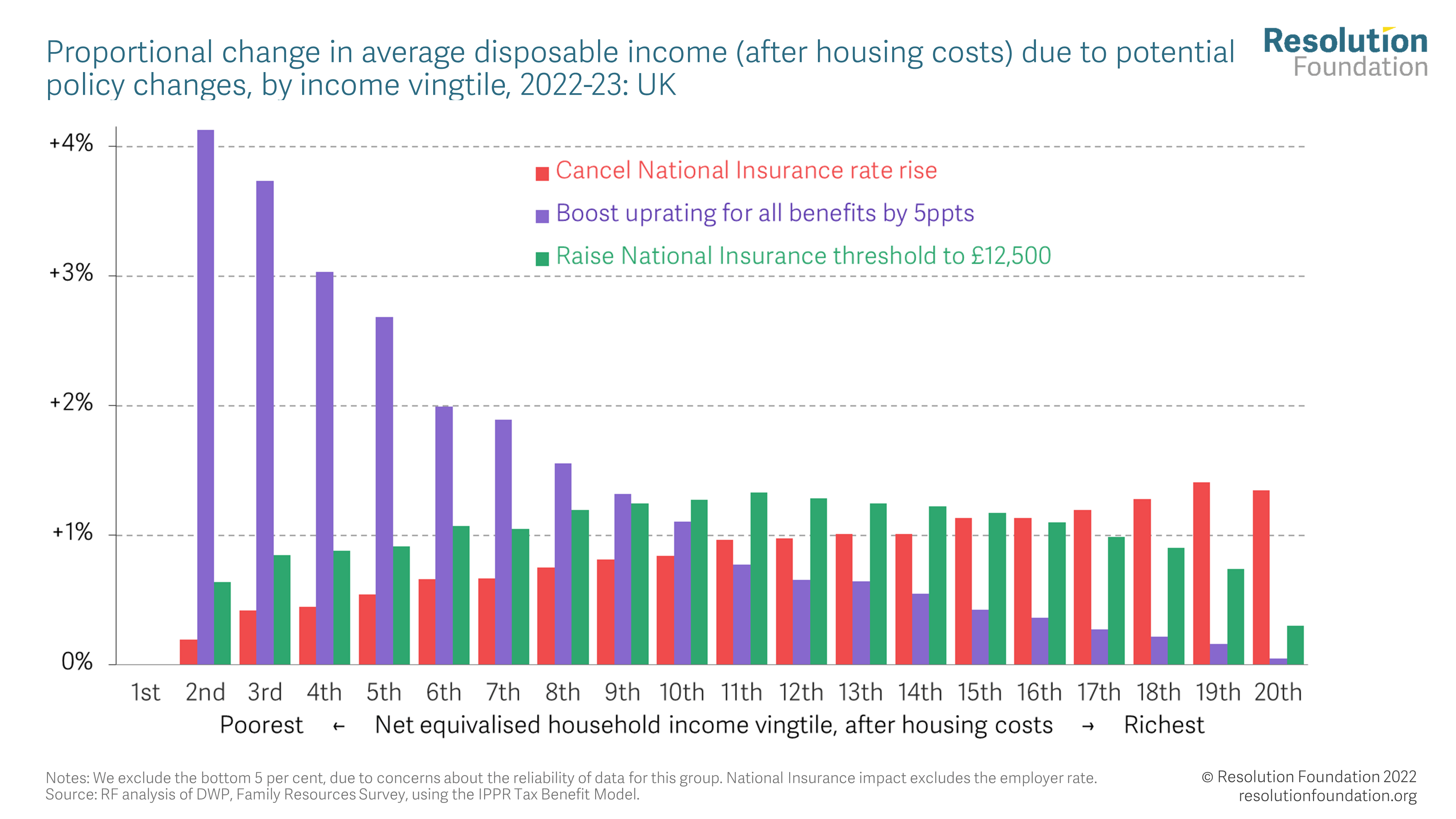
Changes to tax cuts won’t help the families who need it most now. Raising the National Insurance threshold mostly benefits middle earners and, compared to increasing benefits payments, does little to help those with low income. This can be seen in the chart below, from the Resolution Foundation.
And promises of income tax cuts tomorrow do nothing for families facing cuts to their living standards now.
And the Chancellor has missed another opportunity to raise sick pay and make it available to all. Living with Covid requires decent sick pay for all, yet we’re still waiting for government to take action on this.
VAT-free insulation and solar panels
Alongside this was the removal of the 5% Value Added Tax currently applied to building materials, like home insulation and solar panels. But this only benefits families who own a home and can afford to renovate it anyway.
The Chancellor should’ve taken the opportunity to invest in home retrofits at scale. Improving the average UK home’s energy efficiency to band C would reduce the country’s gas demand by 15% and cut hundreds of pounds off fuel poor homes’ energy bills. A massive social homes retrofits programme, delivered by local authorities, could also create over a quarter million good jobs over two years. But here again the Chancellor failed to act.
Transport
The 5p cut on fuel duty does next to nothing to support those at the sharp end of the wages and bills crisis. Analysis by NEF estimates that a third of this tax cut will go directly to the richest 20% of households, while the poorest 20% will on average only receive £5 per month. To make transport truly affordable for everyone, Government should be expanding bus and rail services in the public sector.
The Chancellor didn’t talk about the long-term changes needed for a high-wage, high skill, high productivity economy
We heard nothing on reforms to corporate governance, industrial strategy or expanding the public sector workforce to deliver the decent public services we need to level up.
The Chancellor did announce a review of the apprenticeship levy. We believe that any changes to the levy should focus on significantly increasing the number of high-quality apprenticeships and widening access to groups facing long-standing barriers. A review must not be an exercise in allowing employers to duck their responsibilities on apprenticeships.
And much more than this is urgently needed to tackle the shortfall in training, including increased government skills funding and new workplace training rights to expand opportunities for everyone to upskill and retrain.
The Chancellor didn’t stand up to the scandalous behaviour by bosses P&O
The Chancellor talked about security but did nothing to take on the bosses who take every measure to undermine their workers’ job security. He could’ve made it clear that no employer who treats workers with the contempt shown by P&O Ferries would receive a penny of public money until they reinstate their workforce, including by taking freeports contracts off DP World, the parent company of P&O.
Yet once again the Chancellor failed to mention the issues that matter to working people.
The government’s response to those fleeing conflict and war is inadequate
The Spring statement document outlines the £400m in humanitarian support the government has given to Ukraine, and says it has committed “to provide local authorities with £10,500 per person for support services, and between £3,000 and £8,755 per pupil for education services depending on phase of education, as well as £350 per month for sponsors for up to 12 months”.
But it’s clear that the government’s support for the people fleeing war and conflict is worse than inadequate. The Ukraine for Homes scheme is no substitute for a properly funded system that provides universal refugee protection. And yesterday, the Government’s nationality and borders bill, passed a vital stage in the House of Commons, meaning that those fleeing conflict may find themselves treated as criminals and deported, instead of finding sanctuary.
The Chancellor let families down today.
Families are facing soaring bills at a time when their incomes have been squeezed by years of wage cuts and attacks on the social security system. The wages and bills crisis is a consequence of decisions taken by successive governments. Today the Chancellor chose to make the pain last for longer.
THERE WAS SOME PRAISE FOR SUNAK’S MINI-BUDGET, HOWEVER:
Simon Roberts, Chief Executive Officer, Sainsbury’s said:“We know our customers and colleagues are concerned about increases to the cost of living and at Sainsbury’s we are doing everything we can to support them.
“We really welcome today’s changes to fuel duty and national insurance. We are passing a 6 pence per litre cut in fuel across our forecourts from 6pm tonight as we know fuel costs are one of the biggest pressures everyone is facing right now.
“We were pleased to welcome the Chancellor to one of our stores today to discuss what we are doing to offer customers great value and to invest over £100 million in increasing pay for our colleagues with a new hourly rate of £10 per hour nationally and £11.05 in inner London.”
Michelle Ovens CBE, Founder, Small Business Saturday said:“Moves in today’s Spring Statement to increase the employment allowance, reduce fuel duty and raise the National Insurance threshold are welcome, and will go some way to help businesses deal with rising costs.
“In particular, It is good to see the immediacy of this rise in employment allowance.”
Martin McTague, Chair, Federation of Small Businesses, said:“We are very pleased to see the Chancellor adopting our top ask for this Spring Statement: uprating the Employment Allowance to help small employers with national insurance costs.
“We originally put forward the Employment Allowance as a targeted measure to help small firms, and it has now been expanded three times since its creation.
“Together with a cut to fuel duty, these measures will provide crucial breathing space for our embattled small employers.
“This Spring Statement marks a good starting point, with welcome measures on business rates, net zero and energy investment taking effect next month.
“With steep inflation, energy bills increasing fast, without the same support in place as enjoyed by consumers, and hiring pressures landing hard on small firms, more of the right stuff will be needed in the autumn given this challenging backdrop.
“We’ve seen a VAT cut on net zero investments for households today, which is good for small firms involved in their installation.
“However, a high street shop or local bar cannot access the same support that consumers do when dealing with the same energy supplier, and they should have access to the same assistance to reduce energy use and support the move to net zero.
“We look forward to working with the Chancellor on his new tax plan. Achieving the new culture of enterprise vision he rightly aspires to, alongside levelling up aspirations, will mean putting community small firms and sole traders front and centre of reforms.
“That means taking more of them out of the business rates system, protecting SME R&D investment incentives and delivering on commitments to end an endemic late payment culture that destroys thousands of firms a year.”
Alex Towers, Director of Policy and Public Affairs, BT Group said:“We welcome the Chancellor’s focus on tax reforms for business investment, given how central this is to UK infrastructure and growth.
“This is particularly important for BT Group as we make once in a generation investments to build the UK’s full fibre broadband and 5G networks. The existing super-deduction has already helped us to significantly increase and accelerate that investment.
“We agree that longer-term incentives are now needed, to support this country’s growth and competitiveness, and we will be keen to contribute evidence to aid the Government’s decision-making.”
Dr Clive Hickman OBE, Chief Executive, the Manufacturing Technology Centre said: “We welcome the Spring Statement, which outlines concrete steps to ensure that the manufacturing sector remains competitive, sustainable, and resilient.
“The Government’s commitment to cut tax rates on business investment is important if the UK is to boost manufacturing productivity and create high-quality jobs. In addition, the reform to R&D tax credits is a very positive step that will enable the scheme to be more effective, better value for money, and more generous.
“These measures will be crucial to spur innovation and encourage investment across the country.”
Julian David, Chief Executive, TechUK said: “Rightly the majority of the Spring Statement focused on addressing the cost of living concerns resulting from the war in Ukraine and rising inflation. Along with this vital action, the Chancellor also outlined a welcome package of consultations and policy programmes aimed at boosting businesses investment.
“In our recent Digital Economy Monitor Survey UK tech companies said increasing support to invest in R&D would be their top ask of Government, with 76% saying R&D is important to their business operations in the UK.
“The proposals unveiled today to further expand R&D tax credits and consult on ways to maintain the tax deduction for capital expenditure have the potential to unlock more investment into UK innovation.
“However, to get this right the Government must ensure that the software and intangible assets that power modern business investment are kept in scope. Otherwise, the Government risks missing an opportunity to unleash the potential of tech led growth.”
Dom Hallas, Executive Director, COADEC said:“Better R&D tax credits would mean more innovation from startups and innovative companies.
“We’re delighted the Chancellor recommitted to expanding it to cover cloud and data costs – and look forward to discussing the many ways to improve the credit further.”
Irene Graham OBE, Chief Executive, ScaleUp Institute said: “In the face of increasing pressures of inflation and wider international uncertainties, it is very good to see the Spring Statement continues to recognise the importance of business growth and innovation.
“It reaffirms policies targeted towards R&D, people and skills, investment, and innovation including the new Innovation Challenge across central government departments. We will continue to work closely with the Government on the evolution and development of these policies which are so vital to our scaleup economy.”
Michael Moore, BVCA Director General, said:“Increased business investment is key to the future of the UK economy and we welcome the measures announced by the Chancellor today which support this objective.
“Private capital’s focus on sectors like AI, robotics and fintech has helped the UK to become a world leader in these areas – further reform of R&D tax credits will help businesses to drive further innovation and strengthen the UK’s position in this new economy.”
Fuel Duty
Edmund King, President, the AA said: “The AA welcomes the cut in fuel duty. However, we are concerned that the benefit will be lost unless retailers pass it on and reflect a fair price at the pumps. Average pump prices yesterday hit new records- despite the fall in wholesale costs.
“The Chancellor has ridden to the rescue of UK families and businesses who use their vehicles, not for pleasure, but to function in their daily lives. Since the start of the year, the 20p-a-litre surge in pump prices has been the shock that rocked the finances of families, and particularly young drivers, pensioners and lower-income workers who need to commute each day.
“AA research showed that even in November, when petrol pump prices set new records at around 148p a litre, 43% of drivers were cutting back on car use, other spending to compensate or both. That rose to 59% among young drivers and 53% among the lower-paid. Petrol started this week averaging 167p a litre.
“On top of the duty cut, there has been a substantial reduction in wholesale road fuel costs feeding through to the forecourts since 9 March. That needs to drive lower pump prices also. The road fuel trade shouldn’t leave the Treasury to do the heavy lifting when cutting motoring costs.”
Elizabeth de Jong, Director of Policy, Logistics UK said:“With average fuel prices reaching the highest level on record and rising inflation, there has been an unstainable burden on logistics businesses which operate on very narrow margins of around 1%; the Chancellor’s decision today will help to ensure operators can continue to afford supplying the nation with all the goods it needs, including food, medicine and other essential items.
“Fuel is the single biggest expense incurred by logistics operators, accounting for a third of the annual operating cost of an HGV. The cut in fuel duty of 5ppl will result in an average saving of £2,356 per year per 44-tonne truck; this move will help to strengthen the UK’s supply chain during a time of ongoing financial and operational challenges.”
Zero rating VAT in energy efficiency measures
David Cowdrey, Director of External Affairs, MCS said:“The Chancellor has used the Spring Statement as an opportunity to kick-start the home heating revolution by zero rating VAT on home energy efficiency and renewable technologies for five years.
“This announcement allows people to insulate their homes and save on our fuel bills, making houses cheaper to run, especially when gas prices are at a record high.
“The government’s bold move to zero rate VAT can help the UK meet its net zero targets by using proven, off the shelf, zero carbon domestic energy solutions, such as solar and heat pumps, which are ready to be upscaled now.“
Professor Robert Gross, Director, U.K. Energy Research Centre, Professor of Energy Policy, Imperial College said:“The VAT cut on energy efficiency products is a great first step in helping households adopt simple measures to help cut fuel bills for the coming winter.
“Better insulated houses need less energy to keep warm and this is good for our bills, energy security and the environment.”
Amy MacConnachie, Director of External Affairs, Association for Renewable Energy and Clean Technology (REA), said:“The REA warmly welcomes today’s announcement to remove VAT on domestic renewables for five years. We have long campaigned for this change because we know these installations will help protect people from volatile gas prices and reduce their energy bills, while also supporting the transition to Net Zero and providing a catalyst for new jobs and investment across the country.
“The move to bring forward business rate exemptions for green technologies from April 2022, including solar panels and heat pumps, will help to further drive down costs and support the decarbonisation of buildings.
“We now want to see the Government clarify and go further on the range of technologies included as Energy Saving Materials, particularly energy storage, but this is a positive package of measures for our sector.
“We stand ready to deliver an energy future which is independent, secure, and stable.”