Clean energy jobs boom ‘to bring thousands of new jobs’

Clean energy will bring 400,000 extra jobs by 2030, with high demand for roles including plumbers, electricians and welders

  • Government publishes first ever national plan to recruit workers needed for clean energy mission, with over 400,000 extra jobs by 2030 
  • 31 priority occupations such as plumbers, electricians and welders are particularly in demand  
  • 5 new clean energy Technical Excellence Colleges to train next generation of workers, as part of government’s drive for two-thirds of young people to be in higher-level learning 
  • Energy Secretary to set out measures ensuring companies receiving public grants and contracts need to deliver good jobs across the clean energy sector
  • A generation of young people across Britain will benefit from the good jobs and high wages that the booming clean energy economy can bring, under new plans announced by the government today as part of the clean energy superpower mission

Backed by record government and private sector investment in clean energy such as renewables and nuclear, the clean energy economy is sparking a boom in demand for good industrial jobs in all regions and nations of the UK – with 31 priority occupations such as plumbers, electricians, and welders particularly in demand. 

For the first time, government will today (Sunday 19 October) publish a comprehensive national plan to train up the next generation of clean energy workers, with employment expected to double to 860,000 by 2030, ensuring jobs are high quality and well paid.  

See the Clean Energy Jobs Plan

Setting clear workforce estimates for the first time will galvanise industry, the public sector, and education providers to work together to deliver one cohesive strategy to invest in training for specific in demand occupations. 

The Energy Secretary will also set out how this government sees trade unions as an essential part of the modern workplace and economy. Across the broader energy sector, trade union coverage has declined from over 70% in the mid 90’s to around 30% today. Recognising trade unions is vital to securing high pay and good conditions for workers. 

Energy Secretary Ed Miliband said: “Communities have long been calling out for a new generation of good industrial jobs. The clean energy jobs boom can answer that call – and today we publish a landmark national plan to make it happen.  

“Our plans will help create an economy in which there is no need to leave your hometown just to find a decent job. Thanks to this government’s commitment to clean energy, a generation of young people in our industrial heartlands can have well-paid secure jobs, from plumbers to electricians and welders. 

“This is a pro-worker, pro-jobs, pro-union, agenda that will deliver the national renewal our country needs.”

Secretary of State for Work and Pensions Pat McFadden, said: “We’re giving workers the skills needed for switch to clean energy, which is good for them, good for industry – and will drive growth across the nation. 

“Our new jobs plan will unlock real opportunities and ensure everyone has access to the training and support to secure the well-paid jobs that will power our country’s future, as part of our Plan for Change.”

The government’s clean energy mission is already delivering for the UK, with the certainty and stability of the government’s mission having galvanised over £50 billion of private investment since last July.  

The government has also given Sizewell C the green light, which will support 10,000 jobs at peak construction, announced Rolls Royce as the preferred bidder for the small modular reactor programme to support up to 3,000 jobs, and kickstarted the Acorn and the Viking projects in Scotland and the North East that is estimated to support a combined 35,000 jobs, including 1,000 apprenticeships. This builds on the 4,000 jobs already set to be created in CCUS projects in the North West and Teesside.  

For young people, these jobs can offer higher levels of pay- with entry level roles in the majority of occupations in clean energy paying 23% more than the same occupations in other sectors.  

Jobs in wind, nuclear, and electricity networks all advertise average salaries of over £50,000, compared to the UK average of £37,000, and are spread across coastal and post-industrial communities. 

New initiatives include: 

  • Training up the next generation of clean energy workers – 5 new Technical Excellence Colleges will help train young people into essential roles. Skills pilots in Cheshire, Lincolnshire and Pembrokeshire will be backed by a total of £2.5 million – which could go towards new training centres, courses or career advisers
  • Harnessing the valuable expertise and transferrable skills of veterans – Working with Mission Renewable, the government is launching a new programme to match veterans up with careers in solar panel installation, wind turbine factories, and nuclear power stations
  • Tailored schemes for ex-offenders, school leavers, and the unemployed – Last year alone, 13,700 people who were out of work possessed many of the skills required for key roles in the clean energy sector, such as engineering and skilled trades
  • Upskill existing workers – Oil and gas workers will benefit from up to £20 million in total from the UK and Scottish governments to provide bespoke careers training for thousands of new roles in clean energy. This follows high demand for the Aberdeen skills pilot, which is already supporting workers into new careers. Government is also extending the ‘energy skills passport’, which identifies routes for oil and gas workers to easily transition into roles in offshore wind, to new sectors including nuclear and the electricity grid

The plan also includes landmark proposals to ensure that jobs in the clean energy sector have world class pay, terms and conditions. 

  • Closing loopholes in legislation to extend employment protections enjoyed by offshore oil and gas workers working beyond UK territorial seas, including the national minimum wage, to the clean energy sector
  • A new Fair Work Charter between offshore wind developers and trade unions to ensure that companies benefiting from public funding provide decent wages and strong workplace rights
  • Workforce criteria in grants and procurements to test and pilot innovative ways to drive fair work and skills in DESNZ grants and contracts, including through the Clean Industry Bonus and Great British Energy

It comes after the Prime Minister announced a package of reforms to elevate and transform the education skills system, with a new target for two-thirds of young people to participate in higher-level learning – academic, technical or apprenticeships – by age 25, up from 50% today. 

With at least 1 in 6 ex-military already armed with many of the skills needed for the clean energy sector, the government is joining forces with Mission Renewable to match them up with careers in solar panel installation, wind turbine factories, and nuclear power stations.   

The pilot will initially focus on the East of England, which will benefit from the biggest increase in the size of the clean energy workforce with over 60,000 people expected to be employed in the sector by the end of the decade.  

Secretary of State for Wales Jo Stevens said: Wales’s growing clean energy industry is delivering the well-paid, highly-skilled jobs of the future.

“Projects right across the country from Pembrokeshire to Flintshire are creating opportunities for hundreds of our young people and will help drive regional growth as well as accelerating our drive towards lower bills and energy security.!

Paul Nowak, General Secretary of the TUC, said: “After years of previous governments starving British industry of investment, this represents a serious plan to start to rebuild our industrial heartlands and deliver quality jobs in clean energy – as well as supporting even more in supply chains right across the country.   

“Crucially, it puts decent work at the heart of our energy system. And it shows that when government makes a plan with unions and workers, the whole country can benefit.   

“Whether it’s welders in Wrexham or pipefitters on Teesside, the firm commitment to clean energy jobs being good union jobs is one which will improve working lives the country over.    

“We now look forward to government delivering a similarly robust and funded plan for the North Sea transition, which safeguards jobs and livelihoods.”

Charlotte Brumpton-Childs, National Officer at the GMB, said:  “GMB has long campaigned for a jobs first transition. The government is listening and having a jobs plan to underpin the industrial strategy is exactly what this country needs

“GMB welcomes this roadmap for clean energy jobs and the cast iron expectation unions and their members will be at the heart of this. 

“We need fair work agreements and taxpayers’ cash has to be spend where good jobs are going to be created. Today’s plan not only sets out that expectation but crucially, how good jobs can be measured.”

Eddie Dempsey, General Secretary of the RMT, said: “RMT welcomes the government’s commitment to closing loopholes in maritime and offshore employment law, which should in turn create domestic opportunities in coastal communities that support the entirety of the offshore wind supply chain. 

“This plan has the potential to create hundreds of thousands of good jobs across the UK, offering real opportunities for those wishing to transition from oil and gas and for a new generation of workers in their own communities.”

Christina McAnea, General Secretary of UNISON said: “Clean, homegrown energy is essential in tackling climate change and delivering economic growth. This plan can help create a UK workforce with highly skilled, fairly paid and secure jobs. 

“Extra investment for retraining will mean experienced staff already employed in the sector are able to take on new roles. Additional funding for apprenticeships and opportunities for young people are crucial too if the UK is to have a bright and clean energy future.”

Alasdair McDiarmid, Assistant General Secretary of Community, said: “After long years of managed decline and neglect under previous governments, we now have an ambitious government which is serious about rebuilding Britain’s industrial base. Crucially, the government is also investing in the skills needed to power the future of British manufacturing – something Community has long called for.  

“The push for new clean energy jobs will also support our members in both the light industries and steel sector, with steel being an essential component for green energy infrastructure and construction.  

“We look forward to opportunities to collaborate with the government as they roll out this initiative across the UK, delivering for working people in the communities they live in.”

Sue Ferns OBE, Senior Deputy General Secretary at Prospect, said: “The infrastructure investment required to achieve the government’s clean energy mission must be backed by a major boost to jobs and skills.

“If this mission is to be a success, and support the wider industrial strategy and growth agendas, then we urgently need a step-change in the level of workforce development. In this context is it welcome that this Jobs Plan now exists and the new initiatives are a welcome step in the right direction.”

Frances O’Grady, Former General Secretary of the TUC, said: “Energy workers and their families are at the heart of this plan – showing the clean energy transition provides not just energy security but job security. 

“Alongside this, it’s a promise that every pound of taxpayers’ money will be used to help create the decent apprenticeships,  jobs, and livelihoods that Britain needs.”

Unite general secretary Sharon Graham said: “Well paid, secure work must be at the heart of any green transition. Unite members will welcome the commitment to 400,000 green jobs with strong collective bargaining rights.

“The actions set out in this plan are initial steps in what must be an ambitious strategy for tangible jobs, backed by an equally ambitious programme of public investment.

Chris O’Shea, Chief Executive of Centrica, said: “We have committed to creating a new apprenticeship for every day of this decade. These new secure, skilled, well-paid jobs are key to unlocking the economic growth the UK so desperately needs.  

“Clean energy isn’t simply about new technology – it’s about renewing purpose and harnessing the skills and infrastructure that have served us for decades to power the next chapter. 

“I’m proud Centrica has the largest unionised workforce in UK energy and services, and we are delighted to welcome the government’s Clean Jobs Plan as a vital step in recognising the skills, protections and careers that must underpin the energy transition.”

Keith Anderson, CEO of ScottishPower, said: “Thanks to the clear direction set out by the government’s Clean Power 2030 Mission, we’re investing at record levels in the clean electricity infrastructure the UK needs for energy security and economic growth. 

“Our £24 billion investment plan is creating thousands of job opportunities. We’re recruiting for good, well-paid skilled jobs at record levels. We’re welcoming 300 new recruits in the last 3 months of 2025 alone and aim to bring on another 2,000 jobs up to 2027. 

“Many of these jobs are in the communities that we serve in Scotland, England and Wales. This is on top of the benefits for local supply chain businesses across the country from our commitment to domestic procurement that currently supports 70,000 jobs in the UK supply chain.”

EDF power solutions UK CEO Matthieu Hue said:  “We welcome the plan which brings clarity on the scale of the opportunity for people across the UK to work in high quality jobs which will contribute to our electric future.  

“EDF power solutions has 2 GW of wind, solar and battery in operation and our goal is to have 5 times that amount by 2035, so we will need many more skilled people to help us reach our ambition.  

“Our partnership with 4 trade unions, GMB, Prospect, Unison and Unite shows our commitment to working together with them to grow our business.”

Darren Davidson, Vice President of Siemens Energy UK&I, said:  “Siemens Energy is a major employer in the UK with 6,500 workers at sites across the UK. We have taken on 140 new apprentices this autumn, and we currently have more than 200 active vacancies.  

“The jobs plan announcement is welcome news, building on the Clean Power 2030 Action Plan that was launched at our Hull offshore wind blade factory.”

Chris Norbury, CEO of E.ON UK, said:  “Clean power is a defining opportunity to grow the economy, strengthen energy security, and create skilled jobs that support communities nationwide. We welcome the Clean Energy Jobs Plan as a vital step towards building the workforce to realise that potential. 

“We’re proud to already be delivering on this ambition by supporting around 800 people annually through our Net Zero Training Academy and wider skills initiatives, and welcoming over 1,300 apprentices across 100 programmes since 2018.  

“Through partnerships with trade unions, schools, and local governments, we’re ensuring green jobs are good jobs, rooted in local communities with real progression, purpose, and opportunity. We look forward to working with government and industry to scale up this mission and ensure no region is left behind.”

Michael Lewis, CEO Uniper said: “We’re really pleased to see the launch of the Clean Energy Jobs Plan and the recommendations within it.  

“Uniper aims to invest approximately €8 billion into growth and transformation projects by the early 2030s, including solar and onshore wind projects, hydrogen projects, and a new combined-cycle gas turbine power station with carbon capture technology at our Connah’s Quay site – contributing to the retention and creation of jobs, and supporting the regional economy.  

“We recognise the need for workers to have the right skills now, and in the future, to support the UK’s and our own ambitions.”

Zac Richardson, Group Chief Engineer at National Grid, said: “Secure, affordable and clean energy is essential to unlocking UK economic growth and productivity – ambitions which are underpinned by electricity networks and the unprecedented levels of planned investment in them. 

“We welcome the government’s focus on skills and training – especially for technical roles vital to our energy future – and look forward to working together to build a diverse, homegrown workforce that can deliver the grid of tomorrow.”

Tania Kumar, Director of Net Zero at the CBI, said: “The growth of the clean energy economy is creating opportunities for people and places across the whole of the UK. The launch of the Clean Energy Jobs Plan offers a tangible way to connect communities with both the opportunities emerging across the sector and the businesses at the forefront of delivering them. 

“If we want people to feel invested in the transition and ensure they are able to participate in it, we must show them how they fit into the vision. This plan begins to do just that, laying out clear pathways no matter whether you’re in work, seeking employment or returning to the job market.”

Dhara Vyas, CEO of Energy UK, said: “Today’s announcement is a critical step forward in building the workforce required to deliver our future energy system. It rightly recognises the need to tackle the skills challenge collectively by investing in both new talent and our existing workforce.  

“With up to 400,000 new jobs on the horizon and a clear focus on high-quality, inclusive opportunities, the Clean Energy Job Plan spotlights a once-in-a-generation opportunity to build a cleaner, fairer energy system whose benefits will be felt by people and communities across the country.”

Jane Cooper, Deputy Chief Executive at Renewable UK, said:  “The Clean Energy Jobs Plan sets out the scale of the massive opportunity which the UK has to create tens of thousands of new jobs in renewables all over the country.  

“It includes practical measures which will enable government and industry to work even closer together to maximise this, such as opening new Technical Excellence Colleges, building on Britain’s current success as a global leader in clean power.  

“This long-awaited plan delivers on employers’ calls for a coherent government workforce strategy for clean energy and we look forward to working with Ministers to realise its ambitions.”

Katy Heidenreich Supply Chain and People Director at Offshore Energies UK, said:  “Investing in skills development is essential to support the UK’s energy sector and it is encouraging to see governments recognise the huge resource of our oil and gas workforce and how their skills can be developed to provide the expertise needed for the energy mix of the future.  

“Oil and gas workers have a continuing role in powering the UK today and for years to come. A successful energy future—one that is increasingly homegrown—depends on supporting the industries and people delivering energy now, alongside growing capability across all technologies.”

Claire Mack OBE, Chief Executive of Scottish Renewables, said: “The clean power mission is not just about energy security for the country, it’s about good jobs and a workforce fit the future in your locale. The scale and importance of the energy transition requires new approaches to ensure investments in skills, apprenticeships and training serve the needs of the entire economy. 

“Scotland is home to world-class energy skills expertise. Working with both governments, the clean energy industry can build on this through the breadth of projects coming forward today and in the years ahead. The Clean Energy Jobs Plan is an important signal to the public and private sectors of how we must quickly strengthen our partnership on jobs and skills.”

Ben Martin, Policy Manager at the British Chambers of Commerce, said: “The net zero economy is continuing to grow, and the Clean Energy Jobs Plan clearly sets out how the government will recruit essential workers who are critical for the UK’s energy transition. This will support both net zero and economic growth across the UK, providing certainty for people and local communities.  

“The plan also recognises the critical role that oil and gas workers in the North Sea will play in driving the renewable energy sector. Aligning skills standards between these 2 sectors and identifying current and future skills needs to support our low carbon future, are essential to delivering a successful UK energy transition.”

Verity Davidge, Director of Policy and Public Affairs, at Make UK said: “Manufacturers are moving at pace to invest in decarbonisation and net zero projects and the transition to clean energy offers huge opportunities for industry. To take full advantage, companies will need to have access to increasingly higher levels of skills and a talent pipeline which will fuel the growth we need to see.  

“As such, this plan is a welcome recognition by government and a positive step forward that work needs to start now to get ahead of our competitors and ensure industry is equipped with the skills to do the job. In tandem with this plan we need to accelerate skills reform including ensuring that apprenticeship courses are funded to cover the real cost of training, as outlined in the clean energy sector plan.”

Clare Jackson, CEO of Hydrogen UK, said: “We welcome the Clean Energy Jobs Plan’s recognition that hydrogen will be vital to net zero and to creating high-quality jobs. Much of the oil and gas workforce already has transferable skills, and supporting their transition into hydrogen will be key to a just and rapid shift to a clean energy economy.  

“The Hydrogen and Carbon Capture Skills Accelerator is a crucial first step, and over time we must move from designing courses to delivering hands-on training and upskilling to build the workforce of the future.”

Olivia Powis, CEO of the Carbon Capture and Storage Association, said: “We welcome the Clean Jobs Plan and its recognition of the vital role CCUS and hydrogen will play in achieving the UK’s growth and decarbonisation goals while keeping industries competitive. Developing the necessary skills base is crucial to unlocking these sectors’ full potential and protecting thousands of existing industrial jobs.  

“Establishing a dedicated Hydrogen and CCUS Skills Accelerator, in partnership with industry, marks an important step toward creating high-quality employment and ensuring a just transition for skilled workers from the North Sea. The CCSA looks forward to collaborating with government and partners to build the workforce powering the clean energy future.”

Tom Greatrex, Chief Executive of the Nuclear Industry Association, said: “This Jobs Plan shows the huge opportunity clean power offers the UK, and the vital role nuclear will play in delivering it.

“With 100,000 people already working in nuclear in good, skilled jobs across the country, new stations like Sizewell C and a fleet of SMRs will create thousands more — especially for young people — in clean and secure energy.”

Chris Hewett, Chief Executive, Solar Energy UK, said: “Solar energy and battery energy storage already support over 20,000 British jobs, with expectations that the sectors will employ more than twice the number in 10 years’ time.

“But to reach our goals for cheaper, cleaner power, we need to redouble our efforts to attract and train staff for these fast-growing sectors. With our Solar Careers UK programme and critical support from government under the Clean Energy Jobs Plan, we have every expectation that our aspirations will be fulfilled.”

Yselkla Farmer, CEO of BEAMA, said: “We have a long heritage of manufacturing for the electricity industry in the UK. As a supply chain at the heart of the clean energy sector we know the growth potential is substantial as we electrify our energy system.  

“The biggest limiting factor for investment today is the availability of a skilled workforce and therefore we welcome the focus on job creation for our supply chain. For network equipment manufacturing alone our average member expects to double employment by 2035.  

“This plan sets the foundations we need to help this statistic rise further.  Our members offer good jobs, in an industry rooted in local communities right across the UK, what they need is long term certainty and a commitment to support investment which this plan targets.”

Lawrence Slade, CEO of Energy Networks Association, said:  “This plan is an important step towards accelerating the real economic benefits of the clean energy transition right around the country.

“Today network operators employ around 26,000 people and facilitate 1,500 apprenticeships, in order to maintain the safe, reliable operation of over 500,000 miles of wires and cables.

“Tomorrow, the clean energy transition will underpin new employment opportunities and economic expansion, with tens of thousands of jobs across the country needed to upgrade the grid, not just temporary positions, but long-term careers, from apprenticeships to advanced engineering roles.

“By working together on the Electricity Networks Sector Growth Plan, we will build on existing work and give industry and government the clarity and confidence needed to invest in the workforce, skills and supply chain capacity that will help drive us towards a clean power system.”

Lieutenant General (Retd) Richard Nugee CB CVO CBE, Chair, Mission Renewable, said: “The Clean Energy Jobs Plan reflects the valuable contributions those who have served have made and can continue to make to the nation.

“By linking veterans and their families with career opportunities in the clean energy sector, Mission Renewable helps companies tap into and retain skilled talent, while at the same time enabling Armed Forces communities to thrive and feel valued. The sector and companies benefit, the veterans benefit and ultimately the nation benefits from skilled people delivering growth and opportunity.” 

Paul Cox, Group CEO of Energy & Utility Skills, said: “For the government to achieve its 2030 target, we must put people at the heart of that ambition – only by having the right people with the right skills will we deliver the UK’s energy future.   

“Energy and Utility Skills Group has worked closely with the Office for Clean Energy Jobs on its plans, scoping the workforce demands as well as convening the industry to create a UK-wide awareness and attraction campaign.  

“We will continue to work with purpose and pace to support the Clean Energy Jobs Plan alongside our partners in the sector.

“Together, we can turn ambition into impact.”

David Hughes, Chief Executive of Association of Colleges, said: “This exciting plan will help people get the skills they need to secure good work locally and it is great to see the investment in colleges to back the government’s ambitions on a net zero future.  

“With employers stepping up as well, colleges will be able to offer the training young people need to enter the net zero construction sector, as well as the re-training adults need to move jobs. 

“Colleges are ready to be at the heart of this transition, to create real career pathways and help the country lead the global green economy.”

Scotland’s plumbing and heating apprentices shine at national competition

Three outstanding apprentices have been named winners at the 49th Scottish Plumbing Apprentice of the Year (SPAY) competition, each taking top honours in the categories of copper, lead, and renewable technologies.

The competition, organised by the Scottish and Northern Ireland Plumbing Employers Federation (SNIPEF), showcases the diverse skills and emerging talent within Scotland’s plumbing and heating profession.

Shaun Wilcox, representing Moray College, University of the Highlands and Islands (UHI), clinched his second consecutive win in the copper category, building on his success in the lead category in 2023. Jude MacAskill of Inverness College UHI triumphed in the renewable category, and Hubert Parysek from Forth Valley College took top honours in the lead category.

Fiona Hodgson, Chief Executive of SNIPEF, commended all the apprentices who participated: “These achievements not only highlight the remarkable skills of our category winners but also showcase the exceptional talent of all the apprentices.

“Their success is supported by their respective colleges and employers, which helps to lay a solid foundation for their future careers in the plumbing and heating profession.

“The addition of a renewable technology category to the competition reflects the updates to our Modern Apprenticeship in Plumbing and Heating, providing apprentices with the essential skills to lead the nation’s transition to sustainable, low-carbon heating systems.”

Now in its 49th year, the SPAY competition was held at South Lanarkshire College in East Kilbride. It features three categories: copper, lead, and renewables.

Apprentices are tasked with demonstrating their knowledge and practical skills, from creating intricate copper pipework essential for modern plumbing systems to managing and shaping lead components for use in older buildings and deploying advanced renewable technologies.

Notably, the copper category serves as the Scottish qualifier for the SkillPLUMB UK finals, highlighting its importance on a national level.

Neil Collishaw, Chief Executive of BPEC and competition headline sponsor, highlighted the competition’s importance: “The copper category serves as the Scottish qualifying heat for the SkillPLUMB UK finals.

Integrating these regional heats into our national competition framework ensures broad attainment of standards across the UK, fosters professional growth, and equips participants for success on both national and international stages.

“I look forward to seeing the best of all the SkillPLUMB UK-wide competitors at this year’s UK finals in Manchester between 21 and 23 November.”

University of the Highlands and Islands scoop six out of nine top prizes.

The University of the Highlands and Islands achieved remarkable success by securing six of the top nine awards, reinforcing its reputation as a centre of excellence in vocational education and a major contributor to the development of Scotland’s future plumbing and heating professionals.

Shaun Wilcox, Shay Ewing, and Ben MacDonald swept the copper category, taking all three prizes. In the renewables category, Jude MacAskill claimed first place, with Sean Davidson taking third, and Liam Marshall earned a second-place prize in the lead category.

Dale Thomson, SNIPEF Training Services Manager and organiser of the competition, praised UHI’s strong performance at this year’s competition, saying, “The University of the Highlands and Islands has consistently demonstrated its commitment to training the next generation of plumbing and heating professionals at its colleges in Moray, Perth, and Inverness.

“We celebrate their success and also recognise the vital support from employers who invest in these apprentices, nurturing remarkable talent.”

The 2024 competition was supported by BPEC as the headline sponsor, with category sponsors NIBE for renewables, Airdrie Mechanical Services for copper, and City Plumbing for the lead category.

Over 26,000 extra construction workers required in Scotland by 2028 to meet demand 

  • Industry faces ongoing need to match growth with workforce
  • Recruitment and retention are key opportunities for sector resilience 

The annual industry forecast from the Construction Industry Training Board (CITB) highlights the continuing persistent gap between what Scotland needs to keep up with demand and the workforce available to meet the challenge.  

CITB’s Construction Skills Network (CSN) 2024-28 report reveals that in Scotland:  

·         Construction output is set to rise by 2.1% annually between now and 2028 

·         26,100 extra workers (5,220 a year) will be needed in order to meet the continued construction growth expected over the next five years 

·         The major opportunities are in: 

o    Repair and maintenance 

o    Public non-housing 

o    Commercial. 

Despite the industry managing to recruit around 200,000 people every year UK-wide, in 2023, an average of 38,000 vacancies were advertised per month. For almost a third (31%) of construction employers, finding suitably skilled staff remains their key challenge, particularly with more older workers retiring and not being replaced. 

Although the UK construction industry welcomed 200,000 new workers, it saw the loss of more (210,000 workers). With the ongoing difference between the predicted need for construction work and the available workforce, CITB’s forecast shows how important it is for the industry to tackle the issues with effective recruitment and training to replace those leaving and better prepare for the future, as well as to take advantage of key opportunities such as productivity improvements and meeting net zero retrofit targets. 

In response to the challenges, CITB has invested £267m to help the industry improve diversity, quality and productivity as well as making construction a more attractive career choice for future generations.

Among the areas this investment will directly support are three expanded initiatives:  

·         New Entrant Support Team (NEST) – helping employers to better navigate the recruitment process, access grants and suitable training, when and where needed 

·         Industry Impact Fund – making direct funding available for employers to design and test new solutions for talent recruitment and retention challenges 

·         Employer Network – rolling this out across Great Britain, to enable local employers to set their own funding priorities and meet area-specific skills needs. 

CITB Scotland Engagement Director, Ian Hughes, said: “Construction is an essential sector for our regional and national economic prosperity. We anticipate continued industry growth in Scotland, but we need to meet demand with more people in the workforce with the right skills.  

“CITB’s CSN report highlights how Scotland employers can address the challenge by recruiting and developing a skilled, competent and diverse workforce that is able to meet current and future needs. 

“Scotland has a number of construction investments supported by City Region Deals, Regional Growth Deals and Green Freeports. 

“These wide-ranging projects include the proposed debris flow shelter for the A83 at Rest & Be Thankful, the £25m hydrogen demonstration network in Fife, and £200m towards the mains replacement for Scottish Gas Networks.

“Works are underway for the £91m Clyde Waterfront & Renfrew Riverside development, with a new River Clyde Bridge as part of the Glasgow City Region Deal. Dunfermline’s £250m Learning Campus is due for completion on a purpose-built low carbon site in the eastern expansion area.

“Meanwhile, proposals for the £250m revamp of Charing Cross would bring student accommodation and healthcare facilities followed by mixed-tenure residential, office and leisure space as well as the creation of a new gateway into the city.

“We are committed to ensuring that the skills system is fit for purpose to deliver on the great opportunities across Scotland, now and in the future.

“The industry has shown particular resilience throughout what has been an undeniably tough few years. Here at CITB, we have a crucial role to play in supporting its growth through recruitment, training, development and upskilling.” 

SNIPEF honours the rising stars in Best Apprentice Plumber awards

Apprentices in the plumbing and heating sector, whose importance has seldom been more keenly recognised, have once again been recognised with the Scotland and Northern Ireland Plumbing Employers’ Federation (SNIPEF) Best Apprentice Plumber awards.

The talent and enthusiasm they bring to their journey towards the status of a qualified plumber is the pride of the sector and their achievement confirms to them that the career choice they made has been comprehensively vindicated.

To celebrate the hard work and determination they have displayed, the campaigning trade association has honoured 17 apprentices from the colleges in Scotland in which they study their craft. Each one received a £100 voucher.

SNIPEF’s accolade for the future stars of the profession comes at a time when plumbing and heating is increasingly being seen as making a valuable social contribution during the transition to net zero carbon as well as being a pathway to a rewarding and satisfying working life.

Fiona Hodgson, Chief Executive of SNIPEF, said: “This is the 32nd year that SNIPEF has been seeking out and rewarding the best talent among our stars. It is an accolade that they most certainly deserve.

“It is also a great tribute to employers, for the faith they have demonstrated in our people, but also to the apprentices themselves, the colleges which nurture their ambitions and the organisations such as SNIPEF which wholeheartedly support them.

“We were hard hit over the last few years, when uncertainty stalked the land, so it is very heartening not only that apprentice numbers are back up to where they were before the pandemic, but that the quality of people we are bringing in is so satisfying.”

Dale Thomson, Apprentice Training Manager for SNIPEF, said: “The industry has always been very aware that its future lies in the skill and dedication of the people who are embarking on their careers at this time.

“Unlike a university further education, for which people may have to take out student loans, a plumbing apprenticeship offers the opportunity to gain a nationally recognised qualification and for apprentices to earn while they learn.

“The industry and employers within the sector are always on the lookout for people with the right qualities – initiative, enthusiasm and willingness to learn – and if someone is attracted by the prospect, they could start here.”

Those picked out and honoured by their respective colleges this year include:

  • Ayrshire College. Winner: Aiden McIlroy, Derek Campbell Plumbing, Heating and Gas Services.
  • Borders College: Winner: Stephen Cairns, Mike Cairns Heating and Gas Services
  • Dundee College. Winner: Gregor McNee, Tayside Boiler Services.
  • Edinburgh College. Winner: Jack Forbes, A Alexander & Son (Electrical) Ltd (pictured top)
  • Fife College East. Winner: Owen Robertson, Alistair Thorpe, Cupar, Ltd
  • Forth Valley College. Winner: Hubert Parysek, Comfort Systems Plumbing & Heating Ltd.
  • Glasgow Clyde College. Winner: Kyle Shanahan, Emtec Group.
  • Glasgow Kelvin College. Winner: Matthew Strachan, Axwell Technical Services.
  • Inverness College. Winner: Kirsty Maclean, Alex Matheson Plumbing and Heating
  • Moray College. Winner: Sean Esslemont, McDonald & Munro Ltd.
  • North East Scotland College. Winner: Grant Hunter, Willie Gauld Plumbing, Heating and Renewables.
  • Perth College. Winner: Daniel Van Wyk, DM Plumbing.
  • South Lanarkshire College. Winner: Tom Gillies, BS Plumbing and Heating Services.
  • Tullos Training Ltd. Winner: Adam Myron, Heatcare Oil and Gas Ltd.
  • West College Scotland Clydebank. Winner: Ben Anderson, The Boiler Repair Man.
  • West College Scotland Greenock. Winner: Ritchie McArthur, James Paterson and Sons Plumbing and Heating.
  • West College Scotland Paisley. Winner: Paul Marshall, James Frew Ltd.

SNIPEF has been at the forefront of innovation in training and skills to ensure a vibrant and dynamic industry staffed by professionals versed in the complexity of the technologies which are underpinning renewables and meeting the demand for clean energy in an age of climate change.

Mesothelioma Awareness Day: 29% of Edinburgh tradespeople encounter asbestos every year

New research has found that 29% of tradespeople in Edinburgh are exposed to asbestos every single year.

Ahead of Mesothelioma Awareness Day tomorrow (26th September), an event aiming to bring more attention to the dangers of asbestos, ElectricalDirectsurveyed trade workers from across the nation to see how often they encounter it, and the impact this has on their health.

The study found that 57% of tradespeople in Edinburgh have come across asbestos – the fibre-like material once used for insulation – in their working lives.

This has serious consequences, with 14% having had symptoms of an asbestos-related disease, or knowing a colleague who has. 

Tradespeople are amongst the most at-risk workers of asbestos-related diseases, and across all industries, the majority are exposed to the potentially lethal material on a regular basis. Three in five (60%) find it every year, over a third (35%) say every month, and one in 12 (8%) come face to face with asbestos every day. 

Tragically, one in 20 (5%) know someone who has died of such a condition, and every week, 20 tradespeople deaths are attributed to asbestos. 

Some trades are more likely to be exposed than others, and so should be particularly cautious. Almost every carpenter (95%) questioned had some history with asbestos, and bricklayers (88%) are a close second. 

The trades that are most likely to encounter asbestos are: 

With such severe consequences, it’s important that tradespeople know the warning signs of the diseases, and consult a doctor straight away if any appear. Dr Rhianna McClymont, Lead GP at Livi, the digital healthcare provider, says that asbestosis causes a range of symptoms, including: 

  • Persistent cough 
  • Shortness of breath 
  • Wheezing 
  • Pain in the chest or shoulder 
  • Tiredness Swollen or ‘clubbed’ fingertips 

However, ElectricalDirect’s research found that the majority of UK tradespeople are unaware of these symptoms. When asked to identify the signs of asbestosis, almost two-thirds (64%) failed to select a persistent cough, and over half (55%) didn’t pick out shortness of breath. 

Dr Rhianna explains more about the condition: 

What is abestosis? 

“Asbestosis is a chronic lung disease caused by breathing in large amounts of asbestos dust for a long time. The asbestos gets lodged in the lungs causing scarring around the air sacs (alveoli), which means oxygen can’t reach the bloodstream easily. The scarring leads to the lungs hardening, making it more difficult to breathe because the lungs cannot hold as much air as they used to.” 

What causes it? 

“The condition is caused by long-term exposure to asbestos, a material used in the past for cement, insulation, car parts, and some roof and floor tiles. The fibres in asbestos break down into little pieces when they’re damaged, released into the air and then breathed in. These fibres get stuck in the lungs, and over a long time, can cause permanent lung damage.” 

Dominick Sandford, Managing Director at ElectricalDirect, said: “Despite being banned in the UK in 1999, asbestos is a still a real issue in the industry, and it’s awful that so many tradespeople die from related diseases every year. 

“Some people might not experience symptoms for decades after their exposure to the material, so it’s important that individuals remain vigilant, and see a doctor immediately if they spot any signs.” 

To read ElectricalDirect’s full Asbestos and the Trades: 2022 report, including what to do if you encounter asbestos at work, and the treatment options for those who spot symptoms, visit: https://www.electricaldirect.co.uk/blog/asbestos-and-the-trades-2022

Edinburgh electricians reveal the 10 most common electrical mistakes they see in homes

Leaving switches or outlets loosely connected is the most common electrical mistake seen by Edinburgh electricians

Edinburgh electricians have revealed the 10 most common electrical DIY mistakes they see in people’s homes, with some possibly leading to serious injuries or worse. 

Almost half (49%) of Brits have meddled with their home’s electrics, so ElectricalDirect, the specialist retailer of electrical products, asked hundreds of electricians to reveal the most common errors people make, and then rank them in terms of severity. 

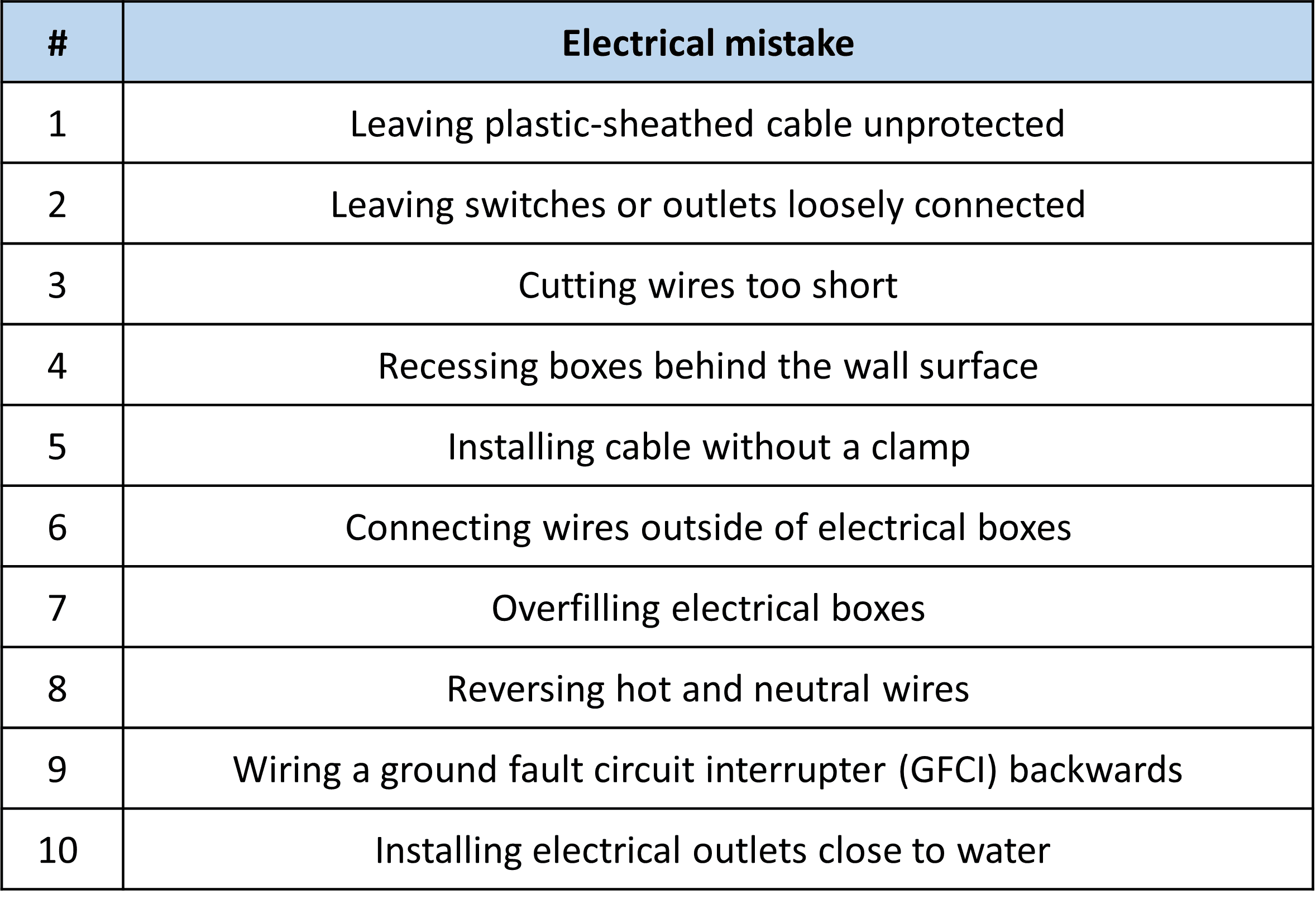
These are the 10 most common electrical mistakes seen by Edinburgh electricians:

1. Leaving switches or outlets loosely connected

2. Installing electrical outlets close to water

3. Leaving plastic-sheathed cable unprotected

4. Installing cable without a clamp

5. Reversing hot and neutral wires

6. Installing lightbulbs near flammable materials

7. Over-stacking extension cords or electrical outlets

8. Recessing boxes behind the wall surface

9. Cutting wires too short

10. Handling electrical appliances or outlets with wet hands

The most dangerous mistake is not protecting plastic-sheathed cable. John McCallister, electrical expert at MyJobQuote.co.uk, explains why this is problematic: “Leaving plastic-sheathed cables unprotected exposes them to snagging and cuts, which could lead to fires or lethal shocks. Running them through a conduit minimises this risk.” 

The 10 most dangerous electrical mistakes we make at home are: 

Second on the list is leaving switches or outlets loosely connected.  

John says: “Loose connections cause movement that can potentially disrupt the power supply or allow live wires to wiggle loose, exposing them to your fingers. This means that there’s a potential risk of electrocution or fire.”


Dominick Sandford, Managing Director at ElectricalDirect, said: “Interest in DIY has massively increased over the last few years and while this is great to see, it’s important that people stay away from certain electrical jobs that can lead to injuries. 

“That’s why we consulted electricians from across the country to reveal the tasks which are best left to the professionals.” 

For more expert comments about why these 10 electrical mistakes are dangerous, visit: https://www.electricaldirect.co.uk/blog/10-dangerous-electrical-diy-mistakes

SkillsPLUMB: Scotland’s apprentice plumbers display their expertise

Following a two-year Covid gap, Scotland’s top plumbing apprentices have finally had the opportunity of demonstrating their expertise at the much-anticipated SkillsPLUMB competition held at Glasgow Clyde College last month.

Organised by SNIPEF, Scotland and Northern Ireland’s plumbing and heating industry’s trade association, the SkillPLUMB competition, which enables talented apprentices to showcase their skills and knowledge of best plumbing practice, is designed to promote standards and skills across the plumbing industry by developing competence into excellence.

Under close inspection by industry experts, competing apprentices tested their expertise on a series of challenging practical tests and were assessed on their individual knowledge, practical skills and employability attributes against set criteria in a competitively timed environment.

The action-packed day saw a total of 24 apprentices from colleges and training centres across Scotland competing for the top prizes in the lead and copper competitions. The winners were as follows:

LEAD Winners

  • First: Gregor McNee of Dundee & Angus College who is employed by Tayside Boiler Services.
  • Second: Ryan McCrone of Glasgow Clyde College who works for Cruden Building (Scotland) Ltd.
  • Third: Ben Mitchell of West College Scotland (Paisley) who is employed by James Frew.

COPPER Winners

  • First: Sean Esslemont of Moray College who is employed by McDonald & Munro Ltd.
  • Second: Kayne Forsyth of North East College Scotland who works for Camwater Ltd.
  • Third: Jack Forbes of Edinburgh College who is employed by A Alexander & Son (Electrical) Ltd.

The competition gave participants three hours to complete practical exercises in copper pipework or lead work before their work was to be critiqued assessed and marked by a panel of technical experts.

As the Scotland regional heat for SkillPLUMB, the highest-scoring competitors in the copper competition may go onto represent Scotland in the WorldSkillsUK 2022 National Finals which will take place this November in Middlesbrough.

The judges of the lead competition were Alan Marshall, Associated Lead Mills, Robin Hall, SNIPEF Past President and George Todd, SNIPEF Technical Advisor.

The judges of the copper competition were John Docherty, SNIPEF Junior Vice-President, Paul Dodds MBE, UK Skills, Mally Butters, British Plumbing Employers Council (BPEC) and Martyn Raine, SNIPEF Technical Manager.

Jamie Hepburn MSP, Minister for Higher Education and Further Education, Youth Employment and Training, attended the event as the SkillPLUMB competition’s guest of honour.

Stephanie Lowe, Acting Chief Executive Officer of SNIPEF, said: “This great event would not be possible without the support of our partners, funders and sponsors to whom we wish to say a huge thank you, not least to Associated Lead Mills for supplying the lead and Mueller Europe for supplying the copper.”

Edinburgh College selected to host major national skills competitions

Edinburgh College has been confirmed as one of six venues across the UK, and the only Scottish college, to host WorldSkills UK 2022 National Competition Finals in November.

WorldSkills UK sees the country’s top students and apprentices compete in a wide range of competitions for medals and a potential place at a global WorldSkills finals event in France in 2024.

Designed by industry experts, WorldSkills UK competitions help young people grow personally and professionally by developing their technical and employability skills, as well as shining a light on the skills potential across the UK.

The finals are the culmination of a seven-month process including regional heats and intensive training.

The College is hosting eleven finals at its Granton Campus, including Forthside building, during the week commencing Monday 14 November.

Students and apprentices will descend on Scotland’s capital to participate in the following finals: Bricklaying, Carpentry, Foundation Skills: Woodworking, Furniture and Cabinet Making, Joinery, Painting and Decorating, Plastering, Plastering and Drywall Systems, Roofing and Tiling, Stonemasonry, Wall and Floor Tiling.

The week culminates with a live medal ceremony broadcast presented by Steph McGovern who will reveal who winners are from her Packed Lunch studio on Friday 25 November.

Young people across the region will be able to attend competitions and experience the spectacle of the finals at Granton Campus, and drop-in to events showcasing what the college offers as well as gain careers advice and the opportunity to talk to employers and industry experts.

People who cannot attend local events will get the chance to follow things online through a special broadcast featuring live finals action, as well as interviews and advice from previous winners, experts and career advisors.

Other venues across the UK hosting finals are as follows: Barking and Dagenham, Belfast Metropolitan, Blackpool and the Fylde, Cardiff and Vale, and Middlesbrough colleges.

Edinburgh College Principal Audrey Cumberford said: “We’re thrilled to have been selected as one of six venues to host finals of WorldSkills UK. We’re looking forward to welcoming students, apprentices, visitors and other stakeholders to our Granton Campus in November.

“Skills competitions like WorldSkills UK are enormous spectacles and provide a platform for skilled students to thrive, and for other young people and those perhaps looking to change jobs to learn more about careers which these highly-skilled disciplines provide. WorldSkills sets the bar extremely high with globally recognised standards and businesses increasingly looking to employ students reaching the heights the standards set. 

“More than that, in the context of plugging future skills gaps and the requirement for more skilled workers to be produced to meet national targets across a range of issues including house-building, sustainability, digital infrastructure, to name a few – it is vital that we continue to highlight skills training with events like these.”

WorldSkills UK Deputy CEO Ben Blackledge said: “We are really excited to be taking the show on the road with finals hosted by colleges across the UK. We hope witnessing the drama of the finals live will inspire young people to keep developing their technical and employability skills.

“With 62 finals spread over six venues there should be something for everyone, but we will also be providing loads of online content for people who are unable to get to one of the host venues that week.

“We are looking forward to producing our special broadcast with live action and top tips from industry experts and careers advisors. We are also delighted to confirm that Steph McGovern will be doing the duties on awards night and revealing the winners live from her Packed Lunch studio.

“With skills at the heart of UK government plans to level up and rebuild the economy, we are delighted to be playing our part and giving more young people the opportunity to explore the many opportunities and careers that high-quality skills offer.”

Sparking an interest in electrical apprenticeships

Scotland’s electrical training body has saluted an “excellent” start to the academic year after the number of electrical apprentices and adult trainees beginning their studies reached a 12-year high.

More than 800 new learners have enrolled on the Electrical Apprenticeship and Adult Trainee Programmes for 2021, with colleges and training centres reporting full classrooms as future professionals take their first steps on the electrical ladder.

The intake is the highest in Scotland since 2009 – and the Scottish Electrical Charitable Training Trust (SECTT) says it’s another encouraging sign of the determination to tackle the UK-wide skills shortage .

Barrie McKay, Training and Development Manager at SECTTwhich manages high-quality training on behalf of the Scottish Joint Industry Board (SJIB), said: “I’ve been at SECTT for more than 20 years and it’s really encouraging to see a return to such high numbers.

“The figures are particularly satisfying  given the position the industry was in this time last year, when only 500 people began training due to the impact of COVID-19.

“This improved intake illustrates that people recognise that the future is electric and also understand that their personal prospects will be brighter if they’re part of a sector that is going to play a key part in all our lives.”

A total of 2,158 electrical apprentices and adult trainees are currently training in Scotland, including the 715 apprentices and 126 adult trainees recruited for the 2021 intake.

Barrie added: “Not only are the numbers looking good, but the quality of the young people being taken on – both male and female – is really impressive.

“The industry has been concerned for some time about skills shortages as the demand for qualified electricians accelerates, and the enthusiasm and dedication of these new recruits goes a long way to easing these fears and suggesting that there is an appetite to learn among the electrical talent of tomorrow.

“As colleges continue to recover from the challenges of COVID-19, they will now help their students embrace all the modern technologies which will play such a huge part in a greener and more sustainable future.”

SECTT and the SJIB praised employers for taking on apprentices in numbers earlier this year, confounding fears that recruitment could be a casualty of the ongoing effects of the COVID-19 pandemic.

Both bodies also pointed towards the altered perception of employment in the sector, thanks to the long-running campaign for regulation of the electrical industry spearheaded by SELECT, Scotland’s largest construction trade association.

Fiona Harper, Director of Employment & Skills at SELECT and The Secretary of the SJIB, said: “The industry as a whole is committed to the next generation of talent coming through, and employers are clearly supportive of creating a pool of highly-trained, highly-qualified personnel to take their business and the sector forward.”

Local MSP supports SELECT campaign

Almost one third of Scotland’s MSPs have now given their support to SELECT’s campaign for regulating the profession of electrician after two more politicians added their names to the electrical trade body’s Wall of Support.

Local MSP Lib-Dem MSP Alex Cole-Hamilton (above) and SNP MP Alan Brown this week became the latest politicians to feature on the online wall, which shows the many individuals and organisations supporting SELECT’s crusade for Protection of Title.

Mr Cole-Hamilton, MSP for Edinburgh Western, said: “I agree that poor quality electrical work carries huge risks to people’s homes, their businesses and even their lives.  It is vitally important that consumers are helped to make informed choices when they employ an electrician.”

41 out of 129 MSPs now back the association’s call for legislation which would make it an offence for someone to call themselves an electrician when they have no, or inadequate, qualifications. 

Mr Brown, Westminster MP for Kilmarnock and Loudoun said: “I am delighted to support SELECT’s campaign to regulate the electrical industry. It is a massive step in the right direction which protects my constituents and businesses within my constituency when using electricians.

“As an engineer I appreciate the protection of professional qualifications. It will ensure constituents and businesses get exactly what the pay for when hiring an electrician to carry out and keep themselves safe from faulty work.

“Far too much public cash is being spent on repairing faulty electrical work, I believe the regulation of the electric industry will reduce this significantly – that is why I am happy to work cross-party with other members and support SELECT’s campaign.”

SELECT Managing Director Alan Wilson, said: “We are grateful for all the support we have received, across parties, from our politicians and, despite the difficulties all sectors of the economy are currently facing, we remain firm in our belief that our ongoing campaign to make electrician a regulated profession will ultimately succeed.

“Once we are through the worst of this pandemic, the need for properly qualified electricians will be more important than ever to help Scotland rebuild and recover safely.”

Other bodies that have contributed a brick to SELECT’s Wall of Support include the Scottish Joint Industry Board (SJIB), Unite the Union, Electrical Safety First, The Royal Institution of Chartered Surveyors, the Scottish Association of Landlords, the Specialist Engineering Contractors’ Group and the Energy Saving Trust.

The issue is now progressing through the Scottish Parliament and, before the COVID-19 pandemic, a Member’s Bill was being prepared for discussion later this year.

The Scottish Government has also pledged to publish a consultation on the regulation of electricians as part of its 2019-20 Programme for Government, which was released in September 2019.