ROYAL COLLEGE of EMERGENCY MEDICINE RELEASES NEW REPORT
Without a sustained political focus on reducing extreme long waits in Scotland’s Emergency Departments, it could take more than 200 years to reduce the number of people enduring these waits down to levels seen in 2016.
That’s the warning from the Royal College of Emergency Medicine following new analysis published today (24 March).
Last year, more than 75,077 people waited 12 hours or more to be admitted, discharged or transferred from major EDs in Scotland.
While this number is an ever so slight improvement from 2024 (76,510), at the current rate (a reduction of 1.8% a year) it would take 237 years to reduce these extreme long waits to their 2016 levels (1,005).
These statistics and latest analysis are contained in RCEM’s ‘State of Emergency Medicine in Scotland’ report, published today. It sets out what patients and staff faced in Emergency Departments across the country last year, including the very real impact long waits are having on patients.
Further analysis for the previous year (2025) reveals of those patients who waited 12 hours or more, 58,870 were waiting to be admitted to a hospital ward for further care.
Using the Standard Mortality Ratio – a method which calculates that there will be one additional (excess) death for every 72 patients that spend eight–12-hours in ED prior to their admission – RCEM conservatively estimates that there were 818 associated excess deaths related with long waiting times in 2025.
That’s the lives of 16 people lost every week. And remains unchanged from the previous year.
Dr Jayne McLaren, RCEM’s Vice Chair in Scotland, said: “It’s deeply concerning, and put bluntly, a national disgrace, that over the course of a year, there has been no meaningful improvement in the number of patients waiting 12 hours or more in Emergency Departments across the country.
“A small reduction of just over 1,400 patients waiting this long in the space of a year is nothing to celebrate. Because look at the sheer scale who still waited this long – 75,077. These are people not just numbers. And more often than not, they would’ve experienced this extreme wait on a trolley in a corridor, or another inappropriate space that was never designed to deliver care in.
“But what’s most upsetting, as an Emergency Medicine consultant, whose whole profession is to help people in their time of need, is seeing how many people died because of the system not working as it should.
“Ultimately, because there wasn’t an inpatient bed for them when they needed to be moved to a ward.
“People are losing their lives. And today’s figures suggest that the same number of people died in association with long waits as in 2024.
“This is a conservative estimate too. We know there may well be many more tragic deaths linked to long stays because this methodology only applies to one group of patients.
“That needs to spark anger and upset from those in power to bring about the changes that are desperately needed in our hospital system.
“Our State of Emergency Care report should serve as essential reading for ministers, NHS leaders and policymakers. It sets out clear, practical recommendations to make our emergency care system something that we can be proud of once again.
“Patients, and those working within our Emergency Departments deserve so much better – a service that is safe, timely, and fit for purpose.”
Responding to analysis from the Scottish Liberal Democrats, which suggested that there were 871 deaths in Emergency Departments (EDs) associated with a 12 or more hour wait for admission, Dr Fiona Hunter, Royal College of Emergency Medicine Vice President for Scotland, said: “These harrowing figures show that something must change in the approach to fixing the crisis in our EDs.
“Heartbreaking doesn’t cover it. Each of these 871 people may have had families and friends who would have had to face the devastating reality that their loved one died not because they were too sick to treat, but because our hospitals don’t have the capacity to look after them properly.
“Patients enduring these long waits are often the sickest or most injured, in need of further care on a ward. But a lack of beds, driven in large part by delayed discharges, meant they had to wait in A&E – and this can go on for hours and hours.
“Almost 900 people may have paid the ultimate price for this complete breakdown in hospital flow.
“Last year, RCEM published figures for 2024, which suggested there were 818 excess deaths associated with 12 hour waits in EDs. Today’s figures suggest that the problem is getting worse, not better.
“Whoever forms the next government cannot ignore this problem. The numbers speak for themselves: more people will die, who otherwise would go home to their families, if overcrowding and long waits in ED aren’t fixed.
“Addressing the ‘back door’ blockage of hospitals must be a priority for all political parties. Only then will the needless and agonising waits, and the avoidable deaths they cause, stop.
“These are fixable issues and we encourage all political parties to make this a priority. Lives are at stake.”
NHS Scotland spent £440m last year on beds for patients who were unable to get out of hospital despite being ready to be discharged, according to a new report by Scotland’s public spending watchdogs.
The report from the Audit Scotland and the Accounts Commission said one in nine hospital beds were occupied because of delayed discharges in the 12 months to April 2025.
It said the Scottish government must set out a plan to tackle the problem.
Delays in discharging patients from hospital affect people’s physical and mental health, and make it harder to admit others to hospital. Delayed discharges are a symptom of wider pressures across health and social care in Scotland.
The joint report by the Auditor General for Scotland and the Accounts Commission warns this has a significant effect, despite impacting only around three per cent of hospital patients. People medically ready to leave spent 720,000 unnecessary days in hospital in 2024/25. Whilst the full financial impact is unknown, the cost to the NHS in hospital days alone is an estimated £440 million a year.
The causes are complex, including rising demand for health and social care services, financial pressures, long-standing recruitment and retention problems across Scotland and for some, not having a Power of Attorney in place.
Reducing delayed discharges is a priority for the Scottish Government and their partners in health and social care, with significant activity underway to tackle this. But a lack of evaluation of initiatives across the country means it is difficult to measure what is having the greatest impact and whether these initiatives represent value for the money and time spent.
Stephen Boyle, Auditor General for Scotland, said: “Delayed discharges from hospital have far-reaching impacts on people’s health and well-being. The Scottish Government, health bodies, councils and other partner organisations agree on the need for major changes and are actively trying to reduce delayed discharges.
“Now they must improve how they collect, analyse and use data to evaluate the initiatives underway to tackle the problem. Without this, it’s impossible to understand the impacts and costs of delayed discharges and whether the initiatives across Scotland are improving lives, services and delivering value for money.”
Malcolm Bell, Member of the Accounts Commission said: “Significant change is critical across our health and social care services, shifting towards preventative care, greater use of technology and ongoing investment in the workforce. Without this, the care and support individuals need to leave hospital won’t always be available.
“The Scottish Government and COSLA’s joint health and social care service renewal framework is an opportunity for progress to be made with health and social care reform. But IJBs and social care need to be at the centre of planning and decision-making on service renewal, and it’s not clear how the framework will address the challenges faced by social care.”
‘The current approach has failed’
In response to the joint report into delayed discharges by the Auditor General for Scotland and Accounts Commission, Dr Fiona Hunter, RCEM Vice President for Scotland, said: “This report lays bare the scale of delayed discharge, and the impact it has on our health and social care system and the people it serves.
“720,000 days’ worth of unnecessary hospital stays in the 2024/25 financial year. That’s almost 2,000 years – an almost inconceivable amount of wasted resources which, if exit block had been addressed, could be used to help the patients lining the corridors of Emergency Departments day in, day out.
“The knock-on effect delayed discharge has on EDs cannot be overstated.
“Every hospital bed occupied by someone who does not need it, but cannot leave through no fault of their own, adds pressure to EDs which are receiving more patients than they can move on.
“And these unnecessary stays in a hospital bed puts patients at greater risk of hospital-born infection, and can lead to deconditioning, stripping them of their independence.
“This is something RCEM has been raising the alarm about for years now, and while the government has acknowledged the issue and taken some steps to address it – the total breakdown in hospital flow outlined in this report shows that the current approach has failed.
“Things cannot go on like this and I hope the government, health service and local authorities heed the recommendations set out by the Auditor General for Scotland.
“Improvements to data gathering and discharge planning, among the other recommendations, would be a step towards the system-wide approach we have long said is needed to fix Emergency Care.”
RCEM said earlier this week that The Scottish government must prioritise tackling delayed discharges and overcrowding in Emergency Departments (EDs) or risk the entire system collapsing under the strain of an incredibly difficult winter.
Th message from the Royal College of Emergency Medicine (RCEM), followed the release of ED performance figures on Tuesday (6 January) by Public Health Scotland (PHS) for November 2025.
One in 15 patients (8,065) waited 12 or more hours in a type-1 ED before being admitted, transferred or discharged in that month alone, the worst figures for a November since records began in 2007.
Further, the new data found that:
It was the worst November on record for eight-hour waits, which stood at 17,259, or 14.5% of patients attending a major ED
Only 63% of patients seen within four hours at type-1 EDs, a far cry from the government target of 95%
Compared to November 2018, waits of four or more hours were four times higher, eight-hour waits were 14 times higher, and 12-hour waits were 39 times higher
Meanwhile, the number of people attending ED was only 5.5% higher in November 2025 compared to November 2018
Dr Fiona Hunter, RCEM Vice President for Scotland, said: “This is yet another month of predictable broken records for Emergency Medicine performance in Scotland.
“The Scottish government continues to shout about improvements to NHS waiting lists. We, of course, welcome these but a lack of political will to put the same emphasis on addressing delayed discharges means our departments are at risk of total derailment.
“We are now in the depths of winter. Patients are arriving into EDs only to find that there isn’t the space to treat them safely, let alone quickly.
“Very sick and injured people are lining corridors, crammed into whatever space we can find, because of exit block and a complete breakdown in flow out of hospitals.
“With warnings of storms, snow and freezing temperatures, the situation is likely to get a lot worse before it gets better.
“It’s unacceptable that this has been allowed to happen, but it’s not too late to act. We call on the government to support health boards so they can make the improvements needed to tackle delayed discharges and improve patient flow.”
12-hour waits in EDs joint worst on record for October
The Scottish government must take urgent action on overcrowding and delayed discharges, or Emergency Departments (EDs) in Scotland will be completely swamped – and patients will be the ones who suffer.
ED performance figures, released today (2 December 2025) by Public Health Scotland (PHS) for October 2025, showed that one in 16 (7,362) patients waited 12 or more hours before being admitted, transferred or discharged in that month.
That is the same proportion as last October, which was the worst since records began in 2007 for 12-hour waits.
The figures also showed:
16,659 patients, or 14.1% of all attendances, waited eight or more hours, the worst of any October on record, and an increase of 1,211 on last year
Only 62.8% of patients were seen within four hours at major (Type-1) Emergency Departments, which is the worst four-hour performance for any October since records began and far below the target of 95%
There was an average of 1,981 beds each day occupied by patients medically fit to be discharged
These figures come shortly after the publication of the Scottish government’s winter plan, in which it pledged £20m to tackle delayed discharges across the devolved nation.
Dr Fiona Hunter, RCEM Vice President for Scotland, said: “The figures for October demonstrate the unacceptable pressures our departments are under, and just how bad things are as we go into winter.
“Now, seasonal pressures such as flu are beginning to hit EDs and the system is starting to crack under pressure,which means patients and staff are suffering. And we are only in the early stages of winter so it will likely become even worse for patients if nothing changes.
“As our hospitals deal with the inevitable strains and stresses on vital resources that the colder weather brings we’ll once again see the consequences of the failure to properly tackle the issues EDs face; overcrowding, long delays and avoidable deaths.
“The number of patients experiencing the longest waits is utterly unacceptable and something must change. Clinicians, through no fault of their own, are struggling to provide our patients with the care they deserve and need.
“Last month, we welcomed the government’s £20 million funding announcement to boost social care capacity this winter, and its accompanying plan for the health service to tackle the cold months.
“This showed that the government understood the issue. But we need that understanding to translate into further meaningful short and long-term action. Urgent action is needed to ensure that health boards can make the improvements that are needed to improve patient flow and tackle delayed discharges.
“Our EDs will only get through the coldest months if the government steps in – or we all need to brace ourselves for a truly ugly winter.”
Health Secretary urges those eligible to get flu vaccine
Health Secretary Neil Gray has updated parliament on winter preparations for the NHS, urging people to take up the flu vaccine and confirming up to £20 million to bolster social care capacity.
The £20 million investment will be targeted at initiatives by health boards to increase social care capacity and provide extra support at the front door of A&Es, which will reduce admissions and relieve pressure on acute services.
Mr Gray also warned of the potential impact of the flu virus this winter, with emerging evidence suggesting an early and potentially difficult flu season. He urged everyone eligible to get their vaccination, particularly children and young people who can transmit the virus to vulnerable family members and friends.
To help deal with increased winter pressures, the Scottish Ambulance Service (SAS) will recruit more than 290 new frontline A&E staff this year, including newly qualified paramedics and ambulance care assistants.
To ensure callers are dealt with more efficiently this winter, NHS 24 has also implemented a new call centre system backed by £5 million of investment. Over 90% of callers triaged by NHS 24 as needing an ambulance response now have their call information transferred and referred digitally – this removes repetitive stages of the call process and significantly speeds up the process for patients.
The Health Secretary has also directed health boards to undertake a new approach, working together to plan digital care and business systems, and make best use of available capacity for orthopaedic elective services – ensuring patients receive the care they need as soon as possible.
Health Secretary Neil Gray said: “We know pressure on the system exacerbates over winter and I am determined to ensure that pressure is relieved as much as possible. We have been preparing plans for this winter season throughout the past year with NHS boards and local authorities.
“Our investment of £20 million will be crucial in our efforts to bolster social care capacity, reduce unnecessary hospital admissions and ensure people receive the right care in the most appropriate setting.
“A key part of our winter response is prevention and our national flu vaccination programme is well underway. Vaccination is one of the best ways to protect our own health and those around us – with flu cases rising and initial evidence suggesting this may be an early and potentially difficult flu season, I urge all those who are eligible to get vaccinated.
“We have significantly increased Scottish Ambulance Service staffing and we are investing in capacity in our NHS 24 call centres so that people are getting the right support quickly and when they need it.
“Our dedicated health and social care staff are the cornerstone of our winter response every year – they will continue to work tirelessly in the coming months to provide excellent care, and I thank them for their outstanding efforts.”
The funding of £20 million comes from the 2025-26 health and social care budget to deliver improvements in urgent and unscheduled care and patient flow, linked to the Operational Improvement Plan.
Winter planning is undertaken collaboratively between health boards and local authorities and the Scottish Government has worked with the NHS and COSLA to ensure local plans are underpinned by consistent national principles.
“Even though this funding is not for care happening inside the walls of Emergency Departments, bolstering social care capacity is one of the best ways to make sure people can leave hospital when they are deemed medically well enough to do so.
“Last winter, from November to February, there were 1,991 patients stuck in hospital each day, despite being well enough to leave. That was a record. We can’t let a new record be set this year.
“We need these beds. Patients are spending extreme hours in our departments waiting for that elusive ward bed to become available, often in a corridor, on a trolley or another inappropriate space.
“However, this burst of funding could be too little, too late, to make a meaningful difference this winter. We are already in November and on the cusp of what will be gruelling months ahead for both our workforce, and our patients.
“Further winter plans announced place too much emphasis on attendance avoidance – diverting people away from ED. While this is of course welcome, the crisis in which our EDs find themselves has not been caused by an increase in demand.
“The number of people attending our departments this summer was lower than it was in 2019, yet 20 times as many people this year waited 12 or more hours to be admitted, discharged or transferred.
“And we know this is where the harm lies for our patients in ED.
“The announcement is a good start at a time when the health service is about to enter what will be yet another very challenging winter. But the crisis in our Emergency Departments is taking a heavy toll on our members, and their colleagues.
“We need continued support and action from the government to address these deep-rooted long-term problems that are no longer confined to winter.”
Emergency Departments record worst-ever September performance
Accident and Emergency
As Scotland’s Emergency Departments experienced the worst September on record for performance, the Royal College of Emergency Medicine has asked the government: ‘where is the tangible plan for winter?’
The figures, released yesterday (4 November 2025) by Public Health Scotland, come as Health Secretary, Neil Gray, is reported to have said waiting times in A&E are ‘below the levels we all wish to see’.
The PHS data, for the month of September, reveals 6,427 patients waited 12 hours or longer in an Emergency Department before being admitted, discharged, or transferred.
That’s around one in every 19 people and the highest number who experienced this wait for the month of September since records began in 2007.
The data, for major EDs in Scotland, also showed that in September 2025:
12-hour waits were almost 34 times worse than in September 2018 – that’s despite the number of people attending EDs only increasing by 4.5% in the same period
One in eight people (15,348) waited eight hours or more to be discharged or transferred – the worst September on record
63.7% of patients were seen within four hours – again, the worst September on record and is far below the government’s target of 95%
There was an average of 1,955 beds occupied by people healthy enough to be discharged – a decrease of only nine compared to the previous month
The new data comes shortly after RCEM published its political manifesto for Scotland, urging all political parties to end overcrowding in EDs, and provide enough Emergency Medicine staff to deliver safe and sustainable care, along with adequate resources to ensure equitable care throughout the emergency care system.
Meanwhile, recently published analysis from the College revealed there were more than 800 deaths associated with long A&E waits before admission last year.
Dr Fiona Hunter, RCEM Vice President for Scotland, said: “These figures prove what I and many other EM clinicians already know – that we are in crisis and the depths of winter, when the inevitable seasonal pressure hits, is yet to arrive.
“Our members and their Emergency Medicine colleagues tell me about the relentless pressure their hospitals are under and the impact this has on patient care – people are being treated in ambulances, in corridors, and other inappropriate spaces.
“Our EDs don’t have elastic walls. These are visual signs our hospitals are full to bursting– we can’t move patients from our departments into wards because of a lack of available inpatient beds.
“On top of dealing with system pressures, our clinicians are facing violence and aggression from those we are trying our best to care for – that can be caused by frustration over long waits. It’s beyond unacceptable.
“We know that Scottish Health Secretary understands the scale of the issue, and just today acknowledged that ‘ED performance is below where it should be’.
“But we are yet to see any tangible plan from the government about how it intends to tackle the season ahead – which will be nothing short of challenging.”
51,400 older people endured dangerous 12 hour waits in Scotland’s A&Es last year
Extreme long waits in Emergency Departments across Scotland are a political responsibility that can no longer be ignored as more than 51,400 older patients endured stays of 12 hours or more last year – the worst on record.
New analysis from the Royal College of Emergency (RCEM) reveals in major EDs, one in every eight patients (51,423) aged 60 or over waited more than 12 hours to be transferred, admitted or discharged in 2024.
That’s 14,407 more patients than the year before (2023).
And is over 16 times more people than in 2019 when just 3,135 older people endured waits of this length.
The figures, obtained by RCEM via Freedom of Information requests to Public Health Scotland, also reveal that, concerningly, the older a patient is the longer they are likely to wait in A&E.
People aged 70-79 have a 12% chance of waiting 12 hours or more – almost 16 times higher than it was in 2019.
Meanwhile, people aged 80-89 have a 16% chance of enduring extreme waits, and the likelihood rises to 19% for those aged 90 and above.
Compare that to patients aged 18-29, whose average likelihood of experiencing a 12-hour wait last year was just 2.2%.
Older patients often arrive to the Emergency Department with more complicated or multiple health issues.
This, when combined with the inability to admit them onto a ward due to the lack of available in-patient beds, means older people can become stuck in Emergency Departments – enduring extreme long waits, often on trolleys in corridors.
And when patients do finally get admitted, they often find themselves stranded in hospital, unable to go home when they are well enough to leave, frequently due to a lack of available social care support.
Public Health Scotland recently revealed that in 2024/25, there was a record 720,119 days spent in hospital by patients whose discharge was delayed – 474,153 of which were experienced by people aged 75 or over. This accounted for two out of every three (66%) delayed discharge bed days.
Dr Fiona Hunter, Vice President of RCEM Scotland, said, “This data is both shocking and shameful, and it is abundantly clear that older people are bearing the brunt of a system in crisis.
“Hundreds of thousands of dearly loved people – great-grandparents, grandmas, grandads, parents – forced to experience extreme long stays in our Emergency Departments every year mainly because we don’t have enough in-patient beds to admit them to when they need one.
“Often enduring these waits on trolleys in areas that aren’t designed to deliver care in – corridors or even cupboards.
“It’s a failure of the system. It’s unacceptable, it’s dangerous and it’s putting lives at risk.
“Enough is enough. The government can’t ignore the ongoing crisis our Emergency Departments – the workforce and patients – continue to face day in, day out.
“We all deserve an Urgent and Emergency Care system that works as it should and not letting people, our most vulnerable, down when they need it most.”
Dr Bob Caslake, Chair of the BGS Scotland Council, said, “This report highlights the urgent attention that is needed across the health and social care system to allow older people to access the care they need at the time they need it.
“The current waiting times faced by older people in Emergency Departments are unacceptable, and reducing these delays is a matter of equity, dignity, and patient safety.”
Professor Andrew Elder, President of the Royal College of Physicians of Edinburgh said, “It is disappointing that this information is not routinely collected, analysed and published and it is unacceptable to see so many older people waiting hours — sometimes days — in A&E wards for the care they need.
“These older people are often living with frailty, dementia, and multiple other health conditions. They deserve to be treated with dignity and compassion.
“Long waits for care are neither dignified nor compassionate and can also lead to serious harm. This is not the standard of care we should accept for our parents, grandparents, or neighbours.
“With the numbers of older people in Scotland in need of care expected to increase dramatically, we urgently need a system that prioritises timely treatment and supports frontline staff in delivering the respect and care our older population deserves.”
The figures come after the Royal College of Emergency Medicine published a report earlier this year looking at the care older people, aged 75 and over, receive in Emergency Departments across the UK.
Titled ‘Care of Older People 2023-24’, the research found there was insufficient screening for three common conditions which primarily affect this age group, including delirium and for general frailty.
The Royal College of Emergency Medicine has asked ‘where are the tangible plans for Emergency Care?’ after Scotland’s A&Es experienced the worst February on record for performance.
The figures, released yesterday (1 April 2025) by Public Health Scotland comes just a day after the Scottish government revealed its ‘operational improvement plan’ which RCEM says ‘missed the mark’ in tackling extreme and dangerous long stays in A&Es.
The new PHS data shows that in A&Es in Scotland in February, 6,072 patients waited 12 hours or longer before being admitted, discharged or transferred.
They also reveal just how much long waits have increased since the 2010s.
Since February 2018, for example, the number of people waiting four hours or more in major EDs has increased by 3.4 times (10,979 to 37,274) eight hours or more by 13 times (1,023 to 13,638) and 12 hours or more by almost 35 times (174 to 6,072).
Patients are often experiencing these extreme long stays on trolleys in corridors due to the lack of available in-patient beds.
People in these beds are often stuck in hospital, despite being well enough to be discharged, because there is no appropriate social care support.
So called ‘delayed discharges’ meant there was an average of 1,986 patients in hospital each day, waiting to be discharged, even though they are well enough to leave. This is the highest number for the month of February since 2016, when guidelines changes.
Responding to the data, Dr Fiona Hunter, Vice President of RCEM Scotland said: “Scotland’s Health Secretary has said he is ‘encouraged’ by a weekly improvement to the four-hour target for admission, treatment or discharge – but our members and their colleagues certainly don’t feel encouraged when you look at the bigger picture.
“Across the board – four, eight and 12 hour waits – were the worst on record for the month of February.
“This should sound alarm bells to politicians and galvanise them to act before A&Es delve into an even deeper crisis.
“This data comes hot on the heels of the government’s NHS improvement plan, which did little to reassure burnout Emergency Medicine clinicians that they won’t be treating patients, who have endured a stay on trolley in a corridor for 12 hours or more, in the weeks, months and years to come.
“It was a golden opportunity, and it missed the mark.
“It’s left us asking, where are the tangible plans for Emergency Care?
“Time is ticking for the government to act and #ResuscitateEmergencyCare.”
RCEM responds to new ONS research into deaths linked to long A&E stays
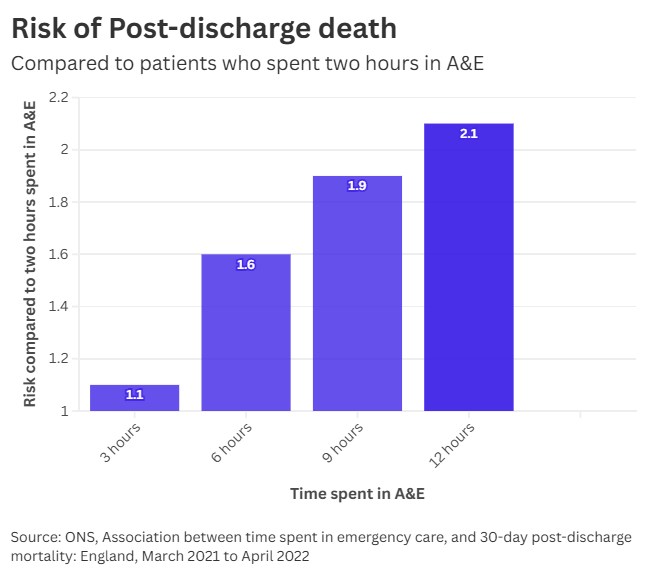
Comprehensive new statistical analysis of the link between long stays in A&E and the associated risk of dying, confirms the huge threat to life the issue creates – and must be a catalyst for political action.
That’s the call from the Royal College of Emergency Medicine following the release of a defining new study by the Office for National Statistics – the UK’s official statistical authority – which was published yesterday (17 January 2025).
The research examined the cohort of people who required non-immediate care and were treated, admitted or discharged alive from an A&E in England between 21 March 2021 and 30 April 2022.
It concludes that patients who wait in A&E for more than two hours are exposed to an increasing risk of death.
And by the time a patient reaches a stay of more than 12 hours in an Emergency Department, they are twice as likely to die within 30 days as those treated, admitted or discharged within two hours.
This is even after accounting for differences in case mix and other important factors such as age.
Although using different methodology, and looking at different patient groups, the ONS data supports the conclusion of the Jones and Moulton Study from 2023.
Dr Adrian Boyle, President of the Royal College of Emergency Medicine, said: “This is a seminal piece of work by the ONS, the authoritative national voice of data, which validates and reinforces what we know; long waits in the ED are extremely dangerous and a significant threat to patient safety. We thank the ONS team for their hard work and diligence.
“Hundreds of deaths each week are associated with long waits in A&E – each one someone’s loved one – mums, dads, sisters, brothers, grandparents.
“We focus on the four-hour target for admission, treatment or discharge – but we have to acknowledge that this standard was put in place before 12, 24 and even 48 hour stays became common. Things have deteriorated significantly, and the system must accept that and respond to it.
“There must be a point where we go beyond analysis and accept that this is a serious problem that needs urgent political action.
“This data is too compelling to ignore and must be the catalyst for change.”
Emergency Departments in Scotland are struggling against the combined pressures of extreme weather and a rise in hospital admissions from flu.
The Royal College of Emergency Medicine (RCEM) has described the country’s health service as being “in the depth of a winter crisis” as Scotland braces itself against snow and ice.
Yesterday, after coming under increasing pressure regarding the condition of Emergency Care in Scotland, Health Secretary Neil Gray said A&E demands had been “exacerbated by higher than normal levels of influenza infection in the community”. Data released last week showed hospital admissions caused by flu increased by 12% in a week.
The Health Secretary’s comments come as data released yesterday by Public Health Scotland revealed last November 6,429 patients waited 12 hours or more in Emergency Departments – the highest proportion of 12 hour waits for any November since records began in 2011.
Dr Fiona Hunter, Vice Chair of RCEM Scotland said: “Today’s data, and every previous month’s data, shows just how much pressure Scottish EDs were under coming into this winter.
“The system was already under extreme pressure, and this huge flu surge and cold spell are likely to be the straw that breaks the camel’s back.
“But it cannot – and must not – be blamed as the sole cause of the crisis we are currently experiencing.
“My colleagues are working flat out in very difficult conditions with some departments nearing 400% capacity- four times as many patients as there are cubicle spaces for. We are running on hard work and goodwill, and our patients are receiving unacceptable, undignified and unsafe care in corridors and in the back of ambulances.
“The main issue is that we can’t move our patients who desperately need admission to a hospital bed in to wards or high dependency units. These wards have the highest level ever known of patients who are ready to be discharged but have no available social support to allow them to do so.
“We are predictably gridlocked, in the depth of a winter crisis, and our patients and staff are the ones suffering.”