Business confidence dips for Scottish firms in January

Bank of Scotland Business Barometer for January 2023 shows: 

  • Business confidence in Scotland fell five points during January to 10% 
  • As National Apprenticeship Week approaches 27% of businesses in Scotland say investing in training and development presents the biggest opportunity for growth in the next six months 
  • Overall UK business confidence reaches six-month high at 22% with twice as many businesses optimistic about the economy than in December   

Business confidence in Scotland fell five points during January to 10%, according to the latest Business Barometer from Bank of Scotland Commercial Banking. 

Companies in Scotland reported lower confidence in their own business prospects month-on-month, down 17 points at 8%.  When taken alongside their optimism in the economy, up six points to 12%, this gives a headline confidence reading of 10%.  

Scottish businesses identified their top target areas for growth in the next six months as evolving their product and service offer (42%), investing in sustainability (29%) and investing in their teams (27%).  
 
The Business Barometer, which surveys 1,200 businesses monthly, provides early signals about UK economic trends both regionally and nationwide. 
 
A net balance of 14% of businesses in the region expect to increase staff levels over the next year. This is up from December when a net balance of 11% of businesses reported plans to make new hires.  

Overall UK business confidence climbed in January, with firms reporting their highest confidence levels since July last year.  

Business confidence increased by five points to 22% and the net balance of businesses feeling optimistic about the economy doubled on December’s reading to 16%. 

Ahead of National Apprenticeship Week (6-12th February) 30% of businesses across the UK reported that they are looking at opportunities to grow by investing in staff development and training. A net balance of 17% of firms reported plans to create new jobs in the next twelve months. 

Chris Lawrie, area director for Scotland for Bank of Scotland Commercial Banking, said: “Ongoing pressures from wider economic challenges are clearly continuing to impact Scottish businesses, but confidence remains in positive territory and firms’ resilience shines on.  

“Over the next few months as concerns such as rising costs continue, it is important firms keep a close eye on cash flow. Having reserves ready for when challenges hit makes managing turbulent periods easier. We’ll remain by the side of Scottish firms to help them successfully navigate the months and years ahead.”    

For the second month in a row, confidence in the manufacturing and service sectors increased, with manufacturing rising to 28% (up 15 points) and services up to 25% (up seven points). 

Business confidence in construction was down two points to 27%, while retail confidence fell for the second month in a row to 7% (from 13%), the lowest level since February 2021. 

Paul Gordon, Managing Director for Relationship Management, Lloyds Bank Business & Commercial Banking, said: “After a challenging 2022, it’s heartening to see confidence rising for the second consecutive month.

“This is the first back to back increase since September 2021. There is no doubt that the business environment remains challenging and uncertainty still remains, but this improvement in optimism is very welcome as we start 2023.  

“With pay expectations tempering, trade expectations set to improve, and a clearer way forward on energy price support, this may give businesses a bit more certainty and the confidence they need to inspire investment and promote growth.” 

Hann-Ju Ho, senior economist for Lloyds Bank Commercial Banking, said:“Business confidence continues to improve following the December boost. Firms are clearly more optimistic about the wider economy and this is driving the increase, helped by precursory signs that wage and other cost pressures may be easing. 

“It is still a tough environment for businesses, with high energy bills remaining a concern during the winter months, but there are grounds for optimism for 2023 if inflation starts to trend lower.” 

Green light for Beaverhall BTR and creative workspace scheme

Developer HUB and Bridges Fund Management (“Bridges”), a specialist sustainable and impact investor, have received planning permission for a residential-led development on Beaverhall Road.

The scheme will provide 205 Build to Rent homes, including 52 affordable homes, as well as creative workspace and a new publicly accessible courtyard.

The proposal for Beaverhall Road will replace an existing warehouse with a contemporary scheme that maintains the site’s status as a focal point for the resident creative community, delivering 45% more creative workspace than provided by the current building, whilst also bringing new homes to the area. 

Designed by architects shedkm, the proposal has been developed in close collaboration with the local community and current businesses, with the ground floor creative workspace co-designed by the existing tenants, many of whom plan to move into the new development.

The focal point of the scheme will be a new public courtyard, Makers Yard, providing a space for relaxing and gathering for residents and commercial tenants, as well as neighbours. The new development will also feature a large mural by a local Edinburgh artist on one of the external walls.

In line with HUB and Bridges’ shared values, the scheme will prioritise both people and planet. The plans exceed current Scottish sustainability regulations and include a biodiverse green roof, as well as a communal air source heat pump to provide environmentally responsible heating for the entire building.

The designs maximise the potential of a brownfield city centre site and will deliver ‘tenure-blind’ homes, meaning all residents’ homes will be of the same high quality.

Situated in Canonmills, just north of Edinburgh’s New Town, the proposed development is within easy reach of the iconic city centre, while benefiting from a sense of community created by the area’s existing amenities.

Tom Valente, Development Manager at HUB, said: “We are hugely excited to be moving forward with one of our first developments in Edinburgh. It’s a fantastic city which has a long-established creative scene, and prides itself on its wealth of small, independent businesses.

“Our plans for Beaverhall will maintain the site’s status as a hive of creativity by placing studios and maker spaces at the heart of the development, alongside high quality, sustainable homes for local people.

“What we are doing here demonstrates the potential to create lively mixed-use communities on urban brownfield sites, and this is a model that we want to champion both in Edinburgh and elsewhere across the UK.”

Simon Ringer, Partner and Head of Property at Bridges, said: “For Bridges and HUB, people and planet are central to the design and planning of all our new developments.

“By building high-quality, sustainable lower-cost housing, coupled with enticing public spaces that reflect the needs of local people, we can create highly attractive developments that really deliver for the local community.

“Beaverhall will be a perfect example of this; and we’re particularly delighted that we’ve also been able to reflect the site’s heritage as a creative hub in the design. We can’t wait to see it come to life in the months ahead.”

James Spencer, Associate at shedkm, said: “We’re really excited to be working with HUB to preserve this creative heart in Edinburgh, while improving the built environment for the local community.

“We look forward to bringing our longstanding experience in regenerating areas across the UK, to create a modern, sustainable place that builds upon Edinburgh’s industrious heritage and remains a key piece of the city.”

National Planning Framework 4: New houses in Edinburgh cut by 4,500

The Scottish Government’s decision to reduce by 4,500 homes the number of houses to be developed in Edinburgh has been questioned by Sarah Boyack, Scottish Labour MSP for Lothian following the Ministerial Statement on National Planning Framework 4.

Ms. Boyack asked the Planning Minister, Tom Arthur, to explain why the number of houses to be developed in Edinburgh has been reduced by 4,500 homes at a time when the city is facing a long-standing deepening crisis.

The MSP for Lothian raised also issues around the capacity of GPs to cope with rising demand and asked about whether new GP and local health services will be included in planning application for the new housing being proposed across the Lothian given the challenges the region is already facing in terms of GP capacity in areas where significant new development is being planned.

The National Planning Framework (NPF) is a long-term plan for Scotland that sets out where development and infrastructure is needed.

Scotland’s fourth National Planning Framework (NPF4) will guide national and regional spatial development and set out priorities and national planning policies up until 2045.

Commenting, Sarah Boyack MSP said:  “A housing crisis affecting those on low or modest incomes, students and families looking for long term housing is unfolding not only in Edinburgh but across Scotland. The available properties are unaffordable or inaccessible for many and affordable, high-quality properties are almost non-existent.

“Reducing the number of new housing developments in Edinburgh will be catastrophic for people, the city and our local economy. 

“The SNP claim they want to build a new Scotland – but they are going into reverse.

“In Musselburgh, people are struggling to access vital GP services – with rising local population and housing developments, this is rapidly becoming a pattern we see across Scotland.

“Planning applications should be considering issues around GPs’ capacity – we can’t gamble with people’s lives.

“The Minister dodged my question, offering nothing more than empty rhetoric.”

  • The revised draft NPF4 is available here

Housing developer awards £5000 to local good causes

A SCOTTISH housing developer has recognised the dedication and positive impact of five good causes in the Musselburgh community, awarding each with a £1000 grant.

The Dundas community fund – which had been extended to allow more time for deserving groups in and around Musselburgh to apply – came to a close at the end of July.

Hollies Community Hub, Blue Triangle Housing Association, First Step Community Project, Changes East Lothian and DadsWork were the chosen recipients, with each playing a vital role in the local area.

The roll out of the £5000 fund came as the Livingston-based firm launched its 140-home Wireworks development in the seaside town, forming part of its pledge to deliver lasting benefits to Musselburgh, in addition to contributions of up to £400,000 towards schooling and infrastructure.

Craig Fairfoull, Head of Sales and Marketing at Dundas, said: “We were thrilled that the decision to extend the community fund resulted in four times the number of original applicants.

“It did, however, make the decision to choose just five recipients out of a strong, deserving and varied group of applicants that bit harder.

“It has been a real pleasure to learn about each of the applicants, their inspiring causes and their contributions to the local community – I’d like to thank each and every one of them for their interest in the fund and wish them every success in achieving their project’s endeavours.

“While it has been a challenging task, we are really pleased to be able to announce the five recipients of the fund and believe that their initiatives are essential in supporting the local area.”

Hollies Community Hub, an organisation which aims to help elderly people in Musselburgh retain their independence by providing them with a safe space where they can engage with and meet their friends, will be using the £1000 fund to organise fun excursions to the East Coast for its members.

Liz Shannon, Manager of Hollies Community Hub said: “The Hollies would like to thank Dundas for allowing us to take our lunch club members for a much-needed day out. 

“After nearly two years of social isolation, a trip down the coast with a fish supper and ice cream will be a day for them to remember and a chance to reminisce with their friends about past trips.”

Blue Triangle Housing Association is a supported homeless accommodation service which houses up to 14 young people at a time, helping them gain independent living skills. The community fund will help the group revamp its enclosed garden area to provide its tenants with a safe and secure communal area for socialising.

Steven Cranston, Assistant Project Manager at Blue Triangle said: “We are so thankful and grateful to Dundas for this opportunity. Our garden area can now be upgraded, which will provide our service users with a space to relax while also giving us the opportunity to teach them how to grow fruit and vegetables and how to then be self-sustainable by cooking what they grow.”

Set up by a group of local parents over 30 years ago, First Step Community Project works within the close-knit Musselburgh community supporting vulnerable families who are facing extreme financial difficulties during the current cost of living crisis.

With its funding from Dundas, the group will be issuing Winter Warmer Packs which seek to provide families with essentials such as hot water bottles, flasks and thermals, as well as useful information on how to help save on energy bills while keeping warm and healthy over the winter period.

Jennifer Mitchell, Early Years Manager of First Step Community Project, said: “From the bottom of our hearts, we would like to thank Dundas. We will now be in a position to help families and community members ahead of what’s expected to be a very tough winter.”

Changes East Lothian is a mental health and wellbeing charity which provides free support services for over 16s living, or registered with a GP, in East Lothian. The charity provides counselling, therapeutic and peer support groups, as well as a wide range of activities and volunteer opportunities. 

Marina Ramsay, Communications and Engagement Officer at Changes said: “Accessible mental health support is crucial for the happiness and wellbeing of people in communities across East Lothian and the funding will allow us to reach even more people, reassuring them that help is within reach and they don’t have to face challenges alone. We are incredibly grateful.”

DadsWork, a charity that delivers much needed support and services to men, fathers and male carers, will be using the fund towards its four-week programme for new expectant dads which aims to increase their confidence as they prepare for fatherhood.

Kevin Young, Project Manager of DadsWork said: “As a charity, we are delighted to be awarded £1000 from Dundas. As we know, emotional, practical and physical support for men is vitally important and this support should be readily accessible and offered locally. DadsWork and its beneficiaries thank Dundas for their donation and the benefits it will bring.”

Dundas has a mission to create homes that make people feel great. Headquartered in Livingston and proudly Scottish, it has a track record of building well-designed homes that are higher spec than a vast majority of competitor properties.

The independently-owned developer is focused on building welcoming, integrated communities and making the journey of buying a home more straightforward, inspiring and fun.

Through a partnership with Tesco, East Lothian Council and NHS Lothian, Dundas acquired The Wireworks site after receiving planning permission to regenerate the former Brunton Wireworks site and neighbouring land in 2008.

The development will have the capacity to store 140 bicycles in internal and external bikes stores. Electric car charging facilities will be available throughout the development. Private gardens and balconies will also be available at various apartments.

To learn more about The Wireworks visit: 

https://www.dundas.co.uk/developments/the-wireworks, call 0131 243 3858 or email: thewireworks@rettie.co.uk

Green light for 142 homes at Silverlea

Proposals for another ‘net zero’ housing development, as part of the City of Edinburgh Council’s £1.3bn Granton Waterfront regeneration project, have been granted approval by city planners.

This major milestone follows the start of construction work at the £72m, 444-home ‘Western Villages’ project, which is also part of the local authority’s wider regeneration of the area. Over the next ten years 3,500 mixed-tenure homes and associated infrastructure will create a new, sustainable coastal community.

Hart Builders will start work on site in 2023 at Silverlea to deliver 142 high quality sustainable homes, including wheelchair-accessible ground-floor dwellings in a mix of social rent (91) and mid-market rent (51) each benefitting from coastal views and access to parkland. 

Cllr Jane Meagher, Housing, Homelessness and Fair Work Convener, said: “I’m delighted with today’s decision. We’ve reached another major milestone on our Granton Waterfront project to deliver much needed sustainable affordable housing in the area. I recently visited our Western Villages development nearby and was very pleased to see we’re already starting work there to deliver 444 net zero homes on the site. 

The homes that we build here will make such a difference for wheelchair users and others who find it so difficult to get a home that meets their needs. Our proposals for the site have been carefully designed to improve the quality of the surrounding green space and to make it easier for people to walk or cycle around the area.

Cllr Jane Meagher: Facing up to Edinburgh’s housing challenge by building smart new homes

Councillor Jane Meagher, the city council’s Housing, Homelessness and Fair Work Convener, writes:

After a slowdown during the pandemic, it’s great to see so much work underway to build the new affordable and sustainable homes our growing city needs. 
 
Last week I had the pleasure of marking the site start for our newest housing development – Western Villages at the new Granton Waterfront. Spanning a site the same size as the New Town, this regeneration of the waterfront really is going to create a brand new coastal community. 
 
This is growth which will benefit those who already live in the area and the city as a whole and I have to say, it’s incredible to watch the start of construction. There is a team of people working extremely hard so that, over the next decade, we’ll see drastic change and thousands of people move into beautiful new homes.

They will join a 20-minute neighbourhood where they can shop, socialise, and access support. With our partners we’re investing millions in the area, including the fantastic gas works holder, which will become an amazing spectacle; a home for events and a glowing beacon for North Edinburgh below everyone who flies into the city. 
 
I am strongly committed to doing what I can to secure more affordable homes for Edinburgh. Over 150 households bid for every Council and housing association home that becomes available so that’s why we’re driving forward with building new affordable homes on sites across the city.

Close to Granton, in nearby Pennywell and Muirhouse, new homes and a new civic centre are taking shape. We’re also investing in improving existing homes with major works underway in both multi storey blocks and low-rise housing.   
 
As the city grows, the demand we are seeing for affordable and social homes is only going to increase. That is a reality we must face, not least with the country in the grip of a cost-of-living crisis and fears of recession on the horizon.

It’s why it’s critical the Council and its partners press ahead with a truly ambitious and forward-thinking housebuilding strategy and it’s why we must continue to make the case for increased investment in this programme to the Scottish Government. Our capital city, after all, is per head the lowest funded local authority in Scotland.
  
The way we’re building homes is also changing, with innovative measures being used to reduce energy. Western Villages is a great example of that, as Scotland’s largest net zero development. We want the whole city to become net zero carbon by 2030 so we are committing to ‘build smarter’ and create new homes which are greener and use eco-friendly technology.

This construction work is also helping to boost and create new jobs and apprenticeships which will further help us to support people into employment and keep our economy resilient, which is particularly significant after the impacts of Covid. 

The future is challenging, but together with developers and others we are doing everything within our powers to make it fairer on residents and on our environment. We’ll keep working to tackle our housing pressures and deliver these affordable and sustainable new homes.

This article first appeared in the Edinburgh Evening News

Proposals for significant mixed-use development in Falkland set to go out for public consultation

Proposals for a significant mixed-use development in Falkland  and an extensive range of new facilities for the village are set to go out for public consultation.

Scotch Whisky Investments (SWI) is bringing forward proposals for the delivery of a mixed-use development in Falkland. The Falkland development forms part of a multi-million-pound investment in Fife, including a single malt Scotch whisky storage and bottling facility in Glenrothes.

The international business, which is involved in the whisky asset management sector, has a license to offer financial investment products in the form of bottles and casks of single malt Scotch whisky issued by the Dutch Authority for Financial Markets (AFM).

SWI seeks to showcase the history of, and educate people about single malt Scotch whisky, as well as promote investment in the commodity.

SWI is seeking to deliver a mixed-use development in Falkland at the former St John’s Works site, located to the south of the village. This includes proposals for a new iconic corporate headquarters building with restaurants, museum and serviced accommodation and extensive community facilities for Falkland.

The development will deliver significant investment, creating employment and tourism opportunities for the village.

The 3.64-hectare St John’s Work’s site was formerly a linoleum factory and then taken over by Smith Anderson, a manufacturer of paper bags, before its closure in 2013, after which it was demolished.

This headquarters building aims to act as a centrepiece for learning about and showcasing single malt Scotch whisky, as well as providing a place of hospitality for worldwide investors in this commodity. Designed to house the worldwide administrative functions of the company itself, the intent is that the site will have stature and status with global appeal.

The Scottish Government has suspended in-person public consultation events due to COVID-19.

Full details about the proposals will be available to the public at 9 am on Tuesday 2 August on the dedicated project website: 

https://orbitconsultations.scot/falkland/

An online consultation for Falkland will take place between 3 pm and 8 pm on Tuesday 2 August.

A second in-person public consultation for the Falkland event will be held on Wednesday, 14 September, between 4.30 pm and 7.30 pm, at Falkland Community Hall, Back Wynd, Falkland, Fife KY15 7BX.

If you cannot access the exhibition boards on the day of the event, please contact Orbit Communications at Falkland@orbitconsultations.scot or on 0131 202 3259 or at 4 Queen Street, Edinburgh EH2 1JE, and we can arrange for them to reach you in an alternative manner.

A spokesperson at SWI said: “We’re delighted to be giving the public the chance to have a say on our development proposals at Falkland. 

“This exciting development provides much-needed investment in the community with a globally recognised headquarters for Scotch Whisky Investments. 

“We are consulting extensively to ensure that that the public have an opportunity to input their views and shape our proposals. We encourage the community to attend, raise any questions they may have and provide feedback.”

Latest residential development plot launched at Blindwells

A new residential development opportunity has been launched at Blindwells, the East Lothian scheme which is on course to deliver a community of 1,600 homes as well as employment land and a new town centre

Plot 4a is being marketed by the Edinburgh office of JLL on behalf of Blindwells’ creator, Hargreaves Land.

Planning permission in principle has been granted for residential purposes on the 7.2 acre site and a development of c.140 properties is proposed. Adjacent to a plot earmarked for business use, as well as what will become the new town centre, plot 4a lies in a raised area with views over the Firth of Forth, making it a highly appealing opportunity for the right development partner.

A number of other housebuilders are already on site and the first Blindwells residents moved in at the start of the year. Bellway is in the process of completing 146 homes and Cruden is due to finish the final phase of 60 affordable homes later this summer for East Lothian Council. Ogilvie Homes is expected to commence construction of 77 properties before the end of the year.

Meanwhile, work by Persimmon Homes is progressing towards the creation of 197 homes including 30 which will be classified affordable.

The new opportunity follows three planning approvals by East Lothian Council Planning Committee in June, allowing Hargreaves Land to press ahead and progress major parts of the site infrastructure.

Once complete, the town centre, which will feature a car-free high street with shops, cafes and a supermarket, will provide a 21st century quality of life with modern touches flanked by open areas of natural beauty, including Princes Loch and community green space.

Jonathan Graham, development surveyor at Hargreaves Land said: “Our vision for Blindwells is rapidly taking shape and we’re excited to be looking for a housebuilder to bring yet another plot to life.

“The indicative layout earmarked for this plot has a mix of two, three and four bedroom houses, plus two apartment blocks, and we expect a lot of interest.”

Jason Hogg, director at JLL, added: “Less than 15 minutes from Edinburgh Waverley station, Blindwells will further add to the excellent quality of life already on offer in East Lothian, with outstanding beaches, coastal towns and villages, walking routes, world class golf courses and restaurants all within easy reach.

“Crucial to its creation are the many respected construction partners involved in giving the scheme a varied selection of house types, all offering an impeccable standard of living, and we look forward to talking to interested parties in the weeks ahead in regard to this latest plot.”

Glenigan forecasts Construction Sector return to growth by 2023

Glenigan, one of the construction industry’s leading insight and intelligence experts, has released its UK Construction Industry Forecast 2022-2024.

The key takeaway from this Forecast, which focuses on the next three years (2022-2024) indicates the construction industry will face challenging economic conditions.

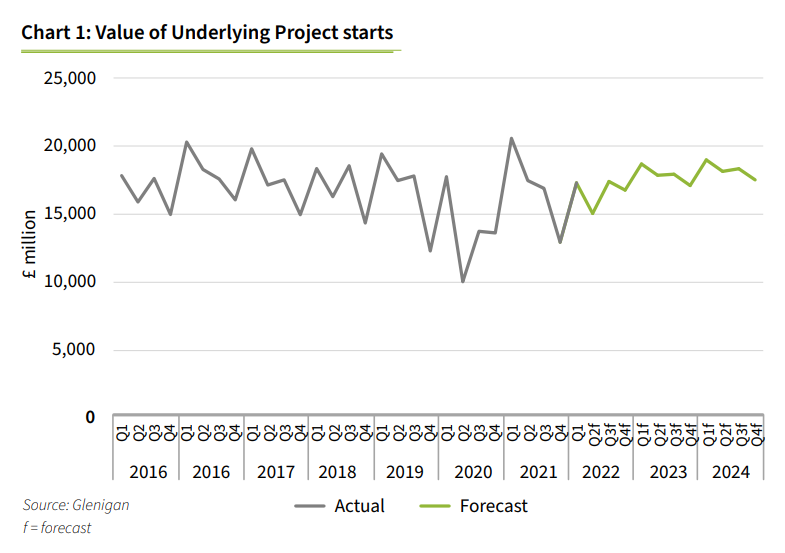
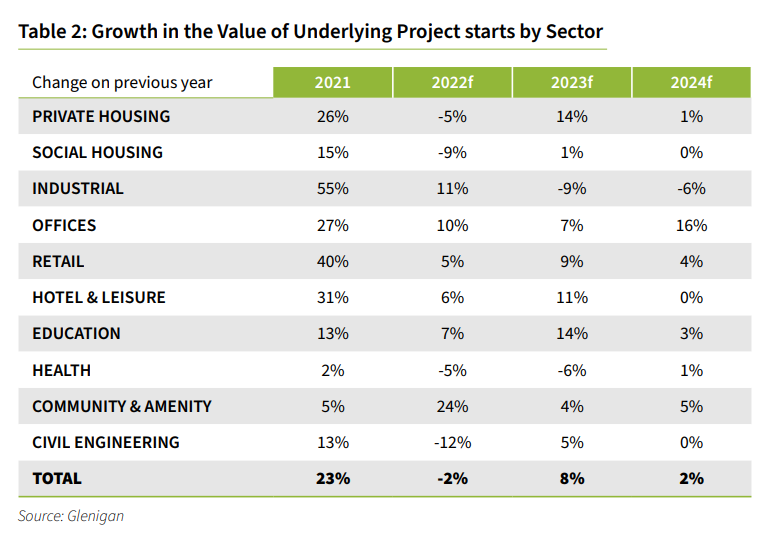
However, whilst growth will be stifled in 2022 (-2%), 2023 is predicted to see a modest 8% increase and a smaller 2% lift in 2024, representing an average rise of 2.6% over the Forecast period.

Glenigan Forecast 2022_Value of Underlying Project Starts.png

This report is predominantly focused on underlying starts (< £100m in value), unless otherwise stated, and contains a comprehensive overview of the current state of the construction industry. Crucially, it provides overall sector and vertical-specific insight into performance over the next few years.

Significant disruption stifles short-term growth

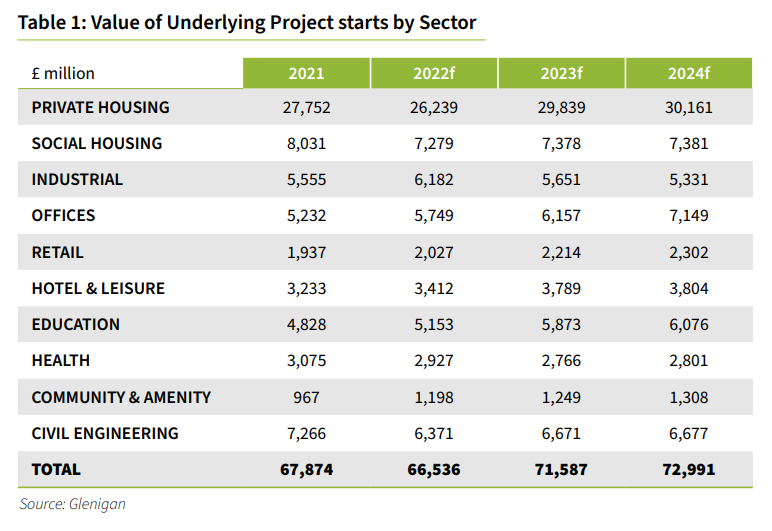
The next few years will be challenging for the construction industry as a whole. The war in the Ukraine is creating considerable economic uncertainty which is having a direct, current effect on output, derailing post-COVID recovery. As a result, overall project starts are forecast to slip back 2%.

Aside from this ongoing conflict, current inflation spikes, higher taxes and rising mortgage costs are expected to constrain activity in consumer-related areas, such as private housing, retail and hotel & leisure.

In contrast, a firm development pipeline is predicted to lift industrial and office starts in 2022, as well as Government-funded areas such as education, health and community & amenity.

More positively, the value of project starts is expected to rise in 2023, as the UK economy stabilises and short-term supply chain pressure ease. However the lingering impact of higher construction, material and energy costs means this growth will be significantly lower than predicted in previous forecasts.

Glenigan Forecast 2022_Value of Underlying Project Starts By Sector.png

Housing Starts Depressed

Although a buoyant housing marked helped to lift new housebuilding activity in 2021, with starts rising 26%, this recent surge is fading.

Predicted to drop 5% in 2022, following the removal of temporary Stamp Duty relief and dwindling homebuyer confidence, higher taxes and mortgage costs, housebuilders are expected to moderate project starts and focus on building out developments already on-site.

However, this slowdown appears temporary, with a renewed build-for-sale starts recovery anticipated in the second half of the Forecast period, rising 14% in 2023 and 1% in 2024, as household financial positions and UK economic prospects improve. Furthermore, a strong development pipeline has also be registered for Build-to-Rent starts, following a productive 12 months in 2021.

Glenigan Forecast 2022_Growth in Value of Underlying Project Starts By Sector.png

Bright spots for non-residential work

Industrial starts, particularly warehouse and logistics, are set to remain a growth area, building on the ever-increasing appetite for online retail, which accelerated during the pandemic. With e-commerce expected to be a significant growth market in the coming years, 2022 will see start value increase by 11%.

However, the online shopping boost has hit physical retail hard, with high street and outlet footfall remaining far lower than pre-pandemic levels. Unsurprisingly, lower consumer spending power, an overhang of empty retail premises and a greater share of the market moving online, means growth will be tempered over the Forecast period. Here, increased investment by the deep discount supermarkets, Aldi and Lidl, will be the primary drivers of the predicted 6% average uplift between 2022 and 2024.

The leisure and hospitality sector, hit hard by the pandemic, is also only set to expect modest recovery over the Forecast period due to reduced consumer discretionary spending during a tighter economic climate.

Moving from play to work, office starts bounced back sharply last year (+27%) and are predicted to benefit over the forecast period (av. +11%). This potential growth can be attributed to a rise in refurbishment projects as tenants and landlords adapt premises to accommodate changing working practices. However, new build office projects will likely be slower to recover as tenants and developers assess the effects of the shift towards remote and hybrid working on the long-term demand for office accommodation.

Public Sector Pick-Up

Public sector investment is set to be an important driver for construction activity over the Forecast period. However, the latest Spending Review revealed only modest growth in capital funding for a handful of central Government departments over the next three years.

Whilst the value of social housing starts is set to dip almost 10% this year, following a 15% surge in 2021, the vertical is predicted to rally for the remainder of the Forecast period, helped by a strong pipeline of already approved projects commencing on site.

Education construction is a vertical predicted to grow significantly over the next few years (av. +8%), partly driven by the Government’s commitment to building 500 new schools over the next decade. This is supported by a modest rise in universities capital spending during the second half of the Forecast period

The outlook for the health sector is also brightening. Starts remained high in 2021 post-Pandemic and the increase in capital funding and a growing development pipeline means the value of starts are expected to remain steady over the Forecast period, will slight declines this year (-5%) and next (-6%) .

Focusing on civils and infrastructure, a significant funding increase in areas such as roads, especially to address the maintenance backlog on the nation’s local roads, is helping to lift the value of project starts.

Investment in rail projects and utilities development, as well as ongoing work on major infrastructural projects such as Thames Tideway, HS2 and Hinkley Point are also set to support vertical activity over the Forecast period.

Commenting on the Forecast, Glenigan’s economic director Allan Wilen says, “Circumstances have changed significantly since the November 2021 Forecast and, whilst the short-term picture appears challenging, we should adopt a sanguine approach for the next few years.

“Markets sent into turmoil by the Russia-Ukraine War are starting to stabilise as new supply chain solutions are developed and established.

“Of course, in the near future construction and building product costs will remain high. However this situation will no doubt encourage a burst of imagination and innovation which will see the sector weather the current storm and progress to, if not sunny uplands, then at least towards a trajectory of upward growth.”

To download Glenigan’s UK Construction Industry Forecast 2022-2024 click here.

To find out more about Glenigan, its expert insight and leading market analysis, click here.

Drum Property Group starts construction at Stead’s Place

Edmond de Rothschild Real Estate Management to Forward Fund First Phase of 110 Build-to-Rent Apartments

Drum Property Group’s ambitious vision for the long-awaited redevelopment of a key site on Leith Walk, Edinburgh, is now to be realised with on-site construction starting in July 2022. 

Drum’s proposals for Stead’s Place, near the foot of Leith Walk, were approved by the City of Edinburgh Council in 2021 heralding a major regeneration of the 2.9-acre site and bringing much-needed investment to this important part of the city. 

The Stead’s Place site has been earmarked for development by the Council since 2008 and consisted largely of an aged industrial estate and office space, together with a two-storey red sandstone building facing directly on to Leith Walk. 

With refurbishment of the red sandstone building nearing completion, Drum has cleared the Stead’s Place site to the rear and, in the first phase of construction, will build 110 high-quality build-to-rent apartments for Edmond de Rothschild Real Estate Investment Management (REIM), who have agreed to forward-fund the development.

The apartments will be completed by spring 2024. The Stead’s Place apartments represent the second Scottish investment for the firm, having forward funded a build-to-rent development of 114 apartments in Finnieston, at Drum’s G3 Square development in December 2021. 

Graeme Bone, Group Managing Director of Drum said: “The start of construction of the new apartments represents another significant step forward in the long-awaited regeneration of the Stead’s Place site. 

“Once completed, the apartments will be a huge boost to the area and to local businesses, bringing life and access to what has been an inhospitable site, and delivering much-needed homes for local people.” 

The Edmond de Rothschild Residential Investment Fund UK, which invests in the private rented sector (PRS) on behalf of European institutional investors, was launched in August 2018 and to date has raised equity commitments of £320m. 

Charlie Miller, co-head of residential in the UK and director of residential transactions at Edmond de Rothschild REIM, said: “Stead’s Place is an excellent opportunity to establish the fund’s first development in Edinburgh and second in Scotland. 

“We will provide high-quality rental accommodation at affordable levels in line with the strategy for the fund. Edinburgh is the sixth most competitive financial centre in Europe, second in the UK behind London and has six universities, a diverse economy and a thriving tourist market – all contributing to exceptionally strong demand for homes to rent”. 

The final phase of construction at Stead’s Place will start at the end of the year, and will comprise of 38 affordable homes, owned and operated by registered social landlord, Hillcrest Homes, completing the attractive landscaped residential scheme linking Leith Walk to Pilrig Park and beyond.  

David Milton, Development Manager at Hillcrest Homes said, “Stead’s Place provides the opportunity to deliver 23 new social-rented homes and 15 mid-rented homes, all of which will be allocated to those in housing need.  

“The Social Rented homes will deliver a good mix of one, two and three bed apartments and we are particularly pleased to be delivering family sized homes in this location.

“There is a continuing unmet demand for affordable homes across Edinburgh and this development will help meet this demand and provide high quality, energy efficient new homes to those who need them the most.” 

The start of construction is the culmination of five years of research, planning and local community engagement by Drum since the company first purchased the site in 2017.  For more information about Drum Property Group’s redevelopment of the Stead’s Place site, visit www.steads-place.com